

How to Write a Business Introduction Email That Gets Replies
A RevOps lead we know learned this the hard way: the templates were fine, but the list quality wrecked deliverability. That's the thing most guides won't tell you about the business introduction email - your copy is maybe 20% of the problem. Deliverability is the other 80%.
What You Need (Quick Version)
- Keep it under 75 words. Emails in the 50-75 word range hit a 12% response rate. Over 200 words? That drops to 2%.
- Lead with the recipient, not yourself. "My name is..." is an instant delete. They can see your name in the sender field.
- Verify every email address before sending. A 5%+ bounce rate is dangerous for domain reputation and can get you throttled or blocked.
Below: the latest benchmarks, 8 copy-paste templates, and the deliverability fundamentals most guides skip.
What Counts as an Introduction Email?
A business introduction email is the first message you send to establish a professional relationship. It falls into three categories. Cold outreach goes to someone who doesn't know you exist. Warm introductions come through a mutual connection or referral. Connector emails introduce two other people to each other - you're the bridge, not the pitch.
All three follow the same physics: short, relevant, easy to act on. The templates differ, but the principles don't.
Benchmarks: What "Good" Looks Like
Most introduction emails perform poorly because senders don't know what "good" actually means. The data from an analysis of 10,000+ B2B campaigns tells a clear story.
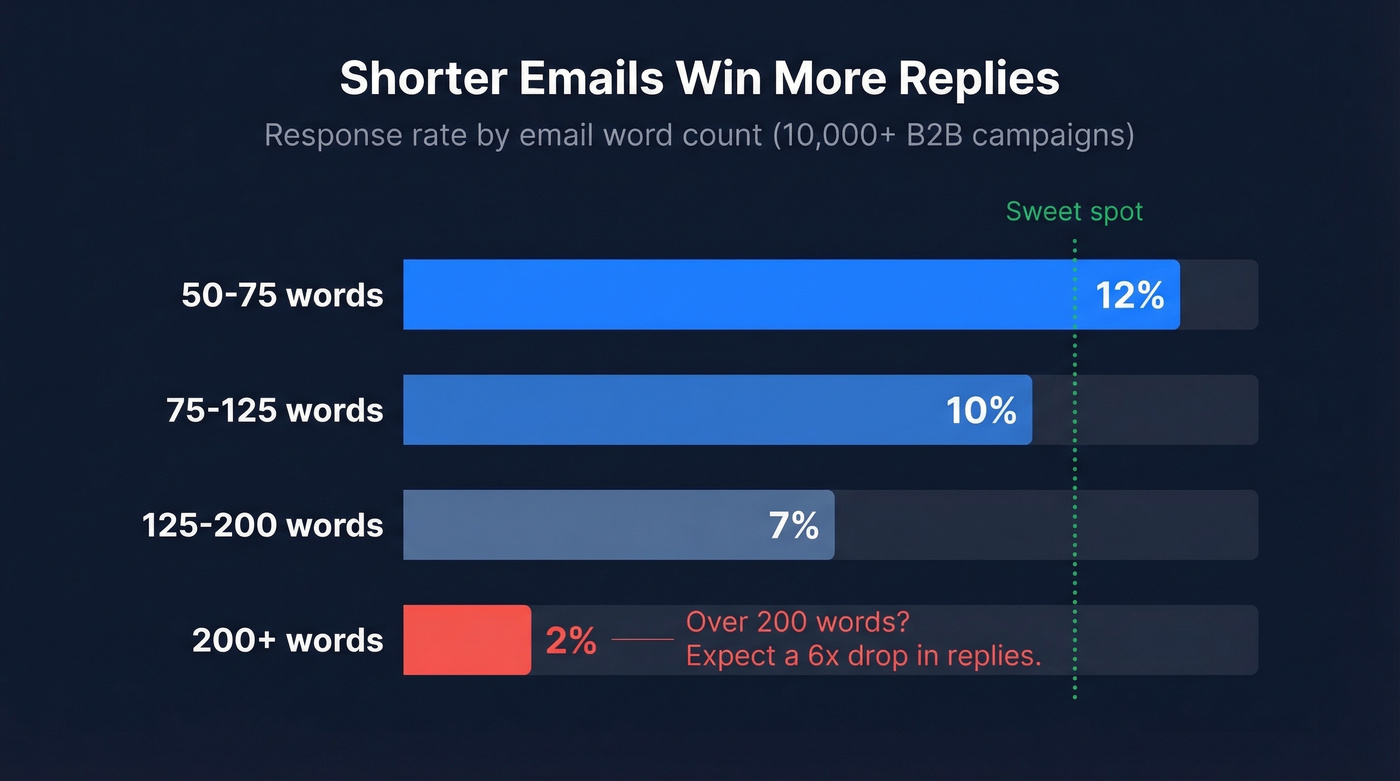
Email Length vs. Response Rate
| Word Count | Response Rate |
|---|---|
| 50-75 words | 12% |
| 75-125 words | 10% |
| 125-200 words | 7% |
| 200+ words | 2% |
Shorter wins. Two scrolls on mobile is the absolute ceiling.
Industry Benchmarks (Open Rate / Reply Rate)
| Industry | Open Rate | Reply Rate |
|---|---|---|
| SaaS / Tech | 21-28% | 3-6% |
| Financial Services | 18-24% | 2-4% |
| Recruiting / HR | 28-38% | 5-9% |
One critical caveat: Apple Mail Privacy Protection inflates open rates by 10-30%. If you're tracking opens as your primary metric, you're measuring noise. Reply rate is the KPI that matters.
Multichannel outreach shifts the numbers significantly. Email alone gets 4-6% response rates. Add social touches and you can reach 8-10%. Layer in phone and direct mail, and top performers push 12-15%. The introduction email isn't a standalone play - it's the opening move in a B2B cold email sequence.

Anatomy of a Strong Intro Email
Subject line. 6-10 words hit a 21% open rate, outperforming longer alternatives. Personalized subject lines get 26-50% higher opens than generic ones. Keep it under 45 characters so it doesn't get truncated on mobile. Questions work. Numbers work. Pattern interrupts can push open rates above 35%. "Quick question about [their initiative]" beats "Introduction - [Your Company Name]" every single time. If you want more options, pull from these email subject line examples.
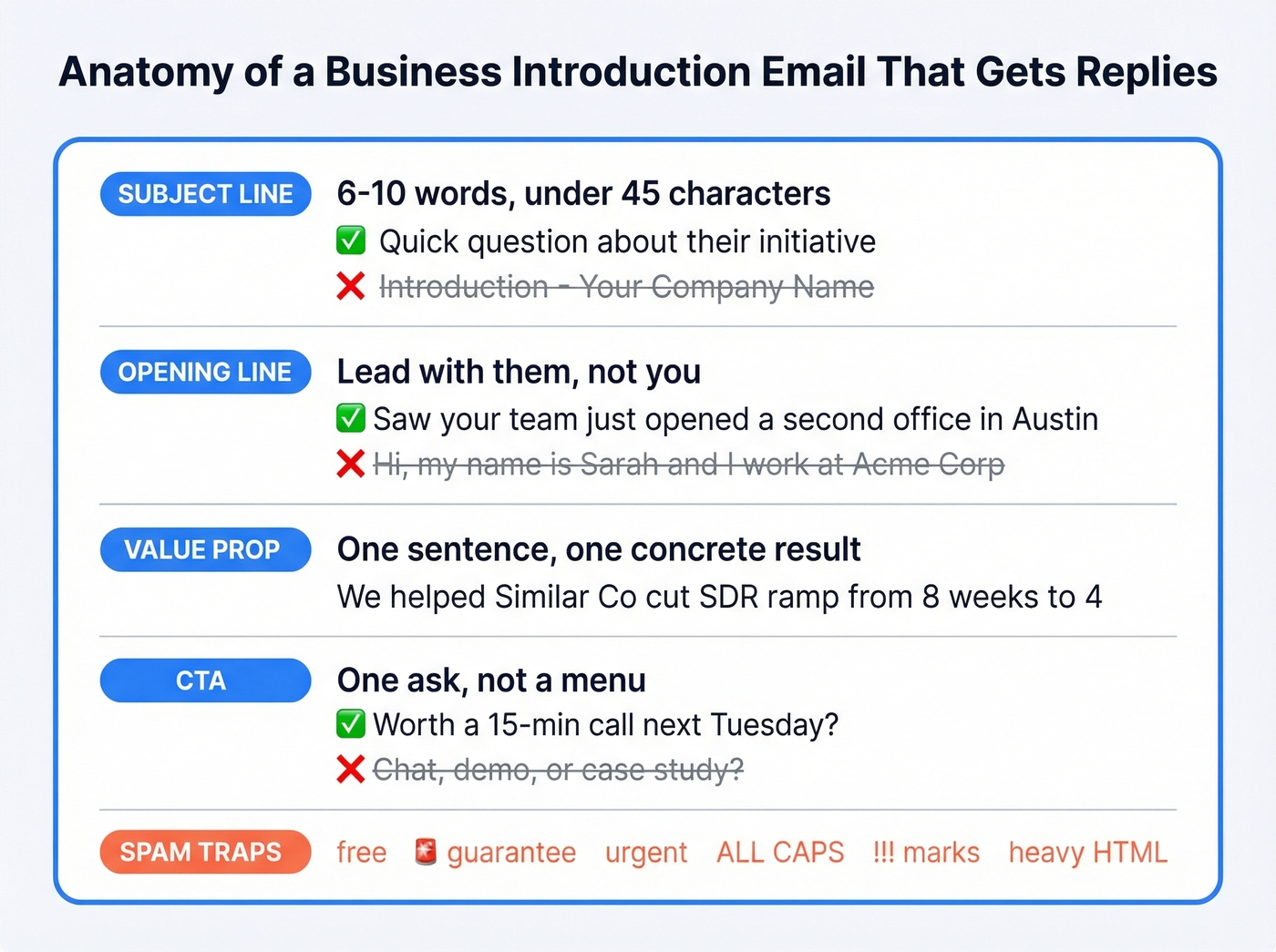
Opening line. Don't open with "My name is..." - the recipient already sees your name in the sender field. Lead with something about them: a recent hire, a funding round, a podcast appearance, a specific challenge their role faces. This signals you did homework, not a mail merge. (More on that here: personalized outreach.)
Here's what that looks like in practice. A weak opener reads: "Hi, my name is Sarah and I work at Acme Corp." A strong opener reads: "Hi [Name], saw your team just opened a second office in Austin - congrats." The difference is three seconds of research and a complete shift in who the email is about.
Value proposition. One sentence. What specific outcome can you help them achieve? Not "we help companies grow revenue" - that's meaningless. Try "we helped [similar company] cut their SDR ramp time from 8 weeks to 4." Concrete beats abstract every time. If you need a framework, borrow from email copywriting.
CTA. One ask. Not two. Not a menu of options. "Worth a 15-minute call next Tuesday?" is better than "Let me know if you'd like to chat, see a demo, or get a case study." Decision fatigue kills replies. (More examples: email call to action.)
Spam triggers to avoid. Words like "free," "guarantee," and "urgent" trip filters. So does excessive capitalization, multiple exclamation marks, and image-heavy formatting. Plain text often beats heavy HTML for cold outreach. If you're troubleshooting, use an email spam checker.

A 5%+ bounce rate wrecks your domain reputation - and your introduction emails never reach the inbox. Prospeo's 5-step email verification catches bad addresses, spam traps, and honeypots before you send. 98% accuracy at $0.01 per email.
Stop writing great intro emails to addresses that don't exist.
Before & After Teardown
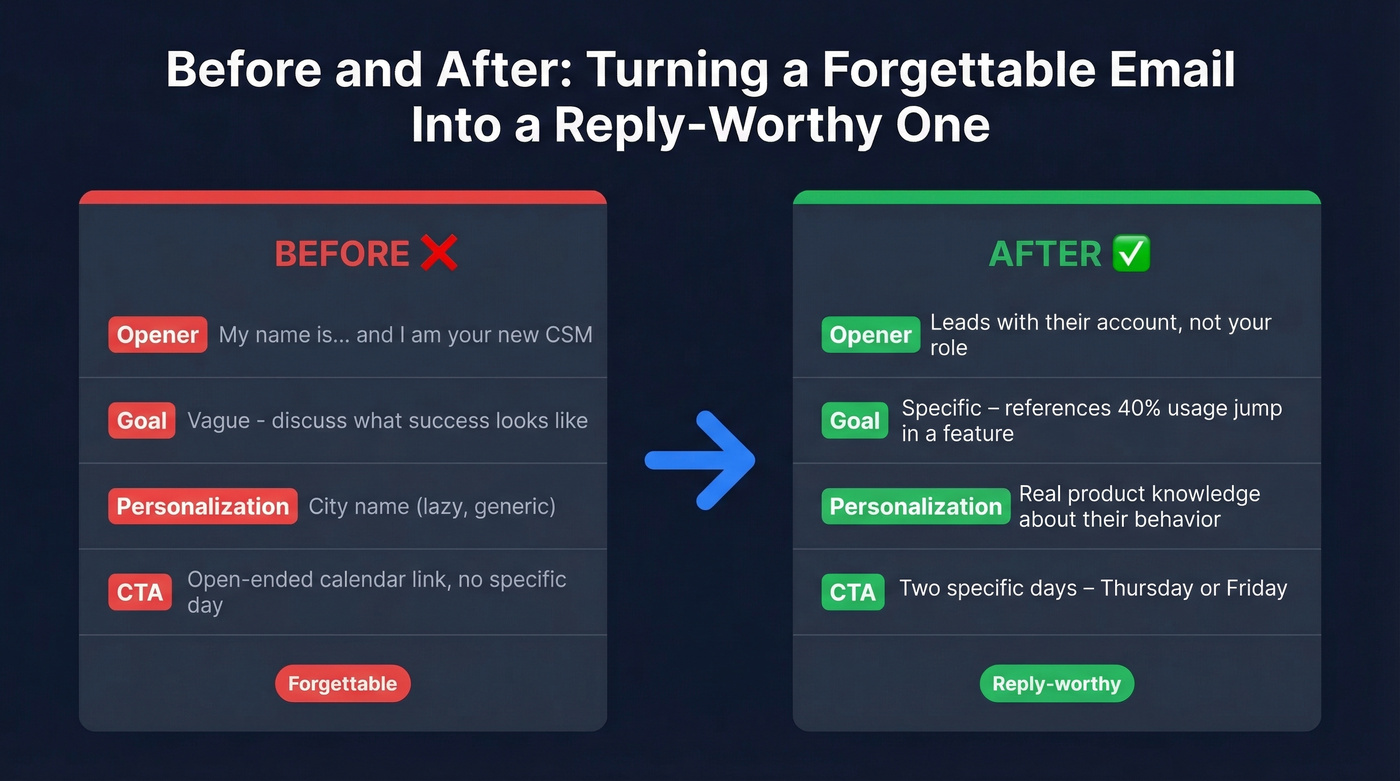
A CSM posted their introduction email on Reddit asking for feedback. It's not terrible - but it's forgettable. Let's fix it.
Before:
Hi [Name], my name is [CSM Name] and I'm your new Customer Success Manager at [Company]. I'd love to set up a quick 15 minute meeting to discuss what success looks like for you, how you're feeling about the product, and your goals for Q4. Here's my calendar link: [link]. PS - I saw you're based in [city], great place!
After:
Hi [Name], I'm taking over your account at [Company] - and before I do anything else, I wanted to understand what's working and what isn't. I noticed your team's usage of [specific feature] jumped 40% last quarter. I'd love to hear what drove that and where you're hitting friction. Got 15 minutes Thursday or Friday?
What changed? The opener shifted from "me" to "them." The vague "what success looks like" became a specific observation about their usage. The PS personalization - city name, really? - became genuine product knowledge. And the CTA went from an open-ended calendar link to two specific days.
That's the difference between a forgettable message and one that earns a reply.
8 Templates for Every Scenario
Each template below stays in the 40-60 word sweet spot. Copy, customize the bracketed sections, and send.
1. Cold Outreach to a Prospect
Subject: Quick question about [their initiative]
Hi [Name], I noticed [Company] just [specific trigger - new hire, funding round, product launch]. When [similar company] hit that stage, they struggled with [specific problem]. We helped them [concrete result] in [timeframe]. Worth a 15-minute call to see if that's relevant for you?
Step zero before sending any cold outreach: verify the address. Bad data kills campaigns before they start. Prospeo's Email Finder runs a 5-step verification in real time - catch-all handling, spam-trap removal, honeypot filtering - so you're not burning sends on dead inboxes.
2. Warm Introduction (Referral-Based)
Referred leads convert 4x more often than leads from other channels and show 37% higher retention. If you have a mutual connection, use it. This is the highest-converting template on the list, and it's not close.
Subject: [Mutual contact] suggested we connect
Hi [Name], [Mutual contact] mentioned you're working on [specific challenge]. We helped their team [specific outcome], and they thought the approach might fit what you're building. Happy to share what worked - would a quick call next week make sense?
The mutual contact's name in the subject line bypasses the "who is this?" filter entirely. The recipient opens it because they trust the referrer, not you. That's the whole game.
3. Connecting Two Parties
Write this so the connector can forward it without editing. Reduce their friction to zero. And a critical etiquette point: always confirm with both parties before making the introduction. Sending an unsolicited intro can damage your relationship with both sides.
Subject: Introduction - [Person A] <> [Person B]
Hi [Person A], meet [Person B] - they lead [function] at [Company] and just [relevant achievement]. [Person B], [Person A] has been [relevant context]. I think you'd both benefit from a conversation about [specific overlap]. I'll let you two take it from here.
4. New Employee to a Client
Subject: Your new point of contact at [Company]
Hi [Name], I'm [Your Name], taking over from [Previous Contact] on your account. I've already reviewed your setup and noticed [specific observation]. Before I make any assumptions, I'd love 15 minutes to hear what's top of mind for your team this quarter.
5. Partnership Inquiry
Most partnership emails read like one-sided asks. Flip it - lead with what's in it for them.
Subject: [Their product] + [Your product] - potential fit?
Hi [Name], our customers keep asking for [specific integration/capability] that [their company] does well. I think there's a natural overlap - [one sentence on mutual value]. Would you be open to a quick call to explore whether a partnership makes sense?
6. Investor Outreach
Don't do this: "Hi, we're an AI-powered platform disrupting the $50B market for..." Investors click on numbers, not buzzwords.
Subject: [Company Name] - [one-line traction metric]
Hi [Name], we're at [traction metric - ARR, growth rate, customer count] and raising our [round]. Your investment in [portfolio company] caught my eye - we're solving a similar problem for [different segment]. Deck attached. Happy to walk through the numbers in 15 minutes.
7. Post-Event Follow-Up
Subject: Good meeting you at [Event]
Hi [Name], enjoyed our conversation about [specific topic] at [Event]. You mentioned [specific challenge they raised]. We've seen [concrete approach] work well for teams in your position. Want to continue the conversation over a quick call this week?
8. Re-Engagement After Going Dark
Subject: Should I close your file?
Hi [Name], I sent a couple of notes about [topic] but haven't heard back - totally understand if the timing's off. If [original value prop] isn't a priority right now, just let me know and I'll stop reaching out. If it is, I'm here.
We've seen the breakup email pull the highest reply rate in a sequence - often 2-3x the initial outreach. Sales reps on r/sales consistently report the same thing. Something about the finality triggers action.
Building a Follow-Up System
60% of replies come after the first follow-up. Yet 70% of salespeople stop after one email. That gap is where deals hide. If you want plug-and-play copy, use these sales follow-up templates.
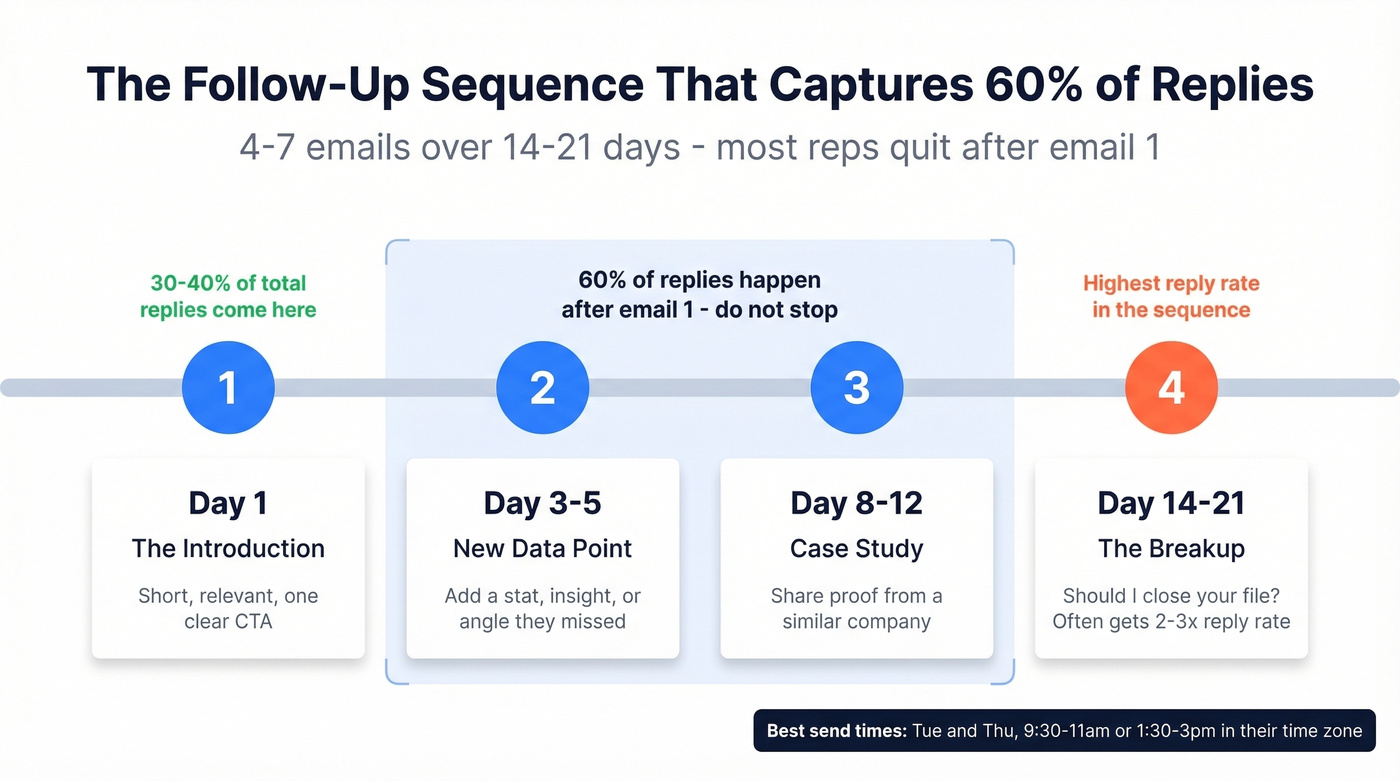
The recommended cadence is 4-7 emails over 14-21 days. Not 4 emails in 4 days - that's harassment. Space them out, and vary the angle each time. Email one is the introduction. Email two adds a new data point. Email three shares a relevant case study. Email four is the breakup.
Best send windows: Tuesdays and Thursdays, 9:30-11:00am or 1:30-3:00pm in the recipient's time zone. (More data here: best time to send cold emails.)
Here's the thing: if your average deal size is under $5k, you probably don't need a 7-touch sequence. Three emails and a move-on is more efficient. Save the elaborate cadences for deals worth the effort.
Why Your Email Never Arrives
Delivery and deliverability aren't the same thing. Delivery means the recipient's mail server accepted your message - it didn't bounce. Deliverability means it actually landed in the inbox, not spam or promotions. According to Litmus, 70% of emails show at least one spam-related issue. Your beautifully crafted introduction is probably sitting in a spam folder right now. For a deeper fix, start with this email deliverability guide.
The technical prerequisites:
- SPF, DKIM, and DMARC must be configured. These authentication protocols prove you're allowed to send from your domain. Without them, you're flagged before the recipient ever sees your name. (If you're stuck, see how to verify DKIM is working.)
- Domain warming. New domains need 3-6 months of warming. Start at 20 emails per day, scale to a max of 50 per day per mailbox.
- Bounce rate. Under 2% is healthy. Over 5% is dangerous - ESPs start throttling or blocking you entirely. If you need the mechanics, read our email bounce rate breakdown.
The fix for bounce rates is straightforward: verify every address before you send. This is where most outbound campaigns silently fail. You write great copy, build a solid list from a database, and then a chunk of those addresses bounce because the data was stale. In our experience, teams that skip verification end up burning their domain reputation within weeks - and rebuilding it takes months.
Prospeo's email verification catches invalid addresses, catch-all domains, spam traps, and honeypots before they ever hit your outbox. The 98% accuracy rate keeps your bounce rate well under that 2% threshold, and the free tier covers 75 emails per month - enough to verify your first campaign without spending a dollar.
Every template above requires one thing: the right email address for the right person. Prospeo's Email Finder searches 300M+ verified profiles so your business introduction lands in a real inbox - not a bounce log. 75 free lookups, no credit card.
Nail the copy, then nail the contact data. Start free today.
Compliance Checklist
Sending cold introduction emails is legal - with conditions. The penalties for getting it wrong are steep enough to matter.
| Regulation | Consent | Unsubscribe Rules | Max Penalty | Scope |
|---|---|---|---|---|
| CAN-SPAM | Not required | Honor within 10 days | $50,120/email | US |
| GDPR | Legitimate interest | Immediate | EUR 20M or 4% revenue | EU/EEA |
| CASL | Express or implied | Functional 60 days | $10M/violation | Canada |
Every introduction email needs a physical mailing address and a working unsubscribe link. This isn't optional - 53% of users mark emails as spam simply because they can't find an unsubscribe option. A one-line footer with your address and an opt-out link costs you nothing and keeps you out of legal trouble.
Most B2B cold emailers operate under CAN-SPAM's opt-out model or GDPR's legitimate interest basis. But if you're emailing into Canada, CASL's express consent requirement is stricter. Know your audience's geography before you hit send.
FAQ
How long should a business introduction email be?
Aim for 50-75 words. That range produces a 12% response rate in B2B campaigns. Emails over 200 words drop to roughly 2%. Write your draft, then cut it in half. Then cut it again.
What's a good response rate for introduction emails?
The average B2B cold email gets 1-3% replies. Top performers with strong targeting and personalization hit 8-12%. If you're below 1%, the problem is usually list quality or deliverability, not copy.
Should I follow up if I don't get a reply?
Yes - 60% of replies come after the first follow-up. Send 4-7 emails over 14-21 days, varying your angle each time. The breakup email often pulls the highest response rate in the entire sequence.
How do I stop introduction emails from landing in spam?
Set up SPF, DKIM, and DMARC authentication on your domain. Verify addresses before sending to catch spam traps and invalid contacts. Keep bounce rates under 2% and avoid trigger words like "guarantee."
Is it legal to send cold introduction emails?
Yes, with conditions. CAN-SPAM (US) requires an unsubscribe link and physical address. GDPR (EU) requires legitimate interest or consent. CASL (Canada) requires express or implied consent. Include an opt-out mechanism in every email and honor requests promptly.