

Client Outreach: The System That Gets Replies in 2026
You sent 500 emails last week and got 4 replies. One was an auto-responder. Another was someone asking to be removed from your list. That's not a campaign - that's a domain reputation problem waiting to happen.
The r/b2bmarketing crowd puts it bluntly: "Cold emails: 2% reply rate" and "LinkedIn requests: ignored." They're not wrong - if you're treating client outreach as a volume game instead of a system. The teams that consistently book meetings aren't writing better subject lines. They're running a tighter machine: clean data in, multichannel cadence out, measurement loop feeding improvements back.
What you actually need is simpler than most guides make it sound. Outreach that works in 2026 requires three things: verified contact data (not a purchased list), a multichannel cadence across email, phone, and social, and a measurement loop tracking reply rates and cost per meeting - not just opens. If you only do one thing today, verify your email list before you send. A bounce rate over 2% quietly destroys your domain reputation and makes every future email harder to deliver.
What Is Client Outreach?
Client outreach is the deliberate act of initiating contact with potential or existing clients to start a business conversation. It's not advertising. It's not content marketing. It's one human reaching out to another with a specific reason to talk.
The distinction matters because outreach is relationship-building at scale. Marketing casts a wide net and waits. Outreach picks a target, crafts a message, and follows up until there's a clear yes or no. Every channel - email, phone, social, video - is just a delivery mechanism for that core intent.
Start With Your ICP
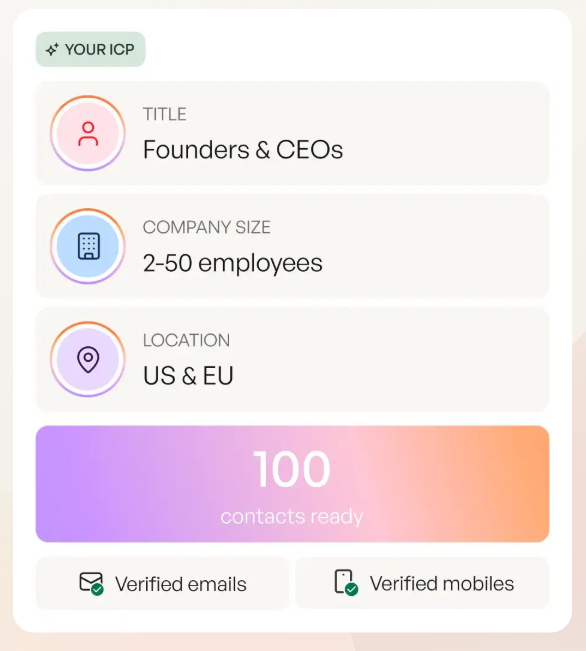
Look, outreach without a defined Ideal Customer Profile isn't outreach. It's spam. Targeting too broadly is the single most common mistake in outbound programs, and it poisons everything downstream - your reply rates, your deliverability, your reps' morale.
Before you write a single email, nail these components:
- Industry and company size - revenue range, headcount, growth stage
- Job titles and departments - who actually signs off on your deal
- Pain signals - hiring patterns, tech stack, funding events, job postings
- Disqualifiers - who looks like a fit but never converts (these save more time than qualifiers)
- Geography and compliance zone - GDPR vs CAN-SPAM changes your approach
If your ICP fits on a napkin, it's probably too vague. If it takes a slide deck, it's probably too complex. Aim for a paragraph that any new rep could read and immediately know who to call.
The 5 Channels That Work
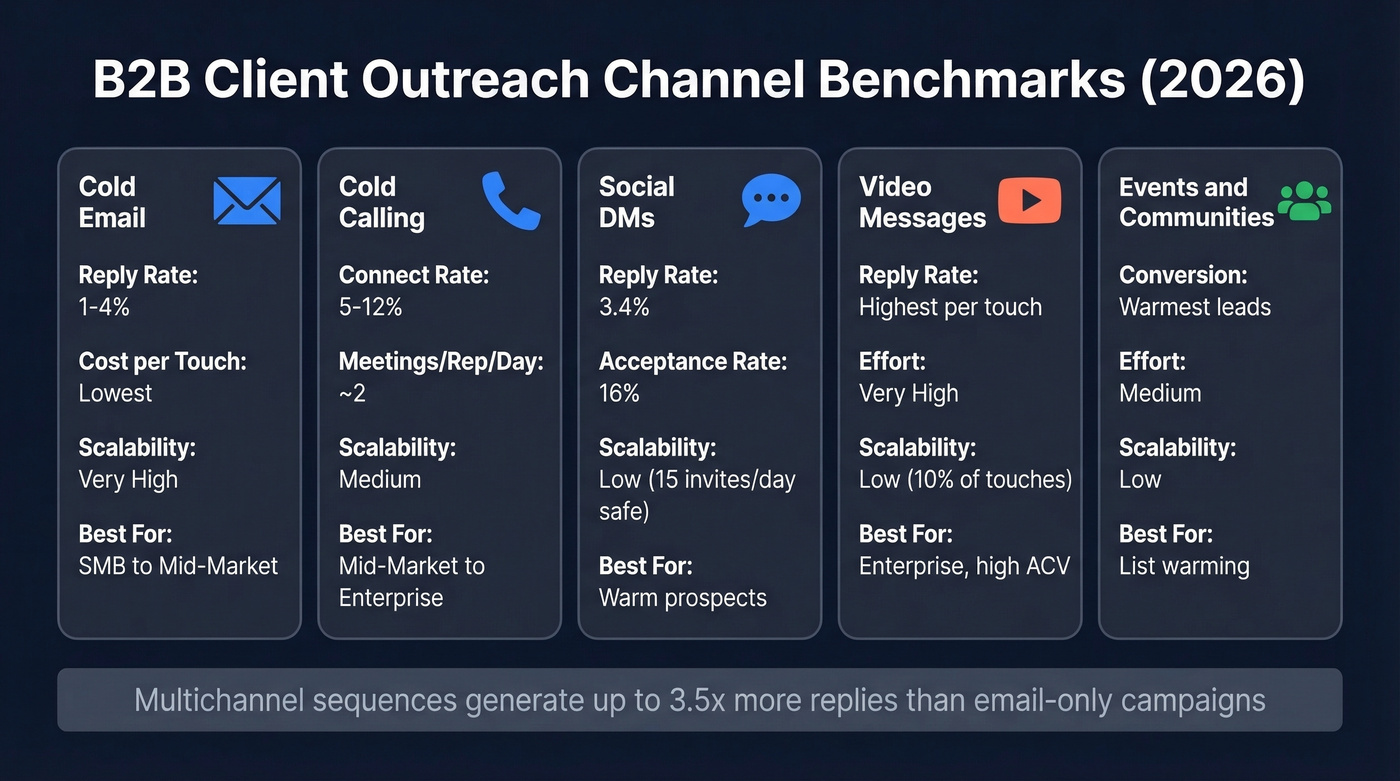
A Belkins analysis of 16.5M cold emails, 20M+ social outreach attempts, and 5M cold calls confirmed what most practitioners already felt: email alone can't carry the load anymore. Multichannel sequences generate up to 3.5x more replies than email-only campaigns. The teams booking meetings are running three or more channels in parallel.
Cold Email
Cold email remains the backbone of outbound - scalable, measurable, and cheap per touch. But the benchmarks are sobering. Realistic reply rates sit between 1-4%, with enterprise prospects on the low end and SMBs with strong product-market fit on the high end.
35% of recipients decide whether to open based solely on the subject line. Keep subject lines under 50 characters - six or seven words is the sweet spot per Salesforce's guidance. Personalized cold emails see open rates jump 29% higher than generic ones.
The copy ratio of "I/my" to "you/your" should be roughly 1-to-2. Write at an 8th-grade reading level. Nobody's impressed by jargon in their inbox at 7 AM. And the hard rule: keep your bounce rate under 2%. Anything above that and you're actively damaging your sender reputation with every batch.
If you want a faster starting point, use proven follow-up templates and iterate from there.
Cold Calling
Cold calling still works. Teams actually doing it see 5-12% connect rates, with roughly 24% of those connects turning into quality conversations of 60+ seconds. About 20% of quality conversations convert to meetings, which works out to roughly 2 booked meetings per rep per day - around 40 per month.
The operating range is 400-750 dials per day per SDR with parallel or power dialers. If your reps are manually dialing 50 calls a day, you don't have a cold calling program. You have a warm-up exercise.
If you're rebuilding the motion, start with a repeatable cold calling system before you add more tools.
Social DMs
Social selling is the third leg of any B2B cadence, but it comes with guardrails. Platform invite thresholds work like a health score: 1-15 invites per day is green, 16-25 is yellow, and anything above 25 puts you in restriction territory. Real-world funnel math from a recent sample: 6,800 requests sent, 1,100 accepted (16% acceptance rate), 230 replies - a 3.4% overall reply rate.
That 3.4% doesn't sound impressive until you factor in that social replies convert to meetings at a significantly higher rate than email replies. Someone who responds to a DM has already looked at your profile. The intent is different.
Video Messages
Video is the high-effort, high-reward play. Reserve it for roughly 10% of your cadence touches - high-value prospects where a 60-second Loom or Vidyard clip can cut through the noise. A personalized video referencing a prospect's recent earnings call or product launch signals effort that templates can't fake.
If you're using Loom specifically, this Loom video cold email playbook will help you avoid the common mistakes.
Events and Communities
Webinars, industry Slack groups, and partner intros create context that makes your cold outreach warmer. A connection request that says "enjoyed your question in the Pavilion session yesterday" converts at a completely different rate than a blind invite. These aren't cold outreach in the traditional sense, but they're the best way to warm up a cold list without buying ads.
A note on deal size: For enterprise deals above $100K ACV, reduce touch volume and increase research depth per prospect. The cadence below is built for mid-market volume. If you're selling seven-figure contracts, skip automation entirely and send fewer, deeply researched emails. The math changes when one deal pays for a quarter.
Design Your Multichannel Cadence
The research converges on a clear framework: 8-12 touches across 3 channels over 17-21 days. It takes an average of 5 touches to engage a prospect, and reaching executives often requires around 9. One email is never enough. Three isn't either.
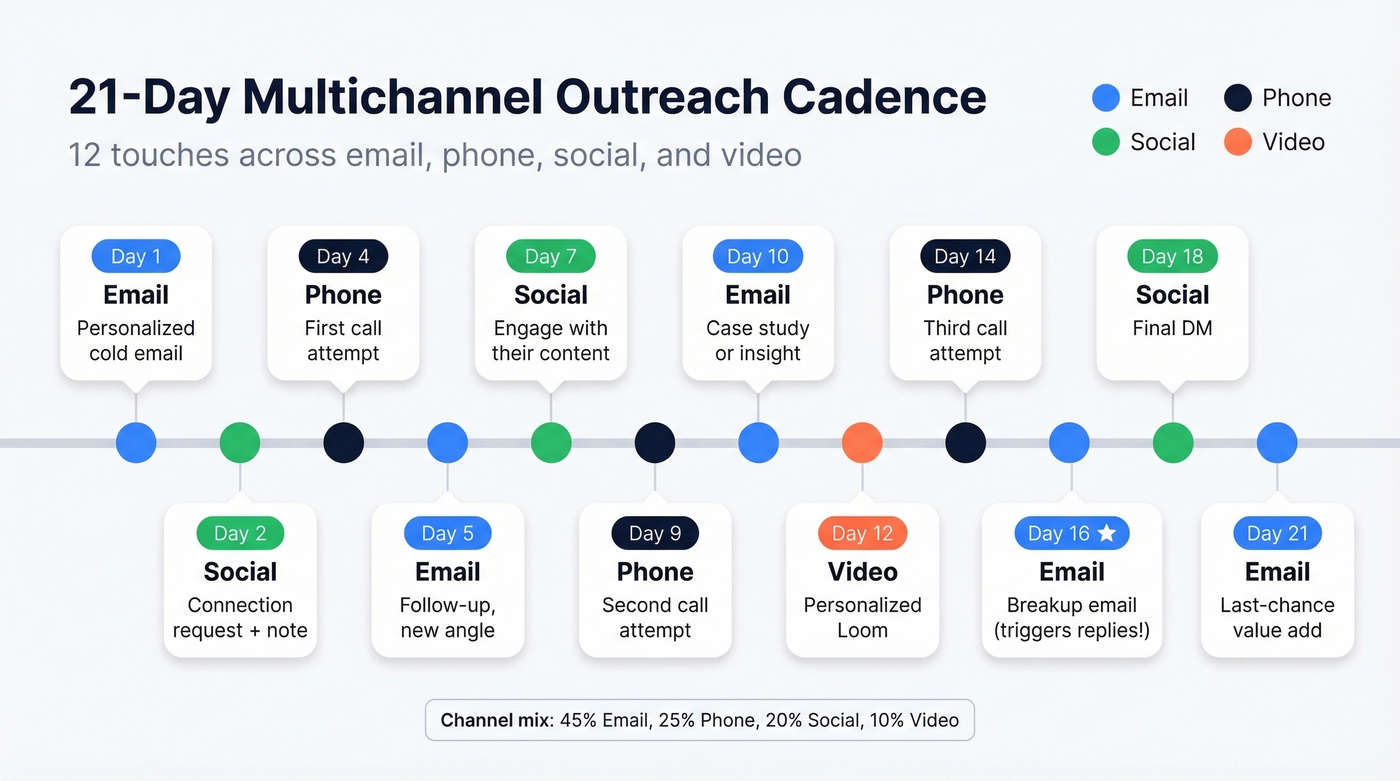
The channel mix that consistently performs: roughly 45% email, 25% phone, 20% social, and 10% video.
| Day | Channel | Action |
|---|---|---|
| 1 | Personalized cold email | |
| 2 | Social | Connection request + note |
| 4 | Phone | First call attempt |
| 5 | Follow-up (new angle) | |
| 7 | Social | Engage with their content |
| 9 | Phone | Second call attempt |
| 10 | Case study or insight | |
| 12 | Video | Personalized Loom |
| 14 | Phone | Third call attempt |
| 16 | Breakup email | |
| 18 | Social | Final DM |
| 21 | Last-chance value add |
The breakup email on Day 16 isn't just a gimmick - it often triggers replies because it forces a clear yes/no decision.
Pipeline Math for a Real Team
Let's break this down with actual numbers. A 3-person SDR team puts 200 contacts into the cadence per rep per month - 600 total. At a 3% positive reply rate, that's 18 replies. At 40% reply-to-meeting conversion, that's 7 meetings. If your average deal is $25K and close rate is 20%, that cadence generates roughly $35K in pipeline monthly from one cycle.
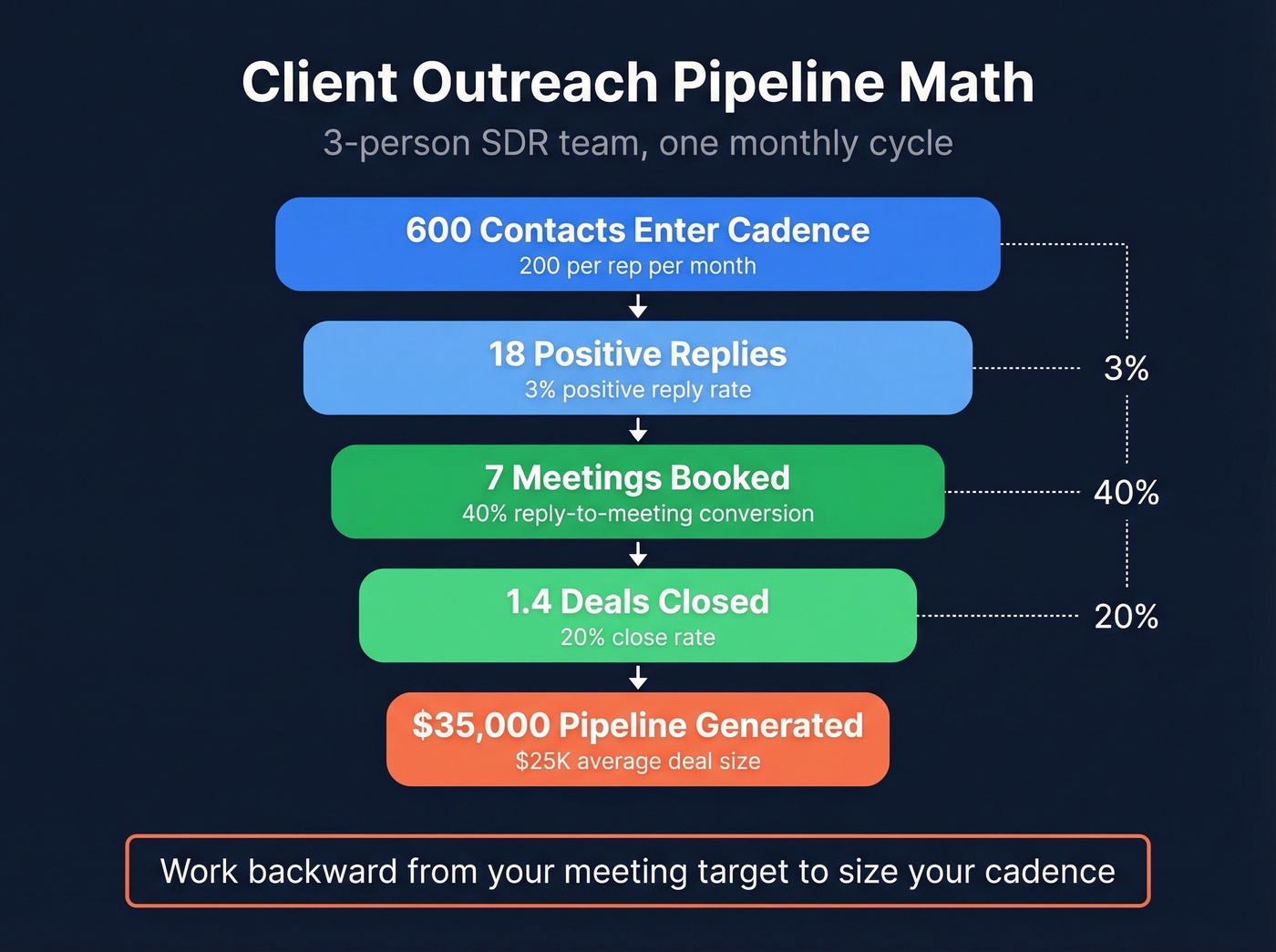
Between positive reply and booked meeting, expect a 30-50% conversion rate. Work backward from your meeting target to figure out how many contacts need to enter the top of the cadence.
If you want to pressure-test the top of funnel, compare your numbers to current sales pipeline benchmarks.

You read it above: bounce rates over 2% destroy your domain reputation and kill every future campaign. Prospeo's 5-step email verification delivers 98% accuracy - teams using it cut bounce rates from 35% to under 4% and tripled their pipeline.
Stop burning your domain. Verify before you send.
Deliverability and Compliance
None of your outreach matters if your emails land in spam. And the rules got stricter fast.
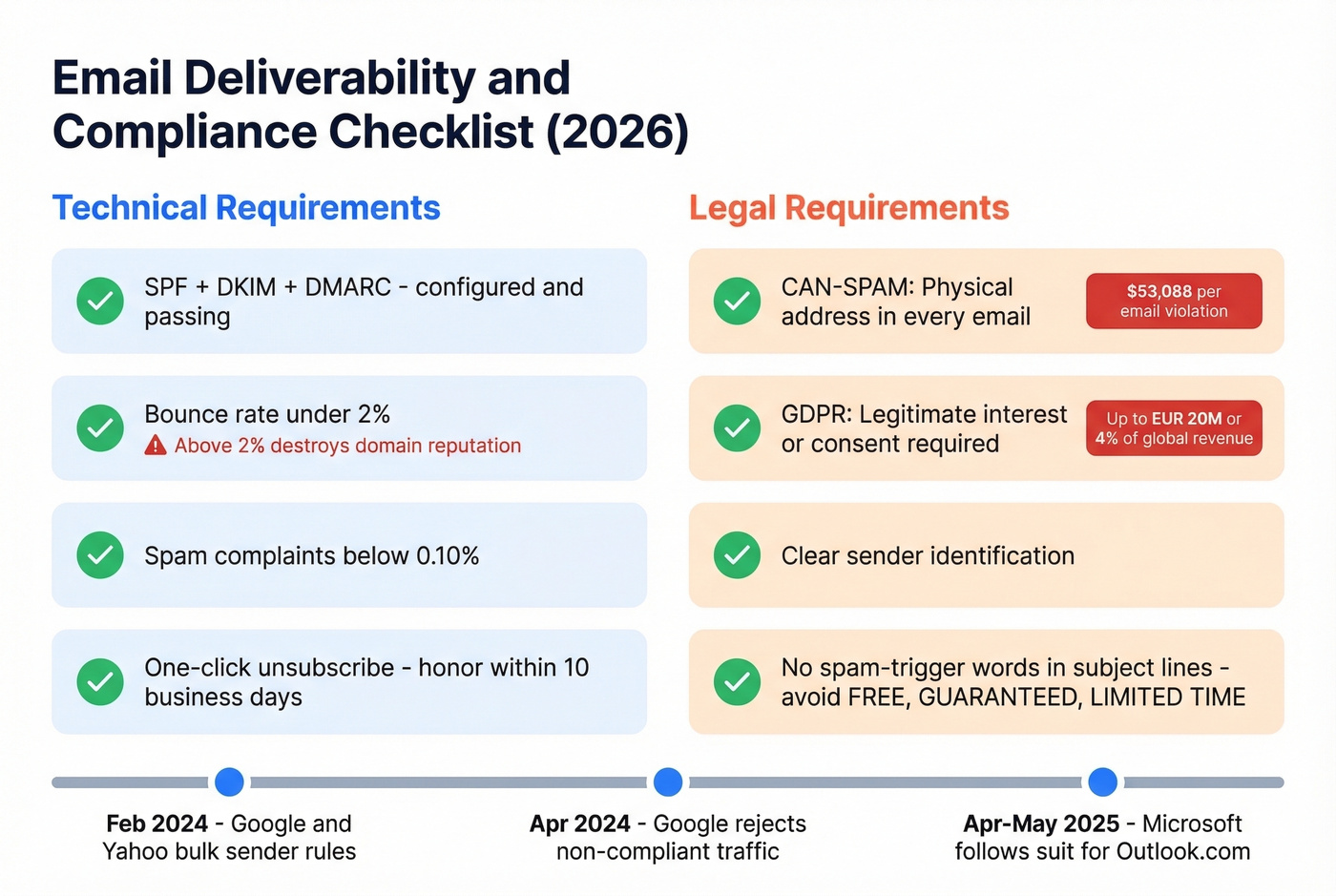
In February 2024, Google and Yahoo rolled out bulk sender requirements - SPF, DKIM, and DMARC authentication, spam complaint rates below 0.10%, and one-click unsubscribe. By April 2024, Google started rejecting non-compliant traffic. Then in April-May 2025, Microsoft followed suit for Outlook.com. SPF, DKIM, and DMARC aren't optional anymore. They're the minimum to get your emails delivered.
On the legal side, the penalties are real. CAN-SPAM violations can cost up to $53,088 per email. GDPR fines reach up to EUR 20M or 4% of global annual turnover. Every cold email needs a physical address, clear sender identification, and an opt-out mechanism you honor within 10 business days.
The compliance checklist:
- Authentication - SPF + DKIM + DMARC configured and passing
- Bounce rate - under 2%, non-negotiable
- Spam complaints - below 0.10%
- Unsubscribe - one-click, honored within 10 business days
- Physical address - in every email
- No spam-trigger words - avoid "FREE," "GUARANTEED," "LIMITED TIME" in subject lines
This is where email verification becomes non-negotiable. Sending to unverified lists is the fastest way to torch a domain. We've seen teams go from 35% bounce rates to under 4% just by running lists through Prospeo's verification before sending - it catches spam traps, honeypots, and catch-all domains that other tools miss.
If you're troubleshooting deliverability, use this email deliverability guide and then audit your sender reputation.
Tools for Client Outreach
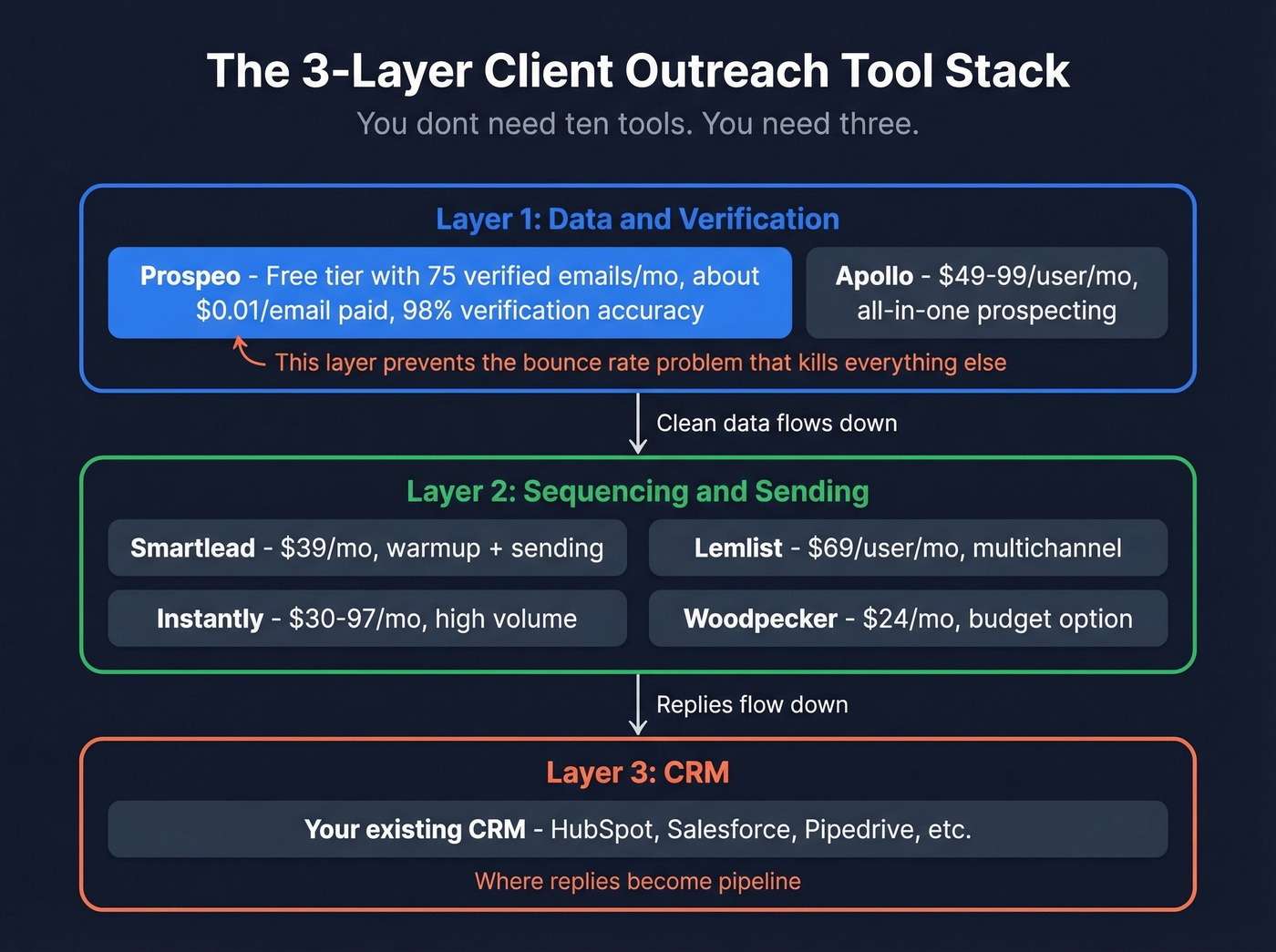
You don't need ten tools. You need three: a data and verification layer, a sequencing tool, and a CRM. Everything else is optimization.
| Tool | Starting Price | Best For | Free Trial |
|---|---|---|---|
| Prospeo | Free (75 verified emails/mo); ~$0.01/email paid | Verification + B2B data | Free tier (no CC) |
| Smartlead | $39/mo | Warmup + sending | 14-day |
| Woodpecker | $24/mo | Budget cold email | 7-day |
| Mailshake | $29/mo | Email-focused outreach | 30-day (CC required) |
| Lemlist | $69/user/mo | Multichannel sequences | 14-day |
| Apollo | ~$49-99/user/mo | All-in-one prospecting | Free tier |
| Instantly | ~$30-97/mo | High-volume cold email | 14-day |
| QuickMail | $9/mo | Low-cost entry point | 14-day |
| Klenty | $50/user/mo | CRM-integrated sequences | 14-day |
Lemlist is the strongest multichannel sequencer for teams that want email, phone, and social steps in one workflow. At $69/user/month it's not cheap, but the built-in warmup and personalization features justify the premium for most mid-market teams. We've used it on campaigns where the social + email combo outperformed email-only by 2x on reply rate.
Smartlead is the budget pick for email-heavy operations - $39/month gets you unlimited warmup and solid inbox rotation. For teams running high-volume campaigns across multiple sending accounts, it's hard to beat on price.
Skip Apollo if you already have a dedicated data provider and just need sequencing - you'll pay for features you won't use. It's best when you need prospecting and outreach in one platform and don't mind trading some data accuracy for convenience.
On Reddit, SDRs frequently mention ReachInbox for inbox rotation, ManyReach for combined email and social outreach, and ListKit for quick niche list building. The consensus across r/salesdevelopment: run your lists through at least two verification tools before sending.
If I had to build a stack from scratch today: Prospeo for data and verification, Lemlist or Smartlead for sequencing, and HubSpot or Salesforce for CRM. That's it. Most teams overcomplicate this.
If you're evaluating options, start with this list of SDR tools and narrow down based on your motion.
Building a Strategy That Scales
These are the seven mistakes that consistently tank campaigns - and how to avoid them so your outreach strategy holds up as you grow.
Targeting too broadly. Your product isn't for everyone. Narrow your ICP until it feels uncomfortable, then test. Define three specific personas before writing a single email.
If you need a structure, use an Ideal Customer Profile template and scoring rubric.
Writing like a pitch deck. Nobody reads "driving outcomes through strategic alignment" and thinks "I should reply to this." Write like you'd talk to a colleague. The 1-to-2 ratio of I/my to you/your keeps you honest.
One email and done. It takes 5 touches minimum to engage a prospect. Sending one email and moving on is leaving meetings on the table. Build a 10-touch cadence before you launch.
Fake personalization. "Hi {first_name}, I noticed {company_name} is doing great things" fools nobody. Reference something specific - a recent hire, a product launch, a conference talk. We once tested a batch where the only personalization was mentioning the prospect's most recent blog post in the opening line. Reply rate tripled compared to the template version.
If you want a deeper system, follow a personalized outreach playbook and standardize what “specific” means.
Missing or weak CTA. "Let me know if you're interested" isn't a CTA. "Do you have 15 minutes Thursday at 2pm?" converts better than open-ended invitations every time.
For examples you can copy, see these email call to action rules and benchmarks.
Poor data quality. Bounced emails, wrong titles, stale domains - bad data doesn't just waste time, it burns your sender reputation. Run every list through a verification tool before you hit send. Stack Optimize built from $0 to $1M ARR while keeping client deliverability above 94% and bounce rates under 3% by making verification a non-negotiable step.
If you're diagnosing list issues, start with email bounce rate benchmarks and fixes.
Not testing or measuring. If you're not A/B testing subject lines and tracking reply rates by segment, you're guessing. Send two versions to 20% of your audience, roll the winner to the remaining 80%.
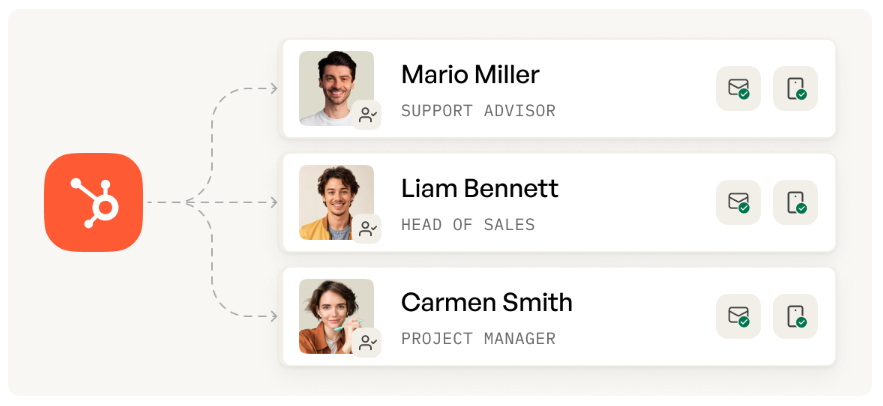
A multichannel cadence needs emails, phone numbers, and social profiles for the same prospect. Prospeo gives you all three from one platform - 143M+ verified emails, 125M+ direct dials with 30% pickup rates, and 30+ filters to nail your ICP.
Build your entire outreach list in minutes, not days.
How to Measure Outreach ROI
Most teams track opens and call it measurement. That's like measuring a restaurant's success by how many people read the menu.
| Metric | What It Tells You |
|---|---|
| Positive reply rate | Is your messaging working? |
| Meeting set rate | Are replies converting? |
| SQL rate | Are meetings qualified? |
| Stage drop-off | Where are prospects disappearing? |
| CPL (cost per lead) | What does a reply cost you? |
| CPA (cost per acquisition) | What does a customer cost? |
The distinction between CPL and CPA matters more than most teams realize. A $50 CPL looks great until you discover your CPA is $4,000 because leads aren't converting past the meeting stage. Track both, and track where prospects drop off between stages.
Sales teams waste an average of 40% of their time on manual prospecting tasks - that's the hidden cost most ROI calculations miss entirely. A rep spending 4 hours a day on manual prospecting at an $80K salary costs roughly $40/hour in outreach labor alone. Factor that into your ROI calculations or you'll undercount your true cost per meeting by 50% or more.
If you want a cleaner measurement model, map your stages to a B2B sales funnel template and track drop-off by segment.
FAQ
What is client outreach?
Client outreach is the process of proactively contacting potential or existing clients to start a business conversation. Unlike inbound marketing, it involves picking a specific target, crafting a relevant message, and following up across multiple channels until you get a clear yes or no.
What's a good reply rate for cold outreach?
For cold email, 1-4% is the realistic range in 2026. Social DM reply rates sit around 3.4%. If you're consistently below 1%, check your data quality and targeting before rewriting copy - the problem is almost always who you're emailing, not what you're saying.
How many follow-ups should I send?
Plan for 8-12 touches across multiple channels over 17-21 days. It takes an average of 5 touches to engage a prospect and roughly 9 to reach an executive. One email is never enough, and neither is three.