

Cold Calling Email Templates That Get Replies (2026)
The average rep sends 344 cold emails to land one meeting. That's from Gong's analysis of 28M+ cold emails. Top performers book 8.1x more meetings from the same channel - and the gap isn't talent. It's templates, timing, and the discipline to pair emails with actual phone calls.
Here's the thing: every template guide gives you email-only copy. The keyword literally has "cold calling" in it, and nobody covers the pre-call warmup or post-call follow-up. This one does.
What Separates 3% From 10%+
Three things:
- Nail three template types first. The value-first first touch, the post-call follow-up, and the trigger-based email. These consistently outperform everything else. Don't touch the other 50 templates floating around until you've got these dialed.
- Follow the rules. Keep emails under 80 words, use 1-4 word subject lines, ask interest-based CTAs (not meeting requests), and follow up 4-7 times. (If you need more options, pull from these cold email subject line examples.)
- Fix your data before your copy. Templates are 20% of the equation. Verified contact data and deliverability hygiene are the other 80%. If your bounce rate sits above 2%, no template will save you. (Use this email deliverability guide as your baseline.)
Cold Email Benchmarks Worth Knowing
Before writing a single template, you need to know what "good" actually looks like. These numbers come from Instantly's 2026 benchmark report, which analyzed billions of cold email interactions:
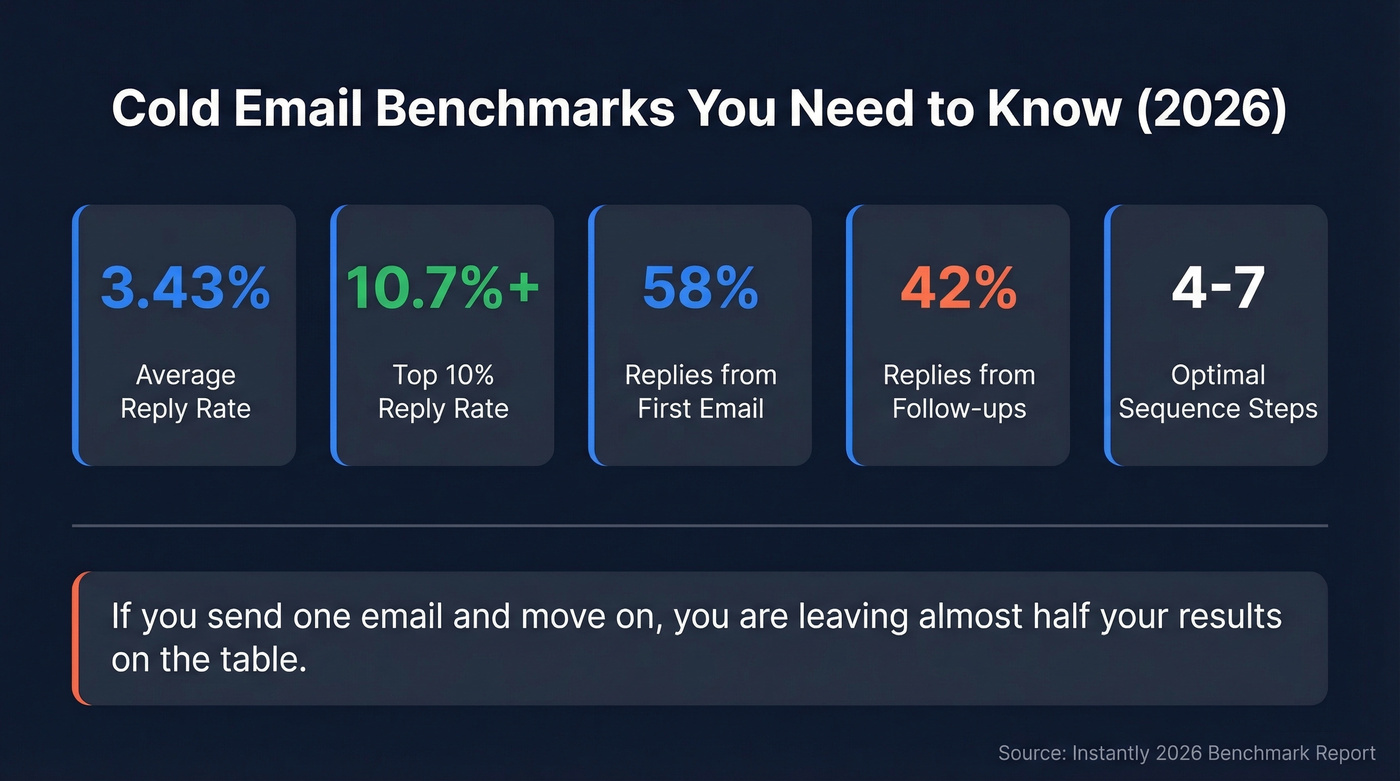
| Metric | Number |
|---|---|
| Average reply rate | 3.43% |
| Top 10% reply rate | 10.7%+ |
| Replies from first email | 58% |
| Replies from follow-ups | 42% |
| Optimal sequence length | 4-7 steps |
The stat that should change how you build sequences: 42% of replies come from follow-ups. If you're sending one email and moving on, you're leaving almost half your results on the table. (For more, see these cold email follow-up templates.)
And pitching in a cold email drops reply rates by up to 57%. The templates below are built around both of those findings.
Data-Backed Rules for Cold Email Copy
Subject Lines
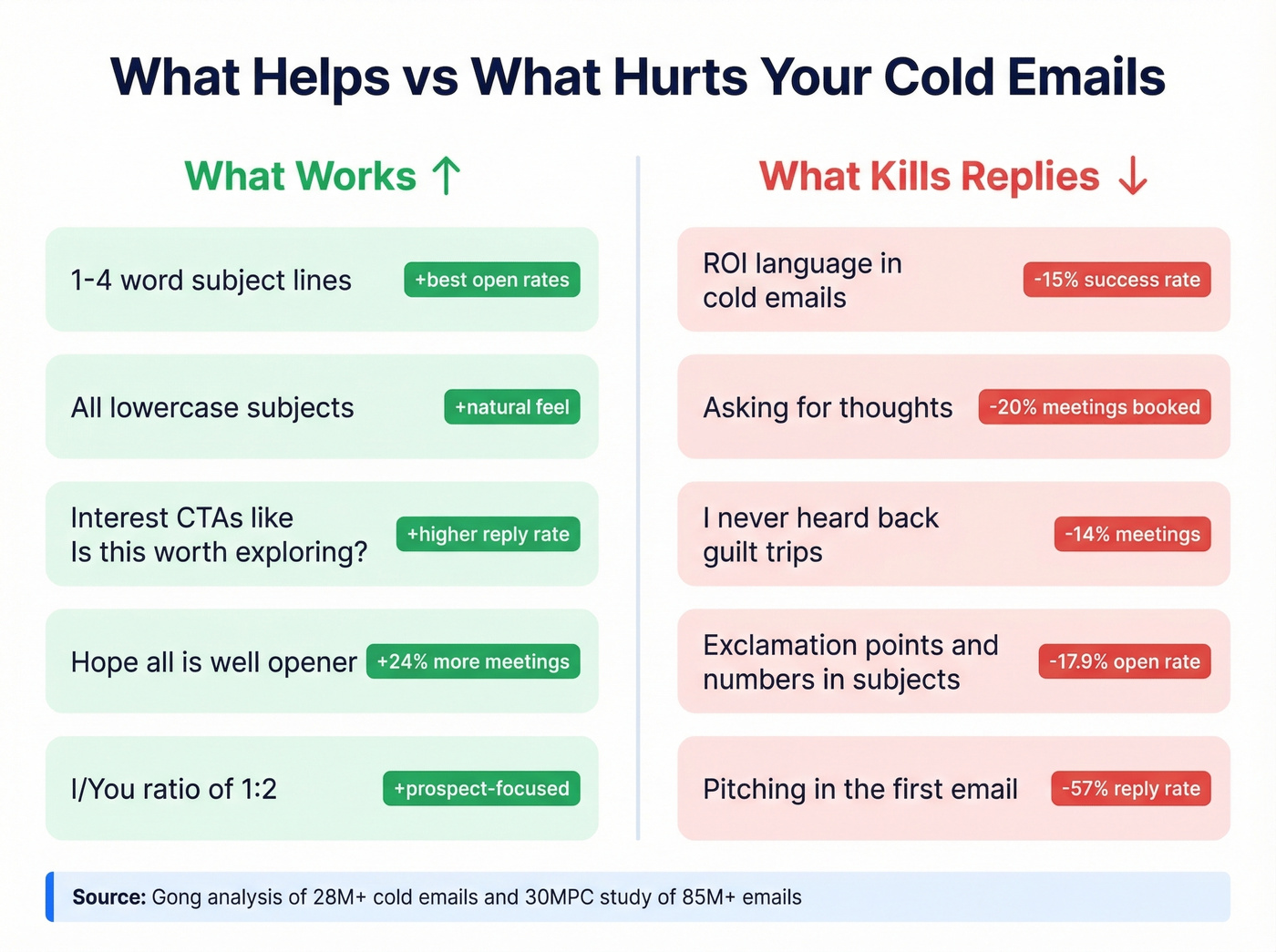
An analysis of 85M+ cold emails found clear patterns: 1-4 words is the sweet spot. All-lowercase outperforms title case. "Salesy" techniques - exclamation points, numbers, marketing-speak - reduce open rates by up to 17.9%. Empty subject lines boost opens by ~30% but tank reply rates by 12%. That's a gimmick, not a strategy. (If you want a bigger swipe file, use these email subject lines examples.)
One Reddit practitioner tested this directly. "Quick question" pulled 39% opens. Company-name subject lines hit 33%. "Partnership opportunity" landed below 19%. Subject lines that sound like a human wrote them to one person win. Subject lines that sound like a marketing campaign lose.
A/B test your subject lines weekly. Most reps agonize over body copy and never test the one element that determines whether anyone reads it at all. Run a 20/80 split - 20% of your list gets the variant, then roll the winner to the rest. (Here’s a deeper playbook on email preview text A/B testing.)
Words That Kill Reply Rates
CTA research from Gong reveals some counterintuitive findings. ROI language in cold emails decreases success rates by 15%. Asking for "thoughts" drops meetings booked by 20%. Guilt-trip follow-ups like "I never heard back" decrease meetings by 14%.
The surprise? "Hope all is well" - the phrase every sales trainer tells you to cut - actually correlates with 24% more meetings booked. A little warmth works.
Keep your I/my-to-you/your ratio at 1:2. Every sentence about you should have two about them. The biggest lever, though, is your CTA. Interest CTAs ("Is this worth exploring?") consistently outperform meeting-request CTAs ("Are you free Thursday at 2?"). You're asking for curiosity, not commitment. That's a lower bar, and more people clear it. (More examples in this email call to action guide.)
First Outreach Templates
The Value-First Email
This is your default first touch. Under 80 words, no pitch, interest CTA. Pitching drops replies by 57%, so resist the urge. (If you’re building a full sequence, start with this B2B cold email sequence framework.)
Subject: quick question
Body:
Hi {{firstName}},
Noticed {{company}} is scaling the {{department}} team - congrats. Most teams at your stage hit a wall with {{specific problem}}.
We helped {{similar company}} cut {{metric}} by {{result}} in {{timeframe}}.
Worth a look?
Why this works: It leads with observation, not product. The prospect sees you've done homework, gets a relevant proof point, and faces a low-commitment CTA. Compare that to the typical cold email that opens with "I'm reaching out because we're the leading platform for..." - that's the version that tanks your reply rate.
The PAS Email
PAS stands for Problem-Agitate-Solve: name the pain, twist the knife, offer the fix. Use this when you know the prospect's pain point from research or intent signals.
Subject: {{company}} + {{problem}}
Body:
Hi {{firstName}},
{{Specific problem statement - one sentence.}}
That usually means {{consequence of the problem - lost revenue, wasted time, missed quota}}.
We built {{solution description}} that helped {{similar company}} {{specific result}}.
Interested in seeing how?
Skip This If You Don't Have a Case Study
The Social Proof Email only works when you have a strong, specific number. "We helped companies improve results" is worthless. "Cut bounce rates from 35% to under 4%" does the heavy lifting.
Subject: {{similar company}} result
Body:
Hi {{firstName}},
{{Similar company}} was dealing with {{same problem you suspect}}. After switching to {{your solution}}, they {{specific metric: "cut bounce rates from 35% to under 4%" or "tripled pipeline from $100K to $300K/week"}}.
Happy to share what they did differently if it's relevant to {{company}}.
The Trigger-Based Email
Timing beats copy. When a prospect's company hits a trigger event - funding round, leadership hire, expansion signal - your email feels relevant instead of random. We've found that layering intent data with job changes and funding signals makes these far more effective than guessing at timing. (If you want a system for this, see how to track sales triggers.)
Subject: congrats on the raise
Body:
Hi {{firstName}},
Saw {{company}} just closed a {{Series B / new hire / expansion}}. Teams at that stage usually start investing in {{relevant area}}.
We help companies like {{similar company}} {{specific outcome}} - typically within {{timeframe}}.
Worth a conversation?
The Mutual Connection Email
Your shortest, highest-converting template. The connection does the trust-building for you, so get out of the way. (More examples in our connection email guide.)
Subject: {{connection name}} suggested I reach out
Body:
Hi {{firstName}},
{{Connection name}} mentioned you're working on {{relevant initiative}}. We helped them with {{specific result}} - happy to share what worked if useful.
That's it. Don't add a paragraph explaining your product. The referral is doing the work.

You read it above: templates are 20% of the equation. The other 80% is verified data and deliverability. Prospeo's 5-step email verification delivers 98% accuracy - teams using it cut bounce rates from 35% to under 4% and tripled pipeline.
Stop perfecting templates on top of bad data.
Pre-Call and Post-Call Templates
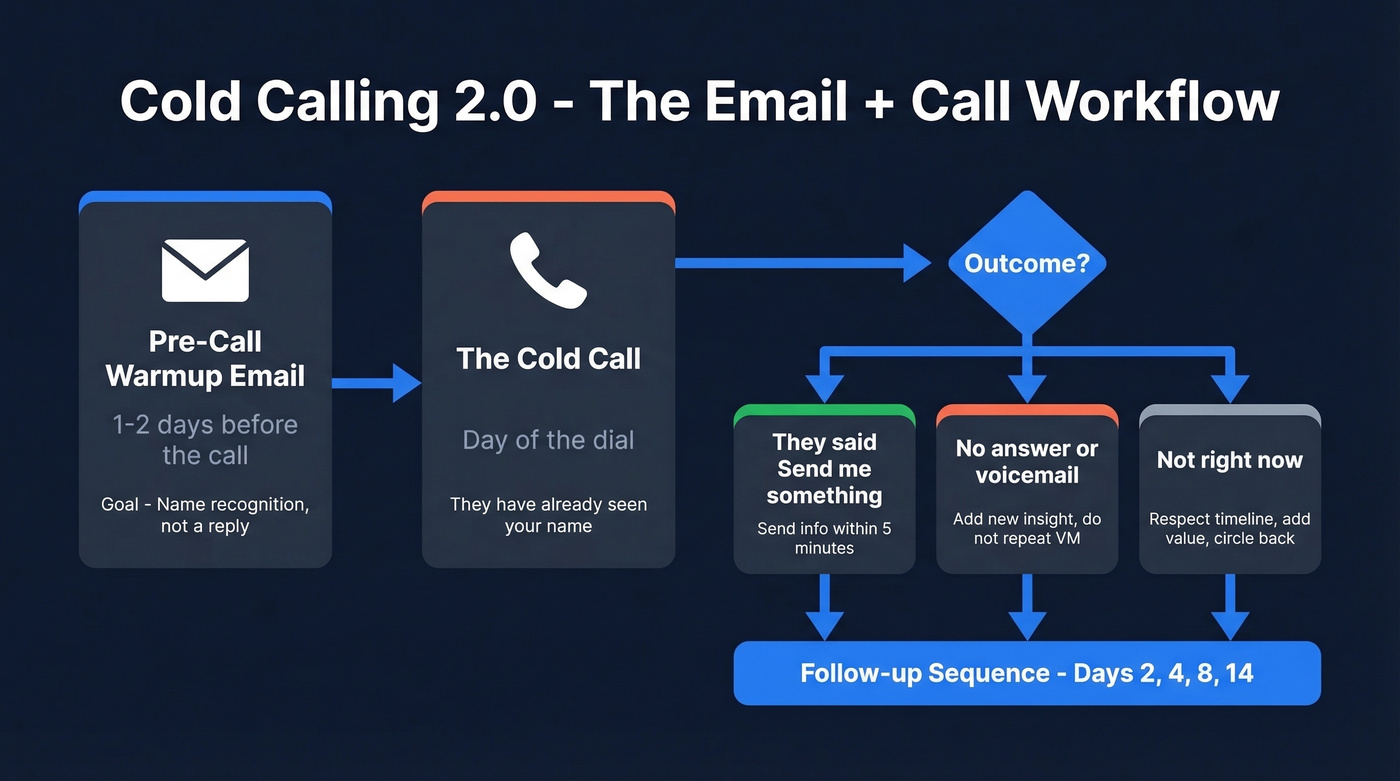
This is the section every other guide skips, and it's the reason the keyword says "cold calling." The Cold Calling 2.0 approach - where you use email to warm prospects before and after every dial - consistently outperforms either channel alone. We've tested dozens of pre-call and post-call sequences, and the combination is what separates modern outbound from spray-and-pray dialing. (If you’re building the full motion, start with a cold calling system.)
Pre-Call Warmup Email
Send this 1-2 days before you plan to dial. The goal isn't a reply - it's name recognition. When you call, they've already seen your name.
Subject: {{specific insight}}
Body:
Hi {{firstName}},
Noticed {{specific observation about their company - a job posting, a product launch, a tech stack change}}. Sending over a quick thought on {{relevant topic}} - will try to connect this week.
Keep it under 50 words. You're planting a seed, not pitching.
Post-Call: "Send Me Something"
They asked you to send information. This is the warmest follow-up you'll ever write. Send it within 5 minutes of hanging up.
Subject: as discussed
Body:
Hi {{firstName}},
Great chatting just now. As promised, here's {{the specific resource, case study, or one-pager you discussed}}.
The part most relevant to {{their specific situation}} is {{specific section or insight}}.
Happy to walk through it whenever works - no rush.
Reference what you actually talked about. Generic "as discussed" bodies with a PDF attachment get ignored.
Post-Call: No Answer / Voicemail
A Regie.ai benchmark found that 4-word subject lines paired with 39-word email bodies hit 56.6% open rates and 41.8% reply rates for post-voicemail follow-ups. Don't repeat your voicemail pitch - add something new.
Subject: just left you a vm
Body:
Hi {{firstName}},
Just tried you - left a quick voicemail. Rather than repeat myself: {{one new insight or resource relevant to their role}}.
Worth a quick chat?
Post-Call: "Not Now"
Respect the timeline. No guilt language - remember, "I never heard back" kills meetings by 14%.
Subject: for when the timing's right
Body:
Hi {{firstName}},
Totally understand - {{Q3 / after the migration / next quarter}} makes more sense. In the meantime, here's {{a relevant report, benchmark, or insight}} that might be useful as you plan.
I'll circle back in {{timeframe they mentioned}}. No follow-up barrage in between - promise.
Follow-Up Email Templates
42% of all replies come from follow-ups. These aren't "just checking in" emails. Every message adds new information or reframes the problem. (If you want more variations, use these sales follow-up templates.)
Day 2 - Quick Value-Add
Subject: one more thing
Body:
Hi {{firstName}},
Came across {{new article, stat, or insight relevant to their problem}} and thought of our conversation. {{One sentence on why it matters to them.}}
Day 4 - Social Proof Nudge
Subject: what {{similar company}} did
Body:
Hi {{firstName}},
{{Similar company in their space}} was dealing with {{same challenge}}. They {{specific result with numbers}} after {{timeframe}}.
Happy to share the playbook if it's relevant.
Day 8 - Different Angle
Switch your approach entirely. If you led with a cost problem, try a speed problem. If you asked "worth a look?" before, try "want me to send the case study?" this time.
Subject: different thought
Body:
Hi {{firstName}},
I initially reached out about {{original angle}}. But looking at {{company}} more closely, the bigger opportunity might be {{reframed problem or different use case}}.
Would that be more relevant to what you're focused on right now?
Day 14 - The Breakup
Subject: closing the loop
Body:
Hi {{firstName}},
I'll assume the timing isn't right and won't keep following up. If {{problem}} becomes a priority, happy to pick this back up.
No guilt. No "I've tried reaching you several times." Just leave the door open. This should be the shortest email in your sequence.
The 15-Day Call + Email Cadence
Templates in isolation don't work. You need a system. Here's a multi-channel cadence that maps calls, emails, and social touches across 15 days - prospects typically need 15-17 touches before engaging. (For more outbound plays, see these sales prospecting techniques.)
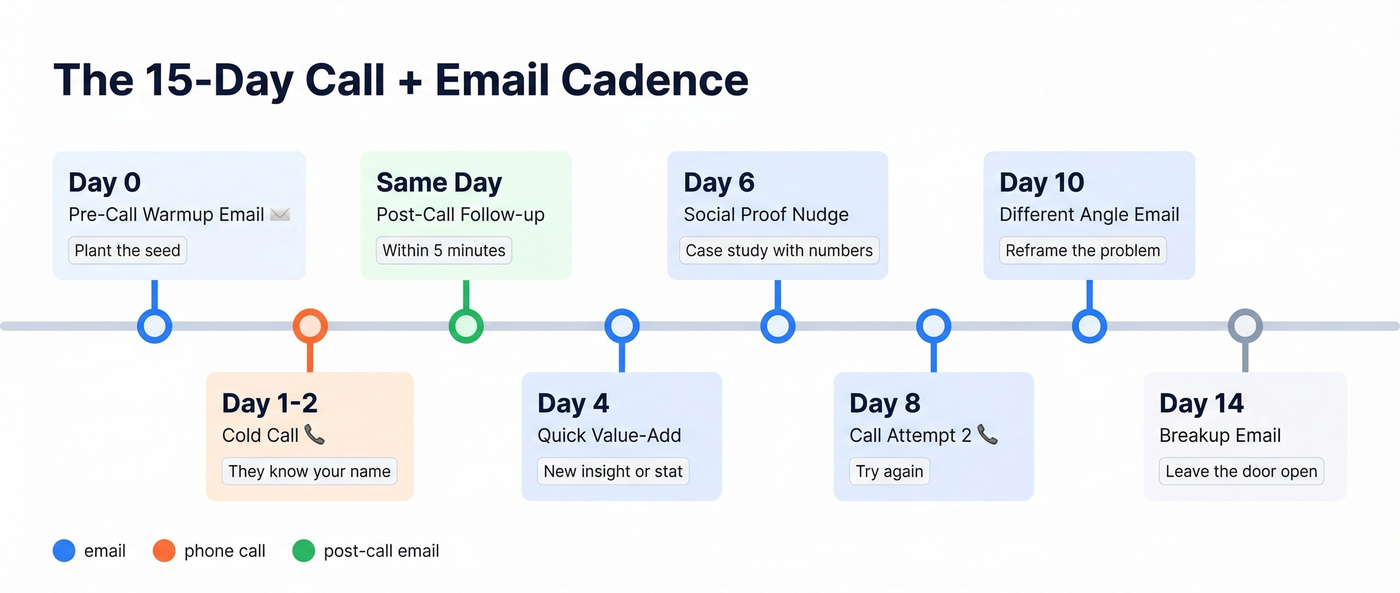
| Day | Channel | Action | Template |
|---|---|---|---|
| 1 | Social | View their profile | Profile view only |
| 2 | Personalized first touch | Value-First | |
| 4 | Social | Connect request (ref email) | Brief note referencing email |
| 6 | Follow-up with new value | Day 2 Value-Add | |
| 8 | Social | Engage with their content | Comment or like |
| 10 | Phone | First call (ref prior touches) | Use pre-call warmup |
| 10 | Post-call follow-up | Post-Call template | |
| 11 | Social proof nudge | Day 4 Nudge | |
| 13 | Different angle | Day 8 Reframe | |
| 15 | Phone | Final call attempt | Reference prior emails |
| 15 | Breakup email | Day 14 Breakup |
Send emails Tuesday-Thursday, 8-11am in the prospect's timezone. One Reddit practitioner reported a 16% improvement in opens just from fixing send timing. (More data in our guide to the best time to send cold emails.)
Deliverability Checklist
You've probably bookmarked a dozen template articles and your reply rate is still 3%. Here's the frustrating truth: templates are the easy part. Deliverability is where campaigns actually die. We've seen teams double their reply rates just by fixing bounce rates - zero copy changes. (Start with these email reputation tools.)
Domain authentication is non-negotiable. Configure SPF, DKIM, and DMARC records on every sending domain. Add the RFC 8058 one-click unsubscribe header, required since May 2025. (If you’re troubleshooting, use this guide on how to verify DKIM is working.)
Sending limits and warmup take patience. Warm up new domains at 5-10 emails/day, ramping over 4-6 weeks. Run 5-7 sending domains, max 25-26 emails per domain per day. Total infrastructure cost runs about ~$420/mo for domains, sending tools, and verification.
The thresholds that matter: spam complaints under 0.3%, bounce rate under 2%. Pause sending immediately if you cross either. One practitioner on r/Entrepreneur dropped bounces from 11% to under 2% by verifying every email on their list. Their reply rate doubled from 3% to 6%.
Let's be honest - templates are useless if your emails bounce. Prospeo verifies emails in real-time with 98% accuracy and refreshes data every 7 days, compared to the 6-week industry average. The 5-step verification process catches spam traps, honeypots, and catch-all domains. A free tier gives you 75 verified emails per month to test before you commit. Start there before you optimize a single subject line.
Trigger-based emails crush generic outreach - but only if you catch the signal in time. Prospeo tracks 15,000 intent topics, job changes, and funding events on a 7-day refresh cycle so your timing is never stale.
Send the right template to the right person at the right moment.
Is Cold Emailing Legal?
Short answer: yes, in most jurisdictions, with rules.
US (CAN-SPAM): No prior consent required. You must include a valid physical address, honor opt-outs within 30 days, and avoid deceptive subject lines - no fake "Re:" prefixes. Penalties run $51,744-$53,088 per violation.
EU (GDPR): Cold email is legal under Article 6(1)(f) - legitimate interest. You need a documented Legitimate Interest Assessment covering purpose, necessity, and balancing tests. Target by role relevance, include opt-out, and keep records.
Canada (CASL): Stricter than CAN-SPAM. Honor unsubscribe requests within 10 business days. Implied consent scenarios exist but document everything. Retain opt-out records for 3 years.
The biggest legal risk isn't the law - it's deceptive practices. Don't use fake "Re:" subject lines, don't hide the unsubscribe, and don't blast irrelevant lists. Follow the rules and cold email is a perfectly legal sales channel.
FAQ
How long should a cold email be?
Under 80 words for the highest reply rates. One practitioner cut emails from 141 words to under 56 and saw reply rates double. Front-load your value proposition in the first sentence.
How many follow-ups should I send?
Four to seven touchpoints is the optimal range. 42% of all replies come from follow-ups, not the first email. Each message must add new value - a fresh stat, case study, or reframed angle.
What's the best day to send cold emails?
Tuesday through Thursday, 8-11am in the recipient's timezone. Wednesday slightly edges out the others for reply rates. One rep saw a 16% lift in opens just from fixing send timing.
Should I email before or after a cold call?
Both. A pre-call email 1-2 days before creates name recognition. A post-call email within 5 minutes reinforces the conversation. This call-plus-email approach consistently outperforms either channel used alone.
How do I verify emails before sending a cold campaign?
Use a dedicated verification tool - don't trust CRM data at face value. Prospeo's free tier lets you verify 75 emails per month at 98% accuracy, which is enough to test a first campaign. Bounce rate must stay under 2%, so verify every address before it enters your sequence.