

The B2B SaaS Cold Email Playbook for 2026
You've read ten guides that hand you email templates but never mention SPF records or daily send caps. Then you wonder why your "proven template" gets 0.5% replies. Stop obsessing over copy. The number-one reason cold email for B2B SaaS fails isn't your writing - it's your data and your infrastructure.
Across 16.5 million cold emails spanning 93 business domains tracked by Belkins in 2024, the average reply rate dropped to 5.8%, down from 6.8% the year before. The bar is higher now. Here's how to clear it.
What You Need Before Sending a Single Email
Three things, in order of importance:
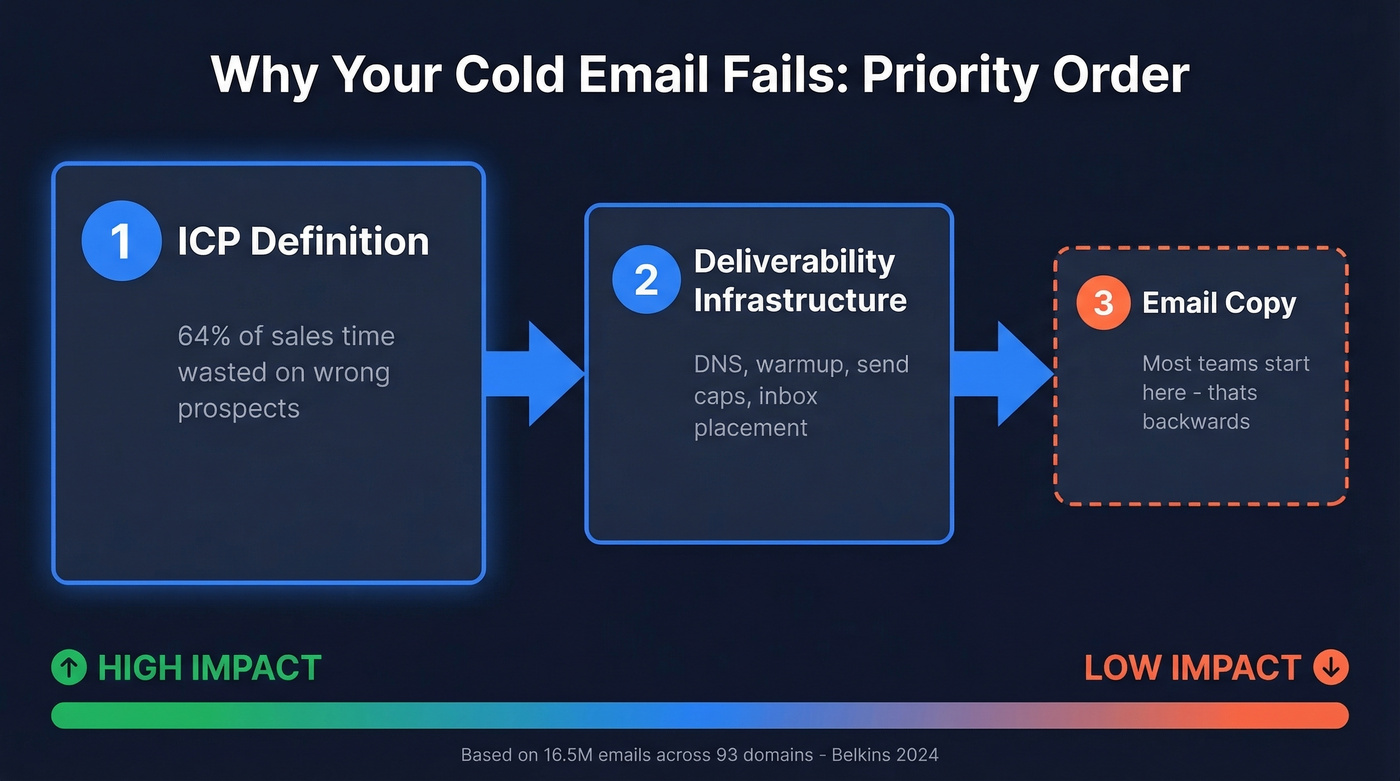
- Your ICP is the lever. Tighten it before anything else.
- Deliverability infrastructure matters more than copywriting right now.
Define Your ICP First
Most SaaS teams skip this or half-ass it. That's expensive. B2B salespeople spend 64% of their time on prospects who never convert, and only 42% of companies have a formally documented ICP. Without a sharp ICP, no outbound strategy delivers consistent results.
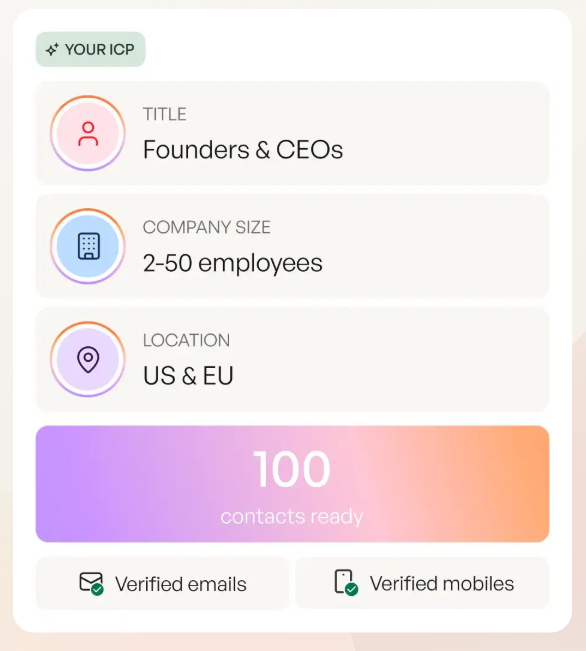
Build your ICP around three pillars. Firmographic data: industry, headcount, revenue, funding stage. Technographic signals: the tools they already use. Behavioral indicators: hiring surges, job changes, intent data. Score each criterion as mandatory or preferential - 73% of B2B sales teams using a structured ICP shorten their sales cycle by 30%.
If you need a starting point, use an ICP scoring rubric before you build lists.
Here's the thing: if your ACV is under $5K, cold email ROI depends on volume. Blast a tight ICP with short sequences. Above $20K ACV, personalization depth matters more than send volume. Most teams get this backwards.
One Reddit practitioner shared a telling example - after tightening their ICP to a specific pain point and vertical, they sent to just 190 leads and hit a 9% reply rate, with 70% of those replies being genuine interest. Broad lists don't do that.
Build Your List and Verify It
Your target is under 1% bounce rate. Anything above 2% actively damages your sending reputation, and that damage takes 6-12 months to rebuild. Verify every email within 72 hours of sending. Catch-all domains need special handling because they can pass basic checks but still create downstream bounce risk. This verification step separates campaigns that scale from ones that crater on launch day.
If you're diagnosing deliverability issues, start with bounce rate benchmarks and fixes.

We've tested a lot of data providers, and the verification step is where most of them fall short. Prospeo's 5-step verification catches invalid addresses, catch-all domains, and spam traps before they reach your sending tool - 98% email accuracy with a 7-day data refresh cycle. The free tier gives you 75 verified emails per month to test, and it integrates natively with Instantly, Smartlead, and Lemlist so verified contacts flow straight into your sequences.
If you're comparing vendors, see our breakdown of data enrichment services and where verification fits.
Another Reddit case study used Apollo to collect ~4,000 university technology director contacts, set up 15 inboxes across 3 domains, and generated $100k in revenue from cold email alone. The infrastructure mattered as much as the list.
Deliverability Infrastructure
This is the section most guides skip. It's also the section that determines whether your outreach actually lands in inboxes.
If you want the full technical checklist, use this email deliverability guide alongside the steps below.
Domains and DNS
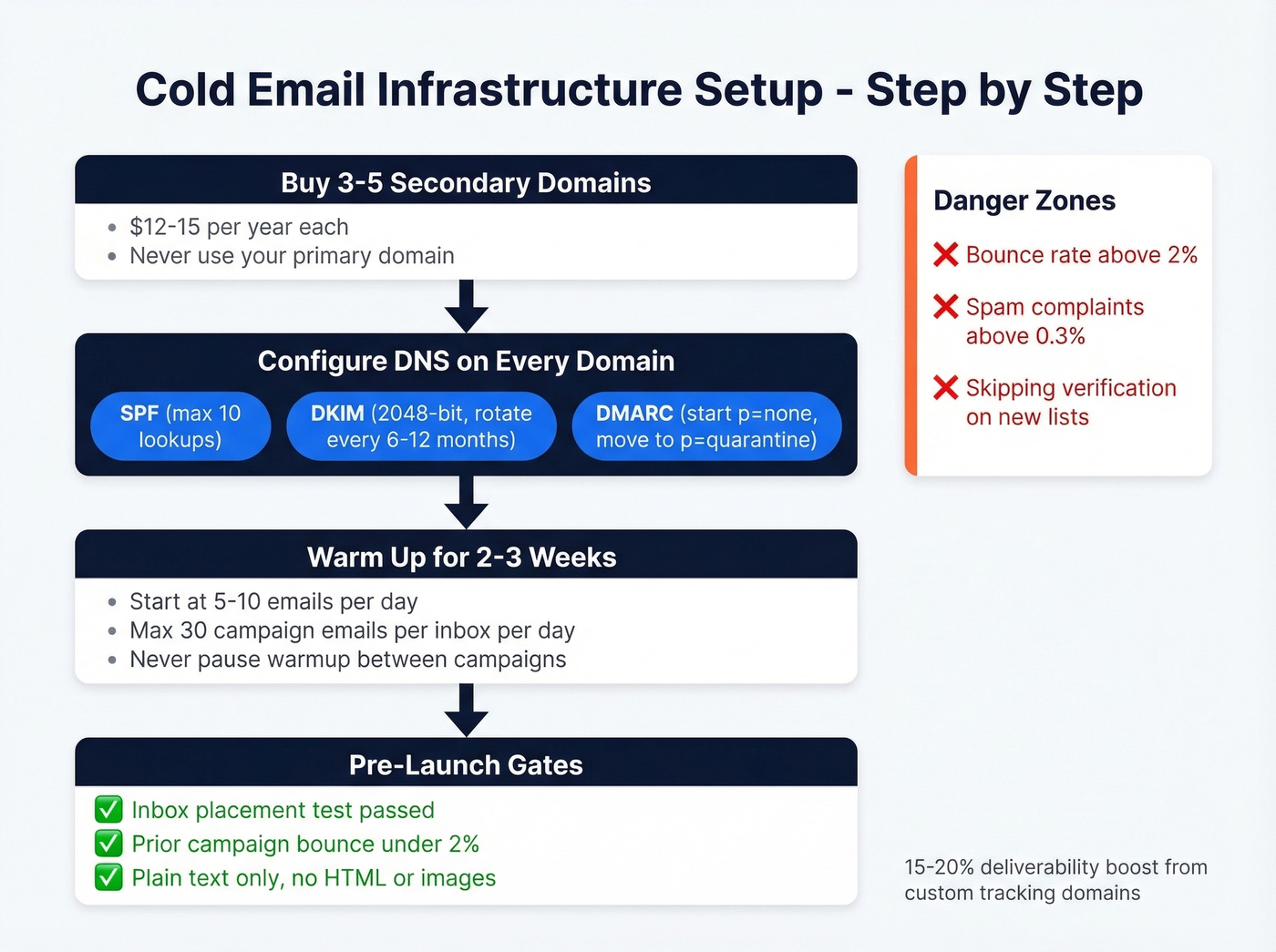
Never send from your primary business domain. Buy 3-5 secondary domains that are close variations of your brand - they run $12-15/year each. On every domain, configure SPF with a maximum of 10 DNS lookups (flatten if needed), DKIM at 2048-bit minimum with key rotation every 6-12 months, and DMARC starting at p=none before moving to p=quarantine after 2-4 weeks of clean reports. Custom tracking domains deliver a 15-20% deliverability improvement over generic ones.
For examples you can copy/paste, use these SPF record patterns, and make sure your tracking domain is set up correctly.
Warmup and Send Caps
Warm new domains for 2-3 weeks before sending any campaign emails. Start at 5-10 emails per day and ramp gradually. Instantly's recommended cap is 30 campaign emails per day per inbox, so 10 inboxes give you 300 emails/day of sending capacity. For a campaign targeting 200-400 prospects over 2-3 weeks, plan on 4-6 mailboxes across 2 secondary domains and keep the rest in reserve for rotation.
To avoid getting throttled, manage email velocity and keep caps consistent across inbox pools.
Keep warmup running continuously - don't pause it between campaigns. Use a real-person mailbox with a profile photo and a simple signature. Role accounts like sales@ or info@ get flagged. Segment your inboxes into pools: primed, ramping, and resting, based on domain age and health score. Mixing healthy and degraded inboxes in the same campaign invalidates your A/B test results.
Pre-Launch Gates
Run inbox placement tests before every campaign launch. Don't send if seed tests hit spam. Pause if your prior campaign bounced above 2%. Use plain text only - no HTML, no images, open tracking off. Apple Mail Privacy Protection makes open rates unreliable anyway.
Since May 2025, bulk-sender rules require SPF + DKIM + DMARC + domain alignment + RFC 8058 one-click unsubscribe. Keep spam complaints under 0.3% and bounces under 2%. This is why your data source matters so much: bad addresses that slip through verification burn your domain, and that damage compounds fast. We've watched teams go from 7% reply rates to under 2% in a single week because they skipped verification on a new list.

Bad data kills SaaS cold email campaigns faster than bad copy. Prospeo's 5-step verification delivers 98% email accuracy with catch-all handling and spam-trap removal - keeping you under the 2% bounce threshold that protects your domains. Native integrations with Instantly, Smartlead, and Lemlist mean verified contacts flow directly into your sequences.
Stop burning domains on unverified lists. Start with 75 free emails.
Write Emails That Get Replies
The data across 16.5 million emails shows messages with 6-8 sentences hit a 6.9% reply rate. Under 200 words consistently outperforms longer copy. Your email doesn't need to be clever. It needs to be short, relevant, and human.
The format that works best right now: one observation about the prospect's situation, then one question. SaaS buyers expect to see a path to a product demo, not just a vague meeting request - so make your CTA specific.
If you're stuck on the ask, use these email call to action rules and examples.
Personalization beyond {first_name} is non-negotiable. Reference a specific pain point, a tech stack signal, or a trigger event like new funding, a job change, or a hiring surge. Plain text only. No HTML templates, no fancy formatting.
Hey {first_name}, noticed {company} just {trigger event}. Most {role}s at that stage run into {specific pain point} - curious if that's on your radar? Happy to show you how we handle it in a 15-min demo.
Short, specific, conversational. That's it.
Follow Up Smart, Not Hard
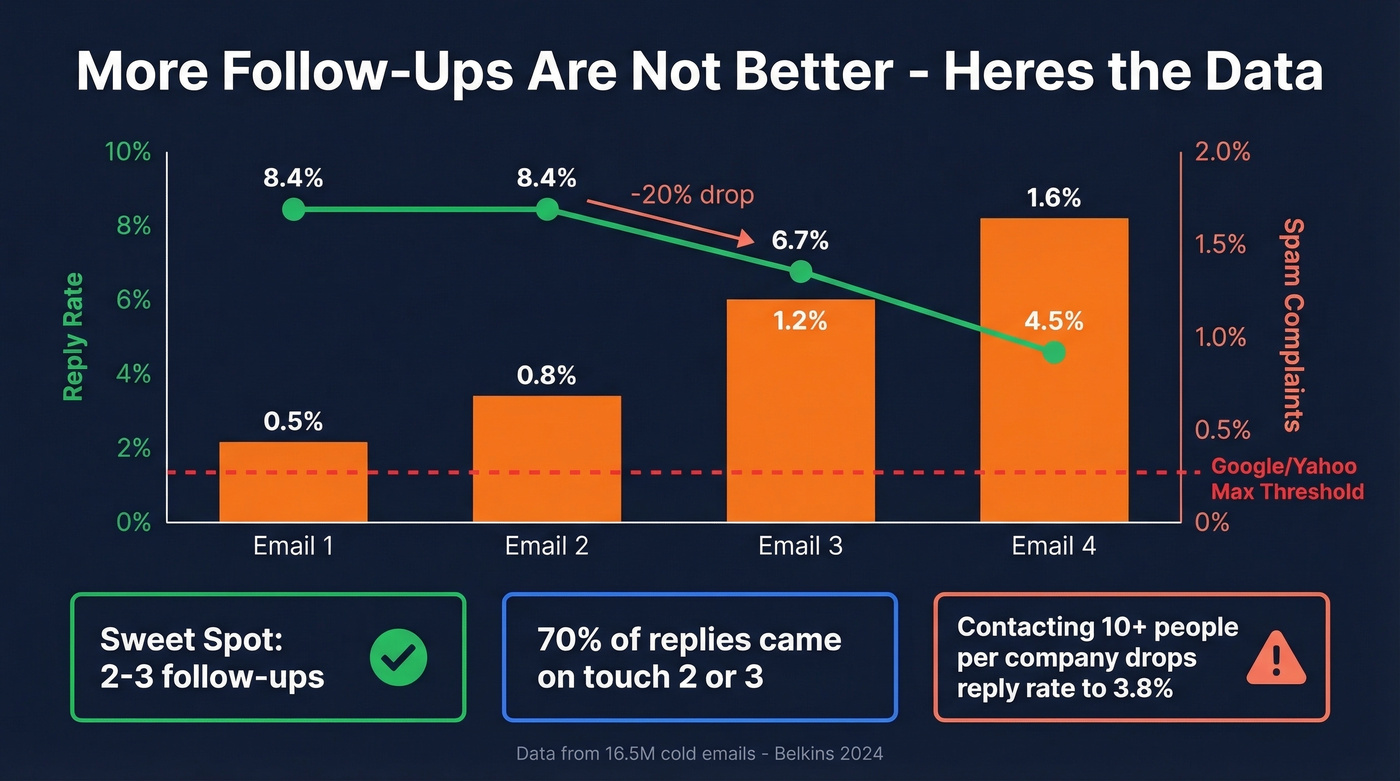
A lot of cold outreach advice pushes long follow-up chains. The data says that's harmful. Across those 16.5 million emails, adding a third email dropped reply rates by 20%. Spam complaints tripled between email #1 and email #4.
| Metric | Email #1 | Email #2 | Email #3 | Email #4 |
|---|---|---|---|---|
| Reply rate trend | Highest (8.4%) | Good | -20% drop | Diminishing |
| Spam complaints | 0.5% | ~0.8% | ~1.2% | 1.6% |
| Unsubscribes | 0.1% | 0.05% | 0.8% | 2.0% |
Two to three follow-ups is the sweet spot. That Reddit practitioner who hit 9% reply rates? About 70% of their replies came on touch #2 or #3. Enterprise prospects with six-figure deal sizes are less tolerant of persistence than SMB - adjust accordingly.
If you want plug-and-play copy, use these cold email follow-up templates.
Contacting 1-2 people per company yielded a 7.8% reply rate. Contacting 10+ people at the same company dropped it to 3.8%. Multi-threading works, but aggressive multi-threading backfires hard.
Stay Legal
| Region | Rule | Key Requirement | Penalty |
|---|---|---|---|
| US | CAN-SPAM | Physical address, opt-out within 30 days, truthful headers | $51,744-$53,088/email |
| EU | GDPR Art. 6(1)(f) | Documented Legitimate Interest Assessment | Up to 4% global revenue |
| Canada | CASL | Prior consent required | Up to CAD $10M |
Cold email is legal in the US without prior consent under CAN-SPAM - you need a physical address, an opt-out mechanism honored within 30 days, and honest subject lines. In the EU, GDPR permits B2B outreach under legitimate interest, but you must document a Legitimate Interest Assessment before sending. Canada is the strictest: CASL requires consent first. Keep opt-out records for at least 3 years for CASL compliance.
If you're unsure about list sourcing, read Is it illegal to buy email lists?
2026 Benchmarks and Funnel Math
| Metric | Benchmark |
|---|---|
| Avg reply rate | 5.8% |
| Best day | Thursday (6.87%) |
| Best send window | 8-11 PM (6.52%) |
| Optimal length | 6-8 sentences |
| Meeting booked rate | 0.5-2% of delivered |
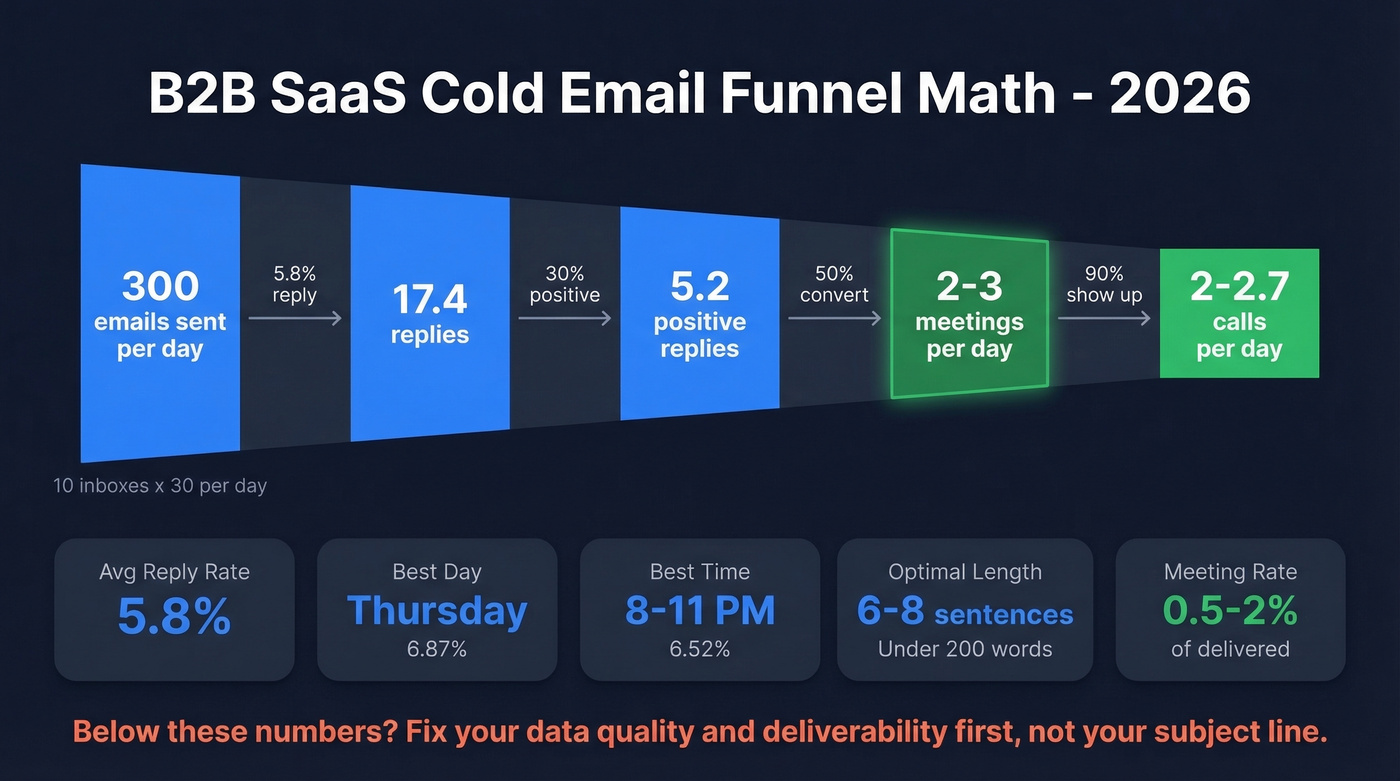
With a tight ICP, verified data, and proper infrastructure, 7-10% reply rates are achievable. B2B SaaS reply rates typically run 0.5-1% below cross-industry averages due to higher inbox competition, but SaaS deal sizes make even modest reply rates profitable.
Let's run the funnel math: 300 emails/day x 5.8% reply x 30% positive reply x 50% meeting conversion = roughly 2-3 meetings per day. That math works for most B2B SaaS companies running cold email at scale. If you're below those numbers, the fix is almost always data quality or deliverability - not your subject line.
If you want to systematize the numbers, map this to a B2B sales funnel template and track the right funnel metrics.
The playbook above works - but only when your ICP data is fresh. Prospeo refreshes 300M+ profiles every 7 days (not the 6-week industry average), so your cold email lists reflect real-time job changes, funding rounds, and hiring surges. Filter by buyer intent across 15,000 topics, technographics, headcount growth, and 30+ other signals to build the tight lists that hit 7-10% reply rates.
Build laser-targeted SaaS prospect lists at $0.01 per verified email.
FAQ
Is cold email legal for B2B SaaS?
Yes. In the US, CAN-SPAM allows unsolicited B2B email with a physical address, opt-out link, and truthful headers. The EU permits it under GDPR legitimate interest with a documented assessment. Canada's CASL is strictest - prior consent is required.
What reply rate should B2B SaaS teams expect in 2026?
The 2024 benchmark across 16.5 million emails was 5.8% average. Teams with verified data, proper DNS setup, and a tight ICP consistently hit 7-10%. If you're below 4%, your list quality or deliverability infrastructure needs work.
How do I keep cold emails out of spam?
Use secondary domains with SPF, DKIM, and DMARC configured. Warm inboxes for 2-3 weeks minimum. Verify every address before sending - catch spam traps and catch-all risks before they reach your sending tool. Keep bounce rates under 2% and spam complaints under 0.3%.
What's the best free tool for building verified prospect lists?
Prospeo's free tier includes 75 verified emails per month with full 5-step verification and catch-all handling - enough to test a campaign against a tight ICP. Apollo offers 50 free credits monthly but has lower accuracy (79% vs. 98%), which means more bounces and domain risk.