

Cold Emailing Best Practices: The Data-Driven Playbook for 2026
Most cold emailing best practices guides are backwards. They start with subject lines and templates - that's like choosing paint colors before pouring the foundation. If your infrastructure is broken, your best copy lands in spam. A Belkins study of 16.5M cold emails across 93 domains found the average reply rate fell from 6.8% to 5.8%, a 15% relative decline year-over-year, and the gap between disciplined operators and everyone else is widening fast.
Before we go further, let's kill a misconception. Cold email isn't spam. They're fundamentally different:
| Cold Email | Spam | |
|---|---|---|
| Targeting | Researched, role-specific recipients | Mass-blasted to purchased lists |
| Personalization | Tailored to the recipient's situation | Generic or non-existent |
| Opt-out | Clear unsubscribe, honored promptly | No opt-out or ignored requests |
If your outreach looks like the right column, no best practice will save you.
Quick-Start Summary
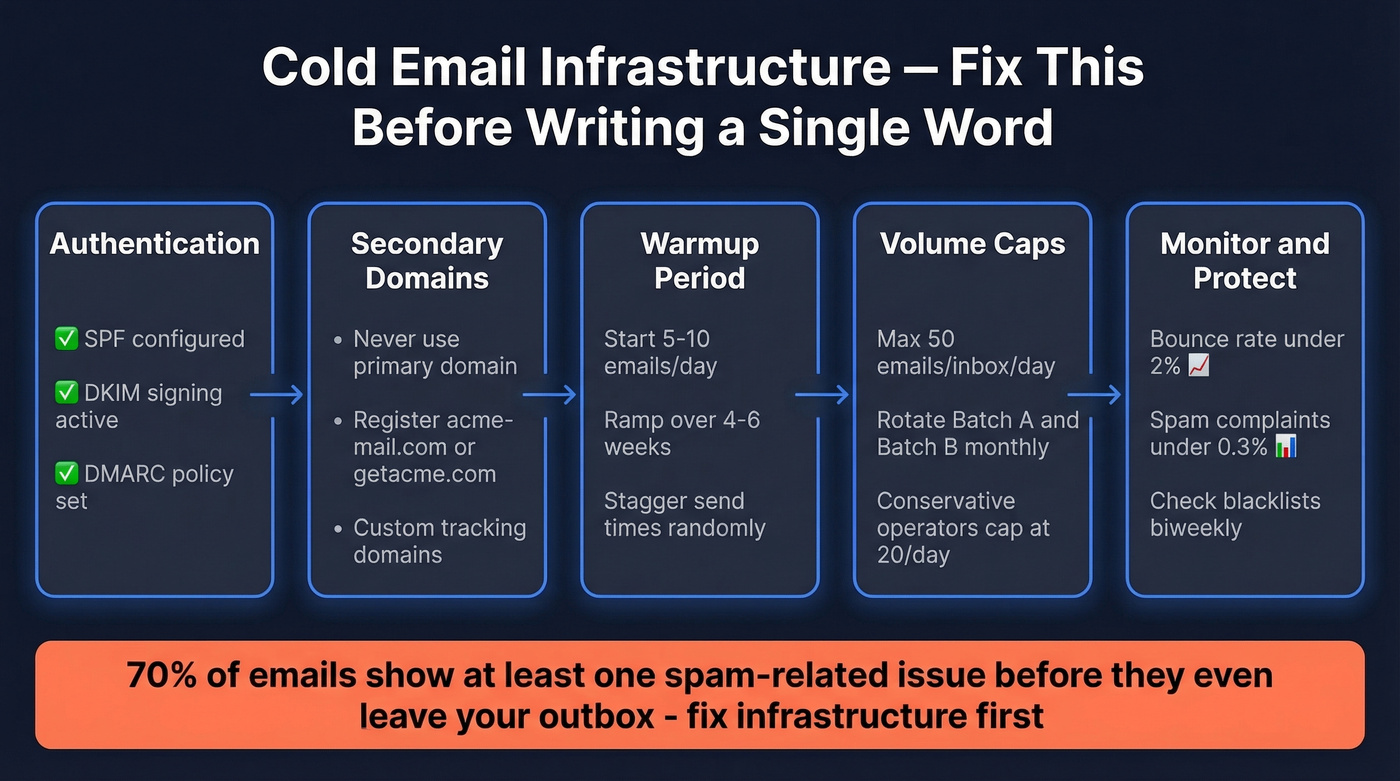
- Fix your infrastructure first. Authentication, warmup, volume caps - most campaigns fail here. [70% of emails show at least one spam-related issue](https://www.litmus.com/blog/why-emails-go-to-spam-instead-of-inbox) before they even leave your outbox.
- Use verified data. Bounce rates above 2% trigger domain reputation damage. (If you need a deeper breakdown, see bounce rates.)
- Write short, follow up 2-3 times max, send on Thursdays. Emails of 6-8 sentences hit 6.9% reply rates. The first follow-up lifts replies up to 49%. Thursday outperforms every other day.
That's the skeleton. Now let's build the muscle.
Infrastructure Before Copy
A perfectly written cold email that lands in spam generates exactly zero replies. Infrastructure determines whether anything else matters, and it's the single area where outbound email practices have shifted most dramatically heading into 2026. (For a full technical checklist, use this deliverability guide.)
Authentication and Domains
SPF, DKIM, and DMARC are non-negotiable. If you haven't configured all three, stop reading and go do that now. Every major inbox provider checks alignment on these records before deciding where your email lands.
Use secondary domains for outbound. Never send cold email from your primary domain. If your company is acme.com, register acme-mail.com or getacme.com and point your outbound infrastructure there. Set up custom tracking domains too - shared tracking domains pool your reputation with every other sender on that platform, and that's a gamble you don't want to take. (More on tracking domains.)
Warmup and Volume
New inboxes need a ramp period. Start at 5-10 emails per day and increase gradually over 4-6 weeks. A reasonable progression looks like 10-20/day in week one, 20-40/day in week two, then 40-50/day once inbox health metrics look clean. Stagger send times with random delays between messages to mimic human sending patterns - inbox providers flag robotic cadences.
At scale, cap at 50 emails per day per inbox. The consensus on r/coldemail is even more conservative: some operators cap at 20/day and run multiple inboxes. Rotate inboxes monthly using a Batch A / Batch B pattern so one set sends while the other cools off, then swap. (If you're calibrating limits, see email velocity and unlimited email warmup tools.)
2026 Bulk Sender Rules
Google and Yahoo's bulk sender requirements are fully enforced, and Microsoft has followed suit:
- SPF, DKIM, and DMARC authentication with proper alignment
- RFC 8058 one-click unsubscribe via List-Unsubscribe headers
- Spam complaint rate under 0.3% in Gmail Postmaster Tools
- Bounce rate under 2%
One distinction most guides skip: delivery means the server accepted your email. Deliverability means it reached the inbox instead of spam. You can have high delivery and low inbox placement. Monitor both. Run seed tests and aim for 80%+ inbox placement before scaling any campaign.
When to Pause
Pause the mailbox if bounce rate exceeds 2%, spam complaints approach 0.3%, or you land on a blacklist. Check domain and IP blacklists biweekly with MXToolbox. Catching a blacklisting early is the difference between a one-day fix and a month-long reputation rebuild. (If you do get listed, follow a Spamhaus blacklist removal process.)
Build a Clean Prospect List
Every cold email guide tells you to "clean your list." Almost none explain what clean actually means.
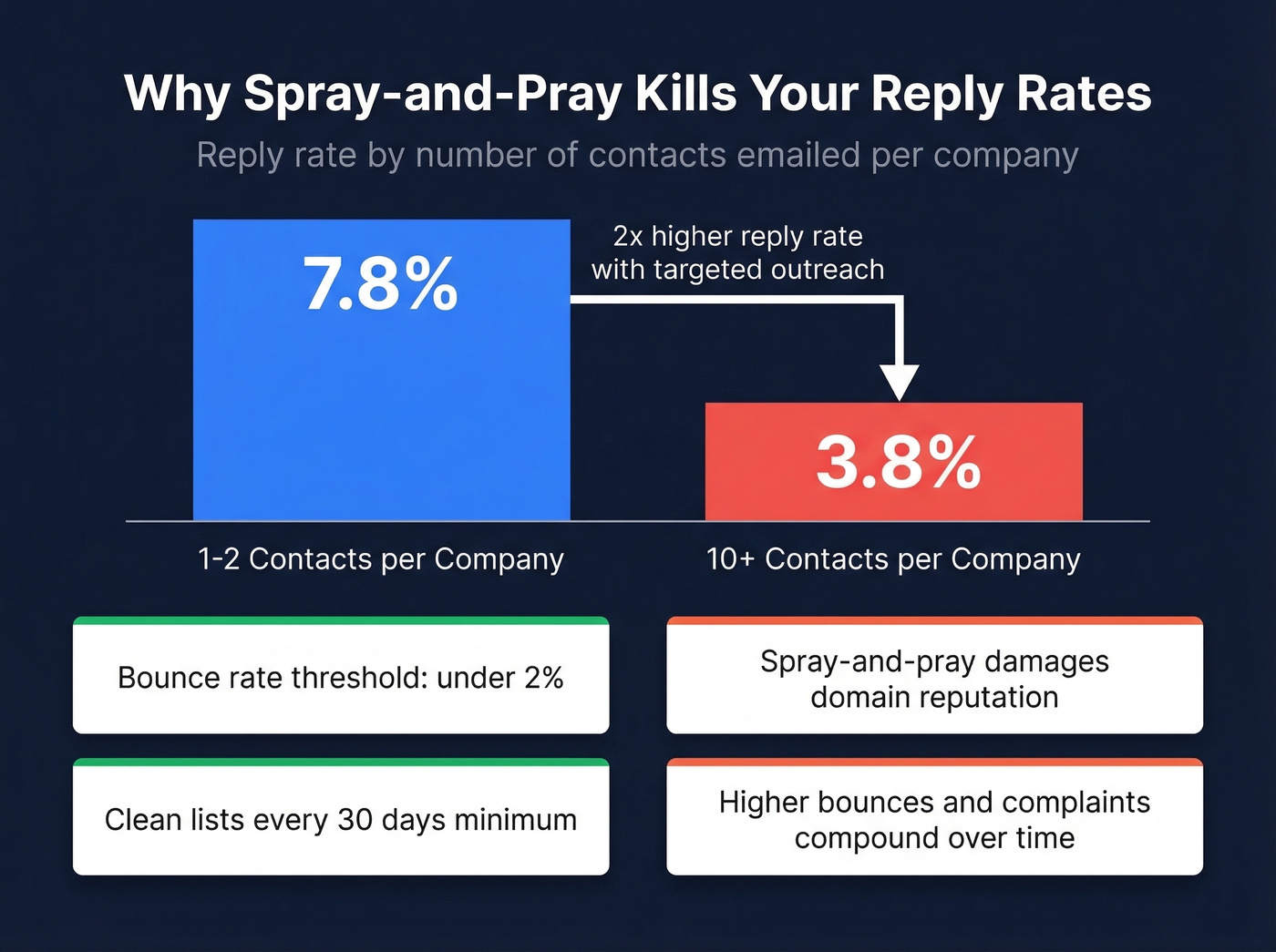
Here's the thing: emailing 1-2 contacts per company yielded a 7.8% reply rate versus 3.8% when emailing 10+ contacts at the same company. Spray-and-pray doesn't just underperform - it actively damages your domain reputation through higher bounce and complaint rates.
The bounce rate threshold is 2%. Above that, inbox providers start throttling your sending and routing you to spam. Prospeo's 5-step verification process handles catch-all domains, spam traps, and honeypots to maintain 98% email accuracy, with data refreshing every 7 days versus the 6-week industry average. That means you're not emailing people who changed jobs last month. Stack Optimize built to $1M ARR using this data - 94%+ client deliverability, bounce rates under 3%, zero domain flags across all clients. (If you're comparing vendors, see data enrichment services.)
Clean your lists every 30 days minimum. Email addresses decay faster than most teams realize: people change jobs, companies restructure, domains expire. This is one of the most overlooked steps in outbound prospecting, yet it has the highest impact on campaign health. (Related: spam trap removal.)

This article proves that bounce rates above 2% destroy domain reputation and kill campaigns. Prospeo's 5-step verification delivers 98% email accuracy with a 7-day data refresh cycle - so you're never emailing stale contacts. At ~$0.01/email, protecting your sender reputation costs less than a single bounced opportunity.
Fix your data before you fix your copy. Start free today.
Subject Lines That Get Opens
An analysis of 85M+ cold emails compiled by 30 Minutes to President's Club using Gong data found the best-performing subject lines share consistent traits. Keep them to 1-4 words. Use all lowercase, proper nouns excepted. Salesy techniques - exclamation points, ALL CAPS, "limited time" language - reduce open rates by up to 17.9%. (If you want a swipe file, use these cold email subject line examples.)
Four formula categories that consistently perform:
- Pervasive problems - name a pain the recipient already knows they have
- Industry trends - reference something happening in their market right now
- 1-2 word pattern interrupts - short enough to create curiosity without clickbait
- Competitor share - mention a competitor or peer company by name
One gimmick worth addressing: the empty subject line. It boosts opens by ~30% but drops replies by 12%. That's a net negative. You're optimizing for the wrong metric.
The data is clear: emailing 1-2 contacts per company yields 7.8% reply rates vs 3.8% for spray-and-pray. Prospeo's 30+ search filters let you pinpoint the exact decision-maker by role, intent signals, and company growth - so every send counts. Stack Optimize used this approach to hit $1M ARR with sub-3% bounce rates.
Send fewer emails to better contacts. That's how you win in 2026.
Writing the Email Body
The copy length question is settled. 6-8 sentences, under 200 words, produced a 6.9% reply rate - the highest of any length bracket. Longer emails didn't just underperform; they actively suppressed replies. (For more structure, see email copywriting.)
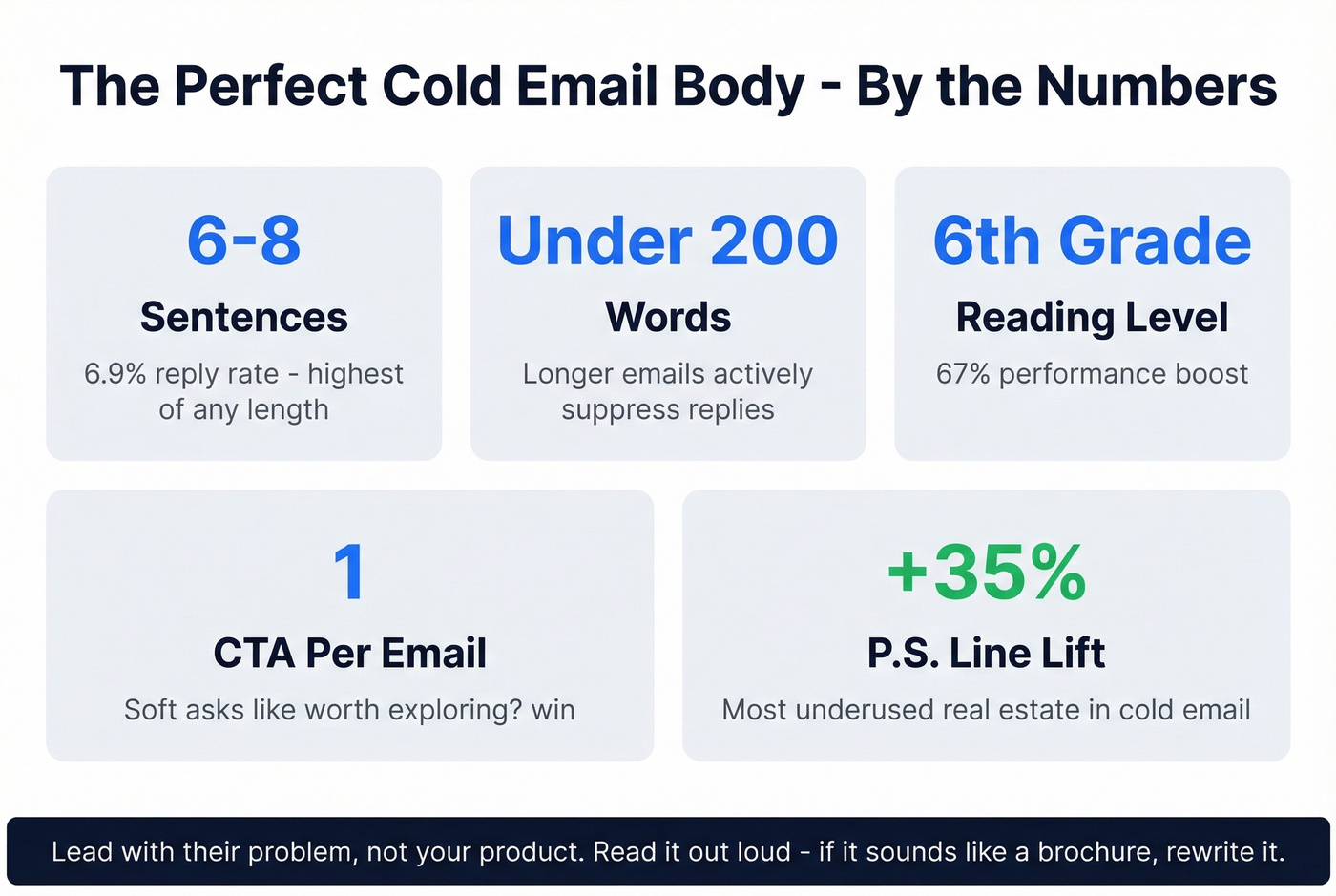
Lead with the recipient's problem, not your product. The first sentence should make them think "this person understands my situation," not "this person wants to sell me something." Personalize with actual research - a recent company announcement, a specific challenge their role faces, a mutual connection - not just {{first_name}} merge tags. (If you're tightening targeting, use an ideal customer profile.)
Writing at a 6th-grade reading level boosts performance by 67%. That's not dumbing it down; it's respecting your reader's time. Read your email out loud before sending. If it sounds like a brochure, rewrite it. If it sounds like something you'd say to a colleague, ship it.
One CTA per email. Non-negotiable. Soft CTAs like "worth exploring?" outperform hard asks for 30-minute meetings. You're starting a conversation, not closing a deal. (More examples in email call to action.)
I'll be blunt about something we've seen too many teams get wrong: if you're selling deals under $10k, you probably don't need a 7-touch multichannel sequence with video and gifting. A tight 3-email sequence with a strong P.S. line will outperform it. Personalizing your P.S. line lifts performance by 35%. It's the most underused real estate in cold email. Drop a specific observation about their company or role there, and watch replies climb.
Follow-Up Strategy
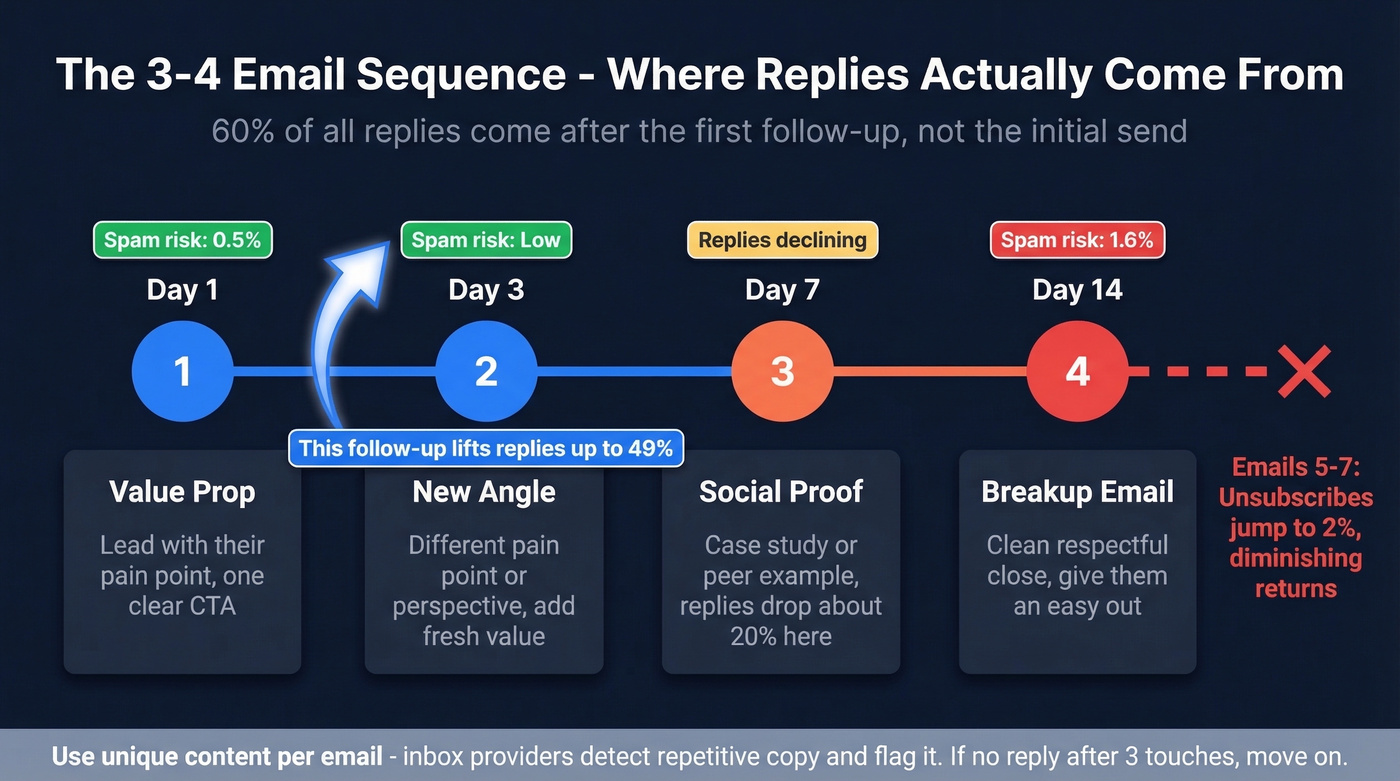
The first follow-up is the highest-leverage email in your sequence. It lifts replies up to 49%, and roughly 60% of all replies come after that first follow-up rather than the initial send. (If you need copy, use these cold email follow-up templates.)
But there's a ceiling, and most teams blow past it.
By the fourth email, spam complaints jump from 0.5% to 1.6% and unsubscribe rates escalate from 0.1% to 2%. The data doesn't support 7-email sequences - three to four total emails over 14-21 days is the ceiling for most B2B outreach.
| Day | Purpose | Spam Risk | |
|---|---|---|---|
| 1 | Day 1 | Value prop | 0.5% |
| 2 | Day 3 | New angle | Low |
| 3 | Day 7 | Social proof | Replies drop ~20% |
| 4 | Day 14 | Breakup | 1.6% spam rate |
Each follow-up must add new value - not "bumping this to the top of your inbox." Email two introduces a different angle or pain point. Email three brings social proof or a case study. Email four is the breakup: a clean, respectful close that gives them an easy out. Use spintax and unique content across each message because inbox providers detect repetitive copy and flag it.
If someone hasn't replied after three touches, they're either not interested or not the right contact. Move on.
Timing and Testing
Thursday is the best day to send cold email, with a 6.87% reply rate versus Monday's 5.29%. Evenings between 8-11 PM hit 6.52% - your email sits at the top of the inbox when they check first thing the next morning. (If you want the full breakdown, see best time to send cold emails.)
Stop tracking opens. Seriously. Open tracking is unreliable thanks to Apple Mail Privacy Protection and pixel blocking, it adds deliverability risk through shared tracking pixels, and it creates false confidence. We've seen teams celebrate 50% open rates while getting 1% replies. Track replies and bounces - those are the metrics that correlate with revenue.
A/B test subject lines only after 200-300 sends minimum per variant. Anything less and you're reading noise, not signal. Monitor spam complaints in Gmail Postmaster Tools weekly. If complaints creep toward 0.3%, pause and diagnose before scaling.
Legal Compliance
Cold email is legal in most jurisdictions - with conditions. Getting this wrong costs real money.
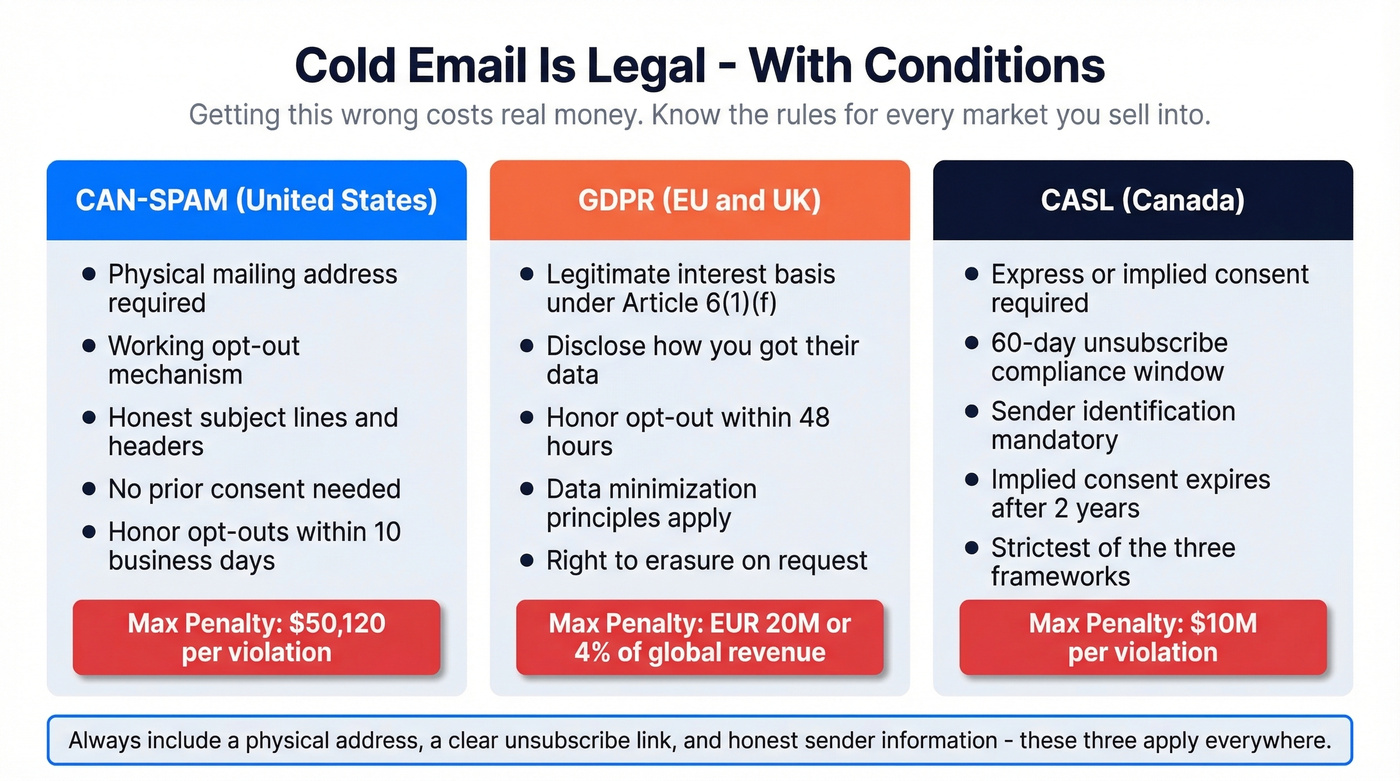
| Jurisdiction | Key Requirements | Max Penalty |
|---|---|---|
| CAN-SPAM (US) | Physical address, opt-out, honest headers | $50,120/violation |
| GDPR (EU/UK) | Legitimate interest, source disclosure, 48-hr opt-out | EUR 20M or 4% revenue |
| CASL (Canada) | Express/implied consent, 60-day unsub window | $10M/violation |
For GDPR, the relevant framework is Article 6(1)(f) - legitimate interest. B2B cold email is permissible when the outreach is relevant to the recipient's professional role and their rights don't override your interest. You need to disclose how you obtained their contact information, include an unsubscribe mechanism, and honor opt-outs within 48 hours. PECR in the UK is more flexible for B2B specifically but still requires an opt-out.
Every cold email must include three elements: your physical business address, a clear unsubscribe mechanism, and accurate sender identification. Use GDPR-compliant data sources with global opt-out enforcement so your prospect data is lawfully sourced from the start. Compliance isn't a legal checkbox - it's a discipline you build into every campaign from day one.
Benchmarks: What Good Looks Like
Based on the 16.5M-email dataset and Instantly's benchmark framework:
- 5-10% reply rate: good - you're beating the average
- 10-15% reply rate: excellent - targeting and copy are working
- 15%+ reply rate: best-in-class - tight segments, strong personalization
The average across that dataset was 5.8%. If you're above that, you're outperforming most operators. If you're below 3%, skip the copywriting tweaks and revisit infrastructure and data quality first. Those two levers explain the majority of underperformance we see.
Reply rates are declining on average because most senders are lazy - bad data, no warmup, 12-email sequences, generic templates. For teams that invest in infrastructure, verified data, and disciplined follow-up cadences, cold email remains one of the highest-ROI outbound channels available. The gap is widening, and that's good news if you're on the right side of it.
FAQ
How many cold emails should I send per day?
Cap at 50 per inbox per day at scale. During warmup, start at 5-10 and increase over 4-6 weeks. Rotate across multiple inboxes and secondary domains to protect sender reputation.
What's a good cold email reply rate?
5-10% is good for B2B outreach. 10-15% is excellent. Above 15% means your targeting and personalization are dialed in. The average across 16.5M emails was 5.8%.
How many follow-ups should I send?
Two to three follow-ups, so 3-4 total emails over 14-21 days. The first follow-up lifts replies up to 49%, but spam complaints jump to 1.6% by the fourth email. Each follow-up must introduce a new angle - never just "bumping this."
Is cold email legal?
Yes, in most jurisdictions with conditions. CAN-SPAM requires an opt-out mechanism and physical address. GDPR allows B2B outreach under legitimate interest if it's relevant to the recipient's professional role. Always include an unsubscribe link and honor opt-outs within 48 hours.
How do I keep my emails out of spam?
Authenticate your domain with SPF, DKIM, and DMARC. Warm up new inboxes over 4-6 weeks. Keep bounce rates under 2% by verifying every address before sending - Prospeo's catch-all handling and spam-trap removal prevent bounces from damaging your sender reputation before a campaign even starts.