

Company Introduction Email: Templates, Data, and the Infrastructure That Gets Replies
You spent 20 minutes crafting the perfect company introduction email. Personalized opener, tight value prop, clear CTA. You hit send. It bounced. The address was dead, your domain took a hit, and the next 50 emails in that sequence landed a little closer to spam.
Most guides hand you templates and wish you luck. That's half the job. The other half - making sure your emails actually arrive - is what separates a 3% reply rate from a 10% one.
The Short Version
- Keep emails under 80 words with one clear ask. The average reply rate is 3.43%. Every word has to earn its place.
- Fix your infrastructure first. Verified list, dedicated sending domain, bounce rate under 2%. Templates don't matter if emails don't land.
- Follow up 4-7 times. 42% of replies come after the first email. Your intro starts a sequence, not a standalone shot.
Cold Email Benchmarks in 2026
Instantly analyzed billions of cold email interactions and published their 2026 benchmark report. The picture is sobering.
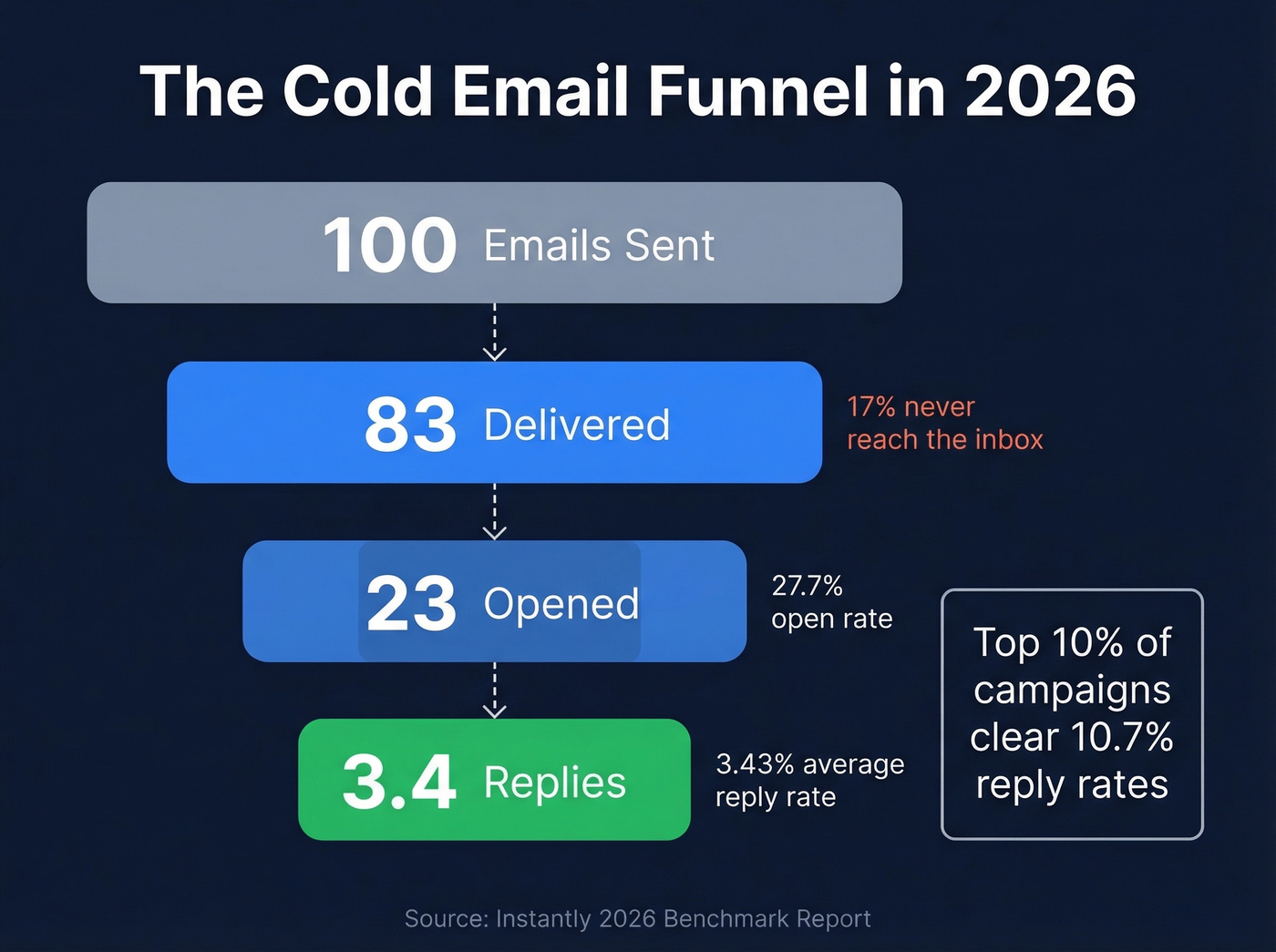
The average cold email reply rate sits at 3.43%. Top-quartile campaigns hit 5.5%+. Elite performers - the top 10% - clear 10.7%. That gap isn't mostly about copywriting. It's about deliverability, list quality, and sequencing discipline. Here's the split: 58% of replies come from the first email, and 42% come from follow-ups. If you're sending one email and moving on, you're abandoning almost half your results.
Open rates have stabilized around 27.7%, down from ~36% in 2023. Roughly 17% of cold emails never reach the inbox - they bounce or get filtered. For every 100 emails you send, about 83 arrive, 23 get opened, and 3-4 get a reply. That funnel is why infrastructure matters more than templates. You can't copywrite your way past a 17% non-delivery rate.
Anatomy of an Intro Email That Works
Five components. Most people botch at least two.
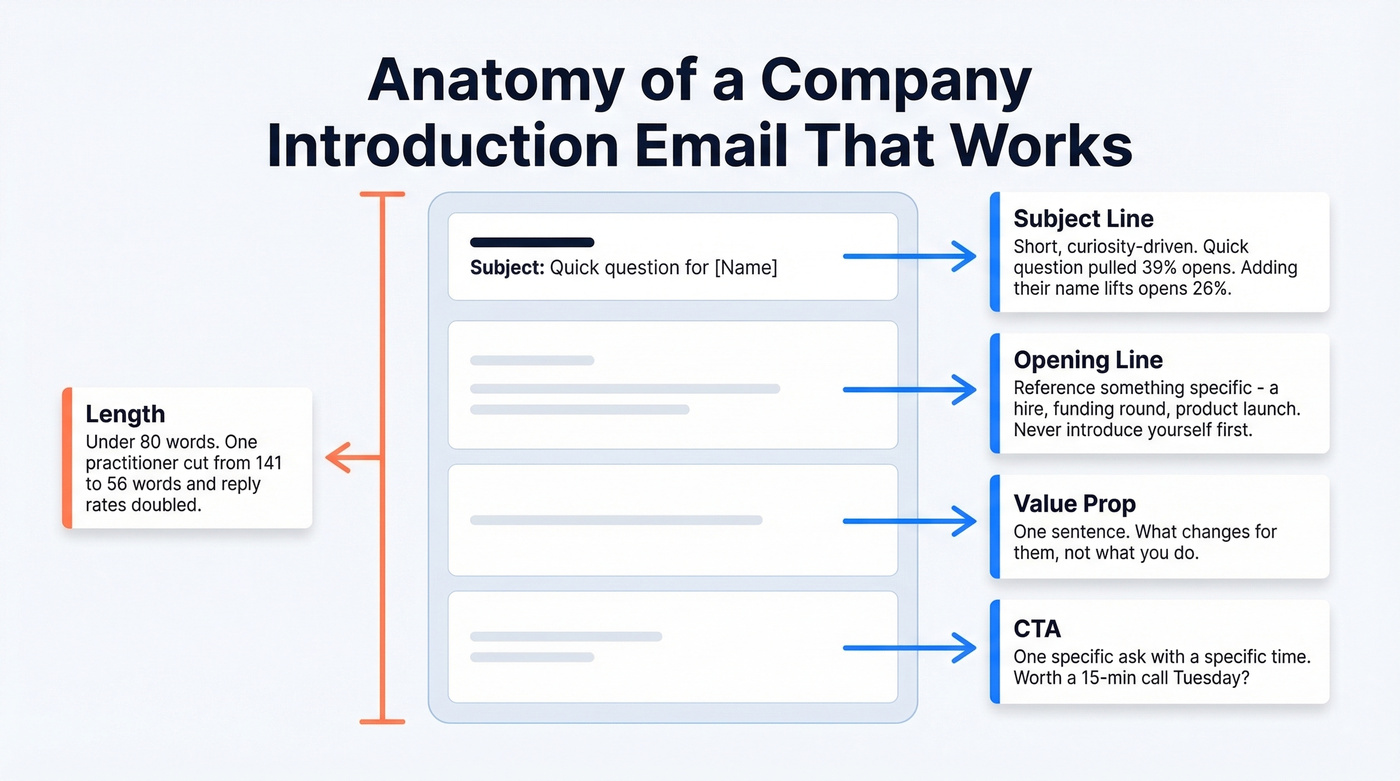
Subject line: "Quick question" pulled 39% opens in one practitioner's testing. "Partnership opportunity" got under 19%. Stop trying to sound important - short, curiosity-driven subject lines win. Using the lead's name in the subject line lifts open rates by roughly 26%, making it the easiest personalization win available.
Opening line: Don't introduce yourself. Introduce the reason you're writing. Reference something specific: a recent hire, a funding round, a product launch. The reader decides in two seconds whether to keep going.
Value prop: One sentence. What outcome do you enable? Not what you do - what changes for them.
CTA: One ask. Not "let me know if you're interested" - that's a shrug, not a CTA. Try "Worth a 15-minute call Tuesday?" or "Can I send a 2-minute walkthrough?" (More rules and examples: CTA.)
Length: Under 80 words. One practitioner cut emails from 141 words to 56 and watched reply rates double. The email is the ad. The meeting is the product.
8 Templates That Get Replies
Cold Prospect (B2B SaaS)
Use when: You're reaching out cold to a company showing growth signals.
Subject: Quick question about [Company]'s outbound
Hi [First Name], saw [Company] just expanded the SDR team - congrats. Most teams scaling outbound hit a wall around deliverability before messaging. We help teams like [Similar Company] keep bounce rates under 2% while tripling send volume. Worth a 15-minute call this week?
Partnership Pitch
Use when: You've identified a natural overlap between your audiences.
Subject: [Your Company] + [Their Company]
Hi [First Name], we work with 200+ agencies running outbound for SaaS clients. Your [specific product/service] keeps coming up in conversations with our customers. I think there's a clean co-marketing play here. Can I send over a one-pager? (If you need more angles, see cold email for business partnership.)
Referral Introduction
Subject: [Mutual Contact] suggested I reach out
Hi [First Name], [Mutual Contact] mentioned you're rebuilding your outbound stack this quarter. We helped their team cut list-building time from 15 hours to 3 hours a week. Happy to share what worked - would a quick call Thursday make sense?
New Product Announcement
Use when: You've just shipped something and want to create urgency.
Subject: Something new for [Their Industry] teams
Hi [First Name], we just launched [Product Name] - it solves [specific problem] without requiring [common pain point]. Early users are seeing [X result]. Here's a 90-second demo: [link]. Worth a look? (For a tighter pitch, borrow from these sample elevator pitches.)
Investor Outreach
Subject: [Your Company] - [one-line traction metric]
Hi [First Name], [Your Company] helps B2B teams [outcome]. We're at [traction metric, e.g., "$1.2M ARR, 180% net retention"] and raising a [round size] to [specific use of funds]. Your portfolio in [relevant sector] is why I'm reaching out. Can I send our deck?
New CSM Introduction
Use when: You're taking over an existing account and want to build trust fast.
Subject: Your new point of contact at [Company]
Hi [First Name], I'm [Your Name], your new CSM at [Company]. I've reviewed your account and have a couple of quick wins to share. Can we grab 15 minutes this week? Here's my calendar: [link]
Connector Email
Subject: Intro - [Person A] / [Person B]
Hi both - wanted to connect you. [Person A] runs demand gen at [Company A] and is looking for [specific need]. [Person B] built [relevant solution] at [Company B]. I'll let you two take it from here.
Post-Event Follow-Up
Subject: Good meeting you at [Event Name]
Hi [First Name], enjoyed our conversation at [Event] about [specific topic]. You mentioned [specific challenge]. We just published a case study on exactly that - [link]. Worth continuing over a call next week?
Real Email Teardown
Here's a real cold email posted on r/copywriting by an agency owner wondering why nobody replied:
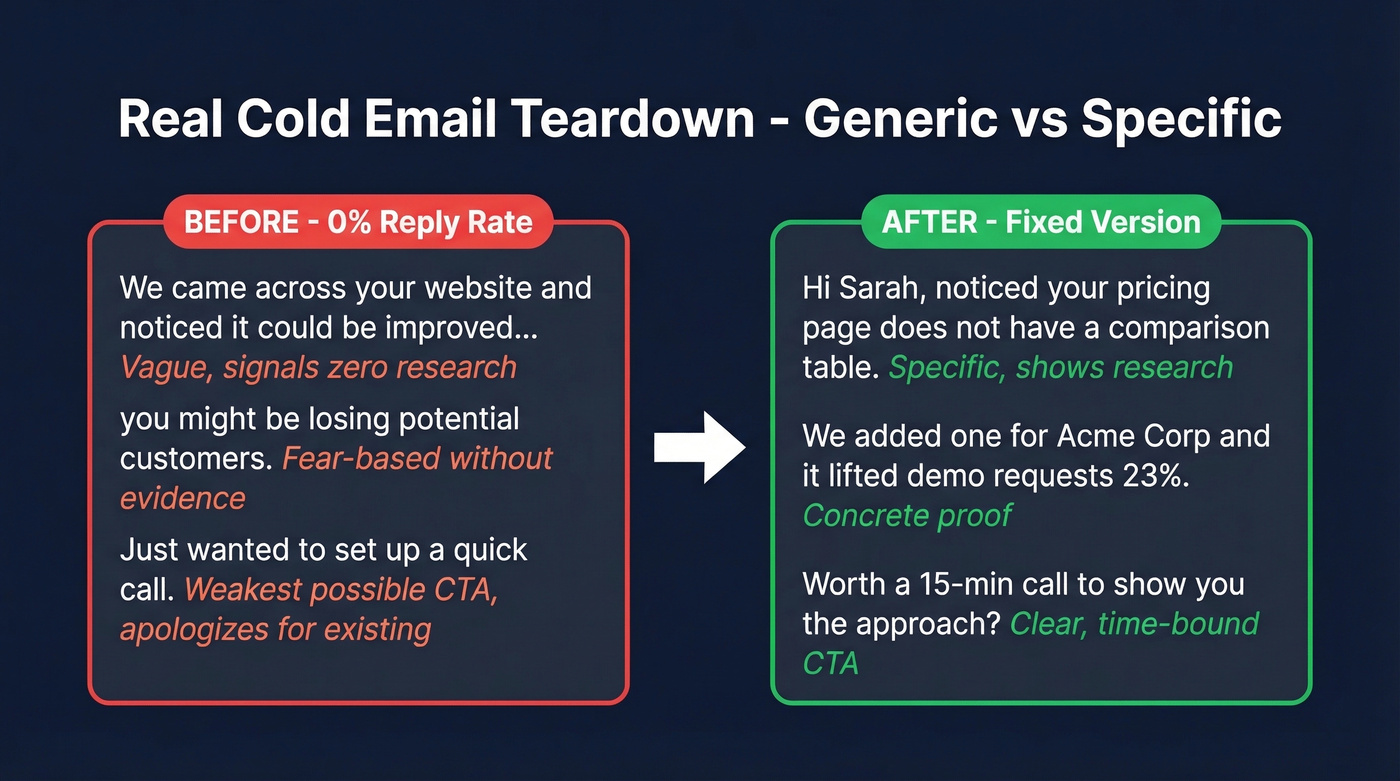
"We came across your website and noticed it could be improved... you might be losing potential customers... Just wanted to set up a quick call!"
We've reviewed hundreds of business introduction emails, and this one hits every failure mode at once. "We came across your website" is vague and signals zero research. "Noticed it could be improved" is accusatory in the first sentence. "You might be losing potential customers" is fear-based without evidence. And "Just wanted to set up a quick call" is the weakest possible CTA framing - it apologizes for existing.
The fix: replace every vague claim with a specific observation. "Noticed your pricing page doesn't have a comparison table - we added one for [Similar Company] and it lifted demo requests 23%." Specificity is the difference between delete and reply. This mirrors what dozens of practitioners on r/copywriting and r/sales consistently report: generic outreach gets generic results. (For more frameworks, see email copywriting.)

17% of cold emails never reach the inbox. That's 17 wasted introduction emails out of every 100. Prospeo's 5-step email verification and 7-day data refresh cycle keep your bounce rate under 2% - so your carefully crafted intro actually lands.
Stop writing perfect emails to dead addresses.
5 Mistakes That Kill Introduction Emails
- Too many "I"s, not enough "you"s. Count them. If your email says "I" five times and "you" once, flip the ratio. The r/sales consensus is clear on this, and in our experience it's the single fastest diagnostic for a broken email.
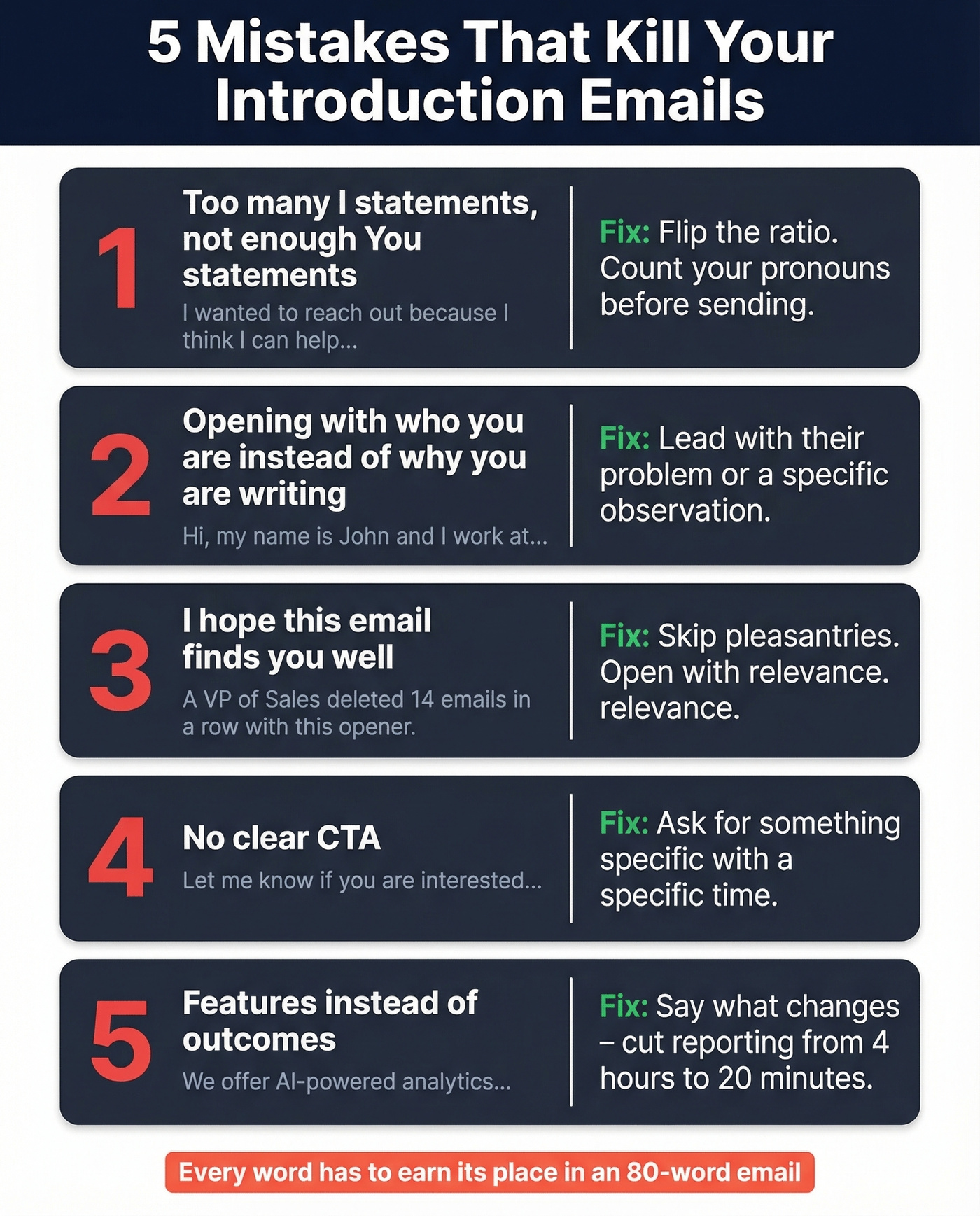
Opening with who you are instead of why you're writing. Nobody cares about your company's founding story. Lead with their problem. (If you want more examples, start with connection email.)
"I hope this email finds you well." I once watched a VP of Sales delete 14 cold emails in a row - every single one opened with this line. It's the fastest way to signal you didn't research the recipient.
No clear CTA. "Let me know if you're interested" isn't a call to action. It's a polite way of saying "I don't really expect a reply." Ask for something specific with a specific time.
Describing features instead of outcomes. "We offer AI-powered analytics" means nothing. "We help RevOps teams cut reporting time from 4 hours to 20 minutes" means something.
The Infrastructure That Actually Matters
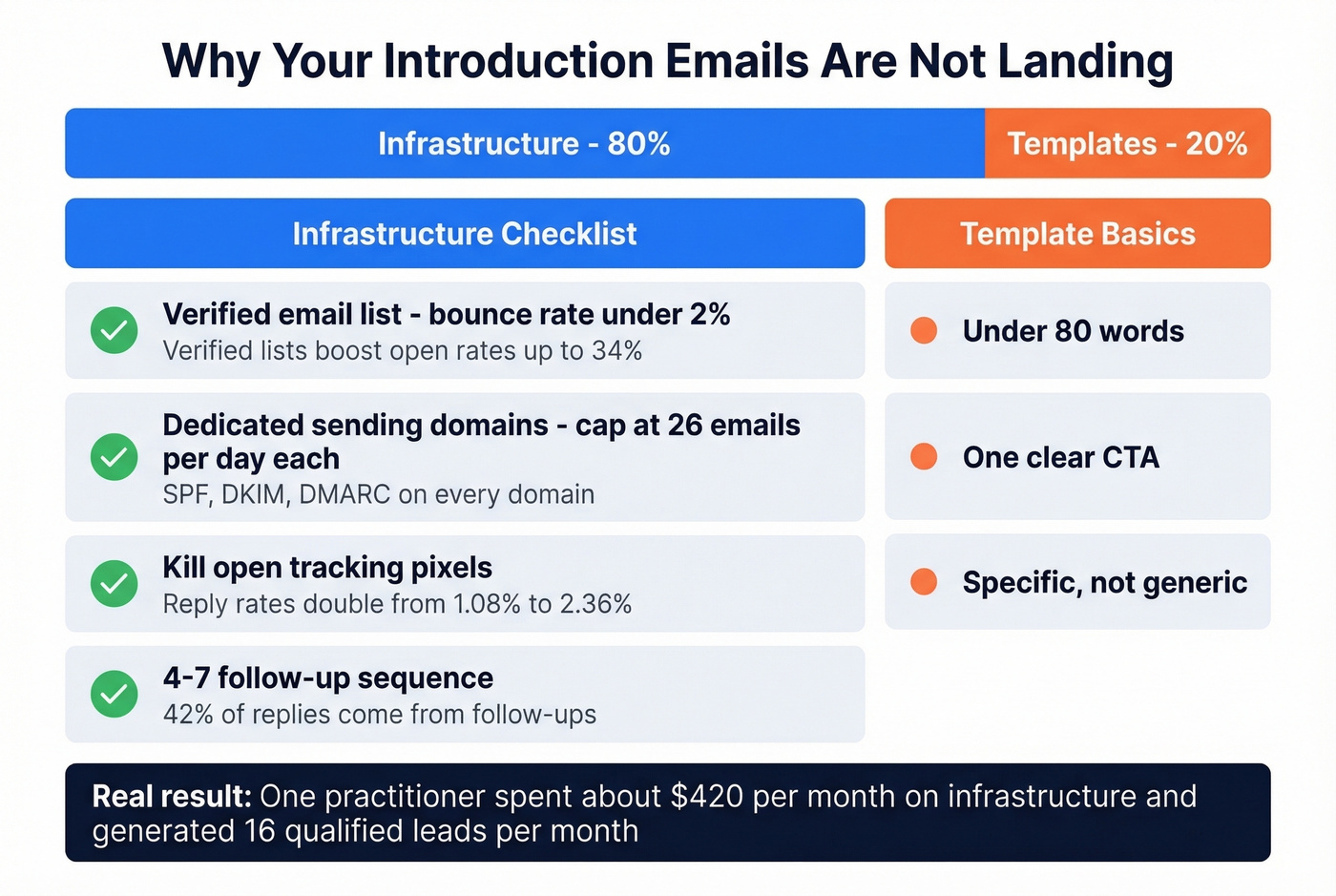
Here's the thing: if your average deal size is under five figures, you probably don't need better templates. You need better data. Templates are maybe 20% of the equation. Infrastructure is the other 80%.
List Quality
Verified email lists increase open rates by up to 34% compared to unverified lists. Your target bounce rate is under 2%. One practitioner on r/Entrepreneur dropped their bounce rate from 11% to under 2% by switching from purchased lists to manually verified contacts - and watched reply rates jump from 3% to 6%. (If you're comparing vendors, see data enrichment services.)
Before you send a single introductory email, verify every address. Prospeo's 5-step verification delivers 98% email accuracy across 300M+ professional profiles, with data refreshed every 7 days. The free tier gives you 75 verified emails per month plus 100 Chrome extension credits - enough to test your first campaign without spending a dollar. Meritt cut their bounce rate from 35% to under 4% after switching to verified data. (More on deliverability fundamentals: email deliverability.)
Domain Reputation
That same practitioner runs 7 sending domains, each capped at 26 emails per day. Set up SPF, DKIM, and DMARC on every domain. This isn't optional anymore - it's table stakes for anyone doing outbound in 2026. (If you need a checklist, start with SPF record examples and DMARC alignment.)
Kill Open Tracking
This is the insight most people miss. Snov.io analyzed 44 million emails and found that turning off open tracking more than doubled reply rates: 2.36% vs 1.08%. Open-tracking pixels trigger spam filters. If you're optimizing for replies, kill the pixel. (Deep dive: email tracking pixel.)
That practitioner's full stack cost ~$420/month and generated 16 qualified leads per month. That's what getting infrastructure right looks like.
The templates above work. But only if you're sending to real, verified addresses. Prospeo gives you 98% accurate emails across 300M+ professional profiles - with 30+ filters to find the exact decision-makers worth introducing yourself to.
Find the right person, nail the first impression.
When to Send
Tuesday and Wednesday consistently show the highest reply rates across multiple datasets. The safe window is 9-11 AM in the recipient's time zone. (More data and testing ideas: best time to send cold emails.)
But here's a contrarian finding worth testing: a study of 16.5 million B2B cold emails found that the 8-11 PM window hit a 6.52% reply rate - the highest of any time slot. Less competition in the inbox. If your morning sends are underperforming, try an evening batch and compare.
One caveat: Apple Mail Privacy Protection auto-opens emails, inflating open-rate data. Optimize for replies, not opens.
Follow-Up Strategy
42% of replies come from follow-ups, not the first email. The sweet spot is 4-7 touchpoints. Beyond 7, diminishing returns set in unless each follow-up adds genuinely new value - a case study, a relevant data point, a different angle entirely. (If you want plug-and-play copy, use these cold email follow-up templates.)
The best tactical move for email #2: make it feel like a reply, not a new message. Same thread, shorter, more casual. Something like "Bumping this - figured the timing might've been off. Still relevant?" Step-2 emails structured this way outperform formal follow-ups by ~30%. Build your follow-up list from verified contacts so every touchpoint reaches a real inbox instead of bouncing into the void.
CAN-SPAM Compliance
Let's be direct: CAN-SPAM applies to B2B email. No exemption. Penalties run up to $53,088 per violating email.
The requirements aren't complicated, but skipping any one of them is expensive:
- Accurate "From," "To," and "Reply-To" fields
- Non-deceptive subject lines reflecting the email's content
- Clear disclosure that it's an ad
- Valid physical postal address (a PO box works)
- One-click opt-out mechanism, no extra steps
- Honor opt-outs within 10 business days
- You're liable for third-party senders acting on your behalf
If you're emailing EU prospects, GDPR adds another layer. Legitimate interest is the typical legal basis for B2B cold outreach, but document it and honor data subject requests promptly.
FAQ
How long should a company introduction email be?
Between 50 and 80 words. One practitioner saw reply rates spike after cutting to 56 words. Three short paragraphs maximum - anything longer and you're writing for yourself, not the reader.
What's a good reply rate for B2B outreach?
The average is 3.43%. Top-quartile campaigns hit 5.5%+. Elite performers clear 10%, typically by combining verified data, multi-touch sequences, and personalized messaging.
How many follow-ups should I send?
Four to seven. 42% of replies come after the first email, so stopping at one leaves nearly half your results behind. Each follow-up should add new value - not just "checking in."
How do I keep introduction emails out of spam?
Verify every address before sending, set up SPF/DKIM/DMARC, keep bounce rates under 2%, and turn off open tracking. Skip any of those steps and you're fighting your own infrastructure.