

The Best Contacts Databases for B2B Prospecting in 2026
You exported 5,000 contacts, launched a sequence on Monday, and by Wednesday your bounce rate hit 23%. Your sending domain got flagged. Sequences paused. Your ops team scrambled to figure out what went wrong. That's not a hypothetical - it's what happens when your contacts database decays faster than you refresh it.
If you just need to organize existing contacts, HubSpot CRM (free) or a Notion template will do. This guide is for teams that need net-new, verified B2B contacts to fill pipeline. B2B contact data decays at roughly 2.1% per month - about 22.5% stale by year-end. The provider you pick, and how often it refreshes, determines whether your outbound actually lands.
We reviewed nine of these tools. Here are the three to shortlist first.
Our Picks (TL;DR)
| Pick | Best For | Starting Price | Why This One |
|---|---|---|---|
| Prospeo | Accuracy + freshness | Free; ~$0.01/email | 98% email accuracy, 7-day refresh |
| Apollo.io | All-in-one SMB outbound | Free; $49/user/mo | 270M+ contacts, built-in sequencing |
| ZoomInfo | Enterprise depth + intent | ~$15K/yr | 260M+ profiles, strong technographics |
What to Look For in a Contacts Database
Here's the thing: database size is a vanity metric. A provider with 300M profiles that refreshes weekly will outperform one with 600M profiles on a six-week cycle. Most providers deliver around 50% accuracy out of the box - verification is what separates usable data from expensive noise. If you want a broader benchmark list, see our guide to the best B2B databases.
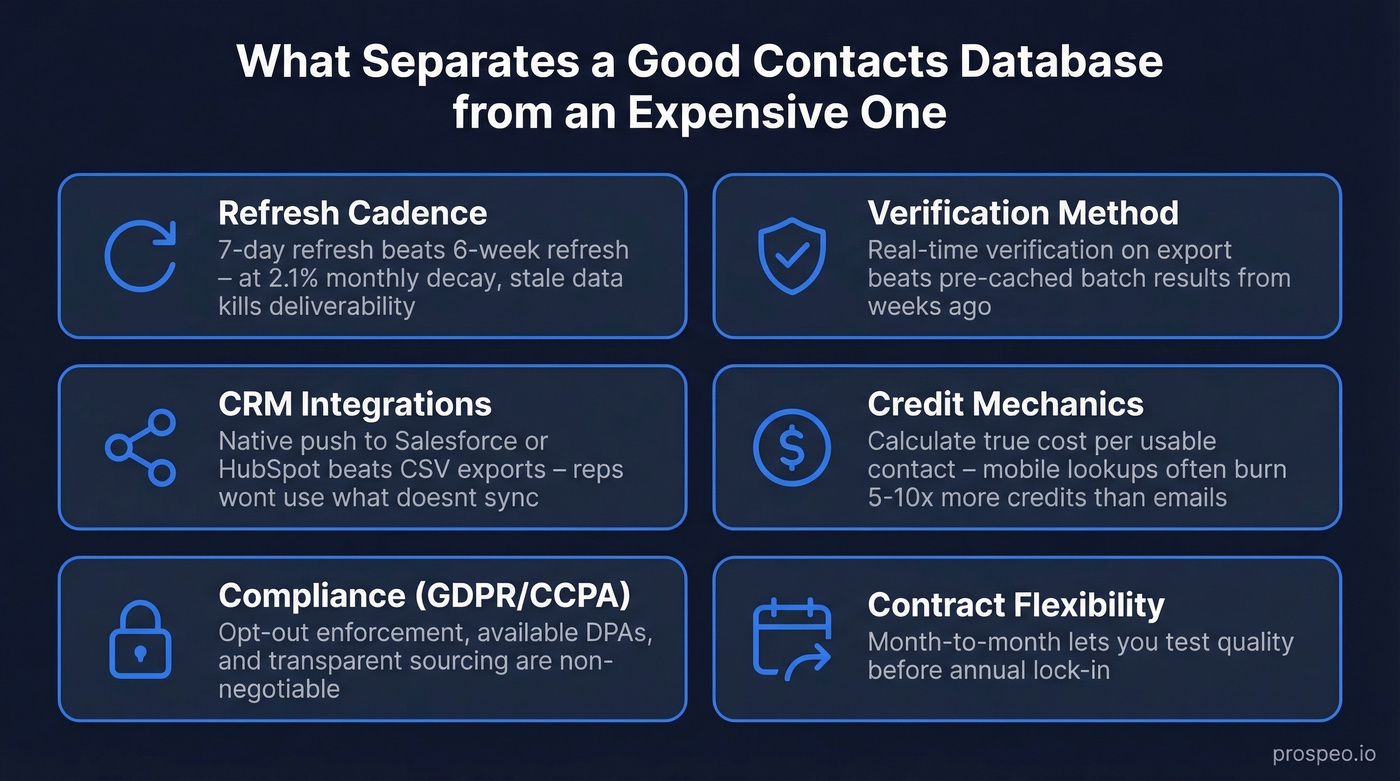
Refresh cadence. The gap between a 7-day refresh and a 6-week refresh is enormous. At 2.1% monthly decay, a database refreshed every six weeks has already lost meaningful accuracy before you even export.
Verification method. Real-time verification on export beats batch verification run weeks ago. Ask whether the provider verifies at the moment of delivery or relies on pre-cached results. (If you need a dedicated verifier, compare options in our email verifier tools roundup.)
Credit mechanics. Some tools charge differently for emails, mobiles, and exports. A "$49/mo" plan that burns 10 credits per mobile lookup gets expensive fast. Calculate your true cost per usable contact, not just the sticker price. If you prefer flexible spend, look at pay-as-you-go B2B data.
CRM integrations. If contacts don't flow into Salesforce or HubSpot cleanly, your reps won't use the tool. Native push beats CSV exports every time. (More on streamlining workflows with CRM automation software.)
Compliance. GDPR and CCPA aren't optional. Look for opt-out enforcement, available DPAs, and transparent sourcing policies. For a deeper checklist, use our GDPR compliant database guide.
Contract flexibility. Annual-only contracts lock you in before you've validated data quality. Self-serve, month-to-month options let you test before committing.
The Best B2B Contact Databases for Prospecting
Prospeo
Use this if you care about data accuracy more than feature count and want to start prospecting in minutes, not months.
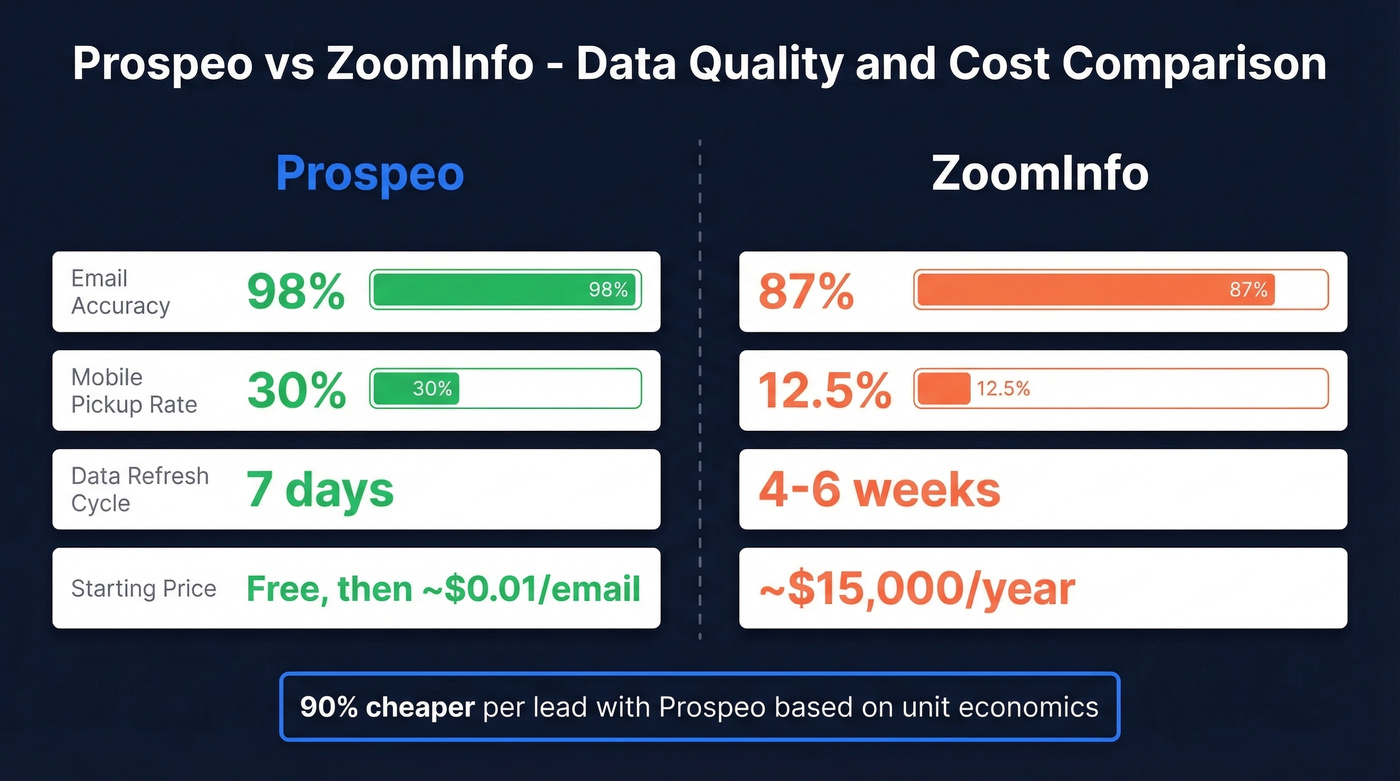
The database covers 300M+ professional profiles with 98% email accuracy and 125M+ verified mobile numbers averaging a 30% pickup rate. Every record refreshes on a 7-day cycle - while most competitors run on 4-6 week intervals. The search interface gives you 30+ filters including buyer intent across 15,000 topics, technographics, job changes, headcount growth, and funding signals. (If you’re building a repeatable outbound motion, pair this with a clear ideal customer profile.)
Pricing is dead simple: ~$0.01 per email, 10 credits per mobile, and a free tier with 75 emails plus 100 Chrome extension credits every month. No annual contracts. No sales calls required. Native integrations push contacts straight into Salesforce, HubSpot, Smartlead, Instantly, Lemlist, Clay, Zapier, and Make.
The numbers hold up in practice. Snyk's 50-person AE team dropped bounce rates from 35-40% to under 5% and saw AE-sourced pipeline jump 180% after switching. Stack Optimize built from $0 to $1M ARR while maintaining 94%+ client deliverability and zero domain flags. Compared to ZoomInfo, email accuracy runs 98% vs 87%, mobile pickup 30% vs 12.5%, and unit economics come in 90% cheaper per lead.
Skip this if you need a full GTM suite with built-in dialing and multi-channel sequencing - pair it with a dedicated sequencer like Outreach or Instantly instead. If you’re evaluating more options in this category, start with verified contact databases.

Apollo.io
Use this if you're an SMB team that wants prospecting, sequencing, and a dialer in one platform without stitching together five tools.
Apollo's database covers 270M+ contacts across 73M+ companies. The all-in-one pitch is real - you can find contacts, build sequences, and make calls without leaving the app. Paid plans run $49-$119/user/mo on annual billing ($59-$149 monthly), and there's a free tier with 60 mobile credits to get started.
The tradeoff? Data quality needs a second look. The consensus on r/sales is that Apollo is a "jack of all trades, master of none." Contacts are partly community-sourced, and experienced teams run exports through a separate verifier before launching sequences - Clay is a popular choice for this. (If you want a structured workflow, see our Clay list building guide.) Apollo's dialer runs on Twilio VoIP numbers, which practitioners report get flagged as spam frequently. Credit mechanics also get tricky: mobile lookups and exports burn credits faster than email-only searches, you can't reduce seats mid-term, and the Organization plan requires a minimum of three users.
Skip this if you're running high-volume outbound where a 5% bounce rate difference compounds into domain reputation damage. If you’re scaling sequences, use an outbound email spam prevention checklist.
ZoomInfo
If your CFO is asking why you're paying $30K+ for a data provider when reps still spend hours verifying numbers, you're not alone. But for enterprise teams that need deep US coverage, technographics, org charts, and intent data unified in one platform, ZoomInfo remains a common default.
The database runs 260M+ professional profiles and 100M+ company profiles. Technographic and intent layers are among the strongest available for ABM workflows. (If you’re operationalizing this, see our guide to technographics.) G2 rating sits at 4.5/5 across 9,035 reviews, with "Contact Information" and "Ease of Use" as top praise categories.
Let's be honest about the pricing: it's brutal. Professional tier runs $15,000-$18,000/year. Advanced typically hits $22,000-$28,000. Elite pushes $35,000-$45,000+. All contracts are annual-only, and renewals typically come with a 10-20% uplift. Extra seats cost $2,500/year each, Global Data runs $9,995, and credit overages pile up quietly. Credit unit costs range from ~$0.60 down to $0.20 at high volumes. Negotiated discounts of 30-65% are common, so never accept the first quote.
The recurring G2 con? "Outdated Data." That's the irony of the largest database - size doesn't guarantee freshness.
Skip this if your team is under 10 people or your annual data budget is below $15K. You'll pay for modules you never activate.
ZoomInfo is still the best all-in-one enterprise platform. But most teams don't need all-in-one - they need accurate emails and working phone numbers. If your average deal size is under $20K, you're almost certainly overpaying.
Cognism
Cognism's Diamond Data program phone-verifies mobile numbers through human researchers, giving it the strongest direct-dial accuracy for European prospects. That makes it the go-to provider for teams selling into EMEA where GDPR compliance is a board-level requirement, not a checkbox.
Pricing runs ~$15,000-$100,000+/year depending on seats and tier, with a platform fee plus per-user costs. G2 rates it 4.5/5 across 1,318 reviews, with "Ease of Use" scoring a 9.0. Where ZoomInfo still wins: US database depth and workflow breadth. The recurring G2 con - "Incorrect Numbers" - suggests the non-Diamond data still has gaps.
Skip this if your ICP is primarily North American. You'd be paying a premium for European compliance you don't need.
Lusha
At $22.45/user/mo on annual billing (or ~$36 monthly), Lusha is one of the cheapest ways to get a contact information database without a five-figure commitment. The 7-step data verification process and dead-simple interface - search, find, export - make it a fast path from "I need this VP's email" to having it. A free tier covers light usage, and onboarding takes minutes. The ceiling is lower than full prospecting platforms, though. You won't get the same depth of intent data or advanced filtering you'd find in enterprise suites.
RocketReach
RocketReach is the tool you keep bookmarked for occasional research - a handful of lookups a week when you need an email or phone number and don't want to pay for a full subscription. Five free searches per month, with Basic plans starting at $39/mo. No sequencing, no intent data, no ICP-level filtering. Good for recruiters, journalists, or sales teams supplementing a primary data source.
Kaspr
A browser extension from the Cognism Group for quick profile-level email and phone grabs. Think of it as Cognism's lightweight entry point for reps who prospect one-by-one rather than in bulk.
Coresignal
Coresignal's 942M+ records with daily updates are built for data teams and developers, not SDRs. Raw B2B datasets via API for analytics, ML models, or custom enrichment pipelines. Custom pricing typically starts in the low thousands for API access.
Forager.ai
A credit-based data marketplace covering 850M+ profiles with bi-weekly refresh. At $50 for 2,250 credits - credits roll over and never expire - it suits teams with irregular prospecting volume who don't want monthly subscriptions.

You just read that B2B contact data decays 22.5% per year. Prospeo's 7-day refresh cycle means your exports never sit on stale records. 300M+ profiles, 98% email accuracy, 125M+ verified mobiles - at ~$0.01 per email with no annual contract.
Stop exporting contacts that bounce by Wednesday. Start with 75 free emails.
Pricing Comparison
Pricing ranges reflect what teams typically pay.
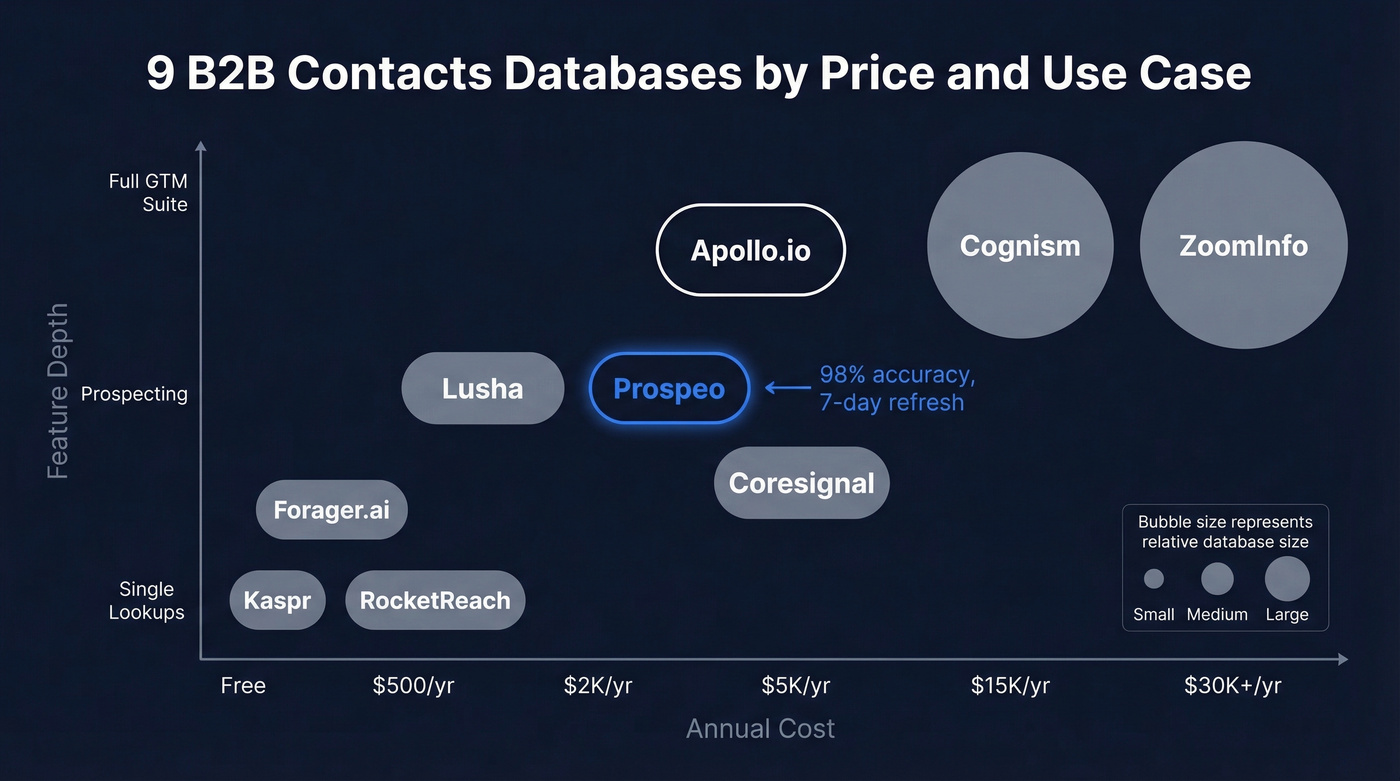
| Tool | Starting Price | Model / Contract | Refresh | Best For |
|---|---|---|---|---|
| Prospeo | Free; ~$0.01/email | Credits, no contract | 7 days | Accuracy + self-serve |
| Apollo.io | Free; $49/user/mo | Credits + seats, annual saves | Ongoing | All-in-one SMB |
| ZoomInfo | ~$15K/yr | Seats + credits, annual only | Ongoing | Enterprise depth |
| Cognism | ~$15K/yr | Platform + seats, annual | Ongoing | EMEA compliance |
| Lusha | Free; $22.45/user/mo | Seats + credits, monthly avail. | Ongoing | Quick lookups |
| RocketReach | Free; $39/mo | Seats, monthly avail. | Ongoing | Occasional research |
| Kaspr | Free tier | Credits, monthly avail. | Ongoing | Browser extension |
| Coresignal | ~$2K+ | API/dataset, custom | Daily | Data teams |
| Forager.ai | $50/2,250 credits | Credits (rollover), no contract | Bi-weekly | Irregular volume |
Keeping Your Data Accurate
Buying a contacts database is step one. Keeping it accurate is where most teams fail. Poor data quality costs organizations an average of $12.9M annually, and sales reps lose roughly 500 hours per year validating and correcting contact info. (For a full workflow, see our guide to the best data enrichment tools.)
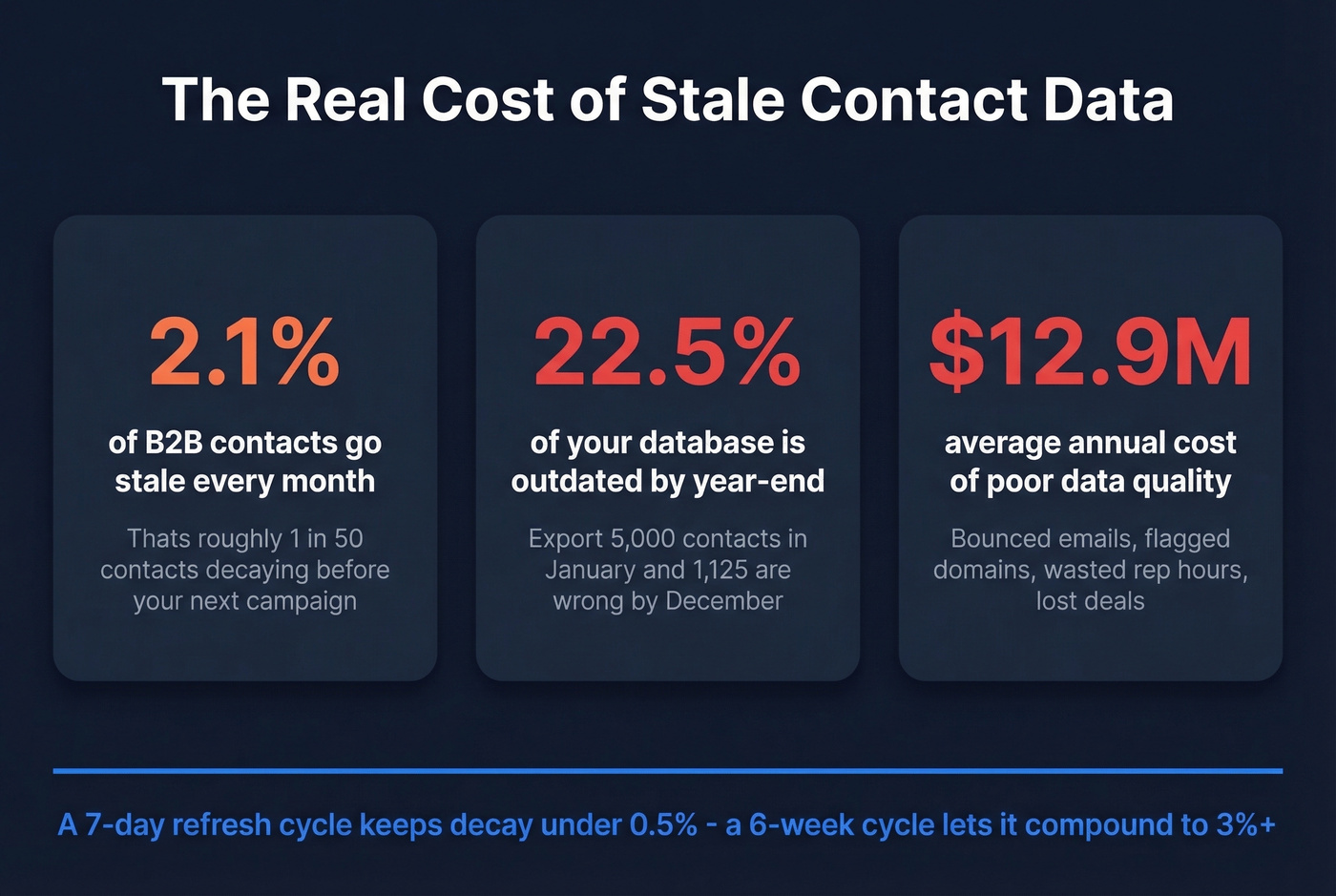
Re-enrich quarterly. Field-level decay rates vary: work emails decay 20-30% annually, job titles 15-25%, and direct phone numbers 15-20%. A quarterly re-enrichment cycle catches most of this drift before it damages campaigns. Tools with weekly refresh reduce the manual burden significantly.
Verify before every campaign. Never send a sequence without running your list through real-time verification first. Batch-verified data from three weeks ago has already started decaying. If you’re troubleshooting deliverability, start with check bounce.
Deduplicate ruthlessly. We've run bake-offs where the "best database" lost because it created 4,000 duplicate contacts in Salesforce in the first week. Automatic deduplication on import isn't a nice-to-have - it's essential.
Audit field completeness monthly. Track what percentage of your active pipeline contacts have verified email, direct dial, and current title. If any field drops below 80% completeness, it's time to re-enrich that segment.
How to Test a Contact Database Before Committing
Don't trust marketing pages. Test the data yourself. In our experience, this framework exposes data quality issues that no demo will show you.
Day 1: Export and verify. Pull 200 contacts matching your ICP. Run them through a separate email verifier. Measure match rate - did the tool find contacts for your filters? - and predicted bounce rate. Anything above 10% bounce is a red flag.
Day 3: Test mobiles. Call 30-50 of the direct dials from your export. Track pickup rate. You want at least 15% connecting to the right person. Below that, the mobile data isn't reliable enough for cold calling at scale. (If you want to improve connect rates, train the basics in phone sales skills.)
Day 7: Check freshness. Re-export the same list. Compare to your Day 1 pull. Have any records updated? If the data looks identical after a week, the provider's refresh cycle is slower than they advertise.
Pass/fail rubric: >90% email deliverability, >15% mobile pickup rate, visible data refresh within the week.
Snyk's 50 AEs dropped bounce rates from 35-40% to under 5% after switching their contacts database to Prospeo. Stack Optimize hit $1M ARR with zero domain flags. The difference isn't luck - it's 5-step verification, catch-all handling, and a weekly refresh cycle that competitors can't match.
Replace your decaying contacts database with one that refreshes every 7 days.
FAQ
What's the difference between a contacts database and a CRM?
A contacts database provides net-new prospect records for outbound, while a CRM stores and tracks relationships you already have. Most B2B teams need both - the database feeds the CRM with fresh leads, and the CRM manages engagement from there.
How fast does B2B contact data go stale?
B2B contact data decays at roughly 2.1% per month, compounding to about 22.5% per year. Work emails decay fastest at 20-30% annually. In high-turnover industries like tech and hospitality, annual decay can exceed 70%.
Are B2B contact databases legal to use?
Yes, when the provider is GDPR and CCPA compliant with ethical sourcing practices. Look for opt-out enforcement, DPA availability, and transparent data origins. You're still responsible for honoring unsubscribes and following local outreach regulations.
What's a good free option for verified B2B contacts?
Prospeo's free tier includes 75 verified emails and 100 Chrome extension credits monthly with no contract - strong for small teams running real campaigns. Apollo.io offers a free plan with 60 mobile credits. HubSpot CRM is free for organizing existing contacts but doesn't provide net-new prospecting data.