

Cybersecurity Lead Generation Strategies That Actually Work (With Real Benchmarks)
You send 500 cold emails to CISOs. Two replies - one's an auto-responder, the other asks to be removed. Meanwhile, global cybersecurity spending is hitting $240B in 2026. The money's there. The pipeline isn't.
That gap is a lead generation problem, not a market problem - and it starts with how this market actually buys.
Cybersecurity is structurally harder to sell than most B2B categories. Buyers default to distrust, vendor claims are homogenized ("visibility, protection, intelligence"), and technical complexity makes differentiation nearly impossible from the outside. Generic B2B playbooks don't work here. What does work: trigger-based outbound, intent data, and educational content - all backed by clean contact data. A 30%+ bounce rate kills every strategy downstream.
How CISOs Actually Buy
Most teams get this wrong: CISOs engage last. A BlueWhale Research survey of 400+ senior IT decision-makers found roughly one-third of CISOs don't meet vendors until the month before purchase - 3x the rate of other senior leaders. Over 40% of IT buyers start vendor meetings six or more months out, but the C-suite shows up at the finish line.
The average B2B deal involves 13 decision-makers, and 80% of buyer interactions happen digitally. Most IT buyers evaluate 2-5 vendors, and 17.6% of C-level executives meet just one. If you're only targeting CISOs, you're arriving after the shortlist is already set.
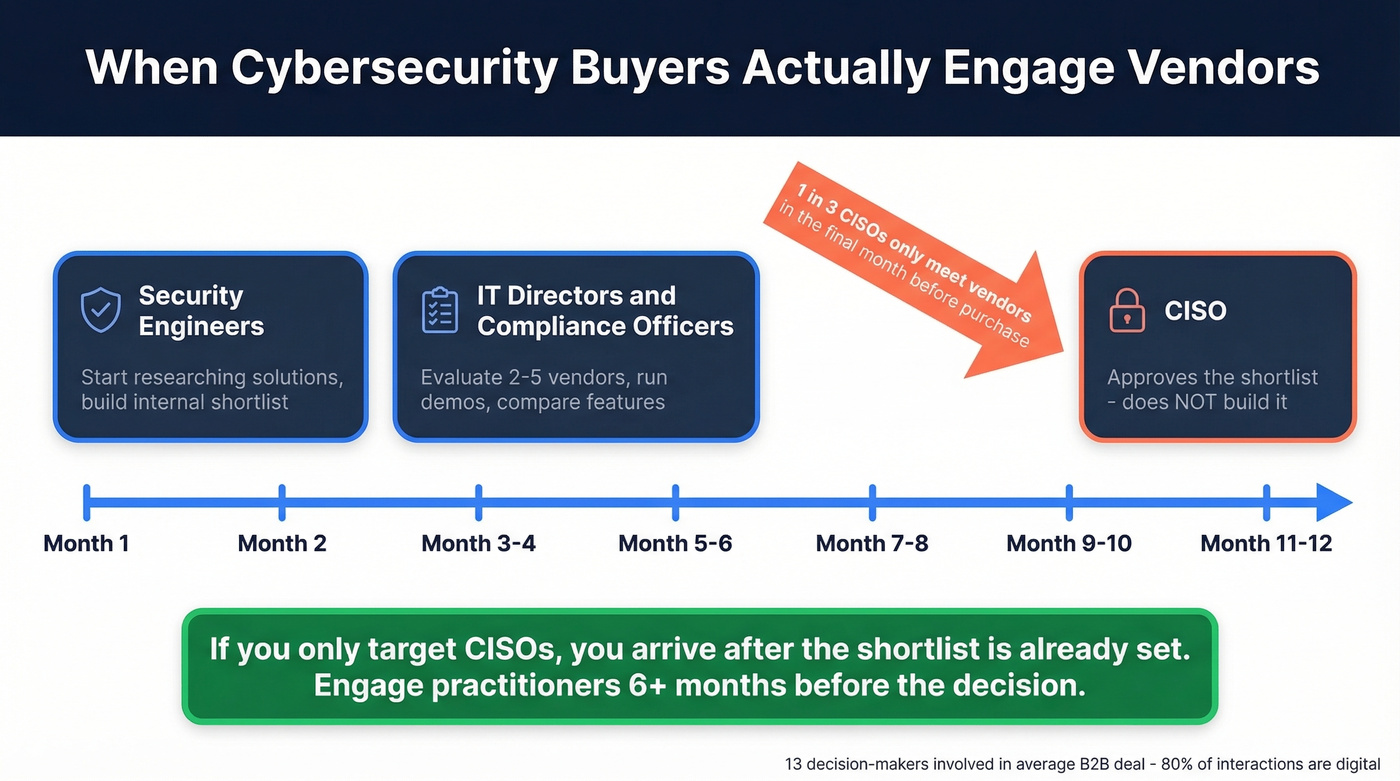
You need practitioner-level champions - Security Engineers, IT Directors, Compliance Officers - engaged 6+ months before the purchase decision. They build the shortlist. The CISO approves it.
Funnel Benchmarks for Security Vendors
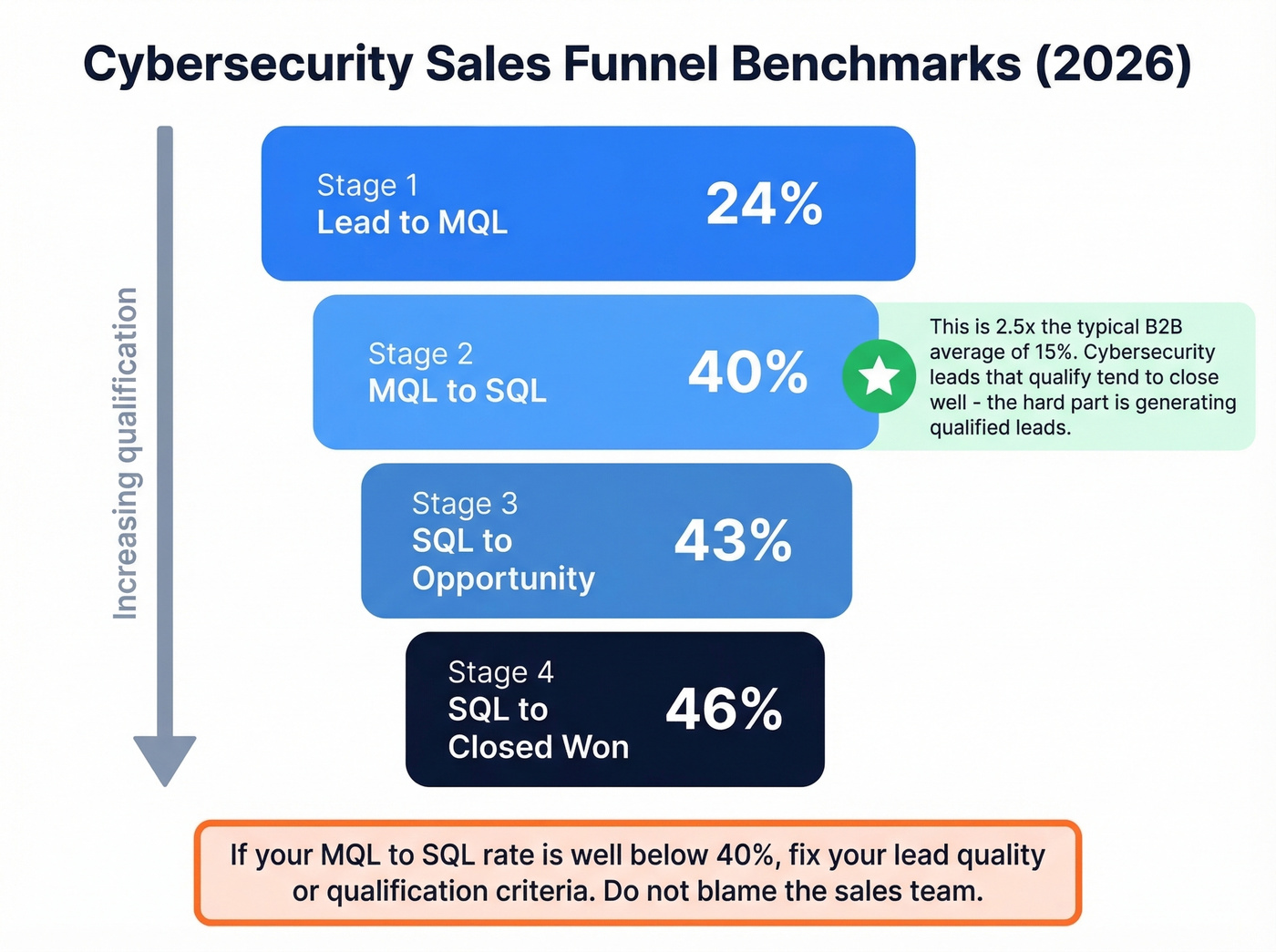
Know what good looks like. These stage-by-stage conversion rates are specific to cybersecurity:
| Funnel Stage | Conversion Rate |
|---|---|
| Lead → MQL | 24% |
| MQL → SQL | 40% |
| SQL → Opportunity | 43% |
| SQL → Closed Won | 46% |
The standout number: MQL → SQL at 40%, versus a ~15% B2B average. Cybersecurity leads that qualify tend to convert well - the challenge is generating qualified leads, not closing them. If your MQL → SQL rate is well below 40%, fix your lead quality or qualification criteria. Don't blame the sales team.
Strategies That Move Pipeline
You don't need 15 tactics. You need three to five that work.
Trigger-Based Outbound
Use this if your team can monitor breach events, compliance deadlines, and funding rounds in real time. Skip this if you're running spray-and-pray sequences to generic CISO lists.
Cold email response rates on CISO-targeted blasts often run under 1%. But outreach tied to a specific trigger - a publicized breach, an upcoming regulatory deadline, a fresh Series B - changes the math entirely. A large share of board-approved cybersecurity spend is triggered by incidents or audit failures. That's your opening.
Here's a channel most vendors ignore: dark web monitoring. When a target company's credentials surface on dark web marketplaces, that's a buying signal with genuine urgency. Build sequences around these moments, not around "just checking in." We've seen trigger-based sequences outperform generic cold email by a wide margin in security sales, and the consensus on r/sales backs this up - personalized triggers beat volume every time.
If you need a system for operationalizing this, start with a simple process for tracking sales triggers.
Intent Data for In-Market Buyers
The intent data market hit $4.49B in 2026. Ninety-one percent of B2B marketers use it, but only 24% report strong ROI - usually because they're paying for signals without verified contact data to act on them.
Intent data comes in four flavors:
- First-party - your own site engagement
- Second-party - partner data shared by review sites
- Third-party - publisher co-op networks like Bombora
- Derived - AI-synthesized buying stage predictions from platforms like 6sense
The pricing spread is enormous. Bombora standalone runs $12K-$40K/year, while enterprise 6sense deployments hit $300K+/year.
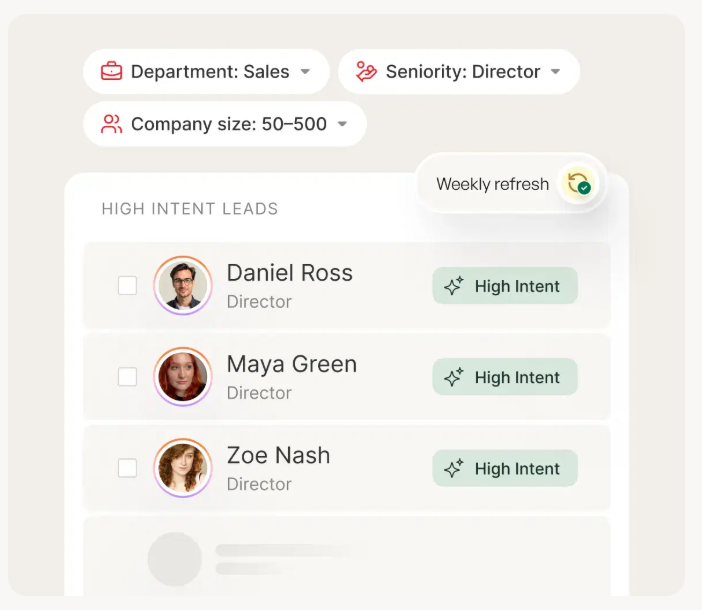
You don't need a $35K intent platform to start. Prospeo bundles Bombora-powered intent data across 15,000 topics with 143M+ verified emails and 125M+ verified mobile numbers - starting at $0.01 per verified email. Filter for security buyers showing active purchase intent from a single platform, no separate subscription needed.
If you want to tighten how you route and prioritize these signals, use an intent based segmentation model and a clear lead scoring rubric.
Educational Content
Use this if you can produce genuinely useful technical content. Skip this if your "thought leadership" is repackaged product marketing.
B2B buyers consume roughly 13 pieces of content before purchasing, and 44% of CISOs consider white papers the most engaging format. Every cybersecurity vendor screams about breaches - the ones that win trust explain how to prevent them without the sales pitch.
Let's be honest: if your average deal size is under $50K, you probably don't need a full content team. One deeply technical white paper per quarter, written by an actual practitioner, will outperform a weekly blog cadence of surface-level posts. And make sure your landing pages display compliance certifications - SOC 2, HIPAA, PCI-DSS badges. Security buyers notice when they're missing.
To keep content tied to pipeline, align it to B2B content marketing fundamentals and track funnel metrics instead of vanity traffic.
ABM for High-Value Accounts
Multi-thread across Security Engineers, IT Directors, and Compliance Officers - not just the CISO. Use the industry matrix below to pick verticals by compliance urgency, and combine ABM with intent data. Trend Micro reported 4x engagement with this approach.
If you’re building this motion from scratch, follow account-based selling best practices and keep your ideal customer profile tight.
One emerging channel worth watching: AI search visibility. Buyers increasingly research solutions through ChatGPT, Perplexity, and similar assistants. If your brand doesn't show up in those answers, you're invisible to a growing segment of the buying committee.
Paid Search
Skip this if you're bidding on "cybersecurity solutions" - you'll burn budget competing against Palo Alto and CrowdStrike.
Bid on vertical + solution intent keywords instead: "XDR solution for finance," "HIPAA compliance monitoring," "SOC 2 audit tools for SaaS." Build aggressive negative keyword lists to exclude job seekers, students, and certification shoppers. LinkedIn ads in security audiences often run $42-$100 per click. Paid search with tight intent targeting is the better investment for most budgets.
If you’re pairing paid with outbound, make sure your sales prospecting techniques and list-building workflow are aligned.

Your trigger-based outbound dies at a 30%+ bounce rate. Prospeo delivers 98% email accuracy with a 7-day refresh cycle - so the Security Engineers and IT Directors you're multi-threading actually receive your outreach. Layer Bombora intent data across 15,000 topics to find companies actively researching cybersecurity solutions, then export verified emails and direct dials from a single platform. No separate intent subscription needed.
Stop paying $35K for intent signals you can't act on.
Industry Targeting Matrix
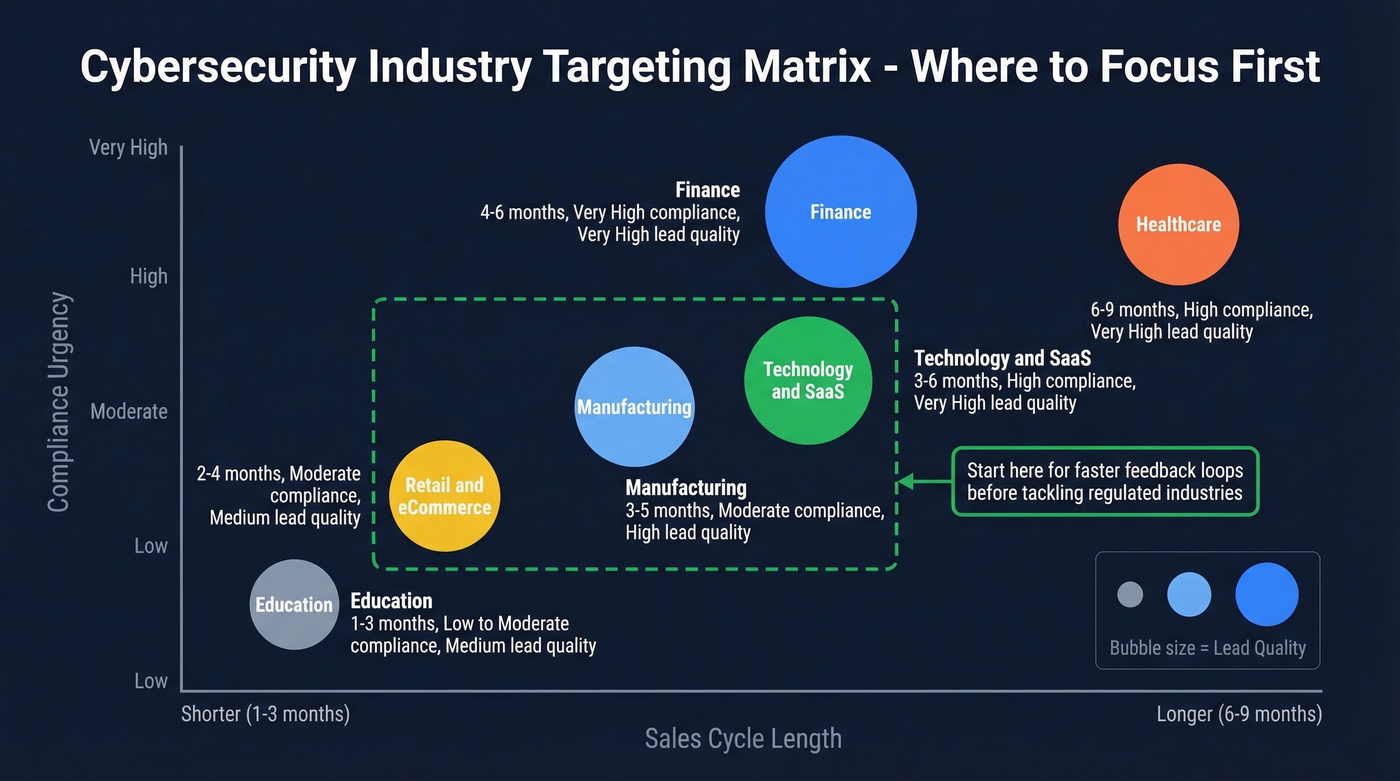
Not all cybersecurity verticals convert the same way. Prioritize your ICP by sales cycle length and compliance urgency:
| Vertical | Sales Cycle | Compliance Priority | Lead Quality |
|---|---|---|---|
| Healthcare | 6-9 months | High | Very High |
| Finance | 4-6 months | Very High | Very High |
| Technology/SaaS | 3-6 months | High | Very High |
| Manufacturing | 3-5 months | Moderate | High |
| Retail/eCommerce | 2-4 months | Moderate | Medium |
| Education | 1-3 months | Low-Moderate | Medium |
For early-stage vendors, technology/SaaS and retail offer faster feedback loops to refine messaging before going after regulated industries with longer cycles and higher stakes.
Mistakes That Kill Security Lead Gen
Unclear messaging is the top offender. Ninety-one percent of decision-makers say unclear marketing makes it harder to compare and select vendors. If your positioning sounds like every other "visibility, protection, intelligence" pitch, you're invisible.
If you need to sharpen this, start with B2B brand positioning.
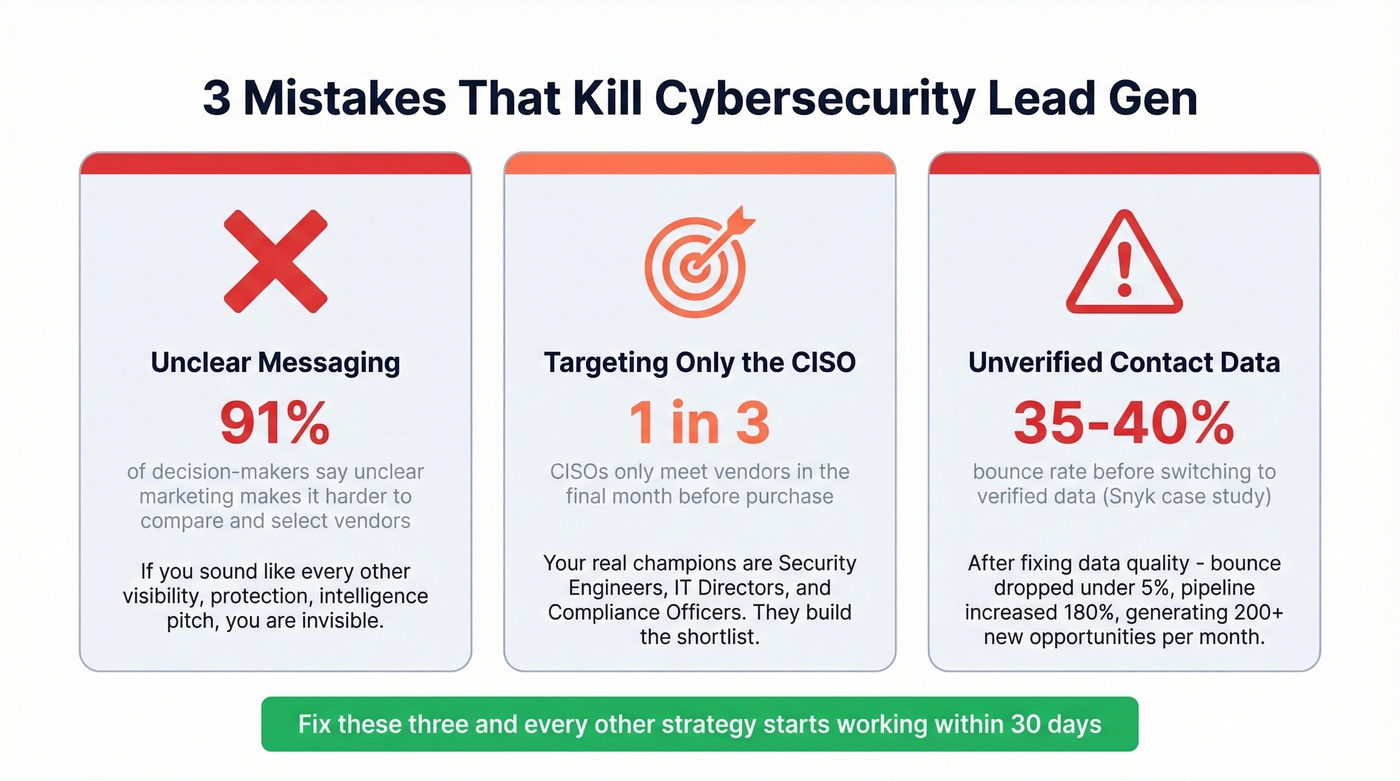
Targeting only the CISO is the second. They show up last. Your champions are mid-level security practitioners and compliance officers.
Using unverified contact data is the silent killer. Look - we've watched this play out repeatedly. Snyk's outbound team of 50 AEs was running a 35-40% bounce rate before switching to verified data. That kind of bounce rate damages domain reputation and cascades into deliverability problems across every campaign. After the switch, their bounce rate dropped under 5% and they generated 200+ new opportunities per month - a 180% increase in AE-sourced pipeline.
If you’re diagnosing this, start with email bounce rate and then work through an email deliverability guide.
Events Worth the Budget
Conferences matter, but ROI comes from pre-event intent data and post-event nurture - not the booth. Sponsorships commonly run $10K-$100K+, so pick carefully.
| Event | Ticket Cost | Best For |
|---|---|---|
| RSA Conference | From $2,195 | Enterprise networking, brand visibility |
| Gartner Security Summit | $3,650-$4,300 | Analyst access, CISO audience |
| Black Hat | Varies | Technical audience, product demos |
| HIMSS | $750-$1,645 | Healthcare vertical |
Book meetings in advance using intent data to identify which target accounts are attending, then run personalized follow-up within 48 hours. The booth generates awareness; the pre-event outreach generates pipeline.
Start With Data Quality
Every cybersecurity lead generation strategy above fails if your contact data is bad. A 98% email accuracy rate and a 7-day refresh cycle should be your baseline - anything less and you're building on sand. Meritt tripled their pipeline from $100K to $300K per week after fixing their data foundation with Prospeo. In our experience, fixing data quality is the single highest-ROI move a cybersecurity sales team can make - teams that do it first see results from every other strategy improve within 30 days.

You can have the best trigger-based sequences, the sharpest ABM plays, and the most compelling content in the market. None of it matters if 30% of your emails bounce.
Cybersecurity buyers evaluate 2-5 vendors before the CISO ever takes a meeting. You need verified contact data for the practitioners who build that shortlist - Security Engineers, Compliance Officers, IT Directors. Prospeo gives you 143M+ verified emails and 125M+ mobile numbers with 30+ filters including job title, department headcount, technographics, and buyer intent. At $0.01 per email, that's 90% cheaper than ZoomInfo.
Reach the buying committee before the shortlist is locked.
FAQ
What's a realistic cost per lead in cybersecurity?
Expect $50-$150 for content syndication, $100-$300+ for paid search, and $200-$500+ for event-sourced leads. Bad contact data inflates CPL by wasting outreach on bounced emails - fix your data first and every channel gets cheaper.
How long is the typical sales cycle?
Healthcare runs 6-9 months, finance 4-6 months, retail/eCommerce 2-4 months. Plan for 4-6 months as a mid-market baseline and multi-thread across the buying committee from day one.
Should I target CISOs directly with cold outreach?
Not as your primary strategy. One-third of CISOs don't meet vendors until the month before purchase. Target Security Engineers and Compliance Officers as champions first - they build the shortlist the CISO approves.
How can I generate cybersecurity leads on a tight budget?
Start with verified contact data and trigger-based outbound - both cost far less than paid channels. One deeply technical white paper paired with intent-filtered prospecting can outperform a $50K ad spend if your targeting is tight and your emails actually land.
What tools do security sales teams use for prospecting?
Most teams combine a B2B data platform for verified emails and intent signals, an outreach sequencer like Lemlist or Instantly, and a CRM. The critical factor is 98%+ email accuracy to prevent domain damage - that's the threshold where deliverability stays healthy and campaigns actually scale.