

Data Segmentation: The Guide That Actually Tells You How to Do It
Your SDR team built beautiful segments last quarter - industry verticals, company size tiers, buying stage. Three weeks into the campaign, bounce rates spiked and reply rates sat below 1%. The segments were right. The data underneath them was wrong.
That's the gap nobody talks about: data segmentation isn't a methodology problem. It's a data quality problem wearing a methodology costume.
89% of business leaders say personalization is crucial to their success over the next three years. 51% of marketers rank audience segmentation refinement as their top optimization technique - one percentage point ahead of conversion rate optimization. Everyone agrees segmentation matters. Far fewer teams do it well.
The Short Version
- Your segmentation is only as good as your data. Fix data quality before you touch a clustering algorithm.
- Start with RFM, not k-means. Simple behavioral scoring beats unsupervised ML for 90% of teams.
- Five actionable segments beat 25 micro-segments nobody uses. Over-segmentation kills more campaigns than under-segmentation.
- Refresh segments quarterly at minimum. Static segments decay fast - behavioral ones even faster.
- Layer compliance into your workflow from day one. GDPR fines hit EUR20M, and more than 20 US states now have privacy laws on the books.
What Is Data Segmentation?
Data segmentation is the process of dividing a dataset into smaller, distinct groups based on shared characteristics - so you can analyze, target, or act on each group differently. No mysticism required.
Don't confuse it with targeting or positioning. The classic STP framework runs Segmentation, then Targeting, then Positioning. Segmentation splits the universe. Targeting chooses which segments to pursue. Positioning determines how you show up. Most articles blur these together, which leads to muddled strategy and teams that can't tell whether they have a segmentation problem or a messaging problem.
One distinction worth making: segmenting data in a marketing/sales context is completely different from network segmentation, which is an IT security concept. If you're here for firewall rules, wrong article.
Why Segmentation Matters (With Numbers)
The average B2B cost per lead runs about $200. Demo request CPLs hit $600-$800. When you're spending that kind of money to fill a pipeline, sending the wrong message to the wrong segment isn't just inefficient - it's expensive.
Email marketing returns $36-$40 per dollar spent, but only when the right message reaches the right group. Segmented campaigns consistently outperform batch-and-blast sends on engagement and conversion when the underlying data is clean. Acquiring a new customer costs 5-7x more than retaining an existing one. And yet, 94% of companies say they find segmentation challenging.
The ROI shows up everywhere - lower bounce rates, higher reply rates, better conversion, shorter sales cycles. When your segments reflect who your buyers actually are, everything downstream works better. When they don't, you're burning budget on noise.
Seven Types of Data Segmentation
Most guides cover four types and call it a day. That's not enough for B2B teams.
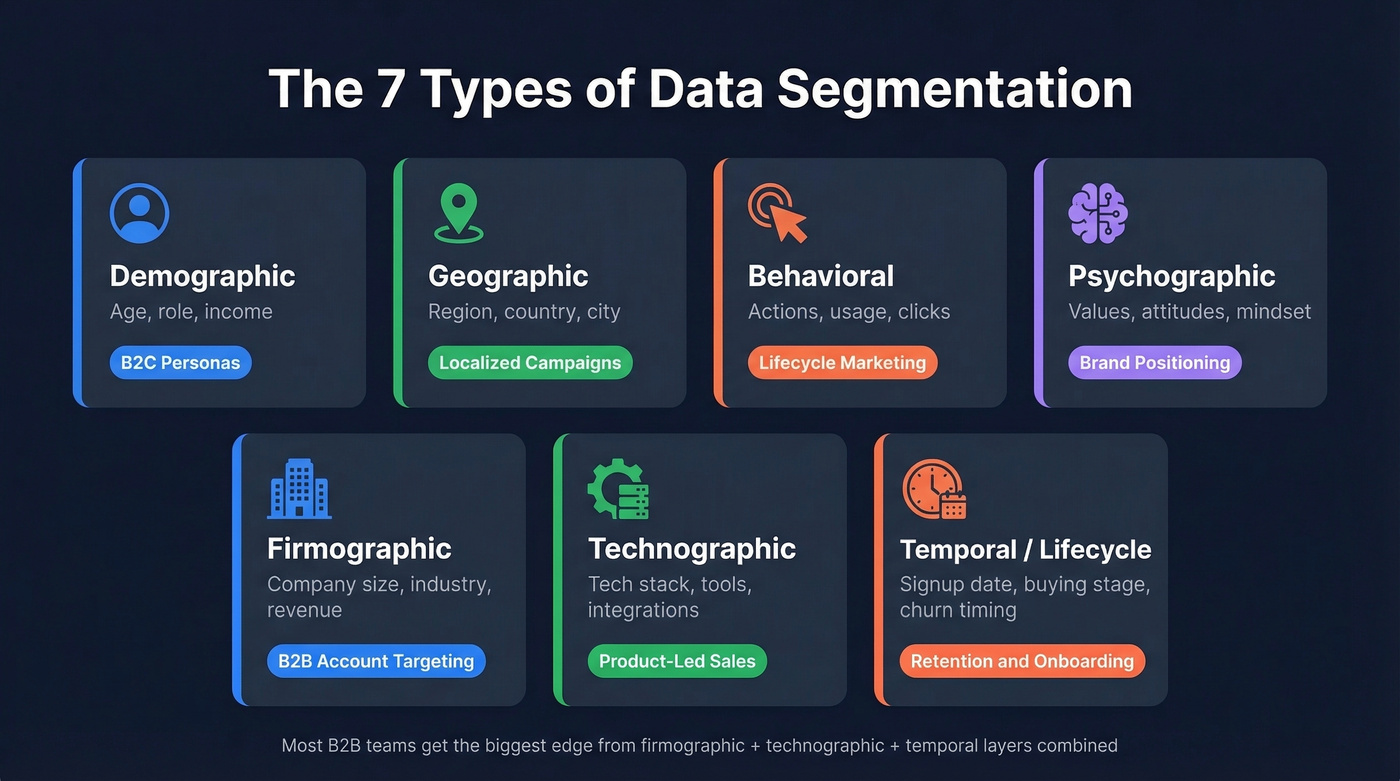
| Type | Divides By | Example Signal | Best For |
|---|---|---|---|
| Demographic | Age, income, role | "VP of Sales" | B2C personas, B2B titles |
| Geographic | Location, region | US Northeast vs. DACH | Localized campaigns |
| Behavioral | Actions, usage | Visited pricing 3x | Lifecycle marketing |
| Psychographic | Values, attitudes | "Early adopter" mindset | Brand positioning |
| Firmographic | Size, industry, revenue | 50-200 employees, SaaS | B2B account targeting |
| Technographic | Tech stack, tools | Uses Salesforce + Outreach | Product-led sales |
| Temporal/Lifecycle | Time-based stage | Signed up Q1, churned Q3 | Retention, onboarding |
Firmographic and technographic segmentation give B2B teams the most edge. Knowing that a prospect company runs HubSpot, has 80 employees, raised a Series B, and is growing headcount tells you far more than their industry vertical alone. (If you want to go deeper on the inputs, start with firmographic and technographic segmentation.)
Temporal segmentation - grouping by when someone entered your funnel or where they sit in the buying cycle - is the one most teams skip entirely. It's often the most actionable. A lead who downloaded your whitepaper yesterday needs a completely different touch than one who went quiet six months ago, even if they share the same title, industry, and company size.
Which Method Should You Use?
| Method | Best For | Complexity | Start Here? |
|---|---|---|---|
| RFM Analysis | Behavioral grouping | Low | Yes |
| Rule-Based | Simple, explainable segments | Low | Yes |
| K-Means Clustering | Finding natural groups | Medium | No |
| Cohort Analysis | Retention over time | Medium | Maybe |
| Hierarchical Clustering | Nested group structures | High | No |
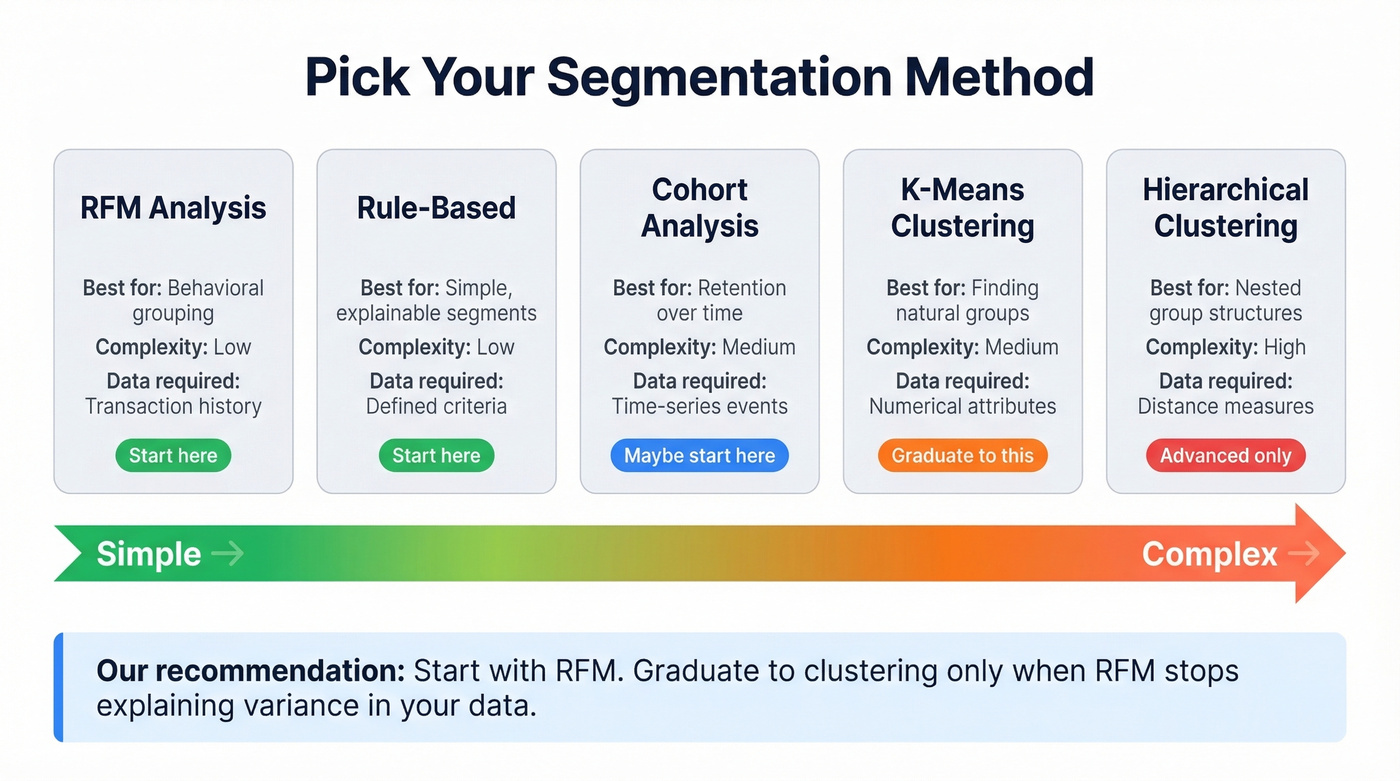
Here's the thing: start with RFM. Graduate to clustering only when RFM stops explaining variance in your data.
RFM scoring works by taking each customer's recency of last purchase, frequency of purchases, and monetary value, then converting each dimension into quantile-based scores from 1-5. Reverse the recency score so more recent activity gets a higher number. You now have a three-digit score per customer that immediately tells you who your Champions, Loyal Customers, At-Risk accounts, and Lost causes are. We've seen teams spend weeks tuning k-means when a two-hour RFM exercise in Google Sheets would've given them 80% of the insight.
For teams that do want clustering, log-transform your RFM features first (transactional data is almost always heavily skewed), standardize them, then run k-means. Use inertia and silhouette scores to pick your k. But for most teams under 50,000 customers, the spreadsheet approach gets you there.
Step-by-Step Implementation
Here's the framework that actually works in 2026.
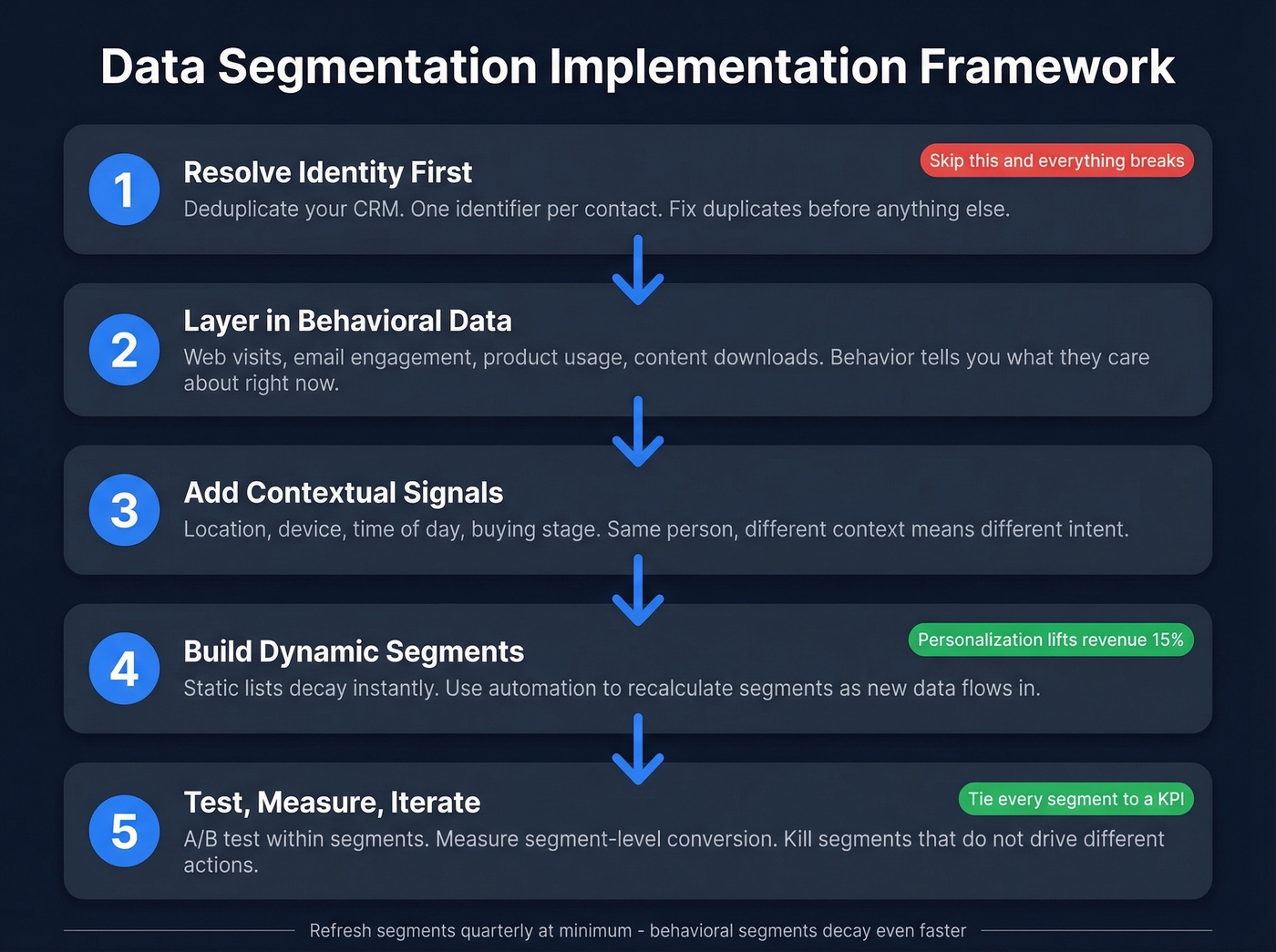
1. Resolve identity first. Before you segment anything, you need to know who's who across devices and channels. If the same person shows up as three different records in your CRM, your segments are built on duplicates. For SMBs without a data warehouse, start with what you have - your CRM, your email platform, and a B2B data provider for enrichment. You don't need a CDP to segment effectively. Start by deduplicating your CRM and establishing a single identifier per contact. (If your CRM setup is messy, it helps to standardize around solid contact management software.)
2. Layer in behavioral data. Web visits, email engagement, product usage, content downloads. Demographics tell you who someone is. Behavior tells you what they care about right now. If you're tying segments to pipeline outcomes, pair this with a simple lead scoring model.
3. Add contextual signals. Location, device, time of day, buying stage. A VP of Engineering browsing your pricing page at 2 PM on a Tuesday is a different signal than the same person reading a blog post on Saturday morning.
4. Build dynamic segments that update automatically. Static lists decay the moment you create them. Use your marketing automation or CRM to build segments that recalculate as new data flows in. Personalized marketing lifts revenue by 15% - but only if the personalization reflects current reality, not last quarter's snapshot. If you're operationalizing this for outbound, a dedicated SDR tool can keep segments and sequences aligned.
5. Test, measure, iterate. Run A/B tests within segments. Measure segment-level conversion, not just campaign-level. Kill segments that don't drive different actions. Replicate what works. For email-specific measurement, track segment-level deliverability and email bounce rate alongside conversion.

You just read that 94% of companies find segmentation challenging. The biggest reason? Dirty data underneath good segments. Prospeo's 5-step verification delivers 98% email accuracy and enriches every contact with 50+ data points - firmographics, technographics, intent signals, headcount growth - so your segments actually reflect reality.
Stop segmenting stale data. Start with records refreshed every 7 days.
How to Validate Your Segments
You ran k-means on a million customers. The elbow method says 4 clusters. Your boss demands 5. Silhouette score comes back at 0.55 - mediocre. When you spot-check individual customers, only about 30% seem to fit their assigned cluster.
Sound familiar? This is the most common segmentation frustration on r/datascience, and it points to a deeper issue.
Here's how to validate properly:
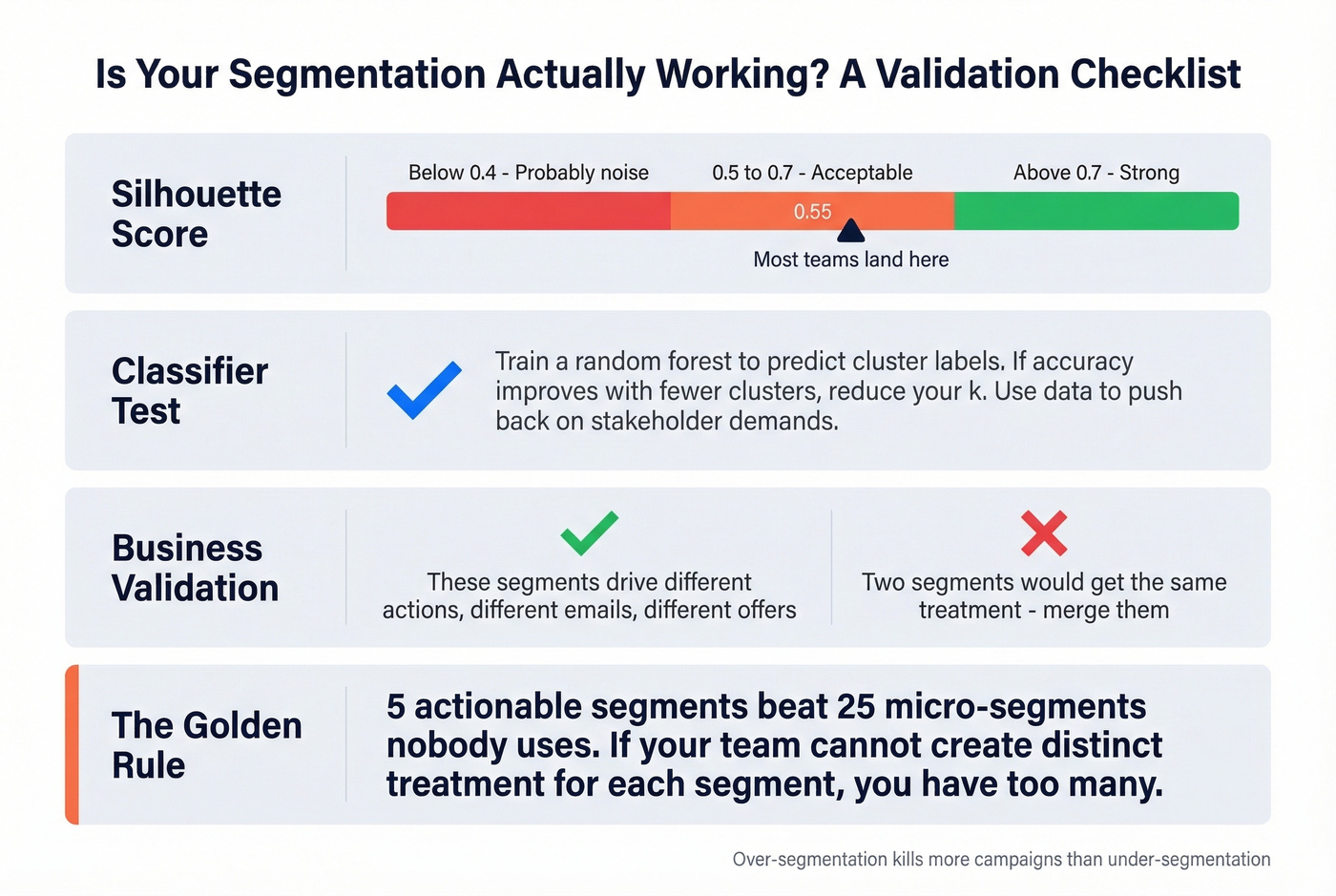
- Silhouette score above 0.5 is acceptable, not great. Above 0.7 is strong. Below 0.4, your clusters are probably noise.
- Train a random forest classifier to predict cluster labels. If it hits 82% accuracy at 5 clusters but 86% at 4, the data is telling you 4 is the better fit. Use that to push back on stakeholder-driven cluster counts. (If you're applying ML in revenue workflows, see data science in sales.)
- Business validation matters more than statistical validation. Do these segments drive different actions? If two segments would receive the same email, the same offer, and the same sales motion, they're not actually different segments. Merge them.
- Watch for mixed data types. Categorical fields like industry alongside numeric fields like revenue are a common clustering headache. Consider k-prototypes or encode categoricals before clustering.
Let's be honest: over-segmentation is a bigger problem than under-segmentation. Five segments you can act on beat 25 micro-segments that paralyze your marketing team every time.
Mistakes That Kill Your ROI
Demographics-only segmentation. Knowing someone is a 35-year-old marketing director tells you almost nothing about their buying intent. Layer behavioral and lifecycle signals on top.
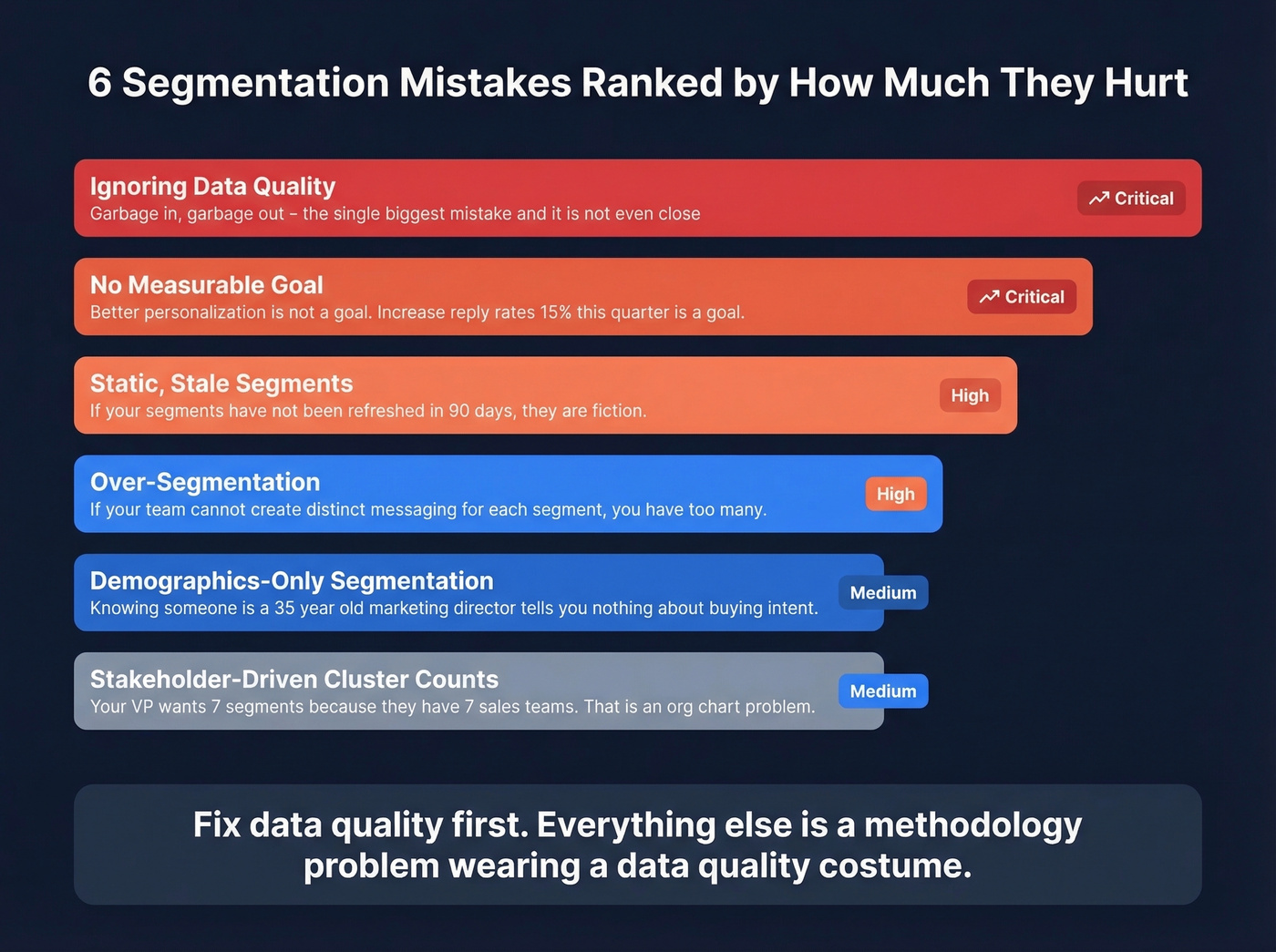
Over-segmentation. If your team can't create distinct messaging and offers for each segment, you have too many. Consolidate until every segment gets a unique treatment.
Static, stale segments. If your segments haven't been refreshed in 90 days, they're fiction. People change jobs, companies get acquired, buying committees shift. Use dynamic segments that auto-update.
Stakeholder-driven cluster counts. Your VP wants 7 segments because they have 7 sales teams. That's an org chart problem, not a segmentation insight. Let the data decide.
Ignoring data quality. This is the single biggest segmentation mistake, and it's not even close. Garbage in, garbage out. If you're enriching or appending emails, make sure you're using reputable data enrichment services rather than dumping unverified fields into your CRM.
No measurable goal. "Better personalization" isn't a goal. "Increase reply rates in the mid-market segment by 15% this quarter" is. Tie every segment to a KPI or skip this if you're not ready to measure outcomes - you'll just create busywork. (For outbound KPIs, it helps to benchmark follow-up email reply rate.)
Real-World Examples
Silk and the "Convincibles." In 2009, Silk's segmentation work identified a group they called "Convincibles" - consumers open to plant-based milk but not yet buying it. That insight led to the launch of PureAlmond in 2010. The soy milk market was estimated at $1.2B in 2008, with Silk driving about $558M in sales. By 2024, total plant-based milk sales had reached an estimated $2.8B. One well-defined segment reshaped an entire product strategy.
Peloton's tiered segmentation. As the market shifted from lockdown-era demand to a more normal fitness landscape, Peloton's offers mapped to different segments: the Bike at $1,445 for price-sensitive fitness enthusiasts, the Bike+ at $2,495 for premium buyers, and the All Access subscription at $44/mo for the content-first segment. Same brand, three distinct value propositions driven by segmentation.
Data Quality: The Make-or-Break Factor
61% of companies worry that inaccurate data compromises their AI and ML effectiveness. They're right to worry. You can't segment what you can't trust.

Here's a pattern we see constantly: a team builds segments using firmographic and behavioral data, launches outbound sequences, and watches bounce rates climb. The segmentation logic was sound. The underlying contact data was old, riddled with job changers and defunct email addresses. The segments were right. The data was wrong.
If your deal sizes sit below five figures, you probably don't need a $50K data platform. But you absolutely need accurate data. The biggest segmentation mistake isn't choosing the wrong clustering algorithm - it's building segments on stale records and wondering why nothing converts. If you're doing outbound at scale, pair segmentation with a real email deliverability guide so your best segments actually see your message.
Best Tools for Segmentation
Different tools solve different parts of the segmentation stack.
| Category | Tool | Starting Price | Best For |
|---|---|---|---|
| B2B Data & Enrichment | Prospeo | Free / ~$0.01/email | Verified emails, enrichment |
| B2B Data & Enrichment | Clearbit | ~$10K-$30K+/yr | Firmographic enrichment |
| B2B Data & Enrichment | UpLead | From $99/mo | SMB prospecting lists |
| CRM / Marketing Auto | HubSpot | Free tier; paid from ~$20/mo | All-in-one lifecycle segments |
| CRM / Marketing Auto | Klaviyo | From $20/mo | E-commerce behavioral segments |
| CRM / Marketing Auto | Kissmetrics | From $299/mo | Product analytics + segments |
| Analytics / Product | GA4 | Free | Web behavior segmentation |
| Analytics / Product | Amplitude | From $49/mo | Product usage cohorts |
| Analytics / Product | Baremetrics | From $129/mo | SaaS revenue segmentation |
| CDP / Infrastructure | Twilio Segment | Free tier; paid plans usage-based | Cross-channel identity |
| Social / CX | Sprout Social | From $199/user/mo | Social audience segments |
For SMB teams, the practical stack is a CRM plus GA4 plus a B2B data provider for enrichment. Mid-market teams typically add a CDP like Segment for identity resolution. Enterprise stacks layer in experimentation platforms and custom data warehouses.
The tool matters less than the data flowing through it. A $20/mo Klaviyo account with clean, verified contact data will outperform a $50K CDP filled with stale records every time. If you're building lists to feed these tools, start with proven sales prospecting techniques so segmentation isn't compensating for weak targeting.
Firmographic and technographic segmentation only work when you have the right signals. Prospeo gives you 30+ filters - buyer intent across 15,000 topics, tech stack, funding, department headcount, job changes - at $0.01 per email. No contracts. No sales calls.
Build segments with real signals, not guesswork. 75 free emails to start.
Privacy and Compliance Checklist
Segmentation without compliance is a liability. Build this into your workflow from day one.
GDPR (if you touch EU data): Establish a lawful basis for each processing purpose - consent, contract, or legitimate interest. Define specific purposes ("improving user experience" is too vague). Practice data minimization and set retention limits. Offer granular consent with separate choices for analytics, marketing, and personalization. Make consent easy to withdraw and maintain audit trails.
CCPA/CPRA (California and expanding): Honor "Do Not Sell or Share" requests when sharing data with ad or analytics partners. Respect Global Privacy Control browser signals. CPRA adds protections for sensitive personal information and requires data retention disclosures.
The regulatory picture is accelerating. Multiple US states enacted privacy laws in 2025 - Delaware, Iowa, Nebraska, New Hampshire, New Jersey, Tennessee, Minnesota, Maryland - with Indiana, Kentucky, and Rhode Island effective January 1, 2026. This isn't optional anymore.
AI and the Future of Segmentation
Over 70% of brands say AI will fundamentally change personalization and marketing. The biggest shift isn't smarter algorithms - it's dynamic segments that update in real time as new behavioral and intent signals arrive. If you're segmenting on intent, use an intent based segmentation approach so "signals" don't turn into guesswork.
AI-driven segmentation increases customer lifetime value by roughly 25% and engagement by about 25% compared to traditional rule-based methods. But the prerequisite is clean data. AI amplifies whatever you feed it - if your contact records are stale or your firmographic data is wrong, AI will just build confident-looking segments on a broken foundation.
The teams getting the most from AI-powered segmentation in 2026 aren't the ones with the fanciest models. They're the ones with the freshest data, the clearest business goals, and the discipline to start simple and iterate.
FAQ
What's the difference between data segmentation and market segmentation?
Data segmentation is the technical process of dividing any dataset into groups based on shared attributes - applicable to analytics, security, and marketing alike. Market segmentation applies that process strategically to customer groups for go-to-market purposes. Data segmentation is the how; market segmentation is the why.
How many segments should I create?
Start with 3-5 high-impact segments you can act on with distinct messaging and offers. If two segments would receive the same treatment, merge them. Over-segmentation paralyzes execution more often than under-segmentation limits results.
How often should I refresh my segments?
Quarterly at minimum for firmographic segments; monthly or dynamically for behavioral ones. Underlying contact data freshness matters just as much - stale records make even well-designed segments useless regardless of how clever the logic is.
Can I segment effectively without a data science team?
Yes. RFM analysis works in a spreadsheet, and platforms like HubSpot and Klaviyo include built-in segmentation builders requiring zero code. Most B2B teams under 50,000 contacts never need clustering algorithms. Start with rule-based segments tied to clear business goals.