

Database Marketing Is Infrastructure, Not a Tactic - Here's How to Build It Right
You exported your "marketing database" last quarter and 30% of the addresses bounced. The campaign tanked, the CMO asked questions, and someone suggested buying a new list. That's not a database marketing problem - it's a symptom of never building the infrastructure in the first place.
This discipline isn't a campaign type. It's the data layer underneath every campaign you'll ever run. Get it right and personalization, retargeting, lookalikes, and lifecycle programs all work better. Get it wrong and you're just blasting emails into the void with extra steps.
What You Need (Quick Version)
Three things separate teams that do database marketing well from teams that just have a CRM with contacts in it:
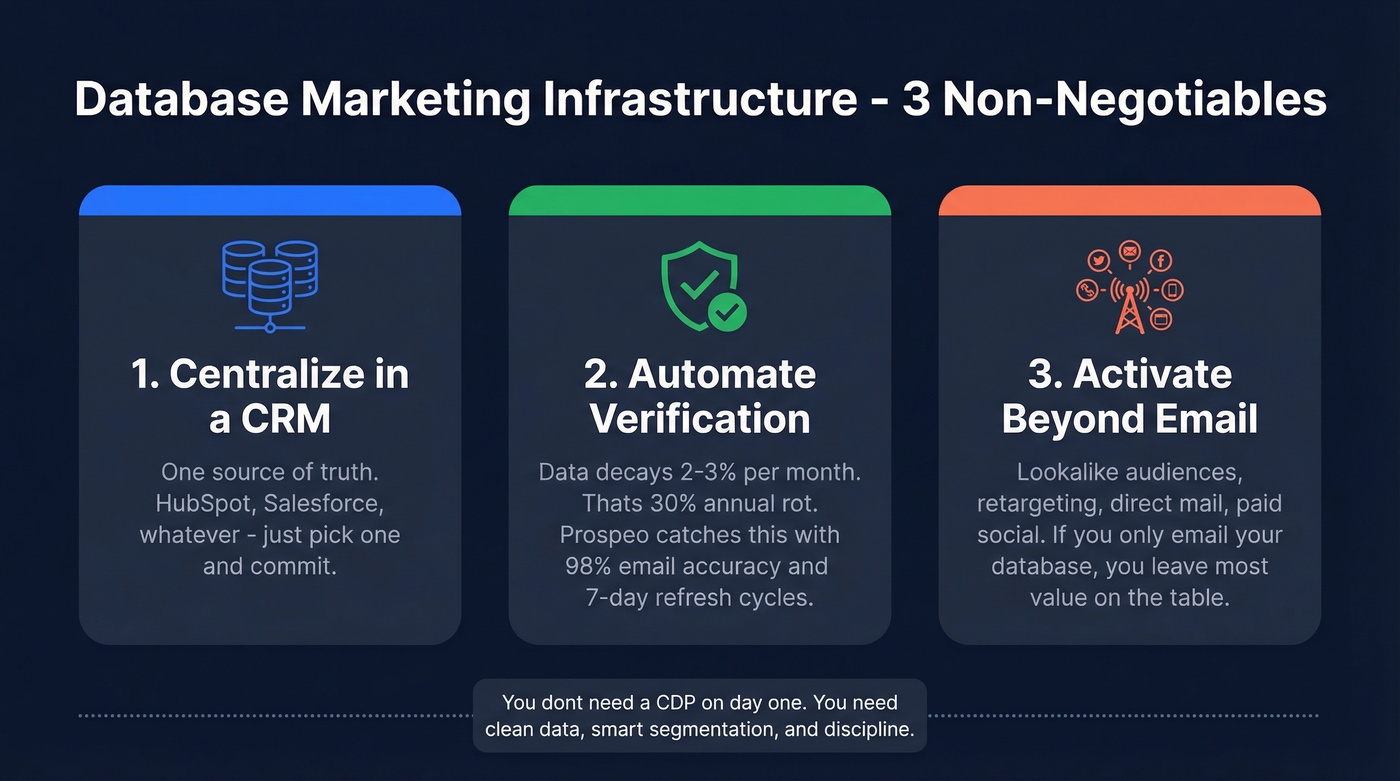
- Centralize your data in a CRM. HubSpot is the starting point for most mid-market teams. Salesforce if you're enterprise. The tool matters less than the discipline of making it the single source of truth. (If you're evaluating tools, start with this CRM guide.)
- Keep it clean with automated verification. Contact data decays at ~2-3% per month. That's roughly 30% annual rot. Prospeo catches this with 98% email accuracy, a 7-day refresh cycle, real-time email verification, and bulk verification that flags invalid records before they tank your deliverability. If you want options, compare email verifier tools before you commit.
- Activate it beyond email. Upload your segments to paid social for lookalikes. Build retargeting audiences from engagement data. Use direct mail for high-value accounts. If you're only emailing your database, you're leaving most of the value on the table.
You don't need a CDP on day one. You need clean data, smart segmentation, and the discipline to actually use what you've collected.
What Is Database Marketing?
Database marketing is the practice of collecting, organizing, and activating customer and prospect data to drive targeted marketing across channels. The more useful definition: it's the infrastructure that makes every marketing channel smarter. The term dates back to the 1980s - associated with the Kestnbaums - but the practice has evolved from mailing lists to real-time, cross-channel data infrastructure.
Most guides treat this like a tactic, something you "do" alongside content marketing or paid ads. That framing misses the point entirely. It's the foundation those tactics sit on. Your retargeting campaigns are only as good as the segments you build. Your email sequences only convert if the addresses are valid and the personalization is relevant. Your ABM programs collapse without accurate firmographic data. (If you're building this motion, use an ideal customer profile to keep targeting tight.)
The ROI case is straightforward. Personalization - which is impossible without a well-maintained database - typically drives 10-15% revenue uplift, with top performers seeing up to 25%. Personalized CTAs outperform generic ones by 202%. And 76% of consumers report frustration when interactions aren't personalized. These aren't marginal gains. They're the difference between a marketing team that drives pipeline and one that generates "awareness." The personalization software market alone is projected to grow from $263M to $2.4B by 2033 - a sign of how central database-driven personalization is becoming.
Here's the contrarian take: if your database is dirty, you'd be better off pausing campaigns entirely and spending a quarter fixing your data. Every message sent to a bad address, wrong persona, or outdated contact actively damages your brand and your deliverability reputation. The benefits of clean, well-structured data compound over time - better deliverability, stronger sender reputation, and increasingly precise segmentation with every campaign cycle. (If you're seeing issues, start with an email reputation check.)
Why It Matters More in 2026
The third-party data ecosystem is eroding, and the timeline keeps shifting. Google's 2025 update confirmed Chrome won't force third-party cookie deprecation - users keep cookie choice via existing settings. But Chrome Incognito already blocks them, and IP Protection rolled out in Q3 2025. The direction is clear even if the deadline keeps moving.
The industry is shifting toward authenticated identity. The data people voluntarily give you - email addresses, form fills, account creation, preference centers - becomes the most valuable asset in your marketing stack. First-party data isn't just a compliance play. It's a competitive moat.
A Cisco survey found that 81% of consumers believe how an organization treats personal data reflects how it respects them as customers. Trust and data quality aren't separate conversations anymore. Teams that build clean, permission-based databases now will have a structural advantage as third-party signals continue to degrade.
States including Montana, Texas, Oregon, and Delaware have enacted privacy laws in the last two years, and the regulatory pressure isn't slowing down. The teams that treat their marketing database as infrastructure - not a project - are the ones that won't scramble every time the rules change. (For a deeper framework, see B2B compliance.)
What Data to Collect
Most marketing databases are too thin. They've got name, email, company, and maybe a job title. That's a contact list, not a marketing database. A proper single customer view pulls from at least these categories:
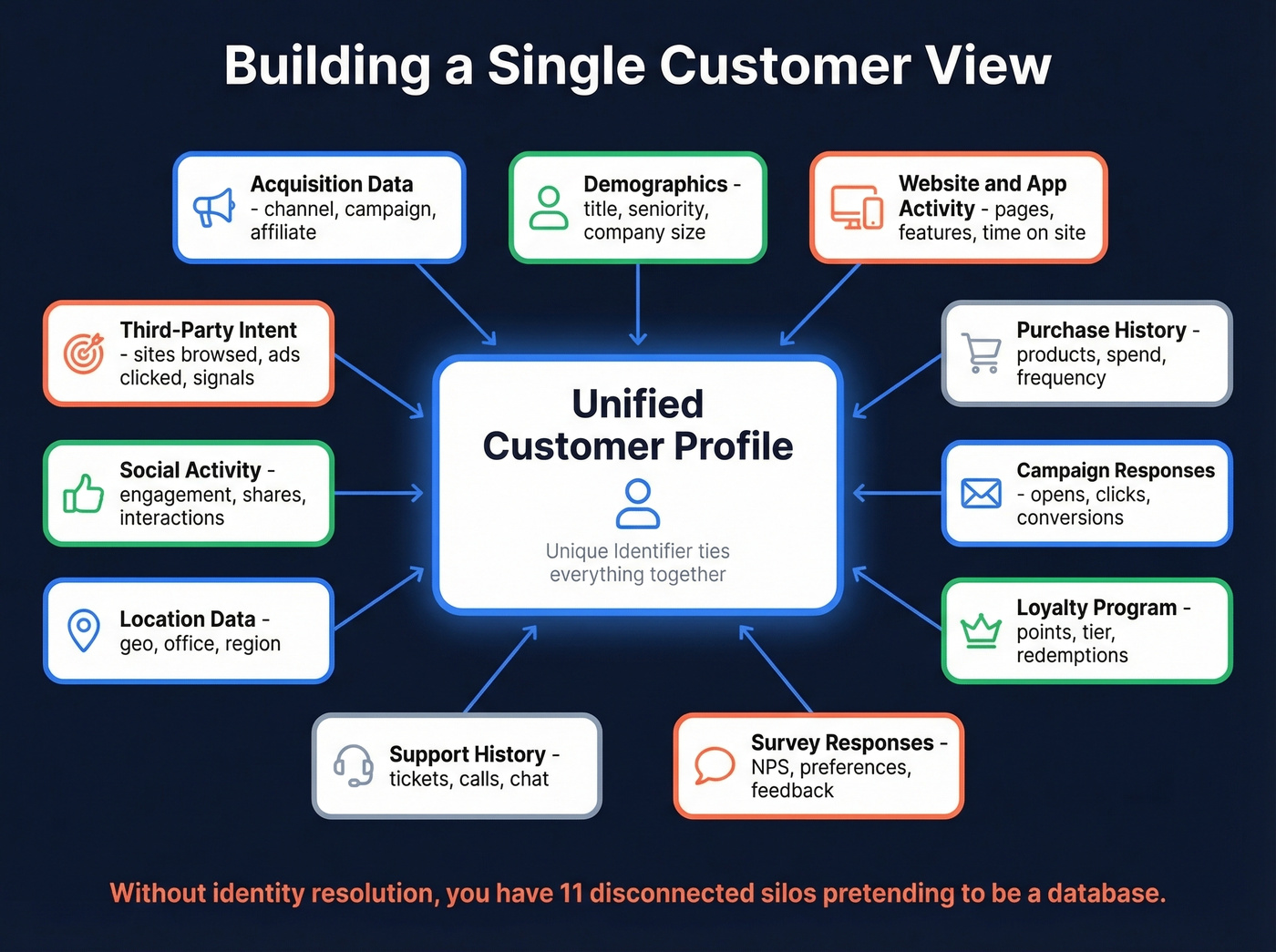
- Acquisition data - which channel, campaign, or affiliate brought them in
- Demographics - job title, seniority, department, location, company size
- Website and app activity - pages visited, features used, time on site
- Purchase and spend history - what they bought, how much, how often
- Campaign response history - opens, clicks, conversions, unsubscribes across every channel
- Loyalty program data - points, tier status, redemption patterns
- Survey and questionnaire responses - stated preferences, NPS scores, feedback
- Correspondence history - support tickets, sales calls, chat transcripts
- Location data - mobile geo, office location, regional signals
- Social media activity - engagement patterns, content interactions, sharing behavior
- Third-party adtech data - sites browsed, ads clicked, intent signals, demographic indicators
The critical requirement underneath all of this is a unique identifier that ties every data point back to a single person or account. Without identity resolution, you've got 11 disconnected data silos pretending to be a database. (This is also where customer profiling gets real.)
B2C vs B2B Approaches
The principles are identical. The execution differs significantly.
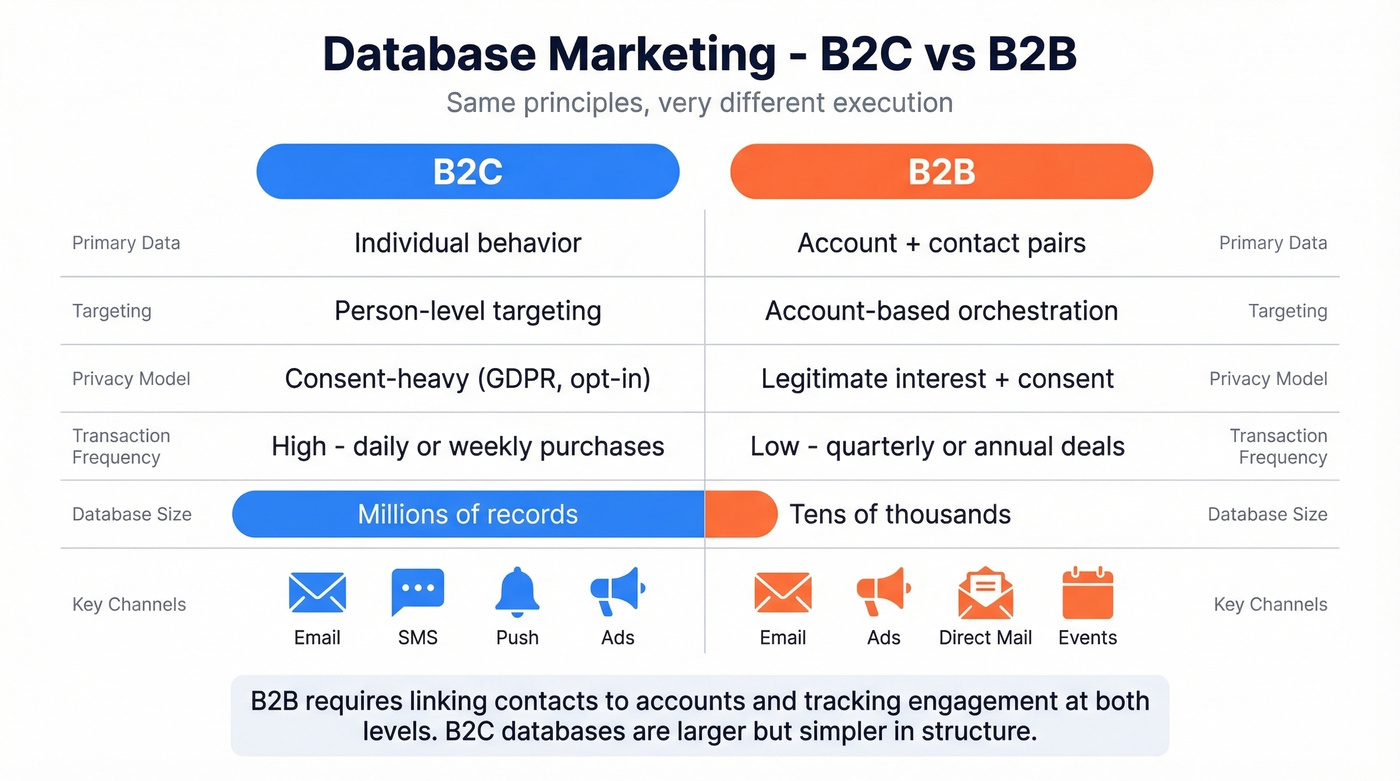
B2B database marketing requires account-level orchestration that B2C teams rarely need, and the data architecture reflects that complexity.
| Dimension | B2C | B2B |
|---|---|---|
| Primary data | Individual behavior | Account + contact |
| Targeting | Person-level | Account-based |
| Privacy model | Consent-heavy (GDPR) | Legitimate interest + consent |
| Transaction frequency | High (daily/weekly) | Low (quarterly/annual) |
| Typical DB size | Millions of records | Tens of thousands |
| Key channels | Email, SMS, push, ads | Email, ads, direct mail, events |
The biggest practical difference is that B2B requires account-level thinking. You're not just targeting Jane the VP of Marketing - you're targeting Jane, her two directors, and the CFO who signs the check. Your database needs to link contacts to accounts and track engagement at both levels. B2C databases are larger but simpler in structure. B2B databases are smaller but demand more relational depth. (If you're running this motion, use account based marketing benchmarks to sanity-check performance.)
How the Operational Loop Works
Most guides explain the process as "collect data, segment, send messages." That's like explaining cooking as "buy ingredients, combine, eat." The actual operational loop has seven steps, and the ones most people skip are the ones that matter most.
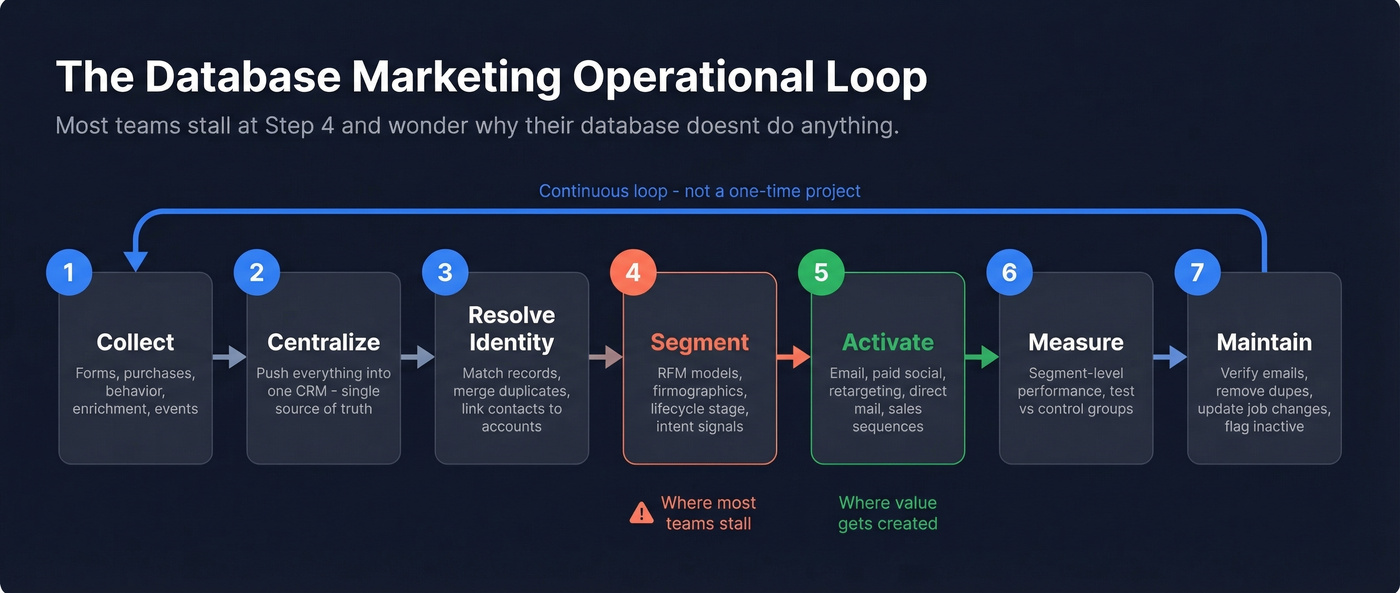
Step 1: Collect. Capture data from every touchpoint - forms, purchases, website behavior, enrichment tools, event registrations. Don't just collect what's easy. Collect what's useful for segmentation.
Step 2: Centralize. Push everything into a single system of record. For most teams, that's a CRM. The goal is one place where every team can access the same customer view.
Step 3: Resolve identity. Match records across sources to a single profile. This is where most databases break down - duplicate records, mismatched emails, contacts without company associations. Invest here early. (RevOps teams: this is basically lead-to-account matching.)
Step 4: Segment. Group contacts by behavior, firmographics, lifecycle stage, engagement level, or intent signals. Basic segmentation uses field values. Advanced segmentation uses RFM models, predictive scoring, or cluster analysis. In our experience, most teams stall at this step and never reach step 5.
Step 5: Activate. This is where value gets created. Push segments to email, paid social, retargeting platforms, direct mail vendors, or sales sequences. Most teams stop at step 4 and wonder why their database doesn't "do anything."
Step 6: Measure. Track performance at the segment level, not just the campaign level. Which segments convert? Which ones churn? Use test and control groups - not every contact should get every message.
Step 7: Maintain. Verify emails, remove duplicates, update job changes, flag inactive records. This isn't a quarterly project. It's a continuous process. Skip it and your database degrades ~30% per year.

You just read that contact data decays at 2-3% per month. Prospeo's 7-day data refresh cycle - 6x faster than the industry average - keeps your marketing database current automatically. With 98% email accuracy and 5-step verification that removes spam traps and honeypots, your campaigns hit real inboxes instead of destroying your sender reputation.
Stop blasting emails into the void. Start with data that's actually clean.
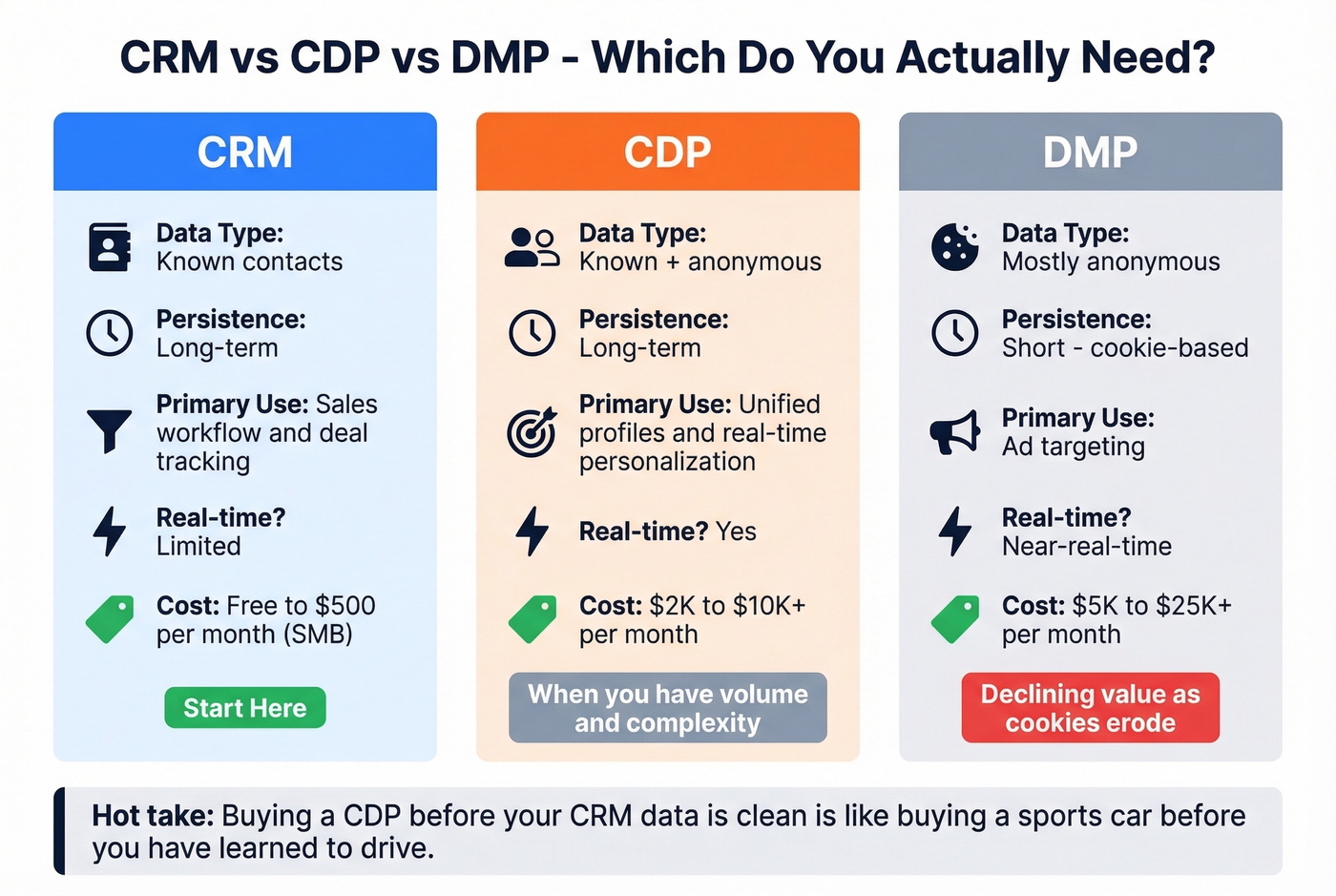
CRM vs CDP vs DMP
These terms get thrown around interchangeably. They shouldn't be.
| CRM | CDP | DMP | |
|---|---|---|---|
| Data type | Known contacts | Known + anonymous | Mostly anonymous |
| Persistence | Long-term | Long-term | Short (cookie-based) |
| Primary use | Sales workflow | Unified profiles | Ad targeting |
| Real-time? | Limited | Yes | Near-real-time |
| Cost range | Free-$500+/mo (SMB) | $2K-$10K+/mo | $5K-$25K+/mo |
A CRM stores relationship data and powers sales workflows. It's historical and workflow-centric - great for tracking deals, less great for real-time behavioral segmentation.
A CDP creates a unified customer profile by ingesting data from multiple sources and making it available for real-time personalization. Per Gartner's definition, CDPs enable analysis of individual-level behavior over time. They're powerful but complex to integrate and expensive.
A DMP builds profiles of anonymous individuals for ad targeting. Short retention windows, cookie-dependent, and increasingly limited as third-party tracking degrades.
Let's be honest: most mid-market teams should start with a CRM, get their data hygiene right, and layer in a CDP when they have the volume and cross-channel complexity to justify $2,000-$10,000+ per month. Buying a CDP before your CRM data is clean is like buying a sports car before you've learned to drive. (If you're automating workflows, shortlist CRM automation software before you buy.)
The Essential Tech Stack
CRM and Marketing Automation
HubSpot is the obvious starting point. Free CRM, and Marketing Hub paid plans typically start around $20-$50/month, scaling into the hundreds depending on seats and features. The ecosystem integrates with practically everything. One agency operator on r/DigitalMarketing put it bluntly: HubSpot is the best marketing automation platform versus Pardot, Marketo, or Act-On. We've seen the same pattern - teams that start with HubSpot spend less time fighting their tools and more time actually marketing.
Salesforce Marketing Cloud is the enterprise play. More powerful, more complex, more expensive. Worth it if you've got the team to run it. Expect enterprise pricing, often $1,000+/month and scaling up with modules and volume.
Brevo is the budget option that punches above its weight - free plan with 300 emails/day, Starter from $9/mo, automation from $18/mo. For small teams that need email plus basic automation without HubSpot's price creep, Brevo gets the job done.
Data Enrichment and Verification
This is where most programs quietly fail. You build the infrastructure, set up the segments, launch the campaigns - and 25% of your emails bounce because nobody verified the data. (If you're shopping, start with these data enrichment tools.)

Prospeo fixes this at the source. The platform covers 300M+ professional profiles, 143M+ verified emails, and 125M+ verified mobile numbers, with 98% email accuracy and a 7-day data refresh cycle - the industry average is six weeks. That refresh cadence matters because contact data doesn't stay accurate. People change jobs, companies rebrand, email systems get reconfigured. The 5-step verification process catches invalid addresses, handles catch-all domains, and removes spam traps before they damage your sender reputation. CRM enrichment returns 50+ data points per contact. Meritt went from a 35% bounce rate to under 4% after switching, and their pipeline tripled from $100K to $300K per week. Pricing starts free with 75 emails/month, and paid plans run roughly $0.01 per email. No contracts, no sales calls required.
Apollo.io is often priced around $99/month and combines prospecting with engagement tools - think ZoomInfo plus Salesloft at a fraction of the cost. Good for teams that want database search and email sequencing in one platform, though the data accuracy doesn't match 98%. (If you're comparing sources, see the best B2B database roundup.)
CDP (When You're Ready)
Segment offers a free tier, with paid plans typically starting in the low hundreds per month - a reasonable entry point for teams that need event tracking and audience syndication without enterprise complexity. BlueConic is the enterprise option at $2,000-$10,000+/mo, built for brands with millions of customer records and real-time personalization needs across channels.
Skip both if you're under 50,000 contacts and only running two or three channels. The ROI won't justify the integration overhead.
Activating Beyond Email
Most marketers treat their database as an email list. The real power is cross-channel activation. A common question on r/Emailmarketing boils down to: "What other ways are you marketing to your email database beyond email?" Fair question. A customer database without cross-channel activation is just email marketing with extra steps.
Retargeting from email lists. Best for engaged segments that aren't converting via email alone. Upload your "opened but didn't click" or "visited pricing page" segments to Google and Meta for display and social retargeting. Not worth it if your list is under 1,000 contacts - the match rates won't give you enough scale.
Lookalike audiences on paid social. Best for teams with a strong customer segment who want to find more people like them. Upload your highest-LTV, fastest-close customers and let Meta or LinkedIn build a lookalike. Skip this if your source audience is too broad - "all customers" makes a terrible seed list.
Direct mail for high-value accounts. The play when you're running ABM against enterprise accounts where digital channels are saturated. A well-timed physical mailer to a buying committee stands out. The unit economics don't work for high-volume, low-ACV motions - save this for deals worth $50K+.
If your average deal size is under $10K, you probably don't need a CDP, an ABM platform, or a multi-channel orchestration tool. You need a clean database, good segmentation, and two channels executed well. Most teams overcomplicate this.
Keeping Your Database Clean
We've watched teams discover 30% of their database is dead mid-campaign. It's always preventable, and it always plays out the same way: someone exports the "marketing database," launches a campaign, and watches the bounce rate climb past 20%. Then comes the scramble - who let the data get this bad?
Nobody "let" it happen. It happens automatically. Contact data decays at roughly 2-3% per month, which means over a year, ~30% of your database goes stale because people change jobs, companies get acquired, and email domains get restructured. A third of companies still move data manually between systems, so every transfer introduces errors, duplicates, and lag.
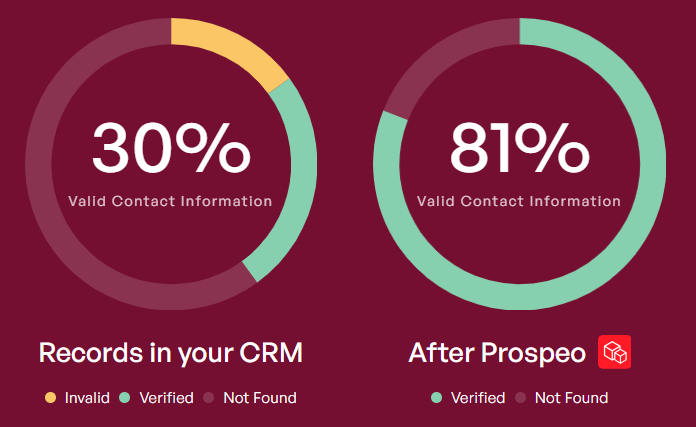
The fix isn't heroic quarterly cleanups. It's automated, continuous verification. Snyk dropped their bounce rate from 35-40% to under 5% after switching to Prospeo, unlocking 200+ new opportunities per month from their existing 50-person AE team.
Operational advice: favor stable fields like company domain and work email over volatile ones like direct dial and job title. Set a monthly verification cadence at minimum. And automate the sync between your CRM and marketing platform - one-way sync is a silent database killer. (If you need a deeper deliverability playbook, start with inbox placement.)
Database marketing only works when every record ties back to a real person with accurate contact data. Prospeo enriches your CRM with 50+ data points per contact at a 92% match rate - firmographics, technographics, intent signals across 15,000 topics - for roughly $0.01 per email. No annual contracts, no sales calls required.
Turn your contact list into an actual marketing database for a penny per lead.
Privacy and Compliance
Database marketing runs on personal data, which means compliance isn't optional - it's structural.
GDPR (EU/EEA): Consent must be freely given, specific, informed, and unambiguous. Pre-checked boxes violate the requirement - don't even think about it. Consent must be easy to withdraw, and you need audit trails documenting what users were told, when they consented, and any changes over time. Purpose limitation and data minimization apply. Fines reach EUR 20M or 4% of global turnover, whichever is higher.
CCPA/CPRA (California): Opt-out model with a mandatory "Do Not Sell or Share My Personal Information" link. Global Privacy Control signals must be honored automatically. Penalties up to $7,500 per intentional violation, $2,500 per unintentional. Data retention timeframe disclosures are required - vague "as long as necessary" language doesn't satisfy CPRA.
The practical takeaway: build consent management into your data collection from day one. Maintain logs. Be specific about how you'll use the data. This isn't just a California or EU problem anymore - it's a structural requirement for any team serious about data-driven marketing.
Mistakes That Kill Your ROI
1. Manual lead handling. A third of companies still move data manually between systems. Every manual transfer introduces lag, typos, and duplicates. If a lead fills out a form and doesn't hit your CRM for 48 hours, you've already lost the moment.
2. Missing lead source data. Your CEO asks "What's our CAC by channel?" and you can't answer because nobody tagged lead sources consistently. This is a data architecture problem that compounds over time - fix it before you have 50,000 unattributed records. (If you need the math, start with cost to acquire customer.)
3. One-way CRM sync. Your marketing platform pushes data to the CRM, but engagement data never flows back. Sales can't see which leads are hot. Marketing can't suppress active opportunities. Everyone's working with half the picture.
4. Treating all customers alike. A video retailer ran a test where one group received targeted emails and a control group didn't - the email group's sales were 28% higher over six months. Miles Kimball found that customers who received both emails and catalogs had 18% higher sales than catalog-only. A B2B lighting catalog generated $2.6M in revenue over six months from a segmented pilot. Segmentation isn't a nice-to-have. It's where the money is.
5. No test and control methodology. Look, if you're not holding out a control group, you don't know if your campaigns are working or if those customers would have bought anyway. Every program should have a testing framework built in from the start.
Real-World Examples
SAP "Inspire the Future." SAP built a data-driven content campaign targeting segmented audiences across channels. Results: 48% higher engagement than other SAP social campaigns, 22,000+ podcast listeners (top 2% benchmark is 18,000), and a pipeline of EUR 924.4M with projected revenue of EUR 266.15M. That's what happens when segmentation meets content meets activation.
Miles Kimball (email + catalog test). Customers who received both email and catalog had 18% greater sales than the catalog-only control group. The database made the difference - knowing which customers to target with which combination of channels turned a standard catalog business into a multi-channel operation with measurable lift.
Video retailer (email test group). Over a six-month test period, customers who received targeted emails generated 28% more sales than the control group. No fancy AI. No CDP. Just clean segmentation, targeted messaging, and a willingness to measure the difference.
FAQ
Is database marketing the same as CRM?
No. CRM is a tool; database marketing is the strategy of collecting, organizing, and activating customer data across channels. Your CRM stores relationship data, but a full marketing database also includes behavioral data, campaign response history, third-party enrichment, and cross-channel engagement signals.
How often should I clean my marketing database?
Monthly at minimum. Contact data decays at roughly 2-3% per month - that's 25-30% annual rot from job changes, company moves, and email turnover. Automated verification on a 7-day refresh cycle catches problems before you discover bounce rate spikes mid-campaign.
What's the difference between database marketing and direct marketing?
Direct marketing is a channel - email, mail, SMS. Database marketing is the data infrastructure that makes direct marketing effective. Without a clean, segmented database, direct marketing is just mass messaging with a mailing list.
Do I need a CDP to get started?
Not on day one. Most mid-market teams start with a CRM like HubSpot, get their data hygiene right, and add a CDP when they have the volume and cross-channel use cases to justify $2,000-$10,000+/month. Clean data in a CRM beats dirty data in a CDP every time.
How does B2B differ from B2C in practice?
The core principles - clean data, segmentation, activation - are the same. But B2B layers in account-level targeting, longer sales cycles, and multi-stakeholder buying committees. Your database needs to map contacts to accounts and track engagement across an entire buying group, not just individual consumers.