

Deal Qualification: The Practitioner's Guide That Actually Sticks
Your best SE just spent 45 minutes demoing to a prospect who doesn't have budget, doesn't have urgency, and was "just exploring options." The rep marked the MEDDPICC fields as complete anyway. That's a deal qualification problem, and it's everywhere. Reps spend 60% of their time on non-selling tasks, and a fat chunk of that waste traces back to deals that should've been killed two stages ago.
The Short Version
Pick one framework that matches your deal motion: BANT for transactional deals under $10K, MEDDIC for enterprise opportunities above $50K, SPICED for SaaS. Build a 100-point scorecard with negative weights for disqualifiers. Ask the "Cost of Inaction" question on every deal. Stop treating qualification as a checkbox exercise.
What Is Deal Qualification?
Deal qualification determines whether a specific opportunity has the need, budget, timeline, and authority to close. It's not lead qualification - that's the MQL-to-SQL handoff deciding if a prospect fits your ICP (use an Ideal Customer Profile to make that handoff consistent). Qualifying a deal happens after a conversation starts, when you're evaluating a live opportunity against real buying signals.
Buying groups now include 6-10+ stakeholders, and "budget" is often created after you build a compelling business case. You're not qualifying a person. You're qualifying an entire buying committee.
Why It Matters
Teams using structured qualification frameworks see a 37% increase in win rates. Without structured methodology, rep roll-up forecasts carry plus-or-minus 25-35% variance, and only 7% of sales orgs achieve 90%+ forecast accuracy. Bad qualification doesn't just waste rep time - it makes your entire revenue forecast unreliable (and it shows up fast in pipeline health).
You'll see the stat "67% of lost sales are due to poor qualification" everywhere. It traces back to a LinkedIn article with no primary research behind it. The real picture: a 37% win-rate improvement from structured methodology is well-documented, and teams typically reclaim 2-5 hours per rep per week just by killing unqualified demos earlier. That's a better story to bring to your VP than an unverifiable viral stat.
Here's the thing: if 80-90% of your opportunities advance past discovery, your qualification bar is too low. A healthy pipeline has a meaningful drop-off at every stage. Reps hate hearing that. It's still true.
How the Qualification Process Works
Think of it as three layers, each building on the last.
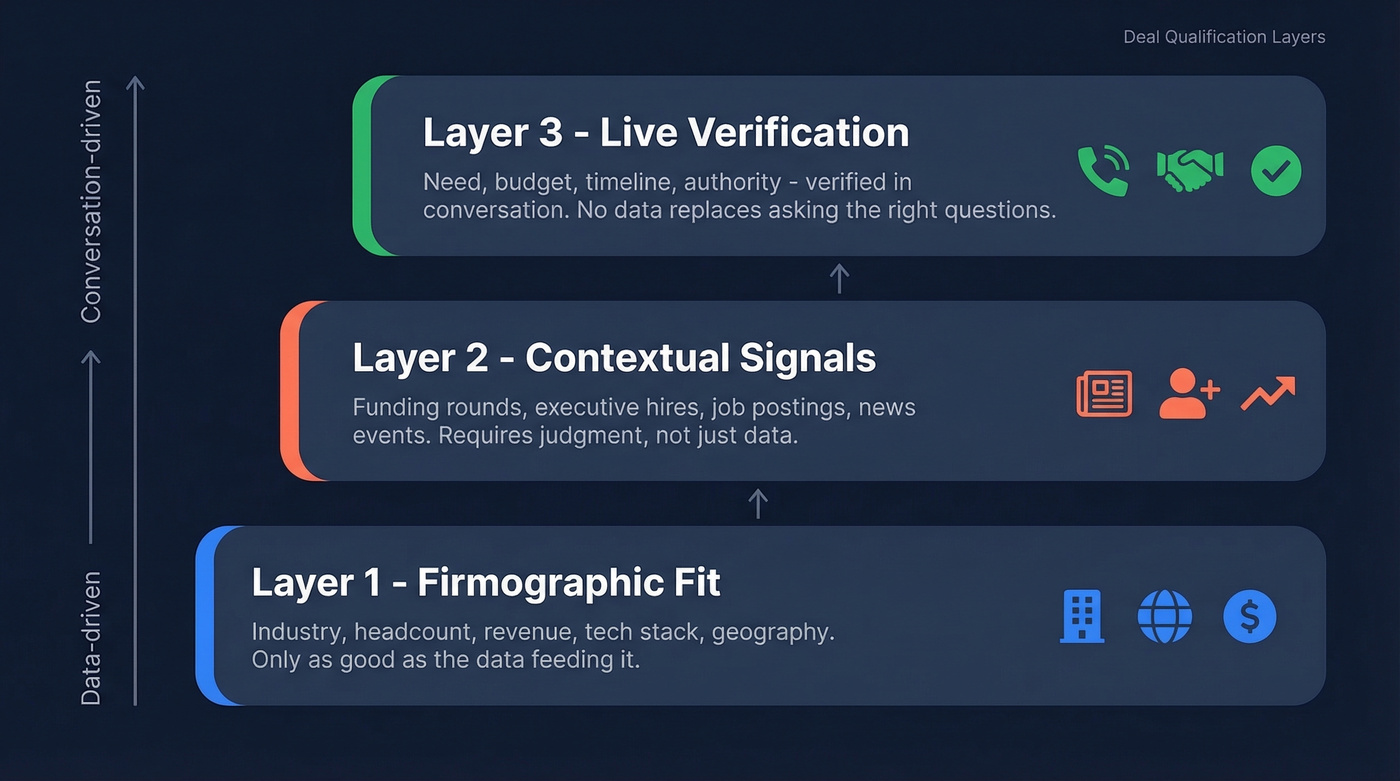
Layer 1 - Firmographic fit. Does this company match your ICP? Industry, headcount, revenue, tech stack, geography. This layer is only as good as the data feeding it. B2B contact data decays roughly 2% per month - within a year, up to 70% of a database becomes unreliable. Tools like Prospeo, with a 7-day data refresh cycle and 30+ search filters, keep firmographic inputs current so you're qualifying against reality rather than last quarter's org chart (more on firmographic filters and firmographic and technographic data).
Layer 2 - Contextual signals. Funding rounds, executive hires, job postings, news events. These suggest spend intent but are rarely explicit "buy now" indicators. A Series B doesn't guarantee they'll outsource. This layer requires judgment, not just data (especially if you're trying to track sales triggers).
Layer 3 - Live verification. Need, budget, timeline, authority - verified in conversation. This is where MEDDIC and SPICED live. No amount of data replaces asking the right questions and listening to what comes back. Stage advancement should be based on customer-verifiable outcomes, not self-reported CRM fields (a solid discovery questions bank helps here).

Your qualification scorecard is only as good as the data feeding it. B2B contact data decays 2% per month - that's stale org charts, wrong titles, and dead emails tanking your firmographic layer. Prospeo's 7-day refresh cycle and 30+ filters (intent, technographics, funding, headcount growth) keep Layer 1 airtight so reps qualify against real signals, not last quarter's guesses.
Kill unqualified deals earlier with data that's actually current.
Which Framework Should You Use?
| Framework | Best For | Deal Size | Cycle Length | Key Limitation |
|---|---|---|---|---|
| BANT | SMB, transactional | Under $10K | Under 30 days | Too shallow for complex deals |
| MEDDIC/MEDDPICC | Enterprise, complex | Over $50K | 90+ days | Heavy to implement |
| SPICED | SaaS, subscription | $10-100K | 30-90 days | Not ideal for every motion |
| CHAMP | Mid-market | $10-50K | 30-90 days | Less proven at scale |
| FAINT | No existing budget | Varies | 60+ days | Requires strong business-case skills |
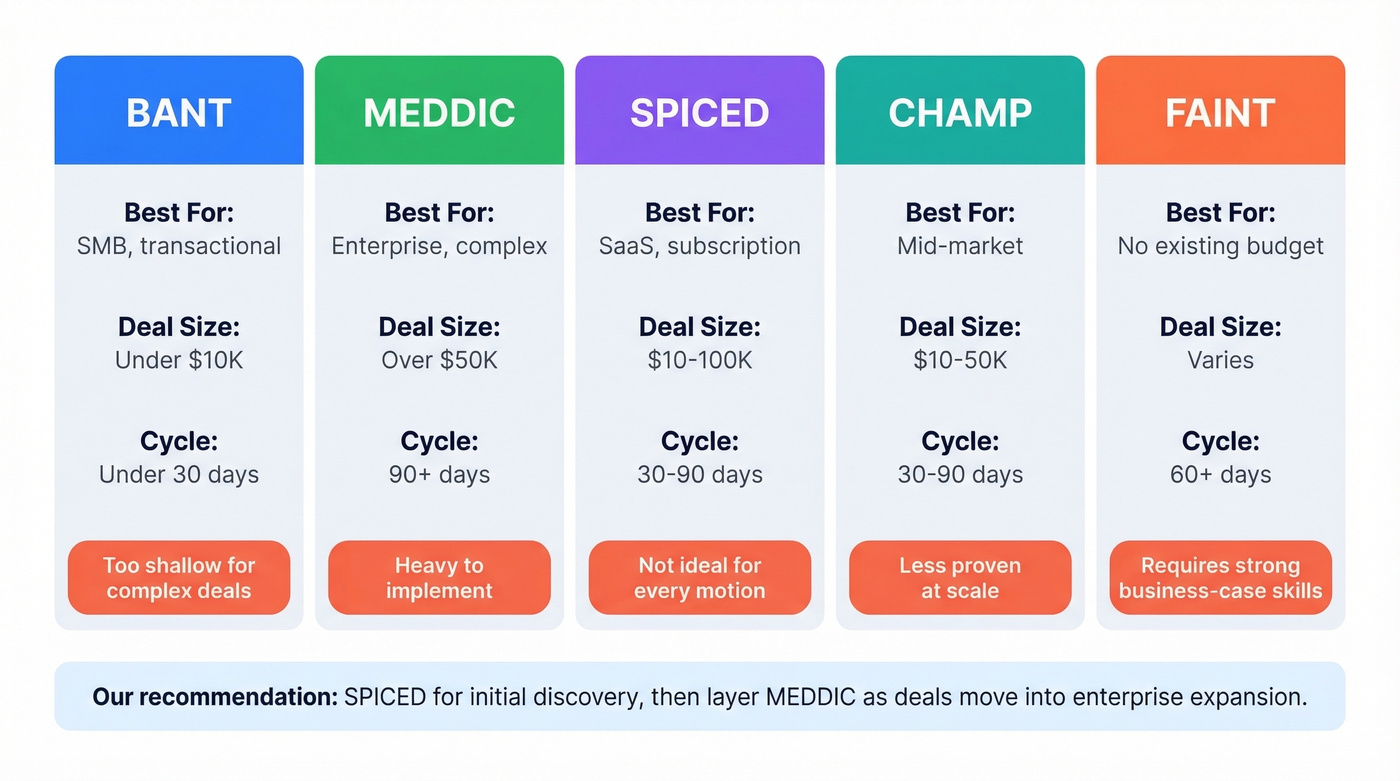
BANT was introduced at IBM in the 1950s for a world where budgets were pre-allocated and one person signed the check. In 2026, using BANT alone on enterprise deals is too shallow for complex buying committees and can push you to disqualify opportunities before a business case creates budget. It still works fine as a quick pre-filter for transactional sales. Skip it as your primary framework for anything above $10K.
For most SaaS teams, the best approach is a hybrid: SPICED for initial discovery, then layer MEDDIC as deals move into enterprise expansion (use a tighter set of MEDDIC discovery questions to keep it consistent). In our experience, this combination catches the deals BANT would kill prematurely while still forcing you to identify the economic buyer and quantify the pain (see MEDDPICC economic buyer).
Five Questions That Actually Work
1. Cost of Inaction: "What happens if you don't implement this in the next 6 months?" Forces the prospect to articulate urgency. If they can't, there probably isn't any.
2. The gut-check: "If we solve this and fit your budget, is there anything stopping you from moving forward?" This surfaces hidden objections - legal reviews, competing projects, a champion without real influence.
3. Direct budget discovery: "What's the expected investment for a project like this?" Straightforward, and you'd be surprised how often prospects just answer it.
4. Indirect budget discovery: "What was the investment for your existing setup?" Works when direct questions get deflected, because people are more comfortable talking about past spend than future commitments.
5. Decision process mapping: "Walk me through how your team evaluated and purchased your last tool in this category." Past behavior predicts future behavior better than hypotheticals. If their last purchase took nine months and four committee reviews, plan accordingly.
Build a Qualification Scorecard
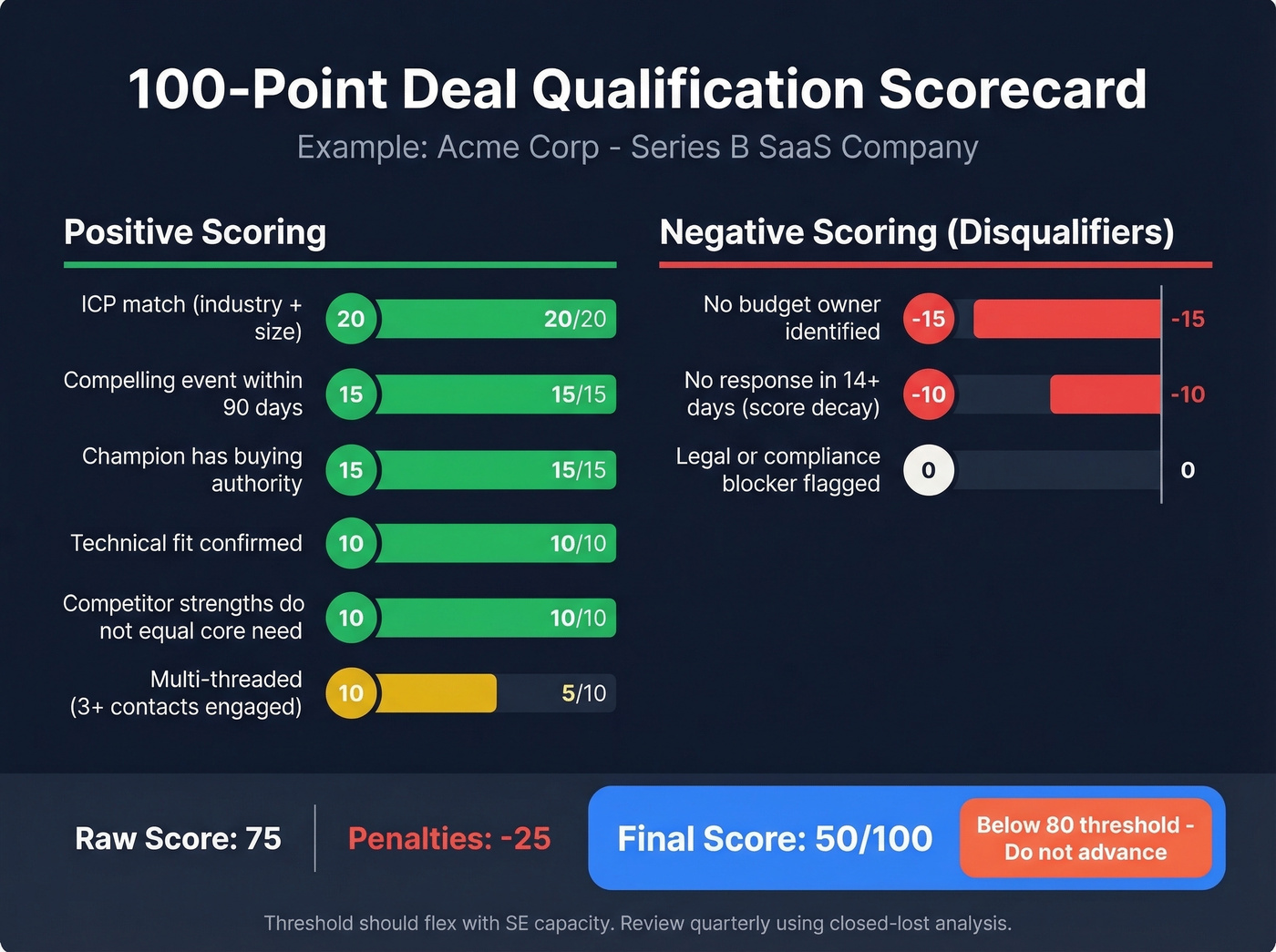
A 100-point scoring model gives you a repeatable, defensible way to evaluate deals. Structure it across three factors - Requirements fit, Budget alignment, and Competitive position - with columns for criteria, weight, completion, and points earned (this is basically data-driven selling applied to pipeline hygiene).
| Criteria | Weight | Score (1/0) | Points |
|---|---|---|---|
| ICP match (industry + size) | 20 | 1 | 20 |
| Budget owner identified | 15 | 0 | 0 |
| Compelling event within 90 days | 15 | 1 | 15 |
| Competitor strengths ≠ core need | 10 | 1 | 10 |
| Champion has buying authority | 15 | 1 | 15 |
The key most teams miss: negative scoring for disqualifiers. No budget owner identified? Subtract points. Competitor's strengths map better to the prospect's core requirements? That's a disqualify signal - don't hope your way through it, subtract more. No driving event? Red flag, not a neutral data point.
We've seen teams cut their unqualified demo rate in half just by adding negative scoring. It sounds simple, but it changes the entire conversation in pipeline reviews because reps can't hide behind "well, it scored a 60" when the scorecard actively penalizes missing information.
Score decay matters too. A deal that scored 85 three weeks ago but has gone silent should lose points automatically. Qualification isn't one-and-done - re-score at every stage.
An 80/100 threshold is a common handoff bar, but your threshold should flex with sales capacity. If SEs are drowning in low-quality demos, raise it. Review quarterly using closed-lost analysis.
Making Qualification Stick
This is where most orgs fail. They pick a framework, build the fields in Salesforce, mandate stage gates, and declare victory. Six months later, reps are filling MEDDPICC fields with "they need better data" and advancing every deal to Stage 3 (classic sales pipeline challenges).
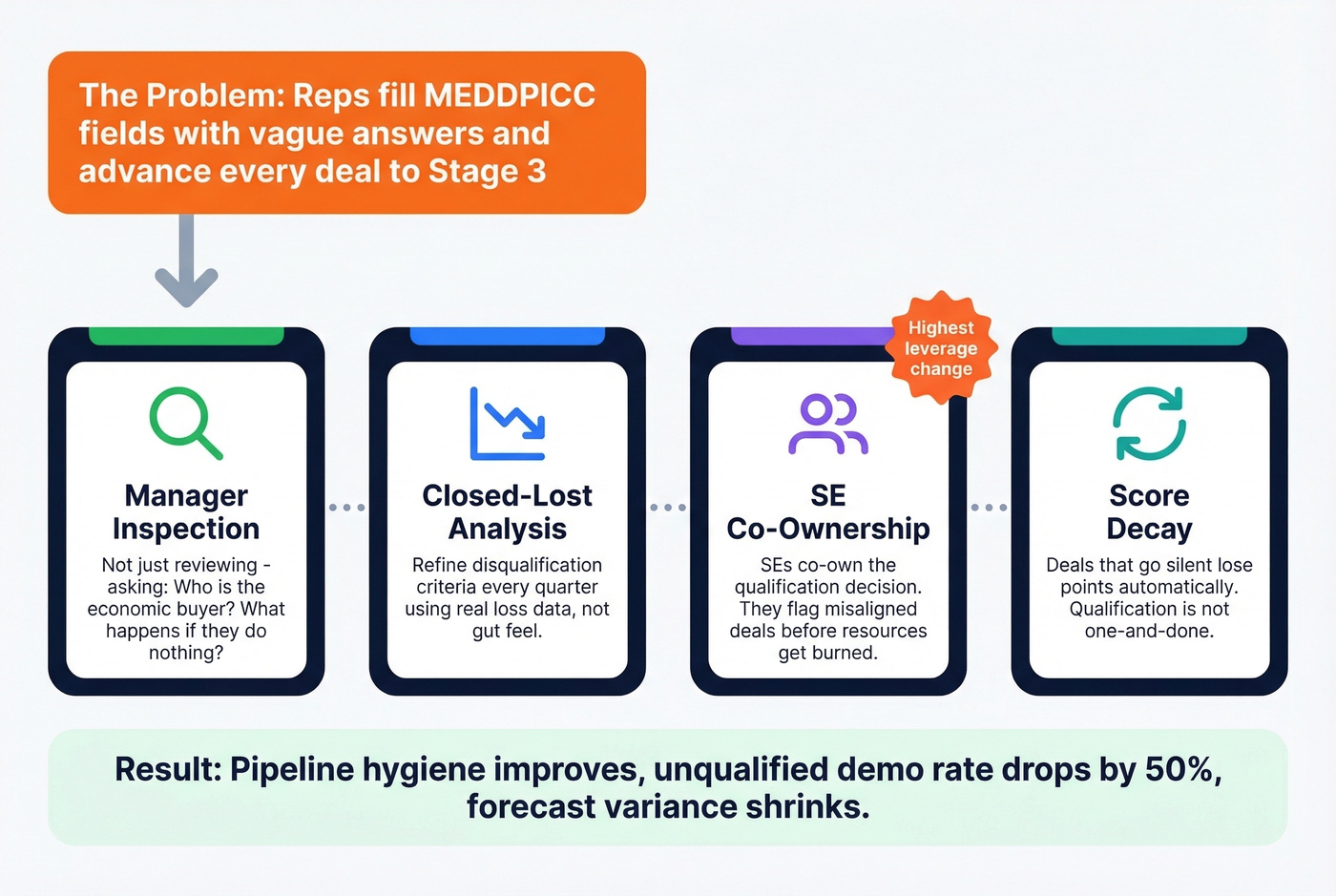
The consensus on r/salesengineers is blunt: stage gates alone don't change behavior. One poster summed it up - reps will always find a way to get an SE on a call if the gate is just a text field.
What actually works: manager inspection during pipeline reviews. Not "this looks good" but "tell me who the economic buyer is and what happens if they do nothing." Closed-lost analysis to refine disqualification criteria every quarter. And SE feedback loops - your solutions engineers know which deals are real before anyone else does.
Let's be honest about the single highest-leverage change we've seen: making SEs co-owners of the qualification decision, not just demo resources. When SEs have a formal role in evaluating opportunities, pipeline hygiene improves almost immediately because they flag misaligned deals before resources get burned. It's not a popular move with AEs. It works anyway.
You just built a 100-point scorecard. Now feed it verified data. Prospeo delivers 98% email accuracy, 125M+ verified mobiles, and 50+ enrichment data points per contact - so when you score for 'budget owner identified' or 'champion has buying authority,' you're reaching the right person on the first attempt, not bouncing at 35%.
Reach every stakeholder in the buying committee with 98% accurate contact data.
FAQ
What's the difference between lead qualification and deal qualification?
Lead qualification filters who you talk to - the MQL-to-SQL handoff based on ICP fit. Deal qualification filters what you invest time in, evaluating whether a live opportunity has the need, budget, timeline, and authority to close. Lead qualification is binary; opportunity qualification is scored and re-evaluated at every stage.
Is BANT still relevant in 2026?
As a quick pre-filter for transactional deals under $10K with short cycles, yes. For enterprise opportunities with multiple stakeholders where budget gets created after the business case, BANT alone is too shallow and will disqualify winnable opportunities too early. Use it as triage, then layer MEDDIC or SPICED for deeper evaluation.
How do you keep qualification data accurate over time?
B2B contact data decays roughly 2% per month. Use tools with frequent refresh cycles so your firmographic inputs stay current. When the data feeding Layer 1 goes stale, every downstream qualification decision inherits that error. Pair fresh enrichment data with quarterly closed-lost reviews to keep scoring criteria calibrated.