

How to Build a Demand Generation Funnel That Actually Converts
Most "demand generation funnels" are just lead gen funnels wearing a trench coat. Teams slap a new label on the same gated-ebook-to-SDR-call pipeline, wonder why conversion rates stall, and blame the content. The problem isn't content. It's architecture.
A real demand gen funnel has three jobs: create demand among out-of-market buyers, capture demand from in-market buyers, and expand revenue from existing customers. Most teams only do the middle one and call it a strategy. Let's fix that.
What Is a Demand Generation Funnel?
Demand generation and lead generation aren't synonyms. Demand gen builds awareness and preference among the vast majority of your market - the 99% who aren't actively buying right now. Lead gen captures intent from the 1% who are. A functional demand gen funnel does both, but most teams over-index on capture and starve creation.
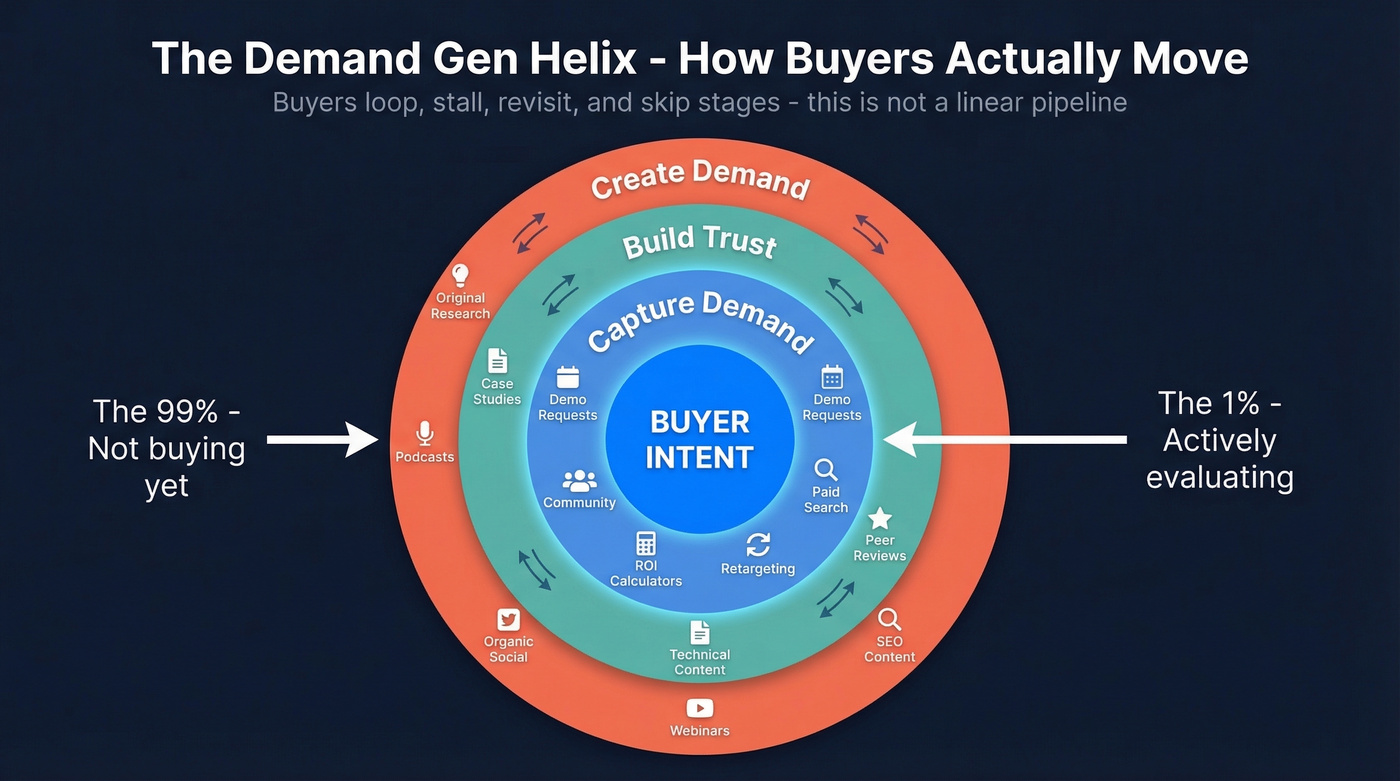
The traditional funnel diagram - awareness, consideration, decision, neat and linear - doesn't reflect how B2B buyers actually move. One practitioner on r/b2bmarketing proposed a "Marketing Helix" model with three layers orbiting intent: create demand on the outer ring, build trust in the middle, capture demand at the core. That framing is closer to reality. Buyers loop, stall, revisit, and sometimes skip stages entirely.
This isn't a pipeline you push people through. It's a system you build around how buyers already behave.
The Modern Buyer Journey
The data on how B2B buyers actually buy should make every marketer uncomfortable. The average B2B buying cycle runs 10.1 months, and first contact with a vendor doesn't happen until 61% of the journey is already complete. Your prospects are forming opinions long before they fill out a demo form.
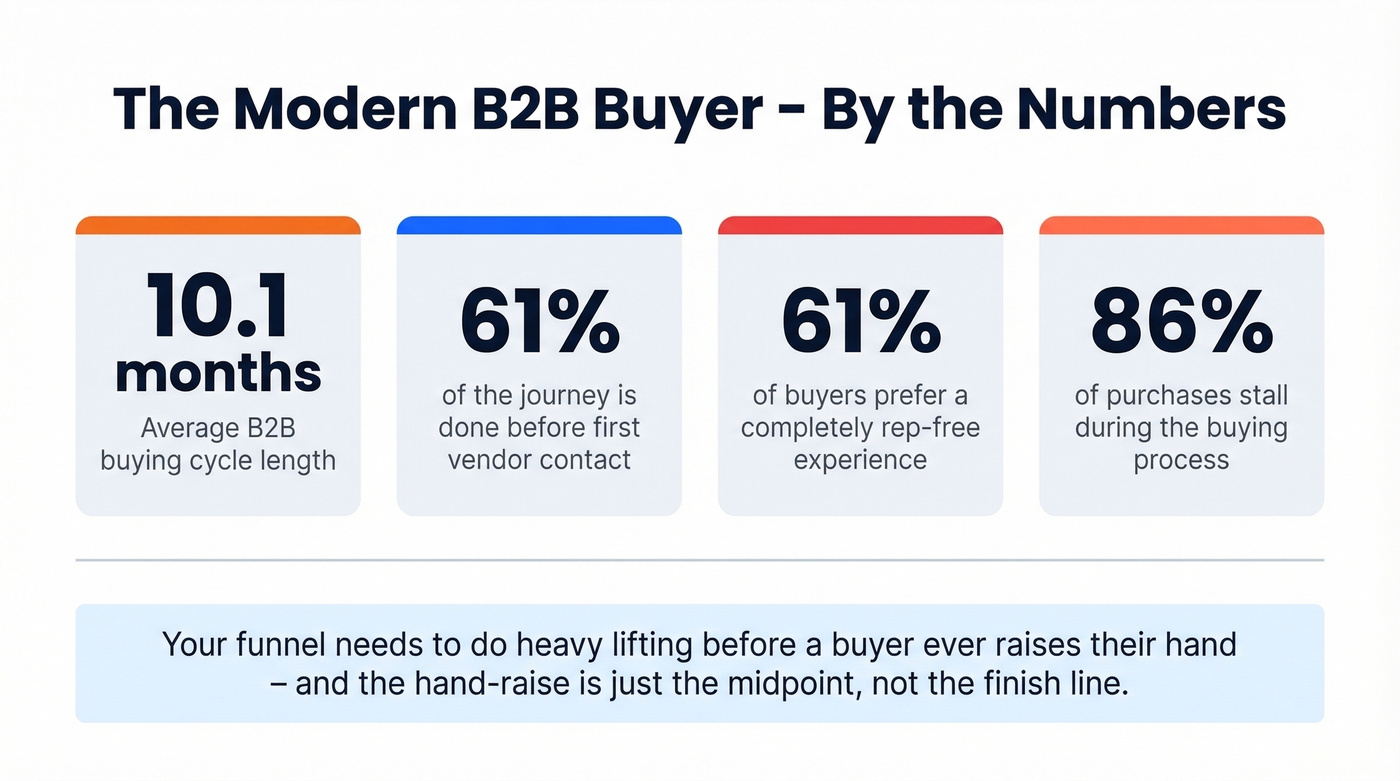
It gets worse. 61% of B2B buyers prefer a completely rep-free buying experience. 73% actively avoid suppliers who send irrelevant outreach. And even when buyers do choose a vendor, 86% of purchases stall during the process and 81% end up dissatisfied with the provider they selected.
These numbers mean your funnel needs to do heavy lifting before a buyer ever raises their hand - and that the hand-raise itself is just the midpoint, not the finish line. Much of this early influence happens in what some call the hidden demand funnel: the conversations, research, and peer recommendations that occur entirely outside your analytics.
Demand Gen Funnel Stages
Create Demand (Awareness + Education)
This is where you reach the 99% who aren't in-market yet. The goal isn't leads - it's mindshare.
Effective top-of-funnel content educates your ICP without asking for anything in return. Think original research, contrarian takes, and reusable frameworks - not gated PDFs that nobody reads after downloading. SEO-driven blog content, organic social, podcasts, webinars, and community participation all belong here. You're building preference so that when these buyers eventually enter a buying cycle, you're already on the shortlist.
Top-of-funnel account engagement - likes, shares, ad clicks, content downloads - helps you identify which accounts are warming up before they ever submit a form. Track these signals, but don't mistake them for intent.
- Entry criterion: Someone in your ICP encounters your brand
- Exit criterion: They can articulate what you do and why it matters
Capture Demand (Intent + Evaluation)
Now you're working with the 1% who are actively evaluating. Tactics shift to gated assets (only when the value justifies the gate), demo request forms, paid search on buyer-intent keywords, and retargeting sequences. Intent signals matter here - Bombora topic surges, job postings that signal a new initiative, tech stack changes visible through tools like Wappalyzer.
The content that converts at this stage is specific: ROI calculators, comparison guides, case studies, and technical deep dives that help buyers compare solutions and build internal consensus. Generic "why our category matters" content doesn't cut it anymore. Your buyer already knows the category matters. They need help choosing.
Speed-to-lead is critical. Directive recommends touching demo and pricing leads in under 5 minutes. Every hour you wait, conversion probability drops.
- Entry criterion: A demonstrated intent signal
- Exit criterion: A qualified meeting booked
Expand Revenue (Post-Sale)
Most funnel guides stop at "closed won." That's a mistake.
Expansion revenue - upsells, cross-sells, referrals - is the cheapest pipeline you'll ever build. Product-led onboarding sequences, customer community content, exclusive webinars, and co-created case studies all drive it. Track net revenue retention, expansion MRR, and NPS as funnel metrics, not just customer success metrics. This stage loops back into creating demand through case studies, referrals, and word-of-mouth - which means your best customers are also your best marketing channel.
Funnel Conversion Benchmarks
One of the biggest gaps in most demand gen content is actual numbers. Here's what First Page Sage found across their 2017-2025 dataset:
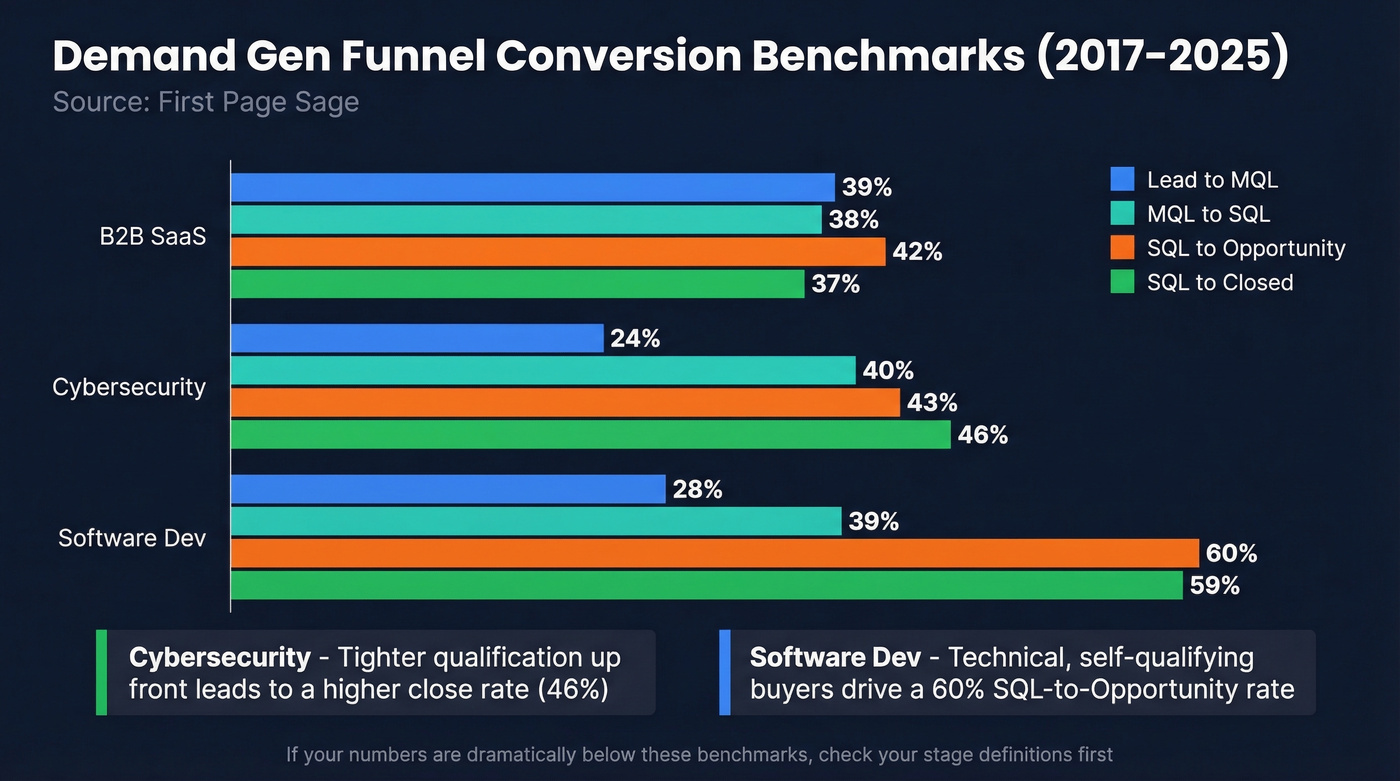
| Industry | Lead-MQL | MQL-SQL | SQL-Opp | SQL-Closed |
|---|---|---|---|---|
| B2B SaaS | 39% | 38% | 42% | 37% |
| Cybersecurity | 24% | 40% | 43% | 46% |
| Software Dev | 28% | 39% | 60% | 59% |
A few things jump out. Cybersecurity has a lower Lead-MQL rate (24%) but a higher SQL-Closed rate (46%), which suggests tighter qualification up front pays off downstream. Software development's 60% SQL-Opportunity rate is remarkable - likely driven by more technical, self-qualifying buyers who know exactly what they need before they talk to sales.
Here's the thing: if your numbers are dramatically below these benchmarks, check your stage definitions first. A "lead" that's really just a newsletter subscriber will tank your Lead-MQL rate and make the whole funnel look broken when it's actually a labeling problem. A healthy AQA-to-SQA conversion rate sits above 20%; if you're below that, your qualification criteria need work.
For proof that this approach works at scale: Cognism cut lead generation efforts by 90% in 2021 and shifted to value-first demand gen. Revenue went from $2M to $6M in six months, with an 85/15 revenue split favoring inbound over outbound.

Capturing demand from in-market buyers means reaching them with verified contact data before your competitors do. Prospeo tracks 15,000 intent topics via Bombora, layers in technographic and job-change signals, and delivers 98% accurate emails - so your capture stage actually converts.
Stop losing in-market buyers to bad data and slow enrichment.
The Dark Funnel
The dark funnel is everything your analytics can't see. Private Slack groups, DMs, podcast mentions, word-of-mouth recommendations, conversations at conferences, and research that never touches your website.
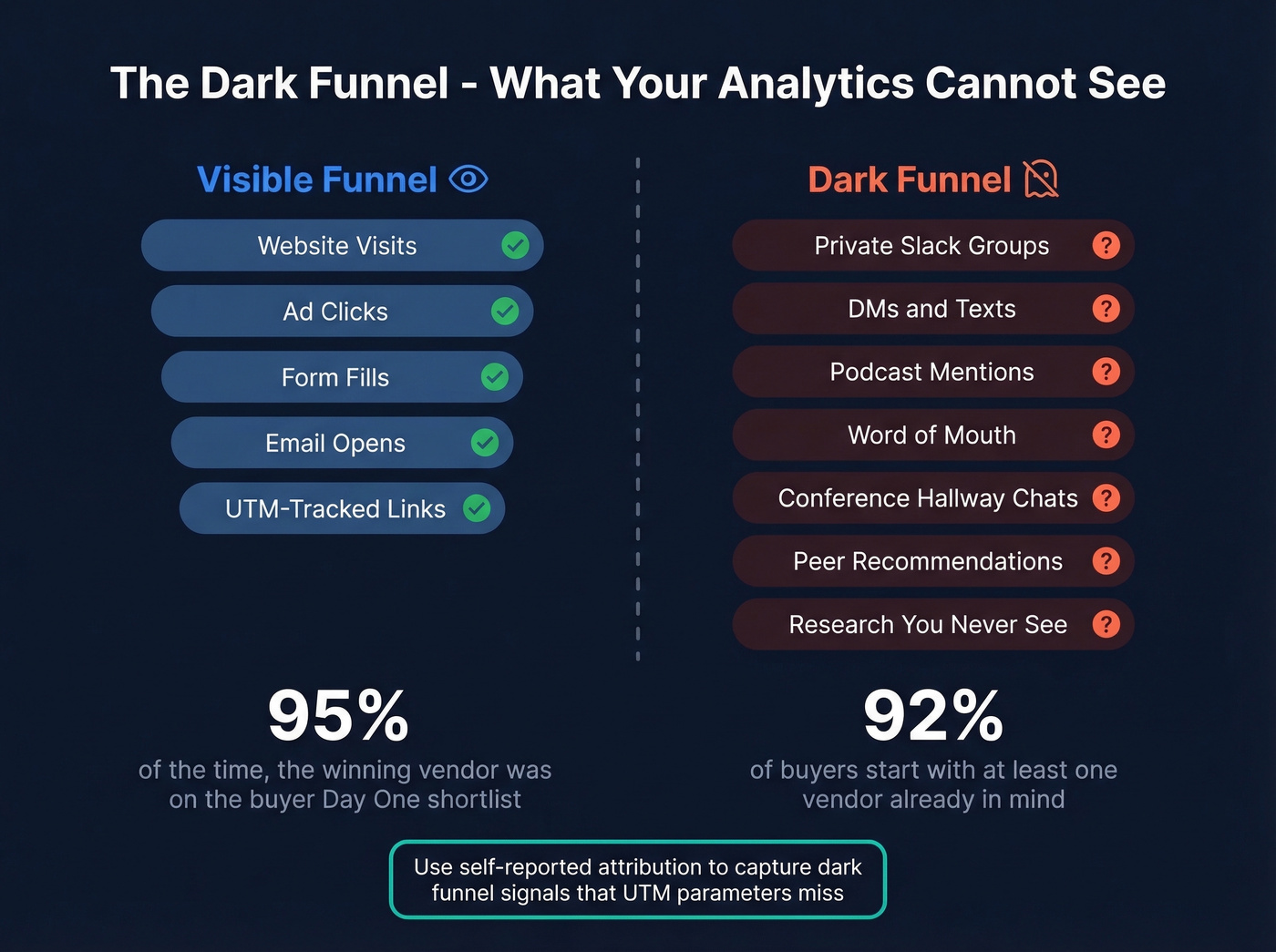
The numbers are stark: the winning vendor is on the buyer's Day One shortlist 95% of the time. 92% of buyers start with at least one vendor already in mind. By the time someone fills out your demo form, the race is mostly over.
This doesn't mean attribution is useless - it means attribution is incomplete. Self-reported attribution ("How did you hear about us?") captures dark funnel signals that UTM parameters miss. Use both. Trust neither completely.
Five Mistakes That Kill Your Funnel
Killing Programs After 90 Days
Demand gen takes time. One practitioner on r/marketing shared their experience - three months of zero inbound opportunities. They kept going. By month six: 9 qualified opportunities, 3 new contracts at 10x ACV, and a 7-figure pipeline. If they'd pulled the plug at 90 days, they'd have concluded the strategy failed.
If your leadership can't commit to a 6-month evaluation window, you don't have a strategy problem - you have a leadership problem. Demand gen is a bet on compounding returns. Pulling the plug at 90 days is like planting a tree and digging it up after a month to check if the roots are growing.
MQL/SQL Definition Mismatch
When marketing calls something an MQL and sales rejects it as unqualified, you don't have a funnel problem - you have a definitions problem. 69% of buyers report inconsistencies between what they read on a vendor's website and what sellers tell them. That's a definitions problem manifesting as a trust problem.
Set SLAs: sales accepts or rejects SALs within 2 business days with a documented reason. Report at the account level, not the contact level, to avoid inflating numbers with multiple contacts from the same company.
Ignoring Data Quality
Your MQL count means nothing if 30% of emails bounce. Bad data inflates funnel metrics, wastes SDR time, and erodes domain reputation. We've seen teams celebrate a "record MQL month" only to discover half the list was undeliverable. Verify contacts before they enter the pipeline - not after your SDRs have already burned hours on dead addresses.
If you want a deeper breakdown, start with data quality and email bounce rate benchmarks.
Under-Investing in Distribution
The consensus among practitioners is clear: great content is only 20% of the equation. The other 80% is distribution. You can write the best whitepaper in your industry, but if nobody sees it, it doesn't exist. The Rule of 7 still applies - prospects need repeated exposure before your brand registers. Pick two or three distribution channels and show up relentlessly.
If you're leaning on organic, treat B2B content marketing and SEO-driven demand capture as first-class funnel levers.
Ending at Conversion
If your funnel diagram stops at "closed won," you're leaving the cheapest pipeline on the table. Expansion, upsell, and referral motions belong in the funnel. We've watched teams obsess over top-of-funnel volume while ignoring a customer base that was practically begging to buy more. A full-funnel approach treats post-sale as a revenue stage, not an afterthought.
For the post-sale motion, align on upsell vs cross-sell and track renewal rate alongside NRR.
Build Your Campaign Strategy in 90 Days
Here's an adapted version of Directive's 8-step plan that we've found works for most B2B teams:
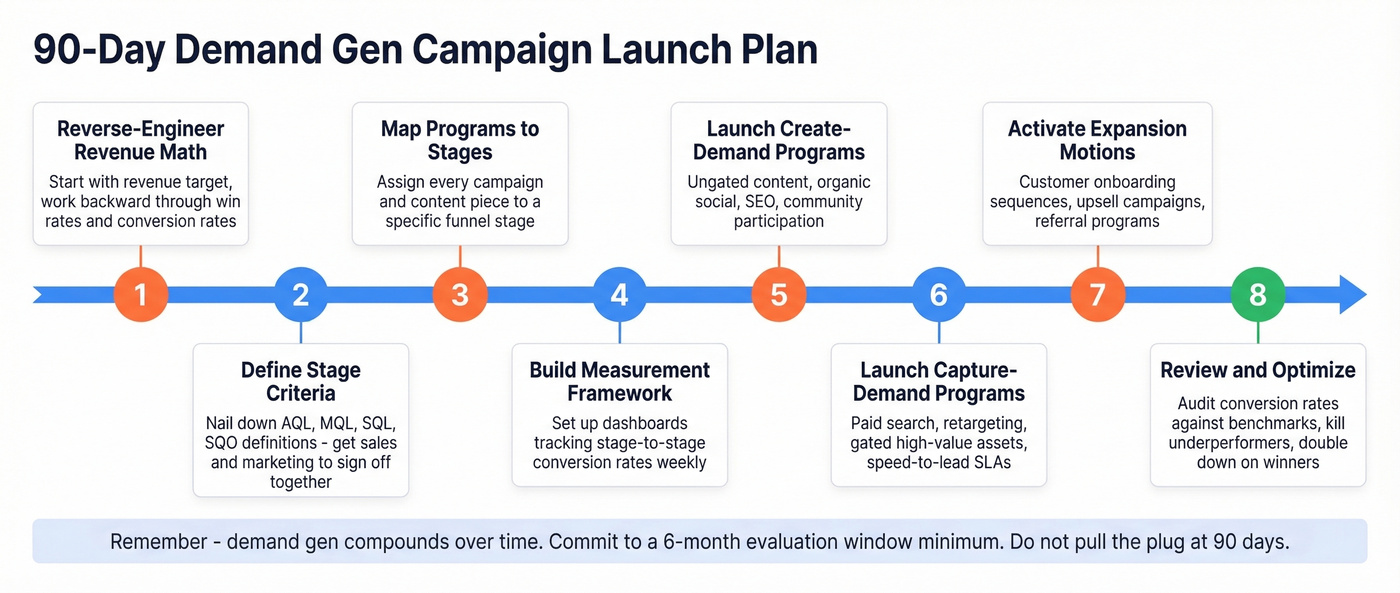
Step 1: Reverse-engineer revenue math. Start with your revenue target and work backward through win rates, opportunity values, and conversion rates to determine how many leads each stage needs. If you can't do this math, you aren't ready to run demand gen - you're guessing.
Step 2: Define stage criteria. Nail down what AQL, MQL, SQL, and SQO mean for your business. Write it down. Get sales and marketing to sign off in the same room.
If you need a starting point, use a lead scoring model and a clear lead status taxonomy.
Step 3: Map programs to stages. Assign every campaign, content piece, and channel to a specific funnel stage. If a program doesn't map cleanly, it's probably unfocused.
Step 4: Build infrastructure. CRM hygiene, enrichment, verification, intent data, and routing rules. This is the plumbing that makes everything else work. For enrichment and verification, Prospeo's API returns 50+ data points per contact at a 92% match rate - plug it into Salesforce, HubSpot, or Clay and let clean data flow through the funnel automatically.
If you're building lists in Clay, this Clay list building workflow helps avoid dirty inputs.
Step 5: Launch creation engines. Pick one ungated channel - a podcast, a newsletter, a social presence - and commit to 6 months of consistent output.
Step 6: Instrument attribution. Enforce UTM governance, replace free-text CRM fields with picklists, and audit routing accuracy weekly. Add a "How did you hear about us?" field for dark funnel capture.
Step 7: Run 30-day tests. Test one variable at a time across channels, messaging, and offers. Document everything.
Step 8: Evaluate and reallocate. After 90 days, you'll have enough signal to shift budget. Teams in nascent categories may need 70%+ allocated to demand creation; PLG companies with high intent volume can weight toward capture. Some teams also run separate creation and capture funnels in parallel to avoid starving one motion while scaling the other.
Metrics That Matter
Don't track everything. Track the metrics that connect to revenue:
| Metric | Formula | Target Range |
|---|---|---|
| Lead-MQL Rate | (MQLs / New Leads) x 100 | 24-39% |
| CPL | Marketing Spend / New Leads | $50-$400 (channel-dependent) |
| Win Rate | (Won / Closed Opps) x 100 | ~47% average |
| Sales Cycle | Avg days, first touch to close | 10.1 months (B2B avg) |
Paid search CPLs for competitive B2B SaaS keywords often land around $150-$400+, while organic and community-driven leads often come in under $50-$100. The important thing isn't hitting a specific CPL target - it's understanding CPL relative to the revenue each channel produces.
If your Lead-MQL rate is 15% in B2B SaaS versus the 39% benchmark, the problem is likely stage definitions or data quality, not lead volume. Tie these metrics back to the stage benchmarks from earlier and diagnose from there. A well-instrumented demand generation funnel makes these gaps visible. A poorly instrumented one hides them behind vanity metrics.
For a fuller KPI set, use a dedicated funnel metrics framework and keep an eye on pipeline health.
Your funnel benchmarks collapse when bounce rates spike and direct dials go to voicemail. Prospeo refreshes 300M+ profiles every 7 days - not every 6 weeks - and delivers 125M+ verified mobiles with a 30% pickup rate. That's how teams like Snyk added 200+ opportunities per month.
Feed your demand gen funnel data that converts at every stage.
FAQ
What's the difference between demand generation and lead generation?
Demand gen creates awareness and preference among the 99% of your market that isn't actively buying. Lead gen captures intent from the 1% who are. A functional funnel does both - but most teams over-index on capture and wonder why pipeline dries up when they stop running paid campaigns.
How long before a demand gen funnel produces pipeline?
Expect 3-6 months before measurable pipeline materializes. One practitioner reported zero inbound opportunities for 3 months, then 9 qualified opportunities and a 7-figure pipeline by month 6. Commit to a timeframe upfront and resist the urge to kill programs early - awareness investments compound as accounts move into capture stages.
How do I know if my funnel conversion rates are good?
Benchmark against industry data: for B2B SaaS, a healthy Lead-MQL rate is ~39% and MQL-SQL is ~38% per First Page Sage's 2017-2025 dataset. If you're significantly below these, check stage definitions and data quality first - make sure your contacts are actually reachable before you blame the funnel itself.
What is the dark funnel and why does it matter?
The dark funnel is every buying signal your analytics can't track - Slack conversations, podcast mentions, peer referrals, and conference hallway chats. It matters because 95% of winning vendors are on the buyer's Day One shortlist. Add self-reported attribution fields alongside UTM tracking to capture these invisible touchpoints.