

Drip Campaign Best Practices That Actually Move Metrics in 2026
A RevOps lead we know launched a 12-email drip sequence last quarter to 40,000 contacts. Open rates looked great. Click rates looked fine. Then she checked the bounce report: 9.2%. Her ESP throttled the domain within 48 hours, and the remaining eight emails never sent. Every drip campaign best practice in the world won't save you if the foundation is broken.
With 392.5 billion emails sent daily in 2026, inbox competition isn't theoretical - it's the reason most automated sequences underperform. But the ones that work? They work dramatically well. An analysis of 183,000+ brands shows automated flows averaging a 5.58% click rate versus 1.69% for one-off campaigns. Placed order rates tell an even sharper story: 2.11% for flows versus 0.16% for campaigns. That's roughly a 13x difference per send.
What You Need (Quick Version)
Three things separate high-performing sequences from inbox noise: verified data before you send a single email, deliverability hygiene most guides ignore, and cadence matched to your industry rather than guesswork. The ten practices below cover all three - plus templates, benchmarks, and the deliverability rules that Google, Yahoo, and Microsoft now enforce. Short on time? Start with practices #1, #3, and #10.
What Is a Drip Campaign?
A drip campaign is a sequence of automated emails triggered by a specific behavior or event - a signup, a cart abandonment, a trial expiration, an inactivity window. The key word is "triggered." A drip isn't a newsletter blast sent to your whole list on Tuesday. It's a sequence that starts when a contact does (or doesn't do) something, then guides them toward a specific outcome over days or weeks.
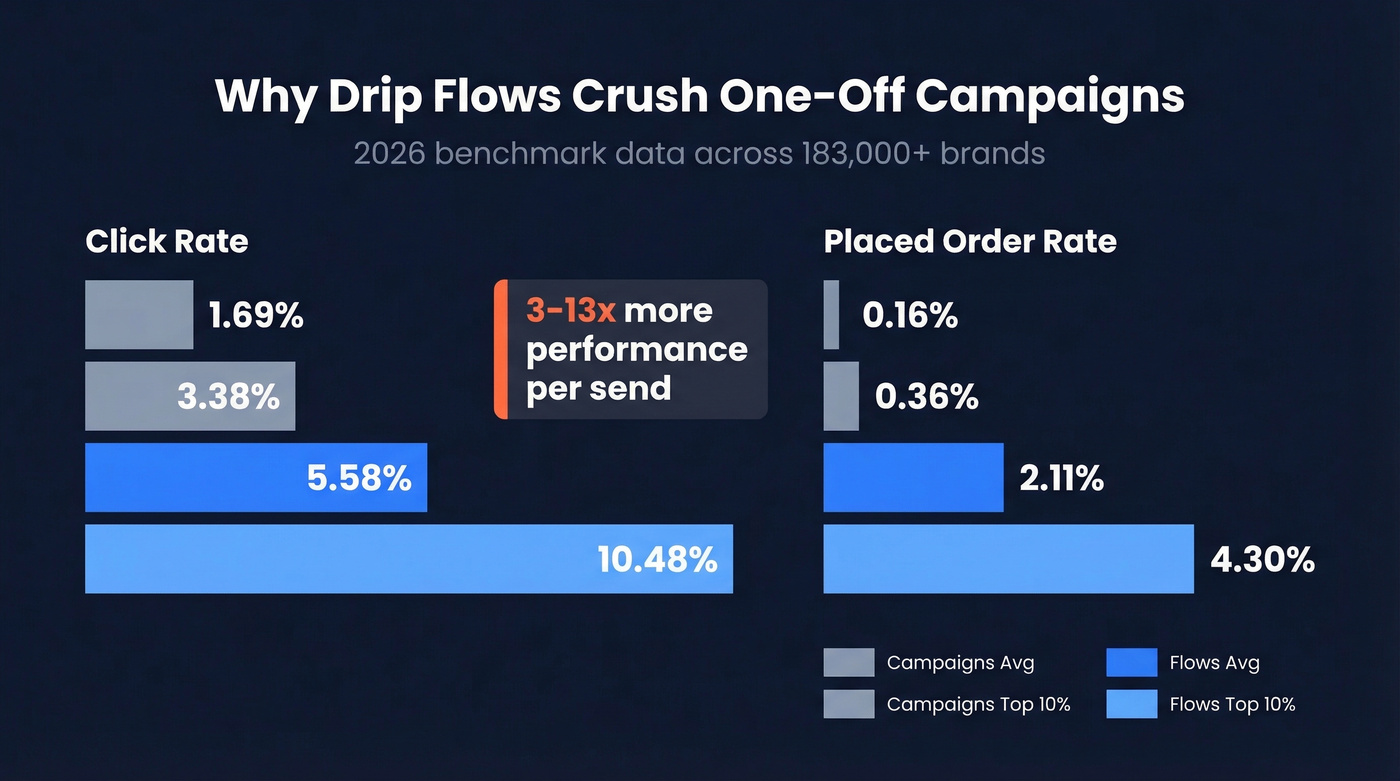
That behavioral trigger is what makes drips outperform campaigns so dramatically. Here's the gap, per 2026 benchmark data:
| Metric | Campaigns (avg) | Campaigns (top 10%) | Flows (avg) | Flows (top 10%) |
|---|---|---|---|---|
| Click rate | 1.69% | 3.38% | 5.58% | 10.48% |
| Placed order | 0.16% | 0.36% | 2.11% | 4.30% |
Open rates are omitted here - Apple Mail Privacy Protection inflates them to the point of uselessness for flow-level comparison.
If you're still sending one-off blasts when you could be running behavioral flows, you're leaving 3-13x performance on the table.
10 Practices That Actually Work
1. Segment Before You Write
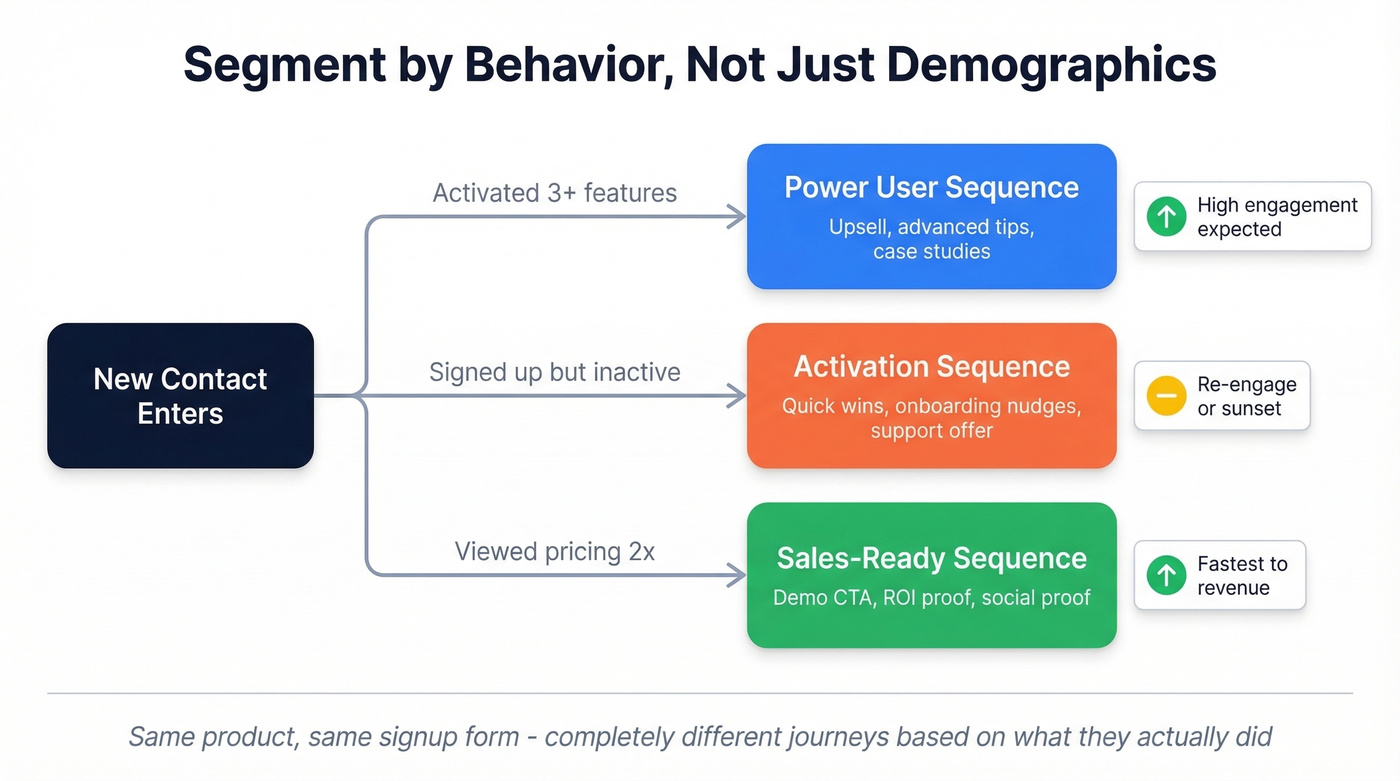
Dropping {first_name} into a subject line isn't personalization. It's a merge tag. Real segmentation means grouping contacts by behavior, intent, or stage - not just demographics. A trial user who activated three features gets a different sequence than one who signed up and vanished. A returning visitor who viewed pricing twice gets a different nudge than someone browsing blog posts.
The practitioner consensus on r/EmailWhisperers is blunt: automation without real personalization is the most common mistake in email marketing right now. Recommendations that aren't tied to actual behavior feel generic, and recipients treat them accordingly - with the delete key.
This is also where AI earns its keep in 2026. Tools with AI-driven send-time optimization and dynamic content blocks can personalize at a scale that manual segmentation can't match. Use AI to determine when and what variant to send; use your brain to determine what to say and to whom. The strategy is still yours. The execution can be automated.
Tight segmentation is the single biggest factor separating high converting drip campaigns from sequences that get ignored. If you want a deeper framework, start with intent signals and an Ideal Customer Profile scoring model.
2. One Goal, One CTA
Pick a single conversion goal for the entire sequence - book a demo, start a trial, complete onboarding. Every email in that sequence pushes toward that one outcome. Each individual email gets one CTA. Not three buttons competing for attention.
Here's what not to do: "Check out our blog, also here's a webinar, oh and we have a new feature, plus follow us on social." Emails with a single CTA can increase click-through rates by up to 371% compared to emails with multiple competing links. That stat sounds aggressive, but the directional truth is obvious. Fewer choices mean more clicks. (If you want examples, see email call to action best practices.)
3. Match Cadence to Industry
Sending frequency is the fastest way to either accelerate engagement or trigger an unsubscribe wave. 69% of users who unsubscribe cite receiving too many emails as the reason. But "too many" varies wildly by industry and context.
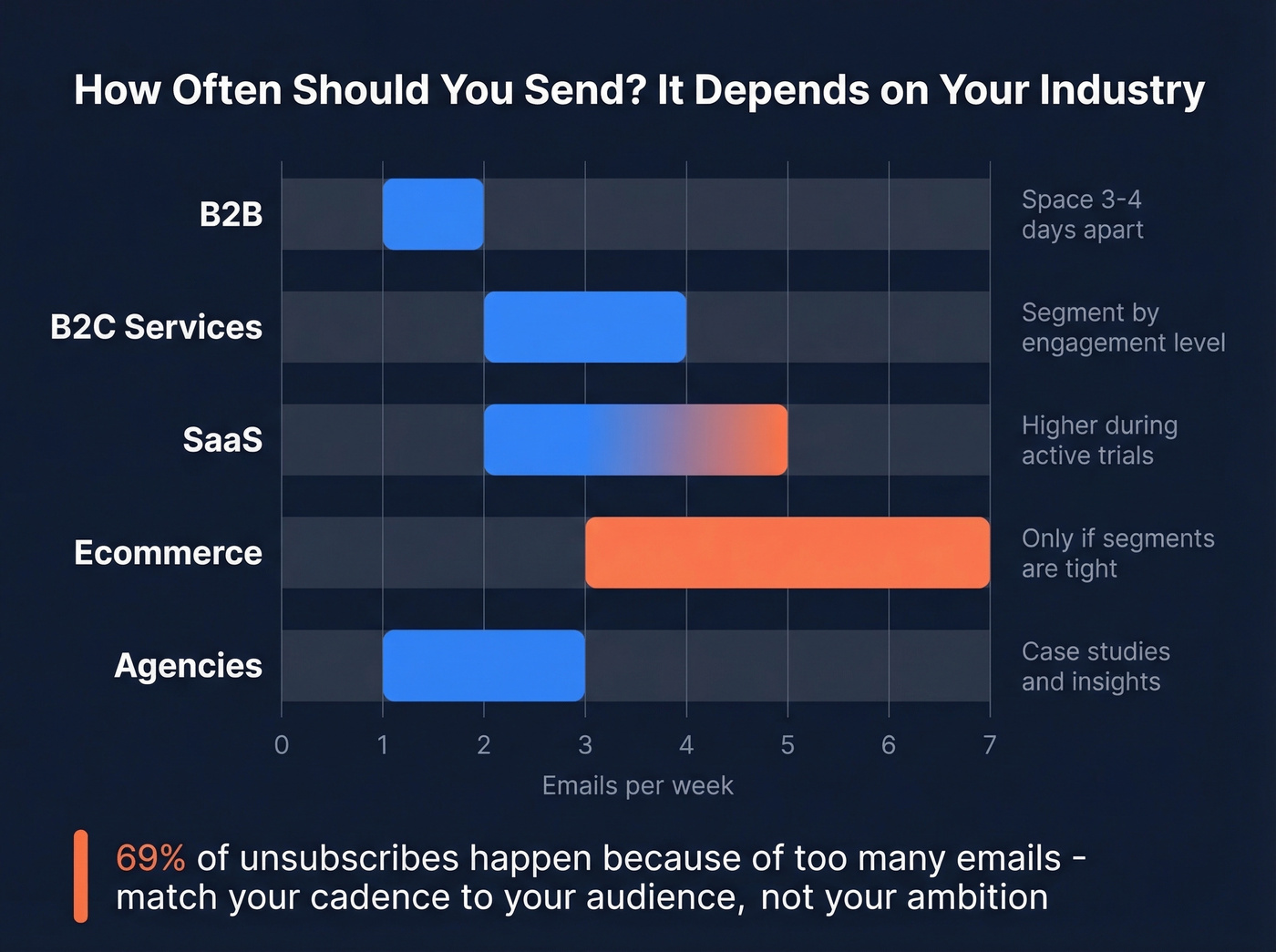
| Industry | Recommended Frequency | Notes |
|---|---|---|
| B2B | 1-2/week | Space 3-4 days apart |
| B2C services | 2-4/week | Segment by engagement level |
| SaaS | 2-5/week | Higher during active trials |
| Ecommerce | 3-7/week | Only if segments are tight |
| Agencies | 1-3/week | Focus on case studies, insights |
These aren't rigid rules. A SaaS trial conversion sequence can justifiably send daily emails in the final week before expiration. A B2B nurture sequence sending daily will get flagged as spam. Context matters more than any universal cadence rule.
Timing matters too. Cold email data shows Monday launches and Wednesday follow-ups consistently outperform other day combinations. That pattern holds for drip sequences - front-load your week and follow up mid-week when inboxes are lighter. (More data here: best time to send cold emails.)
4. Write the Full Sequence First
Most teams build drip campaigns one email at a time. They write email one, publish it, then write email two next week. The result is a sequence that repeats itself, contradicts its own messaging, or has no narrative arc.
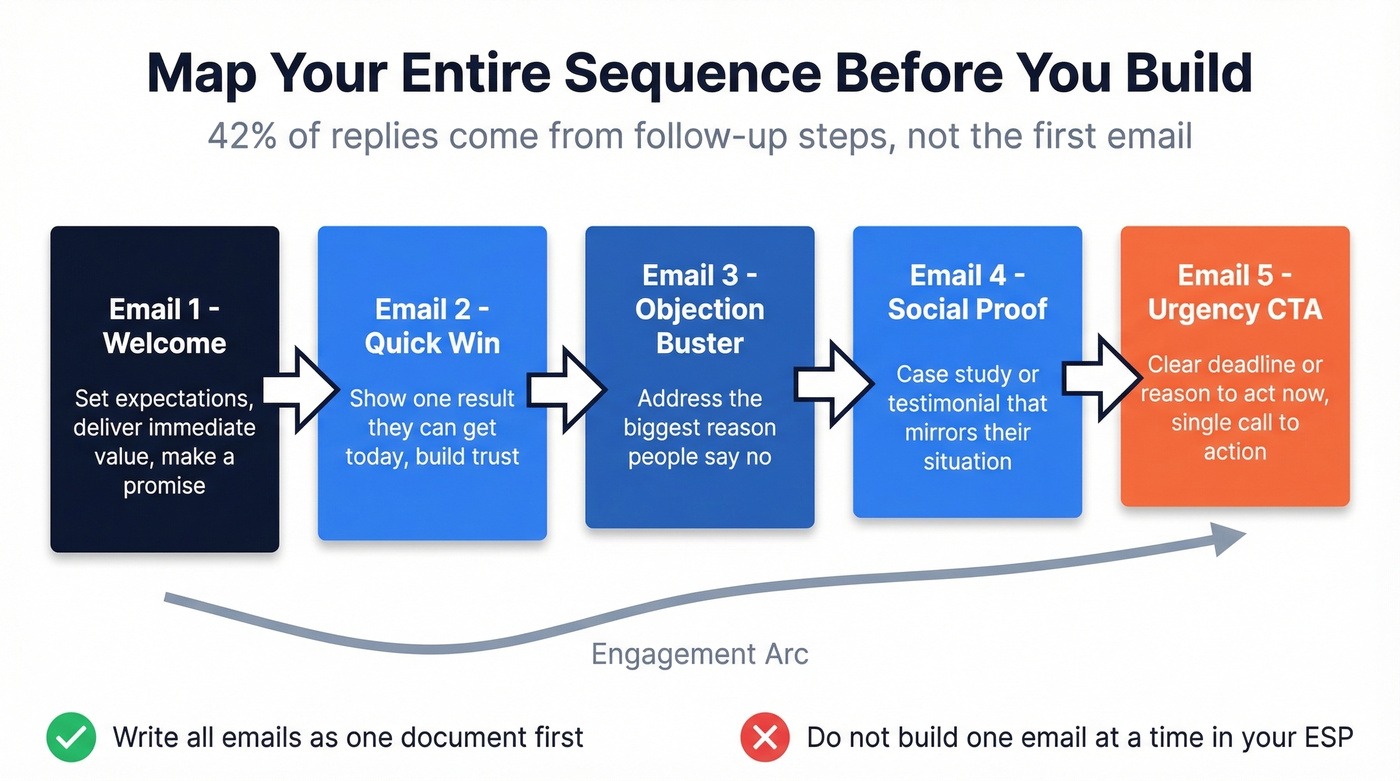
Write the entire sequence as a single document before you build anything in your ESP. Map the story: what does the contact know after email one? What objection does email three address? Where does urgency enter? This approach catches redundancy early and ensures each email earns its place.
Aim for 4-6 emails per sequence. Welcome series typically run 3-5, trial conversion needs about 4, and re-engagement flows work well at 3. Start shorter and extend based on engagement data - you can always add emails, but you can't un-send the ones that caused unsubscribes. And here's a stat worth internalizing: 42% of replies come from follow-up steps, not the first email. The sequence is the strategy, not just the opener. (If you need copy starters, use these sales follow-up templates.)
5. Nail the First Email
Welcome emails generate 86% higher open rates than standard marketing emails. That first touchpoint sets the tone for every email that follows. Use it to set expectations - tell the recipient what's coming, how often, and what they'll get out of it.
Don't waste this moment on a generic "thanks for signing up." Deliver immediate value: a quick-start guide, a relevant resource, or a single action that gets them closer to their goal. The first email is your best shot at training the recipient to open the next one. The best drip sequences treat email one as a promise - and every subsequent email as proof that the promise was worth trusting. (For structure, borrow from emails that get responses.)
6. Build Exit Criteria
Every drip sequence needs clear rules for when contacts leave:
- Goal met: Contact converts (books demo, starts trial, makes purchase) - immediately suppress from the sequence
- Negative signal: Contact unsubscribes, marks as spam, or bounces - remove and suppress
- Re-entry rules: Define whether a contact can re-enter the same sequence (usually no) and what happens next (move to a different flow)
- Time-based exit: If a contact hasn't engaged after the full sequence, move them to a re-engagement flow - don't just keep dripping
Without exit criteria, you'll send upgrade emails to people who already upgraded. We've seen this happen more often than anyone wants to admit. (This is also a sequence management problem, not just a copy problem.)
7. Optimize for Mobile
Over half of emails are opened on mobile devices. If your drip emails aren't mobile-optimized, you're losing the majority of your audience before they read a word.
Use a minimum 14px font size for body text - anything smaller is unreadable on a phone. Tap targets need at least 44x44 pixels because fat fingers need room. Keep subject lines under 50 characters to avoid mobile truncation, stick to single-column layouts, and write preview text that complements the subject line rather than repeating it. (If you want more testing ideas, see email preview text A/B testing.)
8. A/B Test on Conversions
Let's be honest about opens as a metric: they're unreliable. Apple Mail Privacy Protection pre-fetches tracking pixels, inflating open rates across the board. Bot activity from security filters does the same. One marketer sending millions of emails per month stopped A/B testing on opens entirely because the data was too polluted to be useful.
Test what matters downstream: reply rates, click-through to a specific page, demo bookings, trial activations, revenue. These metrics are harder to inflate and directly tied to the outcome your sequence exists to drive. Test one variable at a time - subject line OR send time OR CTA copy - and run tests long enough to reach statistical significance. (If you need a library, use these email subject line examples.)
9. Clean Your List on a Schedule
Clean your list every 3-6 months. Remove non-engagers after 6-12 months, but only after running a re-engagement sequence first. Keep your bounce rate below 2% - that's the threshold where ESPs start paying attention to your sender reputation.
Skip this if you think "we'll clean it eventually" counts as a plan. Every month you delay, your bounce rate creeps up, your sender score drops, and your deliverability erodes. It's the slowest way to kill a drip campaign, and the hardest to diagnose once it's happening. (More detail: email bounce rate.)
10. Verify Data Before You Drip
None of the previous nine practices matter if your emails never reach the inbox. Roughly 10-15% of marketing emails get filtered, flagged, or rejected before a human ever sees them. Bounces above 2% trigger ESP warnings. Above 5%, you're looking at throttling or suspension - exactly what happened to the RevOps lead in our opening story.
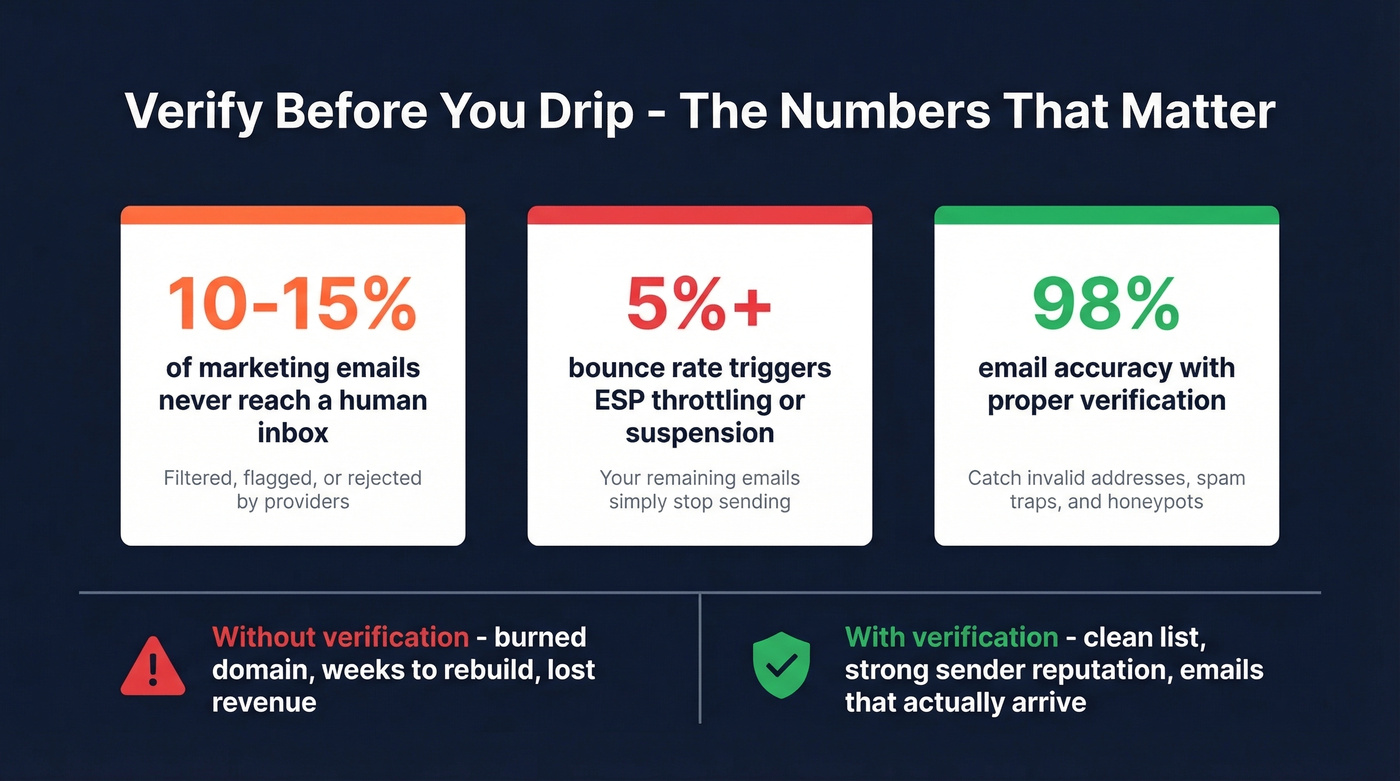
The fix is unsexy but non-negotiable: verify every email address before it enters a drip sequence. Prospeo's 5-step verification catches invalid addresses, spam traps, and honeypots that destroy sender reputation - all at 98% email accuracy. Upload a CSV, run verification in bulk, and export a clean list in minutes. At roughly $0.01 per email, it's the cheapest insurance your drip campaign can have. The alternative - rebuilding a burned domain - takes weeks and costs far more. (If you’re building a full deliverability stack, add email reputation tools too.)

Deliverability Rules Most Guides Skip
Great copy and perfect segmentation mean nothing if your emails land in spam. Inbox providers cracked down hard starting in 2024, and the rules are now non-negotiable. Treating deliverability as a prerequisite - not an afterthought - is what separates teams that scale from teams that stall.
Authentication is table stakes. Every sender needs SPF and DKIM configured correctly. For anyone sending more than 5,000 emails per day, DMARC is required - Google and Yahoo enforced this starting February 2024, and Microsoft followed with similar requirements in 2025, tightening through 2026.
The DMARC rollout path matters. Start at p=none (monitor only), move to p=quarantine (flag suspicious mail), then p=reject (block unauthenticated mail). Don't skip straight to reject - you'll block legitimate emails from misconfigured subdomains. (If you need the technical breakdown, see DMARC alignment and an SPF record example.)
One-click unsubscribe is mandatory. Promotional emails must include a List-Unsubscribe header that lets recipients opt out in one click. Opt-outs must be processed within two days. Making unsubscribe difficult doesn't retain subscribers - it generates spam complaints.
Spam complaint thresholds are tighter than you think. Google's target is 0.1% complaint rate. The hard ceiling is 0.3%. Above that, your deliverability craters. For context, if you send 10,000 emails and 30 people hit "report spam," you're at the danger line.
A few more rules that trip up even experienced teams: warm up new domains gradually - don't send 50,000 emails from a fresh domain on day one. Avoid spam-trigger words in subject lines like "free," "guaranteed," "act now," and "congratulations." And as third-party cookies continue to disappear, your first-party email data becomes even more valuable, which makes protecting your sender reputation through verification and authentication doubly important. (More: email deliverability guide.)
BIMI (Brand Indicators for Message Identification) displays your logo in the inbox but requires DMARC at quarantine or reject level plus a Verified Mark Certificate. Nice-to-have, not a must-have.

That RevOps lead's 9.2% bounce rate? It happens when drip campaigns run on unverified data. Prospeo's 5-step email verification delivers 98% accuracy - so your 12-email sequence actually reaches all 12 inboxes. At $0.01 per email, cleaning your list costs less than one throttled domain.
Fix your foundation before you write a single drip email.
Templates You Can Steal
These four sequence templates cover the most common use cases. Adapt the timing and subject lines to your product and audience, but the structure is proven.
Welcome / Onboarding
| Day | Subject Line Pattern | Purpose |
|---|---|---|
| Day 0 | "Welcome to [Product]" | Deliver value, set expectations |
| Day 1 | "Quick tip: get started with [Feature]" | Drive first activation |
| Day 3 | "Did you know? [Benefit]" | Educate on key value prop |
| Day 5 | "Need help getting set up?" | Plain-text help offer |
Set this up as an event-based trigger on signup, not a list-based trigger. The sequence should fire the moment a contact is created, not on a batch schedule.
Trial-to-Paid Conversion
| Timing | Subject Line Pattern | Purpose |
|---|---|---|
| Trial -7 days | "Keep your momentum going" | Reinforce value realized |
| Trial -3 days | "Your trial ends in 3 days" | Create urgency |
| Trial -1 day | "Last chance to upgrade" | Final push |
| Trial +1 day | "Your trial expired. What's next?" | Win-back attempt |
Trigger this relative to the trial expiration date, not the signup date. If your ESP supports property-based triggers, use the trial_end_date field. This is one of the highest-impact sequences you can build - trial conversion flows are often the single best automated sequence a SaaS team runs in terms of direct revenue attribution.
Abandoned Cart Recovery
| Timing | Subject Line Pattern | Purpose |
|---|---|---|
| +1 hour | "You left something behind" | Gentle reminder |
| +24 hours | "Still thinking it over?" | Address objections |
| +72 hours | "[Item] is selling fast" | Scarcity + final nudge |
Fire on the cart abandonment event. Suppress immediately if the purchase completes between emails.
Re-engagement
| Timing | Subject Line Pattern | Purpose |
|---|---|---|
| 60-90 day trigger | "We miss you - here's what's new" | Re-introduce value |
| +3 days | "Is this still the right fit?" | Qualify intent |
| +7 days | "Last email from us (unless...)" | Sunset warning |
Trigger on an inactivity threshold - no opens or clicks in 60-90 days. Anyone who doesn't engage after the sunset email gets suppressed from all marketing flows. No exceptions.
Real Examples That Work
Huckberry's cart recovery emails read like a helpful nudge from a friend, not a desperate "COME BACK" plea. The tone is casual, the imagery is aspirational, and there's no guilt-tripping. Match your brand voice, not a template's voice.
AllTrails' upsell sequence frames the paid tier as an "enhanced experience" rather than listing what the free tier lacks. It's a subtle but powerful distinction - you're gaining something, not being punished for not paying.
Strava's trial-end emails combine urgency with feature education. Instead of just saying "your trial is ending," they remind you of specific features you used and what you'll lose. Make the loss concrete and personal.
Section's re-engagement emails focus on aspirational outcomes - where you could be in your career if you re-engaged with the platform. They don't lead with "we noticed you haven't logged in." Lead with the future, not the absence.
Mistakes That Kill Performance
Automation without personalization. Behavioral triggers are the starting point, not the finish line. If your "personalized" product recommendations aren't tied to actual user behavior, recipients notice - and disengage.
Over-sending. That 69% unsubscribe-due-to-frequency stat bears repeating. When in doubt, space emails further apart. You can always increase frequency for engaged segments.
Ignoring authentication. SPF, DKIM, and DMARC aren't optional anymore. Skipping them is the fastest way to land in spam, and no amount of great copy fixes a deliverability problem.
Never updating sequences. The "set-and-forget" trap is real. Review your drip sequences quarterly. Check for outdated links, stale offers, and messaging that no longer matches your product. We do this internally and still catch embarrassing stuff every time.
Dripping to unverified addresses. Every invalid email in your sequence chips away at your sender reputation. Verify in bulk before any address enters your ESP - bad addresses should get flagged before they ever touch a drip sequence.
Benchmarks: What Good Looks Like
The campaigns-vs-flows performance gap we covered earlier tells the story. Here's what to monitor for health, and the targets to aim for.
If your automated flows are clicking above 5.58%, you're performing at or above average across 183,000+ brands. Aim for the top 10% threshold of 10.48%. Below 3%? Revisit segmentation and CTA clarity before you start tweaking subject lines. The problem is almost never the subject line.
Here's the thing: most teams obsess over open rates and subject line hacks when their real problem is they're sending the right email to the wrong segment - or the wrong email to everyone. Fix targeting first. Copy optimization is a rounding error compared to segmentation.
Health thresholds to monitor:
- Unsubscribe rate: below 2% is healthy for most B2B programs
- Bounce rate: below 2% protects sender reputation. Remember the 9.2% bounce rate from our opening story? That's what happens when you skip verification.
- Spam complaints: below 0.1% is the target, 0.3% is the ceiling
Industry-specific open rates for campaigns - clothing & accessories at 33.1%, home & garden at 32.5% - are directional at best. Apple MPP inflates open tracking, so treat opens as a rough signal and optimize on clicks and conversions instead. Teams that follow these drip campaign best practices consistently outperform those chasing vanity metrics.
Segmentation is practice #1 for a reason - and it's only possible with rich contact data. Prospeo returns 50+ data points per contact, including buyer intent signals across 15,000 topics, technographics, job changes, and headcount growth. Build drip segments based on real behavior and context, not just a merge tag.
Stop segmenting on guesswork. Start segmenting on 50+ verified data points.
FAQ
How many emails should a drip campaign have?
Most sequences perform best with 4-6 emails. Welcome series run 3-5, trial conversion needs about 4, re-engagement works at 3. Start shorter and extend based on engagement data - 42% of replies come from follow-up steps, so cutting too early leaves conversions on the table.
How often should I send drip emails?
B2B sequences work best at 1-2 per week spaced 3-4 days apart. SaaS can push 2-5 during active trials. Ecommerce handles 3-7 if segments are tight. When you're uncertain, space further apart and increase frequency only for engaged segments.
What's a good click rate for automated flows?
The average across 183,000+ brands is 5.58%. Top 10% hit 10.48%. Below 3% means the issue is segmentation or CTA clarity, not subject lines - fix targeting before you rewrite copy.
How do I stop drip emails from landing in spam?
Authenticate your domain with SPF, DKIM, and DMARC. Keep spam complaints below 0.1%. Verify your email list before launching any sequence - bulk verification catches spam traps and honeypots before they damage your sender score. Warm up new domains gradually, and always include a one-click unsubscribe header.
What makes high converting drip campaigns different?
The biggest differentiator is segmentation depth combined with verified data. High converting drip campaigns target tight behavioral segments with a single CTA per email, verify every address before sending, and use exit criteria to suppress contacts the moment they convert or disengage. Structure matters more than clever copywriting.