

Email Introduction Examples That Actually Get Replies
You sent 30 introduction emails last week and got zero replies. The average cold email reply rate sits at 3.43%, so silence isn't unusual - but it's not inevitable either. Meanwhile, 16.9% of emails never even reach the inbox due to deliverability issues, and another 10.5% land in spam before anyone sees your writing.
Most email introduction examples floating around are bloated, vague, and written by people who haven't sent a cold email in years. Top performers break 10% reply rates consistently. The gap between them and everyone else isn't talent - it's structure, length, and a few copy rules most people ignore.
What You Need (Quick Version)
Three things separate intro emails that get replies from the ones that get archived:
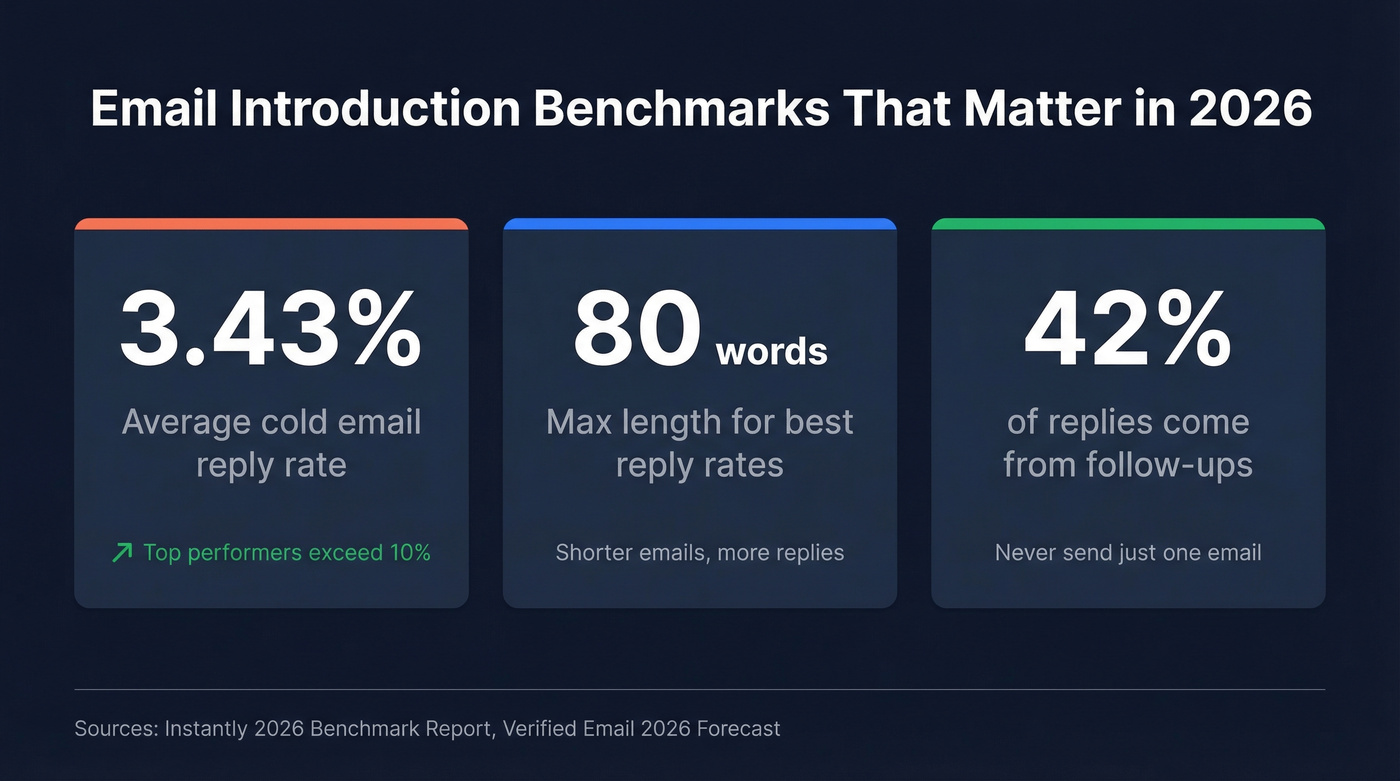
- Pick one structure, swap only the hook and CTA per scenario. Stop rewriting from scratch every time.
- Keep every intro under 80 words. That's where the best reply rates live.
- Always send at least one follow-up. 42% of replies come after the first email.
| Scenario | Jump to | When to use |
|---|---|---|
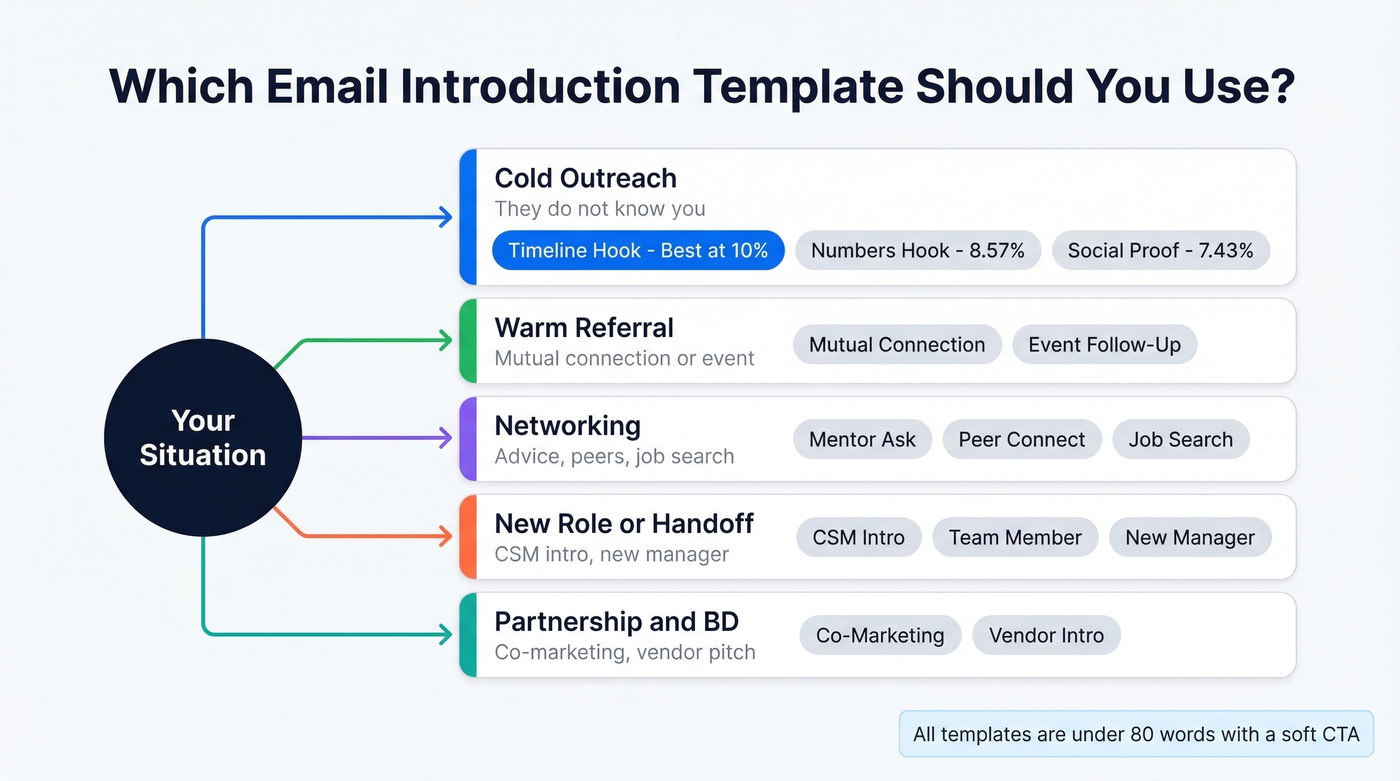
| Cold outreach | Cold Outreach Intros | Reaching prospects who don't know you |
| Warm referral | Warm Referral Intros | Mutual connection or event follow-up |
| Networking | Networking Intros | Advice, peer connection, job search |
| New role / handoff | New Role Intros | CSM intro, new manager, account handoff |
| Partnership / BD | Partnership Intros | Co-marketing, vendor, supplier pitch |
2026 Benchmarks for Intro Emails
The Instantly 2026 benchmark report analyzed billions of cold email interactions and found clear patterns. Average reply rate: 3.43%. Top quartile hits 5.5%+. Top performers exceed 10%. The difference comes down to hook type, email length, and follow-up discipline.
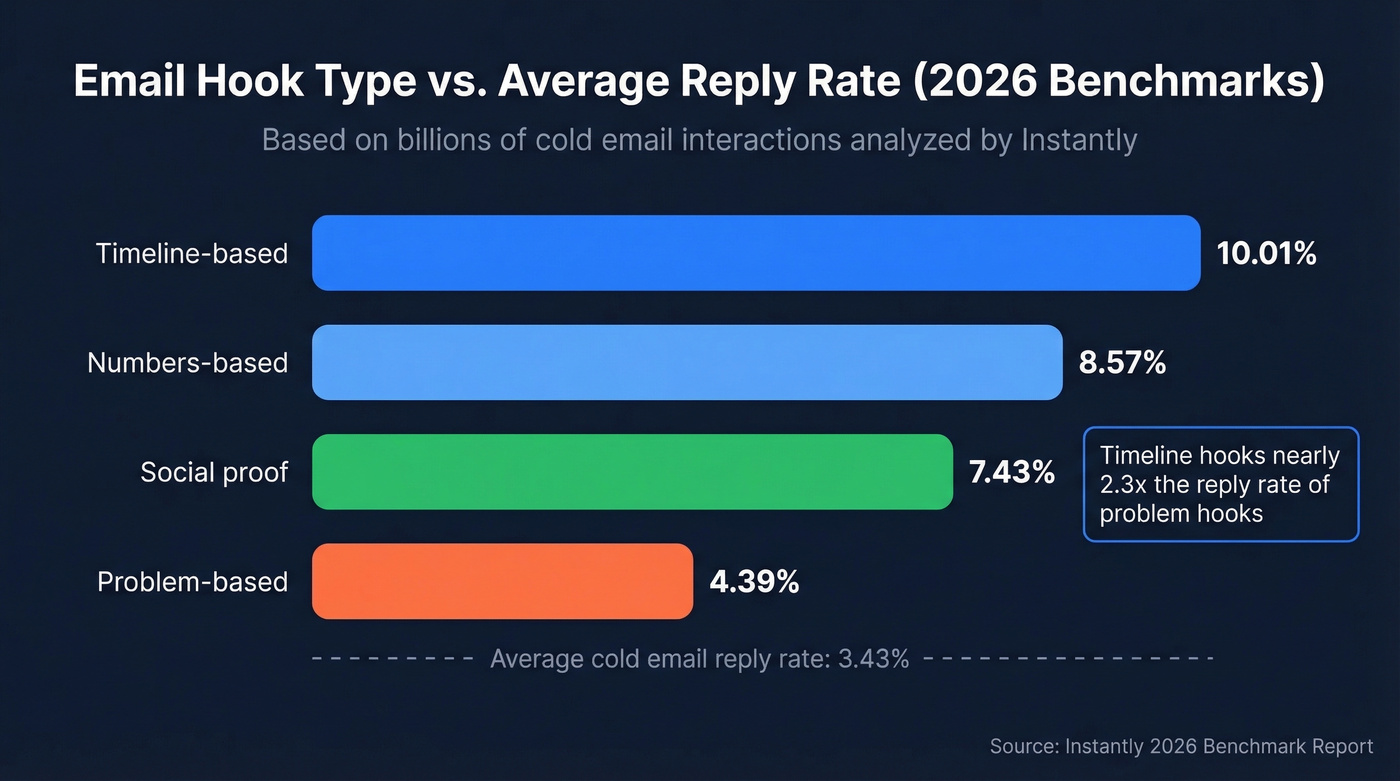
58% of all replies come from the first email. The remaining 42% come from follow-ups - so if you're sending one email and moving on, you're leaving almost half your results on the table. Tuesday and Wednesday are peak reply days, with Wednesday pulling the highest numbers.
The hook you open with matters more than anything in the body:
| Hook Type | Avg Reply Rate |
|---|---|
| Timeline-based | 10.01% |
| Numbers-based | 8.57% |
| Social proof | 7.43% |
| Problem-based | 4.39% |
Timeline hooks ("Before Q3 planning wraps...") nearly double problem-based hooks. Keep that in mind as you pick templates below.
Anatomy of a High-Performing Intro Email
Every high-performing introduction email has six parts. Miss one and reply rates drop.
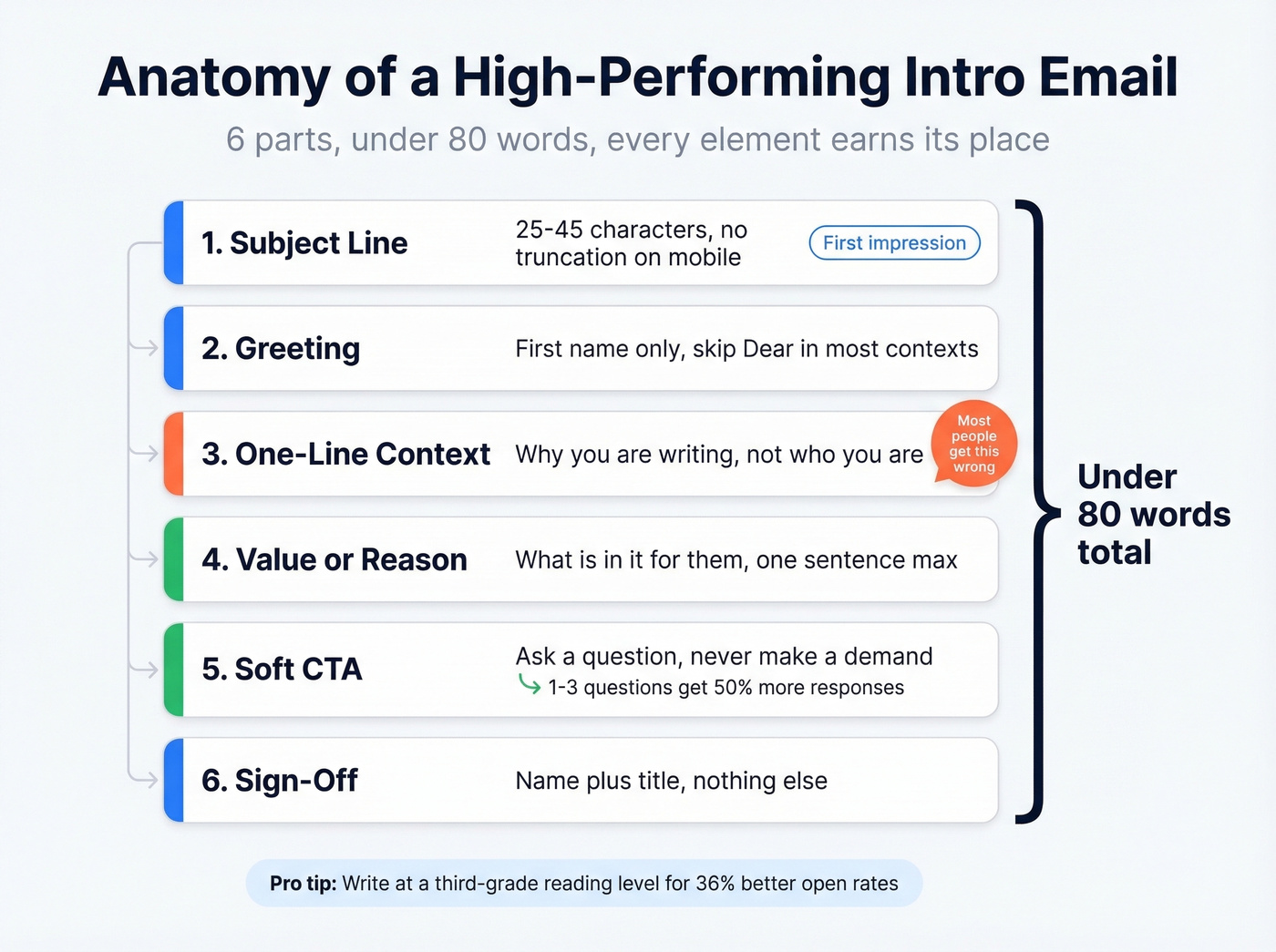
- Subject line - 25-45 characters; longer gets truncated on mobile
- Greeting - first name, skip "Dear" in most Western contexts (see greeting rules)
- One-line context - why you're writing, not who you are
- Value or reason - what's in it for them (tighten this with USP examples)
- Soft CTA - a question, not a demand (use these email CTA best practices)
- Sign-off - name + title, nothing else (use best email sign-offs)
Don't waste your opening line on "My name is..." - your name is in the signature and the "From" field. A proven cold email framework: personalize with something real the recipient did or wrote, then ask a question. Emails with 1-3 questions get 50% more responses than emails without any.
Here's the thing most people miss: a third-grade reading level outperforms college-level writing on both open rate and response rate - 36% better open rate and 17% higher response rate versus high-school-level writing. Short words. Short sentences. No jargon.
Side by side:
❌ "Dear Mr. Johnson, My name is Sarah Chen and I am a Senior Account Executive at Acme Corp. I am reaching out because I believe our platform could potentially help your organization streamline its operational workflows and drive efficiencies across your sales team..."
✅ "Hi Mark - saw your team just opened a London office. We helped Brex scale EMEA outbound in 6 weeks. Worth a 10-min call this week?"
The second one is 26 words. The first is much longer and still hasn't said anything specific.
20+ Introduction Email Templates by Scenario
Every template below is under 80 words, has a labeled hook type, and includes a subject line. Copy, paste, swap the brackets. If you want more variations, start with these professional email introduction templates.
Cold Outreach Intros
Template 1 - Timeline Hook (10.01% avg reply rate)
Subject: Before [Q3 planning / renewal / event]
Hi [First Name] - [Company] hits [milestone/deadline] in [timeframe]. Teams in [their industry] typically lose [X hours/dollars] on [problem] during that window.
We helped [similar company] cut that by [result] last quarter.
Would a 10-minute call before [date] make sense?
[Your name]
Timeline hooks are the highest-performing hook type in the 2026 benchmarks - urgency without pressure. Only use this if you have a real deadline to reference; a fake one will backfire.
Template 2 - Numbers Hook (8.57% avg reply rate)
Subject: [Specific number] for [their company]
Hi [First Name] - [Their competitor/peer] reduced [metric] by [number]% after switching to [your approach].
Your [public data point - job postings, tech stack, headcount growth] suggests you're solving the same problem.
Open to a quick call this week?
[Your name]
Numbers create specificity. Vague claims ("we help companies grow") get deleted. The prerequisite: you need a real, verifiable number. If you're making one up, switch to a different hook.
Template 3 - Social Proof Hook
Subject: [Mutual company] → [their company]
Hi [First Name] - we work with [2-3 recognizable companies in their space]. [One of them] saw [specific result] in [timeframe].
Your team's [specific observation] caught my eye - similar setup.
Worth comparing notes over 10 minutes?
[Your name]
Namedropping peers creates instant relevance. Just make sure the proof is real - fabricated social proof is the fastest way to get blacklisted in a tight industry. (More on doing this right: social proof in sales emails.)
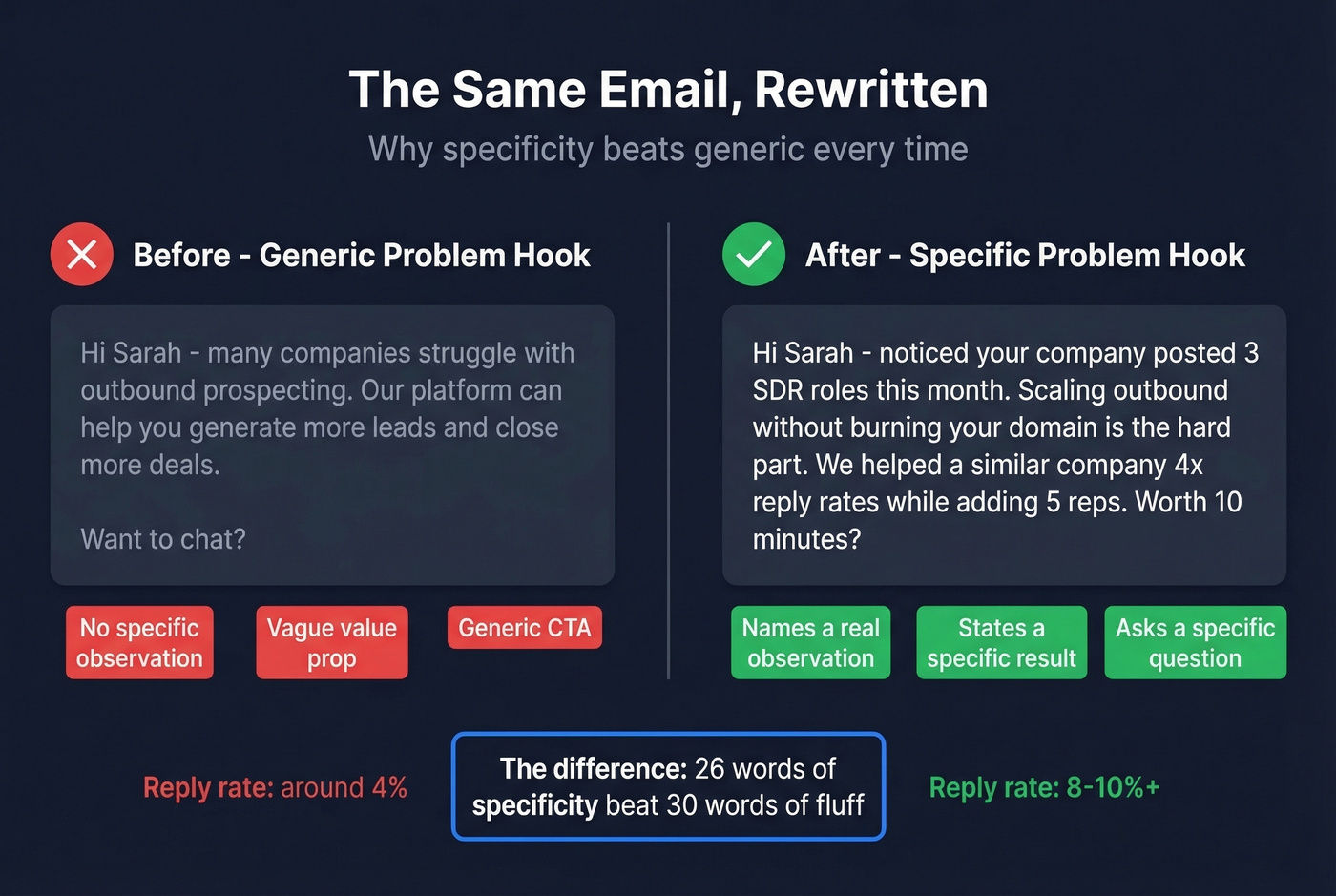
Before/after rewrite - Template 4 (Problem Hook)
Most problem-based hooks underperform because they're generic. Here's the difference:
❌ Before: "Hi Sarah - many companies struggle with outbound prospecting. Our platform can help you generate more leads and close more deals. Want to chat?"
✅ After: "Hi Sarah - noticed [Company] posted 3 SDR roles this month. Scaling outbound without burning your domain is the hard part. We helped [similar company] 4x reply rates while adding 5 reps. Worth 10 minutes?"
The "after" version names a specific observation, states a specific result, and asks a specific question. That's the formula. For more cold-specific structure, use a cold email company introduction.
Warm Referral / Double Opt-In Intros
Template 5 - Mutual Connection
Subject: [Referrer's name] suggested we connect
Hi [First Name] - [Referrer] mentioned you're working on [specific challenge]. We helped their team with [related result], and they thought it'd be worth a conversation.
Do you have 15 minutes this week?
[Your name]
The referrer's name does the heavy lifting. Keep your part short. (More examples: referral email examples.)
Template 6 - Double Opt-In (Introducing Two People)
Subject: Quick intro - [Person A] ↔ [Person B]?
Hi [Person A] - I'd love to introduce you to [Person B], who [one-line context]. I think you'd both benefit from a conversation about [topic].
Mind if I make the intro?
[Your name]
Asking permission before CC'ing someone respects both parties' time. Skip this step and you'll annoy at least one of them. If you need more formats, see introduction email to connect two people.
Template 7 - Event Follow-Up
Subject: Good meeting you at [event]
Hi [First Name] - enjoyed our conversation at [event] about [specific topic]. You mentioned [their challenge or interest].
I've got a [resource/case study/idea] that's directly relevant. Want me to send it over, or easier to hop on a quick call?
[Your name]
Networking & Informational Intro Emails
These templates work best when you're not selling anything - you're building a relationship. The CTA is softer, and the tone shifts from "value prop" to genuine curiosity. For more options, use a dedicated networking email template.
Template 8 - Mentor / Advice Request
Subject: Quick question about [their expertise area]
Hi [First Name] - I've been following your work on [specific project/article/talk]. I'm [one line about you and why it's relevant].
Would you be open to a 15-minute call? I'd love your perspective on [one specific question].
Thanks, [Your name]
One specific question beats "I'd love to pick your brain." Specificity shows respect for their time.
Template 9 - Industry Peer | Template 10 - Job Search Intro
| Peer Connection | Job Search | |
|---|---|---|
| Subject | Fellow [role/industry] - quick thought | [Role title] - referred by [name/source] |
| Hook | I lead [function] at [company] and noticed your [article/post/talk] on [topic]. | I'm exploring [role type] opportunities and [referrer/source] pointed me your way. |
| Body | We're tackling something similar and I think there's a useful overlap. | My background in [one relevant skill] aligns with what [their company] is building in [area]. |
| CTA | Open to swapping notes over coffee or a call? | Would you have 15 minutes for a quick conversation? |
Both follow the same structure - the only difference is the power dynamic. In peer outreach, you're equals. In job search, you're asking for a favor. Adjust your tone accordingly.
New Role / Account Handoff Intros
Template 11 - CSM / Account Manager Intro
Subject: Your new point of contact at [company]
Hi [First Name] - I'm [Your name], your new [CSM/AM] at [company]. I'm taking over from [predecessor] and want to make sure the transition is smooth.
Can we grab 15 minutes this week? I'd like to cover:
- How you define success with us
- Any open items from [predecessor]
- Your priorities for [next quarter]
[Calendar link]
[Your name]
Agenda bullets set expectations. A calendar link removes friction. If you want more handoff variants, see warm handoff email.
Template 12 - New Team Member | Template 13 - New Manager
These two follow the same logic: introduce yourself, state your scope, and ask to learn.
New team member: "Hi [First Name] - I just joined [company/team] as [role]. I'll be working on [area] and wanted to introduce myself. I'd love to learn how [their function] and [your function] collaborate. Do you have 15 minutes this week?"
New manager: "Hi [First Name] - I'm [Your name], stepping into the [role] position, leading [scope] starting [date]. My first priority is understanding what's working and what's not from your perspective. Can we find 30 minutes in the next week?"
Partnership & Business Development Intros
Template 14 - Co-Marketing Pitch
Subject: [Their company] + [your company] - audience overlap
Hi [First Name] - our audiences overlap significantly: we serve [your ICP], and [their company] reaches the same buyers through [their channel].
A joint [webinar/guide/case study] could drive leads for both teams. We did this with [partner] and generated [result].
Worth exploring?
[Your name]
Template 15 - Vendor / Supplier Intro
This one needs two variants. Use the casual version for startups and tech companies. Use the formal version for international contacts, senior executives, and regulated industries.
Casual: "Hi [First Name] - we provide [service/product] to companies like [client name] in [their industry]. Noticed [their company] is [observation]. Happy to share how we've helped similar teams - open to a quick call?"
Formal: "Dear [Title] [Last Name], I represent [your company], a [one-line description]. We provide [service/product] to organizations in [their industry], including [client name]. I would welcome the opportunity to discuss how we might support [their company]'s goals in [area]. Would you be available for a brief call at your convenience? Respectfully, [Your full name], [Title]"
Template 16 - Inbound Lead Response
Subject: Re: your [form/download/demo request]
Hi [First Name] - thanks for [downloading X / requesting a demo / signing up]. Looks like you're focused on [inference from their action].
I've got a few ideas based on what [similar company] did. Worth a quick call this week?
[Your name]
Template 17 - Investor / Board Intro
Subject: [Company] - [one-line traction metric]
Hi [First Name] - [Company] is [one-line description]. We've [traction metric: revenue, users, growth rate] in [timeframe].
[Referrer/context] suggested I reach out. I'd welcome 15 minutes to share what we're building.
[Your name]

A perfect introduction email means nothing if it bounces. 16.9% of emails never reach the inbox - bad data is the #1 reason. Prospeo's 98% email accuracy and 7-day refresh cycle ensure every intro you send actually lands.
Stop crafting great emails for dead addresses.
Follow-Up Templates That Complete the Sequence
42% of replies come from follow-ups. The sweet spot is 4-7 total touches. Reaching executives often requires around 9, while lower-level contacts typically respond within 4.
The best Step 2 emails feel like replies, not new pitches. "Quick follow-up--" outperforms formal follow-ups by roughly 30%. If you want cleaner phrasing, see stop saying “just following up”.
Step 2 - Reply-Style (send 2-3 days after Step 1):
Hi [First Name] - quick follow-up on my note below. Did [the hook from Step 1] resonate?
Happy to share how [similar company] approached it if that's useful.
Step 3 - Value-Add (send 4-5 days after Step 2):
Hi [First Name] - found this [article/benchmark/case study] on [their challenge]. Thought it'd be relevant given [observation].
[Link]
Still happy to chat if timing works.
Step 4 - Breakup (send 5-7 days after Step 3):
Hi [First Name] - I'll assume the timing isn't right. If [problem/goal] becomes a priority, I'm here.
Either way - no hard feelings. Deleting this thread now.
The breakup email works because it releases pressure. People who ignored Steps 1-3 often reply to Step 4 precisely because you gave them an easy out. For subject line ideas, use break up email subject lines.
Don't just bump the thread with "checking in." Every touch needs to add something new - a stat, a resource, a different angle.
Why Good Intro Emails Get Ignored
Sometimes the problem isn't your copy. It's infrastructure.
On average, 84% of emails reach the inbox. The remaining 16.9% never arrive - they get blocked, bounced, or fail inbox placement - and 10.5% land in spam folders nobody checks. If you're sending intros to unverified addresses, bounces accumulate, your sender reputation drops, and even your best emails start hitting spam. We've watched teams with genuinely great copy get sub-1% reply rates because half their list was dead addresses.
88% of office workers say they've regretted an email right after hitting send. 48% judge typos in email more harshly than typos in Slack or Teams. And 60% say email volume itself is a source of stress. Your intro is competing against all of that - a crowded inbox, a skeptical reader, and a hair-trigger delete finger.
If you're sending intros at scale, verify addresses first. Prospeo checks emails in real time with 98% accuracy and a 7-day refresh cycle - bad addresses tank your domain reputation and make great copy irrelevant. There's a free tier to start with.
Here's what kills reply rates, even when your email arrives:
❌ Vague CTA: "Let me know your thoughts" → ✅ Specific CTA: "Do you have 15 minutes Thursday?"
❌ Too long: 150-word wall of text → ✅ Under 80 words: Every word earns its place
❌ Optimizing for opens: Clickbait subject line that gets opened but not replied to → ✅ Optimizing for replies: Honest subject line that sets the right expectation
Let's be honest: if your average deal size is under five figures, you don't need a 12-step nurture sequence. You need a tight 80-word email, one follow-up, and verified contact data. The teams spending weeks perfecting email copy while sending to garbage lists have the equation backwards. In our experience, fixing the list is worth 5x more than rewriting the copy.
Cross-Cultural Intro Rules
Default to the highest level of formality until the recipient signals otherwise.
That's the single most important rule for international emails. Use titles and honorifics (Dr., Mr./Ms. + last name) until they sign off with just their first name. Avoid idioms, slang, and humor - "Let's circle back" means nothing in most languages. Watch direct vs. indirect communication styles: a blunt "Are you interested?" works in the US but can feel aggressive in Japan or parts of the Middle East. Etiquette missteps don't just offend - they stall deals.
Yes, formal emails feel stiff. That's the point. You can always dial formality down. Dialing it up after a too-casual first impression is much harder.
How to Test and Improve Your Intros
Don't guess which template works best - test it. But test correctly.
A/B test one variable at a time: subject line OR hook type OR CTA - never all three at once. You need 250+ contacts per variant for directional results, 500+ for higher confidence. Optimize for positive reply rate, not open rate. Opens are unreliable after Apple Mail Privacy Protection, and a misleading subject line that gets opens but no replies will hurt your deliverability over time. For more subject line patterns, use these email subject line formulas.
Personalized subject lines hit 46% open rates vs 35% without - but the reply rate gap matters more. Keep subject lines between 25-45 characters. Test weekly.
Here's the contrarian take that actually works: pick one email structure, then only swap the hook and CTA per scenario. Most teams waste time rewriting entire emails when the structure already works. The hook is what drives variation in reply rates - not the body copy.
Skip the elaborate 12-variant multivariate tests if you haven't nailed the basics yet. We've seen teams run complex experiments when they'd have been better off just shortening their emails to under 80 words and sending a single follow-up. Start with the fundamentals before you optimize the edges. The best introduction email templates in the world won't save a campaign built on unverified lists and zero follow-ups. The consensus on r/coldemail backs this up - list quality beats copy quality every time.
You just picked the right template and hook type. Now you need the right contact. Prospeo gives you 300M+ verified profiles with 30+ filters - find the exact decision-maker, grab their email, and send that intro in minutes.
Every reply starts with reaching a real person.
FAQ
How long should an introduction email be?
Under 80 words. The best-performing cold campaigns in 2026 benchmark data stay under 80 words - every word has to earn its place. Longer emails see measurably lower reply rates across every hook type and scenario.
What day should I send an intro email?
Wednesday pulls the highest reply rates, with Tuesday close behind. Avoid Mondays (inbox overload) and Fridays (mental checkout). Schedule sends for 8-10 AM in the recipient's local time zone.
How many follow-ups should I send?
Two to four follow-ups, for a total of four to seven touches. 42% of replies come after the first email, so one-and-done leaves nearly half your results behind. Executives typically need around nine touches.
Should I use "Dear" or "Hi" in a professional intro?
Default to "Hi [First Name]" in most Western business contexts. For international contacts, senior executives, or formal industries, use titles and last names until they signal informality by signing off with just their first name.
How do I keep introduction emails out of spam?
Verify recipient addresses before sending - 16.9% of emails never reach the inbox due to bounces and blocks. Beyond verification, avoid spam-trigger words and warm up new domains before scaling volume.