

How to Build an Email Nurture Campaign That Actually Converts
Only 27% of B2B leads are sales-ready when they first hit your CRM. The other 73% aren't lost - they're just not ready yet. And the difference between teams that convert those leads and teams that don't comes down to one thing: an email nurture campaign built on real structure, not a handful of "just checking in" emails.
What You Need (Quick Version)
An email nurture campaign converts the 73% of leads who aren't ready to buy today into pipeline over the following weeks and months. You need three things: a segmentation model (Cold / Warm / Hot), a sequence mapped to funnel stages, and clean contact data so your emails actually land.
Why Most Leads Die Without Nurture
The math is uncomfortable. 40.4% of B2B buyers take 6-12 months to make a purchase decision, and 15.4% take over a year. During that window, 45.8% consume more than seven pieces of content before they're ready to talk to sales. If you're not the one providing that content, someone else is.
Most teams treat lead gen like a light switch - generate the lead, hand it to sales, move on. But sales can't work leads that aren't ready, and marketing can't just generate more to compensate. The result is a leaky funnel where perfectly good prospects go cold because nobody stayed in touch.
Well-executed lead nurturing email campaigns generate 50% more sales-ready leads at 33% lower cost, and nurtured leads make purchases that are 47% larger on average. People buy from companies that educate them, not companies that pitch them.
What Is an Email Nurture Campaign?
An email nurture campaign is a series of automated, behavior-driven emails designed to move a lead from "aware" to "ready to buy" by delivering relevant content at each stage of their decision process. The key word is behavior-driven - the sequence adapts based on what the recipient does (opens, clicks, page visits, downloads) rather than marching through a fixed calendar.
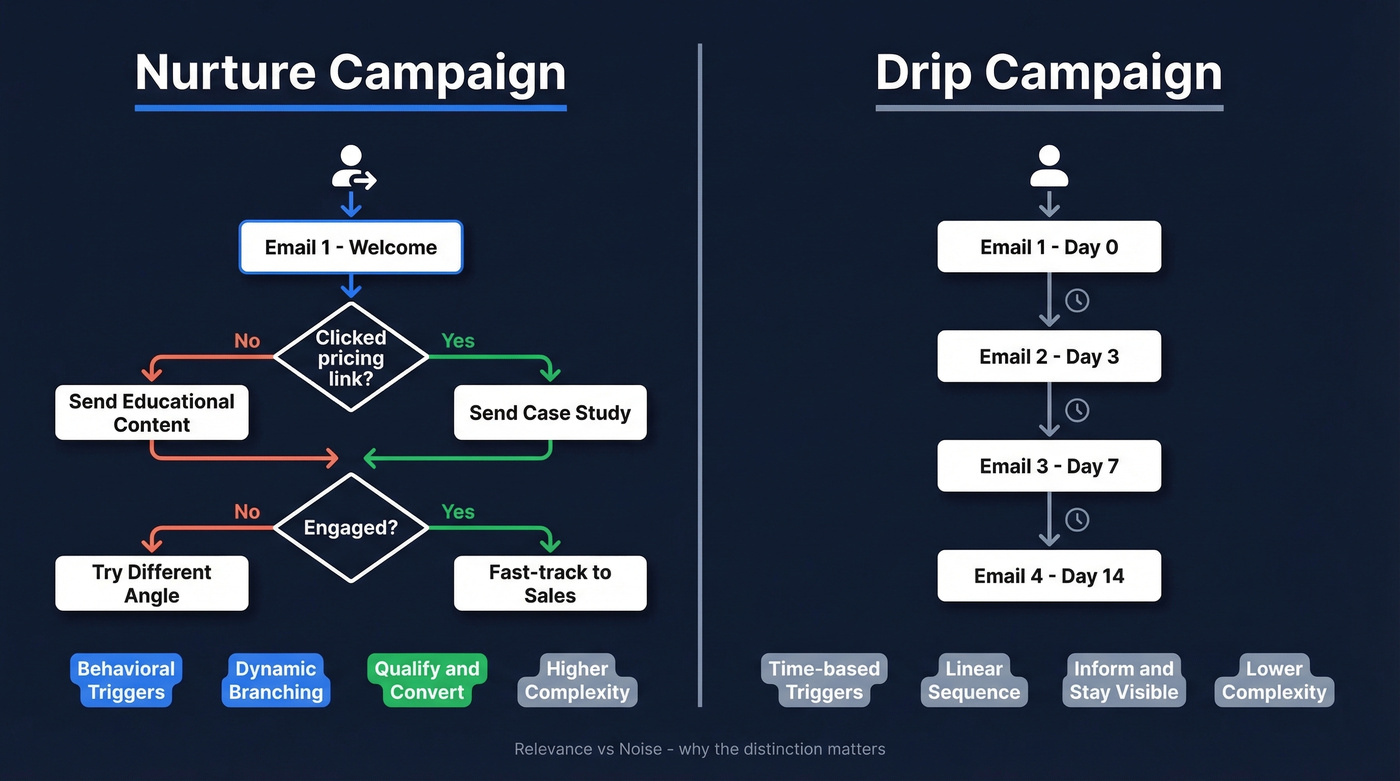
This is where most people confuse nurture with drip.
| Nurture Campaign | Drip Campaign | |
|---|---|---|
| Trigger | Behavioral (actions) | Time-based (schedule) |
| Adaptation | Dynamic branching | Linear sequence |
| Goal | Qualify and convert | Inform and stay visible |
| Complexity | Higher | Lower |
A drip campaign sends Email 2 three days after Email 1 regardless of what happened. A nurturing sequence sends a case study if the lead clicked a pricing link, or a re-engagement email if they went dark. That distinction matters because it's the difference between relevance and noise.
Five Types of Nurture Campaigns
Not every nurture campaign looks the same. The trigger and the goal change depending on where the lead sits in their lifecycle.
Welcome / Onboarding. A new signup just raised their hand - this is your highest-engagement window. Within the first 48 hours, you need to establish trust and set expectations. Don't waste it on a generic "thanks for signing up." Deliver the single most valuable resource you have and tell them exactly what to expect next.
Educational. Think of the lead who downloaded your industry report but has no idea your product exists. They're problem-aware, not solution-aware. Educational nurture bridges that gap with top-of-funnel content - industry guides, short videos, trend analyses - that positions you as the authority before you ever mention your product. (If you need a system for this, start with B2B content that maps cleanly to TOFU/MOFU/BOFU.)
Re-engagement. After 30-60 days of silence, a lead isn't necessarily dead. Practitioners often embed short 30-60 second video snippets in re-engagement flows to reopen stale conversations. The goal is simple: one more interaction before you write them off.
Post-purchase / Upsell. This is the most neglected type, and it drives us crazy. Teams pour resources into pre-sale sequences and then go silent after the contract is signed. Post-purchase nurture drives retention, expansion revenue, and referrals - the cheapest pipeline you'll ever build. (If you're measuring retention impact, pair this with a simple churn analysis.)
Lead qualification. When a lead visits your pricing page or requests a demo, they're signaling intent. A qualification nurture scores that behavior and routes to sales at the right moment. This is where lead scoring and behavioral triggers earn their keep.

Your nurture sequence means nothing if emails bounce. Bad data kills deliverability, tanks sender reputation, and wastes every dollar you spent on content. Prospeo delivers 98% email accuracy with a 7-day refresh cycle - so every lead in your nurture flow hits a real inbox.
Stop nurturing bounced emails. Start with data that actually lands.
How to Build Your Lead Nurturing Sequence
Define Your Segments
Start with three buckets. Cold leads have no meaningful engagement - they downloaded a whitepaper six months ago and haven't been back. Warm leads are familiar with your brand and engaging with content, but they're not showing buying signals yet. Hot leads are visiting pricing pages, requesting demos, or matching your ICP on multiple dimensions.
Every lead enters one of these three segments, and your nurture content changes accordingly. Cold leads get educational content. Warm leads get social proof and comparisons. Hot leads get direct offers and sales touchpoints. (If you need a tighter definition of “matching your ICP,” use an ideal customer profile rubric.)
Map Content to Funnel Stages
Each segment maps to a funnel stage, and each funnel stage needs specific content types.
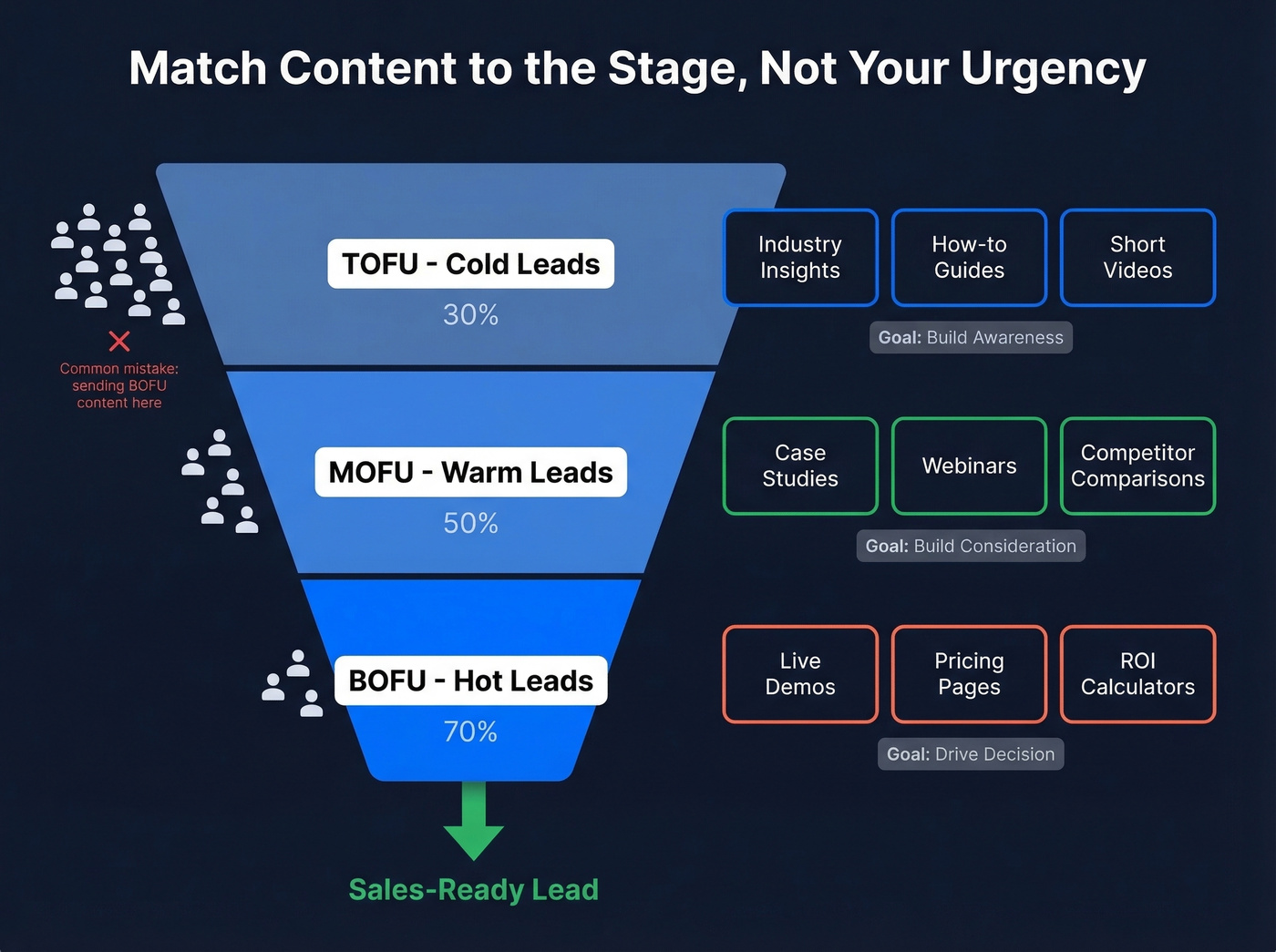
| Funnel Stage | Content Types | Goal |
|---|---|---|
| TOFU (Cold) | Industry insights, guides, short videos | Build awareness |
| MOFU (Warm) | Case studies, webinars, comparisons | Build consideration |
| BOFU (Hot) | Demos, pricing, ROI calculators | Drive decision |
The mistake most teams make is front-loading BOFU content. They send a case study on Day 1 to a lead who doesn't even understand the problem yet. Match the content to the stage, not to your urgency. (If you want a clean framework for stage-by-stage messaging, the AIDA funnel is a solid starting point.)
Build Your Nurture Email Sequence
Here's a complete Day 0-Day 30 blueprint - the piece no one else publishes. An actual implementable sequence with timing, content type, and branching logic.
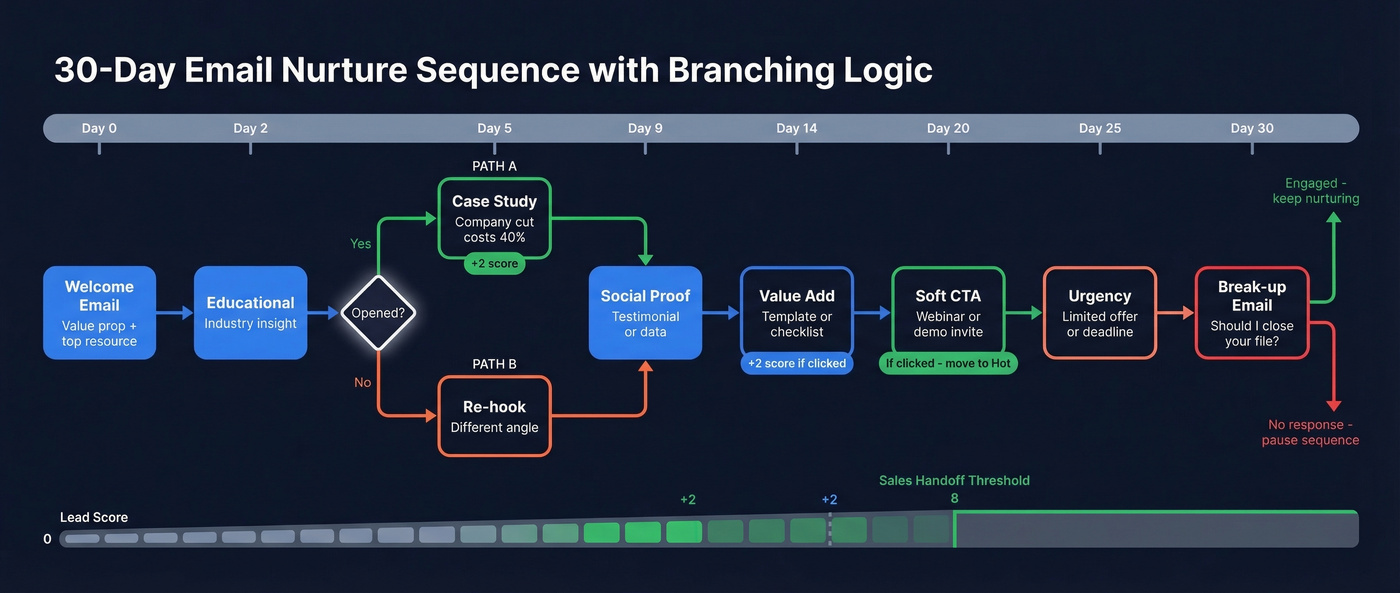
| Day | Content Type | Subject Line Example | Branch Logic | |
|---|---|---|---|---|
| 0 | Welcome | Value prop + resource | "Here's the guide I mentioned" | - |
| 2 | Educational | Industry insight | "3 trends reshaping [industry]" | If opened -> Path A |
| 5 | Path A: Deeper dive | Case study | "[Company] cut costs 40%" | If clicked -> score +2 |
| 5 | Path B: Re-hook | Different angle | "Most teams miss this" | If ignored -> stay on Path B |
| 9 | Social proof | Testimonial or data | "Why 500 teams switched" | - |
| 14 | Value add | Tool, template, or checklist | "Steal this template" | If clicked -> score +2 |
| 20 | Soft CTA | Webinar or demo invite | "15 min - worth it?" | If clicked -> move to Hot |
| 25 | Urgency / scarcity | Limited offer or deadline | "Spots closing Friday" | - |
| 30 | Break-up | Final nudge | "Should I close your file?" | If no engagement -> pause |
The branching is what separates this from a drip. If someone clicks the case study on Day 5, they're showing buying intent - bump their lead score and accelerate them toward a sales touchpoint. If someone ignores the first three emails, don't keep hammering the same angle. Switch to a different hook.
In our experience, the Day 5 branch is where most nurture sequences either accelerate or stall. That fork in the road - case study click vs. silence - tells you more about a lead's readiness than any form fill ever will.
Don't stop at email. The best nurture systems layer in channels beyond the inbox. Retarget engaged leads with display ads that reinforce your email messaging. Have sales drop a personalized note on a professional network after a lead clicks a BOFU asset. Trigger a phone call when a lead hits your pricing page twice in a week. Email is the backbone, but multi-channel touches push conversion rates from good to great. (If you’re building this into outbound, align it with sales prospecting techniques so touches don’t get random.)
Let's be honest: most teams overcomplicate this. Start with the table above, run it for 60 days, then optimize based on what you see in the data. Perfection on paper means nothing if you never launch.
Set Up Triggers and Lead Scoring
A simple 1-5 scoring scale works for most teams. Assign points based on engagement: +1 for an open, +2 for a click, +3 for a pricing page visit, +5 for a demo request. When a lead crosses your threshold - say, 8 points - trigger a handoff to sales.
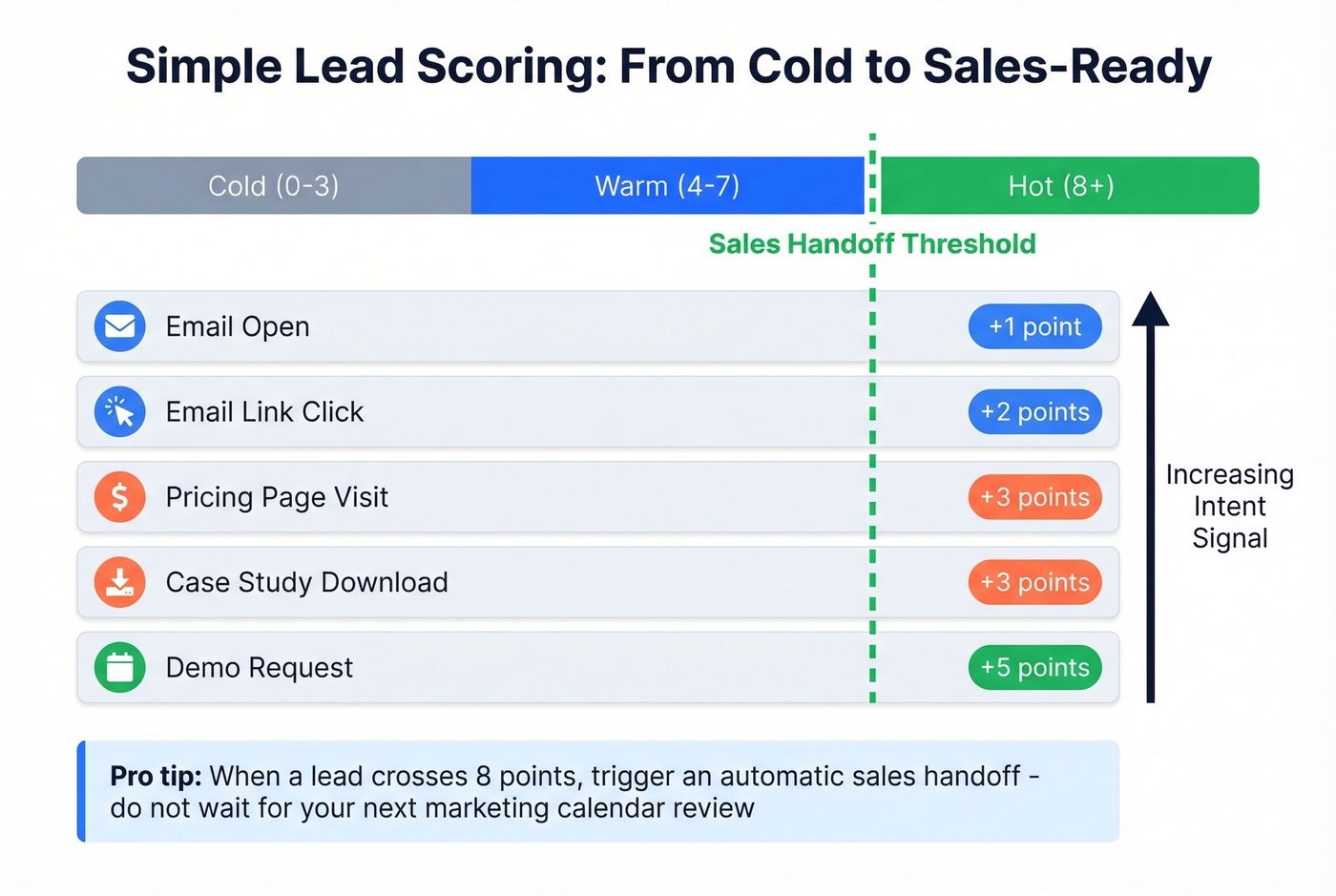
Behavioral triggers are the engine of any lead nurture campaign. A pricing page visit should automatically fire an email offering a consultation or a custom quote. A case study download should trigger a follow-up with a related success story. The goal is to respond to intent in real time, not on your marketing calendar's schedule. (For a deeper operational setup, see lead scoring.)
Verify Your Data Before Launch
This is the step everyone skips, and it's the one that kills campaigns.
You build a beautiful 7-email sequence, hit send on Day 0, and half the list bounces. Your domain reputation tanks. Your sender score drops. Suddenly even your good emails are landing in spam - not just for this campaign, but for everything you send. We've seen teams spend weeks building the perfect nurture flow only to torch their deliverability on launch day because they didn't spend 10 minutes cleaning their list.
Run your list through a verification tool before a single nurture email goes out. Prospeo's 5-step verification process catches invalid addresses, spam traps, and honeypots before they damage your deliverability. At 98% email accuracy and a free tier covering 75 emails per month, there's no reason to skip this step. Upload a CSV, get results in minutes, and launch knowing your emails are actually reaching inboxes. (If you want the full checklist, start with an email deliverability guide and keep an eye on email bounce rate benchmarks.)
Segmenting leads into Cold, Warm, and Hot buckets requires more than engagement data - you need verified contact info, job titles, intent signals, and firmographics. Prospeo gives you 50+ data points per contact, buyer intent across 15,000 topics, and 30+ filters to build segments that convert.
Enrich your CRM so every nurture email reaches the right person at the right stage.
B2B vs B2C Nurture Strategies
The mechanics are similar, but the dynamics are completely different.
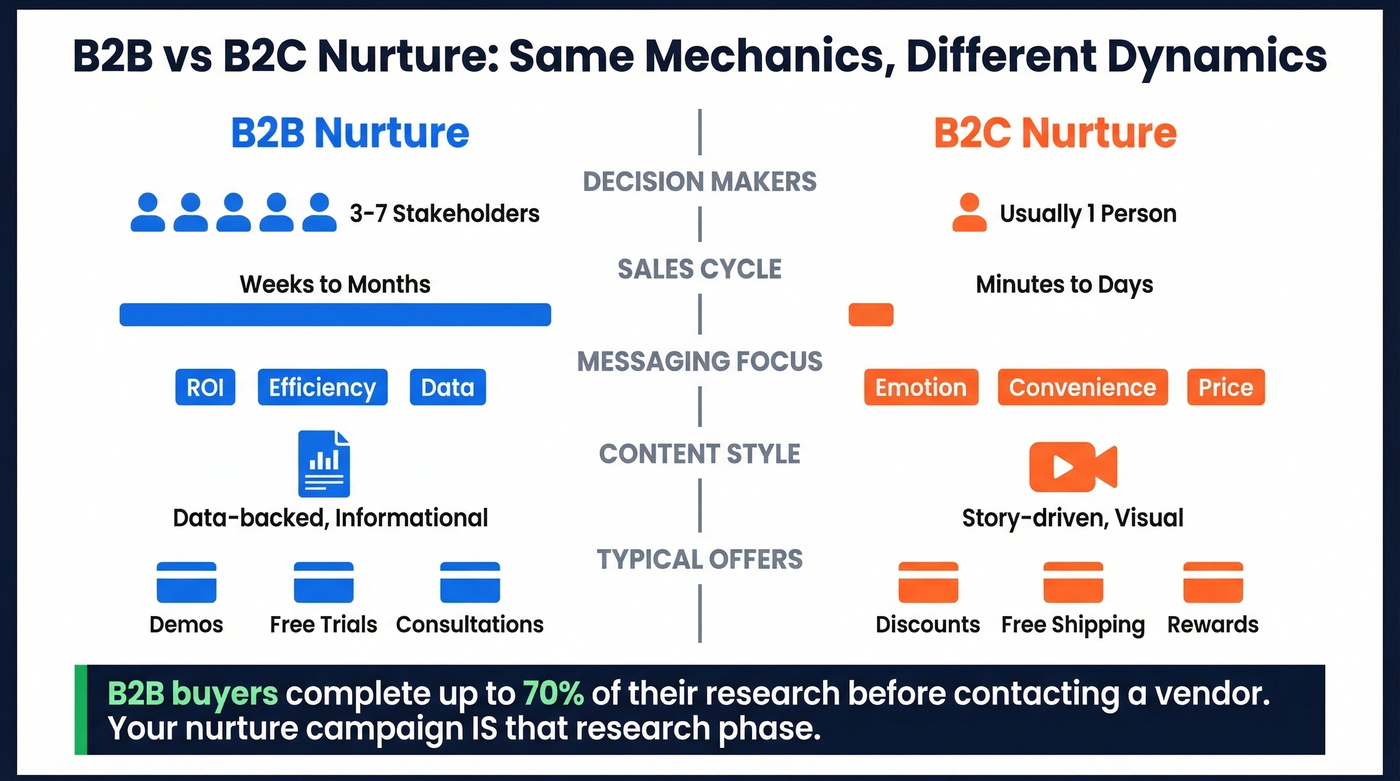
| B2B Nurture | B2C Nurture | |
|---|---|---|
| Decision-makers | 3-7 stakeholders | Usually one person |
| Cycle length | Weeks to months | Minutes to days |
| Messaging focus | ROI, efficiency, data | Emotion, convenience, price |
| Content style | Informational, data-backed | Story-driven, visual |
| Offer types | Demos, trials, consultations | Discounts, free shipping, rewards |
B2B buyers complete up to 70% of their research before contacting a vendor. Your lead nurturing email campaign is that research phase - if you're not in it, you're not in the consideration set. B2C nurture is faster and more transactional, but the personalization bar is just as high. 74% of consumers get frustrated when content doesn't match their interests.
The payoff for getting segmentation right is massive either way. Segmented campaigns drive a 760% increase in email revenue compared to one-size-fits-all blasts. That's not a typo. Seven hundred and sixty percent.
Here's the thing: if your average deal size is under $8k, you probably don't need a 10-email sequence with complex branching logic. A tight 4-email drip with one behavioral fork will outperform an over-engineered sequence that takes your team three months to build and never actually launches.
Benchmarks and KPIs
Open rates get all the attention, but these KPIs actually determine whether your nurture strategy is working.
| KPI | Healthy Range | Why It Matters |
|---|---|---|
| Open rate | 25-45% | Subject line + sender reputation |
| Click-through rate | 2-6% | Content relevance |
| Reply rate | 1-3% cold, 5-10% warm | Conversation signal |
| Bounce rate | Under 2% | Above 5% is a red flag |
| Deliverability rate | 95%+ | Inbox placement, not just "sent" |
| MQL -> SQL conversion | 15-30% | The real measure of nurture |
| Pipeline attribution | Track it | Proves nurture ROI to leadership |
For context on top-of-funnel entry points, opt-in conversion benchmarks from a 14.7M impression dataset show a mean of 3.2%, with exit-intent popups hitting 3.8% and cart abandoner targeting reaching 6.5%. Mobile opt-in rates (3.6%) outpace desktop (2.9%), and fullscreen overlays convert at 4.7% - nearly triple the 1.8% of slide-in corner widgets. Those numbers matter because the quality of your nurture list starts with how you build it.
The KPI most teams ignore is pipeline attribution. Open rates feel good, but they don't tell you whether nurture is actually creating revenue. Set up holdout groups - a slice of your list that doesn't receive the nurture sequence - and compare conversion rates. That's the only way to prove causation, not just correlation. (If you’re diagnosing leaks, use these funnel metrics to pinpoint where nurture is (and isn’t) moving deals.)
Five Mistakes That Kill Nurture Campaigns
The biggest threat to your campaign isn't bad copy. It's bad data.
- Focusing solely on sales. Every email is a pitch. No value, no education, just "buy now." Leads tune out by Email 3.
- Generic messaging. Sending the same sequence to a CMO and a junior marketer. 80% of buyers say experience matters as much as the product - personalization isn't optional.
- Pressing for a sale too early. Jumping to a demo request on Day 2 when the lead just downloaded a whitepaper. Match your ask to their stage.
- Stopping after the sale. Post-purchase nurture drives retention, upsell, and referrals. Ignoring it is leaving money on the table.
- Skipping optimization. Set-and-forget sequences decay fast. Nurture tracks go flat without fresh content and A/B testing. Rotate in new subject lines, swap stale case studies for recent ones, and re-evaluate your branching logic quarterly. (If you need fresh angles fast, pull from proven email subject lines.)
The bonus mistake that underpins all of them: launching on a dirty list. If your bounce rate is above 5%, your campaign is actively damaging your domain reputation. Verify before you send. Always.
Best Tools for Nurture Campaigns in 2026
You need two layers: an automation platform to run the sequences, and a data quality layer to make sure your emails actually arrive.
| Tool | Best For | Price From | Key Feature |
|---|---|---|---|
| Prospeo | Data quality + verification | Free; $0.01/email | 98% accuracy, 5-step verify |
| ActiveCampaign | All-around automation | $19/mo | Branching + lead scoring |
| HubSpot | Teams in HubSpot CRM | $15/mo | Native CRM integration |
| Omnisend | Shopify / eCommerce | $16/mo | Pre-built eCommerce flows |
| Klaviyo | eCommerce alternative | $20/mo | Deep Shopify/product data |
| Brevo | Budget-friendly | Free (300 emails/day) | Solid free tier |
| Mailchimp | Basic needs only | $13/mo | Familiar UI, limited automation |
| Drip | eCommerce automation | $39/mo | Revenue attribution |
Prospeo sits underneath whichever automation platform you choose as the data quality layer. Upload your nurture list as a CSV, run it through 5-step verification - catch-all handling, spam-trap removal, honeypot filtering - and strip out invalid addresses before they tank your sender reputation. With a 7-day data refresh cycle compared to the 6-week industry average, the contact data stays current even on long-running sequences. (If you’re comparing vendors, start with data enrichment services.)
ActiveCampaign is one of the best all-around automation platforms for nurture campaigns right now. Its branching logic, lead scoring, and conditional content are genuinely best-in-class at the SMB price point. HubSpot is the right call if your CRM is already there - the native integration eliminates a lot of friction. For eCommerce, Omnisend and Klaviyo both handle product-triggered nurture well, though Klaviyo's Shopify integration goes deeper on product-level behavioral data, which makes a real difference for abandoned cart and browse-abandonment sequences.
Skip Mailchimp if you need anything beyond basic automation. Its journey builder has improved, but it still can't match ActiveCampaign or HubSpot for multi-branch nurture flows. It's fine for newsletters, not for the kind of behavioral sequences we've been talking about.
The automation platform matters, but it's only half the equation. The fanciest branching logic in the world doesn't help if 8% of your list is bouncing.
FAQ
How many emails should a nurture campaign have?
Five to seven emails works for most B2B sequences. Shorter buying cycles under 30 days can get away with four. Longer enterprise cycles might stretch to 10-12, but space them further apart. Match sequence length to your typical sales cycle - not to an arbitrary template.
What's the difference between nurture and drip?
A nurture campaign adapts based on recipient behavior - clicks, page visits, and engagement signals trigger different email paths. A drip campaign follows a fixed schedule regardless of what the recipient does. Nurture is dynamic; drip is linear. Most modern sequences blend both approaches.
How do I measure performance?
Track MQL-to-SQL conversion rate and pipeline attribution, not just open rates. Set up a holdout group (10% of your list) that skips the sequence and compare conversion rates against nurtured leads. If the nurtured cohort converts at a meaningfully higher rate, your campaign is driving real revenue.
How do I keep nurture emails out of spam?
Verify your list before sending - catch invalid addresses, spam traps, and honeypots before they do damage. Authenticate your domain with SPF, DKIM, and DMARC. Keep bounce rates under 2%, and remove unengaged contacts after 90 days of inactivity. Deliverability is earned, not assumed.
What's the ideal send frequency?
For B2B, space emails 3-5 days apart during the first two weeks, then stretch to 7-10 days. Sending daily burns out your list fast - most teams see unsubscribe rates spike above 2% when frequency exceeds three emails per week. Test cadence with a small segment before scaling.