

Global B2B Marketing: The Operating Manual for 2026
Your CEO says "go global." Now you're staring at a spreadsheet of 14 target countries wondering where to start. Here's the reality: 95% of B2B deals go to a vendor already on the buyer's Day One shortlist, and the average buying cycle runs 10.1 months. If you're not building regional awareness before reps start dialing, you've already lost.
Most companies that "go global" are really just translating their homepage into four languages and calling it a strategy. That's not a global marketing strategy. It's expensive wishful thinking.
Why Most Global Expansion Fails
82% of B2B marketing leaders report budget increases, but after inflation only 35% see a real bump. Most teams are doing more with less - and "more" usually means "more regions." Three patterns kill expansion before it starts.
Treating translation as localization. KFC's "finger-lickin' good" became "eat your fingers off" in China. Walmart exited Germany in 2006 after eight years of trying. These aren't translation failures - they're localization failures. Different problem entirely.
Copy-pasting the playbook. The same channels, offer structure, and sales motion won't work in Frankfurt the way they do in San Francisco. Any international B2B marketing strategy that ignores regional buying behavior is dead on arrival. We've seen teams burn six figures learning this lesson the hard way.
Ignoring local teams. Hiring a regional head, then overriding every decision from HQ. Token hires without real authority produce token results.
The Global Operating Model
The framework that works is simple: centralize what needs consistency, localize what needs relevance. A sound strategy for B2B companies expanding internationally starts by drawing this line clearly.
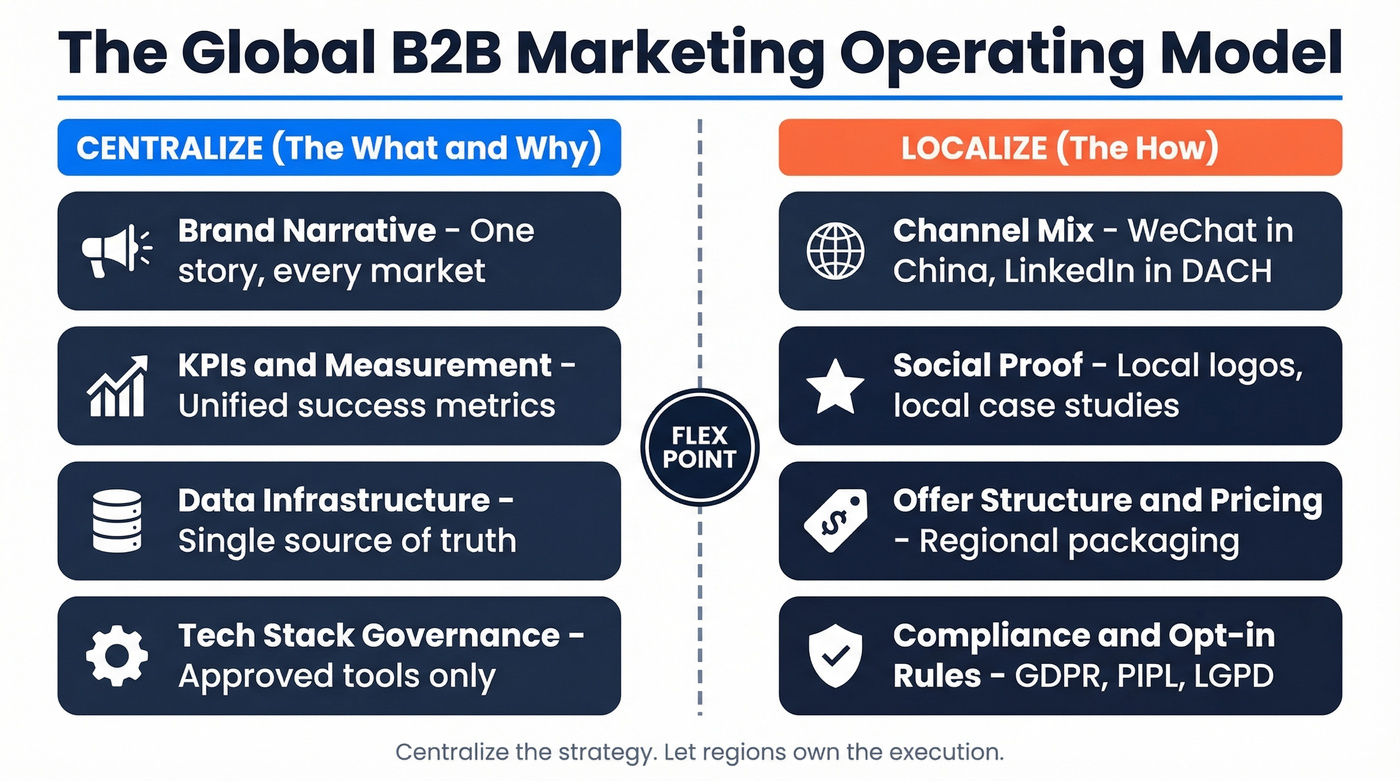
| Centralize | Localize |
|---|---|
| Brand narrative | Channel mix |
| KPIs and measurement | Social proof and case studies |
| Data infrastructure | Offer structure and pricing |
| Tech stack governance | Compliance and opt-in rules |
Cognism's expansion into DACH versus France is the clearest case study we've come across. In DACH, cold emails require explicit double opt-in, which made their email-marketing-data angle less viable, so they went sales-led - hiring SDRs before building a marketing presence. In France, lower regulatory friction allowed a marketing-first approach. France got up and running in half the time.
The lesson isn't "marketing-first is better." It's that the operating model must flex by region while narrative and measurement stay centralized. Strategic ABM programs that combine credible local content with cross-functional alignment deliver up to 20% higher ROI, but only when the operating model supports regional autonomy over demand generation tactics. Centralize the "what" and "why." Let regions own the "how." If you're formalizing this across teams, marketing enablement is the glue that keeps execution consistent without killing local speed.
Localization Beyond Translation
Real localization has layers. Most teams only address the first one.
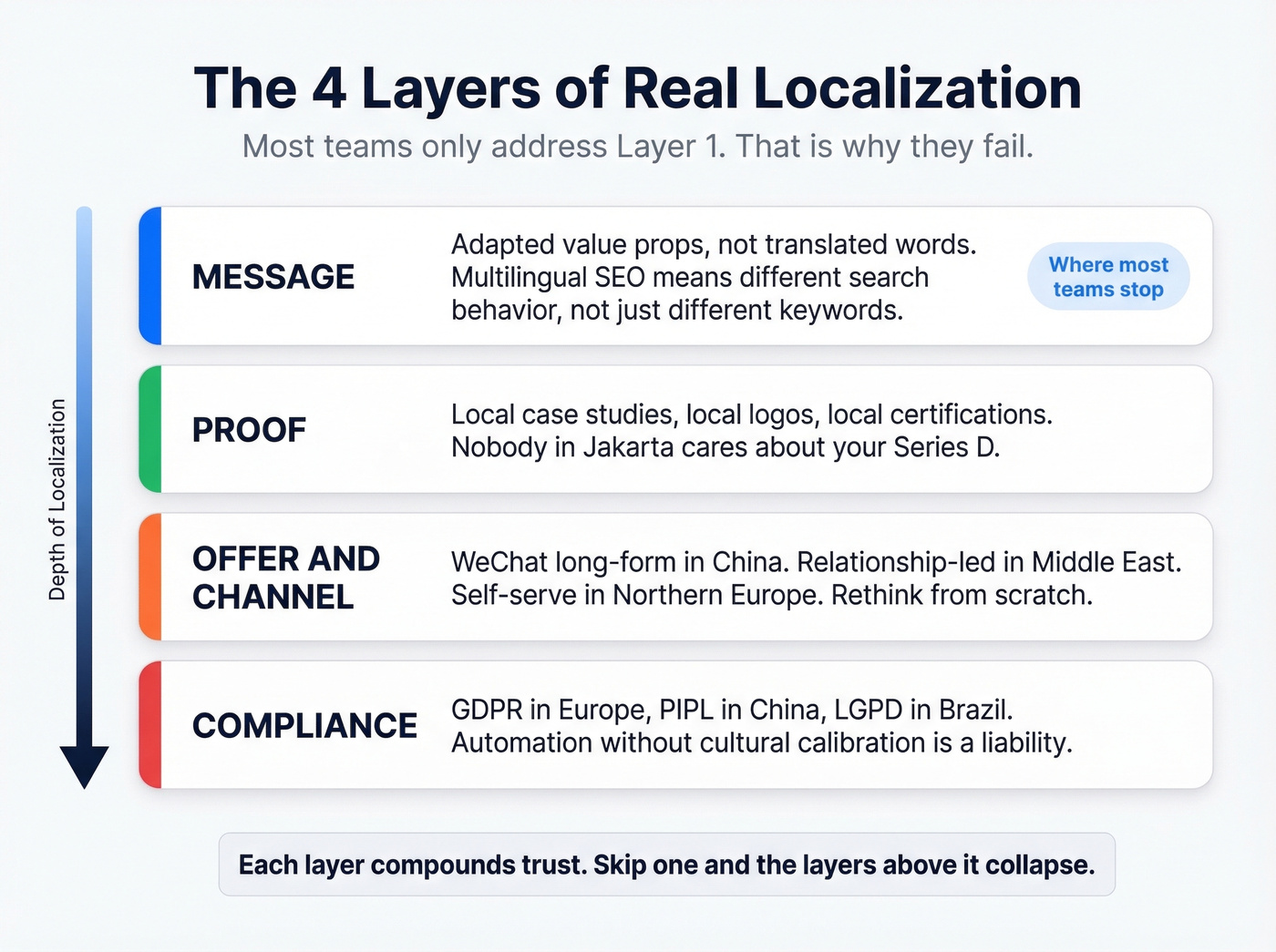
Message goes beyond translated words. It means adapted value propositions and micro-scenario content - role- and context-specific problem solving tailored to how buyers in each market actually search. Multilingual SEO doesn't mean translated keywords; search behavior differs by market, and Generative Engine Optimization is quickly becoming the visibility model for AI-driven search ecosystems like Baidu AI and DeepSeek.
Proof means local case studies, local logos, local certifications. A Fortune 500 reference means less in Southeast Asia than a respected regional brand. Let's be honest - nobody in Jakarta cares about your Series D announcement.
Offer and channel require rethinking from scratch. WeChat long-form technical content often outperforms short promotional posts in China. Relationship-led engagement drives the Middle East. Self-serve information access wins in Northern Europe. Chinese buyers expect higher content density - "busy" pages outperform Western minimalist designs, which throws most SaaS landing page best practices right out the window.
Compliance is non-negotiable. GDPR in Europe, PIPL in China, LGPD in Brazil. One team we heard about sent an AI-generated German holiday email that included inappropriate religious symbols, triggering a wave of complaints. Automation without cultural calibration isn't just embarrassing - it's a liability. If you're scaling outbound, pair compliance with email deliverability fundamentals so you don't learn the hard way.

Expanding into DACH, APAC, or LATAM means nothing if your contact data is wrong. Prospeo delivers 98% email accuracy and 125M+ verified mobile numbers across every region - refreshed every 7 days, not every 6 weeks like competitors.
Stop burning domains in new markets with stale data.
Region Mechanics: China and Europe
China
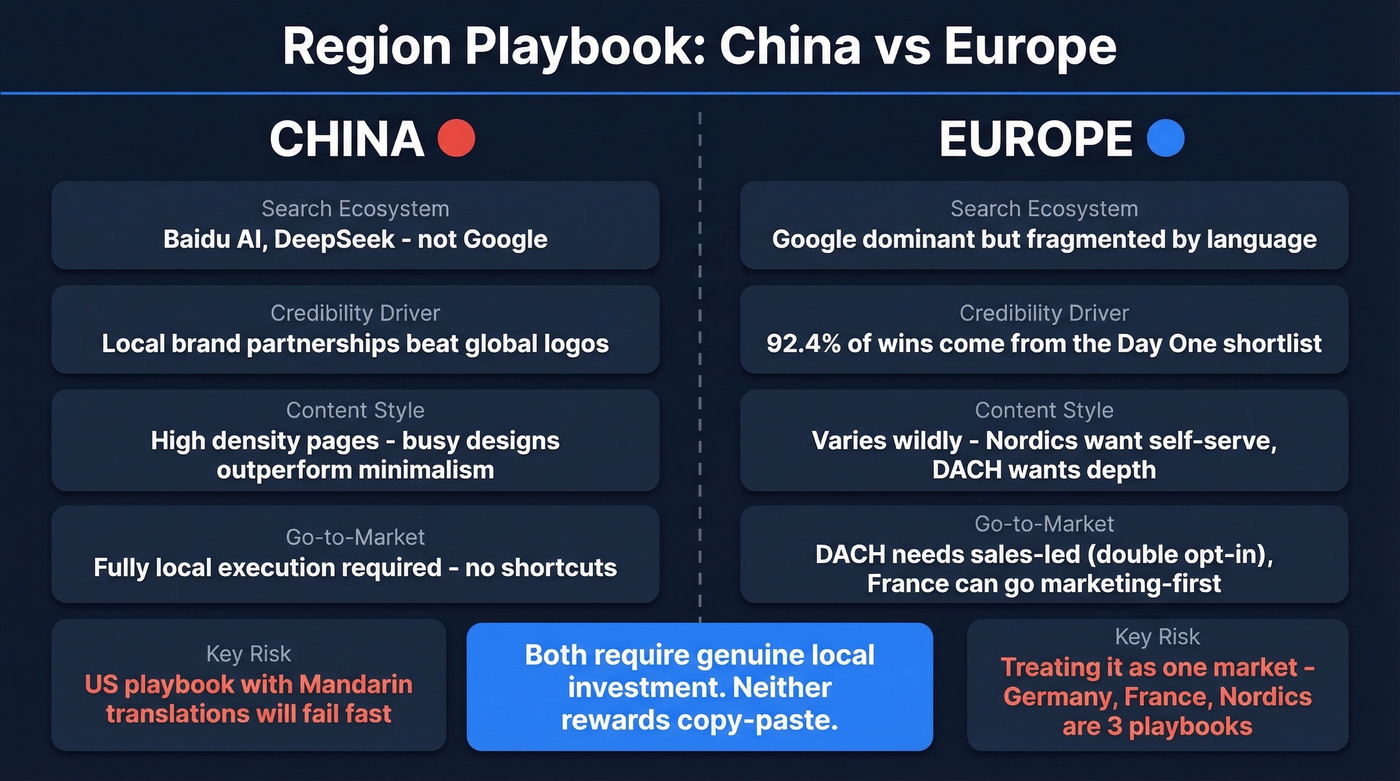
Skip this market if you aren't willing to invest in genuinely local execution. Baidu AI, DeepSeek, and local search ecosystems are where visibility lives now. Local credibility matters more than global brand recognition - a shift practitioners on r/b2bmarketing flag as a major change from five years ago. Don't run your US playbook with Mandarin translations. You'll waste budget and confuse buyers who can smell an outsider from a mile away. If your entry motion is outbound-heavy, align your team on sales prospecting techniques that still work across regions.
Europe
This one trips people up because it looks like a single market. It isn't. 92.4% of the time the winning vendor is already on the Day One shortlist, and European buyers first contact vendors at 58% of the journey - earlier than the global average. Double opt-in in DACH reshapes your entire outbound motion. Germany, France, and the Nordics are three different playbooks sharing a timezone. For list building at scale, your firmographic filters and segmentation rules matter more than your ad budget.
Measurement and Stack
The average B2B org runs 12-20 martech tools, and 65.7% report data integration difficulties. Meanwhile, 32% aren't using the full capabilities of their existing stack. Adding more tools per region compounds this exponentially - and we've watched it happen in real time with teams that bolt on a new vendor for every country they enter.
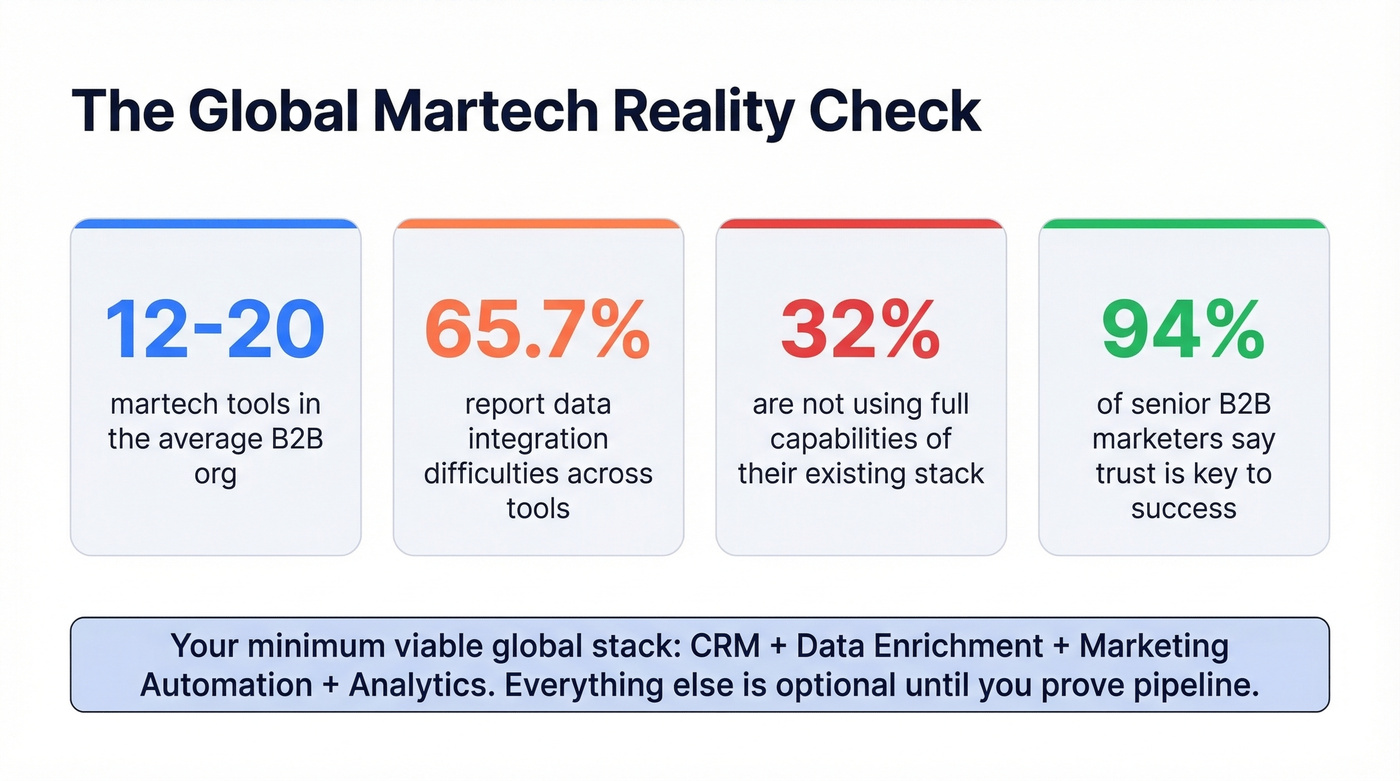
Your minimum viable global stack needs four layers: CRM, data enrichment, marketing automation, and analytics. Everything else is optional until you've proven pipeline in a region. If you're auditing your stack, use a simple funnel metrics view so regions don't optimize for vanity KPIs.
Building trust in markets where you have zero brand equity is a separate challenge. 94% of senior B2B marketers say trust is key to success, and combining video with industry voices makes you 2.2x more likely to be trusted. That's not a content format preference. It's a strategic advantage for new-market entry, especially when you're competing against incumbents who've been in-region for years. This is where B2B brand positioning stops being a brand exercise and becomes a pipeline lever.
Data Quality: The Scaling Limiter
Here's the thing about running outbound across DACH, APAC, and North America simultaneously: stale data doesn't just lower reply rates - it burns domains. We've watched teams launch multi-region campaigns with databases that hadn't been refreshed in over a month. The "global expansion" initiative got shelved within a quarter because deliverability tanked and sender reputation cratered across three regions at once. If you're seeing this pattern, start with email bounce rate and how to improve sender reputation before you scale volume.
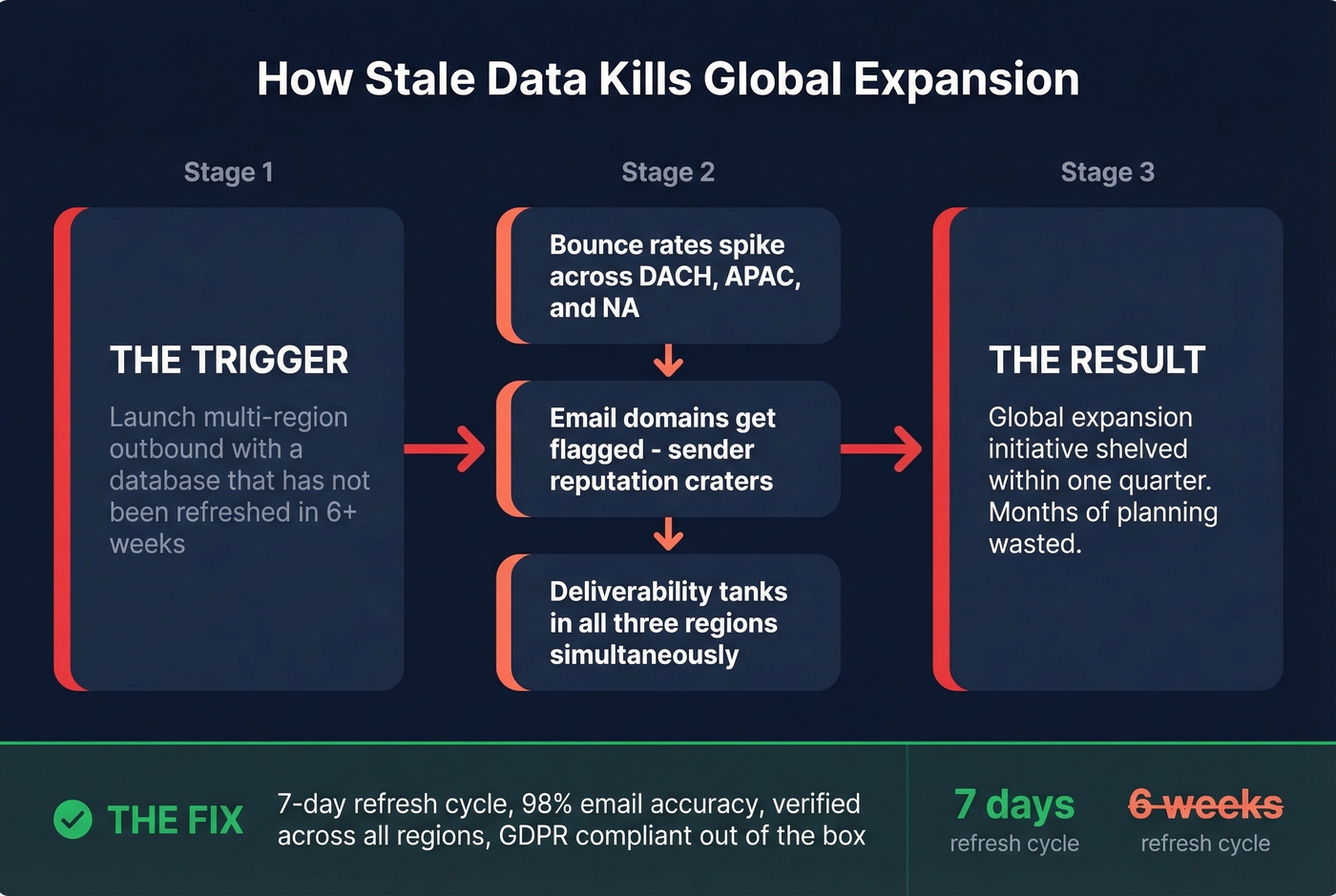
The fix isn't more data. It's fresher, verified data.
Prospeo refreshes all records every 7 days versus the 6-week industry average, delivers 98% email accuracy across all regions, and includes 125M+ verified mobile numbers. It's GDPR compliant out of the box, which matters when half your target markets have strict data regulations. With 30+ search filters - including buyer intent powered by Bombora, technographics, and headcount growth signals - you can build region-specific lists without stitching together five different tools. If you're comparing providers, use a B2B company data checklist so you don't overpay for coverage you can't activate.
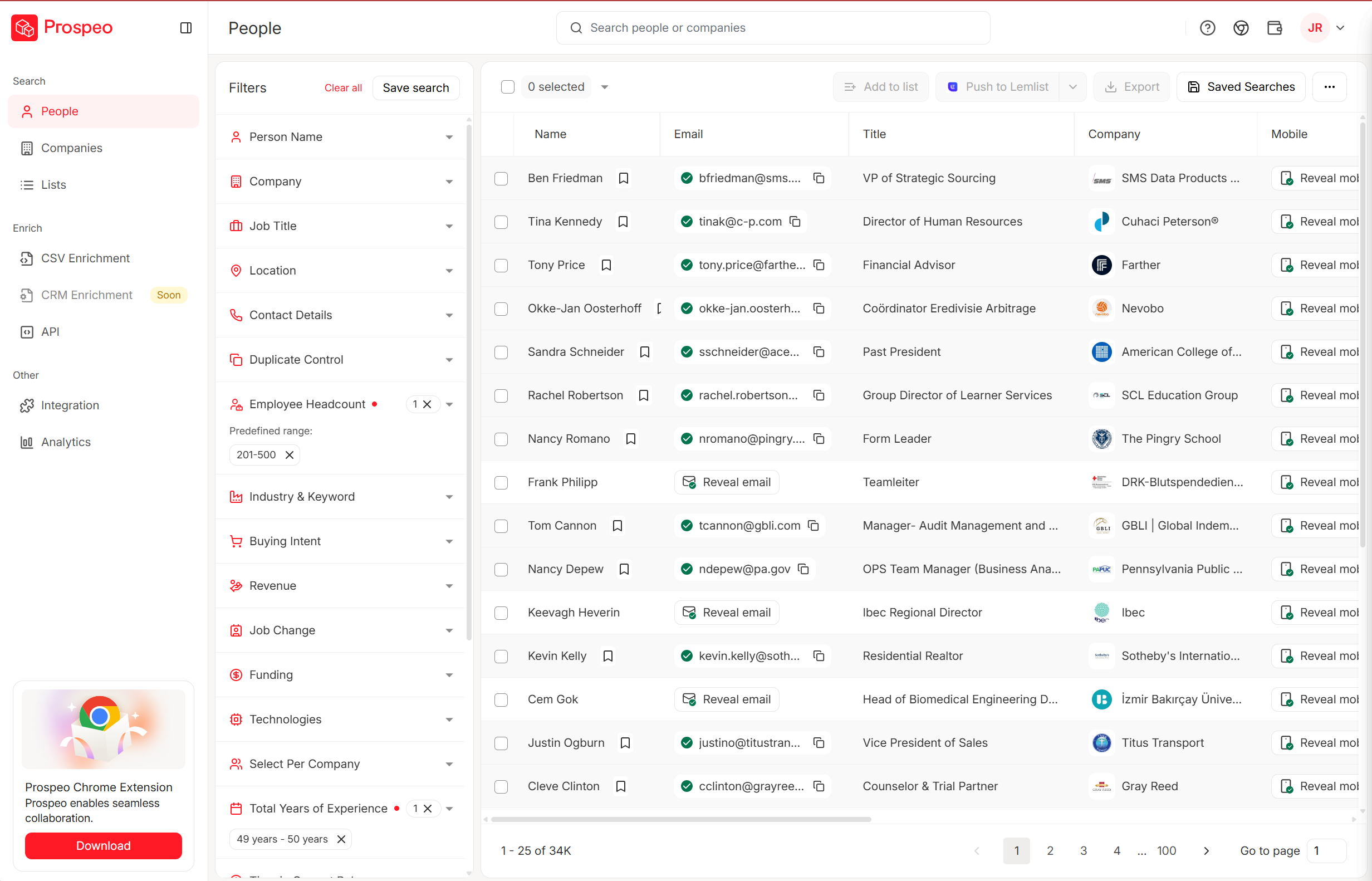
Your global martech stack needs a data layer that actually scales. Prospeo's enrichment API returns 50+ data points per contact at a 92% match rate - with 30+ filters including buyer intent, technographics, and headcount growth across 300M+ profiles worldwide.
Build pipeline in every region at $0.01 per verified email.
FAQ
What's the difference between global and international B2B marketing?
Global B2B marketing is an operating model - centralized strategy with localized execution across multiple regions simultaneously. International marketing typically means entering one market at a time without unified governance. The distinction matters because global requires shared infrastructure, measurement, and brand narrative, while international can be ad hoc.
Should I enter new markets with sales or marketing first?
Match your go-to-market motion to local regulatory and cultural conditions. Markets with strict compliance constraints like DACH's double opt-in often need sales-led entry. Markets with lower regulatory friction can go marketing-first - Cognism's France expansion launched in half the time of their DACH push using this approach.
How do I keep prospect data accurate across multiple regions?
Use a platform with a short refresh cycle and built-in compliance. A 7-day refresh cycle and verified emails at 98% accuracy across all regions are critical when deliverability standards and data protection requirements vary by country. At roughly $0.01 per lead, tools like Prospeo scale without enterprise-level contracts.
What's the biggest mistake in multi-region B2B campaigns?
Running a single playbook across every market. Channel mix, proof assets, offer structure, and compliance rules differ dramatically between regions. Teams that centralize brand narrative but localize execution consistently outperform those that copy-paste their domestic strategy with translated content.