

Go-to-Market Strategy Best Practices: The Operator's Playbook for 2026
40% of new products fail to meet revenue targets. Not because the product was bad - because the go-to-market was a slide deck that nobody executed.
A practitioner post on r/SaaS opened with a line worth tattooing on every founder's whiteboard: "GTM is not a deck. It's a system that produces actions and materials." That's the operating principle behind everything below - go-to-market strategy best practices built on benchmarks from 2,500+ SaaS companies, not theory from a consulting firm's blog. If your GTM plan lives in a Google Doc that nobody opens after launch week, this framework will fix that.
The Short Version
If you're pressed for time, here's the operator summary:
Pick ONE GTM motion first. Below $25 ASP, go full PLG. Calendly built a billion-dollar company on this exact playbook. At $100+ ASP, layer sales on top. At $10K+ ACV, run sales-led or ABM. The data is unambiguous - layering sales too early at low price points correlates with 0% median new business growth.
Validate with 10+ ICP conversations before you build anything. Not surveys. Not assumptions. Real conversations with people who match your ideal customer profile. Half of startups convert less than 10% of their ideal potential customers, and that gap is exactly why you validate before you scale.
Measure one metric at a time. Pick 3-5 KPIs. Optimize one. Then move to the next. Twelve dashboards nobody checks is worse than one number the whole team watches.
What a GTM Strategy Actually Is
A go-to-market strategy isn't a marketing plan. It's a time-bound, cross-functional system that covers how you'll price, sell, distribute, enable, and measure a product's entry into a market. A marketing plan is one component of that system.
The distinction matters because most teams treat GTM as a marketing exercise. They build a landing page, write some ads, and call it a launch. Real GTM includes pricing and packaging decisions, sales motion design, channel strategy, enablement materials, and KPI frameworks - all coordinated across product, marketing, sales, and ops with a specific launch window and a payback target of 12-18 months, not a vague hope that things work out in two years.
Here's the test: does your GTM produce actions and materials, or just analysis? If it generates playbooks, sequences, pricing experiments, and weekly review cadences, it's a system. If it doesn't, it's a deck.
Choose Your GTM Motion First
This decision shapes everything downstream - your hiring plan, your tech stack, your burn rate.
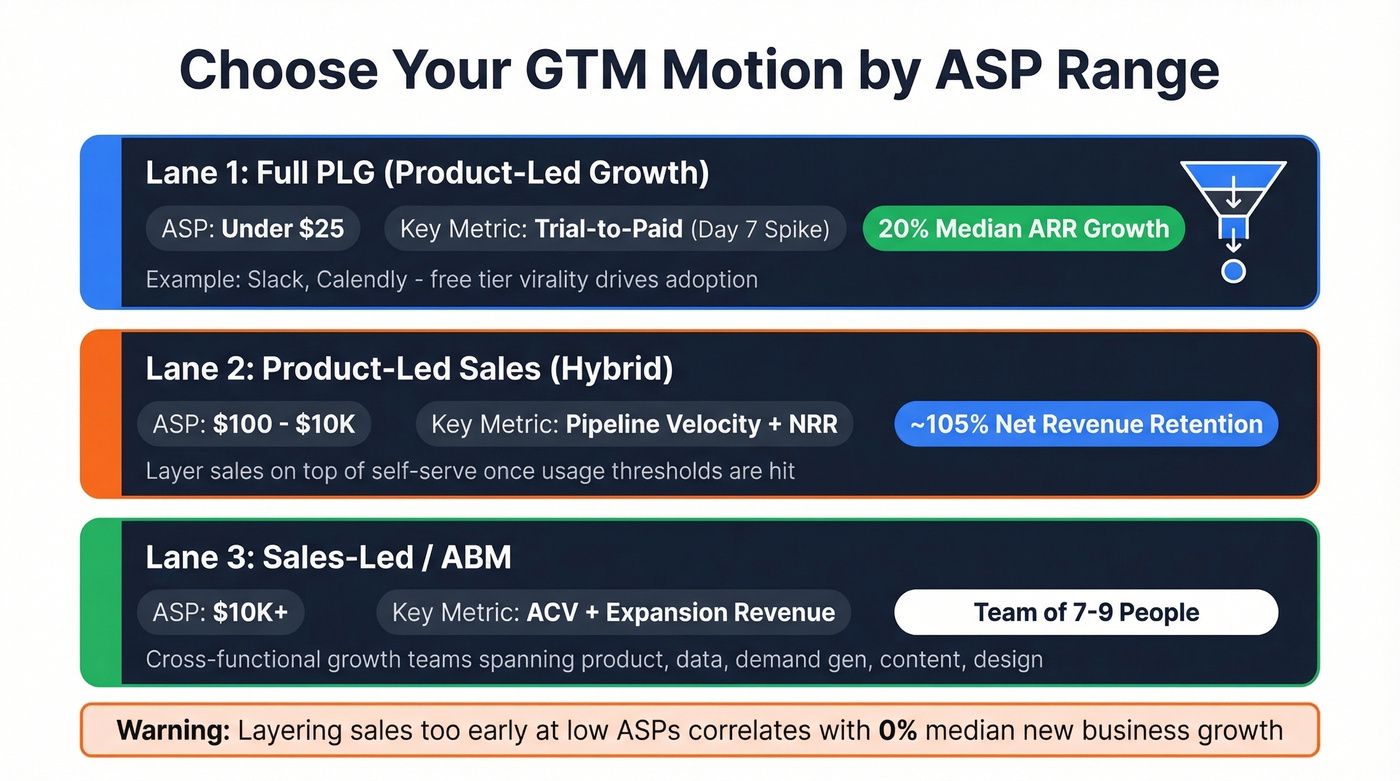
McKinsey's analysis of 107 publicly listed B2B SaaS providers found that PLG outperformers achieve valuation ratios 50% higher than high-performing sales-led companies, with 10 percentage points more ARR growth. But here's the nuance most people miss: most PLG adopters don't see a boost. A small subset of outperformers drives the entire average. So the question isn't "should we do PLG?" - it's "are we set up to be a PLG outperformer?"
The benchmark data makes the decision framework concrete:
| GTM Motion | Best For | ASP Range | Key Metric |
|---|---|---|---|
| Full PLG | Self-serve SaaS | <$25 | Trial-to-paid (day 7 spike) |
| Product-Led Sales | Mid-market B2B | $100-$10K | Pipeline velocity + NRR (~105%) |
| Sales-Led / ABM | Enterprise | $10K+ | ACV + expansion revenue |
Below $25 ASP, companies embracing full PLG see 20% median new business ARR growth versus 0% for those layering sales too early. That's not a marginal difference - it's the difference between growing and flatlining. Slack proved this at scale: free-tier virality drove adoption, and the sales team only engaged once teams hit usage thresholds. Once you cross the $100 ASP threshold, most B2B PLG companies begin layering sales on top of the self-serve motion, creating what McKinsey calls "product-led sales."
For sales-led and hybrid motions, expect to build cross-functional growth teams of 7-9 people spanning product, data, demand gen, content, and design. That's real headcount commitment, which is why the ASP threshold matters - you need enough revenue per customer to justify the team.
If you want a deeper decision tree and what to measure by motion, start with GTM motion.

You just picked your GTM motion and defined your ICP. Now you need to actually reach them. Prospeo's 300M+ profiles with 30+ filters - buyer intent, technographics, headcount growth, funding - turn your ICP definition into a targetable list in minutes, not weeks.
Stop defining your ICP on paper and start reaching them with 98% accurate data.
Core Practices That Drive GTM Success
Validate the Problem
Talk to at least 10 people who match your ICP. Not friends. Not investors. Actual potential buyers who experience the problem you're solving.
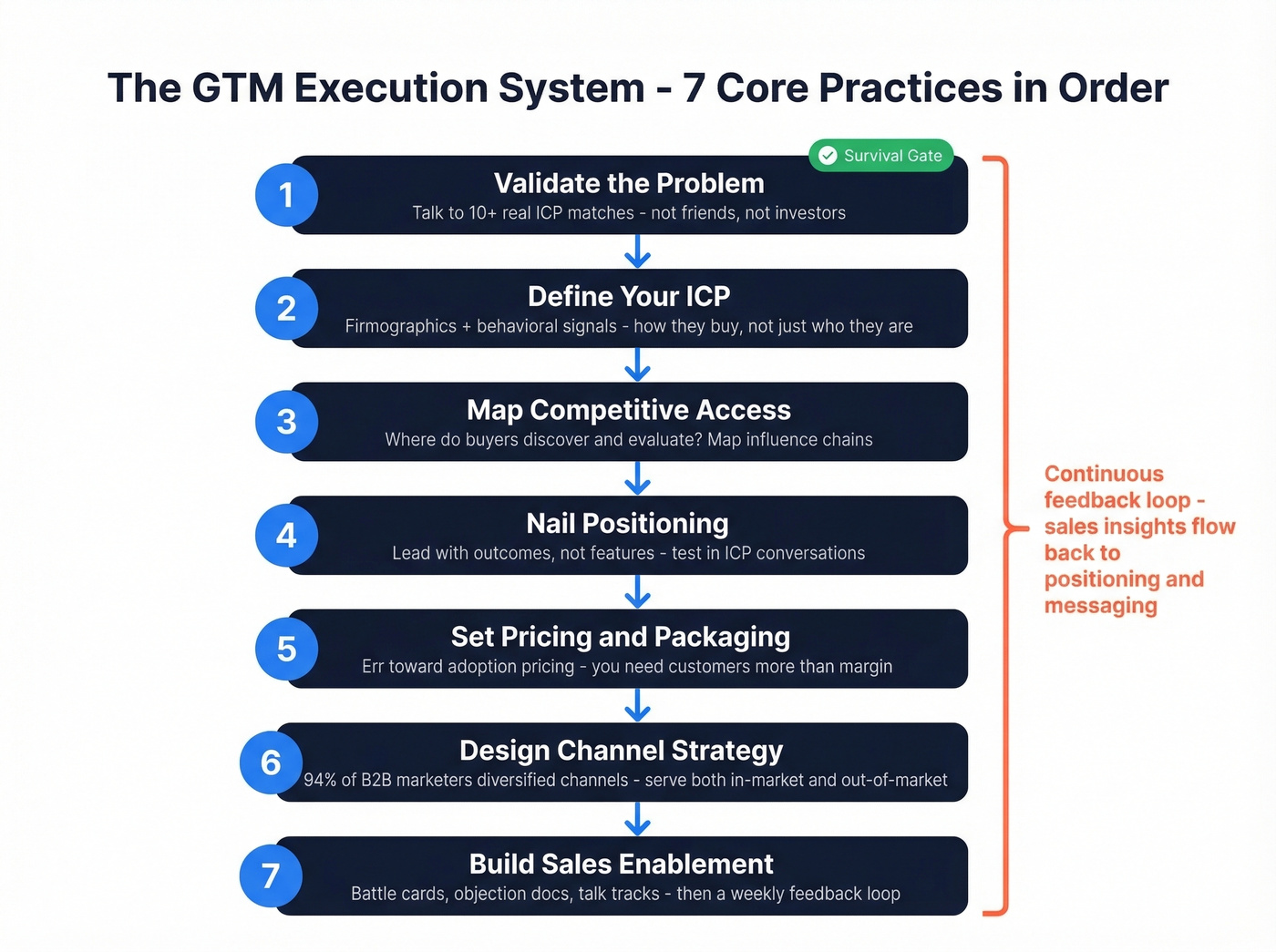
Half of startups convert less than 10% of their ideal potential customers, and the ones that fail that threshold are 50% less likely to survive five years. The validation gate isn't optional - it's the single highest-leverage activity in your entire GTM process. Ask about their current workflow, what they've tried, and what they'd pay to fix it. If you can't find 10 people who care, your GTM problem is actually a product-market fit problem.
Define Your ICP
Your ICP isn't "mid-market SaaS companies with 50-500 employees." That's a firmographic sketch. A real ICP combines firmographics with behavioral signals: what tech stack they run, whether they're hiring for specific roles, how they buy, who influences the decision, and what triggers a purchase.
The principle from the best GTM operators we've worked with: design for buyer behavior, not for channels. Your ICP definition should tell you how these people buy, not just who they are. That behavioral layer determines your channel strategy, your messaging, and your sales motion. Figma nailed this - they didn't just target "design teams," they targeted teams already using collaborative workflows who would spread the tool organically through shared files.
If you need a practical structure for scoring and operationalizing this, use an ICP framework.
Map the Competitive Landscape
Most teams do competitive analysis. Fewer do competitive access analysis.
Knowing your audience but misjudging how they actually discover, evaluate, and buy solutions is one of the most common GTM failures. Map the influence chains: who do your buyers trust? What communities do they participate in? What triggers them to start evaluating solutions? B2B buyers are compressing evaluation cycles by doing more research before ever talking to sales. Your distribution strategy needs to meet them where that research happens - not just where your ads run.
This is also where B2B buyer journey mapping pays off.
Nail Positioning and Messaging
Your positioning isn't your feature list. It's the gap between what your buyer experiences today and the outcome you deliver.
Teams that lead with features ("we have AI-powered analytics with real-time dashboards") lose to teams that lead with outcomes ("your CFO gets the board deck numbers without asking three people to pull reports"). Test your messaging in those ICP conversations. If prospects don't immediately say "yes, that's my problem," your positioning needs work. The feedback loop between sales conversations and marketing messaging should be continuous, not quarterly.
If you want a tighter process for this, see B2B product positioning.
Set Pricing and Packaging
Hybrid pricing models - combining usage-based and subscription elements - deliver roughly 105% net revenue retention. Outcome-based pricing drives the fastest growth.
Let's be honest: most early-stage companies overthink pricing and underthink packaging. Your first pricing page will be wrong. That's fine. Err toward adoption pricing - you need customers and feedback more than you need margin optimization. You can always raise prices later with a grandfather clause. The companies that agonize over pricing for months while competitors ship and iterate are the ones that end up in the "24 months to 1,000 customers" bucket instead of the "11 months" bucket.
If you're pressure-testing unit economics, the CAC payback period is the sanity check.
Design Your Channel Strategy
94% of B2B marketers diversified their channel mix last year, and 45% allocate 10-20% of their budget to testing new channels. The 95-5 rule applies: 95% of your buyers are out-of-market at any given time. Your channel strategy needs to serve both groups - brand and demand gen aren't either/or.
55% of B2B marketers now partner with industry creators and subject-matter experts. Brands using video and influence are 2.2x more likely to be trusted. Partnerships and ecosystem plays deserve a dedicated line in your channel plan - not an afterthought.
For outbound-assisted motions, your channel strategy lives or dies on data quality. We've seen teams build sophisticated outbound sequences, invest in sales enablement, and hire SDRs - only to watch the whole thing collapse because 30% of their emails bounce. Bad contact data is the silent killer of outbound GTM motions. Prospeo's 98% email accuracy and 7-day refresh cycle keep bounce rates under 4%, which means your sequences hit real inboxes instead of bouncing into spam traps.
If you're building the channel mix from scratch, start with B2B marketing channels.

Build Sales Enablement
The most common GTM failure mode we see isn't bad strategy - it's missing enablement. Reps don't have playbooks. Marketing creates collateral that sales never uses. There's no feedback loop between what prospects say on calls and what the website promises.
Build three things before launch: a competitive battle card, an objection-handling doc, and a first-call talk track. Then create a weekly feedback loop where sales shares what's working and what's not. The teams that treat enablement as a living system instead of a one-time deliverable consistently outperform.
If you need a starting point for the talk track, borrow from these objection handling scripts.
Plan Your Launch Sequence
Don't try to do everything at once. A 30-60-90 day phased rollout lets you learn and adjust:
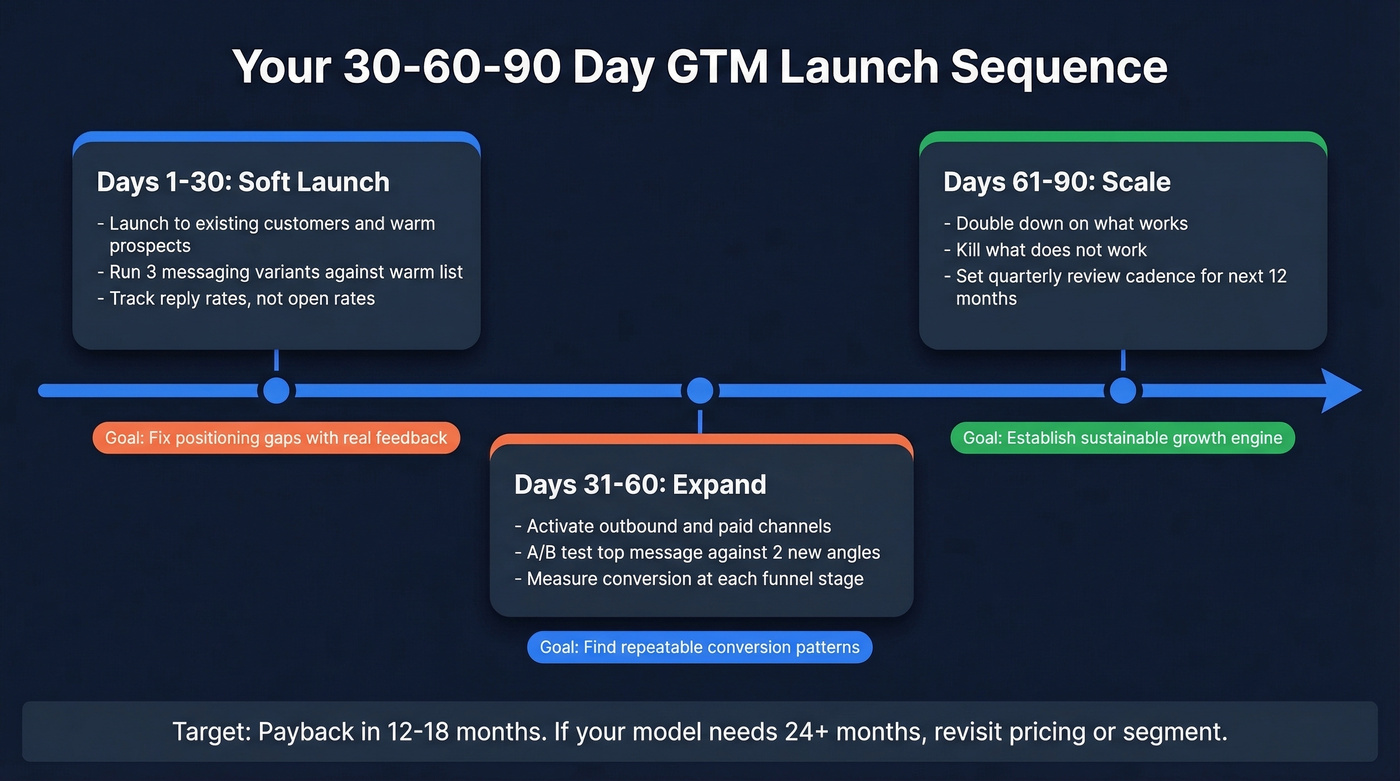
- Days 1-30: Soft launch to existing customers and warm prospects. Run 3 messaging variants against your warm list - track reply rates, not open rates. Fix positioning gaps based on real feedback.
- Days 31-60: Expand to outbound and paid channels. A/B test your top-performing message against two new angles. Measure conversion at each funnel stage.
- Days 61-90: Scale what's working. Kill what isn't. Set the quarterly review cadence that'll govern the next 12 months.
Engineer your launch to pay back in 12-18 months. If your model requires 24+ months to break even, you're either underpriced or targeting the wrong segment.
For a checklist-style rollout, use a go-to-market launch plan.
Set KPIs and Attribution
The biggest measurement mistake: tracking activity instead of impact. Emails sent, calls made, and MQLs generated are vanity metrics unless you can connect them to pipeline and revenue.
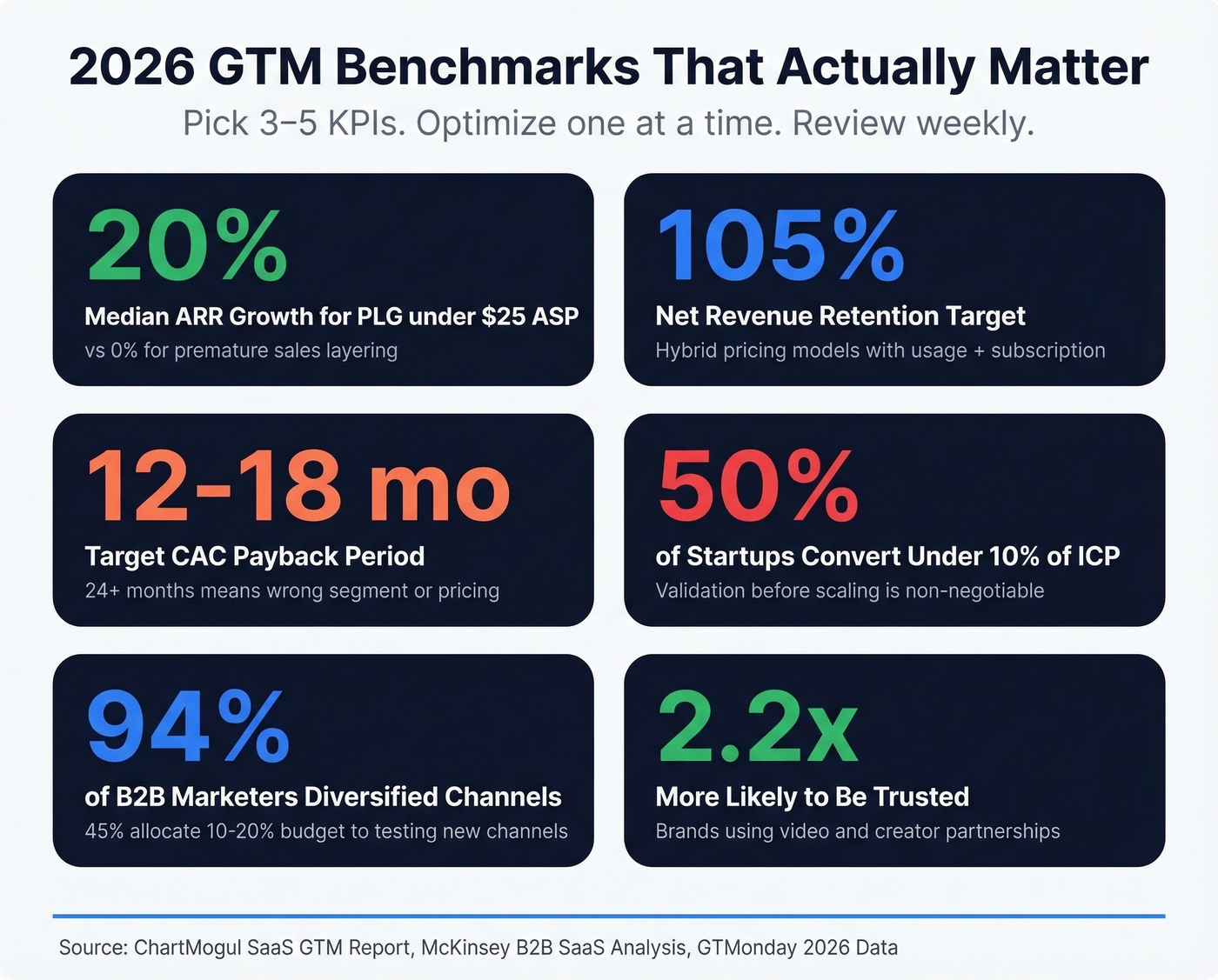
Pick 3-5 metrics that map to actual business outcomes, optimize one at a time, and review weekly. Attribution doesn't need to be perfect. Multi-touch models are better than last-touch, but even a simple "pipeline-sourced vs. pipeline-influenced" split gives you more signal than most teams have. The goal is connecting actions to revenue, not building a perfect attribution model that takes six months to implement. For teams that want a structured planning template, Miro's GTM Strategy Blueprint offers 14 guided boards covering ICP through launch execution.
If you want to go deeper on measurement, revenue attribution is the model to standardize early.
2026 GTM Benchmarks Worth Knowing
Benchmarks are useless without context, so let's pair the numbers with what they actually mean for your planning.
| Metric | Benchmark | Source |
|---|---|---|
| Visitor to Lead | 2.2% | FirstPageSage |
| LTV:CAC | 4:1 | FirstPageSage |
| CAC (Organic) | $942 | FirstPageSage |
| CAC (Paid) | $1,907 | FirstPageSage |
| Email Open Rate | 23% | FirstPageSage |
| Time to 1K Customers (Top) | 11 months | ChartMogul |
| Time to 1K Customers (Median) | 24 months | ChartMogul |
| NRR (Hybrid Pricing) | ~105% | High Alpha |
| Buyers Expecting ROI <90 Days | 57% | GTMonday |
A few things jump out. The gap between organic CAC ($942) and paid CAC ($1,907) is massive - organic is literally half the cost. That doesn't mean you skip paid, but it means your content and SEO investment compounds in ways that paid never will.
The macro environment makes execution matter more than ever. Since early 2022, new business ARR growth rates dropped 34 percentage points for companies below $1M ARR. Top performers under $1M dropped 57 points. The rising-tide era is over - your GTM has to actually be good now.
The time-to-1,000-customers gap is equally telling. Top performers hit that milestone in 11 months; the median takes 24. That's the difference between a Series A story and a bridge round. And after 10 years, only 13% of SaaS companies reach $10M ARR.
On pipeline velocity: top sellers close deals 3x faster and generate 11x more revenue per day than average performers. Deals that slip beyond two months see win rates drop by over 100%. Speed isn't just a nice-to-have - it's the strongest predictor of deal outcomes.
AI search now converts 40% better than traditional search for enterprise software discovery. Privacy regulations are pushing first-party data strategies to the forefront. If your GTM plan doesn't account for how buyers find you through AI-powered search and how you collect first-party data, you're optimizing for yesterday's discovery patterns.
For more sourced numbers you can cite in planning docs, pull from B2B marketing statistics.
GTM Mistakes That Kill Launches
Five failure modes show up repeatedly, and they're almost always organizational problems disguised as strategy problems.
Misaligned market understanding. You validated the pain but didn't validate the buying process. Coca-Cola's C2 launch is the classic cautionary tale - the product tested well, but the go-to-market timing and positioning missed the actual market window. In SaaS, this looks like building a sophisticated tool for SMBs that requires enterprise-level resources to implement. The product works; the market can't adopt it.
Lack of cross-functional alignment. Marketing, sales, product, and ops agree on the GTM plan in a kickoff meeting, then execute in silos. Lead definitions don't match. Handoff criteria are vague. Stage success looks different to every team. A founder on r/SaaS put it bluntly: "Our GTM failed because marketing was optimizing for MQLs and sales was optimizing for ACV. Nobody was optimizing for the same number."
Ineffective positioning. Leading with features instead of customer outcomes. Your buyer doesn't care that you have "AI-powered real-time analytics." They care that their team stops spending 10 hours a week building reports manually.
Inadequate sales enablement. No playbooks. No competitive battle cards. No feedback loops. Reps are left to figure it out on their own, and every deal becomes a custom pitch. This is the "set-and-forget GTM" anti-pattern - you launched, but you didn't equip.
Neglecting metrics and iteration. The GTM plan goes live and nobody revisits it. Channels that aren't working keep getting budget. Messaging that isn't converting stays on the website. No data infrastructure compensates for a GTM that nobody measures or adjusts - though making sure your outbound data is verified before it enters sequences (something tools like Prospeo handle with a 7-day refresh cycle) at least prevents the bounce-rate spiral that tanks sender reputation while you're still figuring things out.
If your motion is enterprise or ABM-heavy, this is where an account-based marketing solution can prevent a lot of operational drift.
How to Measure GTM Success
Most GTM measurement frameworks are overcomplicated. You don't need a 47-metric dashboard. You need to answer three questions every quarter - and you need to define what success means for your business model before you pick the metrics.
Are we acquiring efficiently? Track CAC by channel, conversion rates at each stage, and pipeline velocity. If your paid CAC is 3x your organic CAC, that's a signal to invest more in content - not a reason to panic about paid.
Are we retaining and expanding? Beyond $50M ARR, 60% of new ARR comes from existing customers. Even at earlier stages, NRR is the metric that separates companies that compound from companies that churn. If your NRR is below 100%, you've got a leaky bucket that no amount of top-of-funnel will fix.
Can we prove ROI? 57% of buyers now expect ROI in under 90 days - up from 47% expecting it in six months just a year prior. Connect every GTM action to pipeline or revenue, not to activity metrics.
Set a quarterly review cadence. Monthly is too reactive; annually is too slow. Every 90 days, review what's working, kill what isn't, and reallocate resources. The teams that treat their go-to-market strategy as an ongoing operating system - not a launch event - are the ones that hit their numbers consistently.
If you're building the operating rhythm across teams, a lightweight RevOps framework keeps the system from turning back into a deck.
The best GTM system fails when reps dial wrong numbers and emails bounce. Prospeo delivers 125M+ verified mobiles with a 30% pickup rate and emails at 98% accuracy - refreshed every 7 days, not the 6-week industry average. Teams using Prospeo book 26% more meetings than ZoomInfo users.
Execute your GTM with data that actually connects you to real buyers.
FAQ
What's the difference between a GTM strategy and a marketing plan?
A GTM strategy is a time-bound, cross-functional system covering pricing, sales motions, distribution, enablement, and measurement for a specific product launch. A marketing plan handles demand generation and awareness but doesn't address sales process design, pricing, or cross-functional coordination. Think of GTM as the operating system; marketing is one application running on it.
How long does it take to see GTM results?
Top-performing B2B SaaS companies reach 1,000 customers in 11 months; the median takes 24 months. For PLG motions, trial-to-paid conversions spike around day 7, giving you early signal fast. For sales-led motions, expect 2-3 months before pipeline data becomes statistically meaningful enough to optimize against.
What's the best GTM motion for early-stage SaaS?
Below $25 ASP, full PLG delivers 20% median new business ARR growth versus 0% when layering sales too early. At $100+ ASP, start layering sales on top of self-serve. Match your motion to your price point - not to what a company with a different ACV is doing. The best motion is the one your team can execute consistently with current resources.
What GTM KPIs should I track first?
Start with five: CAC by channel, visitor-to-lead conversion rate, pipeline velocity, net revenue retention, and LTV:CAC ratio. The 2026 benchmarks to beat are 2.2% visitor-to-lead, 4:1 LTV:CAC, and 105% NRR on hybrid pricing. Optimize one metric at a time - focus compounds faster than breadth.
How do I keep bad data from killing my outbound GTM?
Use a verification layer before any contact enters your sequences. Teams like Snyk cut bounce rates from 35-40% to under 5% and saw AE-sourced pipeline jump 180% after switching to verified data. Skip this step and you're burning sender reputation from day one.