

Go-to-Market Strategy Example PDF: A Filled-In Template You Can Actually Use
For every successful product launch, about four fail. That's not pessimism - it's McKinsey math. Most go-to-market strategy example PDFs floating around are slide decks, gated landing pages, or bloated consulting reports that nobody on your team will actually read. Here's what you need instead: a filled-in GTM plan you can steal, a framework that explains why each section matters, and a 90-day checklist to execute the whole thing.
What's in This Guide
- Just want a blank template? Jump to the 90-day checklist - it's structured as a print-ready framework.
- Want a filled-in GTM plan? Go straight to the worked example with real numbers for a hypothetical B2B SaaS company.
- Want real company examples? See how Slack, Oatly, HubSpot, Peloton, and the NYT each took different GTM paths.
- Want a launch checklist? The 90-day checklist breaks execution into three phases with specific tasks per week.
Here's a stat worth keeping in your back pocket: the average company runs 10.5 simultaneous GTM efforts - 5 core channels plus 5.5 experimental initiatives. If that sounds chaotic, it is. A clear plan is the only thing standing between "strategic experimentation" and throwing money at the wall.
What Is a Go-to-Market Strategy?
A go-to-market strategy is the plan for how you'll bring a product or service to market and generate revenue from it. It's not a marketing strategy - marketing is one channel inside a GTM plan. A GTM strategy covers the full arc from "who are we selling to" through "how do we get paid."
Every GTM plan answers four core questions:
- Who has the pain you solve, and how acute is it?
- What are you offering, and what makes your solution different?
- Where do these buyers spend time, and how do they actually purchase?
- How will you drive demand and convert it into revenue?
Fewer than 33% of companies have a formal GTM playbook. The rest wing it. If you're building a GTM plan for the first time or rebuilding one that didn't work, getting these four questions right matters more than any template format.
The 3-Phase GTM Framework
Most GTM frameworks overcomplicate things. Here's a simplified version adapted from Bain's GTM system: Analyze, Design, and Deliver. Companies with a documented GTM framework see 10% higher launch success rates and 3x revenue growth compared to those without one.
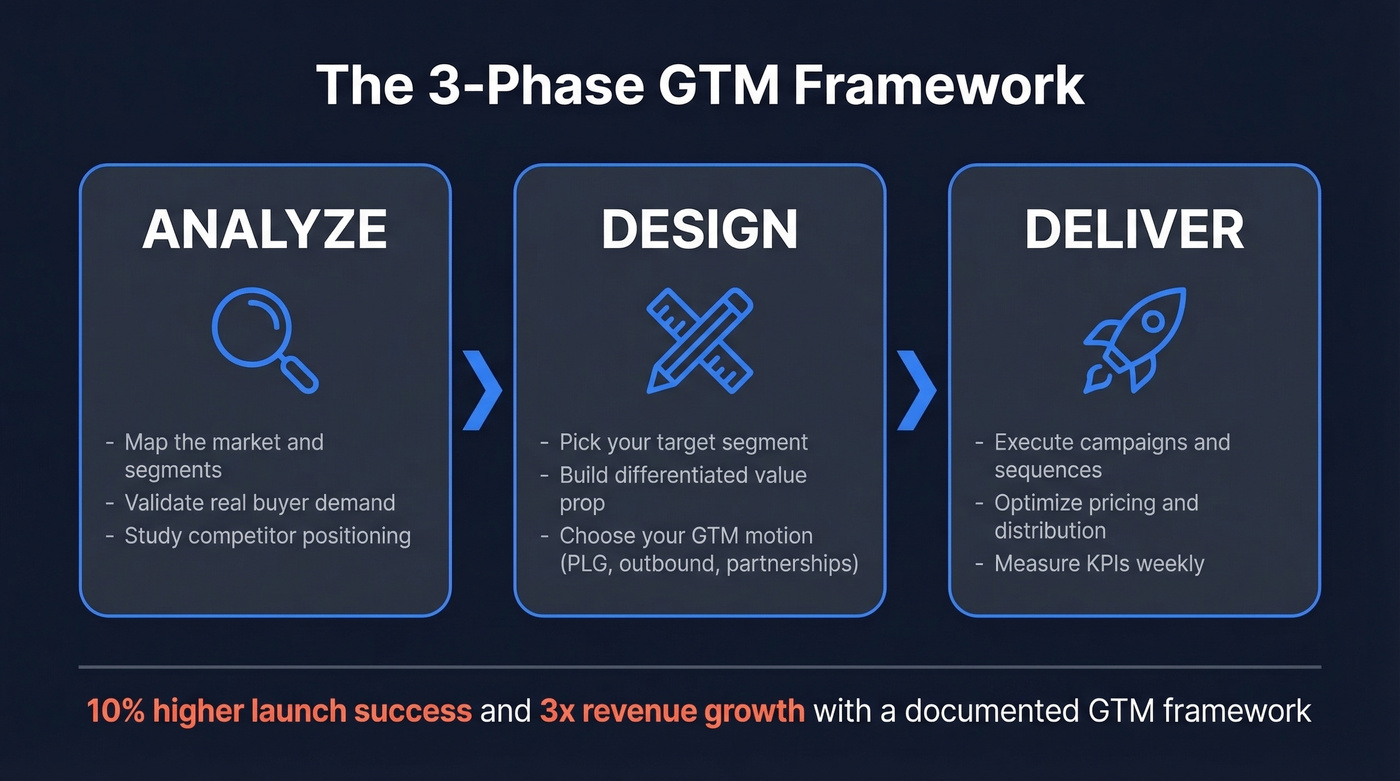
Analyze. Map the market, understand the buyer journey, and segment by need. This is where you validate that real demand exists - not just that your team thinks it does. Talk to prospects. Read support tickets. Dig into competitor positioning. You should walk away with a clear picture of who buys, why they buy, and what alternatives they're considering.
Design. Pick your target segment and build a differentiated value proposition for it. This is also where you choose your go-to-market motion - PLG, outbound, channel partnerships, or some combination. Peloton's early GTM is a great example: they opened luxury mall retail stores for awareness and consideration, even though most purchases happened online. The channel choice matched the buyer psychology, not the transaction model.
Deliver. Optimize sales, marketing, pricing, and distribution. This is execution - the sequences, the content calendar, the sales enablement materials, the pricing experiments. In our experience, most GTM plans die here, not in the strategy phase. The analysis is fun. The design feels creative. Delivery is where discipline either exists or doesn't.
10 Sections Every GTM Plan Needs
Before we fill in a complete example, here's the skeleton. Every serious GTM plan covers these ten areas:
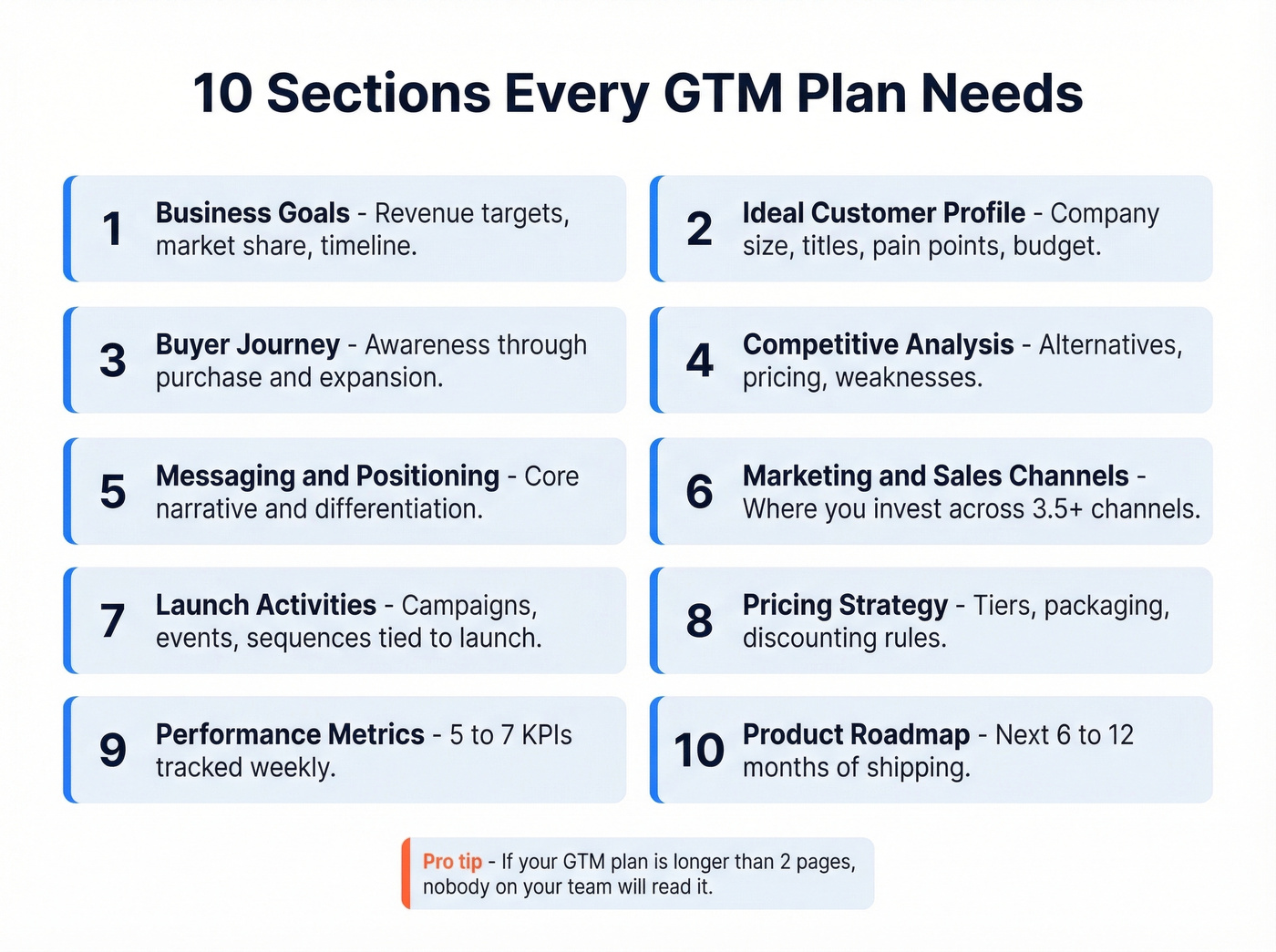
- Business Goals. Revenue targets, market share objectives, and timeline. Be specific - "$2M ARR by Q4" beats "grow revenue."
- Ideal Customer Profile. Company size, industry, job titles, pain points, and budget authority. The average B2B deal involves 6.3 stakeholders, so your ICP needs to account for the buying committee, not just one persona.
- Buyer Journey. Map the stages from awareness through purchase and expansion. Where do prospects research? What objections surface at each stage?
- Competitive Analysis. Who else solves this problem? What's their positioning, pricing, and weakness? (If you need a system, start with a competitive audit.)
- Messaging & Positioning. Your core narrative - the problem you solve, for whom, and why you're different. (This is classic B2B brand positioning.)
- Marketing & Sales Channels. Where you'll invest. B2B deals average 62.4 touches across 3.5 channels before closing, so multi-channel isn't optional.
- Launch Activities. The specific campaigns, events, and sequences tied to your launch date.
- Pricing Strategy. Tiers, packaging, discounting rules, and competitive positioning.
- Performance Metrics. The 5-7 KPIs you'll track weekly to know if the plan is working. (Use a simple funnel metrics view so teams align fast.)
- Product Roadmap. What's shipping in the next 6-12 months that affects positioning or enables expansion.
Filled-In GTM Strategy Example (Your PDF Template)
Here's a complete GTM plan for "ProspectFlow," a hypothetical B2B sales engagement platform launching in Q2 2026. Every section is filled in with realistic numbers. Use this as a template you can adapt to your own product - swap the numbers, rewrite the messaging, and you've got a launch-ready document.
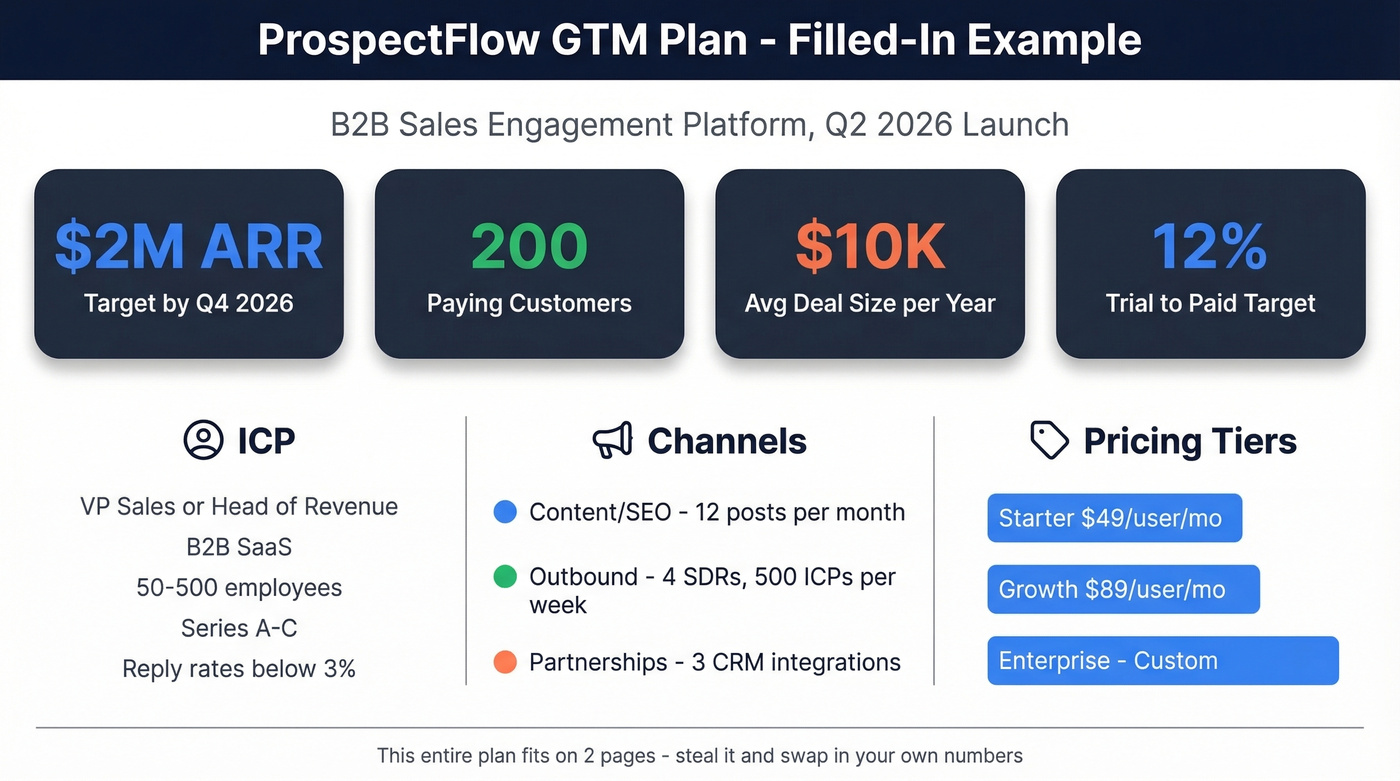
This is also the kind of filled-in GTM plan that PMM candidates get asked to produce in interviews. If you're prepping for one, this structure will get you through it.
Business Goals
$2M ARR by end of Q4 2026. 200 paying customers. Average deal size: $10K/year.
Ideal Customer Profile
VP of Sales or Head of Revenue at B2B SaaS companies with 50-500 employees. Series A-C funded. Running outbound but struggling with reply rates below 3%. (If you want a scoring rubric, use an ideal customer profile template.)
Buyer Journey
Awareness stage: prospects find ProspectFlow through content, peer referral, or cold outbound. Evaluation stage: they run a 14-day free trial and compare against Outreach and Salesloft. Decision stage: needs sign-off from VP Sales plus the RevOps lead.
Competitive Analysis
Primary competitors are Outreach (enterprise-heavy, $100+/user/mo), Salesloft (strong mid-market), and Apollo (bundled data plus sequences, weaker on deliverability). ProspectFlow differentiates on deliverability intelligence and pricing transparency.
Messaging
"Your sequences are only as good as your deliverability. ProspectFlow is the sales engagement platform that protects your sender reputation while scaling outbound."
Channels
Content/SEO: Publish 12 comparison and how-to posts per month targeting mid-funnel keywords. Outbound email: SDR team of 4 targeting 500 ICPs per week using Prospeo for verified contact data - 98% email accuracy and a 7-day data refresh cycle means fewer bounces and a protected sender reputation from day one. Partnerships: Integration co-marketing with 3 CRM and data providers.
Launch Activities
Product Hunt launch in Week 1. Webinar with a RevOps influencer in Week 2. Cold outbound sequences to 2,000 hand-picked accounts across Weeks 1-8.
Pricing
Starter: $49/user/mo (up to 5 users). Growth: $89/user/mo (unlimited users, advanced analytics). Enterprise: custom. All plans include deliverability monitoring.
KPIs
Trial-to-paid conversion: 12%. Outbound reply rate: >5%. Demo-to-close rate: 25%. CAC payback: <12 months. Net revenue retention: >110%. (If you need benchmarks, start with sales conversion rate and average B2B lead conversion rate.)
Product Roadmap
Q2: AI sequence writer + A/B testing. Q3: Native CRM enrichment. Q4: Intent-based send timing.
The content/SEO channel runs in parallel with outbound, and at the early stage, organic content is the cheapest pipeline source that compounds. The partnership channel is slower - expect 60-90 days before co-marketing produces measurable pipeline.
This plan fits on two pages. That's intentional. The HBS Rock Center go-to-market PDF is a useful reference for structuring GTM thinking. If your GTM plan is 30 pages, nobody on your team will read it.

Your GTM plan says 'outbound email' but your data provider determines whether it works. Prospeo delivers 98% email accuracy on 300M+ profiles with a 7-day refresh cycle - so your SDRs hit real inboxes, not bounce logs. At $0.01 per email, your launch budget stretches further than any competitor.
Don't let bad data kill your go-to-market before Week 2.
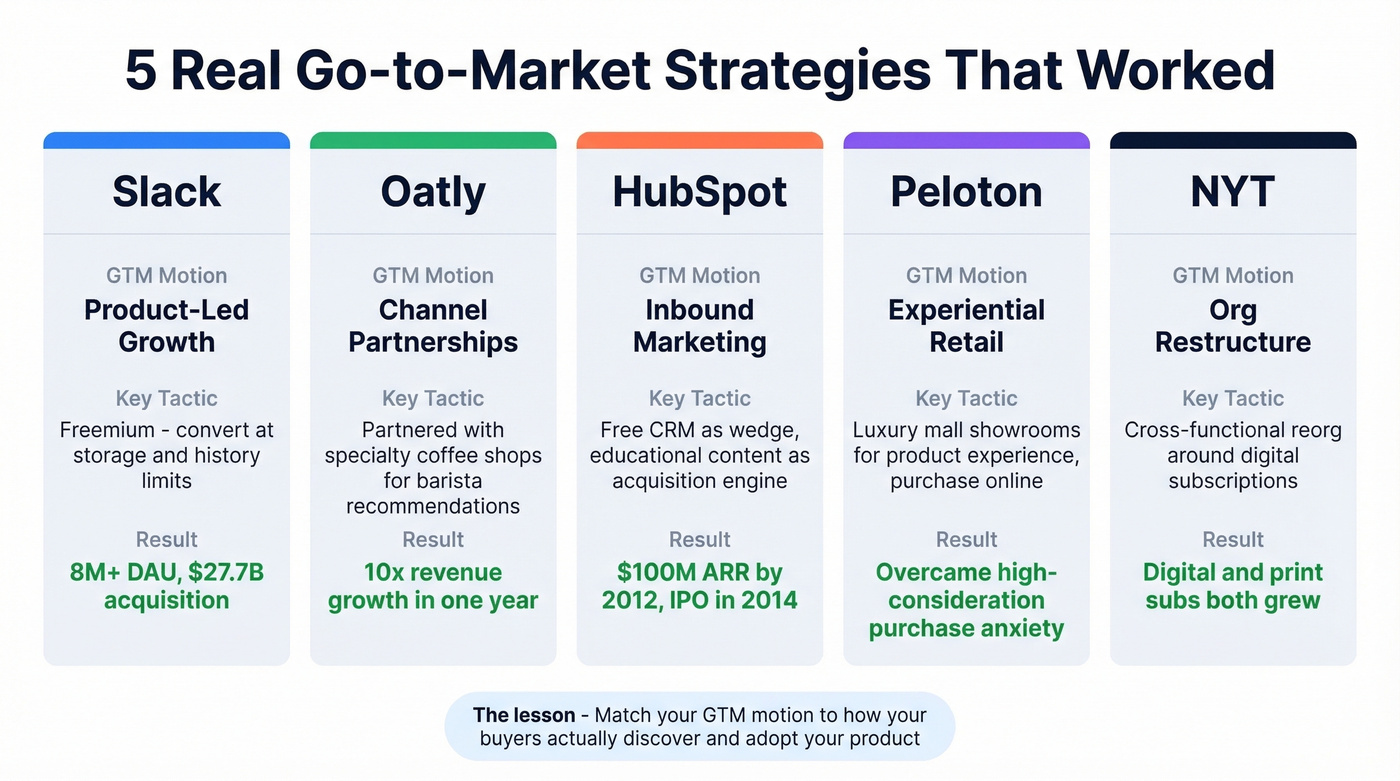
5 Real Go-to-Market Examples
Slack - Product-Led Growth
Slack bet everything on freemium. Let teams use the product for free, make it sticky through integrations and channels, then convert when the team hits the storage or history limit. By 2019: 8M+ daily active users, 3M paid users, and a $27.7B Salesforce acquisition. The lesson isn't "offer a free plan." It's that Slack's GTM motion matched how teams actually adopt communication tools - bottom-up, one team at a time. We've watched dozens of SaaS companies try to replicate this model without understanding that part.
Oatly - Channel Partnerships
Revenue grew 10x between 2017 and 2018. No ads. Oatly partnered with specialty coffee shops, getting baristas to use and recommend oat milk directly. The GTM insight: if your product needs to be experienced to be understood, find the channel where that experience happens naturally. Oatly didn't need to explain oat milk. They needed people to taste it.
HubSpot - Inbound Marketing
HubSpot coined the term "inbound marketing" and then built the entire GTM motion around it. Free CRM as the wedge product, educational content as the acquisition engine, upsell into paid marketing and sales hubs. They crossed $100M ARR by 2012 and IPO'd in 2014. The meta-lesson: HubSpot's GTM strategy was the product category they created. Their original GTM playbook is still worth studying for the structural thinking alone.
Peloton - Experiential Retail
Most DTC brands skip physical retail because it's expensive. Peloton leaned into it. They launched in late 2013 with stores in luxury malls - not to sell bikes on the spot, but to let people experience the product. Most purchases happened online afterward. A high-consideration purchase needs a physical touchpoint to overcome purchase anxiety, and Peloton understood that the showroom was the marketing.
The New York Times - Paywall + Reorg
The NYT didn't launch a new product in 2018 - they restructured how the existing one reached the market. By reorganizing cross-functionally around digital subscriptions, digital subscription revenue increased and, counterintuitively, print subscriptions also rose despite declining industry demand. The GTM lesson is organizational, not tactical. Sometimes the best go-to-market move is changing how your company is organized, not what you sell.
B2B vs B2C: How GTM Differs
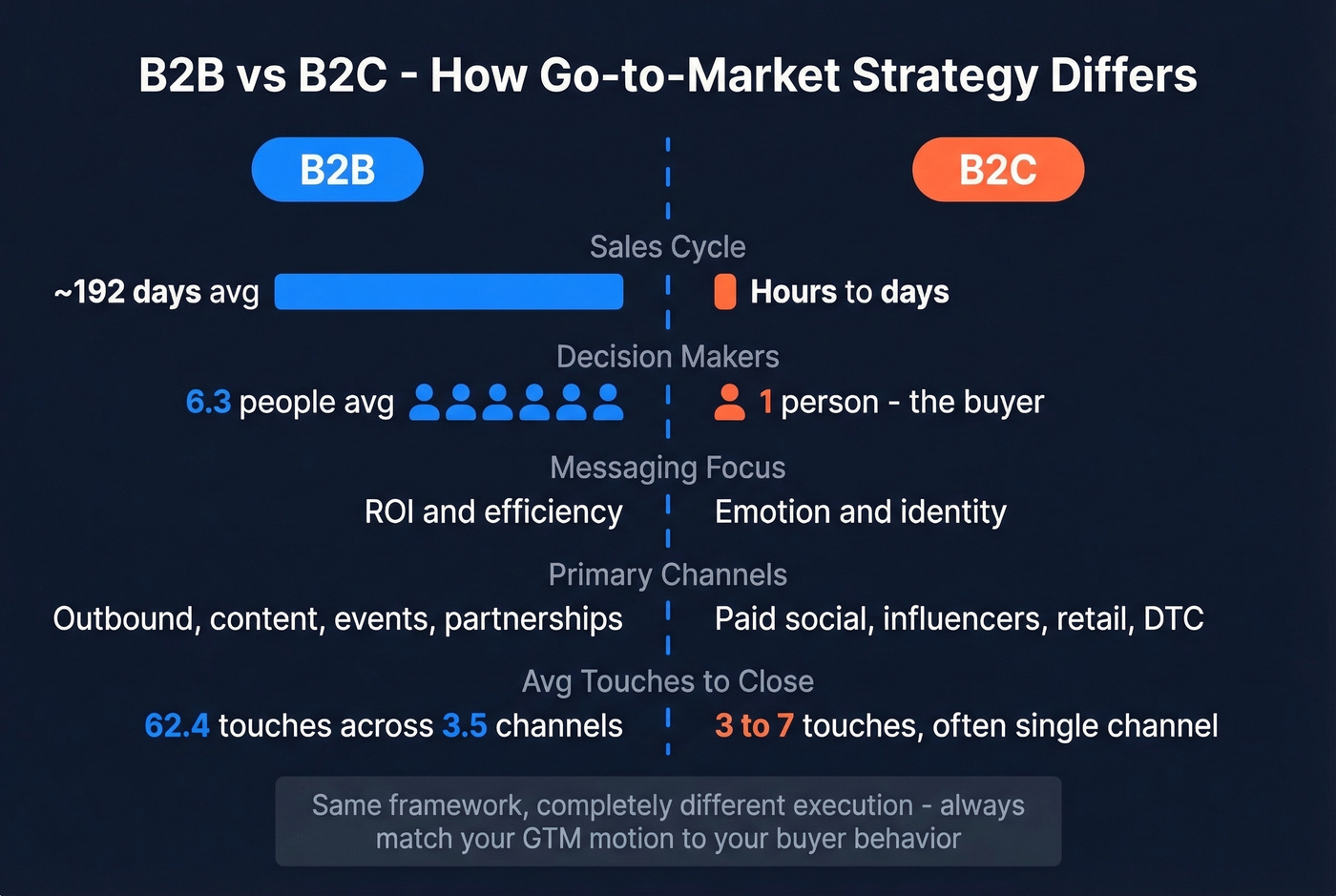
The framework above works for both B2B and B2C, but the execution looks completely different.
| Dimension | B2B | B2C |
|---|---|---|
| Sales Cycle | ~192 days avg | Hours to days |
| Decision-Makers | 6.3 avg | 1 (the buyer) |
| Messaging | ROI and efficiency | Emotion and identity |
| Content | Education-heavy | Entertainment-driven |
| Pricing | Contracts, subscriptions | One-time, impulse-friendly |
| Channels | Outbound + ABM | Mass media + social |
| Relationship Model | Account management | Automated / self-serve |
That 192-day B2B sales cycle should shape your entire GTM timeline. If you're planning a "launch week" for a B2B product, you're thinking in B2C terms. B2B launches are 90-day-minimum campaigns, not events.
Here's the thing: if your average contract value is under $15K, you probably don't need a 30-page GTM plan or a six-month runway. A two-page plan, a verified prospect list, and a strong outbound sequence will teach you more in 30 days than any strategy document will in six months. (If you're building the outbound motion, start with sales prospecting techniques and a clean B2B cold email sequence.)
What's Changed in 2026
GTM strategy in 2026 looks different from even two years ago. Here are the shifts that matter.
93% of GTM teams now use AI in some form, with 73% using ChatGPT specifically. AI isn't a differentiator anymore - it's table stakes for content production, sequence writing, and ICP research.
Cold email reply rates have declined from 6.8% in 2024 to 5.8% in 2025, and the downward pressure hasn't stopped. But the type of hook matters enormously: timeline-based outbound hooks pull a 10.01% reply rate versus 4.39% for problem-based hooks. That's a 2.3x difference from changing the email's opening angle. If you're still leading with "Are you struggling with X?" in your cold emails, switch to "Before your Q3 planning cycle..." and watch what happens. (If you want a deeper playbook, see AI cold email outreach.)
PLG top performers are targeting 65%+ activation rates versus the 33% average. If you're running a product-led motion, activation rate is the metric that predicts everything downstream.
The content distribution picture is shifting too: 51% of teams plan to increase investment in Answer Engine Optimization versus just 14% for traditional SEO. If your GTM plan doesn't account for AI-generated search results, you're optimizing for yesterday's distribution. Gartner's 2026 marketing predictions are worth reading for the broader context here.
7 GTM Mistakes That Kill Launches
Product launch failure rates run between 40% and 80% depending on the industry. Most of these aren't product failures. They're GTM failures.
No real market validation is the most common killer. Teams build for a problem they assume exists instead of one they've confirmed through conversations, data, or pre-orders. The most common request we hear from PMMs building their first GTM plan is "give me something with actual dates and numbers, not a blank template." That instinct is right - specificity forces validation.
Sales and marketing silos are a close second. Marketing generates leads that sales doesn't want. Sales closes deals marketing can't replicate. The GTM plan needs shared metrics and shared ownership. If your marketing and sales teams have separate dashboards, you have a structural problem.
Feature-led messaging kills positioning before it starts. "We have AI-powered analytics" means nothing to a buyer. "Cut your pipeline review from 3 hours to 20 minutes" does.
The remaining mistakes are execution failures that compound fast:
- No sales enablement materials. If your reps don't have battle cards, objection handlers, and case studies by launch day, you've wasted the launch window. (Use a simple sales battle cards format.)
- No KPIs or feedback loops. We've seen teams run outbound for 8 weeks without tracking reply rates by segment. By the time they realize the ICP is wrong, the budget is gone.
- Ignoring the customer journey. If you don't know where prospects drop off, you can't fix the funnel.
- Inflexible pricing. Your first pricing model is a hypothesis, not a strategy. Launching with one tier and refusing to experiment is a common early-stage mistake. The consensus on r/SaaS is that you should plan to change your pricing at least twice in the first year - and they're right.
Your 90-Day GTM Launch Checklist
Here's the execution framework, broken into three phases. Save or print this page - this is the checklist content you'd put in a downloadable go-to-market strategy PDF template.
Preparation (Weeks 1-4)
- Finalize ICP with specific company size, titles, and pain points
- Complete competitive audit - positioning, pricing, and messaging gaps
- Write the core messaging document (one page, not ten)
- Build the sales enablement kit: battle cards, one-pager, demo script, 3 case studies (use a product demo checklist so reps stay consistent)
- Build your verified prospect list using a tool with high accuracy - starting outbound with bad emails is the fastest way to burn your domain reputation before the product gets traction (see email deliverability basics)
Execution (Weeks 5-8)
- Launch outbound sequences to your top target accounts
- Activate the content calendar - publish 2-3 pieces per week minimum
- Enable the sales team with live role-plays and objection handling sessions
- Run first paid experiments (small budget, 2-3 channels, measure CPL)
Monitoring (Weeks 9-12+)
- Track KPIs weekly - reply rates, demo conversion, pipeline velocity
- Run pipeline reviews every Monday with sales and marketing in the same room
- Iterate messaging based on reply and conversion data from the first 4 weeks
- Double down on winning channels and kill underperformers without sentiment
- Expand to adjacent ICP segments only after the primary segment converts
Let's be honest about what this checklist doesn't cover: product readiness. If your product isn't stable enough to survive a 14-day trial without hand-holding, no GTM plan will save you. Fix the product first.
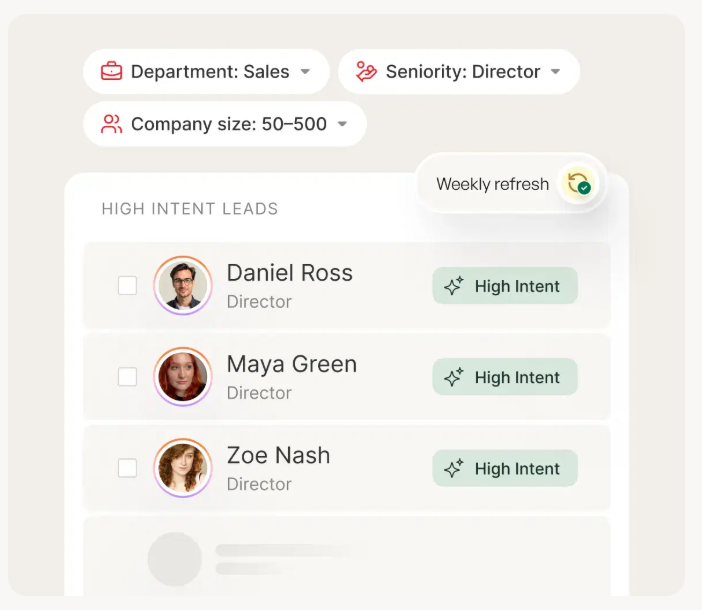
That GTM checklist calls for 500 ICPs per week. Prospeo's 30+ search filters - buyer intent, technographics, funding stage, headcount growth - let you build those lists in minutes, not hours. 83% enrichment match rate means most of your target accounts come back with direct contact data.
Build your entire launch list before your next standup.
FAQ
What should a GTM strategy PDF include?
A complete GTM PDF covers ten core sections: business goals, ideal customer profile, buyer journey, competitive analysis, messaging, channels, launch activities, pricing, performance metrics, and product roadmap. The best examples include filled-in numbers - not blank templates with placeholder text. Aim for two pages maximum so your team actually reads it.
How long does it take to build a GTM plan?
Most teams can draft a solid GTM plan in 2-4 weeks. The real work is execution. The average B2B deal takes 192 days from first contact to close, so plan for a 90-day minimum launch runway before you can meaningfully evaluate whether the strategy is working.
What's the difference between a GTM strategy and a marketing plan?
A marketing plan is one component inside a GTM strategy. The GTM strategy covers the full go-to-market arc - ICP definition, pricing, sales motions, channel selection, competitive positioning, and launch execution. A marketing plan focuses specifically on demand generation: content, ads, events, and brand.
Can I use a GTM template for a B2C product?
Yes, but the execution changes significantly. B2C sales cycles are hours or days instead of months, you're selling to one decision-maker instead of a buying committee, and messaging leans on emotion rather than ROI. The 10-section framework still applies - you'll just fill each section differently. The Oatly and Peloton examples above show strong B2C GTM execution.
What's the best way to build a prospect list for outbound GTM?
Start with a verified data source - 98% email accuracy protects your sender domain from day one. Track bounce rates weekly; if they spike above 4%, stop sending and fix your data before doing permanent damage. Skip providers that don't offer real-time verification or that refresh data on monthly-plus cycles. Stale data is the silent killer of outbound GTM.