

The GTM Playbook for Digital Products: What Actually Works in 2026
You spent eight months building. The product's solid. Launch day comes and goes - 30 beta users, a trickle of signups, no pipeline. CB Insights puts it plainly: 42% of startups die because there's no market need, or more accurately, no plan to connect the product to the market that does need it. 95% of newly launched products fail, and the top reason isn't bad engineering.
A go-to-market strategy for digital products isn't a slide deck. It's the difference between $600 MRR and $8,000 MRR in month one.
The Distilled Playbook
- Default to product-led growth unless your ACV exceeds $25K.
- Narrow your ICP ruthlessly. Vague targeting is the fastest way to burn budget.
- Build audience 6-12 months before launch. Stealth mode is a vanity trap.
- Pick one channel, own it, then expand.
- Measure CAC by channel from day one. Benchmarks below.
Why Digital Products Need a Different GTM Motion
Traditional B2B GTM leans on sales teams, lead forms, and demo requests. Digital products have different levers. Lead forms convert roughly 11% of the time. A free trial signup signals genuine intent and gives you real usage data to act on - that's a fundamentally different starting point.
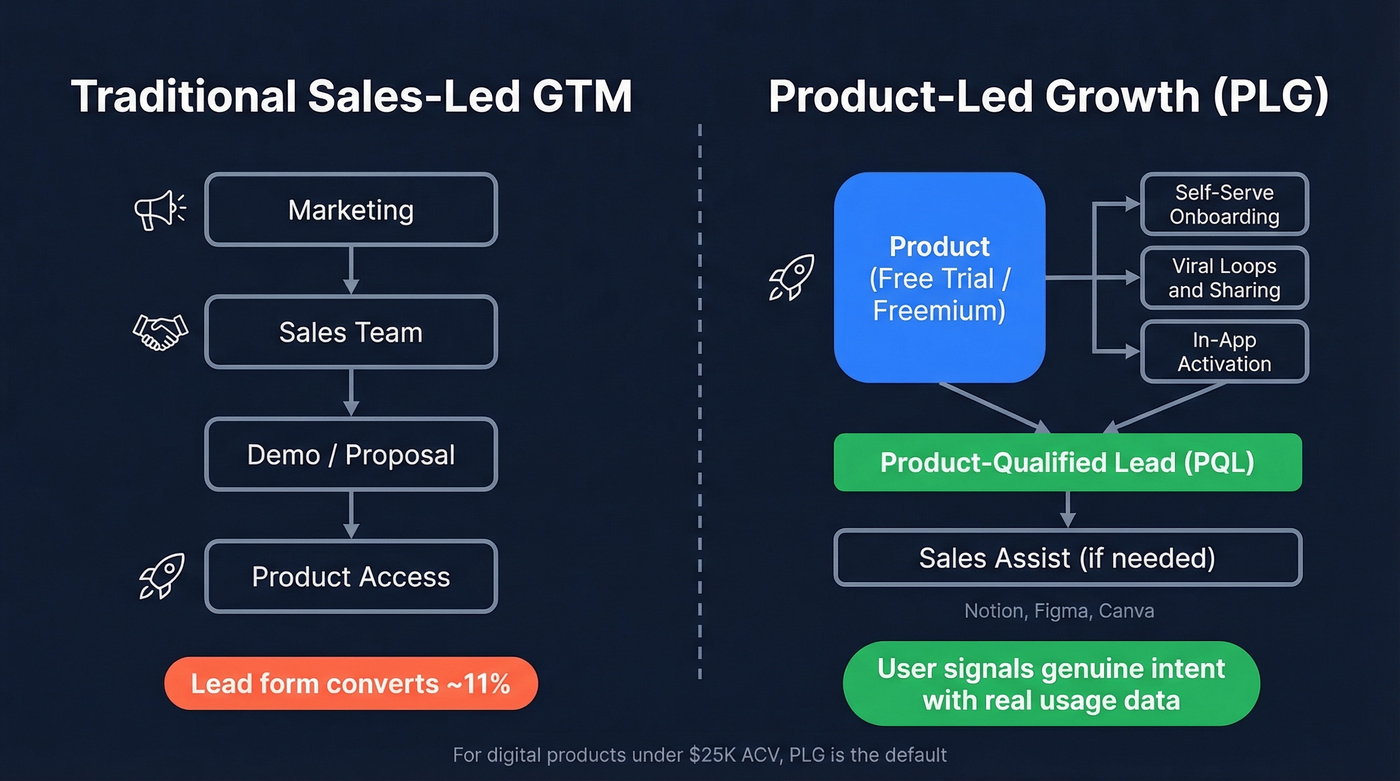
Product-led growth flips the funnel. Instead of marketing to sales to product, the product becomes the channel. Self-serve onboarding, viral loops, in-app activation, and product-qualified leads replace the traditional MQL handoff. Notion, Figma, and Canva are the clearest modern examples: they deliver value in the first few minutes, which is why they scaled through usage rather than sales decks.
If your product can do the same, PLG isn't just an option. It's the default.
A common question in founder communities and r/SaaS threads: which GTM channels actually work? The answer depends on your deal size and stage, but for most digital products under $25K ACV, the product itself is the best channel you have.
Building Your GTM Strategy: 6 Steps
1. Lock Your ICP
Talk to 50 potential customers before you write a single line of launch copy. Map their language, pain points, and willingness to pay. We've watched dozens of founders resist this step - narrowing feels like leaving money on the table.
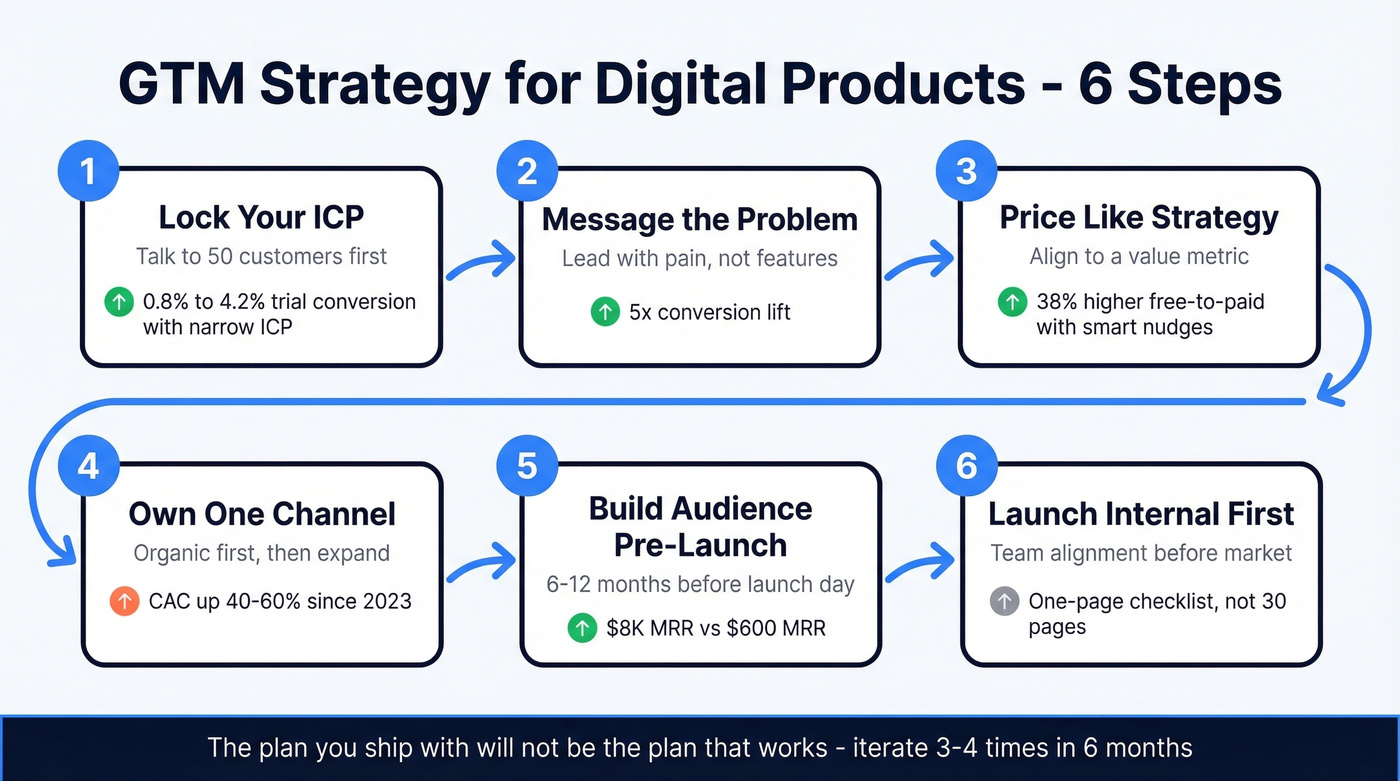
It's not. One team we tracked narrowed from "all marketers" to "B2B content teams at 50-200 person SaaS companies." Trial conversion jumped from 0.8% to 4.2%. Same product, same pricing, just a sharper target. If you need a tighter framework, start with an Ideal Customer Profile Template and score your segments.
2. Message the Problem, Not the Feature
A founder launched with "AI-powered workflow automation with 200+ integrations." Signups were flat. They repositioned to "Stop losing 6 hours a week to manual data entry." Trial conversion jumped 5x.
Lead with the problem every single time. If you want a simple structure for positioning, borrow from B2B Brand Positioning.
3. Price Like It's Strategy
Most SaaS companies undervalue themselves by 30-45%. Usage-based pricing drives 10-20% faster revenue growth when it's aligned to a value metric customers understand. Freemium with AI-driven upgrade nudges yields 38% higher free-to-paid conversion compared to traditional gating, according to OpenView's 2025 Product Benchmarks report.
Here's the thing: a $49/mo tool and a $490/mo tool attract fundamentally different buyers with fundamentally different expectations, support needs, and churn profiles. Pick your lane early. Then track churn analysis so pricing changes don’t quietly spike retention risk.
4. Pick One Channel, Own It
CAC has risen 40-60% since 2023. Spreading budget across five channels means overpaying on all of them.
| Channel | Avg B2B CAC |
|---|---|
| Referral | $150 |
| Facebook Ads | $230 |
| Organic Search | $290 |
| Paid Search | $802 |
| LinkedIn Ads | $982 |
| Outbound Sales | $1,980 |
The smart sequence: organic content first, then community and referral loops, then targeted outbound. Organic search delivers 702% ROI versus 31% for PPC, but takes 6+ months to compound. Outbound works faster, but that $1,980 CAC gets bloated by bad data - bounced emails, wrong numbers, wasted rep time. If outbound is your lever, use proven sales prospecting techniques and a clean lead generation workflow so reps aren’t guessing.

Prospeo cuts that bloat with 98% email accuracy, real-time verification, and roughly $0.01 per lead. Meritt dropped bounce rates from 35% to under 4% and tripled pipeline from $100K to $300K per week after switching. Clean data isn't a nice-to-have when outbound is your channel - it's the entire margin. (If you’re diagnosing deliverability, start with Email Bounce Rate benchmarks and fixes.)
5. Build Audience Before You Launch
Two teams launched competing products last year. Team A built in stealth for nine months, launched on Product Hunt, got press. Result: 23 signups, $600 MRR. Team B spent those same nine months building an email list and running a small community around the problem they were solving. Launch week: 340 signups, $8,000 MRR.
We've seen this pattern over and over. There is no shortcut. If you’re leaning on content as the engine, align it with what is B2B content marketing so it compounds instead of just “posting.”
6. Launch Internal Before External
Your GTM plan is useless if your own team can't articulate the value prop. Run an internal launch first. The essential launch template covers objectives and success metrics, target personas, messaging, timeline, cross-functional ownership, enablement plans, risk management, budget, a launch-day checklist, and a post-launch review process.
You don't need a 30-page doc. You need one page with those items and a team that's actually read it. For tighter execution, borrow a lightweight sales execution cadence.

Outbound is the fastest GTM channel for digital products - but that $1,980 CAC balloons when reps burn hours on bounced emails and wrong numbers. Prospeo delivers 98% email accuracy at ~$0.01/lead with 7-day data refresh, so every dollar you spend on outbound actually reaches a real buyer.
Cut your outbound CAC before it kills your LTV:CAC ratio.
Benchmarks: What Good Looks Like
Over 50% of product launches miss their business targets, per McKinsey.
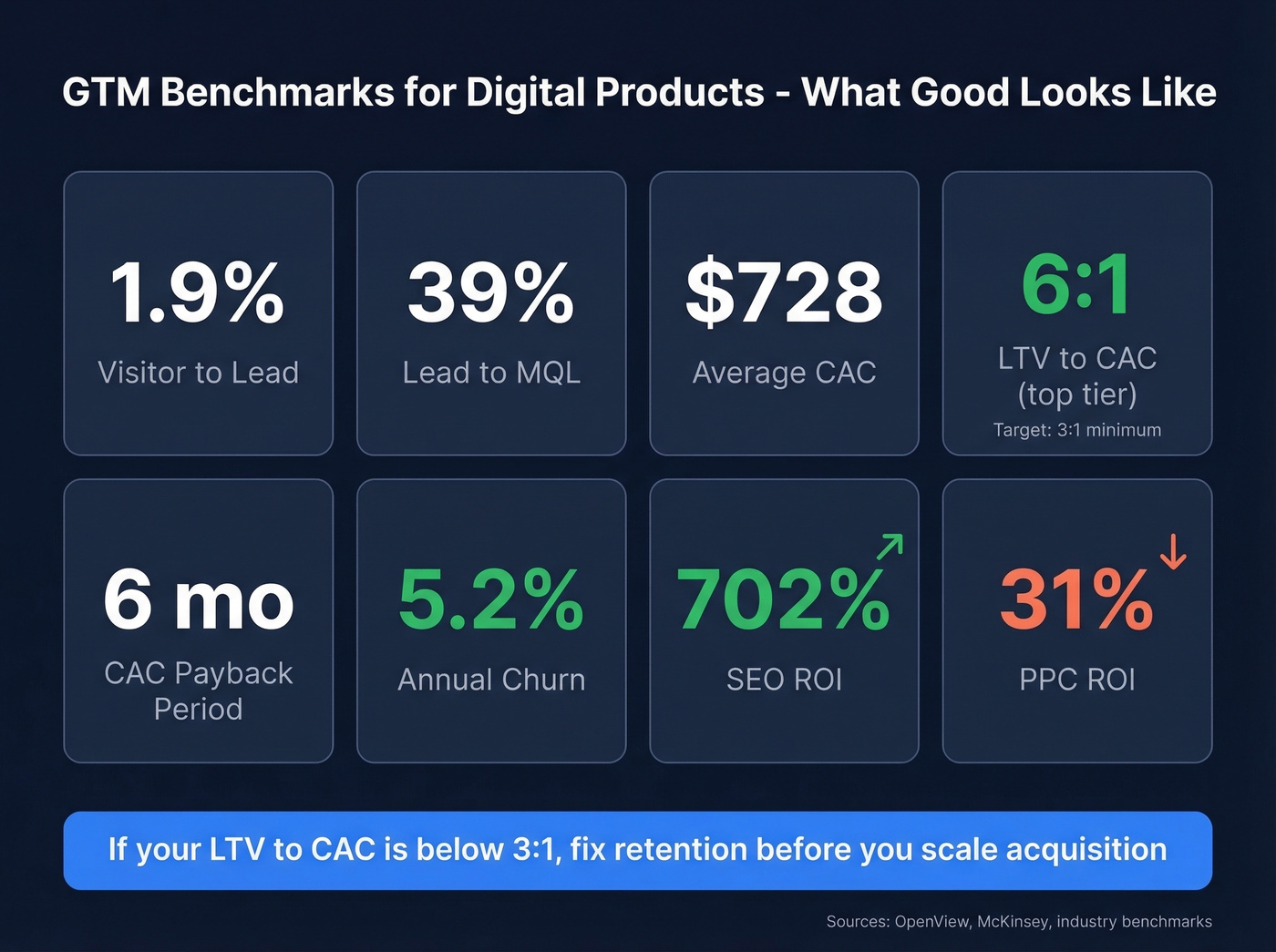
| Metric | Benchmark |
|---|---|
| Visitor to Lead | 1.9% |
| Lead to MQL | 39% |
| CAC | $728 |
| LTV:CAC | 6:1 |
| CAC Payback | 6 months |
| Annual Churn | 5.2% |
| SEO ROI | 702% |
| PPC ROI | 31% |
The LTV:CAC ratio is the number to obsess over. Industry standard target is 3:1; top SaaS companies run 6:1. If you're below 3:1, fix retention before you scale acquisition. Pouring money into the top of a leaky funnel is the most expensive way to learn that lesson. If you need a deeper breakdown, use this cost to acquire customer guide to sanity-check your CAC math.
Most Teams Over-Plan and Under-Execute
Let's be honest: if your deal size is under $10K, you don't need a GTM "strategy" at all. You need a one-page plan and 90 days of disciplined execution. The 30-page GTM document is a procrastination artifact. Successful launch plans iterate 3-4 times in the first six months - the plan you ship with won't be the plan that works.
What Goes Wrong
Launching to nobody. The 23-signup stealth launch from earlier? That's the norm, not the exception. Build audience during development or accept a quiet launch day.
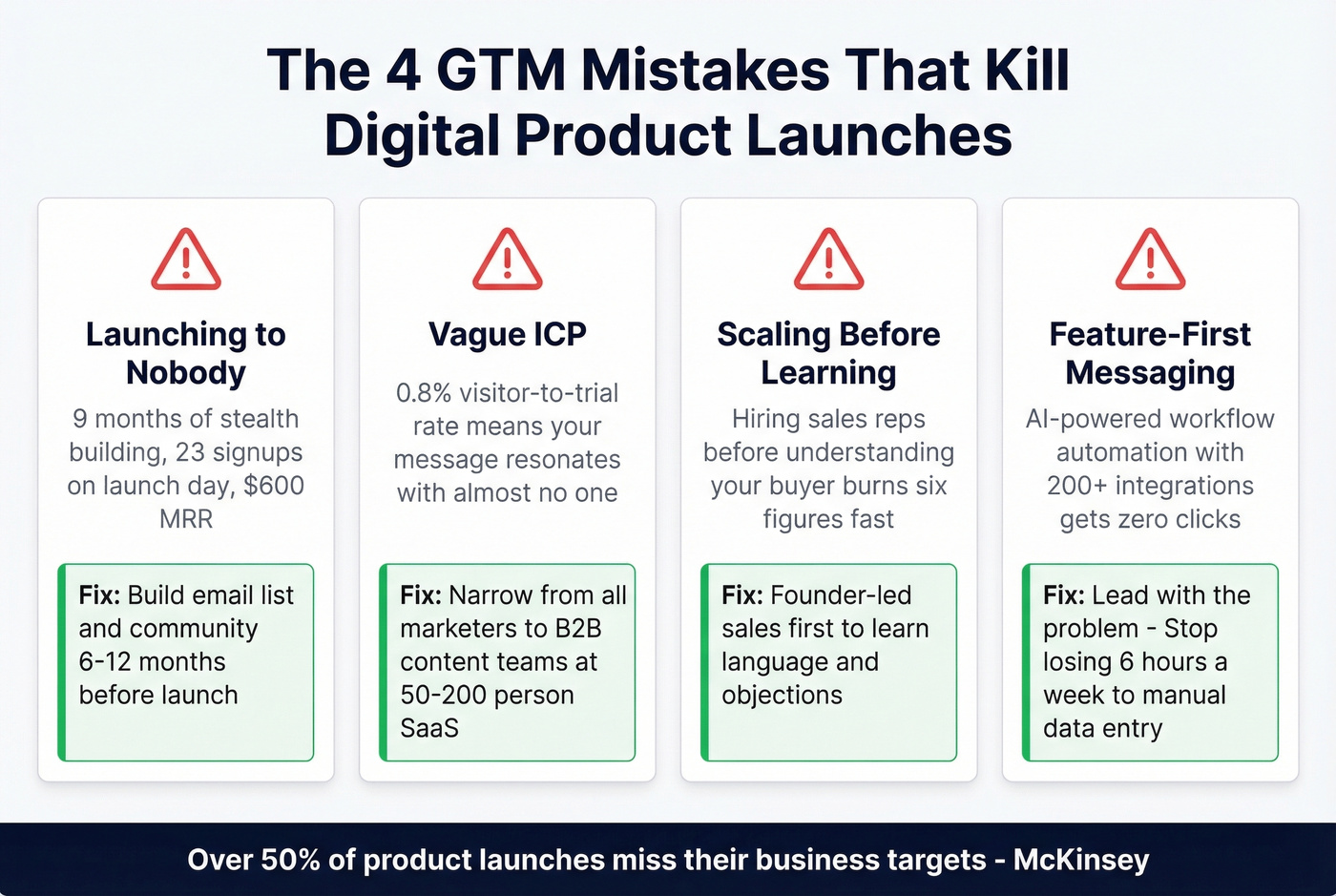
Vague ICP. A 0.8% visitor-to-trial rate means your messaging resonates with almost no one. Narrow until it hurts, then narrow again.
Scaling before learning. Hiring a sales team before you understand your buyer is the most expensive mistake in early-stage GTM. Founder-led sales is where you learn the language and objections that make everything else work. Skip this and you'll spend six figures training reps on a pitch that doesn't land.
Feature-first messaging. That 5x conversion lift came from deleting the feature list and leading with the problem. Nobody cares about your architecture. They care about the hours they're losing.
Start Executing
Set quarterly RevOps reviews to maintain alignment across product, marketing, and sales. Measure CAC by channel. Kill what doesn't convert. Double down on what does. If you want a tighter KPI set, track funnel metrics and review pipeline health monthly.
A go-to-market strategy for digital products only works when it's a living system - not a document that collects dust after launch week. The teams that win aren't the ones with the best strategy deck. They're the ones that executed, measured, and adjusted faster than everyone else.
Step 1 of your GTM is locking your ICP. Step 2 is actually reaching them. Prospeo's 30+ search filters - buyer intent, technographics, headcount growth, funding - let you build hyper-targeted lists that match the narrow ICP this playbook demands. 300M+ profiles, 143M+ verified emails, zero guesswork.
Stop launching to nobody. Build your ICP list in minutes.
FAQ
What's the difference between a GTM strategy and a marketing plan?
A GTM strategy covers the full launch motion - positioning, pricing, distribution, and sales enablement. A marketing plan is one slice of that. GTM decides who you sell to and how; marketing decides where and how you promote.
Should digital products default to product-led growth?
For products with deal sizes under $25K, yes. PLG lets the product drive acquisition through self-serve onboarding and usage-based signals. Above that threshold, layer sales-assisted motions alongside the self-serve experience.
How long before launch should I start building an audience?
Six to twelve months out. The contrast is stark: 340 signups and $8,000 MRR in week one versus 23 signups for a team that launched cold from stealth.
What tools help execute outbound as a GTM channel?
You need verified contact data, a CRM, and a sending tool. Pair a data provider like Prospeo with HubSpot's free CRM and a sequencer like Instantly or Lemlist for a complete outbound stack under $200/month.