

High Velocity Sales: The Methodology Guide Nobody Wrote
You're an AE grinding through 12-month enterprise cycles - buying committees, internal politics, forecast grilling - and you miss the momentum. That feeling of booking meetings, moving deals, and closing on repeat in 30-day sprints? It has a name. It's high velocity sales.
HVS is a sales methodology built on short cycles, structured cadences, and automation - not a Salesforce SKU. To run it well, you need a CRM, a sequencer, and clean data. The rest of this guide gives you the formula, the cadence, the benchmarks, and the stack.
What Is High Velocity Sales?
This methodology takes B2C selling tactics - speed, volume, repetition - and applies them to B2B inside sales. It's the opposite of enterprise selling. HVS teams work high volumes of smaller deals through structured, multi-channel cadences powered by automation and data.
The term got co-opted by Salesforce's product naming, but HVS as a methodology exists independent of any vendor. It's how inside sales teams at SaaS companies close hundreds of deals per quarter instead of nursing five.
| HVS Model | Enterprise Sales | |
|---|---|---|
| Cycle length | 46-75 days | 6-18 months |
| Decision-makers | 1-3 | 5-12 (committee) |
| Rep focus | Volume + speed | Depth + strategy |
| Primary channels | Email, phone, video | Meetings, proposals, POCs |
| Typical deal size | $5K-$50K | $100K-$1M+ |
The appeal on r/techsales is real. Reps describe wanting to "clear $150k+ with shorter, less strategic cycles" and getting back to the rhythm of booking meetings, moving deals, closing, and repeating. That rhythm is the whole point.
The Pipeline Velocity Formula
Everything in HVS comes back to one equation:
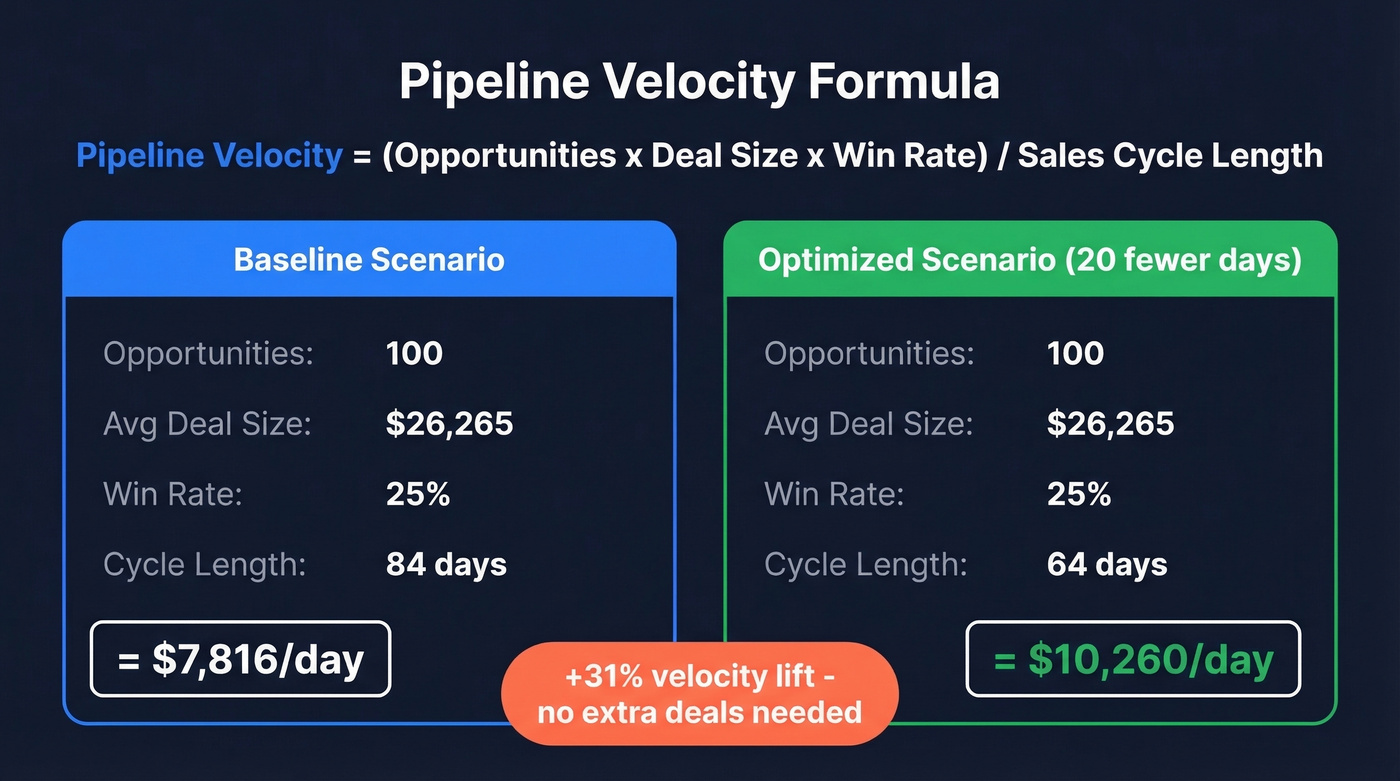
Pipeline Velocity = (Opportunities x Deal Size x Win Rate) / Sales Cycle Length
Let's run the numbers with typical SaaS benchmarks. Say you've got 100 opportunities, a $26,265 average deal, a 25% win rate, and an 84-day cycle. That's ($26,265 x 100 x 0.25) / 84 = $7,816/day in pipeline velocity.
HVS attacks both sides simultaneously. You compress the denominator - cycle length - through structured cadences and fast follow-up. You inflate the numerator - opportunities - through higher outbound volume and better qualification. Shave 20 days off that cycle and velocity jumps to $10,260/day. That's a 31% lift without closing a single extra deal.
Building an Effective Sales Cadence
Most "cadences" are just a series of emails with no structure. A real HVS cadence has a defined channel mix, a purpose for every touch, and a hard stop. Here's the 7-touch, 10-business-day baseline we've seen work consistently:
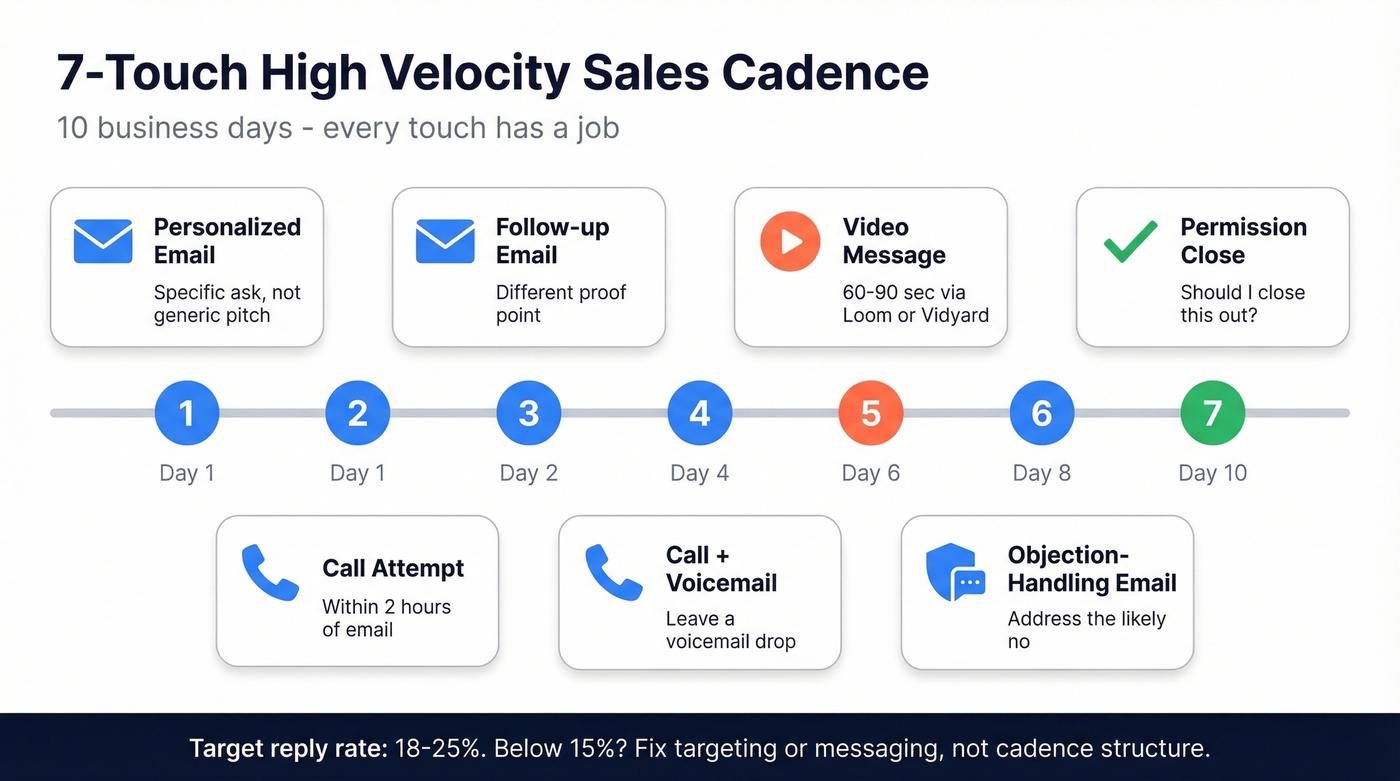
- Day 1 - Personalized email with a specific ask
- Day 1 - Call attempt within 2 hours of email
- Day 2 - Follow-up email with a different proof point
- Day 4 - Call + voicemail drop
- Day 6 - 60-90 second video via Loom or Vidyard
- Day 8 - Objection-handling email addressing the likely "no"
- Day 10 - Permission close: "Should I close this out?"
Every touch needs a job - a new angle, a new proof point, or a new ask. Delete "just checking in" from your vocabulary (or learn how to say "just checking in" professionally). And if your cadence doesn't have a stop line, it isn't a cadence. No momentum by day 10? Change the persona, channel, or offer. Don't run a silent month hoping they'll reply.
For inbound leads requesting demos or quotes, cadence design matters less than raw speed - aim to respond within a few minutes.
SaaS cadences following this structure typically see reply rates between 18-25%. Below 15%? The problem is targeting or messaging, not cadence structure. If you need copy ideas fast, pull from proven sales follow-up templates and test new email subject lines.

Your 7-touch cadence is only as good as the data feeding it. Prospeo delivers 98% email accuracy across 143M+ verified addresses - refreshed every 7 days, not every 6 weeks. That means fewer bounces, higher deliverability, and cadences that actually reach real buyers.
Stop burning sequences on stale contacts. Get data that keeps up with your velocity.
Metrics That Actually Matter
Sales reps spend only 33% of their time actually selling. HVS is designed to push that number up. Here's what to track:
| Metric | Target Range | Why It Matters |
|---|---|---|
| Dials/day | 50-100 | Volume baseline |
| Lead-to-customer | 2-5% | End-to-end efficiency |
| MQL to SQL conversion | 15-21% | Qualification bottleneck |
| Win rate | 20-30% | Deal quality signal |
| Sales cycle length | 46-75 days | Velocity denominator |
| Rep selling time | >40% | Automation ROI check |
The 84-day median SaaS sales cycle is your benchmark to beat. If you're running a true HVS motion and still above 75 days, audit your qualification criteria and handoff process first - that's where cycles bloat. (If you want a tighter system, start with a clear lead scoring model and a defined lead status workflow.)
Here's the thing: if your average deal sits below $20K ACV, you probably don't need a 12-touch enterprise cadence or a six-figure data vendor. A tight 7-touch sequence with accurate contact data will outperform a bloated motion every time.
The HVS Tech Stack
You need three layers: a CRM to manage pipeline, a sequencer to run cadences, and a data platform to feed both with accurate contacts. If you're still evaluating CRMs, skim a few examples of a CRM and compare options in contact management software.
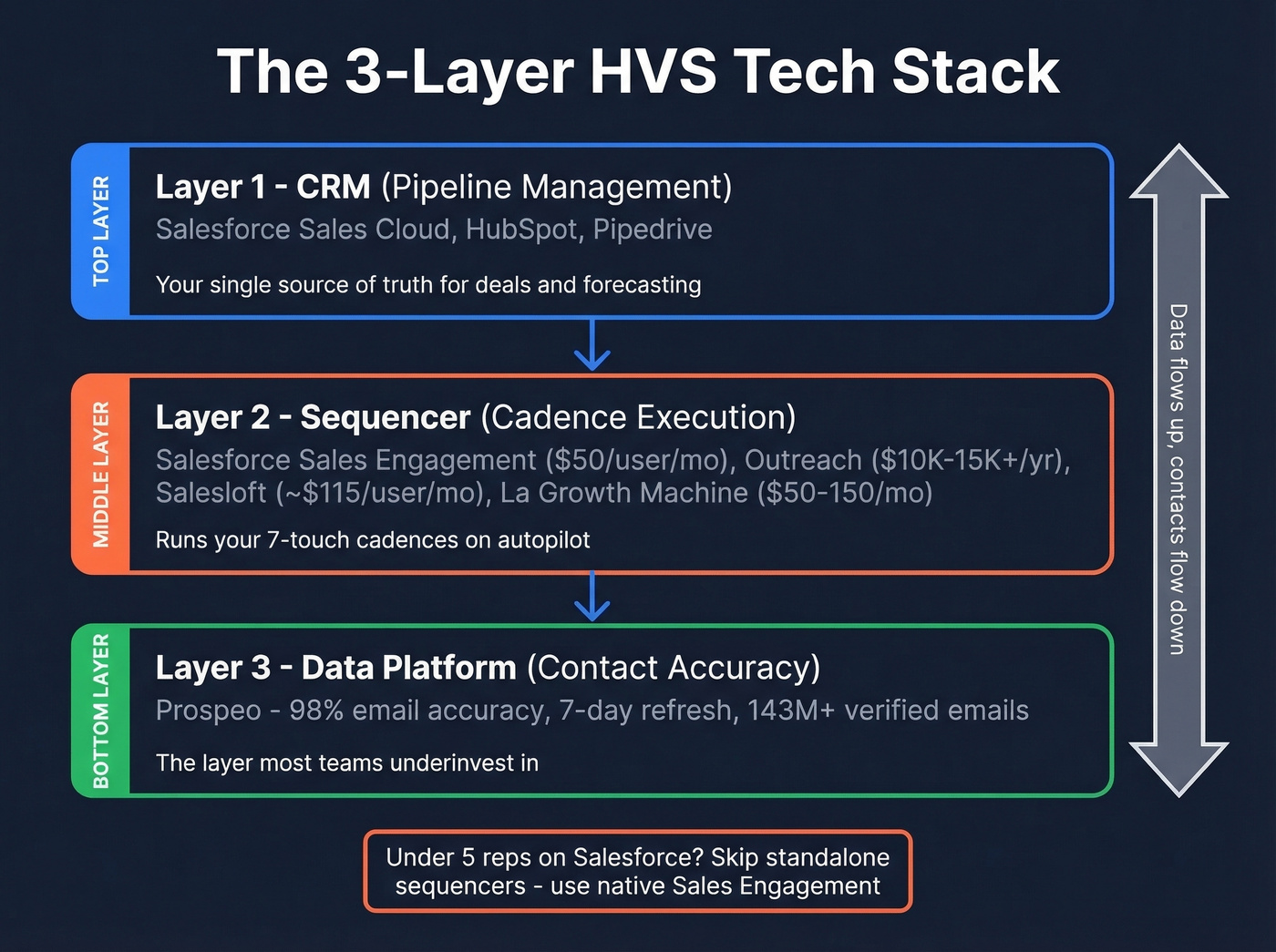
| Layer | Tool | Price | Notes |
|---|---|---|---|
| CRM + Sequencer | Salesforce Sales Engagement | $50/user/mo (annual) | Native CRM workflow |
| Sequencer | Outreach | ~$10K-$15K+/yr for 5 users | Enterprise branching |
| Sequencer | Salesloft | ~$115/user/mo | Merged with Clari in 2025 |
| Sequencer | La Growth Machine | $50-$150/mo per identity | Multi-channel focus |
Salesforce Sales Engagement is the easiest option if you're already on Sales Cloud - it's included in Sales Cloud Unlimited or available as a $50/user/month add-on. Outreach and Salesloft are stronger standalone sequencers with deeper analytics, but factor in 20-40 hours for setup and 5-10 hours monthly for optimization.
Skip Outreach or Salesloft if your team is under five reps and you're already on Salesforce. The native Sales Engagement module will cover 80% of what you need without the integration headaches.
The layer most teams underinvest in is data. Most sequencers don't include a data layer, so you need a separate source for verified contacts. Prospeo handles this with 98% email accuracy on a 7-day refresh cycle across 143M+ verified emails and 300M+ professional profiles, and it plugs into whatever sequencer you're already running via native integrations with Salesforce, HubSpot, Outreach, Salesloft, and Clay. (If you're comparing vendors, start with data enrichment services and a shortlist of sales prospecting databases.)
The Mistake That Kills Velocity
Everyone talks about cadence design and automation. Nobody talks about the fact that the average B2B database decays 30% per year. People change jobs, companies get acquired, email addresses go stale. In our experience, this data decay - not cadence structure - is where most HVS motions actually break down.
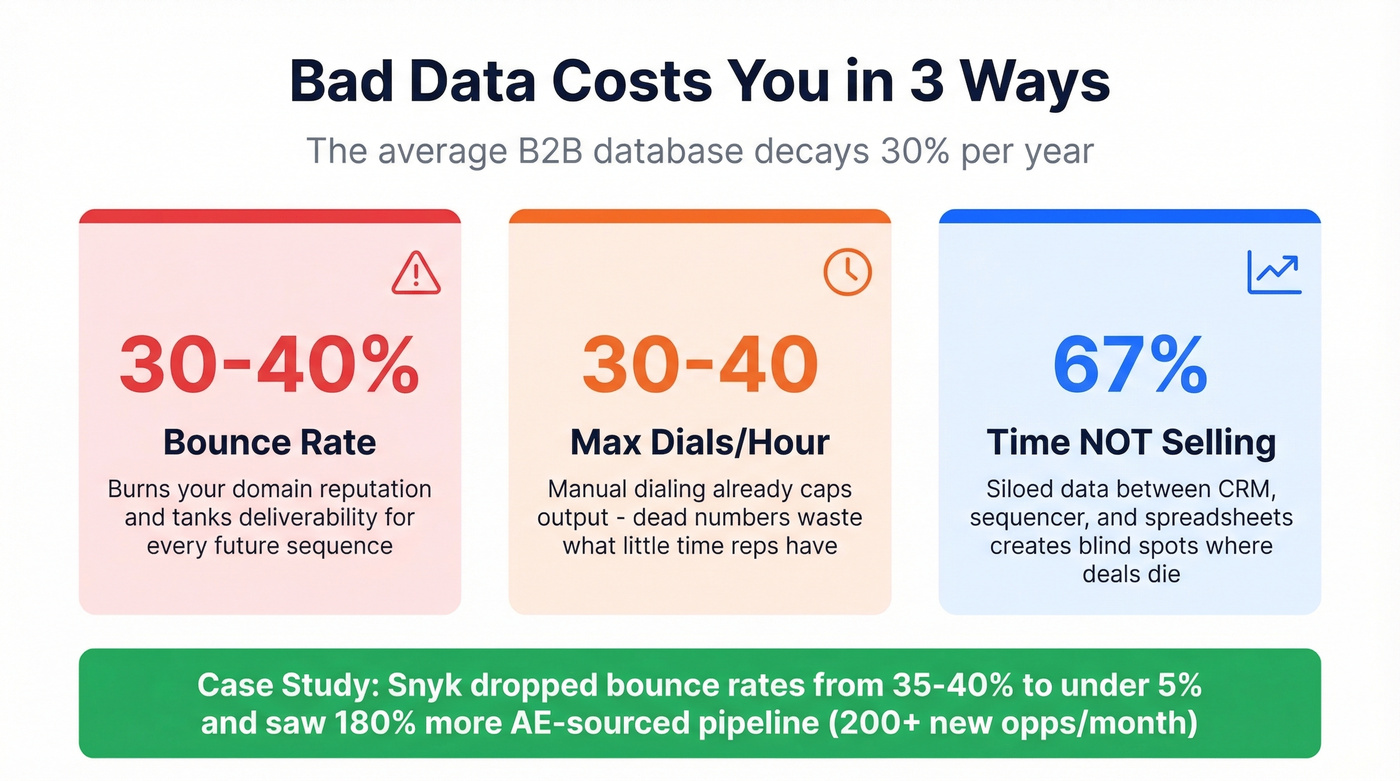
Bad data costs you in three distinct ways. Bounced emails burn your domain reputation, tanking deliverability for every future sequence (use an email deliverability guide and track your email bounce rate). Dead phone numbers waste dial time when manual dialing already caps output at 30-40 calls per hour. And siloed data creates analytics blind spots where deals fall through cracks between your CRM, sequencer, and spreadsheets.
Your cadence is only as fast as your data is accurate. If a third of your emails bounce, you're running high-velocity spam, not a real sales motion. Snyk's 50-person AE team saw bounce rates drop from 35-40% to under 5% after switching their data source - and their AE-sourced pipeline jumped 180%, generating 200+ new opportunities per month.

Database decay kills pipeline velocity faster than bad cadence design. Prospeo's 7-day refresh cycle and 5-step verification process mean your reps spend their 33% selling time talking to real prospects - not chasing dead emails at $0.01 per verified contact.
Shave days off your sales cycle by eliminating bounced emails entirely.
FAQ
Is Salesforce High Velocity Sales the same as Sales Engagement?
Yes - Salesforce rebranded High Velocity Sales to Sales Engagement. Same core workflow: cadences, work queue, and Einstein lead scoring. It's available as a $50/user/month add-on or included in Sales Cloud Unlimited.
What's a good sales cycle length for HVS?
Aim for 46-75 days. The SaaS median is 84 days, so a well-run motion should beat that by compressing qualification and follow-up through structured cadences and verified contact data.
How many dials per day should an HVS rep make?
Target 50-100 depending on channel mix. With an AI dialer, reps can push past 300. But 60 dials with 8 conversations beats 150 dials with 3 - track meetings booked, not raw dials.