

How to Convince a Prospect: The Friction-Removal Playbook
You just had what felt like a perfect discovery call. Nodding, engaged questions, even laughing at your jokes. Then came "Let me think about it" - followed by three weeks of radio silence. The problem wasn't your pitch. It was the friction you didn't see.
Here's the uncomfortable truth: 86% of B2B purchases stall during the buying process. Not because prospects don't want to buy, but because something - internal politics, unclear ROI, fear of making the wrong call - grinds momentum to a halt. And 81% of buyers end up dissatisfied with the provider they ultimately choose, which tells you the process itself is broken, not just the decision.
So if you're figuring out how to convince a prospect, the answer starts with a reframe. Your job isn't to convince anyone. It's to unstick them. Convincing implies the prospect doesn't want what you're selling; unsticking assumes they do but can't get there yet. That single shift changes everything about how you approach sales conversations, follow-ups, and objection handling.
Three Things That Actually Matter
Reps who close consistently do three things differently:
- They remove friction instead of adding pressure. 83% of buyers define their requirements before they ever talk to you. They don't need education - they need help navigating the decision.
- They combine framework + follow-up + clean data. Pick a sales methodology, build a persistent follow-up system, and make sure your contact data is accurate. These three levers do more than any silver-tongue technique.
- They trust process over talent. Companies with a defined sales process are 33% more likely to be high performers. Pick a framework, master it, execute consistently.
The 2026 Buyer Is Already Ahead of You
The prospect on the other end of your Zoom isn't the same buyer from three years ago. They've done their homework. They've asked ChatGPT about your category. They've already formed an opinion before you opened your mouth.
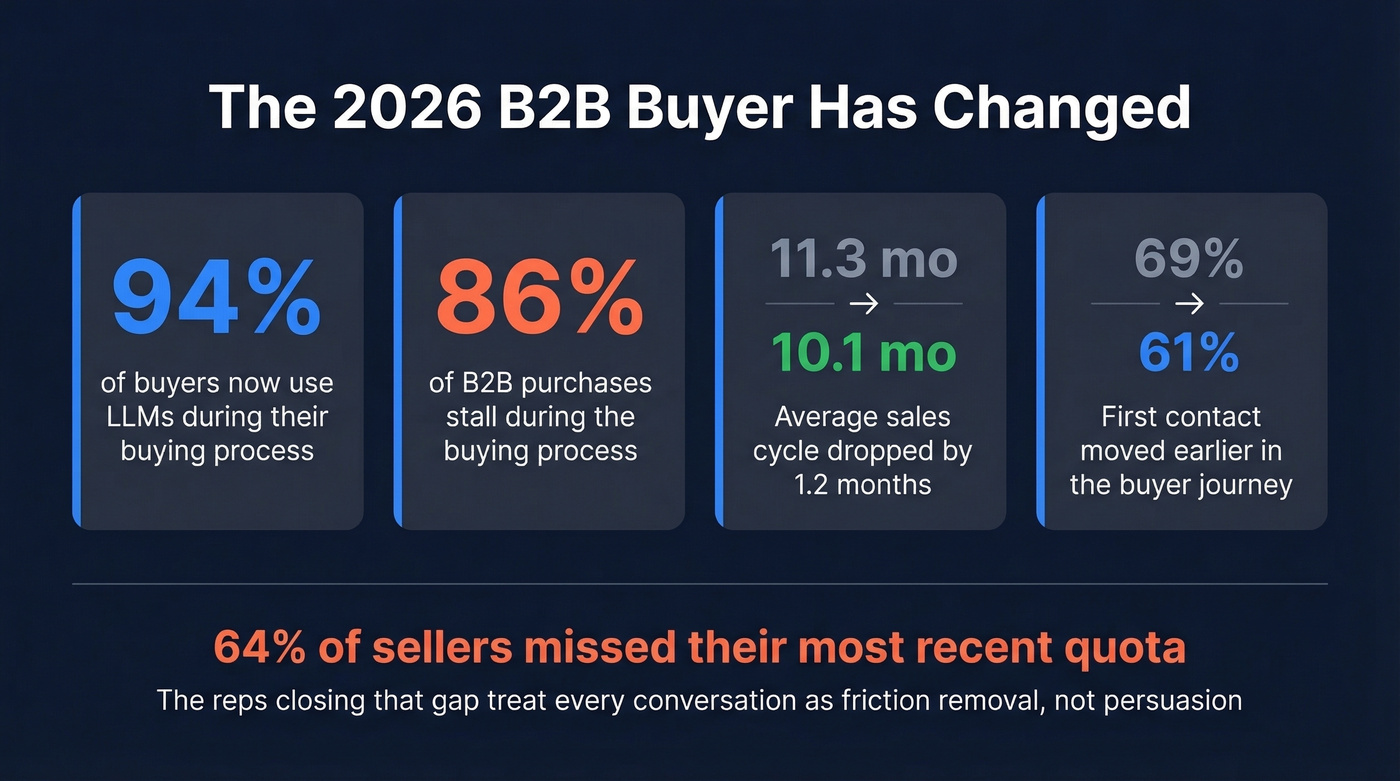
The numbers tell the story: average B2B sales cycles dropped from 11.3 months to 10.1 months between 2024 and 2025, and first contact moved from 69% to 61% of the buyer's journey - pulling outreach forward by roughly six weeks. Buyers are engaging earlier, but they're arriving more informed. 94% of buyers now use LLMs during their buying process, which means your prospect has probably read a summary of your competitor's pricing page before your intro email even lands.
Your pitch can't be "why buy at all." The prospect already knows why. It needs to answer "why you, versus the alternative they've already researched." That's a fundamentally different conversation, and it requires you to understand their decision landscape, not just your feature set.
64% of sellers say they missed their most recent quota. The reps closing that gap treat every conversation as a friction-removal exercise, not a persuasion contest.
Sales Psychology Behind Every "Yes"
The most useful research comes from Tversky and Kahneman's framing experiments) - and it applies to every sales conversation you'll ever have. In their classic study, participants faced a scenario about saving 600 people from a disease. When framed as a gain - "200 people will be saved" - 72% chose the sure option. When the identical math was framed as a loss - "400 people will die" - 78% chose the risky option. Same numbers. Completely different decisions.
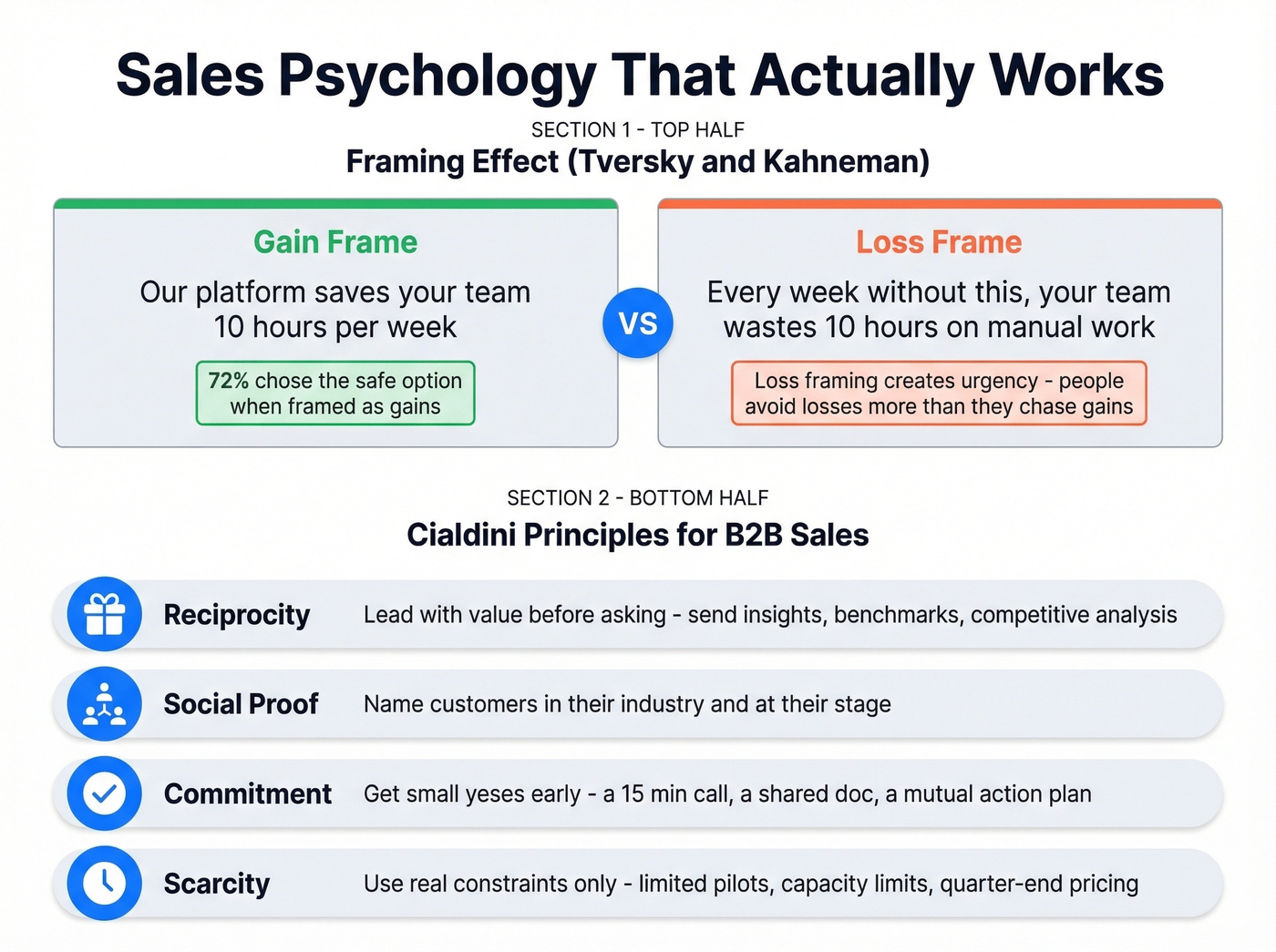
In a real sales pitch, that looks like this:
- Gain frame: "Our platform saves your team 10 hours per week."
- Loss frame: "Every week without this, your team wastes 10 hours on manual work they shouldn't be doing."
Same math. But the loss frame creates urgency because people are wired to avoid losses more aggressively than they pursue gains. When a prospect is stuck in status quo, loss framing is your best friend.
Layer on Cialdini's principles and you've got a practical toolkit. Reciprocity means leading with value before asking for anything - send a relevant insight, a competitive analysis, a useful benchmark. Social proof means naming customers in their industry and at their stage. Nothing builds credibility faster than a prospect hearing that a company like theirs already solved this exact problem with you.
Commitment and consistency means getting small yeses early - a 15-minute call, a shared document, a mutual action plan - so the big yes feels like a natural next step. And scarcity, often overlooked in B2B, works when the constraint is real: limited pilot slots, capacity constraints on onboarding, or end-of-quarter pricing all create legitimate urgency. Manufactured scarcity, on the other hand, gets spotted instantly and destroys trust.
The key is subtlety. Prospects can smell manipulation. These aren't tricks - they're communication choices that align with how humans actually make decisions.
Pick a Sales Framework
Let's be honest: picking any framework beats winging it. Having one puts you ahead of most of your competition before you even pick up the phone.
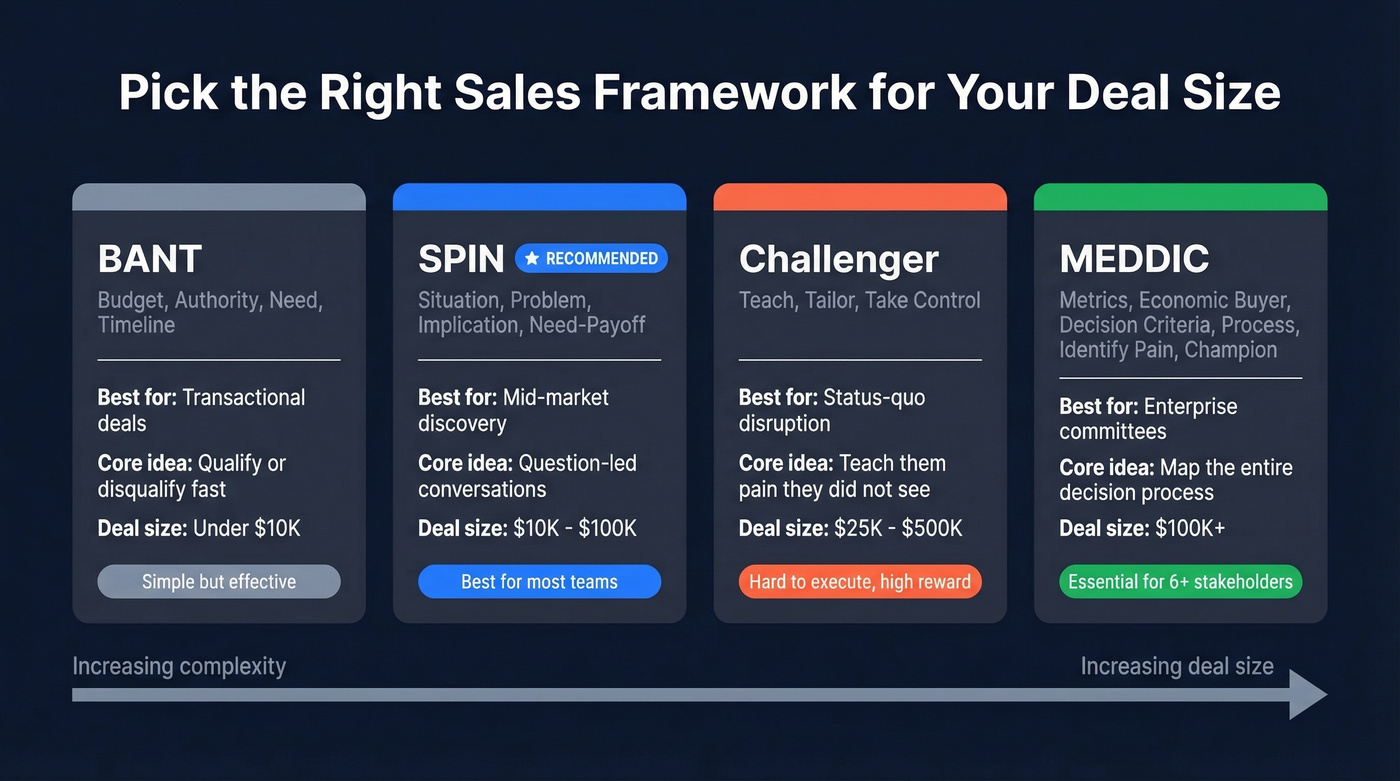
| Framework | Best For | Core Idea | Deal Size |
|---|---|---|---|
| BANT | Transactional | Qualify fast | Under $10K |
| SPIN | Mid-market | Question-led discovery | $10K-$100K |
| Challenger | Complex / status-quo | Teach + reframe | $25K-$500K |
| MEDDIC | Enterprise committees | Map the decision | $100K+ |
BANT (Budget, Authority, Need, Timeline) works when you need to qualify or disqualify fast. It's not sophisticated, but for transactional deals, sophistication is overhead.
SPIN (Situation, Problem, Implication, Need-Payoff) shines in mid-market deals where the prospect knows they have a problem but hasn't quantified the cost of inaction. The implication questions - "What happens if this isn't solved by Q3?" - do more convincing than any slide deck ever will.
Challenger works when the prospect is comfortable with the status quo. You're not discovering their pain; you're teaching them they have pain they didn't recognize. It's harder to execute but devastating in complex sales. If your champion can't articulate your value to their buying committee without you in the room, Challenger gives them the language to do it.
MEDDIC is for enterprise deals with buying committees. If you're selling six-figure contracts into organizations with 6+ stakeholders, you need to map the decision process - identify your champion, understand the economic buyer's metrics, and document the decision criteria - or you'll lose to internal politics every time. (If you want to go deeper, start with MEDDIC and the best MEDDIC discovery questions.)
Our take: Most teams with smaller deal sizes don't need Challenger or MEDDIC. They need SPIN and relentless follow-up. Skip the complexity if your average deal is under $25K. Overcomplicating your methodology is its own form of friction.

Your framework is only as good as the data behind it. 64% of sellers miss quota - and bad contact data is friction you can eliminate today. Prospeo delivers 98% email accuracy and 125M+ verified mobiles so every discovery call actually happens.
Stop losing deals to bounced emails and wrong numbers.
Sell Better in Discovery Calls
The best discovery calls feel like conversations, not interrogations. The 70/30 rule from Cognism's objection-handling framework applies here: the prospect should talk 70% of the time. You talk 30%. Most reps invert this ratio and wonder why deals stall.
Move from features to benefits to meaning. The feature is what your product does, the benefit is what it does for them, and the meaning is why that matters to their career. "We integrate with Salesforce" becomes "so your reps don't do manual data entry" becomes "which means you stop losing deals because pipeline data was three weeks stale."
Three questions that do more work than any pitch:
- "What's driving the urgency to solve this now?" This reveals their timeline and internal pressure - the real buying triggers that no amount of feature-selling can uncover.
- "What happens if this doesn't get solved by [their deadline]?" A classic SPIN implication question that makes the cost of inaction concrete and emotional.
- "Who else needs to be comfortable with this decision?" This maps the buying committee without sounding like you're running a checklist - and tells you whether you're talking to the champion or a gatekeeper.
None of these questions are about your product. That's the point. (If you want more, here are proven discovery questions and a full discovery call script.)
One thing most sales advice ignores: your body language matters even on Zoom. Research from Carol Kinsey Gorman found that maintaining 30%-60% direct eye contact builds trust without creating discomfort, and speakers who use gestures are remembered for 34% of their message content versus just 5% for those who don't. Look at your camera, not your slides. Use your hands. These micro-signals compound across a 30-minute call.
Handle Objections Without Flinching
The 5-Step Framework
Most reps treat objections like attacks. They're not. They're buying signals wrapped in uncertainty. The prospect who objects is still in the conversation. The one who ghosts you isn't.
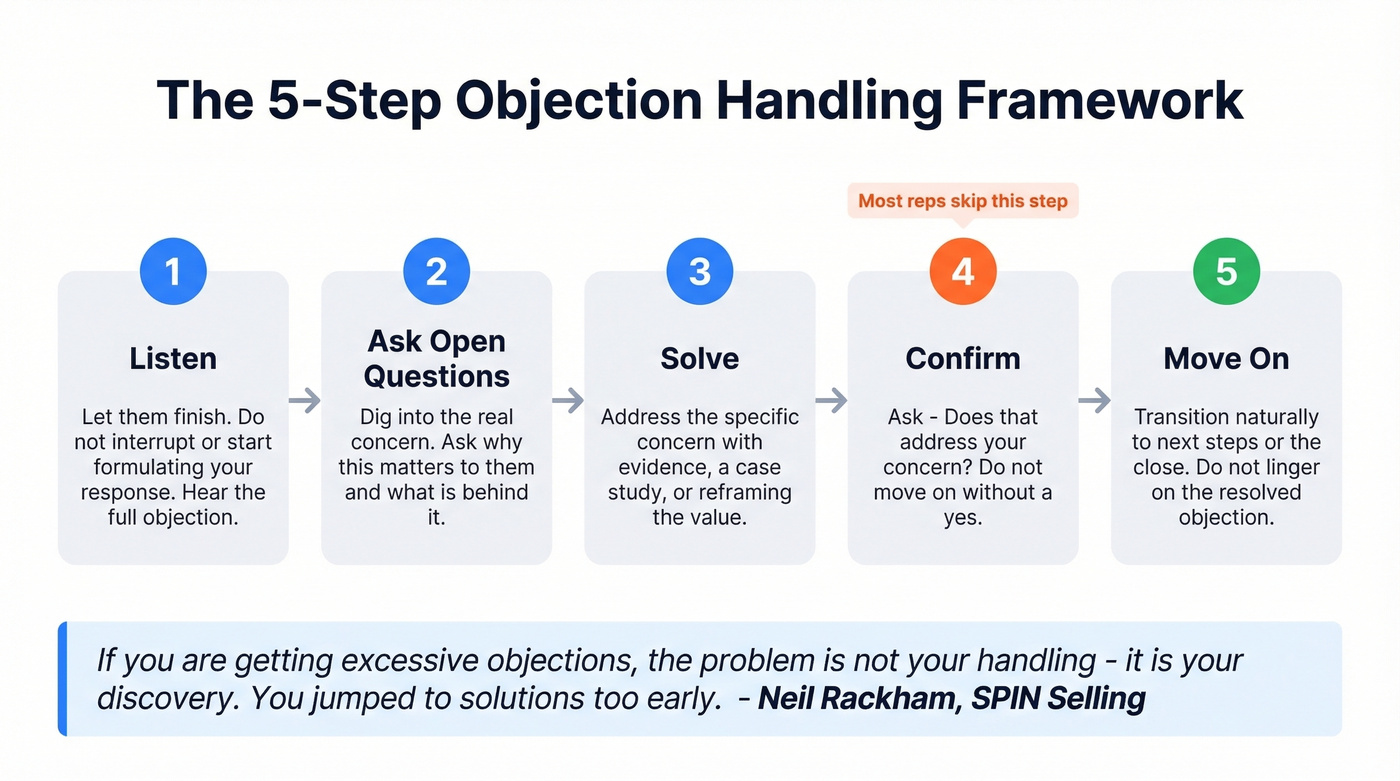
The cleanest framework we've found: Listen, Ask open-ended questions, Solve, Confirm, Move on. The critical step most reps skip is "confirm." After you address the objection, ask "Does that address your concern?" before moving forward. Without confirmation, you're guessing - and guessing compounds into lost deals.
Neil Rackham's insight from SPIN Selling is worth internalizing: if you're getting excessive objections, you jumped to solutions too early. You haven't developed enough need or value. The fix isn't better objection handling - it's better discovery. (If objections are a pattern, use this guide to reduce your sales objection rate.)
Scripts for the Five Objections You'll Hear This Week
60% of prospects say "no" four times before saying "yes." Most reps quit after two.
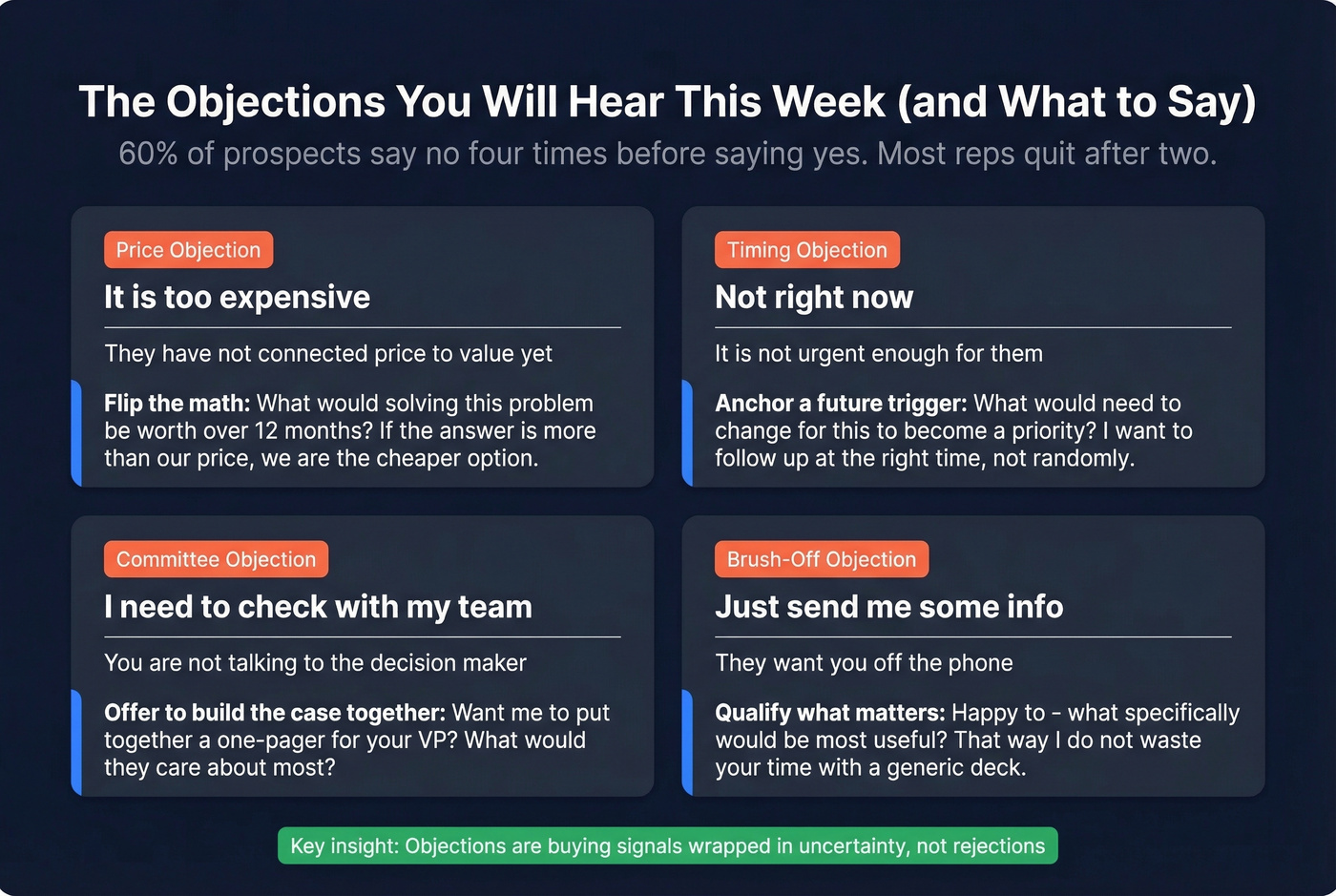
"It's too expensive." They haven't connected price to value. Flip the math: "What would solving [specific problem] be worth to your team over the next 12 months? If the answer is more than [your price], we're actually the cheaper option."
"Not right now." It's not urgent enough. Don't push - anchor a future trigger: "What would need to change for this to become a priority? I want to follow up at the right time, not randomly."
"I need to check with my team." This one deserves a different approach. Instead of a scripted response, try a collaborative move: offer to build the internal case with them. "That makes total sense - want me to put together a one-pager specifically for [their boss's title]? What would they care about most?" You've just turned a stall into a joint project, and you've identified the real decision-maker.
"Just send me some info." The prospect wants you off the phone. Qualify what they actually need: "So I send you the right thing, what's the one question you'd need answered to take a next step?" This forces specificity and tells you whether there's real interest or just politeness.
"We already have a vendor."
Try the negative close: "Is there any reason you wouldn't be open to a 15-minute comparison? Most of our customers switched from [competitor] because of [specific differentiator]." The negative close builds trust because you're inviting them to say no - which paradoxically makes them more likely to say yes. These unconventional tactics work precisely because they break the pattern the prospect expects from a typical sales call.
The Follow-Up System That Wins
Why Reps Don't Follow Up
RAIN Group's research across 489 sellers found it takes an average of 8 touchpoints to get an initial meeting. Top performers do it in 5 - and they convert 52 out of every 100 target contacts, compared to 19 out of 100 for everyone else. That's 2.7x more meetings from the same effort.
C-suite prospects typically require 9 touches, while lower-level contacts convert in roughly 4.
Here's what the data doesn't capture: most reps don't stop following up because they don't know the numbers. They stop because it feels desperate. The internal narrative shifts from "I'm being persistent" to "I'm being annoying." Get over it. The prospect isn't thinking about you nearly as much as you think they are. Your fifth email isn't harassment - it's the first one they actually read. (If you need copy you can paste today, use these sales follow-up templates and cold email follow-up templates.)
Cold Emails That Work in 2026
If you're still sending 200-word cold emails with three paragraphs of personalization and a calendar link, you're writing for 2019. The consensus on r/copywriting and across every outbound community we follow is clear: 40-60 words, offer-led, soft CTA.
The structure that's working:
- Line 1: Context signal - why you're reaching out, one sentence
- Line 2: Specific ICP outcome - what you help people like them achieve
- Line 3: Quick proof - a number, a customer name, a result
- Line 4: Soft ask - "Worth a conversation?" beats a Calendly link every time
That's roughly 47 words. The offer matters more than the personalization. "I read your blog post" doesn't move anyone. "We helped [similar company] cut [specific metric] by 40%" does. (For more, see AI cold email outreach and these cold email subject line examples.)
Before you send that email, verify the address. A bounced email doesn't just waste a touch - it damages your sender domain reputation. Prospeo validates emails in real time with 98% accuracy, so every touch in your sequence actually lands. (If you're troubleshooting, start with email bounce rate and how to improve sender reputation.)
Start With Data That Doesn't Lie
Your SDR sent 500 emails last week. 47 bounced. 12 went to people who left the company months ago. 8 hit spam traps that quietly torched your domain reputation. Every framework in this guide - the discovery questions, the objection scripts, the follow-up cadence - is useless if your outreach never reaches a real person.
Most sales advice gives you the psychology and the scripts but ignores the plumbing. We won't. Prospeo covers 300M+ professional profiles with 143M+ verified emails and 125M+ verified mobile numbers, all refreshed on a 7-day cycle compared to the 6-week industry average. That means the VP of Engineering you're targeting actually still works there, their email is valid, and their phone number connects. (If you're evaluating vendors, compare data enrichment services and sales prospecting databases.)
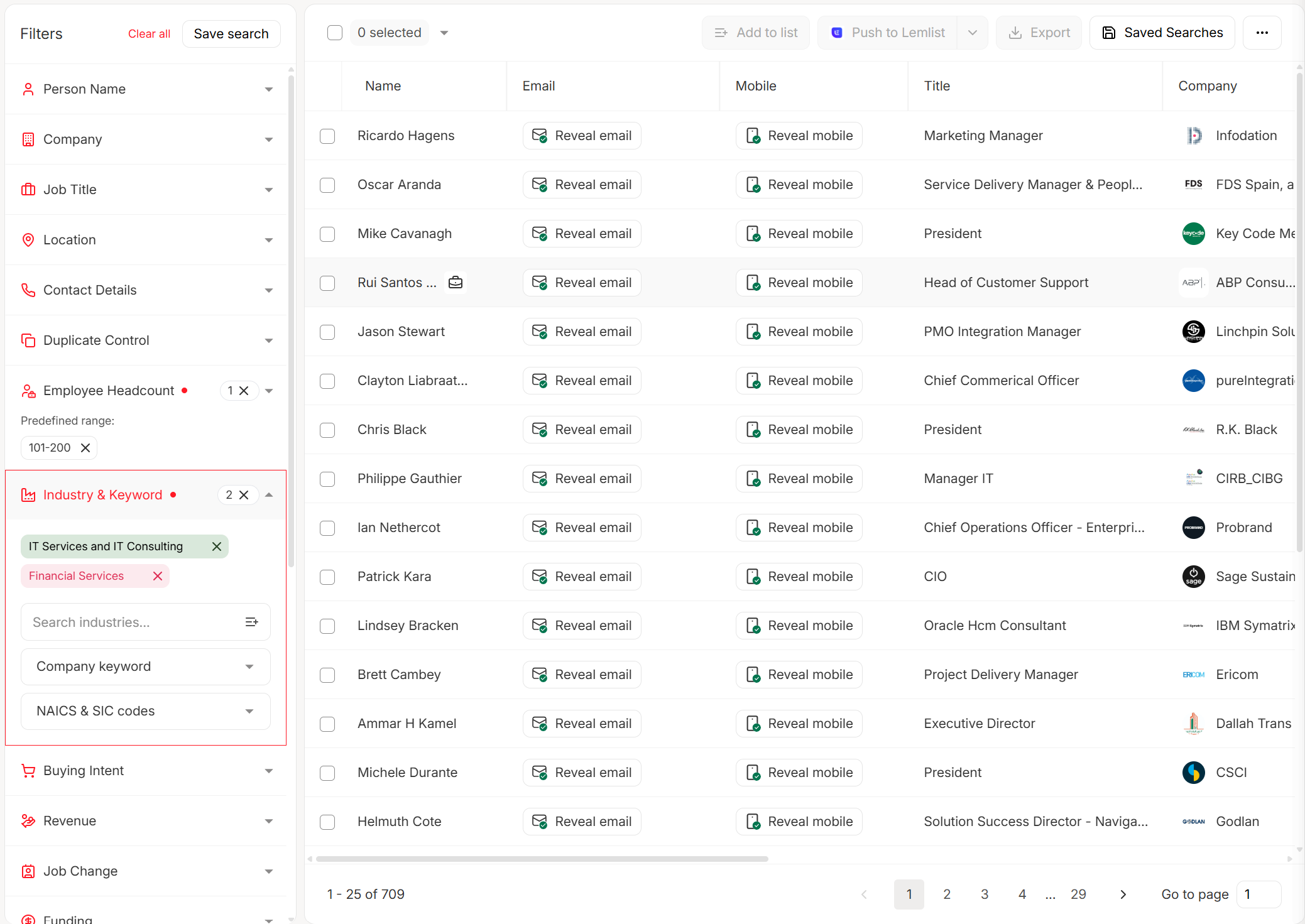
The workflow is straightforward: search by role, industry, company size, or intent signals, export verified contacts, and push them directly into your sequencer. You can start with the free tier - 75 verified emails per month plus 100 Chrome extension credits - which is enough to test every technique in this guide on real prospects.
You just mapped your champion, nailed the loss frame, and built a mutual action plan. Now imagine the follow-up bounces because your data provider refreshes every 6 weeks. Prospeo refreshes every 7 days - so your persistence actually reaches the inbox.
Great follow-up deserves data that keeps up with it.
FAQ
What's the fastest way to persuade a hesitant prospect?
Address the specific objection - don't pitch harder. Use the Listen, Ask, Solve, Confirm, Move on framework and reframe from gain to loss framing. Ask "What's the biggest concern holding this back?" and solve that single issue before anything else.
How many follow-ups before giving up?
Eight touchpoints on average, per RAIN Group's study of 489 sellers. Top performers convert in 5. Most reps quit after two - which means they stop right before the conversion window opens. Space touches across email, phone, and social over 3-4 weeks.
Do cold emails still work in 2026?
Yes, but only short ones. The emails getting replies are 40-60 words, offer-led with a soft CTA. Long personalized intros and embedded calendar links are dead. Lead with a specific outcome you delivered for a similar company.
How do I make sure outreach reaches the right person?
Verify contact data before any outreach. Bounced emails damage sender reputation and waste sequence slots. Real-time verification that confirms addresses and phone numbers are current is table stakes for any serious outbound operation - we've seen teams cut bounce rates from 35% to under 4% just by cleaning their lists before hitting send.