

How to Follow Up on an Email: Examples That Get Replies
Every sales blog teaches you the same thing: send five follow-ups. That advice is outdated and actively harmful. Belkins' analysis of 16.5 million cold emails found that four or more emails in a sequence triples unsubscribe rates and more than triples spam-complaint risk. Your first email gets an 8.4% reply rate. Stack follow-ups beyond two, and performance craters - reply rates drop by more than half.
Here's the thing: if you need more than two follow-ups to get a reply, the problem isn't persistence. It's your targeting, your message, or your data.
Quick Version
- Send 1-2 follow-ups max. Four or more triples spam-complaint risk.
- Add new information every time. "Just checking in" isn't a follow-up. It's noise. (If you need alternatives, see just checking in.)
- Best window: Tuesday-Thursday, with Tuesday-Wednesday 9-11 AM local time as the strongest slot and a secondary peak at 2-4 PM.
How Many Follow-Ups to Send
A single follow-up lifts reply rates from 16% to 27%, according to HubSpot. But there's a hard ceiling, and the founder segment in that 16.5-million-email dataset tells the clearest story: reply rates hold steady through two follow-ups (6.64% to 6.66% to 6.94%), then fall off a cliff at 5.75% on the third and 3.01% on the fourth. That's roughly a 57% drop.
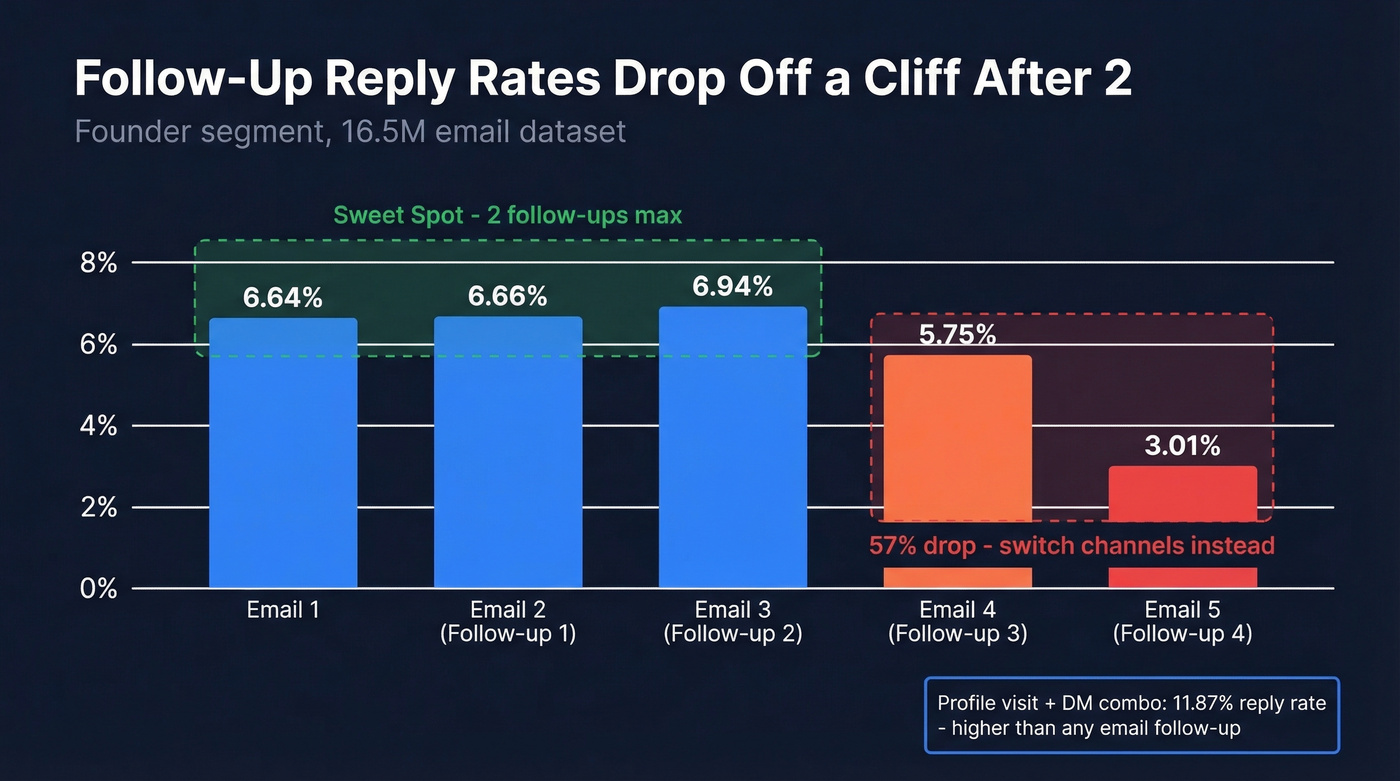
Two follow-ups is the sweet spot. After that, switch channels entirely. The same dataset found that a profile visit plus direct message combo on professional networks hit an 11.87% reply rate - higher than any email follow-up number. More emails aren't the answer. Better channels are.
Follow-Up Email Examples for Every Scenario
Every template below is copy-paste ready. Swap the [bracketed placeholders] for your details. (If you want more options, use these follow-up templates.)
After No Response (Sales)
Template 1 - New Value:
Hi [First Name],
Since my last note, [new development - e.g., "we published a case study showing how [similar company] cut onboarding time by 40%"]. Thought it'd be relevant given [their situation].
Worth a quick look? [Link]
Each follow-up needs new value - not a rehash of your first pitch. GMass calls "bumping" with no new information one of the most common follow-up mistakes. Structure each message around a different objection - price, timing, authority - rather than repeating the same ask (more on sales communication).
Template 2 - Scheduling Hook:
Hi [First Name],
I'm finalizing my schedule for next week - would [Tuesday or Thursday] work for 15 minutes on [specific topic]?
If the timing's off, no worries. Happy to reconnect next quarter.
This approach comes from a sales practitioner on r/sales. It works because it creates a concrete decision (pick a day) instead of an open-ended ask. We've tested variations of this ourselves, and the "pick a day" framing consistently outperforms "let me know when works." (For more meeting language, see schedule a meeting.)
After a Meeting or Demo
Template 3 - Specificity:
Hi [First Name],
Great speaking today. Your point about [specific thing they said - e.g., "reducing rep ramp time from 8 weeks to 4"] stuck with me. I've attached [resource/proposal] that addresses exactly that.
Next step: [clear action - e.g., "I'll send the pilot agreement by Thursday."]
Referencing a specific discussion point proves you were actually listening. Generic "great meeting" emails get deleted. If you need a dedicated post-call format, use a sales meeting follow-up email.
After a Job Interview
Template 4 - Gratitude + Brevity:
Hi [Interviewer Name],
Thank you for the conversation today. I especially appreciated your insight about [specific topic - e.g., "how the team approaches cross-functional launches"]. It reinforced my excitement about the role.
Looking forward to next steps.
Yale SOM's career office recommends this framework: gratitude, specificity, brevity. Send it as soon after the interview as possible - interviewers often log feedback in the ATS within hours. One Redditor reported getting a job offer 20 minutes after sending theirs.
Networking
Template 5 - Conference or Mutual Connection:
Hi [First Name],
[Mutual connection] introduced us last week - or we met briefly at [event]. I enjoyed our conversation about [specific topic].
Would you be open to a 20-minute coffee chat [next week]?
Anchor to a shared moment. The email needs to feel like a continuation, not a cold open. (If you're doing this at scale, build it into your personalized outreach.)
The Break-Up Email
Template 6 - Clean Exit:
Hi [First Name],
I've reached out a couple of times and haven't heard back - totally understand if the timing isn't right.
I'll close the loop on my end, but if [problem you solve] becomes a priority, I'm easy to find.
Most follow-up guides skip the break-up email entirely, which is a mistake. It lowers pressure and gives the other person an easy "not now" exit without burning the relationship. We've seen prospects come back months later specifically because the last email wasn't pushy.

Two follow-ups is the limit - which means your first email has to land in the right inbox. Prospeo's 98% email accuracy and 7-day data refresh mean you're reaching real people at current companies, not bouncing into the void.
Stop following up on bad data. Start with emails that actually deliver.
Best Time to Send a Follow-Up
A Hunter.io synthesis of nine send-time studies - including Moosend's analysis of 10 billion emails - found Thursday has the highest open rates, with Tuesday close behind. Superhuman narrows the window to Tuesday-Wednesday, 9-11 AM local time, with a secondary peak at 2-4 PM. For a deeper breakdown, see best time to send cold emails.
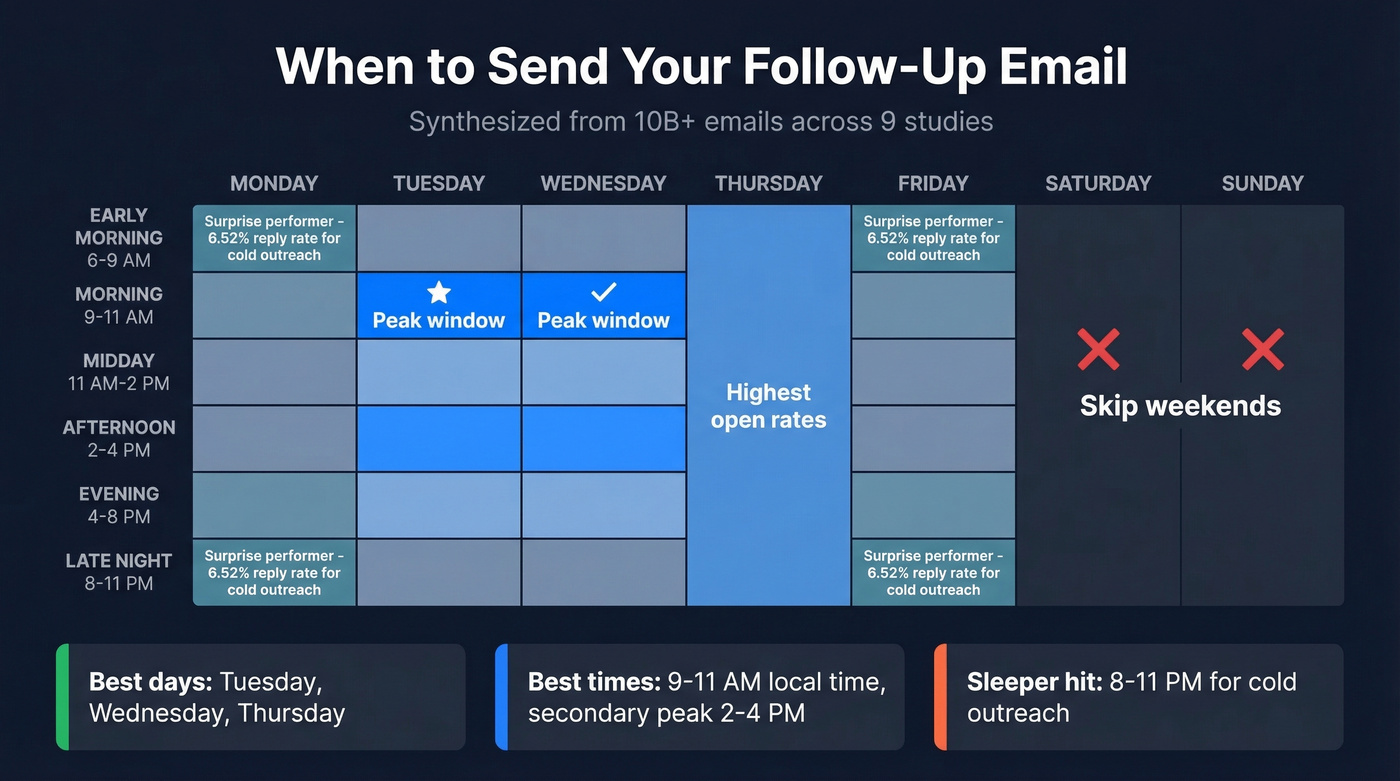
One counterintuitive finding: for cold outreach, the 8-11 PM window hit a 6.52% reply rate in that 16.5-million-email dataset. People checking email before bed respond faster than you'd expect. Skip weekends entirely.
Phrases to Kill in Follow-Ups
| Don't Say | Say This Instead |
|---|---|
| "Just checking in" | "Quick question about [topic]" |
| "Touching base" | "I forgot to mention..." |
| "Circling back" | "One more thing on [topic]" |
| "Following up" (subject line) | "[Benefit] for [company]" |
| "Bumping this up" | "Saw [trigger event] - relevant?" |
| "Any updates?" | "Finalizing my schedule for [date]" |
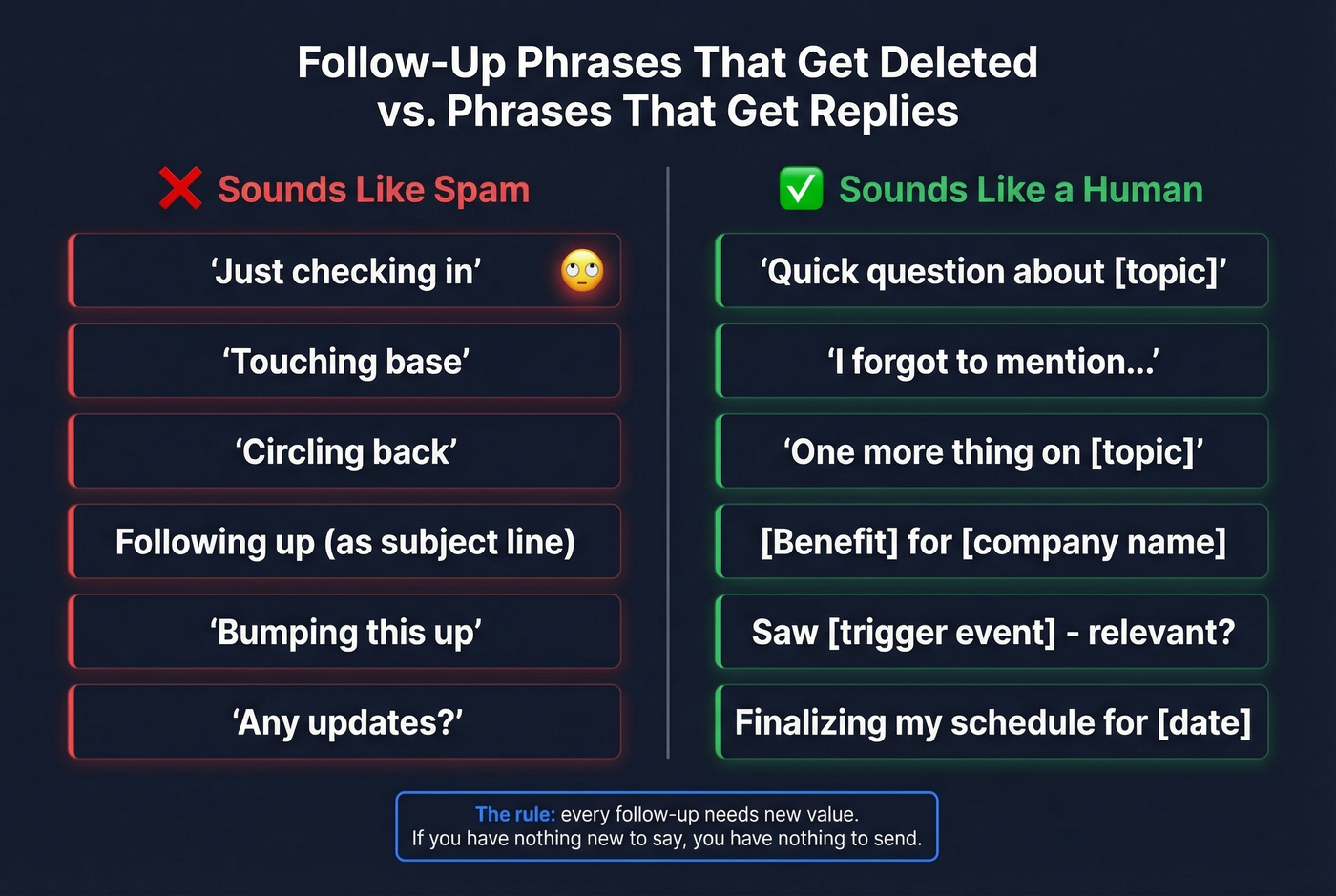
The consensus on r/sales is that "just checking in" is an eye-roll phrase that signals you've got nothing new to say. NetHunt's guidance backs the core idea: ditch vague phrasing and follow up only when you can add value using short, relevant, action-oriented lines. (If you want subject ideas, use these email subject line examples.)
Mistakes That Kill Your Follow-Up
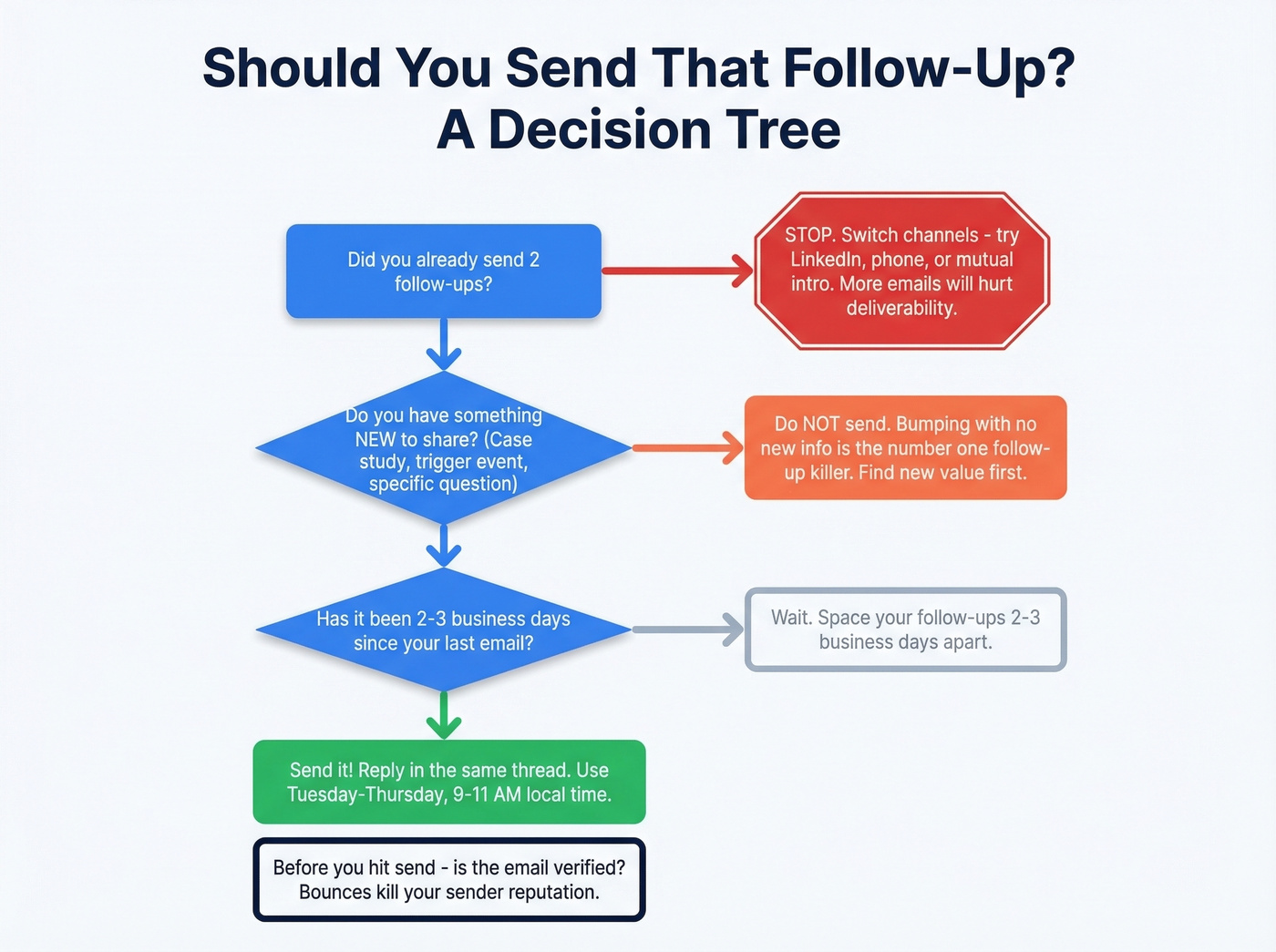
1. Bumping with no new info. "Just making sure you saw this" tells the recipient you have nothing new to offer. Each follow-up needs fresh value - a case study, a trigger event, a specific question. (This is also why AI sales follow-up tools can help - when they’re used to add real context, not spam.)
2. Using "follow-up" as your subject line. It's the email equivalent of "we need to talk." Preview the value inside instead.
3. Sending too many, too fast. Space follow-ups 2-3 business days apart, and cap at two. That's it. (If you're running sequences, tighten your sequence management.)
4. Not verifying contact data. This one's frustrating because it's so preventable. You craft the perfect sequence, but 10-20% of your list bounces because the data is stale. Those bounces hurt deliverability, which means even your good emails land in spam. We use Prospeo for verification - 98% email accuracy, 7-day data refresh, and a free tier with 75 verifications/month - but regardless of which tool you pick, don't skip this step. (More on fixing bounces in email bounce rate and the full email deliverability guide.)
The article says it: if you need more than two follow-ups, the problem is your targeting or your data. Prospeo gives you 30+ filters - buyer intent, job changes, tech stack - so your first email reaches the right person at the right time.
Better targeting beats more follow-ups. Every single time.
FAQ
How long should you wait before following up?
Two to three business days for sales and networking. For job interviews, send your follow-up the same day - interviewers often log feedback in the ATS within hours, so speed matters more than polish.
How many follow-ups is too many?
Two is the ceiling for most scenarios. Belkins' 16.5-million-email study shows that four or more follow-ups triples unsubscribe rates and more than triples spam-complaint risk. After two, switch to a different channel.
Should I reply in the same thread or start a new one?
Reply to the same thread so the recipient has full context. Start fresh only if the original is about a week old or you're changing the topic entirely.
What's the best free tool for verifying emails before follow-ups?
Prospeo offers 75 free email verifications per month at 98% accuracy with a 7-day data refresh cycle. Hunter has a free tier at 25 searches/month but caps enrichment. For teams running real outbound, Prospeo's free plan covers more ground.