

How to Get Clients for Your Business: A Data-Backed Guide for 2026
You launched. You built the thing. And now you're staring at an inbox that's mostly newsletters and Stripe test receipts. The problem isn't effort - it's that nobody told you which channels actually work for your business at your stage. You don't need 15 tactics executed at 20% effort each. You need three, executed well, with real numbers behind them.
The Quick Version
Local business or agency: Build a referral program with real incentives - referrals cost ~$150 per client vs $500 for events. Optimize your Google Business Profile. Respond to every lead within one hour.
B2B or SaaS: Invest in inbound content and partnerships. Companies allocating 40-50% of budget to these two channels see ~30% lower overall CAC. Start targeted cold outreach with verified contact data (see sales prospecting techniques).
Freelancer or consultant: Ask five existing contacts for referrals this week. Pick one social platform and post consistently. Use cold outreach to fill gaps - but only with verified emails, or you'll torch your domain reputation (use an email deliverability guide).
Starting from absolute zero? Offer a free or deeply discounted first engagement to someone in your target market. A photographer shoots a local restaurant for free. A consultant runs a 30-minute audit at no charge. That first case study becomes the foundation for everything else.
Here's a stat worth memorizing: contacting a lead within one hour makes you ~7x more likely to qualify them. Wait 24 hours and your odds drop by over 98%. Speed isn't a nice-to-have. It's the whole game.
What Client Acquisition Actually Costs
Most advice articles skip the money question. Let's not.
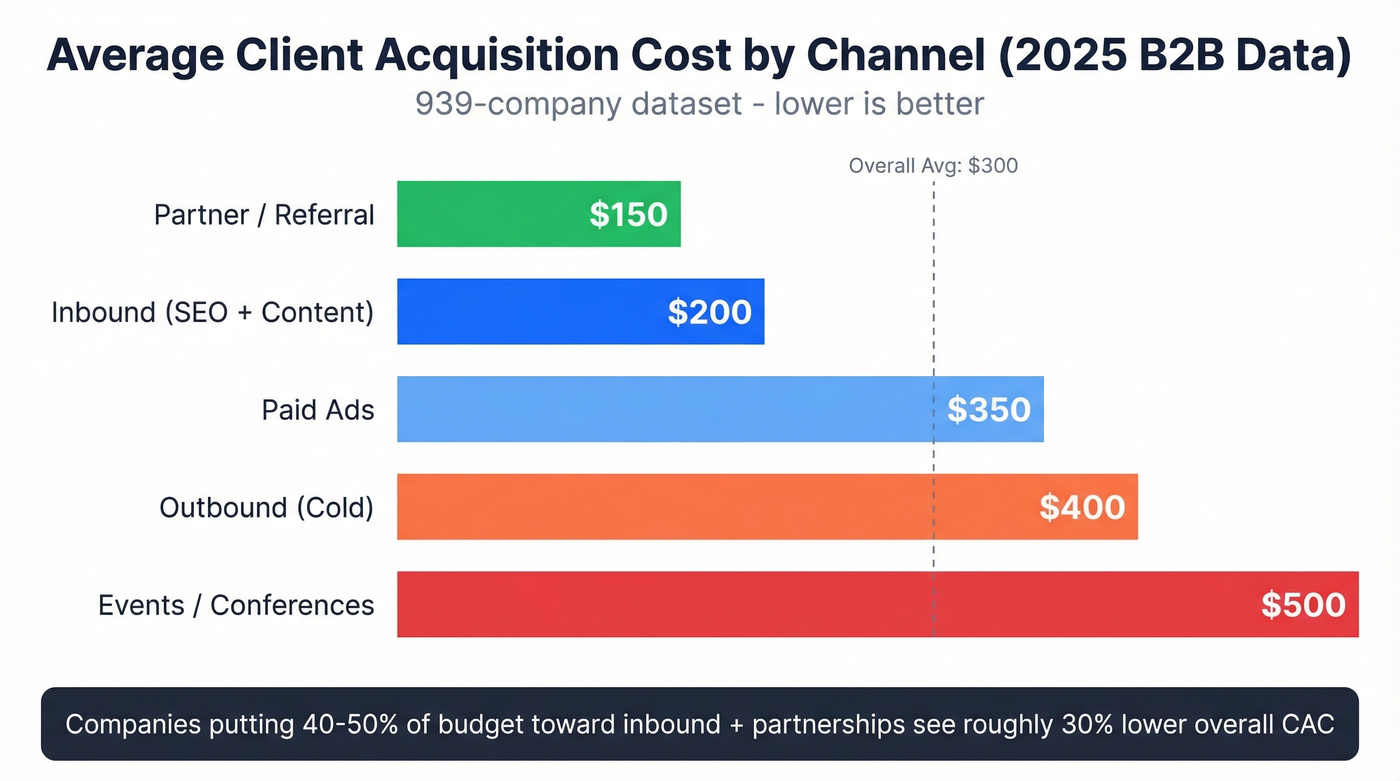
A 939-company B2B dataset from 2025 breaks down average customer acquisition cost by channel:
| Channel | Avg. CAC | Best For |
|---|---|---|
| Partner/Referral | $150 | Every business, every stage |
| Inbound (SEO/content) | $200 | B2B/SaaS with 3-6 month runway |
| Paid Ads | $350 | Local businesses, e-commerce |
| Outbound (cold) | $400 | B2B with defined ICP |
| Events/Conferences | $500 | Enterprise, high-ACV sales |
The overall average across all channels was $300, but that number hides massive variation by industry. SMB SaaS companies typically land between $150-$250 per client, professional services firms run $400-$600, and enterprise SaaS can hit $800-$1,500. A healthy CAC payback period is under 6 months; anything over 18 months is a red flag that your unit economics are broken (see cost to acquire customer).
Companies that put 40-50% of their budget toward inbound plus partnerships see ~30% lower overall CAC than outbound-heavy mixes. A common high-performing split looks like roughly 30% inbound, 25% partnerships, 20% paid, 15% outbound, and 10% events. The takeaway isn't "outbound is bad." It's that diversification pays off, and the cheapest channels deserve the biggest share of your budget.
Define Your Ideal Client First
Skipping this step is mistake number one. Every channel works better when you know exactly who you're targeting (use an ideal customer profile template).
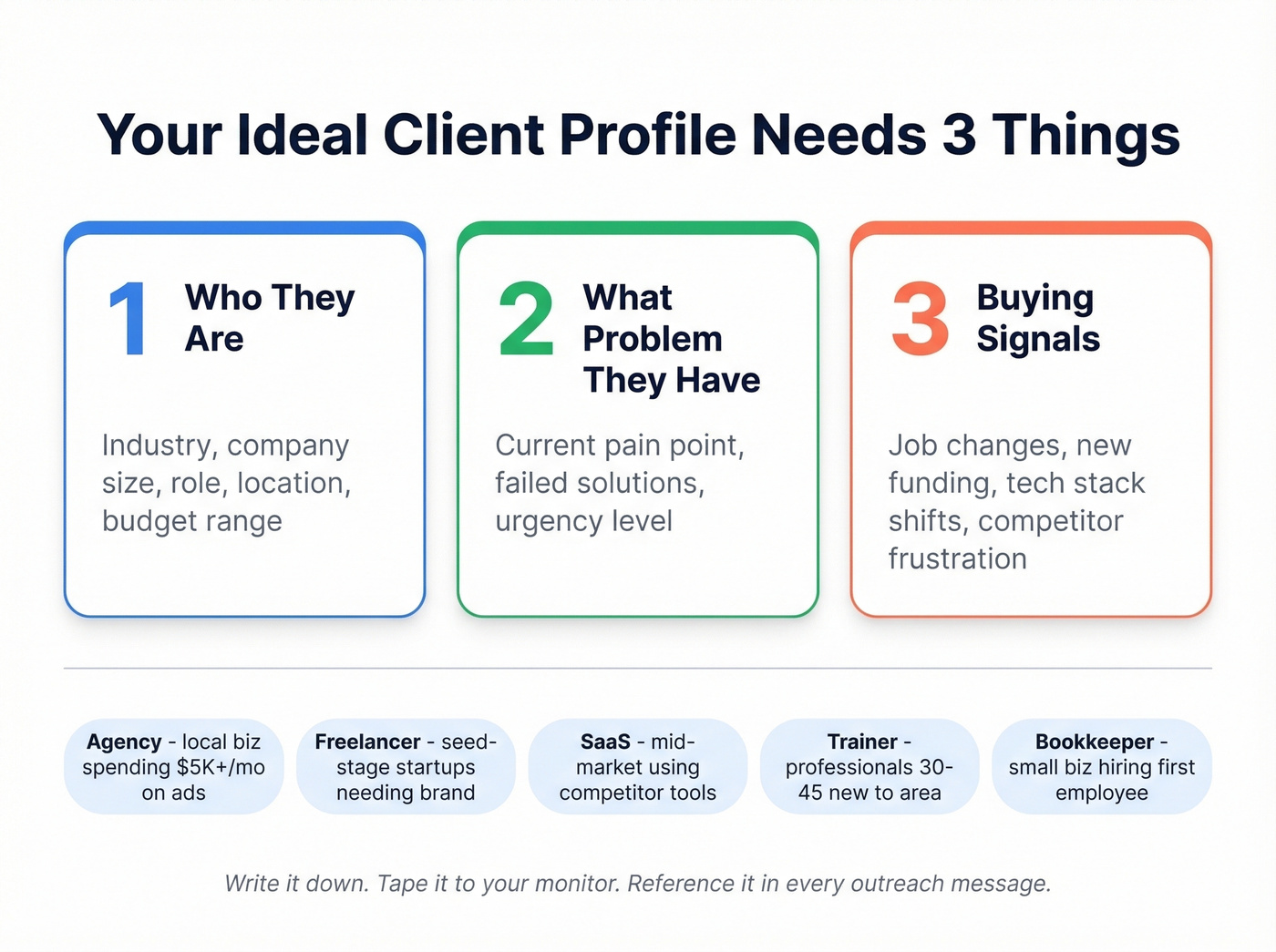
Your ideal client profile doesn't need to be a 10-page document. It needs three things: who they are, what problem they have, and what signals tell you they're ready to buy (see identifying buying signals). Here's what that looks like in practice:
- Agency - local service businesses spending $5K+/mo on ads, frustrated with their current provider
- Freelance designer - seed-stage startups that just raised and need brand identity fast
- SaaS company - mid-market firms currently using a competitor tool with known limitations
- Personal trainer - professionals aged 30-45 who just moved to the area and searched for gyms
- Bookkeeper - small businesses that just hired their first employee and need payroll help
Write this down. Tape it to your monitor. Every outreach message, every piece of content, every partnership conversation should reference this profile. Without it, you're spraying messages into the void and wondering why nobody responds.

You defined your ideal client profile - now you need their contact data. Prospeo gives you 300M+ professional profiles with 30+ filters including buyer intent, headcount growth, and technographics so you reach the right people, not random inboxes. 98% email accuracy means your domain stays clean.
Build your ideal client list in minutes, not weeks.
Three Proven Client Acquisition Strategies
Referrals: Systematize or Forget It
Use this if: You have even a handful of happy clients or professional contacts. Works for every business type, every stage.
Skip this if: You have zero existing relationships. Start with outbound or inbound first, then circle back once you've got a few wins under your belt.
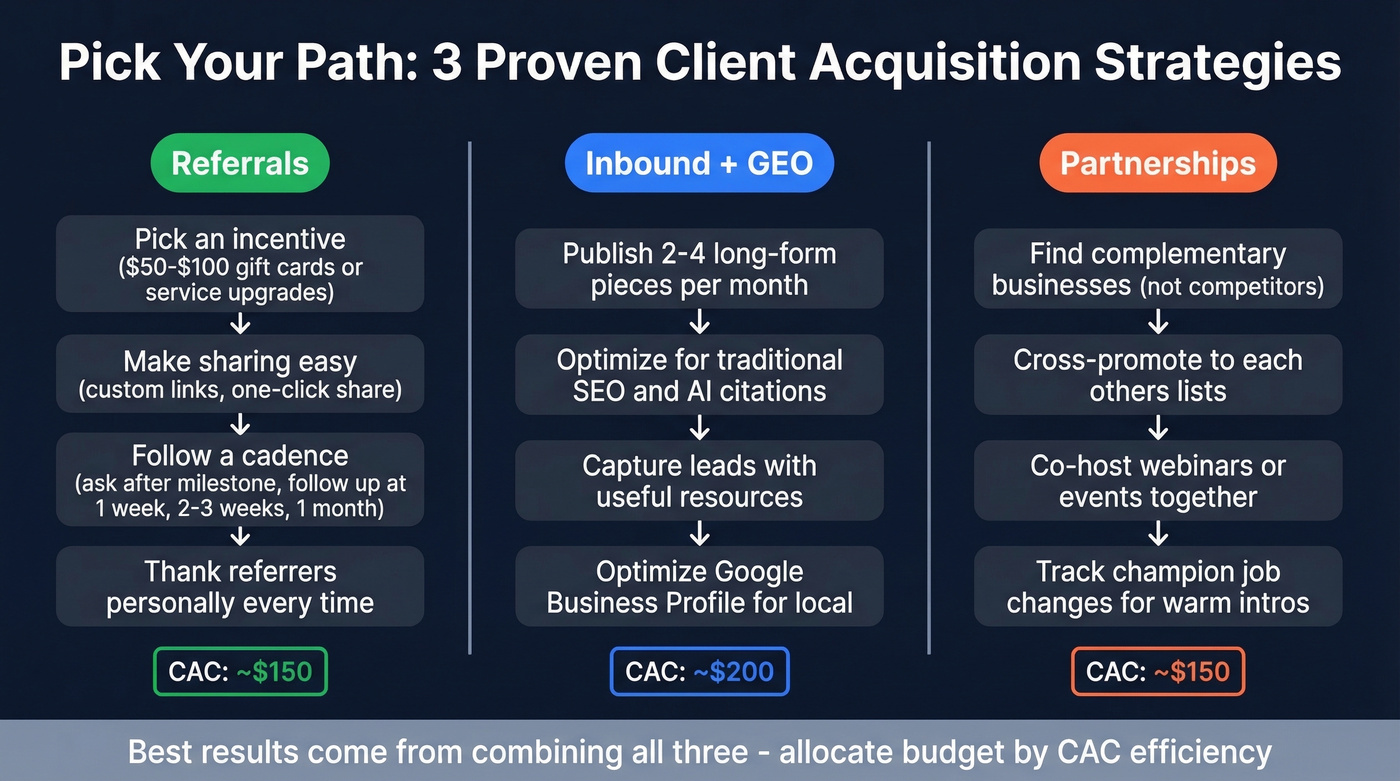
Most people "do referrals" by occasionally asking a client if they know anyone. That's not a system. A system looks like this:
- Pick an incentive. $50-$100 gift cards, discount codes, or service upgrades all work. Tiered rewards for top referrers drive repeat behavior.
- Make sharing easy. Custom referral links or codes, plus a one-click share option.
- Follow a cadence. Ask after a successful milestone, follow up at one week, again at two to three weeks, and send a final nudge at one month. Always thank referrers personally - gratitude drives repeat behavior more than any incentive (see importance of follow-up in sales).
The timing matters because trust dynamics are shifting. Online reviews lost 30% of their influence between 2020 and 2024. Meanwhile, 50% of customers now discover new brands by searching social media for recommendations. People trust people they know. Build a system that makes it easy for them to share.
Inbound: Content, SEO, and GEO
Use this if: You can commit to publishing consistently for 3-6 months. Best for B2B, SaaS, and professional services looking to attract clients through organic search (see what is B2B content marketing).
Skip this if: You need clients this week. Inbound is a compounding asset, not a quick fix.
The inbound playbook hasn't changed dramatically: publish useful content, optimize for search, capture leads. What has changed is where people search. Generative Engine Optimization - getting your content cited in AI-generated answers - is emerging as a real channel in 2026.
A 127-company study tracked GEO performance from January 2024 through July 2025. The average GEO CAC was $559, with 27% higher conversion rates than traditional SEO. GEO CAC fell from $2,134 in Q4 2023 to $559 in Q2 2025 as methods and tooling matured - a steep drop that signals the channel is hitting its stride.
For cadence, B2B companies should aim for 2-4 long-form pieces per month. Local businesses need less: one weekly Google Business Profile post plus monthly blog content builds enough momentum. Speaking of GBP - for local businesses, it's still the single highest-leverage inbound asset. Optimize it fully with photos, reviews, service descriptions, and posts before you spend a dollar on content marketing.
Partnerships: The Overlooked Multiplier
Use this if: You serve a niche where complementary businesses exist. Works especially well for service businesses and consultants.
Skip this if: You're in a market with no natural partners, or you can't commit to reciprocating value.
The high-performing channel mix allocates about 25% to partnerships, yet most small businesses spend close to zero here. That's a miss.
Partnerships don't require formal co-marketing agreements. Start simple: a web designer and a copywriter, an accountant and a business attorney, a SaaS tool and an implementation consultant - these pairings share audiences without competing. Cross-promote to each other's lists, co-host a webinar, or just make warm introductions.
One tactic that's criminally underused: track when your customers change jobs. When a champion moves to a new company, that's a warm intro waiting to happen. We've seen teams use job-change alerts to generate pipeline that closes 2-3x faster than cold outreach because the trust is already built (see how to track sales triggers). Host virtual events where existing clients sit alongside prospects - your clients become live testimonials without you asking them to sell.
Cold Outreach That Actually Works
Here's the thing: cold outreach gets a bad reputation because most people do it terribly. Mass-blast emails to purchased lists, generic templates, zero research. That approach doesn't work anymore.
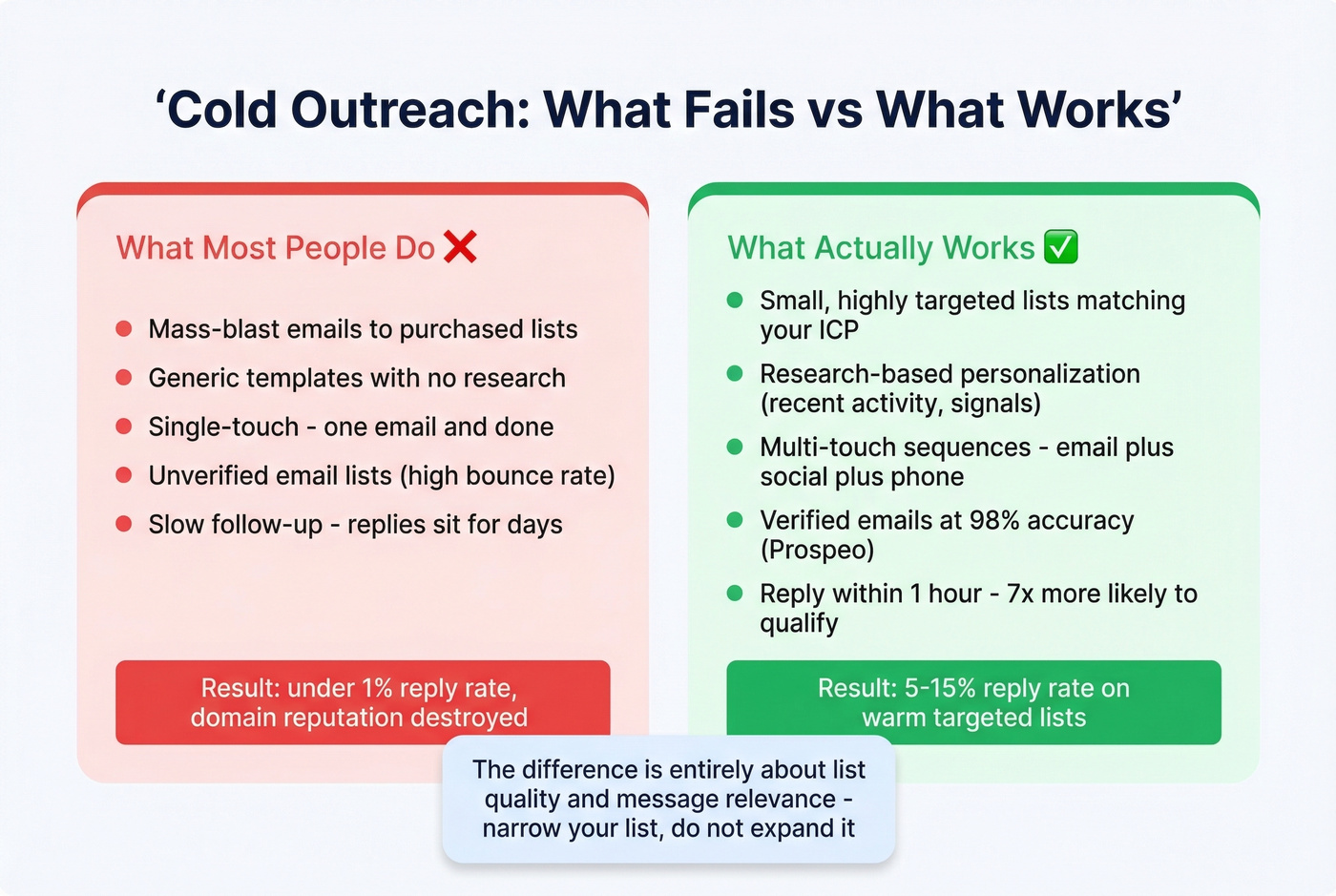
What works is the opposite. Smaller, highly targeted lists with research-based personalization. Multi-touch sequences combining email with social engagement and occasionally phone calls. AI helps with personalization - drafting custom opening lines based on a prospect's recent activity - and AI-powered lead scoring can cut qualification time by up to 30%, freeing you to focus on the prospects most likely to close (see lead scoring).
Expect 1-5% reply rates on truly cold lists. Warm, targeted lists - people who match your ICP and have some signal of intent - can hit 5-15%. The difference between those two numbers is entirely about list quality and message relevance. If you're trying to fill your pipeline, start by narrowing your list rather than expanding it.
Before you send a single cold email, verify your list. Bad emails don't just bounce - they destroy your domain reputation, which tanks deliverability for every future campaign (see email bounce rate). Prospeo handles this with real-time verification at 98% accuracy on a 7-day refresh cycle, and the free tier gives you 75 verified emails per month. That's enough to test whether outbound works for your business before spending a dime.
The speed-to-lead stat applies to outbound too. When someone replies to your cold email, respond within the hour. In our experience, the businesses that struggle most with client acquisition aren't doing too little - they're doing too much across too many channels, treating warm replies like low-priority tasks while chasing the next shiny tactic.
The article shows outbound CAC averages $400 per client. Bad data makes it worse - bounced emails burn your domain and waste every dollar. Prospeo's 5-step verification delivers 98% email accuracy and 125M+ verified mobile numbers with a 30% pickup rate, so your outreach actually lands.
Cut your outbound CAC by reaching real buyers on the first attempt.
Case Study: 10 Clients in One Month
A web design and local SEO agency shared their full breakdown on r/agency - ten new clients in January 2025, all serving local service businesses.
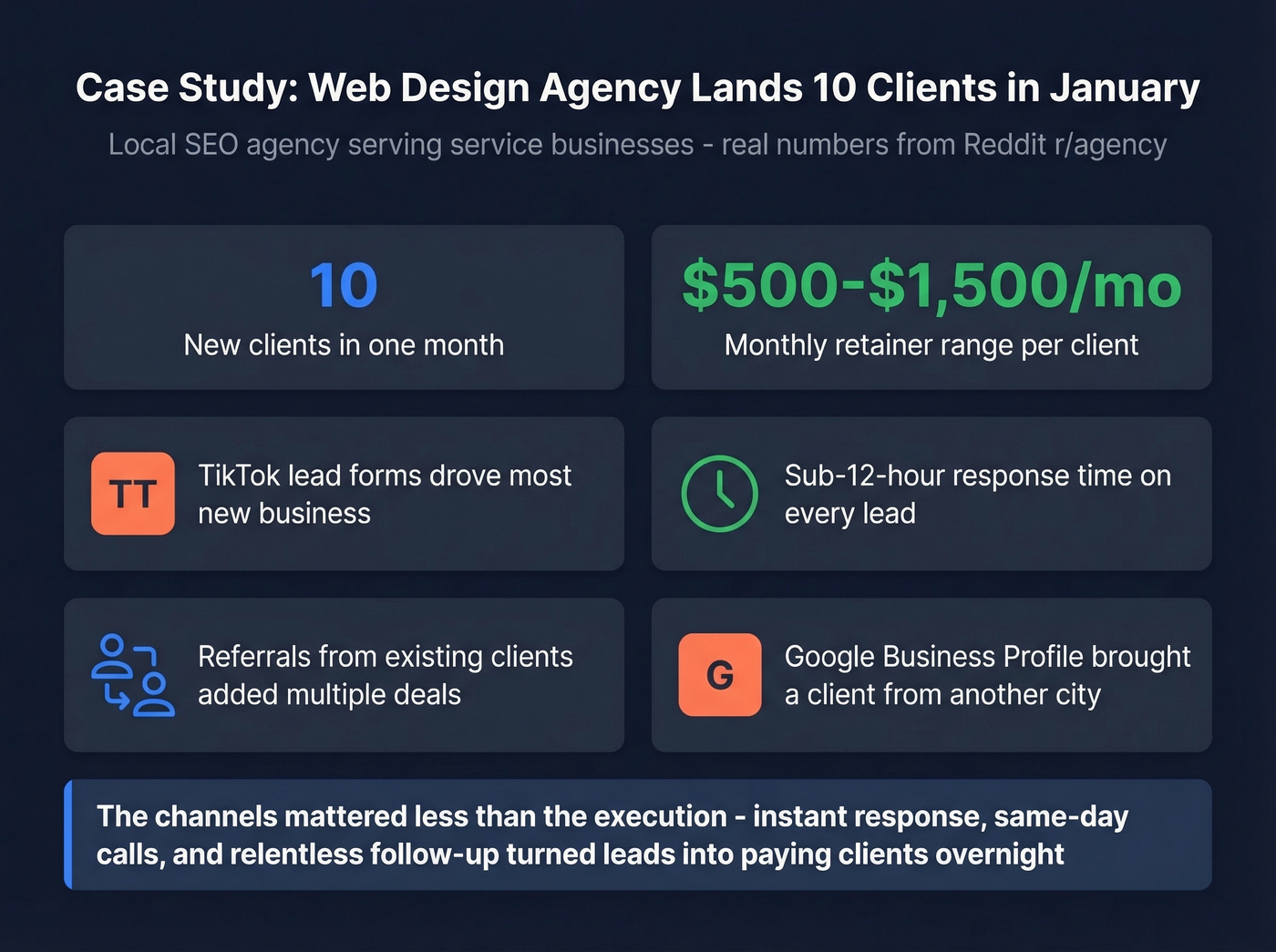
TikTok drove most of the new business, alongside referrals and Google Business Profile discovery. A generator services company came in at $1,500/mo from a TikTok lead form - the agency replied instantly, hopped on a call the same day, and the client paid the next day. An electrician signed at $750/mo from TikTok, then added a second business within two weeks. Multiple detailing and roofing clients came through at $500-$750/mo from a mix of TikTok and existing-client referrals. One detailing client found them through their Google Business Profile from another city entirely. They also landed a roofing client at $750/mo from Instagram after follow-up stretching from November into January.
The execution details matter more than the channels. They aim for sub-12-hour response time on every lead. They send personalized Loom videos quickly - not polished productions, just a quick screen recording showing they've looked at the prospect's business. And they're disciplined about qualification: "quicker to turn clients away or refer them out if it's not a good fit." That last part is key. Saying no to bad-fit clients is what keeps your capacity open for the ones who'll actually stick around and refer others.
Five Mistakes That Kill Acquisition
No ICP defined. You're sending messages to everyone, which means you're resonating with no one. Spend 30 minutes defining your ideal client before you spend 30 hours on outreach.
No follow-up system. That one-hour window isn't a suggestion - it's backed by data. Build a system (even a simple Slack alert) that ensures every inbound lead gets a response fast (use these sales follow-up templates).
Sending cold emails from unverified lists. This is how you land in spam permanently. Verify before you send. The free tier on any decent verification tool is enough to start.
Ignoring existing clients. Re-engaging a past client costs a fraction of acquiring a new one. Set a quarterly check-in cadence for every client who's gone quiet. A therapist who emails past clients about a new group program, a cleaning service that texts dormant customers with a reactivation discount - these are the cheapest "new" clients you'll ever get.
Spreading across six channels at 20% effort. Pick two or three channels. Go deep. The agency that landed ten clients in a month wasn't running ads on seven platforms - they dominated TikTok and referrals, and let everything else compound from there.
FAQ
How do I find clients with no marketing budget?
Start with three free channels: referrals, Google Business Profile, and verified cold outreach. Ask five existing contacts for introductions this week. Optimize your GBP completely - it costs nothing. Use a free verification tier for your first batch of cold emails. Total cost: $0. These three moves cover the cheapest acquisition channels and generate enough volume to build pipeline.
What's the fastest way to land new clients?
Respond to every inquiry within one hour - you're 7x more likely to qualify the lead versus waiting longer. Pair fast response with personalized Loom videos showing you've researched the prospect's business. If you need clients within days, combine speed-to-lead with direct cold outreach to a tight ICP list of 50-100 verified contacts.
How many new clients should I target monthly?
Three to five quality clients beats twenty low-value ones for most small businesses. Focus on increasing value per client - upsells, expanded scope, longer contracts - rather than raw volume. If your average contract is under $5K, nail one channel and close consistently before expanding to a second.
Does cold outreach still work in 2026?
Yes, but only research-based, personalized outreach to verified contacts. Mass-blast cold email is dead. Expect 1-5% reply rates on cold lists and 5-15% on warm, targeted lists with strong ICP fit. The difference comes down to list quality, message relevance, and follow-up speed. The consensus on r/sales is the same: personalization and data quality are what separate replies from spam folders.
Which social platform works best for attracting clients?
Pick the one platform where your ideal clients already spend time - LinkedIn for B2B services, TikTok or Instagram for local businesses. The agency in our case study generated most of their ten January clients through TikTok lead forms, proving social drives real revenue when you commit to one channel and respond to inquiries immediately.