

How to Actually Improve Sales Performance (Not Just Read About It)
You're an AE four months into the year, hitting 50% of quota despite a full day of calls, manager shadowing, and reviewing every recording. You ask for feedback and get "keep doing what you're doing" or "try to build more rapport." The r/sales threads are full of reps in this exact spot - working hard, getting nowhere, drowning in advice that sounds good but changes nothing.
If you genuinely want to improve sales performance, you need to diagnose the constraint before prescribing anything. That's the difference between this piece and those threads.
The Three Highest-ROI Moves
Three strategies worth prioritizing for any team in 2026:
- Audit your data quality. Bad contact data is the silent killer. If 20% of your "booked meetings" are no-shows or wrong personas, you don't have a closing problem - you have a data problem. (If you need a vendor shortlist, start with data enrichment services.)
- Use AI coaching on recorded calls. Reps who use AI daily are 2x more likely to exceed targets. That's the gap between structured feedback and "keep doing what you're doing." (Pair this with a tighter sales performance management system so coaching sticks.)
- Build a deal velocity dashboard that flags anything over 50 days. Win rates drop from 47% to 20% or lower past that mark. If you aren't tracking this, you're letting dead deals consume your best reps' time. (More on the underlying metrics in pipeline health.)
The rest of this article helps you figure out which of these - or which other lever - matters most for your team.
Why Quota Attainment Is Collapsing
The numbers are brutal. In 2025, 84% of reps missed quota, according to benchmarks compiled by Kondo citing Salesforce research. Back in 2012, 53% of reps were hitting quota. That's not a dip - it's a structural collapse.
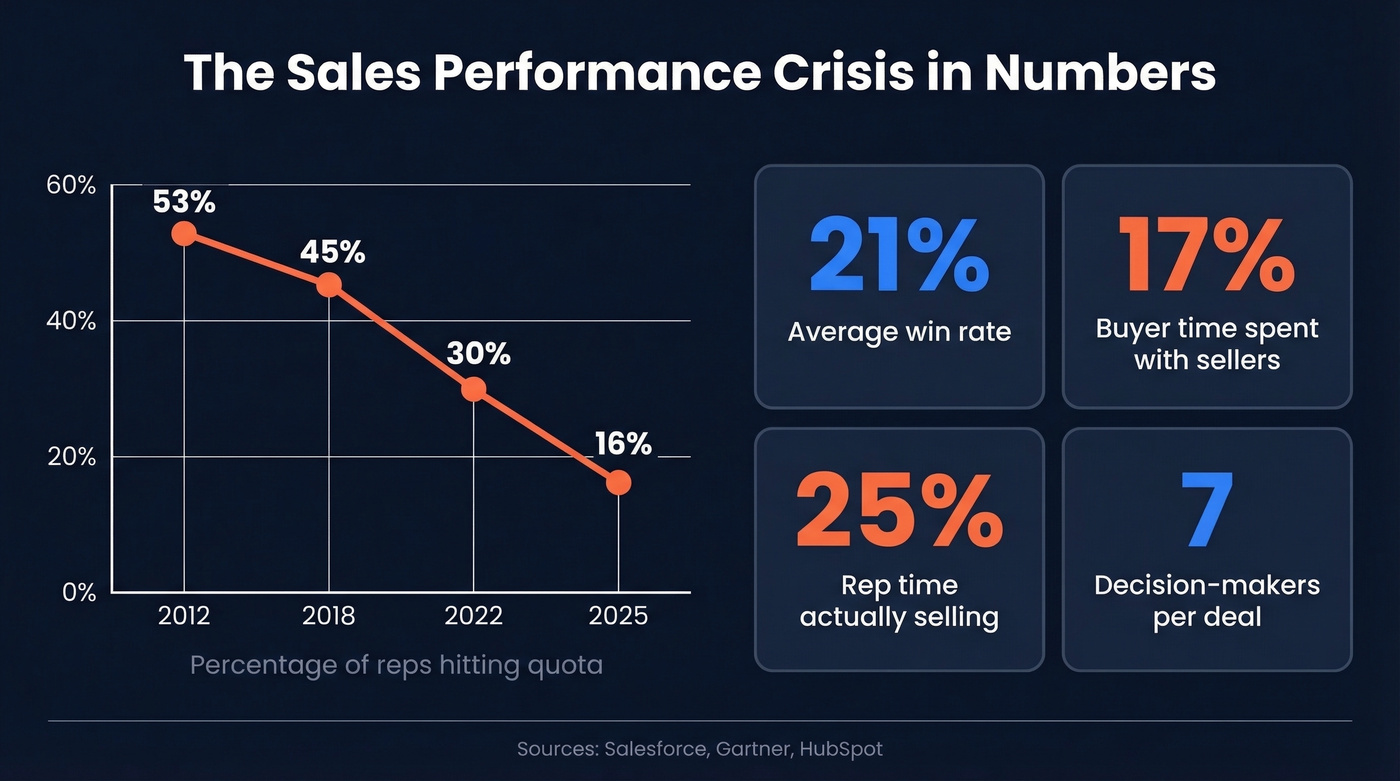
Everything changed on the buyer's side. 80% of B2B interactions are now digital, and buyers use roughly 10 channels (up from 5 in 2016). The average deal involves 7 decision-makers, and 33% of all buyers - 44% of millennials - prefer a completely seller-free experience.
Here's the parallel that should alarm every sales leader: buyers spend only 17% of their buying time meeting with potential suppliers, while reps spend only 25% of their time actually selling. Both sides are barely in the room together. The rest goes to admin, research, internal meetings, and CRM hygiene on the seller's side, and independent research, peer reviews, and committee alignment on the buyer's side.
The average win rate sits around 21%. Sales cycles run 1-3 months for most deals, and 34% of revenue teams report average cycles of 1-2 quarters. Meanwhile, 28% of reps cite "process taking too long" as the top reason prospects back out, and 89% of B2B buyers report a deal stalling in the past year. This isn't a motivation problem. It's a systems problem - and any serious sales performance improvement effort has to start there.
Diagnose Your Constraint First
You don't need 23 tips. You need to find the one thing that's broken. Every performance issue falls into one of five categories, and we've found that running through these questions before changing anything saves teams months of wasted effort.
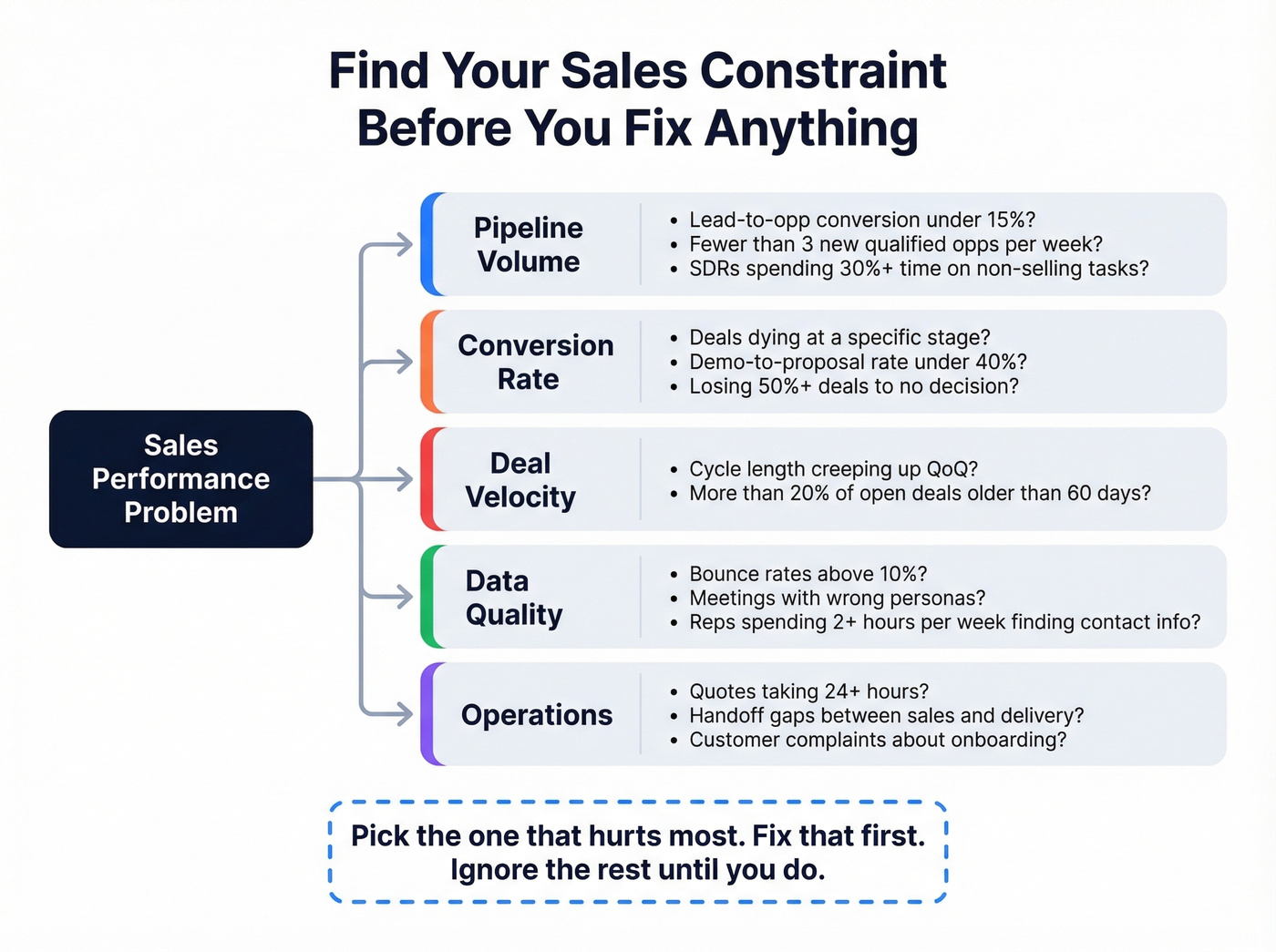
Pipeline volume: Is your lead-to-opportunity conversion rate below 15%? Are SDRs spending more than 30% of their time on non-prospecting tasks? Are reps generating fewer than 3 new qualified opportunities per week? (If volume is the issue, start with sales prospecting techniques.)
Conversion rate: Are deals dying at a specific stage? Is your demo-to-proposal rate below 40%? Do you lose more than half your deals to "no decision"? (Tighten the process with sales process optimization.)
Deal velocity: Is your average cycle length creeping up quarter over quarter? Are more than 20% of your open deals older than 60 days?
Data quality: Are bounce rates consistently high? Are more than 10% of booked meetings no-shows or wrong personas? Do reps spend more than 2 hours per week finding contact info instead of selling? (Benchmarks and fixes: email bounce rate.)
Operations: Are quotes taking more than 24 hours? Do customers complain about handoff gaps between sales and delivery? (If this is the bottleneck, align on sales operations metrics.)
Identify which category hurts most. Then focus there. Everything below is organized by constraint so you can skip to what matters.

You just read how Snyk's 50 AEs cut bounce rates from 35% to under 5% and grew AE-sourced pipeline 180%. The fix wasn't coaching or new messaging - it was switching to verified contact data. Prospeo delivers 98% email accuracy on a 7-day refresh cycle at ~$0.01 per email. That's the cheapest pipeline fix you'll make this year.
Stop diagnosing a closing problem when it's a data problem.
Strategies That Actually Move the Number
Fix Your Data Quality
An SDR team books 40 meetings in a month. Twelve are no-shows. Eight turn out to be the wrong persona entirely. That leaves 20 real conversations from 40 "wins." The team thinks they have a closing problem. They don't - they have a data problem masquerading as a pipeline problem.
Snyk ran into exactly this. Their 50-person AE team was prospecting 4-6 hours per week with bounce rates running 35-40%. After switching to Prospeo, bounces dropped under 5%, AE-sourced pipeline jumped 180%, and they were generating 200+ new opportunities per month. The fix wasn't better messaging or more activity - it was accurate data.

We've seen this pattern repeat across dozens of teams: fix the data, and pipeline problems that looked intractable resolve themselves within a quarter. At roughly $0.01 per verified email with a 7-day data refresh cycle, cleaning up your contact data is the cheapest insurance policy your pipeline can buy. (If you're building lists from names, see name to email.)
Here's the thing: most teams spending $50K+ on sales enablement software would get a bigger lift from spending $500 on verified contact data. The fanciest tools in the world can't fix a pipeline built on bad numbers and dead emails.
Reclaim Selling Time with AI
That 25% selling time stat should make every sales leader uncomfortable. Three-quarters of your reps' week goes to everything except revenue-generating conversations. (If follow-ups are the time sink, use sales follow-up templates to standardize the basics.)
The shift is already underway. 56% of sales professionals now use AI daily, up from 24% in 2023. Reps partnering with AI tools are 3.7x more likely to meet quota, and early deployments show 30%+ improvement in win rates. Outreach reports reps using their AI tools cut research and personalization time by 90%.
But Bain calls out a trap worth taking seriously: automating a broken process just breaks it faster. If your discovery calls are weak, AI-generated prep notes won't save them. If your qualification criteria are vague, AI scoring will automate bad judgment. The real gains come from process redesign first, then layering AI on top. Teams that skip the redesign step end up marginally faster at doing the wrong things - what Bain calls the "micro-productivity trap."
Compress Your Sales Cycle
Outreach's platform data tells a clear story: opportunities closed within 50 days have a 47% win rate. Past 50 days, that drops to 20% or lower. Their AI coaching tool closes deals 11 days faster on average, with up to a 10-point win-rate lift on deals over $50K.
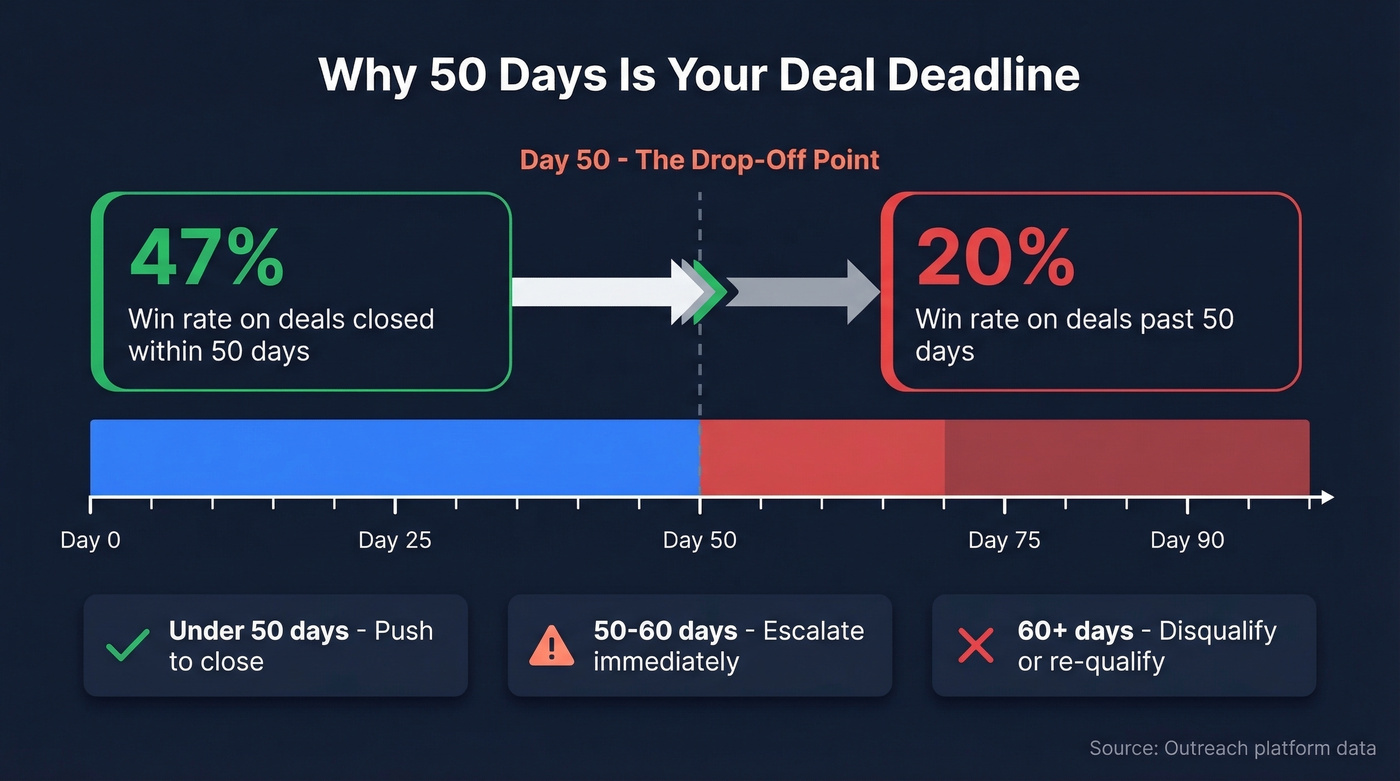
The decision rule is simple. If a deal passes 50 days without clear forward momentum, escalate or disqualify. Don't let reps nurse zombie deals that consume prep time and emotional energy while the pipeline starves.
Before reps spend 30 minutes prepping for a call, make sure the number works - Prospeo's mobile finder covers 125M+ verified numbers with a 30% pickup rate, turning prep time into actual conversations instead of voicemails.
Build a Playbook That Gets Used
42% of best-in-class companies use sales playbooks versus just 14% of laggards. That gap correlates with better quota attainment, higher retention, and stronger lead conversion. Meanwhile, 70% of reps report their sales process has gotten more complex year over year - which is exactly why a living playbook matters more than ever.
Skip the 90-page PDF nobody reads. Build a living document on five foundations:
- Define your sales methodology - MEDDIC, Sandler, Challenger, pick one and commit (If you're standardizing MEDDIC, start with MEDDIC sales qualification.)
- Map your sales process to the buyer's actual buying process
- Create scenario-specific plays for competitive displacement, expansion, and new logo
- Capture knowledge from your top performers, not just management theory
- Keep it short enough that reps actually reference it mid-deal
Set Up a Deal Velocity Dashboard
Teams that implement dashboards as part of their CRM see a 29% average increase in sales. Organizations using mobile CRM access hit targets 65% of the time versus 22% without it. The dashboard isn't optional anymore - it's infrastructure. (If your CRM setup is messy, start with contact management software.)
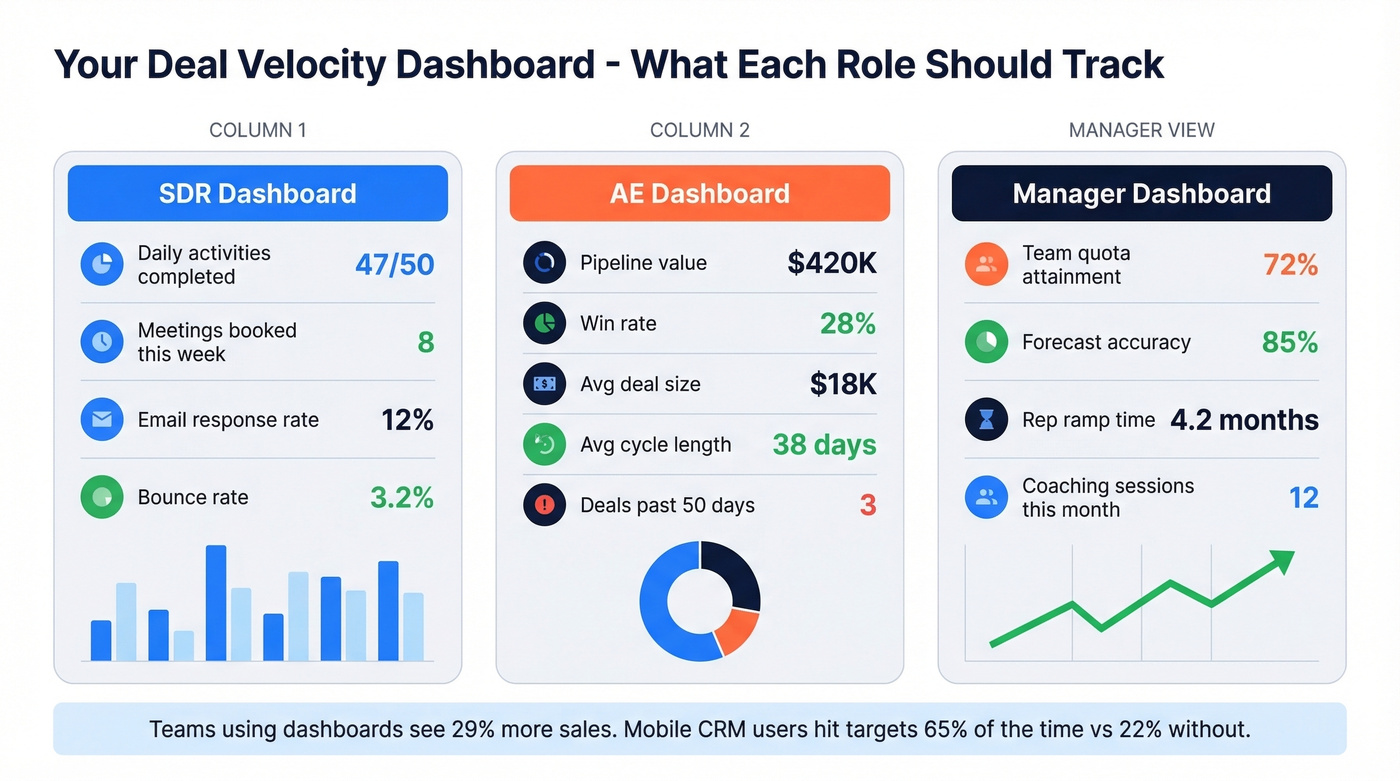
Build role-based views so everyone tracks what matters to them:
| Role | Key Metrics |
|---|---|
| SDR | Activities, meetings booked, response rate |
| AE | Pipeline value, win rate, avg deal size, cycle length |
| Manager | Quota attainment %, forecast accuracy, rep ramp time |
Fix What's Behind the Sale
A post on r/sales put it bluntly: "If you want to improve sales results, improve operations." The poster estimated that delivery failures and slow quote responses cost their company $1M-$4M over 20 years. Prospects remembered those failures decades later.
Look - sales performance isn't only a sales problem. If quotes take 48 hours, you lose to the competitor who responds in 4. If onboarding is rough, renewals suffer and referrals dry up. If delivery teams drop the ball, your best AEs spend cycles on damage control instead of new pipeline. In our experience, the teams that grow fastest are the ones willing to fix the handoff between sales and everything that comes after it.
Coach with a Cadence, Not a Calendar
The quarterly review isn't coaching - it's an autopsy.
A coaching cadence that actually works looks like this: every week, review one recorded call with each rep. Identify one specific behavior to change - not "be more consultative," but "ask about the decision process before demoing pricing." Practice it live in a 5-minute roleplay. Track whether it shows up in next week's calls.
One behavior, one week, one feedback loop. The compound effect over a quarter is enormous compared to vague quarterly feedback that reps forget by lunch.
Mistakes That Kill Sales Performance
Leadership misalignment. Only 52% of CEOs believe in their own growth plans. CEOs who nail their GTM strategy are 2x more likely to meet or exceed revenue expectations, with 74% achieving or surpassing goals. (If you need the systems view, see sales leadership.)
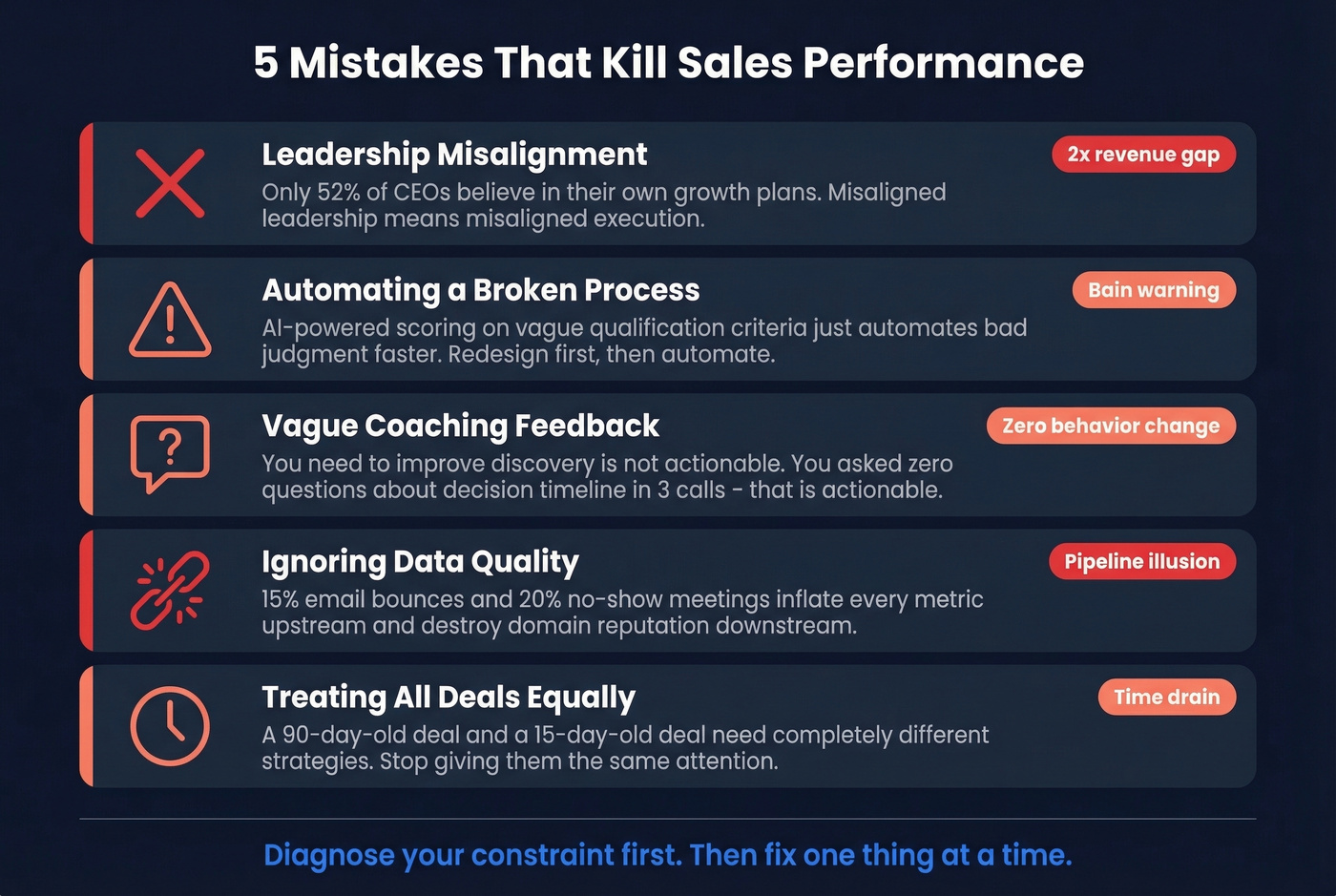
Automating a broken process. Bain's warning bears repeating: if your qualification criteria are vague, AI-powered scoring just automates bad judgment faster. Redesign first, then automate.
Vague coaching feedback. "You need to improve your discovery" isn't actionable. "You asked zero questions about their decision timeline in the last three calls" is. Specificity is the difference between coaching and cheerleading.
Ignoring data quality. Your pipeline looks healthy until 15% of emails bounce and 20% of meetings are no-shows. Bad data inflates every metric upstream and destroys domain reputation downstream.
Treating all deals equally. A 90-day-old deal with no champion identified doesn't deserve the same attention as a 30-day deal with a signed mutual action plan. Deal velocity signals should dictate where reps spend their time - not gut feel or recency bias.
Your First 30 Days
Week 1: Run a data quality audit on your active prospect lists. Identify which of the five constraint categories is your biggest bottleneck. Pull bounce rates, no-show rates, and stage-conversion metrics.
Week 2: Build or update one playbook for your most common deal scenario. Set up deal velocity tracking with a 50-day flag. Start recording all discovery calls if you aren't already.
Week 4: Complete your first weekly coaching cadence cycle with every rep. Get your role-based dashboard live with the KPIs from the table above. Review the data quality audit results and decide whether your current data provider is costing you pipeline. This is a compounding process - the teams that start this cycle earliest see the biggest gains by quarter's end. (If you want a structured ramp plan, use a 30-60-90 day plan for sales reps.)
Your reps spend 75% of their week on everything except selling. Every minute wasted on bounced emails, wrong numbers, and dead contacts is a minute stolen from revenue. Prospeo gives your team 300M+ verified profiles, 125M+ direct dials, and 30+ filters to find the right buyers - so reps sell instead of search.
Reclaim selling time by eliminating bad data from your pipeline.
FAQ
What are the most important sales performance metrics?
Win rate, deal velocity, quota attainment percentage, pipeline coverage ratio, and average deal size are the five to track. Deal velocity is the most undertracked - most teams measure cycle length but don't flag deals crossing the 50-day threshold where win rates collapse from 47% to under 20%.
How does AI help reps close more deals?
AI can double selling time by automating research, call prep, and CRM updates. Real-time coaching tools close deals 11 days faster on average and lift win rates by up to 10 points on enterprise deals. The critical caveat: process redesign must come before automation, or you're just speeding up bad habits.
What's the fastest way to fix a broken pipeline?
Audit your contact data first. Teams switching from unverified lists to verified data routinely cut bounce rates from 35%+ to under 5% and see pipeline jump 100-180% within a quarter. Bad data is the most common - and cheapest to fix - root cause of pipeline problems.