

How to Increase Sales in B2B: 7 Data-Backed Levers (2026)
84% of sales reps missed quota last year. Not "a slight majority." Eighty-four percent. The playbooks that worked in 2020 don't hold up when buyers are 80% through their journey before they'll even talk to a rep - and 95% of winning vendors were already on the buyer's shortlist before outreach started. If you want to increase sales in B2B right now, here's what actually moves the needle.
Do These Three Things First
- Audit your data quality. Bad contact data silently kills every other tactic - bounced emails, wrong numbers, wasted rep hours.
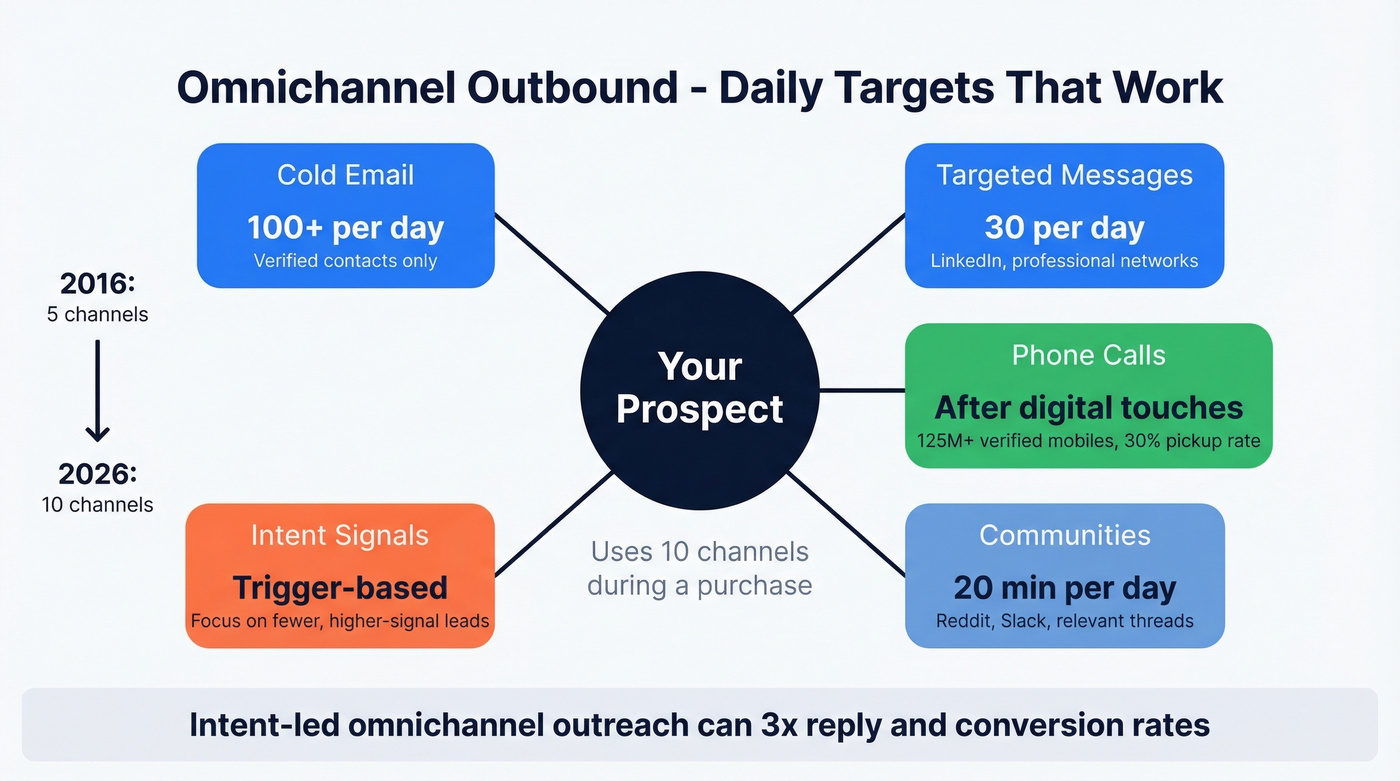
- Build omnichannel outbound with daily targets: 100+ emails, 30 targeted messages, calls after digital touches.
- Sell to the buying committee. Map all 7+ stakeholders in every deal. Single-threaded deals die in procurement.
Benchmark Your Funnel
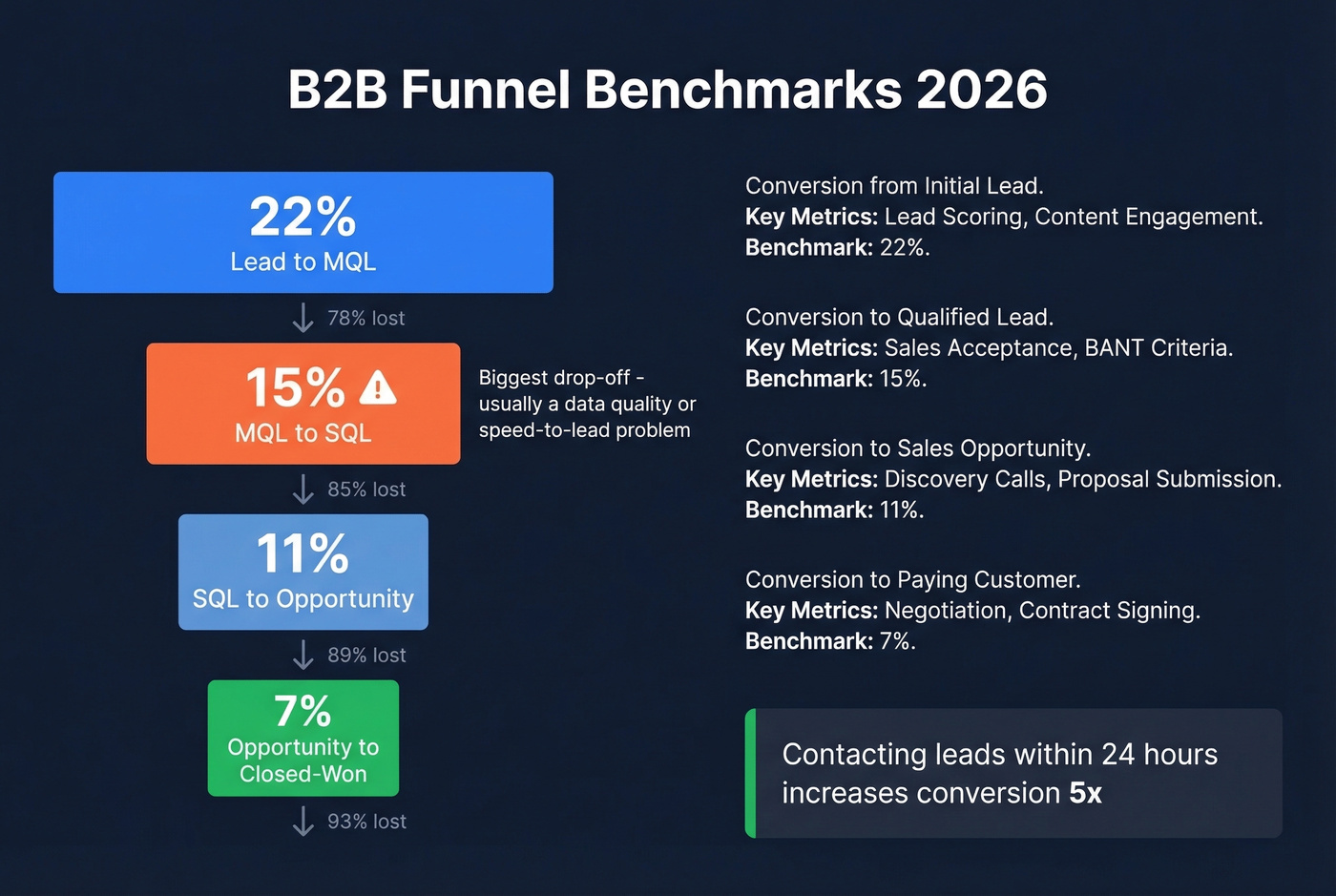
Before you change anything, figure out where your pipeline leaks. MarketJoy's aggregated data gives solid stage-by-stage benchmarks:
| Stage | Benchmark |
|---|---|
| Lead to MQL | 22% |
| MQL to SQL | 15% |
| SQL to Opportunity | 11% |
| Opp to Closed-Won | 7% |
The biggest drop-off is MQL to SQL. In our experience, that gap is almost always a data quality or speed-to-lead problem. Contacting leads within 24 hours increases conversion 5x, so if your BDR team runs a 48-hour SLA on inbound, you're leaving money on the table. Run your own numbers against these benchmarks - the gap tells you which strategy below matters most.

Snyk's 50 AEs dropped bounce rates from 35% to under 5% and grew AE-sourced pipeline 180% - by fixing their data first. Prospeo's 300M+ profiles refresh every 7 days (not 6 weeks), with 98% email accuracy and 125M+ verified mobiles. Every strategy in this article works better when your contacts are real.
Stop losing 21% of outreach to bad data. Start with contacts that connect.
7 Strategies to Improve B2B Sales
1. Fix Your Data First
Your SDR sent 500 emails yesterday. 47 bounced. Another 60 hit catch-all domains and landed in spam. That's about 21% of outreach evaporating before a human sees it, and contact data decays roughly 30% per year as people change jobs and inboxes go stale.
Every strategy below falls apart if the underlying data is garbage. We've seen this firsthand: Snyk's 50-person AE team dropped their bounce rate from 35-40% to under 5% after switching to Prospeo, and AE-sourced pipeline jumped 180%. You can't outwork bad data. Fix this first, then scale everything else. If you need a vendor shortlist, start with data enrichment options and compare against your current source.

2. Get on the Day One Shortlist
95% of the time, the winning vendor is already on the buyer's Day One shortlist. The "pre-contact favorite" wins about 80% of deals. If you're not in the consideration set before the buyer picks up the phone, you're fighting for scraps.
Here's the thing: [71% of B2B buyers are now Millennials and Gen Z](https://www.emarketer.com/content/faq-on-b2b-marketing - what-s-shaping-trends - buyers - expectations-2026), and 68% of millennial buyers prefer self-service research over talking to a rep. They form opinions from peer reviews, community discussions, and your product's digital footprint long before your SDR sends that first email. Invest in content, community presence, and product-led experiences that build preference early - especially if you're building a durable B2B brand. Outbound still works, but it works best when the prospect already recognizes your name.
3. Build Omnichannel Outbound
Buyers now use an average of 10 channels during a purchase, up from 5 in 2016. Single-channel outbound is dead.
Use this if your team runs email-only sequences and reply rates have flatlined. Skip this if you're already running coordinated multi-channel plays with intent triggers.
Daily targets that work: 100+ cold emails to verified contacts, 30 targeted messages on professional networks, and calls after digital touches - the unfair advantage most teams skip. Layer in Reddit and Slack communities too. Practitioners on r/b2bmarketing report that spending 20 minutes a day engaging in relevant threads drives warm inbound that outperforms cold outreach. Intent-led omnichannel outreach can 3x reply and conversion rates by focusing on fewer, higher-signal leads instead of blasting everyone. If you want a tighter system, borrow from proven sales prospecting techniques and standardize your sequence management.
4. Sell to the Committee
Mid-market deals involve roughly 7 stakeholders. Enterprise deals hit 6-10. If you're single-threaded to one champion, you're one reorg away from a dead deal.
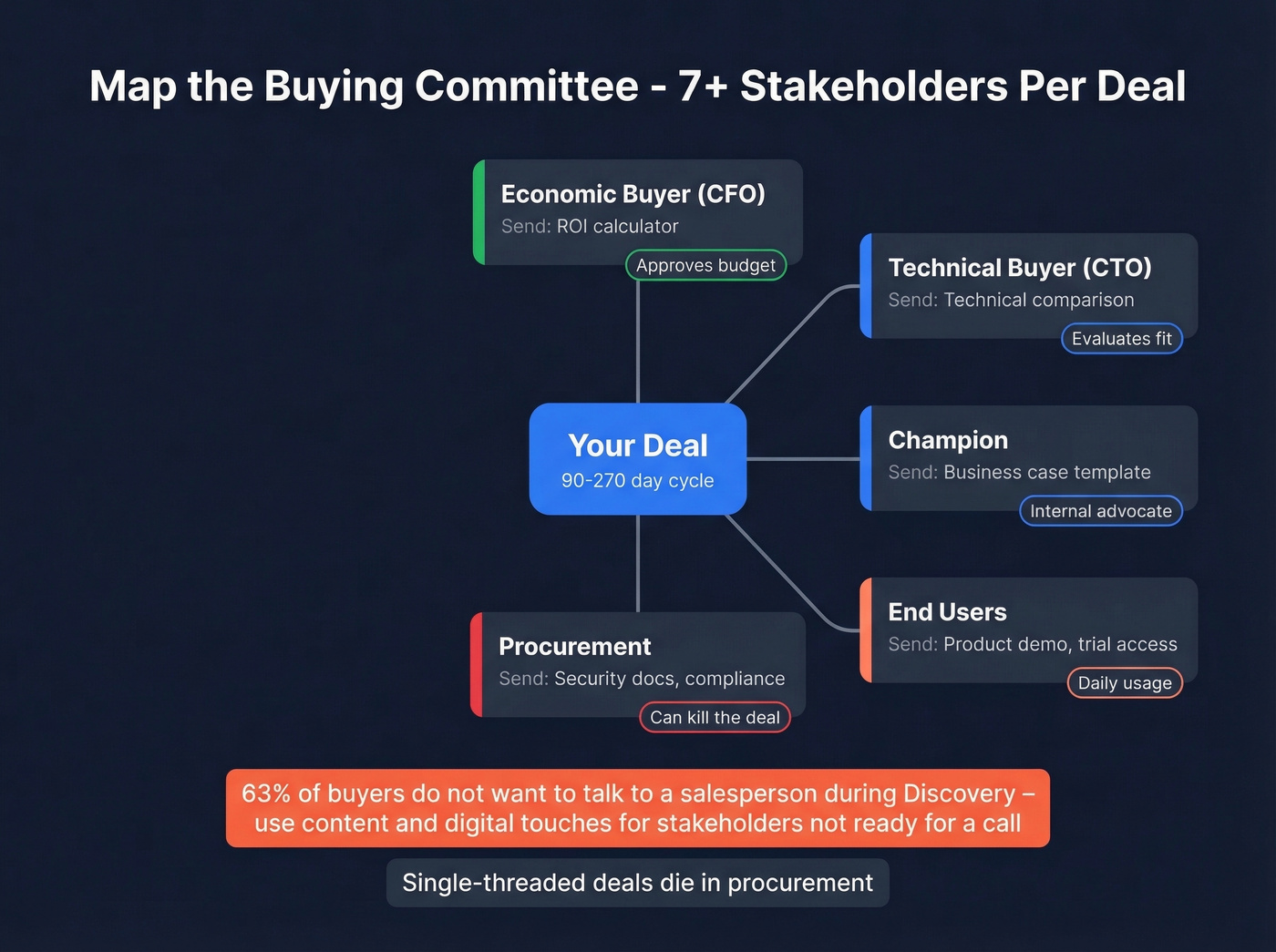
Map these roles in every opportunity: economic buyer, technical buyer, champion, end user, and procurement. Each needs different content. Send the CFO an ROI calculator, the CTO a technical comparison, and the security team an implementation guide. Reddit threads on r/sales consistently reinforce this - reps who multi-thread close at dramatically higher rates than those who rely on a single champion. If your team needs a framework for this, use team selling principles to operationalize multi-threading.
One nuance most teams miss: 63% of buyers don't want to interact with a salesperson during Discovery. Your multi-threading strategy needs content and digital touches for stakeholders who aren't ready for a call, not just more emails from your AE.
5. Use AI to Multiply Output (Not Replace Reps)
83% of AI-using sales teams saw revenue growth versus 66% without. But there's a catch: AI SDR tools churn 50-70% annually, and Gartner predicts 40%+ of agentic AI projects will be abandoned by 2027.
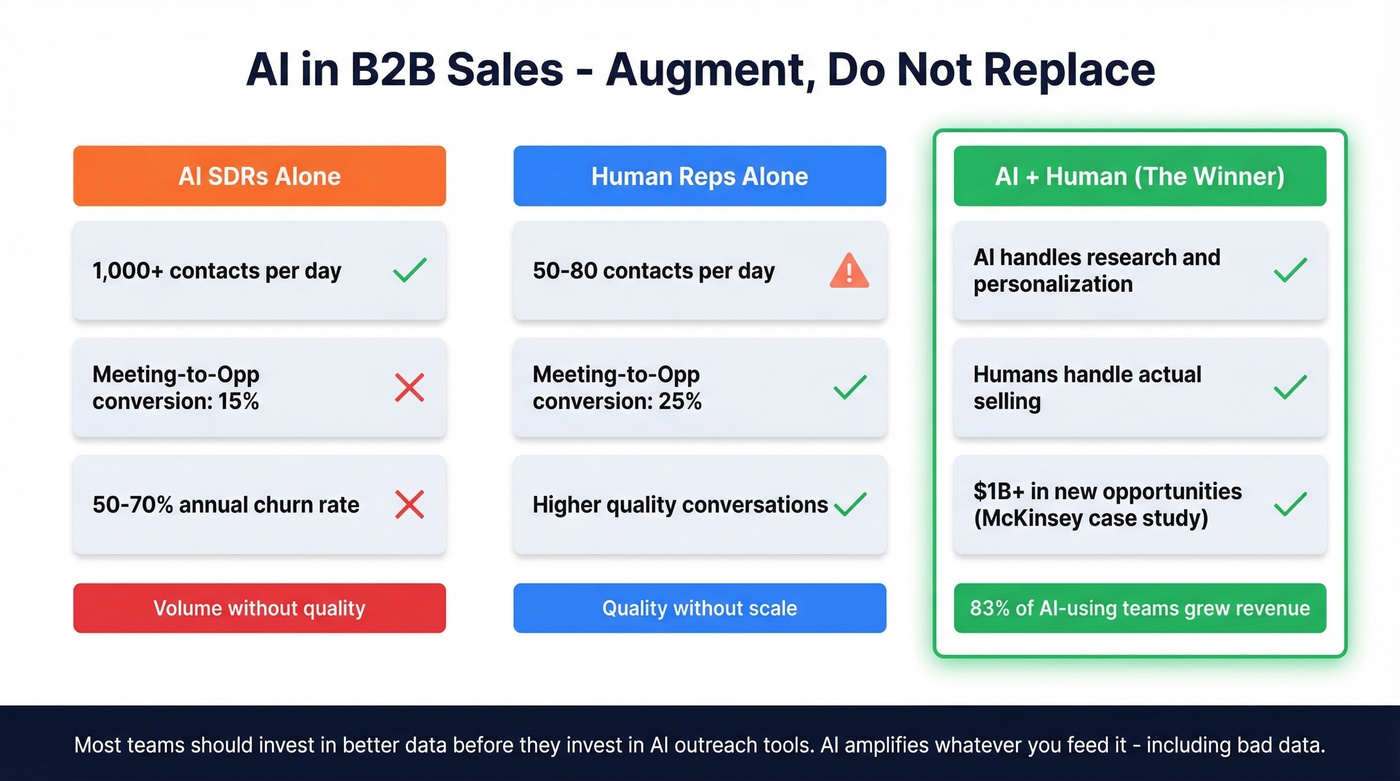
The problem is quality. AI SDRs process 1,000+ contacts per day versus 50-80 for humans, but meeting-to-opportunity conversion runs about 15% for AI versus 25% for human reps. We've seen teams get excited about AI-generated pipeline numbers only to watch conversion rates crater downstream.
The winning approach is augmentation, not replacement. A McKinsey case study of an industrial distributor using genAI for insight extraction and personalized outreach generated $1B+ in new opportunities. AI handled research and personalization at scale; humans handled the actual selling. If you're evaluating tooling, start with a shortlist of SDR tools and prioritize workflows that improve quality, not just volume.
Let's be honest: most teams should invest in better data before they invest in AI outreach tools. AI amplifies whatever you feed it - including bad data.
6. Expand Existing Customer Revenue
The probability of selling to an existing customer is 60-70%. For new prospects, it's 5-20%. That's a 3-14x difference.
And yet most teams still pour 80%+ of sales energy into new logos. Expansion revenue is the highest-ROI motion in B2B. Quarterly business reviews, usage-based upsell triggers, and cross-sell plays into adjacent departments should be systematized - not left to account managers who "check in" when they remember. If you're ignoring your install base, you're ignoring your easiest revenue. To structure this motion, align on upsell vs cross-sell definitions and track renewal rate alongside expansion.
7. Build a Repeatable Playbook
A sales playbook isn't a PDF in a shared drive. It's a living document embedded in your CRM that codifies your ICP, messaging, objection handling, and stage-by-stage process.
What goes in it: stakeholder mapping templates, qualification criteria that match your actual win patterns, messaging by persona and buying stage, and competitive battle cards updated quarterly. Review the whole thing on a fixed schedule - April, July, October, January. Enterprise cycles run 90-270 days, so your playbook needs to evolve with market shifts, not sit static for a year while your competitors iterate monthly. If you need a starting point, build your ICP with an ideal customer profile template and document your steps to close a sale.
Selling to 7+ stakeholders per deal means you need direct dials and verified emails for every buyer on the committee - CFO, CTO, procurement, end users. Prospeo gives you 30+ filters to find each one, with 125M+ verified mobiles (30% pickup rate) and emails at $0.01 each. Multi-thread without guessing.
Map the entire buying committee with verified contact data in minutes.
Key B2B Sales Benchmarks for 2026
Keep this table bookmarked. These are the benchmarks your team should measure against:
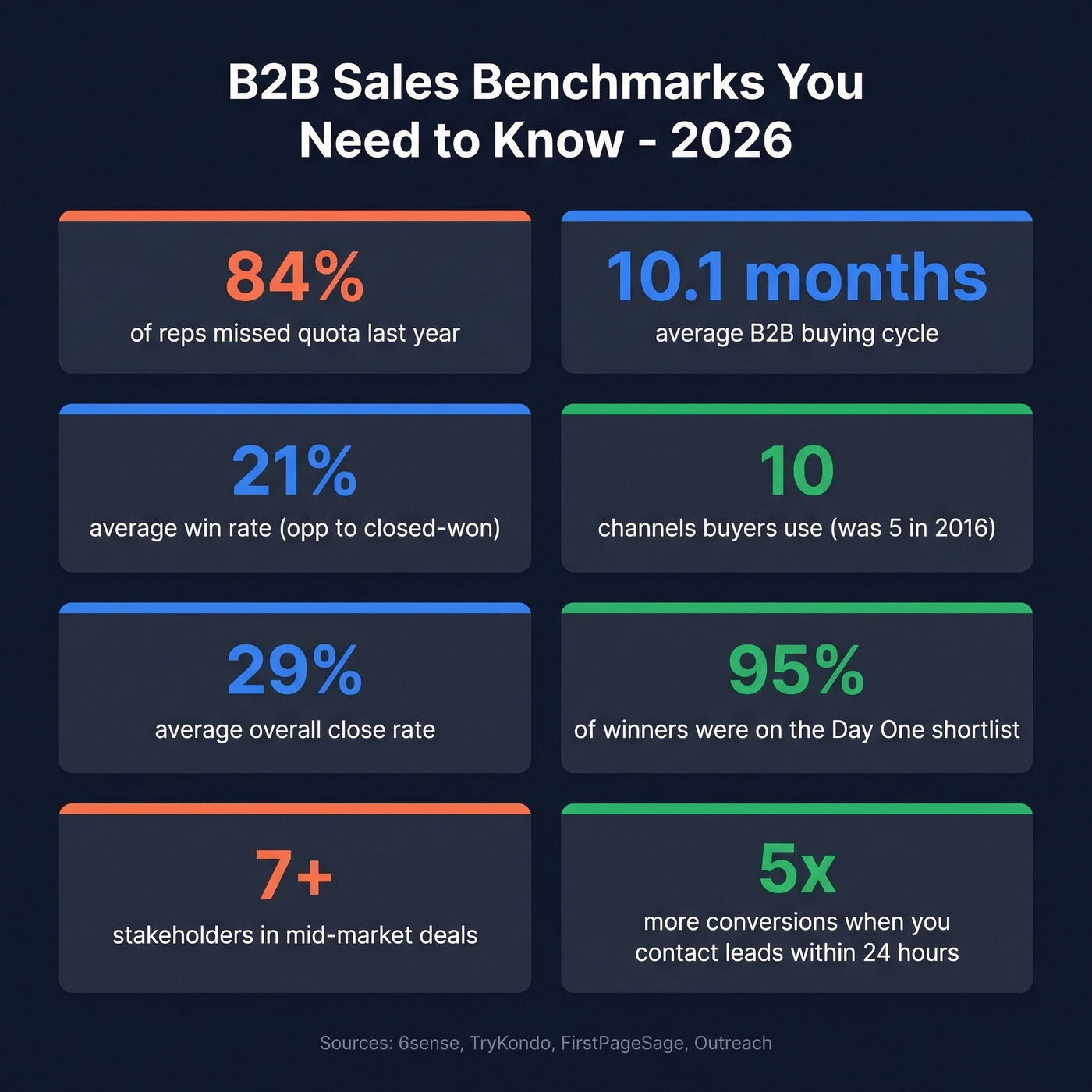
| Metric | Benchmark | Source |
|---|---|---|
| Website to Lead (SaaS) | 1.1% | FirstPageSage |
| Website to Lead (Legal) | 7.4% | FirstPageSage |
| Website to Lead (Mfg) | 2.2% | FirstPageSage |
| Average win rate (Opp to Closed-Won) | ~21% | TryKondo |
| Average close rate (overall) | 29% | TryKondo |
| Average buying cycle | 10.1 months | 6sense |
| Reps missing quota | 84% | TryKondo |
| Channels buyers use | 10 (vs 5 in 2016) | TryKondo |
If your website-to-lead rate is below 1%, your traffic quality or landing page experience needs work before you scale spend. Numbers significantly below these across the board point to a structural problem, not a tactics problem. Fix the foundation before layering on more tools or headcount. For a deeper diagnostic, track pipeline health and compare against sales pipeline benchmarks.
FAQ
What's the fastest way to increase sales in B2B?
Fix data quality and response time. Contacting inbound leads within 24 hours increases conversion 5x, and verified contact data prevents 20%+ of outreach from being wasted on bounces and dead inboxes. These two changes compound across every other tactic you're running.
How do you improve B2B sales when reps are at capacity?
Focus on leverage, not effort. Clean data eliminates wasted touches, AI handles research and personalization, and expanding existing accounts converts at 3-14x the rate of cold outreach. Most teams don't need more reps - they need fewer wasted hours per rep. One agency we work with cut list-building from 15 hours to 2-3 hours per week just by switching their data source.
How many touchpoints does it take to close a B2B deal?
Buyers use an average of 10 channels during a purchase. Most deals require 7+ touches across email, calls, social, and content before a meeting is booked. Consistent multi-channel presence beats volume on any single channel.
What tools do B2B sales teams need in 2026?
At minimum: a CRM like HubSpot (free tier available) or Salesforce ($25-$165/user/mo), a verified data provider like Prospeo for accurate contacts and intent signals, and a sequencing tool - Outreach or Salesloft (~$100-$200+/seat/mo) for mid-market teams, or Instantly (~$30/mo) for startups. Get your intelligence right before automating outreach.