

How to Actually Reach B2B Customers in 2026
You sent 500 emails. 180 bounced. 12 hit spam. Three replies - all unsubscribe requests. If that sounds familiar, you don't have an outreach problem. You have a data problem layered on a strategy problem, and most teams never untangle which is which.
Here's the uncomfortable part: 95% of the time, the winning vendor is already on the buyer's shortlist before a single sales conversation happens. And 80% of B2B sales interactions now happen through digital channels. If you're not showing up during the research phase, you're not in the deal. Period.
How B2B Buyers Actually Buy Now
Buying cycles compressed from 11.3 months to 10.1 months between 2024 and 2025, and they're still tightening. First seller contact now happens at 61% of the journey - eight percentage points earlier than the year before, roughly six to seven weeks sooner. AI-powered due diligence is accelerating the research phase, which means buyers form opinions faster and with less seller input than ever.
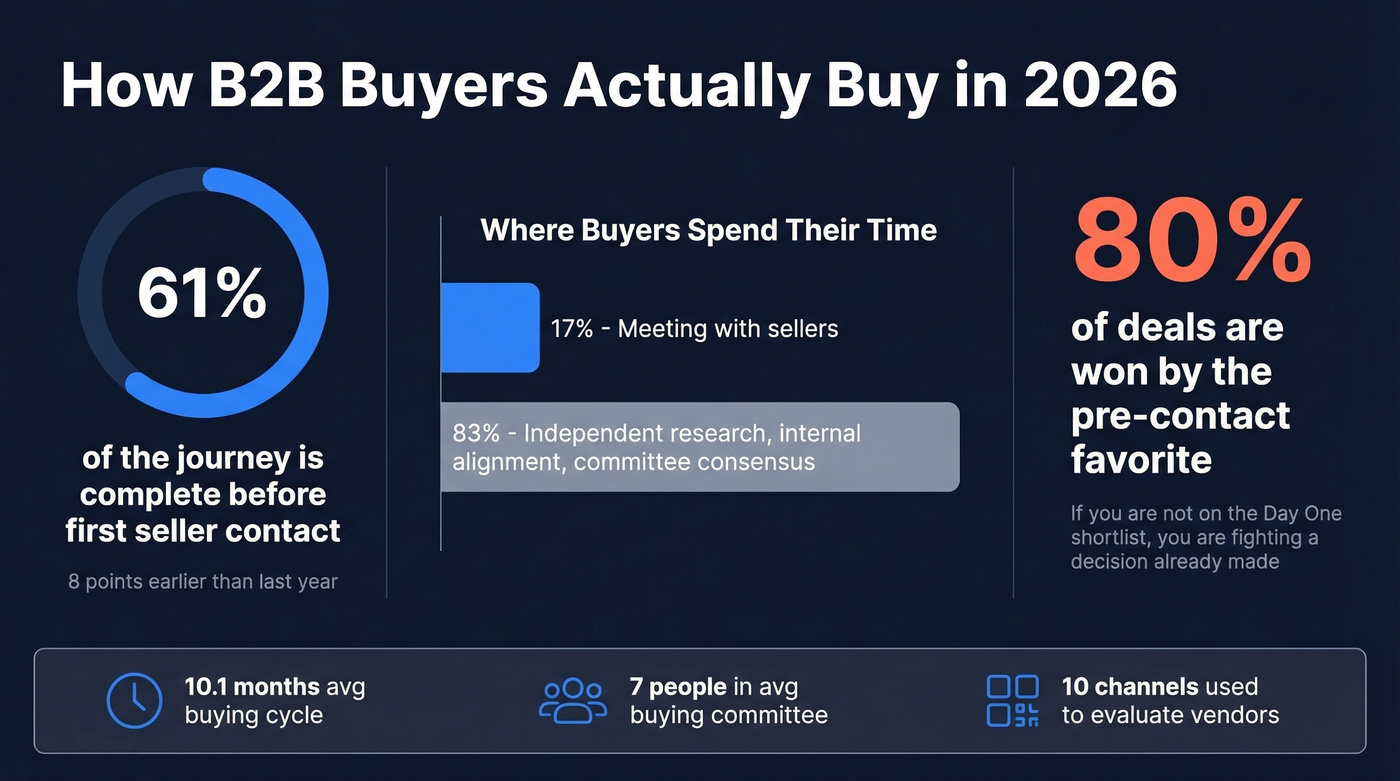
Buyers spend about 17% of their total buying time meeting with sellers. The rest? Independent research, internal alignment, and committee consensus. The average mid-market deal involves about seven people using around ten channels to evaluate vendors, and McKinsey's "Rule of Thirds" still holds: one-third prefer in-person, one-third remote, one-third digital self-serve. You need to cover all three.
The pre-contact favorite wins 80% of deals. If you're not on that Day One shortlist, your outbound is fighting a decision that's already been made.
Define Your ICP First
In our experience, the ICP conversation is where 80% of outreach campaigns are won or lost - before anyone touches a tool or writes a single email. Nail your ICP across three dimensions:
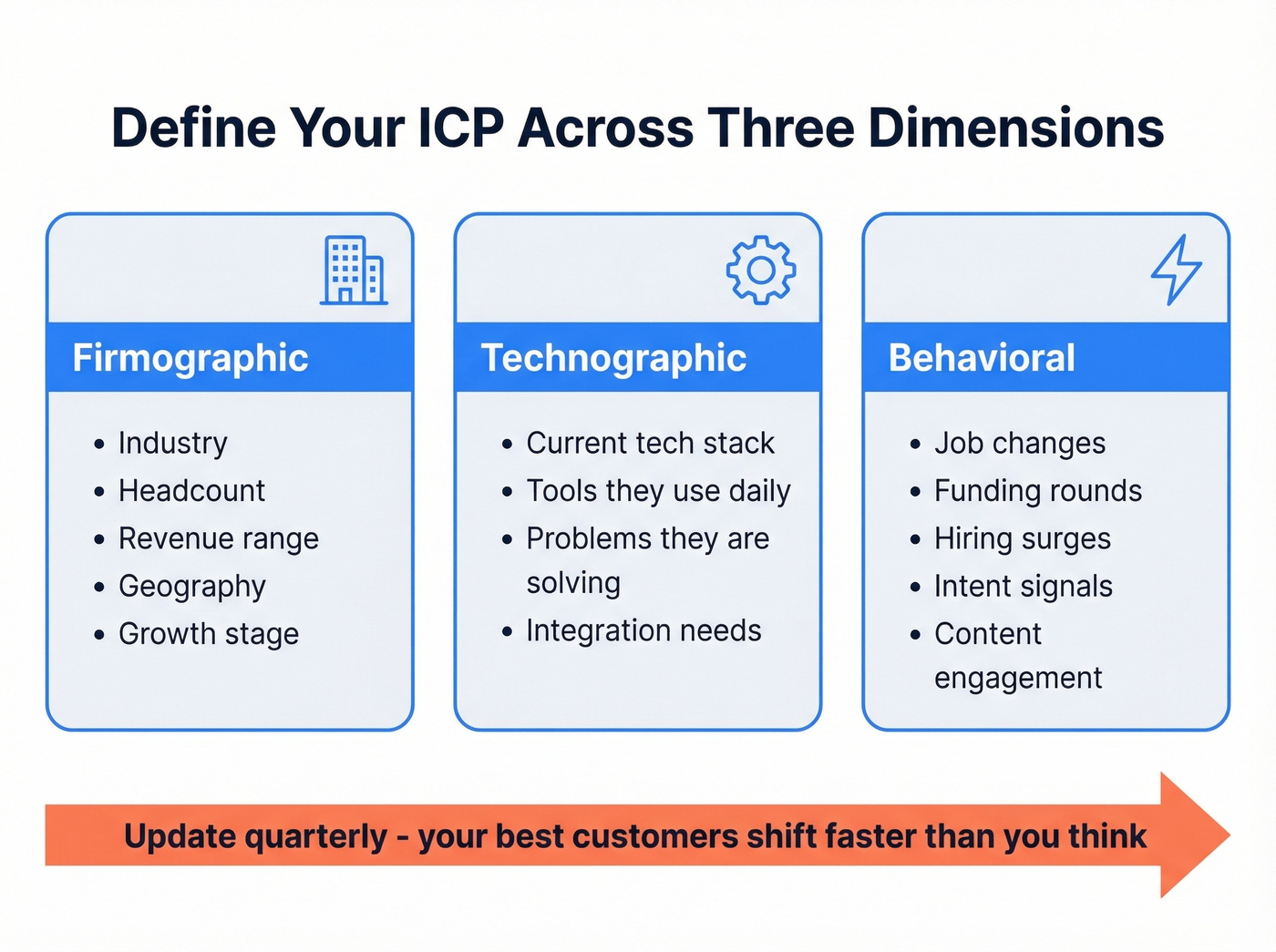
- Firmographic - Industry, headcount, revenue range, geography, growth stage (firmographic filters help you operationalize this)
- Technographic - What tools they use tells you what problems they're solving (firmographic and technographic data is the baseline)
- Behavioral - Job changes, funding rounds, hiring surges, intent signals on relevant topics (use a system for identifying buying signals)
Update this quarterly. An ICP built on last year's closed-won data might not reflect where your next 50 deals are coming from. We've watched teams burn through entire quarters running campaigns against a stale ICP, only to realize their best customers had shifted to a completely different segment.

Your ICP is only as good as the data behind it. Prospeo gives you 30+ filters - buyer intent, technographics, job changes, funding, headcount growth - across 300M+ profiles on a 7-day refresh cycle. Build lists that match your ICP today, not six weeks ago.
Define your ICP, then fill it with contacts that actually connect.
Outreach Channels That Convert
The average B2B conversion rate across 14 industries is 2.9%, based on 100M+ data points - and in that study, a "conversion" means a qualified lead. Benchmark close rate sits around 29%. Set expectations accordingly, then pick channels that match your stage (more benchmarks: average B2B lead conversion rate).
Show Up During Research
Since buyers form their shortlist before talking to sales, your job is to be visible during that research window. SEO-driven content, active participation in industry communities, case studies with real numbers, and social proof from recognizable logos all contribute (see what is B2B content marketing for the full breakdown). In 2026, that also means AI search visibility - if your content doesn't surface in generative search results, you're invisible to a growing share of buyers.
Content compounds. Paid ads stop the moment you stop paying.
For mid-market and enterprise teams, account-based marketing deserves serious attention: 76% of marketers report higher ROI from ABM than any other strategy, and multi-channel ABM drives 300% higher engagement (pair this with account-based selling best practices).
Reach Out With Precision
Look, most teams blame their copy when outreach fails. It's almost never the copy. It's the data. If 30% of your list bounces, your sender reputation tanks, your domain gets flagged, and every subsequent campaign performs worse - a compounding spiral that takes months to reverse. Verification isn't optional. It's the foundation everything else sits on (start with an email deliverability guide).
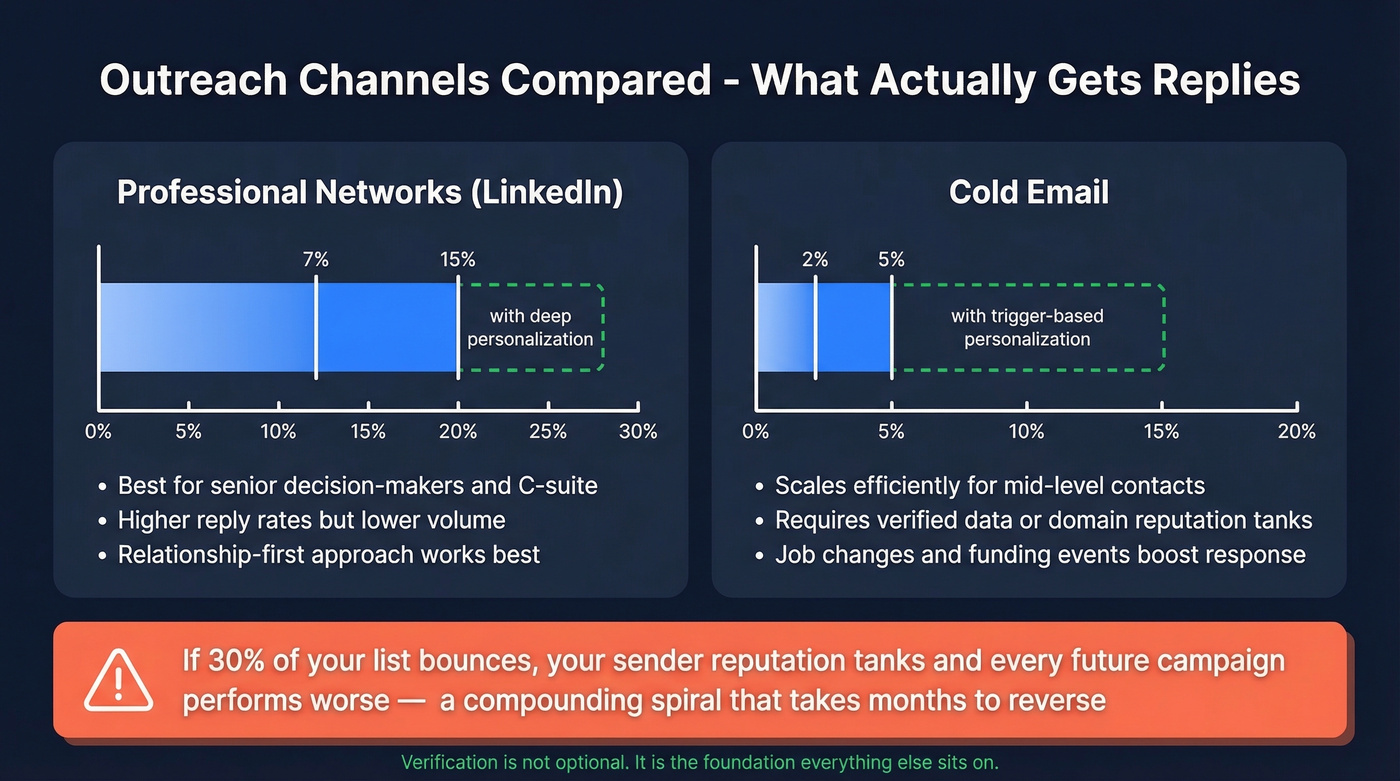
Cold messages on professional networks pull 7-15% reply rates on average, and highly personalized sequences can exceed 25%. Cold email sits at 2-5% reply rates for well-targeted campaigns, higher with trigger-based personalization like job changes or funding events. The key is matching channels to your audience: professional networks work better for senior decision-makers, while email scales more efficiently for mid-level contacts (use a proven B2B cold email sequence structure).
Starting From Zero?
Skip this section if you already have product-market fit and a repeatable sales motion.
If you're early-stage, the playbook is different. As Lenny Rachitsky puts it: "None of these seven strategies scale. That's why they work." Think of channels as concentric circles of trust - your network is the inner ring, cold outbound is the outer. Your first ten customers will come from former colleagues, friends-of-friends, and people who trust you personally before they trust your product. The consensus on r/sales echoes this: warm intros close faster than any cold sequence, especially before you have case studies to lean on.
Build Your Prospecting Stack
You need three to four tools, not ten. A data and verification layer, an outreach tool, and a CRM. That's the core. Everything else is optimization (here are the best outbound lead generation tools if you’re auditing your stack).
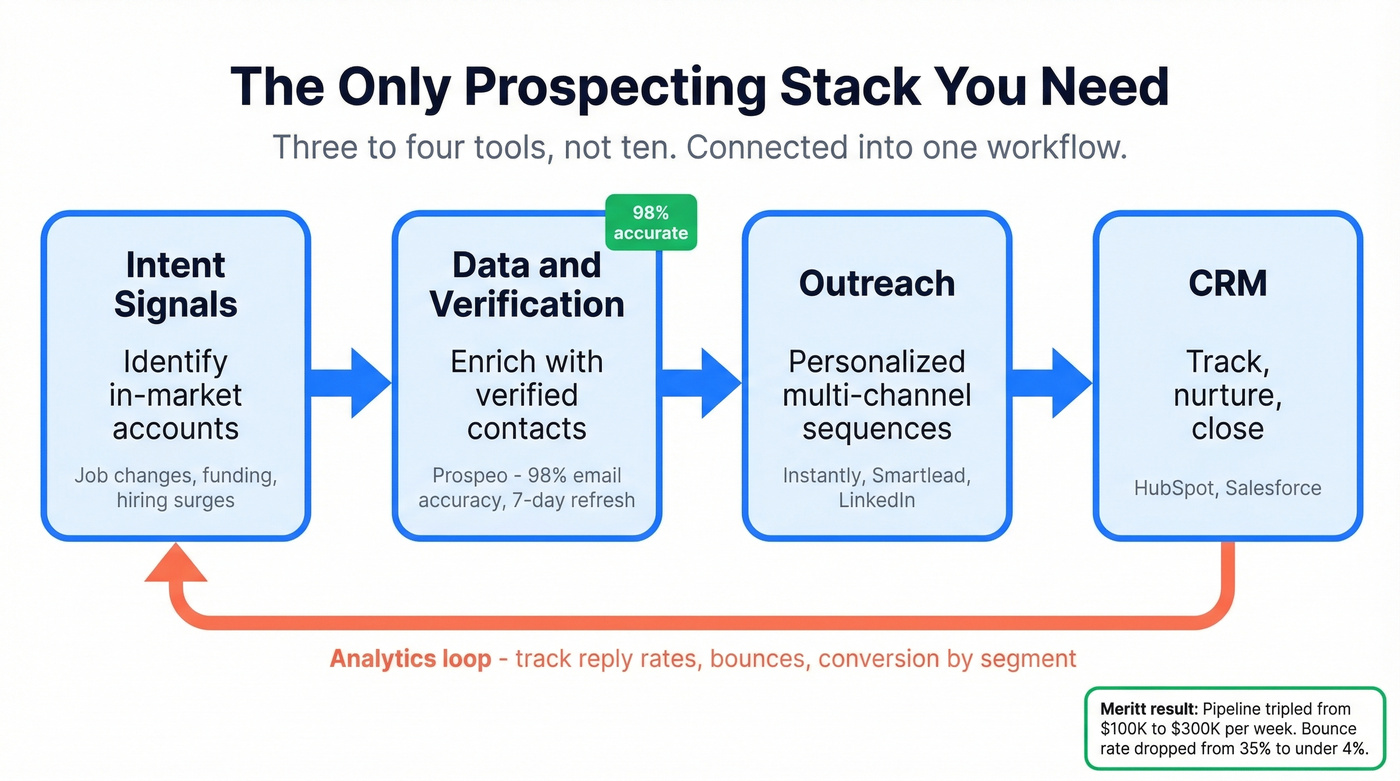
The key is connecting these into a workflow: intent signals identify in-market accounts, enrichment fills in verified contacts, personalized outreach lands in real inboxes, and everything syncs back to your CRM so nothing falls through the cracks (see connect outreach tool to CRM for setup). We've seen teams triple their reply rates just by switching from a disconnected tool pile to this kind of connected stack.
For the data layer, Prospeo covers 300M+ professional profiles with 143M+ verified emails and 125M+ verified mobile numbers. The 98% email accuracy comes from a proprietary 5-step verification process on a 7-day refresh cycle, with native integrations into Salesforce, HubSpot, Smartlead, Instantly, Lemlist, Clay, Zapier, and Make. One customer, Meritt, tripled pipeline from $100K to $300K per week after switching to verified data - bounce rate dropped from 35% to under 4%.
| Category | Tool | Starting Price | Best For |
|---|---|---|---|
| Data & Verification | Prospeo | Free; ~$0.01/email | Verified emails + mobiles |
| Data & Verification | Apollo.io | $59/user/mo | All-in-one on a budget |
| Data & Verification | ZoomInfo | $15,000+/yr | Enterprise, big budgets |
| Outreach | Instantly | $47/mo | Cold email at scale |
| Outreach | Smartlead | From $39/mo | Mailbox rotation + deliverability |
| CRM | HubSpot | Free; Starter $15/seat/mo | SMB + startup default |
| CRM | Salesforce | $25/user/mo | Enterprise |
| Enrichment | Clay | $149/mo | Complex workflows |
Mistakes That Kill B2B Outreach
84% of reps missed quota last year. Much of that comes down to avoidable mistakes:
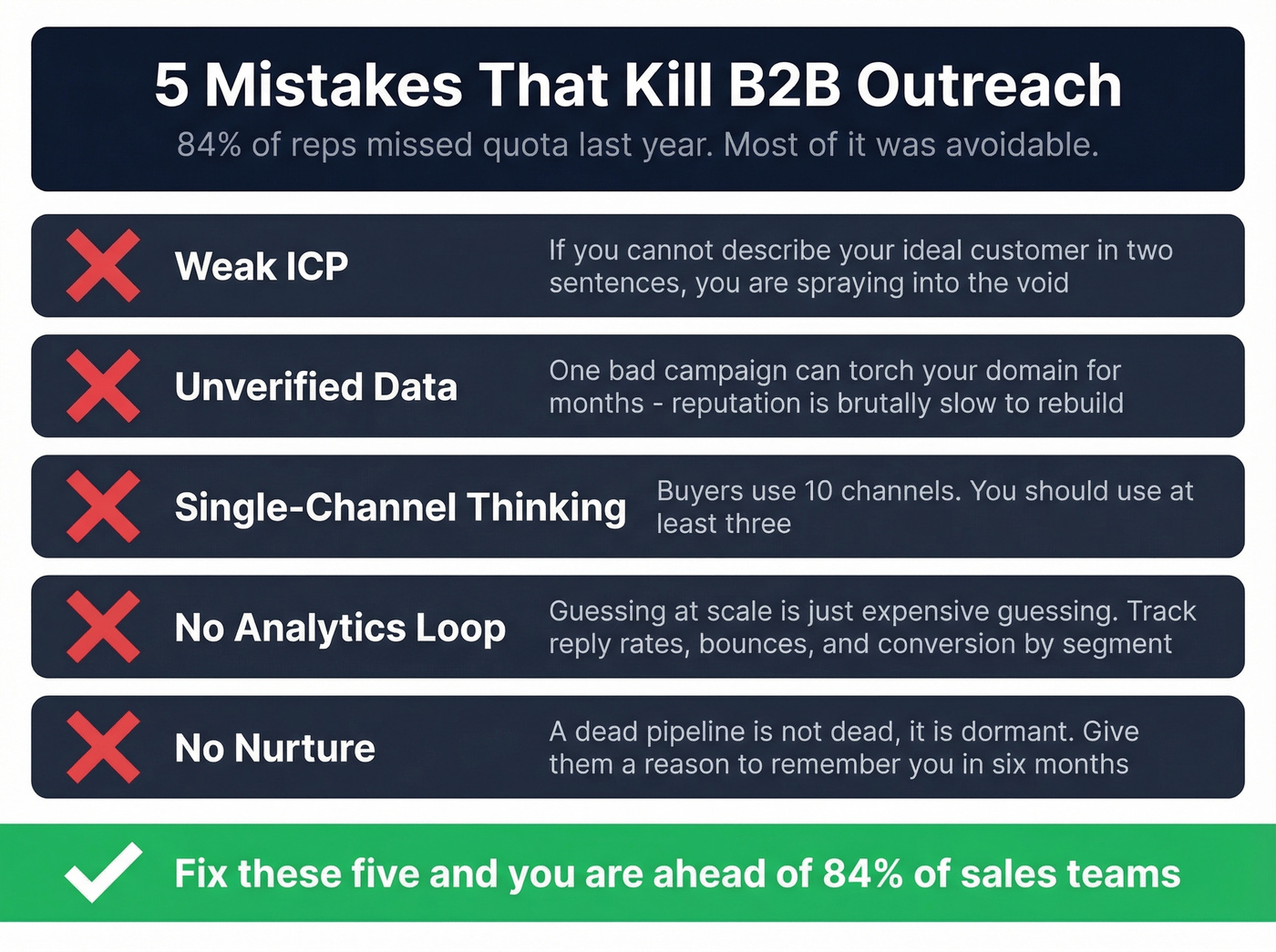
Weak ICP. If you can't describe your ideal customer in two sentences, you're spraying into the void. This is the single most common failure we see - teams skip the hard work of narrowing their target and wonder why nothing converts (use an ideal customer profile template).
Unverified data. Verify before you send. One bad campaign can torch your domain for months, and domain reputation is brutally slow to rebuild (start with email bounce rate benchmarks and fixes).
Single-channel thinking. Buyers use ten different channels. You should use at least three.
No analytics loop. If you're not tracking reply rates, bounce rates, and conversion by segment, you're guessing. And guessing at scale is just expensive guessing.
No nurture. Not every prospect buys today, but they need a reason to remember you in six months. A dead pipeline isn't dead - it's dormant. Treat it that way.
The article says it plainly: it's almost never the copy - it's the data. Meritt tripled pipeline from $100K to $300K/week after switching to Prospeo's 98% accurate emails. Their bounce rate dropped from 35% to under 4%. At $0.01 per email, bad data is a choice.
Stop blaming your copy. Fix the data and start landing replies.
FAQ
Is cold outreach still effective in 2026?
Yes, but only with verified data and genuine personalization. Combine trigger-based targeting - job changes, funding, intent signals - with tight messaging. Well-crafted sequences pull 15-25% reply rates. Generic blasts to unverified lists will tank your domain reputation and waste months of recovery time.
How long does it take to see results?
Expect two to four weeks for initial signal: reply rates, bounce rates, meeting-book rates. Pipeline-to-close takes longer. Average B2B buying cycles run 10.1 months with a roughly 29% close rate. Set benchmarks early - 2.9% is a normal conversion rate for qualified leads across industries.
What's the cheapest way to start?
Combine free tiers: Prospeo for 75 verified emails per month, HubSpot CRM (free), and Instantly at $47 per month. Total cost under $50 per month for a real outbound motion with verified data and automated sequences - enough to validate your ICP before scaling spend.