

How to Sell Remotely Without Losing 70% of Your Day to Admin
61% of B2B buyers now prefer a rep-free buying experience. That doesn't mean they don't want to buy - it means they don't want to be sold to badly. And 73% actively avoid suppliers who send irrelevant outreach. If you're figuring out how to sell remotely in 2026, the bar isn't "be on Zoom." It's be relevant, be fast, and don't waste anyone's time - including your own.
Here's the short version:
- Your outbound sequence needs 10-14 touches across 3+ channels over 30 days. Not 4 emails and a prayer. (If you want a tighter framework, use these outreach sequences.)
- Bad contact data kills remote selling before it starts. Verify every list before you send. (Use a simple BDR contact data QA workflow.)
- You need four tools max: a CRM, a sequencing tool, a data provider, and a video tool. Total cost for a solo rep: under $100/month. (If you're shopping, start with the best outreach tools.)
Remote Selling by the Numbers
Gartner projected 80% of B2B sales interactions would be digital by 2025 - and the data confirms we blew past that. The average B2B close rate sits at 29%. Meanwhile, 84% of reps missed quota last year. The productivity split is brutal: reps spend roughly 30% of their time actually selling and 70% on admin. (To protect selling time, borrow these sales enablement best practices.)
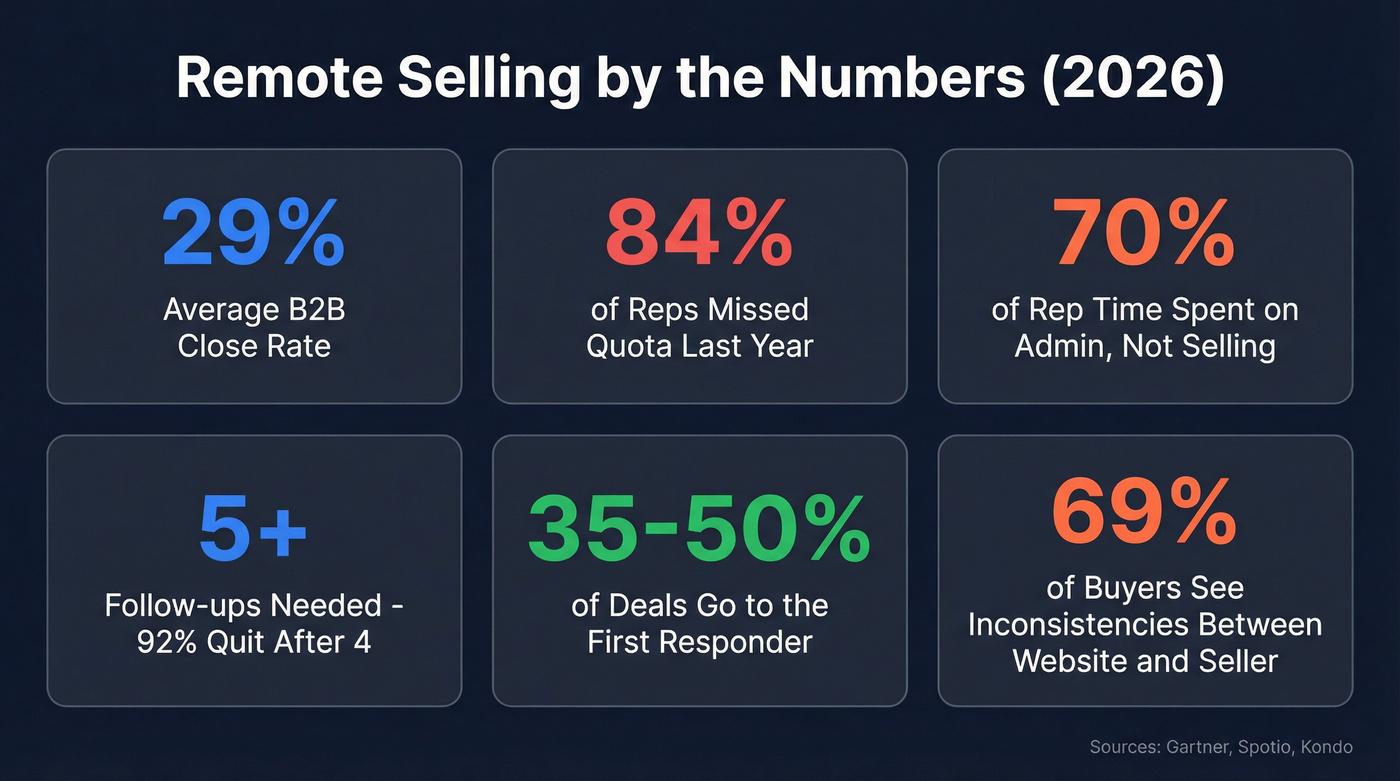
The persistence gap is where most teams bleed out. 80% of sales require 5+ follow-ups, but 92% of reps quit after 4 attempts. Buyers aren't sitting in one channel waiting for you either - they're using around 10 interaction channels on average, up from 5 in 2016. And 35%-50% of sales go to the vendor that responds first, which means speed-to-lead isn't a nice-to-have. It's the whole game.
Here's the stat that should keep every remote seller up at night: 69% of B2B buyers report inconsistencies between what a company's website says and what sellers tell them. When you can't rely on a handshake and a conference room to build trust, your messaging has to be airtight across every channel. (This is where sales communication systems matter.)

Seven Rules for Selling Remotely in 2026
Verify Your Data First
Nothing else on this list matters if your emails bounce. A high bounce rate torches your domain reputation and kills every sequence downstream. We've seen teams spend weeks building sequences only to watch their sender score crater on day one because they skipped verification. Fix the data first - everything else is downstream. (If you need a checklist, see how to check if email address is valid.)

Sell One Problem at a Time
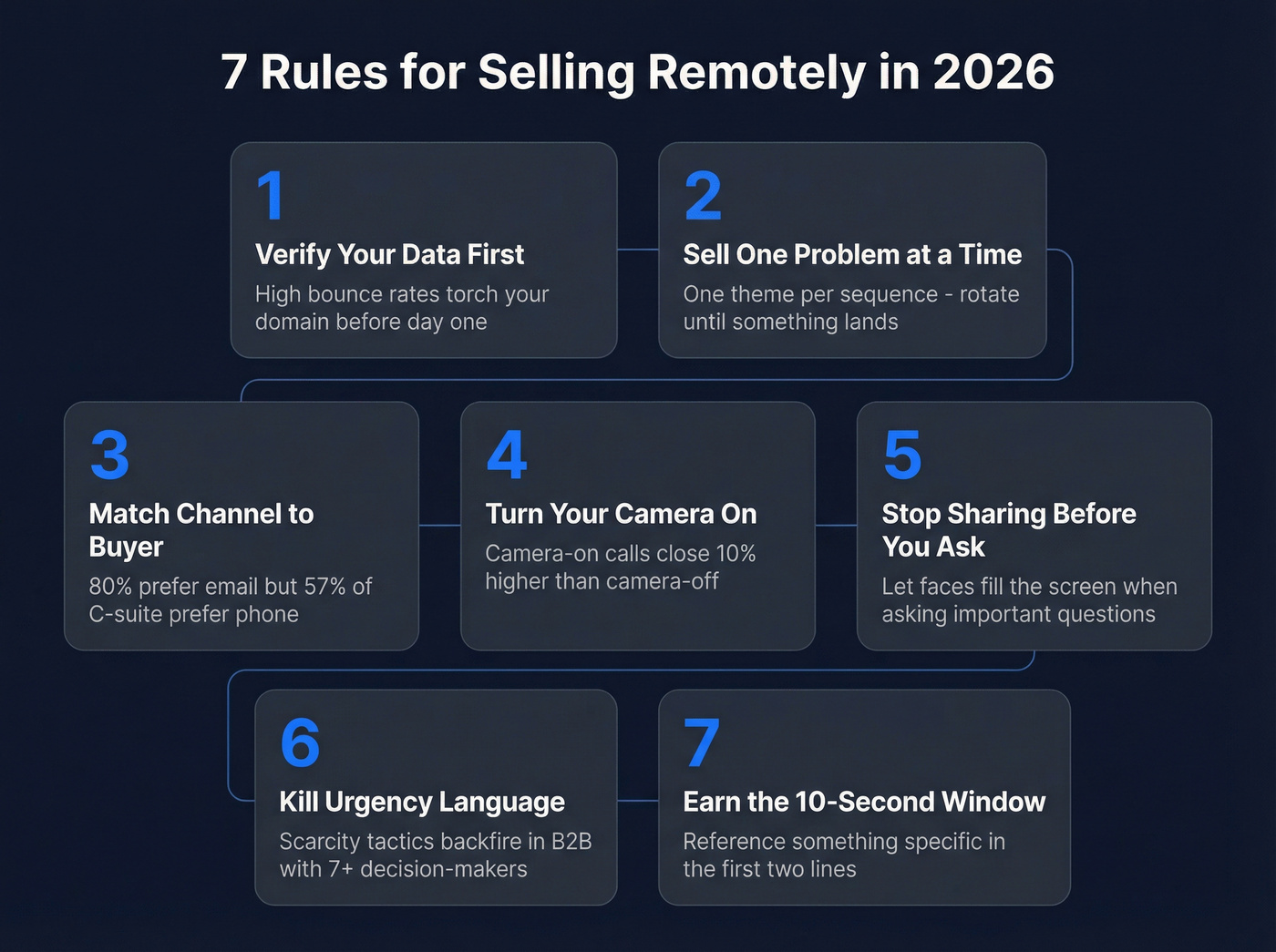
The instinct is to cram every value prop into one email. Resist it. Structure your outreach around a single problem per theme, and if that problem doesn't resonate after a few touches, switch to the next one. Each theme earns its own set of messages. You rotate until something lands. (If you need angles, pull from these pain point examples.)
Match the Channel to the Buyer
80% of prospects prefer email. But 57% of C-suite buyers prefer phone. Don't default to one channel because it's comfortable - match the medium to the persona. A VP of Engineering and a CFO have different communication preferences, and your sequence should reflect that. (For timing and spacing, use an email cadence.)
Turn Your Camera On
Camera-on calls close 10% higher than camera-off. It's a small thing that signals presence and credibility. Set the expectation before the meeting: "We'll have cameras on so we can have a real conversation." Most people comply when you frame it as the norm rather than asking permission.
Stop Screen-Sharing Before You Ask
When you're sharing slides and ask a question, the prospect is staring at your deck, not at you. Stop sharing before you ask anything important. Let faces fill the screen. It transforms the dynamic from lecture to conversation, and you'll get better answers. (If your deck needs work, steal from these sales presentation examples.)
Kill Urgency Language
"Limited time offer" and "act now" work in B2C. In B2B with 7+ decision-makers involved, urgency and scarcity language backfires fast. It reads as gimmicky and damages trust. One B2B team saw a 20% win-rate increase over two quarters after replacing urgency CTAs with data-backed proposals and tailored value maps.
Earn the 10-Second Window
People spend roughly 10 seconds reading an email from a brand. That's your window. Reference something specific - a recent hire, a funding round, a tech stack signal. Generic "hope you're well" openers don't earn the scroll, and every word in those first two lines needs to justify the next two. (If you want faster drafts, test an AI Email Writers workflow.)
The Remote Outbound Sequence
A solid remote selling cadence runs 10-14 touches over 30 days across email, phone, and video. Here's the structure that works:
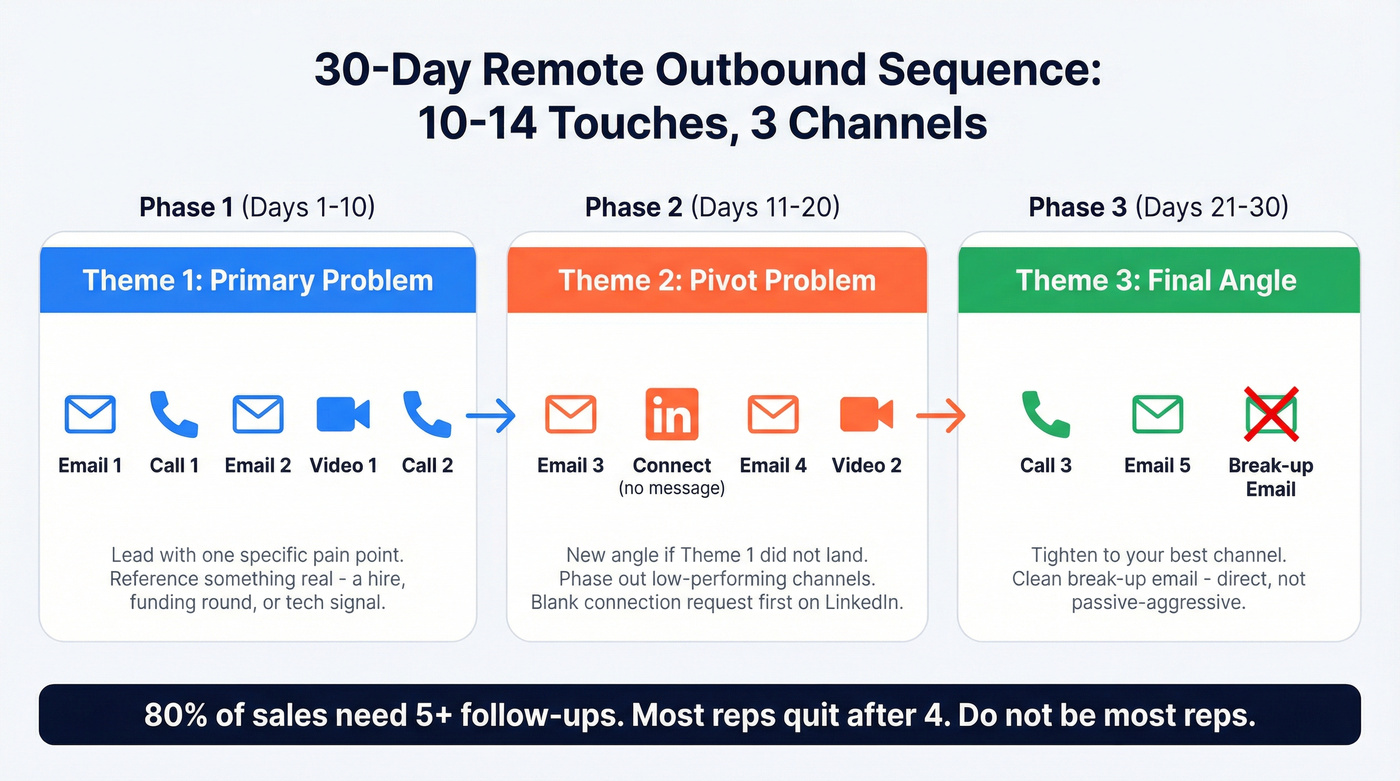
Theme 2 (Days 11-20): Pivot to a second problem if Theme 1 didn't land. Phase out channels showing diminishing returns - if phone isn't connecting, shift that effort to email and video. On professional networks, send a blank connection request first. A message-heavy invite gets ignored. Once connected, lead with context, not a pitch.
Theme 3 (Days 21-30): Final angle. Tighten to your highest-performing channel. The last touch should be a clean break-up email - not passive-aggressive, just direct.
80% of sales require 5+ follow-ups. Most reps quit before the sequence even gets interesting.

You just read that 84% of reps miss quota and 70% of their day goes to admin. Bad data makes both worse - bounced emails torch your domain, kill deliverability, and waste every follow-up in your sequence. Prospeo's 5-step verification delivers 98% email accuracy at $0.01/email, so every one of those 10-14 touches actually lands.
Fix the data first. Everything else in your remote sequence is downstream.
Remote Sales Tech Stack
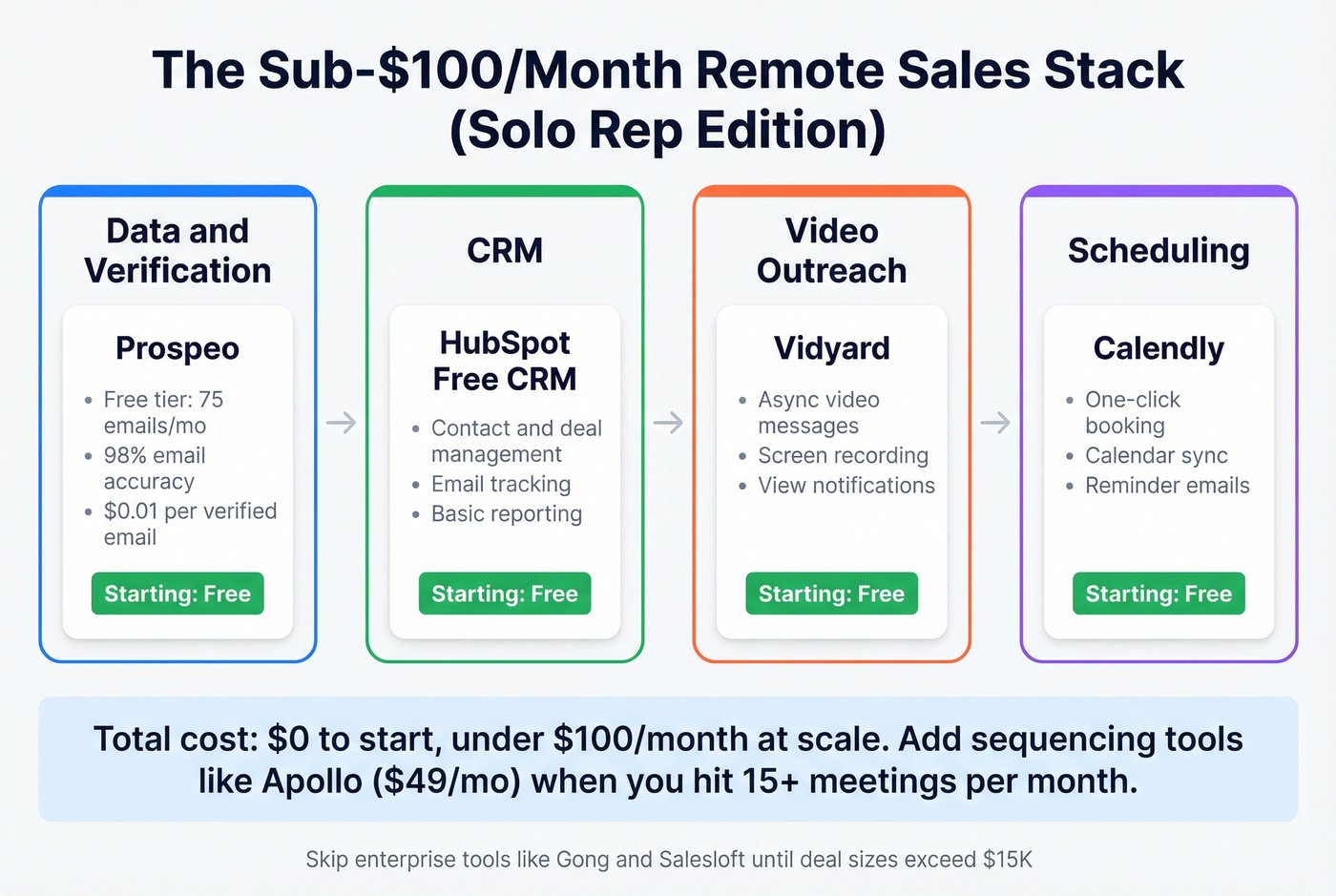
Four tools, used well, beat a bloated stack every time. Pick one from each category and you're set.
| Tool | Category | Best For | Starting Price |
|---|---|---|---|
| Prospeo | Data & Verification | Solo reps and agencies needing verified emails at scale | Free (75 emails/mo + 100 extension credits); ~$0.01/email |
| HubSpot | CRM | Teams needing a free CRM with sales enablement features | Free; Sales Hub Starter from $20/user/mo |
| Apollo.io | Database + Sequencing | All-in-one prospecting on a budget | Free; paid from $49/user/mo |
| Salesloft | Sales Engagement | Enterprise teams with complex cadences | ~$125-$165/user/mo |
| Outreach | Sales Engagement | Mid-market teams scaling outbound | Custom; starts around $100/user/mo |
| Vidyard | Video Outreach | Reps adding async video to sequences | Free tier available |
| Calendly | Scheduling | Anyone booking meetings | Free; paid from $10/user/mo |
| Gong | Conversation Intel | Managers coaching with AI call analysis | ~$100-$200/user/mo (enterprise) |
Let's be honest: most reps don't need Gong or Salesloft until they're consistently booking 15+ meetings a month. If your average deal size is under $15k, a lean stack of HubSpot's free CRM, a verified data provider, Vidyard, and Calendly gets you fully operational for under $100/month. In our experience, reps running four focused tools consistently outperform teams juggling eight - because they actually learn the tools instead of tab-switching all day. Add a paid sequencing tool when volume justifies it.
Skip the enterprise stack if you're a solo rep or small team. You'll spend more time configuring dashboards than selling.
AI is changing the stack fast. Conversation intelligence and sales engagement platforms increasingly ship AI coaching and QA features that help managers spot gaps in discovery and objection handling. If you're evaluating tools today, prioritize ones with AI features baked in - they'll compound your output over the next 12 months.
Three Virtual Call Mistakes to Stop
Slides with walls of text. Keep slides visual. Send the detailed deck after the call. Your slides shouldn't compete with you for attention - they should be a backdrop, not the main event.
Asking open-ended questions to "everyone" on a group call. Direct questions by name. "Sarah, how does your team handle X today?" beats "Does anyone have thoughts on this?" - which produces silence every time.
Not setting next-step expectations up front. Open with the agenda and what happens if the call goes well. "If this is a fit, I'll walk you through pricing and we'll schedule a technical review." Clarity up front prevents the awkward "so... what now?" at the end.
For Sales Managers: Remote Team Playbook
Running a remote sales team requires different muscles than managing an in-office floor. The two biggest gaps we see are almost always data quality and follow-up persistence - and both are management problems, not rep problems. (If you're building systems, use this remote sales team management playbook.)
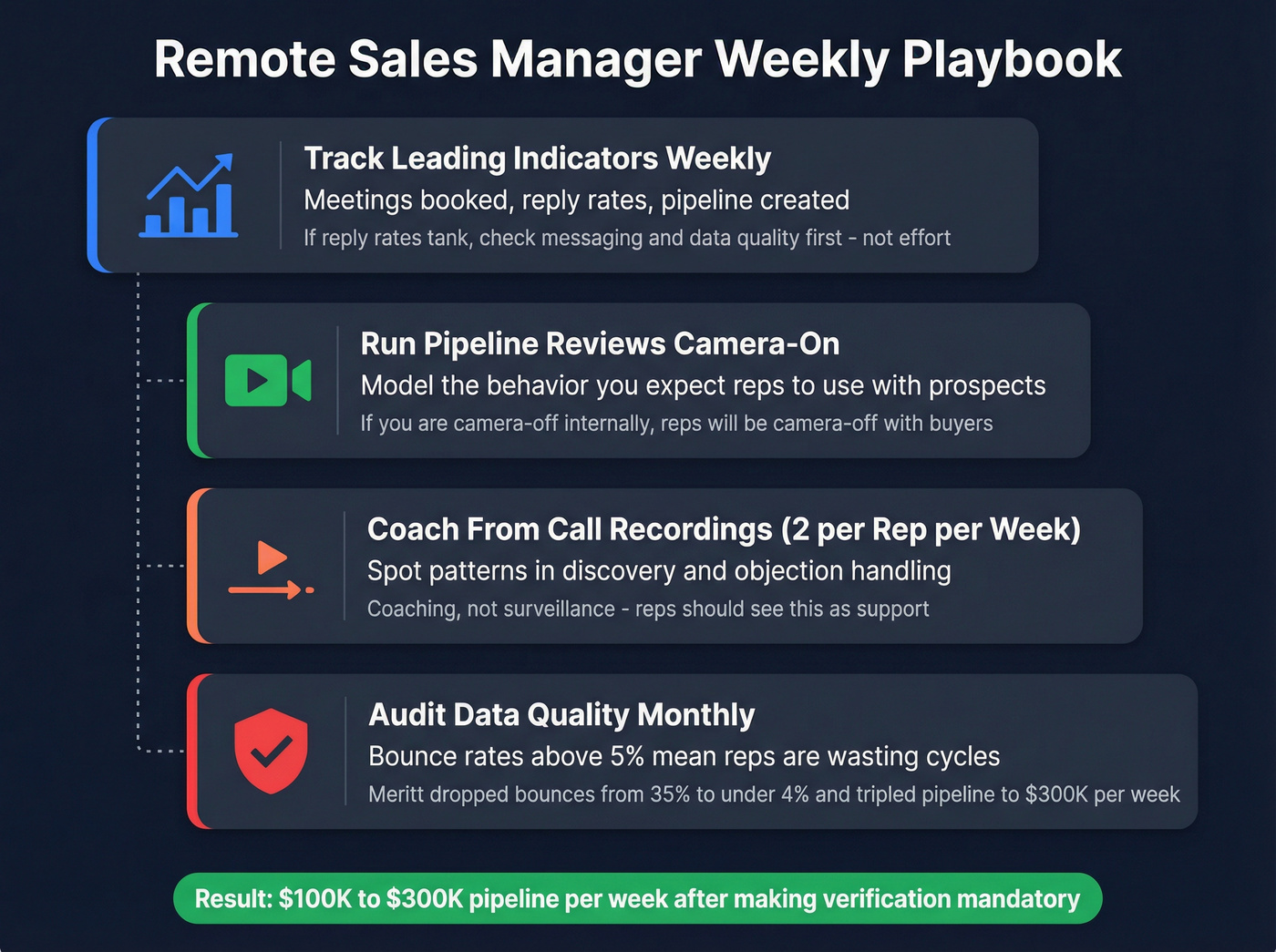
Track leading indicators weekly. Meetings booked, reply rates, and pipeline created matter more than closed-won when diagnosing remote selling issues. If reply rates are tanking, the problem is usually messaging or data quality, not effort. (These 5 Key Performance Indicators in Sales are a good baseline.)
Run pipeline reviews on video with cameras on. Model the behavior you expect reps to use with prospects. If you're camera-off on internal calls, don't be surprised when reps go camera-off with buyers.
Use call recordings for coaching, not surveillance. Tools like Gong turn every virtual demo into a coaching opportunity. Review two calls per rep per week - that's enough to spot patterns without micromanaging.
Audit data quality monthly. If bounce rates creep above 5%, your reps are wasting cycles. Make list verification a non-negotiable step before any sequence launches. One of our customers, Meritt, dropped their bounce rate from 35% to under 4% after making verification mandatory - and tripled their pipeline from $100K to $300K per week.
Start With Clean Data
Monday morning, you load 200 prospects into your sequence. By Wednesday, 40 have bounced. Your domain health drops. By Friday, even your good emails land in spam.
Every tactic in this playbook - the multi-channel cadence, the camera-on calls, the personalized subject lines - depends on reaching real people at real addresses. Learning how to sell remotely is pointless if your messages never arrive. Start there.
Your remote outbound sequence needs verified emails, direct dials, and buyer intent signals to hit quota. Prospeo gives you all three: 143M+ verified emails, 125M+ mobile numbers with a 30% pickup rate, and intent data across 15,000 topics - refreshed every 7 days, not every 6 weeks like competitors.
Build your entire remote selling stack for under $0.01 per lead.
FAQ
Is remote selling as effective as in-person?
Yes - and buyers prefer it. Over 75% of buyers and sellers favor digital self-serve and remote engagement over face-to-face, and 70% of B2B decision-makers are open to remote purchases over $50,000. Teams that combine verified data, multi-channel sequences, and camera-on discovery calls consistently hit quota regardless of medium.
How many follow-ups should a remote seller send?
Aim for 10-14 touches over 30 days across email, phone, and video. 80% of sales require 5+ follow-ups, yet 92% of reps quit after just 4 attempts. Spread touches across channels so you're persistent without being annoying on any single one.
What's the biggest mistake in remote selling?
Sending outreach to unverified contact lists. Bounce rates above 5% damage your sender reputation and push all future emails to spam. Verify every list before launching any sequence.
How much does a remote sales tech stack cost?
A solo rep can run CRM, data, sequencing, and video for under $100/month using free tiers from HubSpot, Prospeo, and Vidyard, plus one paid tool. Enterprise stacks with conversation intelligence and intent data run $250-$600+/user/month. Start lean and add tools only when volume demands it.