

=== CURRENT ARTICLE (slug: how-to-win-more-deals) ===
How to Win More Deals: 7 Strategies Backed by 2026 Data
Your VP just pulled up the Q3 pipeline review. Win rate: 22%. Last year it was 31%. Reps are working harder than ever, but the numbers keep compressing. The answer isn't more activity - it's fixing the 5-7 structural problems silently killing your pipeline.
The Short Version
If you only do three things: adopt Mutual Action Plans (26% win-rate lift), multi-thread to at least 3 stakeholders in every deal (34% lift), and clean your contact data so you're actually reaching the right people. Everything else below is optimization on top of those three structural fixes.
The Win-Rate Reality in 2026
The numbers aren't pretty. Outreach's most recent analysis found the largest group of organizations now falls into the 21-25% win-rate bracket - down from 31-40% the prior year. That's not a dip. That's structural compression.
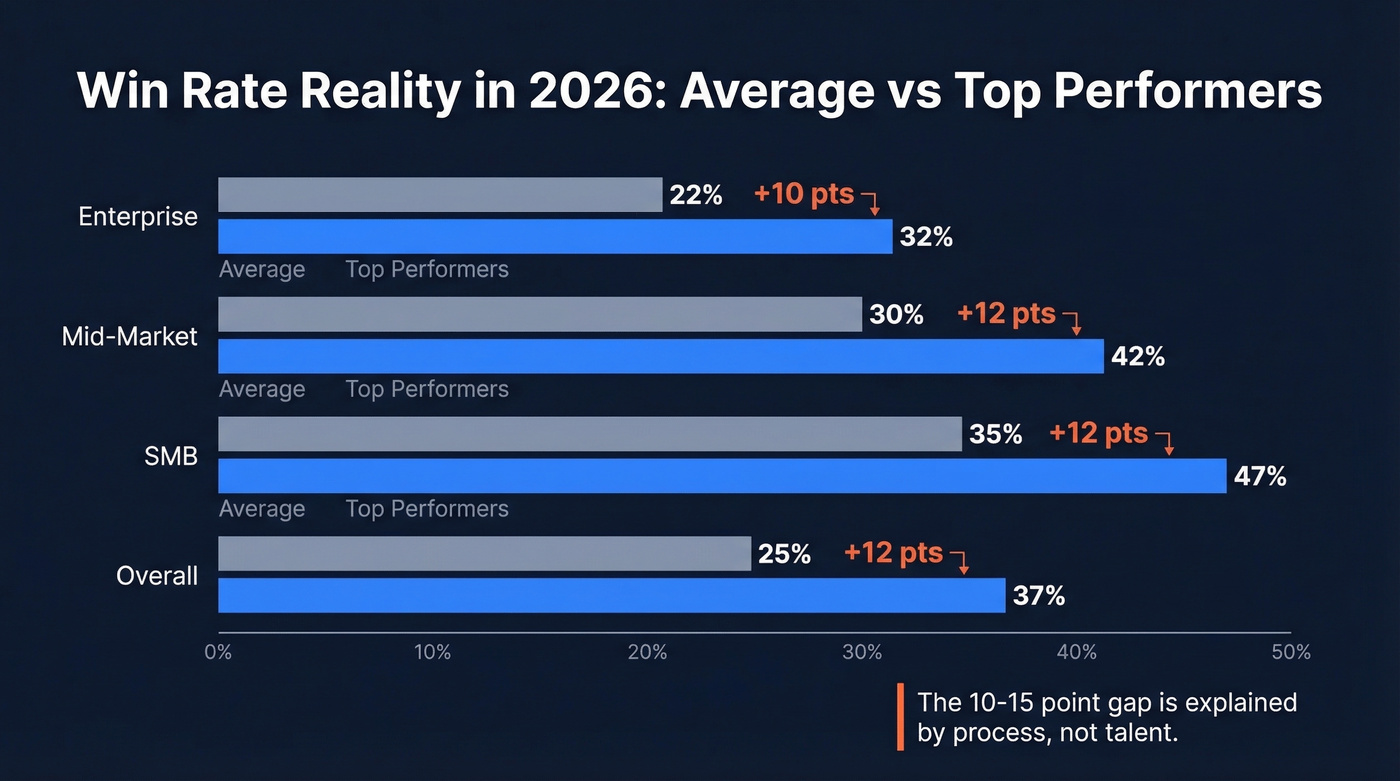
| Segment | Avg Win Rate | Top Performers |
|---|---|---|
| Enterprise | 20-25% | 30%+ |
| Mid-Market | 25-35% | 40%+ |
| SMB | 30-40% | 45%+ |
| Overall | 20-30% | 35%+ |
If you're sitting at 25% and selling mid-market, you're average. The gap between average and top performer is 10-15 points, and that gap is almost entirely explained by process, not talent. The seven strategies below are what separates the two groups.
Why Deals Actually Die
The default assumption is that you're losing to competitors. The data says otherwise. Roughly 40% of B2B pipeline ends in no decision - not a loss to a rival, but a loss to inertia, confusion, or a buying process that stalled out.
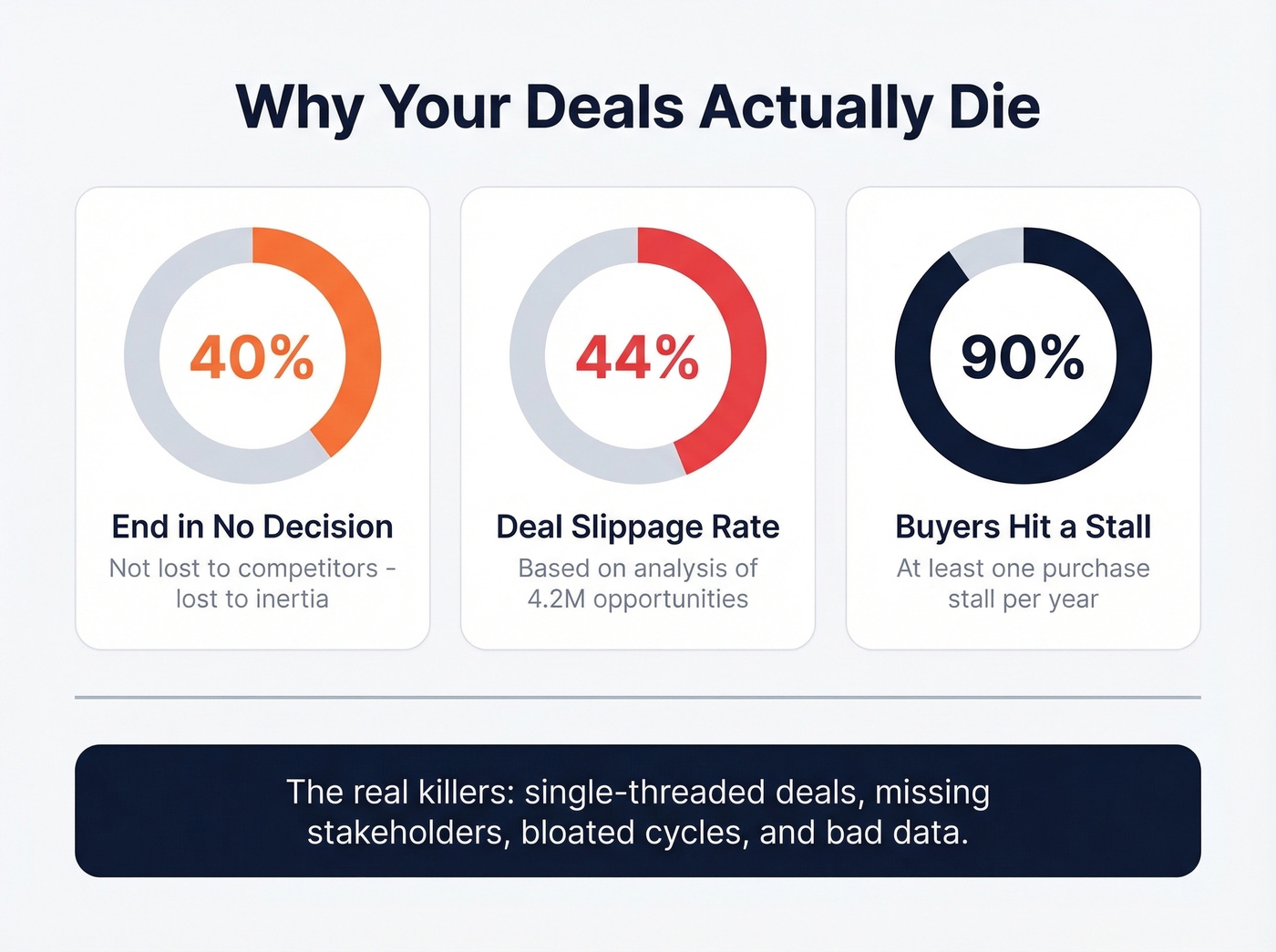
The slippage problem is getting worse. Ebsta's analysis of 4.2M opportunities found 44% deal slippage. Forrester's survey of 18,000+ B2B buyers showed 90% experienced at least one purchase stall during the year.
Every article tells you to "sell value" and "build urgency." That's not the real problem. The real problem is structural: single-threaded deals, missing stakeholders, bloated cycles, and pipelines built on bad data. Let's fix the structure.
Fix Your Pipeline Before Your Close
The fastest way to improve your win rate is to stop working bad deals. Disqualification is the most underrated lever in sales - remove bad-fit opportunities from the denominator, and your win rate jumps overnight.
But disqualification only works if you're reaching the right people in the first place. If your SDR team is sending 500 emails a day and 15% are bouncing, that's not a volume problem. That's a data problem. Bad contact data means your team never enters deals they should be competing for. You're losing before you start.
Speed matters too. The first vendor to respond wins 35-50% of deals. You can't be first if you're chasing wrong numbers and bounced emails. Fixing this upstream bottleneck is how you close more sales without asking reps to work longer hours.
Multi-Thread Every Deal Over $10K
Your best AE just lost a $180K deal. She had 14 meetings over 5 months. The champion went dark in week 12. She was single-threaded into one director who got reorganized.
If you want a repeatable system here, treat this like stakeholder mapping and do it before the deal gets political.
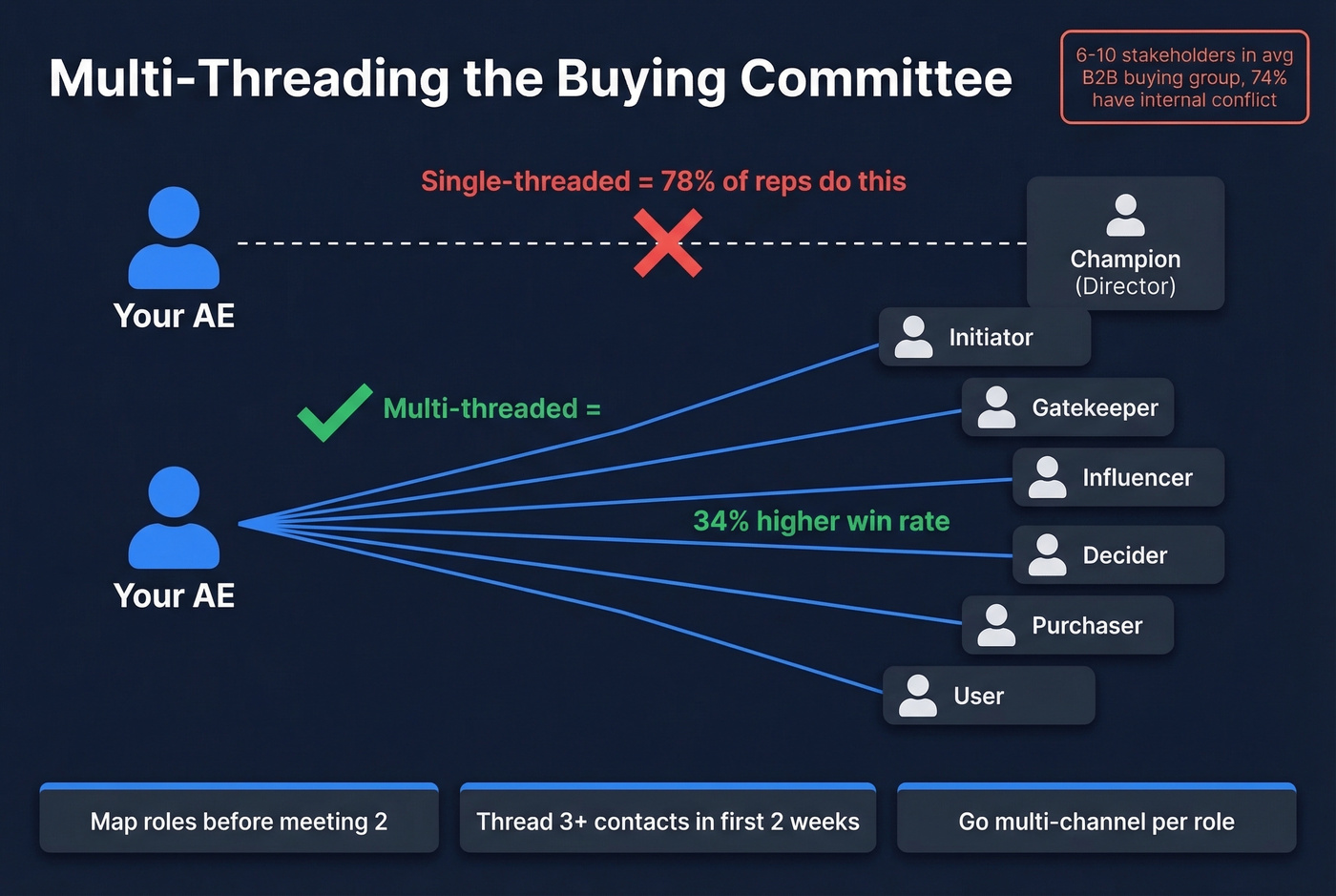
Sound familiar? The consensus on r/sales is that single-threading is the number one deal killer, and the data backs it up: 78% of sales professionals take a single-threaded approach. Only 7% connect to six or more people at the account. Meanwhile, Gartner says the average B2B buying group includes 6-10 stakeholders, each doing 4-5 pieces of independent research before any group discussion happens.
Here's the thing: Gartner's research found 74% of buying groups exhibit unhealthy internal conflict - meaning your champion may be fighting battles you don't even know about. You're talking to one person while nine others form opinions without you. Multi-threading to 3+ contacts delivers a 34% lift in win rates.
The tactical playbook:
- Map the influence hierarchy early. Initiators, Gatekeepers, Influencers, Deciders, Purchasers, Users. Know who's who before your second meeting.
- Start threading before the kickoff call. Don't wait until your champion goes dark. By then it's too late. Connect with at least two additional stakeholders in the first two weeks.
- Go multi-channel. Email the VP. Call the director. Send the technical lead an async video walkthrough. Different roles consume information differently.
- Summarize every call with a TL;DR for the wider committee. Your champion won't relay your message perfectly. Give them a one-paragraph summary they can forward.

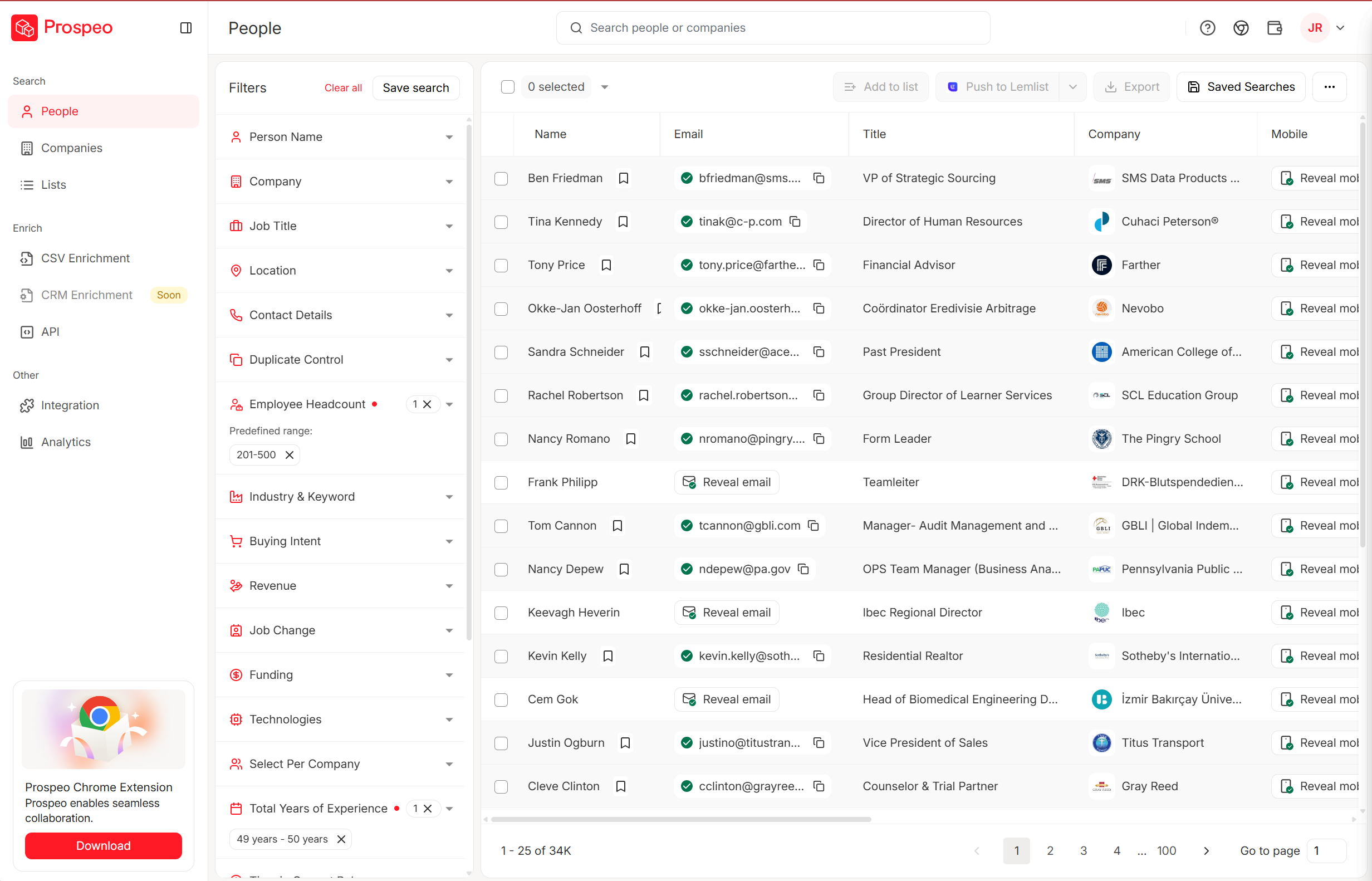
Multi-threading requires verified contact data for every stakeholder in the buying committee. Prospeo gives you 300M+ profiles with 98% email accuracy and 125M+ verified mobiles - so you can reach all 6-10 decision-makers, not just one champion who might go dark.
Stop single-threading because you only have one contact's email.
Use Mutual Action Plans on Every Deal
Deals with a Mutual Action Plan show a 26% higher win rate than deals without one. Teams that use MAPs also see 85% fewer deals slip. Yet only 45% of sellers consistently use them. Another 43% use them sometimes. And 12% never use them at all.
If you're not using a MAP, you're volunteering for deal slippage.
A MAP is a co-created roadmap between buyer and seller - shared milestones, owners on both sides, dates, and deliverables. If only seller names appear in the "owner" column, it's not mutual. It's a project plan the buyer will ignore.
If you want a copy-paste version, start from a Mutual Action Plan template and customize it per account.
A template you can steal:
| Milestone | Date | Owners (Buyer / Seller) | Deliverable | Status |
|---|---|---|---|---|
| Discovery done | [Date] | [Name] / [Name] | Pain map + criteria | ☐ |
| Tech validation | [Date] | [Name] / [Name] | POC results / demo | ☐ |
| Business case OK | [Date] | [Name] / [Name] | ROI model + summary | ☐ |
| Legal / procurement | [Date] | [Name] / [Name] | Redlined contract | ☐ |
| Go-live | [Date] | [Name] / [Name] | Implementation kick | ☐ |
The magic isn't the template - it's the conversation that creates it. When a buyer co-authors the plan, they've psychologically committed to the timeline. They've assigned their own people to milestones. That's a fundamentally different dynamic than chasing a prospect who "needs to think about it."
In our experience, teams that implement MAPs see slippage drop within a single quarter. It's the highest-ROI process change in enterprise sales.
Compress Your Sales Cycle
Opportunities closed within 50 days show a 47% win rate. After 50 days, that drops to 20% or lower. Every week a deal lingers, your odds get worse.
If you’re trying to diagnose where time is leaking, map your sales cycle process stage-by-stage and remove steps that don’t change the buyer’s decision.
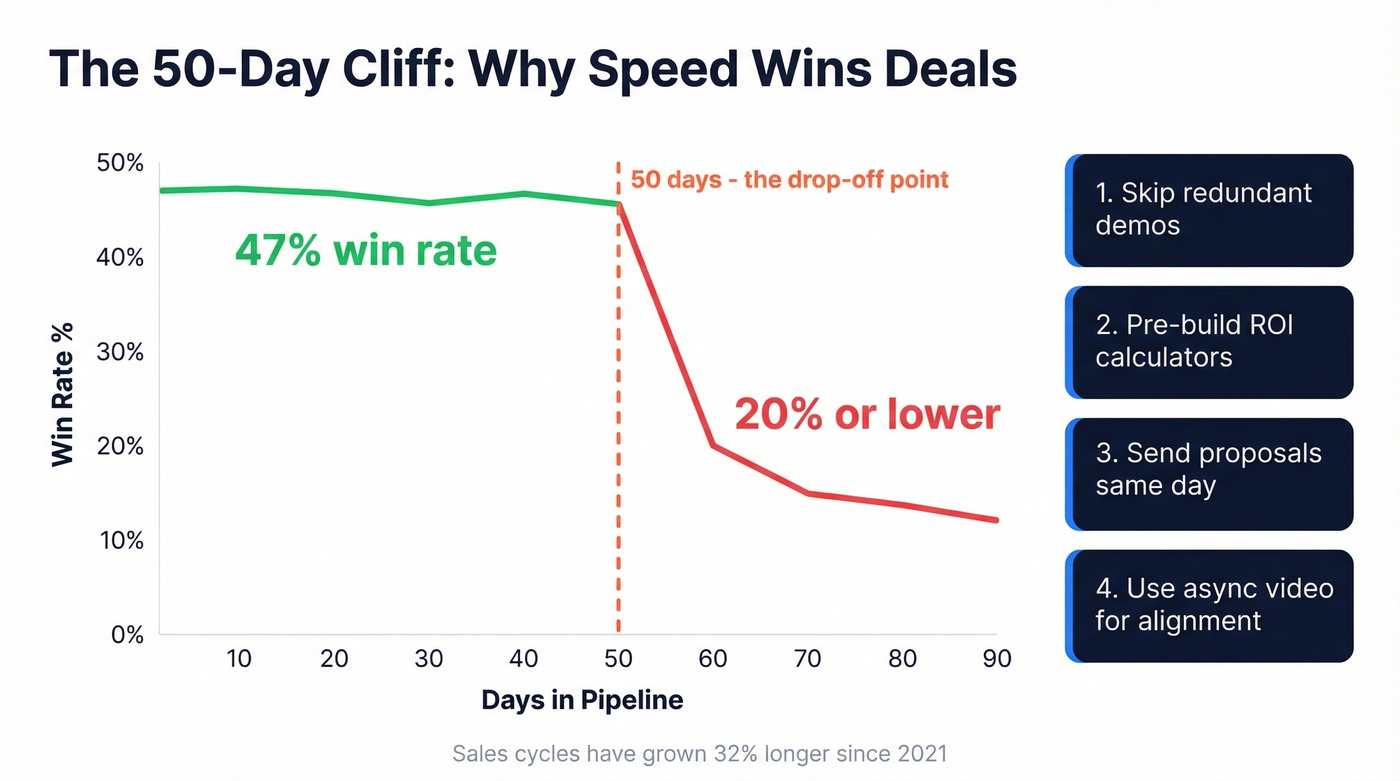
Sales cycles have grown 32% longer since 2021. More stakeholders, more procurement hoops, more "let me loop in my team." You can't control all of that, but you can eliminate the friction you're creating yourself. AI tools can help with pre-call research and personalized outreach, but the biggest gains come from removing unnecessary steps entirely.
Four moves that compress cycles:
- Eliminate unnecessary demo stages. If your prospect saw a product tour on your website, don't repeat it live. Jump to their specific use case. (If you need tighter structure, use a proven sales demo framework.)
- Pre-build ROI calculators. Don't make the buyer build the business case from scratch. Hand them a model with their numbers pre-filled.
- Send proposals same-day. The gap between "verbal yes" and "signed contract" is where deals go to die. Close it fast. (Use a repeatable sales proposal process.)
- Use async video for stakeholder alignment. Record a 3-minute Loom for the CFO who can't make the meeting. Don't let scheduling kill momentum.
Kill the No-Decision Monster
That 40% no-decision stat deserves its own section. No-decision isn't a loss to a competitor - it's a loss to your own process. As Howard Brown put it: "Every minute you spend on a no-decision deal is a minute less you could be spending on a deal that would actually close."
If you’re seeing lots of “stuck” deals, it’s usually a qualification + process issue - use an alternative close to force a real decision instead of endless “check-ins.”
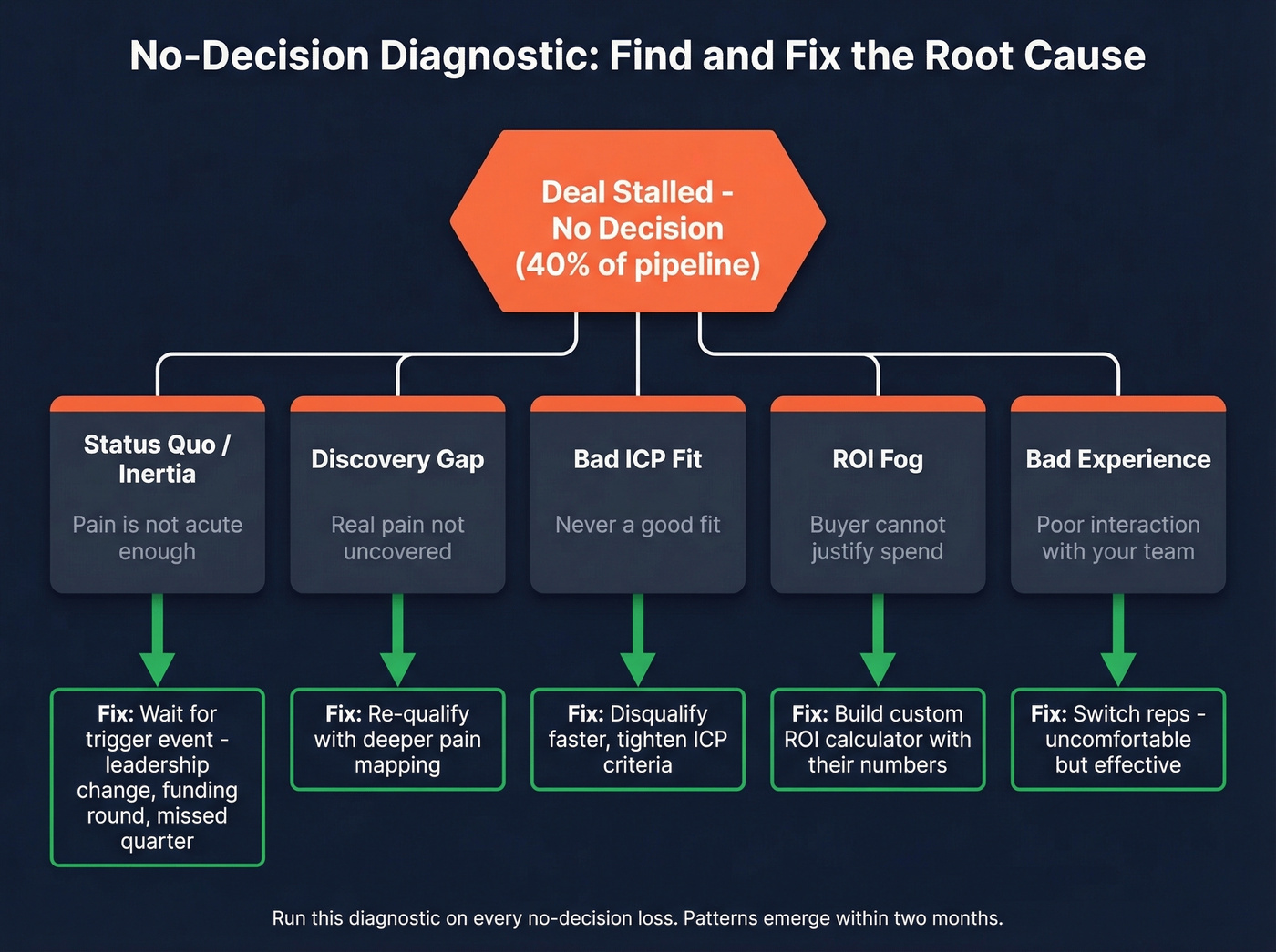
The five root causes and what to do about each:
- Status quo / inertia - The pain isn't acute enough. Re-approach when a trigger event hits: leadership change, funding round, missed quarter.
- Discovery gap - You didn't uncover the real pain. Go back and re-qualify with deeper pain mapping. If you can't articulate their problem better than they can, you haven't done enough discovery.
- Un-ideal ICP - They were never a good fit. Disqualify faster next time. This is a pipeline quality problem, not a closing problem.
- ROI fog - The buyer can't justify the spend internally. Build a custom ROI calculator with their actual numbers.
- Bad experience drift - The buyer had a poor experience with your team. Sometimes the fix is switching reps. Uncomfortable but effective.
Teams treat no-decision as an inevitable part of sales instead of diagnosing the specific failure. Run the diagnostic. Fix the root cause. Stop losing to yourself.
Run Post-Mortems That Fix Things
Your CRM's closed-lost reasons are lying to you. Reps pick "price" because it's the fastest click. The real reasons - inadequate discovery, poor demo execution, single-threading, missing competitive intel - never make it into the dropdown.
A proper root-cause analysis requires a monthly cadence led by sales leadership or RevOps, structured around three questions: What did we miss in discovery? Where did we lose access to the buying committee? What did the competitor do that we didn't? Apply those three to every significant closed-lost deal. The answers will cluster into patterns within two months, and those patterns become your coaching priorities.
If you want a formal structure for this, run a lightweight win-loss analysis and feed the insights back into enablement.
One stat that should haunt every sales manager: 80% of sales require 5-12 follow-ups, but 44% of reps give up after one. Post-mortems catch this. Dashboards don't.
Common Mistakes That Kill Win Rates
- Weak qualification. Pursuing deals outside your ICP because the pipeline looks thin. This is how you end up with a 15% win rate and exhausted reps. (If you need a scoring model, use a BANT score.)
- Feature-dumping. Listing capabilities instead of painting the future state. Nobody buys features. They buy outcomes. (This is where sales psychology tactics help.)
- No objection plan. When "we're happy with our current vendor" comes up, your reps shouldn't be winging it. Build battlecards and talk tracks for the top five objections.
- Over-discounting. Cutting price to "save" a deal that was never properly qualified. You didn't save it - you bought it at a loss.
- Ignoring competitive intel. If your reps can't articulate why you win against your top two competitors in 30 seconds, you have a training gap. Only 16% of reps hit annual quota recently - down from 53% a decade ago. These mistakes are a big part of why. (Build a simple competitive intelligence research loop.)
Skip the complex playbook if your ACV is under $10K. You probably don't need multi-threading or MAPs at that deal size. You need a faster process. Nail the upstream pipeline, shorten the cycle to under two weeks, and let volume do the work.
Start With These 3 Changes
If you're overwhelmed, start here. These three moves alone can increase your close rate by 10+ points:
- Adopt MAPs on every meaningful deal. 26% win-rate lift. 85% fewer slipped deals. Non-negotiable.
- Multi-thread to 3+ contacts in every deal. 34% lift. Stop betting your quarter on one champion.
- Clean your contact data. Bad data is the silent killer. If your bounce rate is above 5%, fix this before anything else. Prospeo's free tier gives you 75 verified emails to prove the point. (If you’re evaluating options, start with an email verifier app.)
Everything else in this article is optimization. These three are the foundation. Get them right and you'll consistently win more deals quarter after quarter.
Bad data kills deals before they start - 15% bounce rates mean your reps never reach buyers who'd say yes. Prospeo's 7-day data refresh and 5-step verification keep bounce rates under 4%, just like the teams that tripled their pipeline from $100K to $300K/week.
Win more deals by reaching the right people on the first attempt.
FAQ
What's a good win rate in B2B sales?
SMB teams typically land at 30-40%, mid-market at 25-35%, and enterprise at 20-25%. Top performers across all segments hit 35-45%+. The 2026 industry average sits around 21-25%, a significant compression from prior years.
Why do most B2B deals end in no decision?
About 40% of pipeline ends in no decision - not a competitive loss, but a process failure. Root causes are status quo bias, weak discovery, poor ICP fit, unclear ROI, or a bad buying experience. Diagnosing which cause killed each deal is the first step to fixing it.
What's a Mutual Action Plan?
It's a co-created roadmap between buyer and seller with shared milestones, owners on both sides, dates, and deliverables. Deals with MAPs show a 26% higher win rate and 85% fewer slipped deals. Only 45% of sellers use them consistently - there's massive upside for teams that adopt them.
How does data quality affect win rates?
Bad contact data means bounced emails, wrong numbers, and wasted outreach - your team never enters deals they should be competing for. Accurate, fresh data keeps pipeline healthy so reps spend time selling, not chasing dead leads.
How many stakeholders should I engage per deal?
Average B2B buying groups include 6-10 stakeholders. Multi-threading to 3+ contacts lifts win rates by 34%. Only 7% of reps currently reach 6+ contacts - the upside for most teams is enormous.