

How to Write a Follow-Up Email That Actually Gets a Reply
You sent the email. It was good. And now you're staring at an inbox that refuses to update.
That silence isn't a "no." A study of 16.5 million cold emails found that small businesses actually match first-email reply rates on the second follow-up, and 90% of buyers respond within two days of their most recent message. Knowing how to write a follow-up email isn't desperate - it's expected. The problem is most follow-ups are terrible. "Just checking in" emails that add nothing, sent at the wrong time, to addresses that bounce. Let's fix that.
What the Data Says About Follow-Ups
The "send 5+ follow-ups" advice is a great way to torch your cold-email deliverability. A Belkins analysis of 16.5 million cold emails across 93 business domains tells a different story.
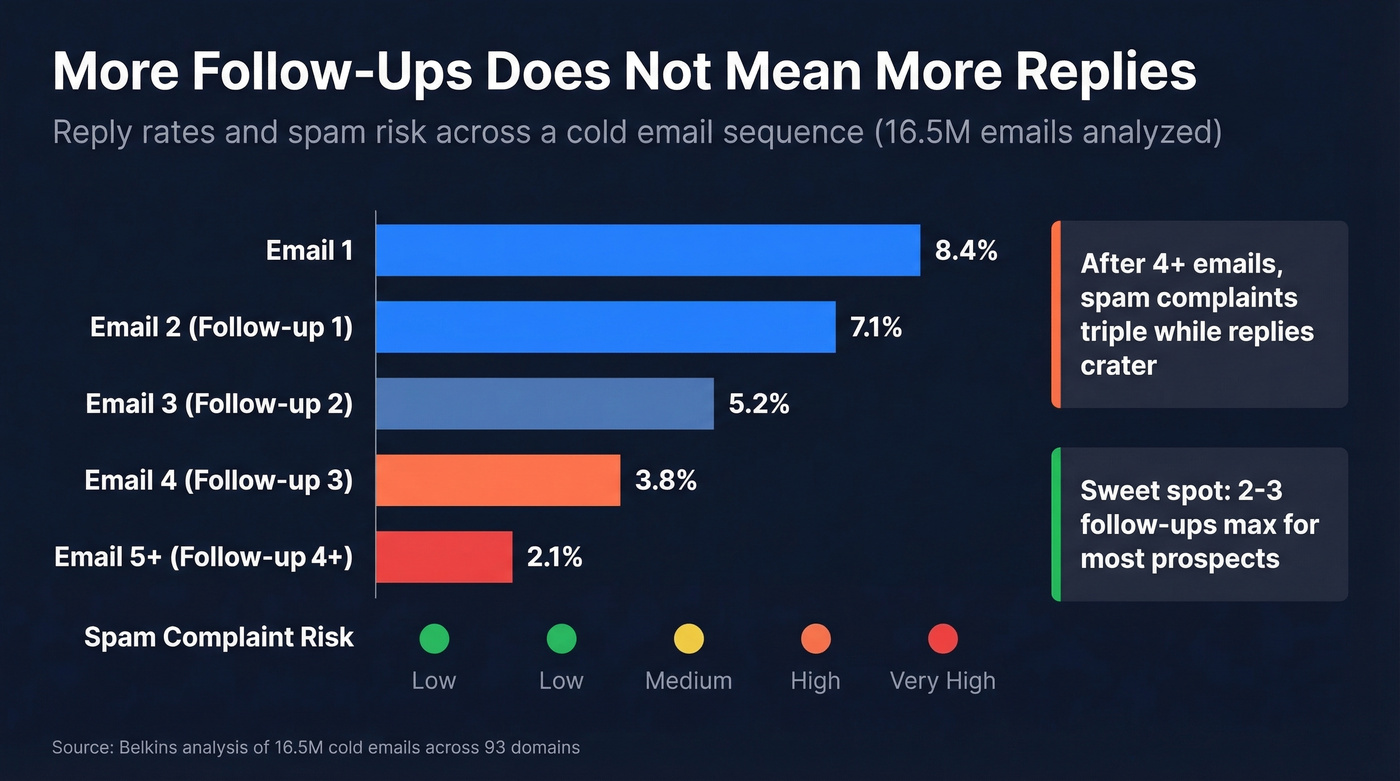
The highest reply rate - 8.4% - came from the first email alone. Every subsequent message saw diminishing returns. Once you hit four or more emails in a sequence, unsubscribe and spam complaint rates more than tripled. That extra message isn't just ineffective; it can actively burn your sender reputation.
Company size matters here. Small businesses (2-50 employees) are more forgiving - reply rates bounce back to 8.4% on the second follow-up. Enterprise contacts (1,000+ employees) drop off faster, and persistence performs worse than it does with SMBs. Two follow-ups might be your ceiling when selling into large organizations (or in enterprise B2B sales).
Founders are an exception. Reply rates actually climb slightly through the second follow-up (6.94%) before cratering at the fourth (3.01%). If you're reaching founders, you've got a slightly longer runway.
Here's the thing: email isn't the only channel worth testing. The same dataset showed that a message paired with a profile visit on professional networks pulled an 11.87% reply rate - higher than any email-only sequence. If your follow-up strategy is email-only, you're leaving responses on the table (see personalized outreach).
The contrarian take: "Send 5+ follow-ups" is advice from 2019. In 2026, with inbox providers aggressively filtering cold email, more follow-ups means more spam complaints, which means worse deliverability on every future campaign. Two to three follow-ups, each earning its place, beats a seven-touch sequence that gets you blacklisted.
When to Send Your Follow-Up
Timing depends on the scenario:
| Scenario | Timing | Why |
|---|---|---|
| After a sales call | Within 2 hours | Momentum fades fast |
| After a demo | Within 24 hours | Before they forget details |
| Cold outreach, no reply | 3-5 business days | Enough gap to not annoy |
| After sending a proposal | 2-3 days | They've had time to review |
| After a job interview | Within 24 hours | Shows professionalism |
| After a networking event | 1-2 weeks | Avoids seeming transactional |
| Breakup email | After 7-10 touchpoints over 2-3 weeks | Clean closeout |
One cold email practitioner improved open rates by roughly 16% by sending Tuesday through Thursday, between 8-11 AM in the recipient's timezone (more benchmarks in best time to send cold emails).
When NOT to Follow Up
Stop emailing after a clear "no." Don't follow up before a stated deadline passes - "We'll decide by March 15" means wait until March 16. Skip holiday weeks and company-wide shutdown periods. Your email will get buried, and the send looks tone-deaf. If you've sent three follow-ups with zero engagement, take the hint.
Crafting a Follow-Up Email Step by Step
Every follow-up needs to earn its existence. This is less about talent and more about structure.
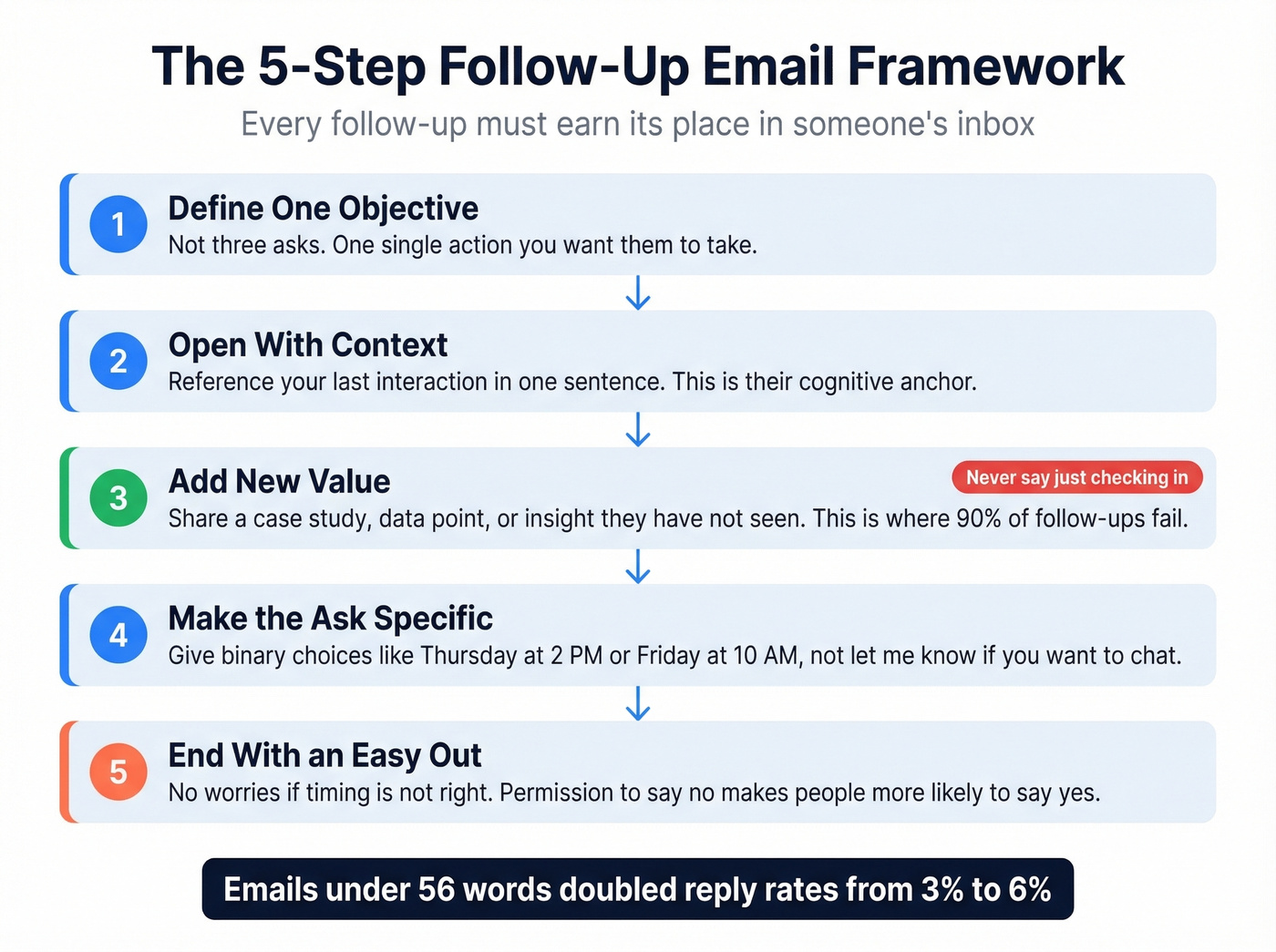
Step 1: Define your one objective. Not three. Not "reconnect and also share this case study and also ask for a meeting." One ask per email. If you can't articulate the single thing you want the reader to do, you're not ready to send.
Step 2: Open with context. Reference the previous interaction in one sentence. "I sent over the proposal last Tuesday" or "We spoke at the Denver conference last week." This is the cognitive anchor that tells the reader why your email matters.
Step 3: Add new value. This is where 90% of follow-ups fail. "Just bumping this to the top of your inbox" adds zero value. Share a relevant case study, a data point they haven't seen, or a specific insight about their business. Each follow-up should address a different reason for silence: the first tackles "I forgot," the second tackles "I'm not sure this is worth my time," and the third tackles "I don't trust you yet." GMass breaks this objection framework down well. (If you want more examples, see emails that get responses.)
Step 4: Make the ask specific. "Would Thursday at 2 PM or Friday at 10 AM work for a 15-minute call?" beats "Let me know if you'd like to chat sometime." Binary choices get faster responses than open-ended invitations (more on email call to action).
Step 5: End with an easy out. "No worries if the timing isn't right" or "Totally understand if this isn't a priority." Counterintuitively, giving people permission to say no makes them more likely to say yes. It removes the pressure that makes people avoid replying altogether.
One more thing worth knowing: one practitioner doubled their reply rate (from 3% to 6%) after cutting emails from 141 words to under 56. Brevity isn't just polite - it performs.

The best follow-up email in the world bounces if it hits a dead address. 35% bounce rates kill sender reputation and bury every future campaign. Prospeo's 5-step verification delivers 98% email accuracy - so your carefully crafted follow-ups actually land in real inboxes.
Stop perfecting emails that bounce. Start with verified contacts.
Subject Lines That Get Opened
Your follow-up is worthless if it never gets opened.
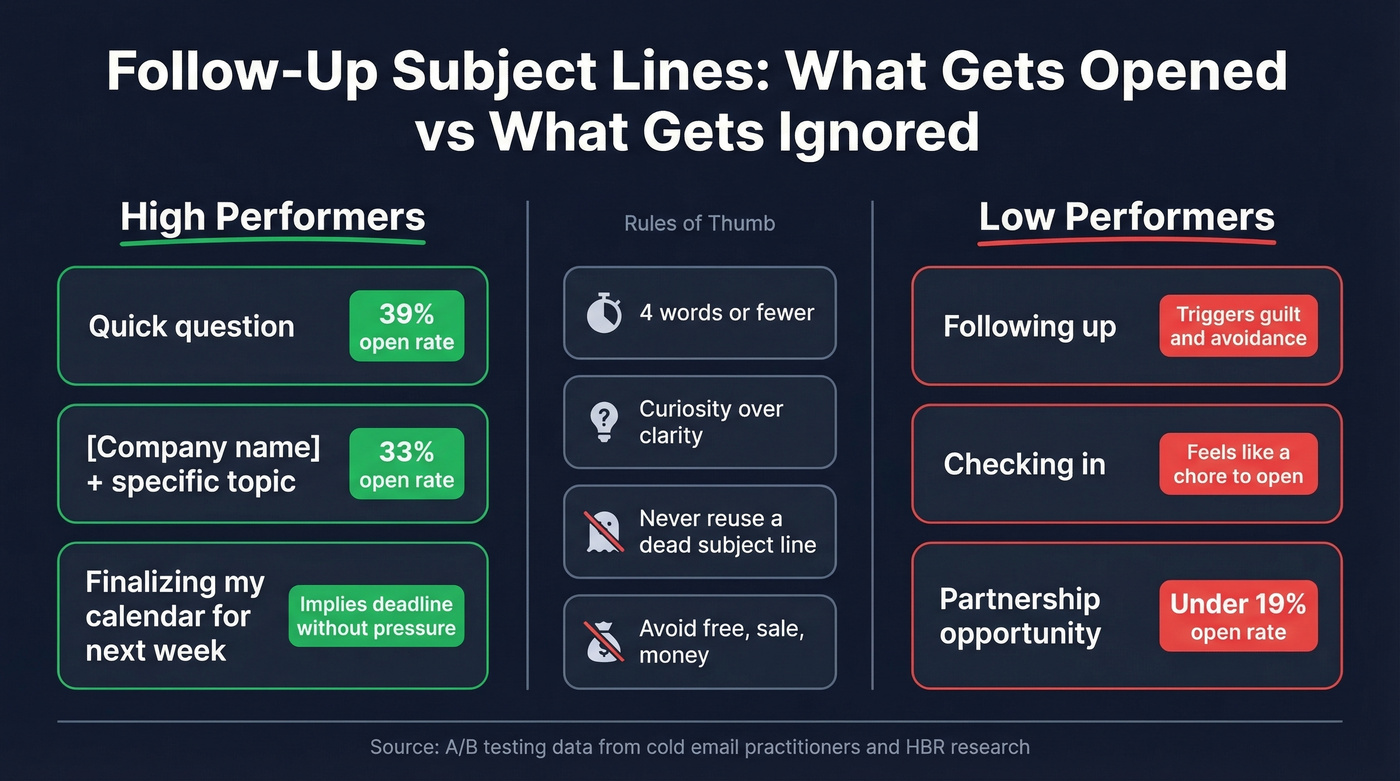
From that same practitioner's testing: "Quick question" pulled 39% open rates. Subject lines containing the company name hit 33%. "Partnership opportunity" dropped below 19%. Short, specific, and curiosity-driven wins (more ideas in email subject line examples).
HBR has warned against vague subject lines like "Following up" and "Checking in." These make recipients feel guilty, which doesn't motivate a reply - it motivates avoidance. Nobody opens an email that feels like a chore.
Keep subject lines 4 words or less. Avoid spam trigger words like "free," "sale," or "money." And a gem from r/sales that works surprisingly well for warm follow-ups: "Finalizing my calendar for next week" - it implies a deadline without being pushy and gives the recipient a concrete reason to respond now.
If your first subject line didn't get opened, don't use it again on the follow-up. Test something new (or use a subject line tester).
Templates for Every Scenario
Each template below is under 60 words. Swap the details but keep the structure tight. (For more options, see sales follow-up templates and cold email follow-up templates.)
After a Sales Call or Demo
Subject line: Quick recap from today
Use within 24 hours. Addresses the "I forgot the details" objection.
Hi [Name], great speaking today. Quick recap: you mentioned [specific pain point] is the priority for Q3. I've attached the one-pager on how we handle that for [similar company]. Does Thursday work to loop in [stakeholder] and map next steps?
Cold Outreach, No Response
Subject line: [Relevant result] at [their competitor]
Use 3-5 days after initial email. Addresses "I'm not sure this is worth my time."
Hi [Name], I reached out last week about [topic]. Since then, [Company] published [relevant result/case study] that's directly relevant to [their challenge]. Worth a 10-minute look? Happy to walk through it Tuesday or Wednesday.
After Sending a Proposal
Subject line: One thing in the proposal
Instead of a generic "checking in," flag the single most compelling section. This gives the recipient a reason to reopen the document and a specific talking point to respond to. Use 2-3 days after sending:
Hi [Name], wanted to flag one thing in the proposal - the [specific section] is where most teams like yours see the fastest ROI. Any questions on that piece specifically? I can jump on a quick call to walk through the numbers.
After a Job Interview
Subject line: Thanks - excited about [specific project]
Use within 24 hours. Reinforces fit and enthusiasm.
Hi [Name], thanks again for the conversation today. The [specific project/challenge] you described is exactly the kind of work I've spent the last [X years] doing at [Company]. Looking forward to next steps - happy to provide anything else that's helpful.
After a Networking Event
Subject line: [Specific topic] from [event]
Use 1-2 weeks later. References a specific moment to stand out.
Hi [Name], we talked at [event] about [specific topic]. I've been thinking about your point on [detail] - here's a [resource/article] that builds on that. Would love to continue the conversation over coffee sometime.
The Breakup Email
This is the one template where showing what not to do is just as useful.
Bad breakup: "Hi [Name], just following up again. I've emailed several times and haven't heard back. Please let me know if you're interested."
Good breakup: "Hi [Name], I've reached out a few times and haven't heard back - totally understand if the timing isn't right. I'm going to close out your file for now, but if [pain point] becomes a priority, I'm here. Wishing you a great Q4."
Subject line: Closing your file
The difference: the good version gives a concrete reason to respond now (the file is closing) while removing all guilt. The bad version just piles on pressure.
Five Mistakes That Kill Reply Rates
1. Bumping without new information. Every follow-up needs a new data point, case study, or angle - not "just circling back."
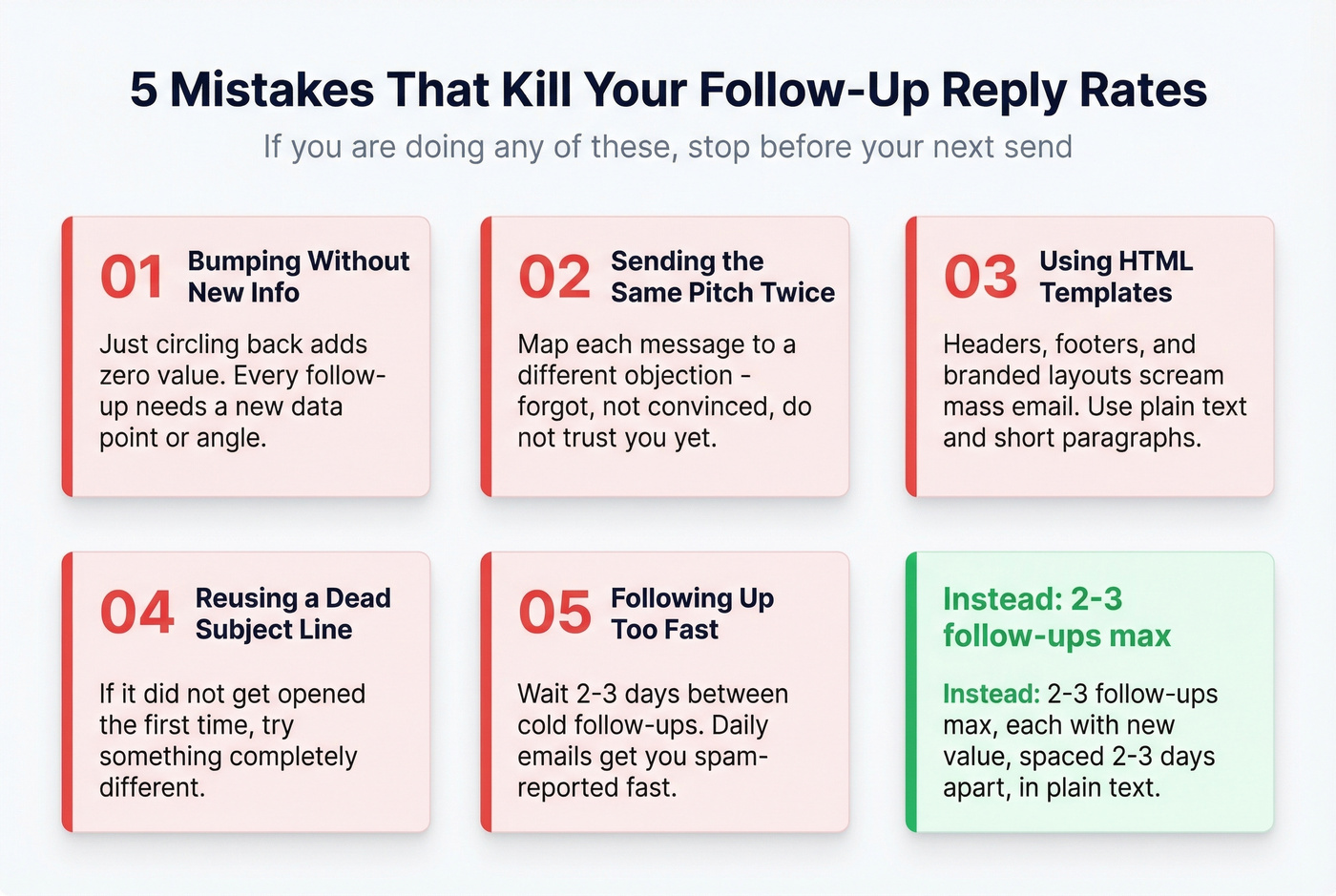
2. Sending the same pitch twice. Map each message to a different objection: forgot, not convinced, don't trust you yet.
3. Using HTML templates. Headers, footers, and branded layouts scream "mass email." Plain text, short paragraphs, reply-thread formatting.
4. Reusing a dead subject line. If it didn't get opened the first time, it won't work on attempt two.
5. Following up too fast. Two to three days between cold follow-ups. Daily emails are the fastest way to get spam-reported.
The Technical Side Most Guides Skip
Look, copy doesn't matter if deliverability is broken. We've seen teams pour hours into crafting the perfect follow-up sequence only to discover 20% of their emails were bouncing. Run through this checklist before your next campaign:
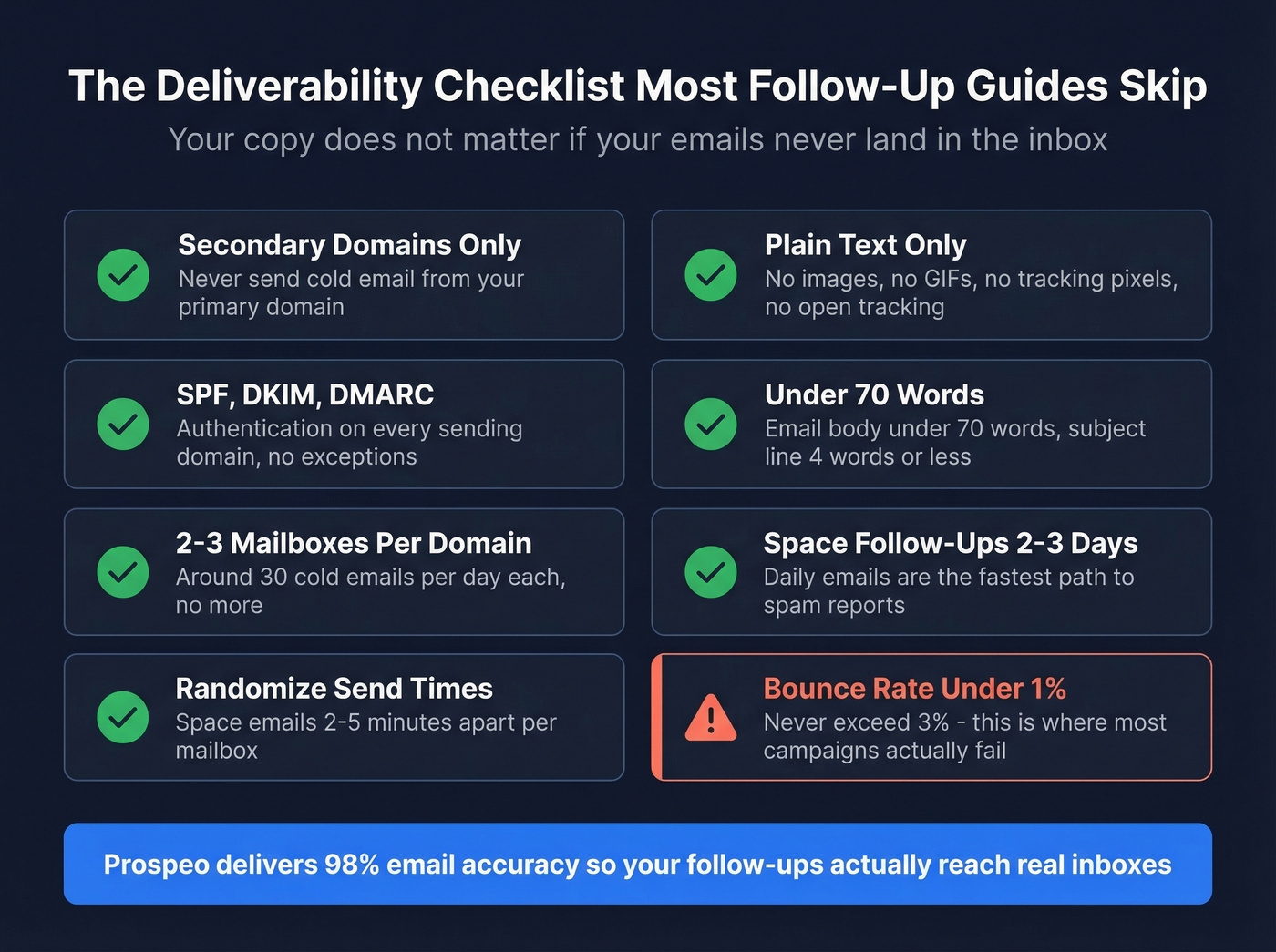
- Secondary domains for cold outreach. Never send cold email from your primary domain.
- SPF, DKIM, and DMARC on every sending domain. Non-negotiable authentication (see email deliverability guide).
- 2-3 mailboxes per domain, ~30 cold emails per day each. Exceeding this tanks reputation (more on email velocity).
- Plain text only. No images, no GIFs, no links in cold emails. Disable open/click tracking - tracking pixels hurt deliverability. Belkins stopped tracking open rates entirely because of this (details in email tracking pixels).
- Randomize send times. Space emails 2-5 minutes apart per mailbox to avoid pattern detection.
- Under 70 words per email body, 4 words or less per subject line.
- Space follow-ups 2-3 days apart.
- Bounce rate under 1%. Never exceed 3% (see email bounce rate).
That last point is where most campaigns actually fail. Your SDR sent 200 follow-ups last week. 47 bounced. 12 landed in spam. 3 got replies. The problem wasn't the copy - it was the data.

Bad emails bounce. Bounces tank your sender reputation. And once your domain reputation drops, every follow-up you send - no matter how well-written - lands in spam. In our experience, verification is the single highest-ROI step you can take before launching any follow-up sequence. Prospeo's 5-step verification process catches spam traps and honeypots on a 7-day refresh cycle, delivering 98% email accuracy. The free tier covers 75 email verifications per month - enough to clean a small campaign before it goes out.
You just learned that two follow-ups outperform seven - but only if each one reaches the right person. Prospeo gives you 300M+ verified professional emails refreshed every 7 days, so you're never following up on stale data that damages your domain.
Fresh data means every follow-up counts. Emails start at $0.01.
FAQ
How many follow-ups should I send?
Two to three for cold outreach. Four or more emails in a sequence more than triples unsubscribe and spam complaint rates based on Belkins' 16.5M-email study. Each must add new value - if you can't say something new, stop sending.
Should I reply in the same thread or start a new one?
Same thread for warm contacts - it keeps context visible and reduces friction. For cold outreach, start a new thread if the original subject line underperformed. A fresh subject gives you a second chance at an open.
How long should a follow-up email be?
Under 60 words. One practitioner doubled reply rate by cutting from 141 words to under 56. Shorter emails signal confidence and respect the recipient's time, which drives faster responses.
How do I follow up without sounding pushy?
Lead with new value instead of a reminder. Reference a specific detail from your last conversation, share a relevant resource, and close with a low-pressure out like "No worries if the timing isn't right." Give the recipient a reason to reply, not guilt.
How do I make sure my follow-ups don't bounce?
Verify every email address before sending. A bounce rate above 3% damages your sender domain, pushing future messages to spam. Tools like Prospeo catch invalid addresses, spam traps, and honeypots before they do damage - the free tier covers 75 verifications per month.