

How to Build an Ideal Customer Persona That Doesn't Collect Dust
You've seen the persona doc. Stock photo of "Marketing Mary," a made-up age, a made-up salary, and a quote nobody actually said. It lives in a Google Drive folder no one's opened since Q2. Meanwhile, your reps are still guessing who to call.
The problem isn't that the ideal customer persona doesn't work - it's that most teams build fairytale personas disconnected from real revenue data. Only 44% of B2B marketers even use buyer personas. The other 56% are winging it or sitting on a dusty PDF that changes nothing. This guide covers how to build personas from real data, a negative persona framework most teams skip, and a copy-paste AI prompt you can use today.
What Is an Ideal Customer Persona?
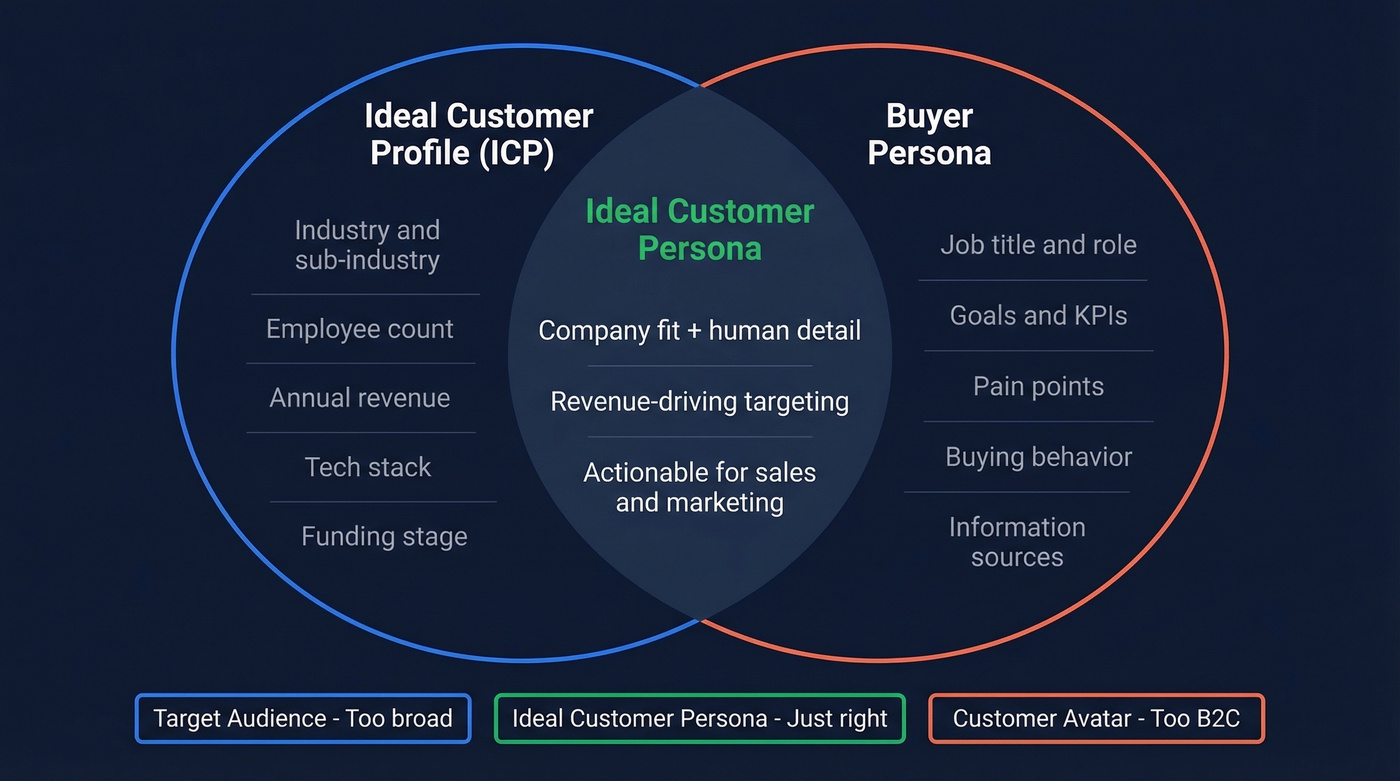
An ideal customer persona is a semi-fictional profile of the person most likely to buy your product, built from real data and informed assumptions. It bridges two concepts that often get confused.
An ICP - ideal customer profile - describes your best-fit company: industry, headcount, revenue, tech stack. A buyer persona describes the individual within that company: their role, goals, pain points, and buying behavior. The ideal customer persona sits at the intersection, combining company-level fit with individual-level psychology. It's not the same as a target audience (too broad) or a customer avatar (tends to be B2C and demographic-heavy). In B2B, you need both the company filter and the human detail.
If you need a starting point for the company side, use an ideal customer profile template and scoring rubric.
Why Personas Matter (With Numbers)
82% of companies using buyer personas report improving their value proposition - which directly affects win rates. [Personalized CTAs convert 202% better](https://blog.hubspot.com/marketing/personalized-calls-to-action-convert-better-data?hubs_content=blog.hubspot.com/marketing/call-to-action-examples&hubs_content-cta=personalized-ctas-perform-202-better) than generic ones, and you can't personalize without knowing who you're personalizing for.
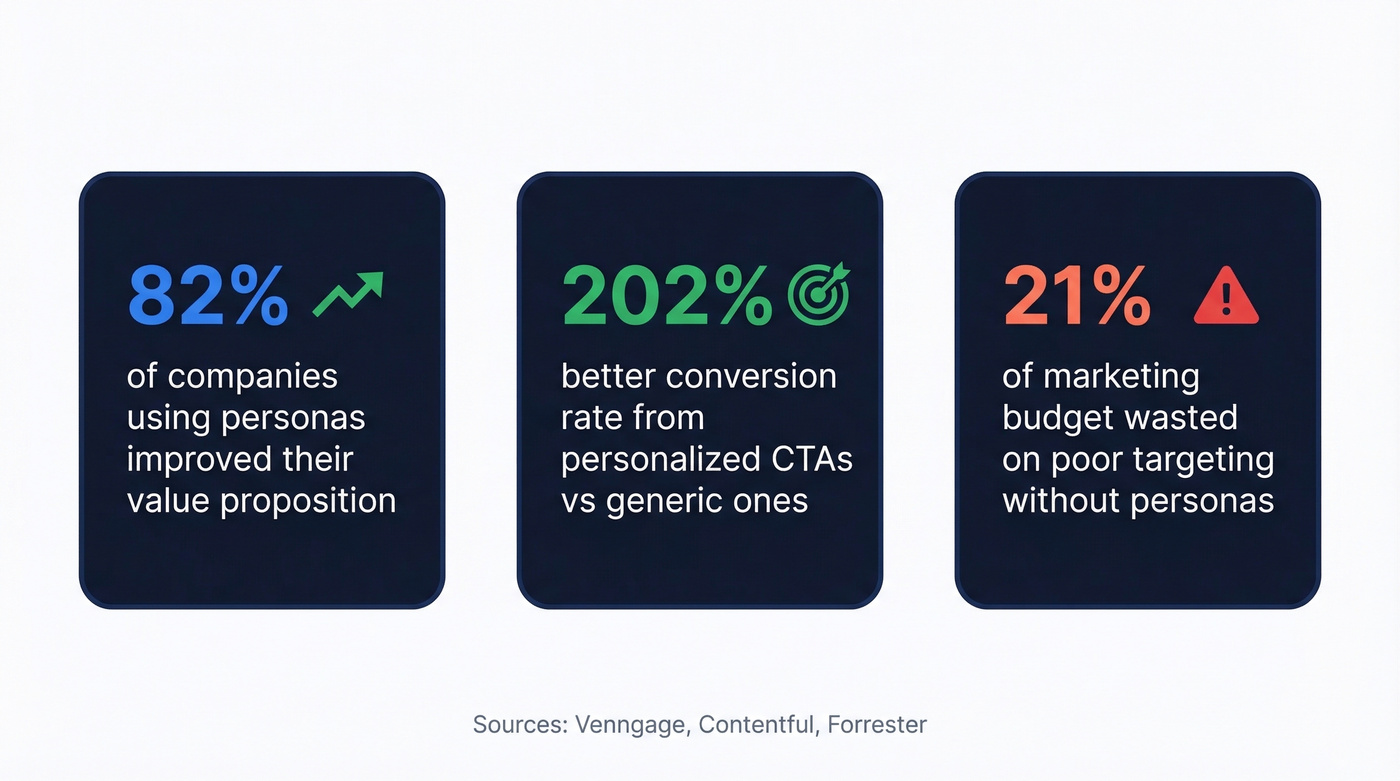
On the flip side, Forrester estimates marketers waste roughly [21% of their budget](https://www.digitalcommerce360.com/2019/09/06/marketers-waste-21-of-their-marketing-budgets-because-of-bad-data/) on poor targeting. That's real money going to leads who were never going to buy. Building a well-researched persona isn't a branding exercise. It's a revenue lever.
If you're trying to quantify the downstream impact, track it like a funnel problem (not a vibes problem) using funnel metrics and persona-level segmentation.
Types of Customer Personas
Most teams end up with a handful of core personas, then refine from there. A useful heuristic is the 20% assessment: if a persona represents far less than ~20% of your audience segments, you'll end up with too many; if it represents far more than ~20%, it's probably too broad to be actionable.
| Persona Type | Definition | When to Use |
|---|---|---|
| Buyer Persona | Decision-maker who signs off | Sales messaging, proposals |
| User Persona | Day-to-day product user | Product design, onboarding |
| Customer Persona | Post-sale account profile | Retention, upsell plays |
| Proto Persona | Assumption-based first draft | Early-stage, pre-data |
| Audience Persona | Content consumer profile | Blog, social, SEO strategy |
| Marketing Persona | Campaign targeting profile | Ad targeting, email segments |
| Negative Persona | Who NOT to target | Lead scoring, disqualification |
The negative persona is the most underrated type on this list - we'll cover it in detail below.
What to Include in Your Persona
Here's where most personas fall apart. They capture demographics and stop. B2B personas need to go much deeper. A practitioner framework from r/ProductMarketing lays out the full field set - some teams prefer a visual canvas format that maps these fields spatially, but the categories matter more than the layout.
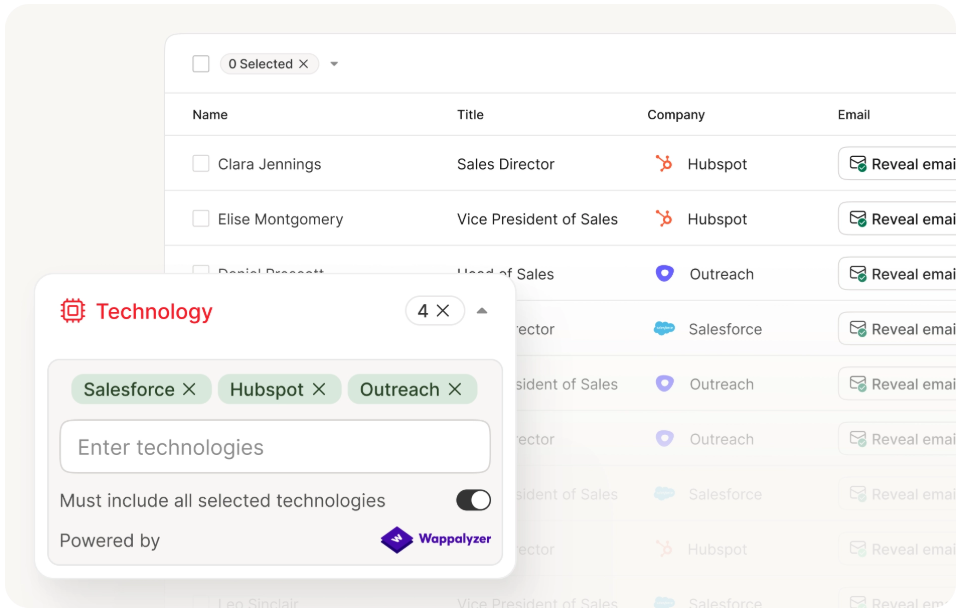
Firmographics. Industry and sub-industry, employee count, annual revenue, location, funding stage, and budget range. This is your company-level filter. (If you want to turn this into something operational, start with firmographic filters.)
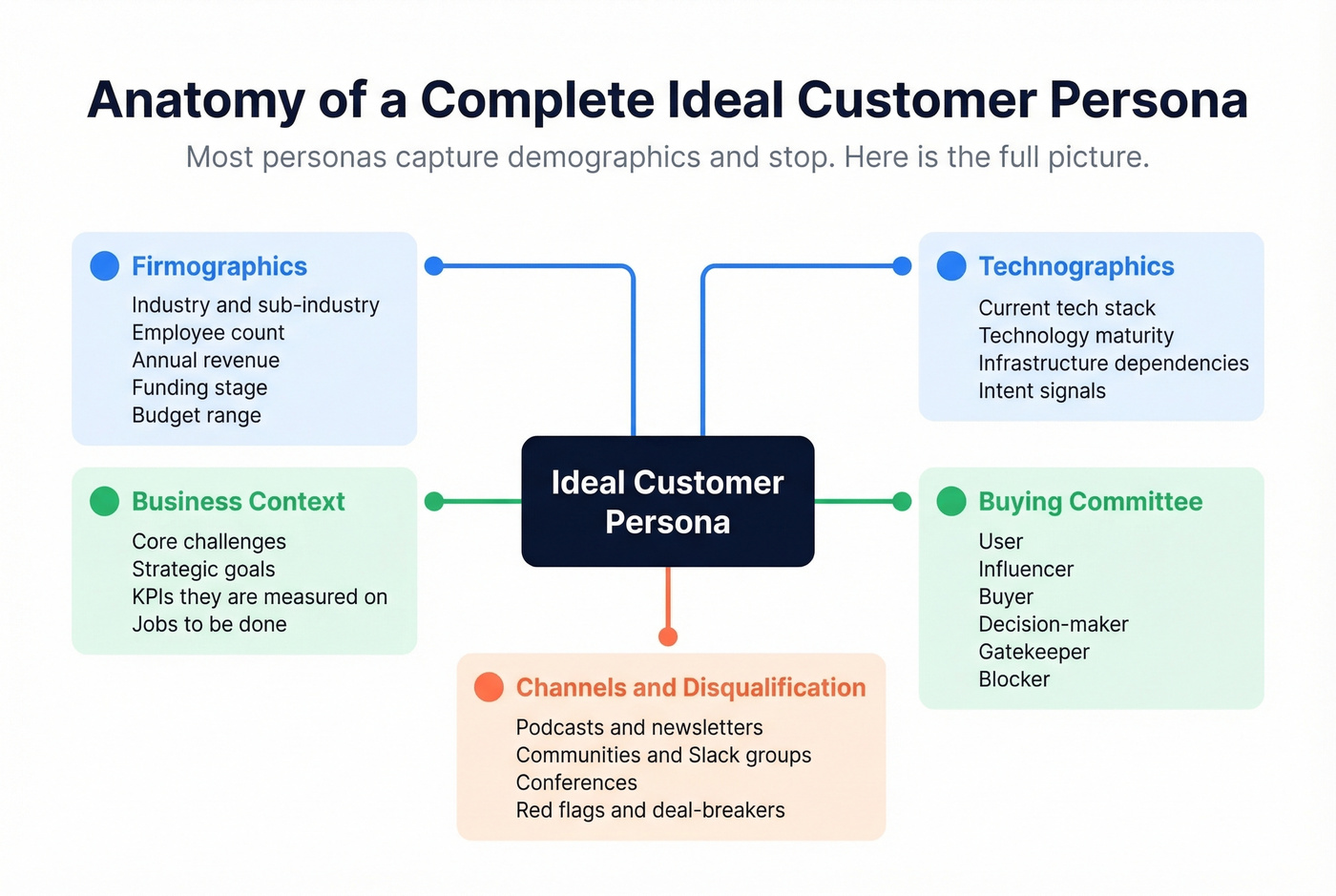
Technographics. Current tech stack, technology maturity, and infrastructure dependencies. A prospect running Salesforce Enterprise has different needs than one on a spreadsheet. B2B data platforms track technographic signals and intent topics - Prospeo covers 15,000 intent topics via Bombora - which can inform both your persona fields and your outreach timing. (More on combining these data types: firmographic and technographic data.)
Business context. Core challenges, strategic goals, KPIs they're measured on, and jobs-to-be-done. This is what makes your messaging resonate instead of getting ignored.
Buying committee roles. Map out the user, influencer, buyer, decision-maker, gatekeeper, and blocker. In B2B, you're rarely selling to one person. Each role needs different messaging, and missing the gatekeeper or blocker can kill a deal you thought was closed. If you want a qualification framework that forces this mapping, use MEDDIC sales qualification.
Channels and disqualification criteria. Where do they spend time - podcasts, newsletters, Reddit communities, conferences, Slack groups? And just as important: what makes someone a waste of time? Including disqualification criteria is what separates a useful persona from a wish list. This is also where lead scoring becomes a persona enforcement mechanism instead of a random point system.

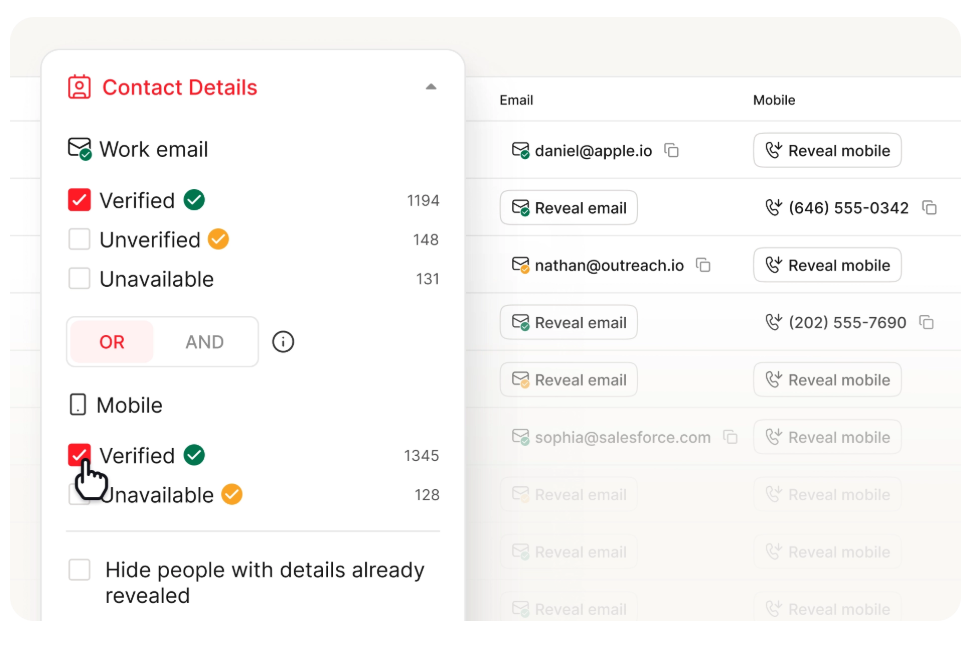
Your persona doc says "VP of Marketing at a 200-500 person SaaS company showing buying intent." Prospeo's database has 300M+ profiles with 30+ filters - including buyer intent across 15,000 topics, technographics, headcount growth, and funding stage. Every field in your persona becomes a search filter.
Turn your ideal customer persona into a live prospect list in minutes.
How to Build an Ideal Customer Persona
Start With CRM Data, Not a Brainstorm
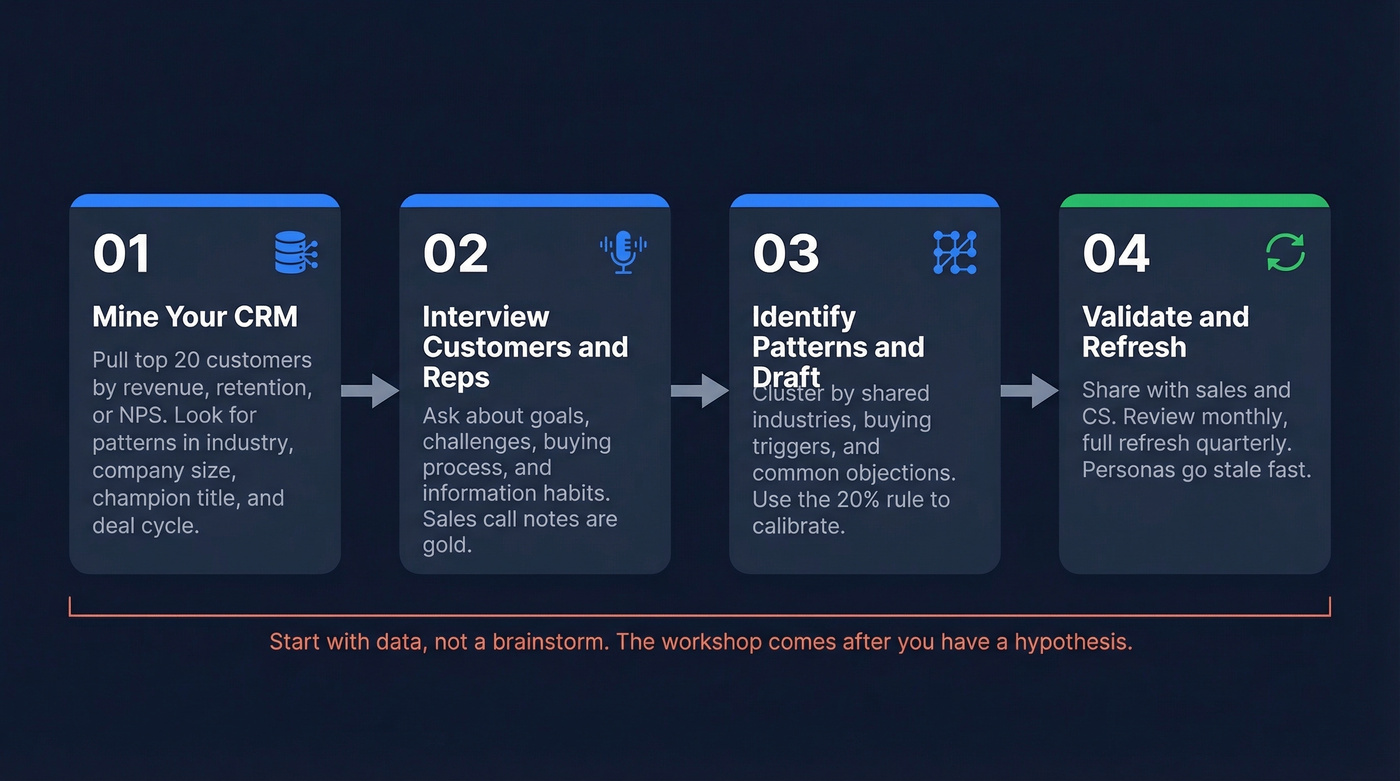
Most persona guides tell you to start with a workshop. Don't. Start with your CRM. Pull your top 20 customers by revenue, retention, or NPS and look for patterns in industry, company size, deal cycle length, champion title, and how they found you. In our experience, this reverse-engineering approach surfaces patterns that brainstorming sessions miss entirely - especially around which titles actually champion deals versus which ones just attend demos. The brainstorm comes later, after you have a hypothesis worth testing.
If your CRM is messy, fix the inputs first with data enrichment services so your persona patterns aren't built on missing fields.
Interview Customers and Sales Reps
Analytics tell you what happened. Interviews tell you why. One HubSpot team changed their content format and headline based on persona interview feedback and saw a 40% conversion lift. Here are the questions worth asking, drawn from HubSpot's question bank and NewtonX's B2B survey framework:
Professional background:
- What's your exact title, and what does your day-to-day actually look like?
- How is your team's success measured?
Goals and challenges:
- What are your top three priorities this quarter?
- What's the biggest obstacle to hitting those goals?
- What would need to change for you to consider a new tool or vendor?
Buying process:
- Who else is involved in purchasing decisions like this?
- What's your typical evaluation process? How long does it take?
Information habits:
- Where do you go to learn about new tools or approaches?
- Which conferences, podcasts, or communities do you trust?
Don't skip the sales team. Reps hear objections, buying triggers, and competitive mentions every day. Their discovery call notes are gold. (If you want a tighter structure for those conversations, use a set of discovery questions that map to persona fields.)
Identify Patterns and Draft Profiles
Once you've got 10-15 interviews plus your CRM data, look for clusters. You'll typically see patterns in shared industries and similar headcount, buying triggers like recent funding rounds or new VP hires, and common objections that keep coming up in the same sequence.
Draft a handful of persona profiles from these clusters. Use the 20% assessment to calibrate - if you end up with too many tiny personas, you've over-segmented; if one persona covers almost everyone, it's too broad to guide messaging.
Validate and Refresh
Share your draft personas with sales and customer success. They'll catch the assumptions that don't match reality. Then treat your personas as living documents: review them monthly, do a full refresh quarterly. Markets shift, buying committees change, and the persona you built six months ago is probably already stale.
To make refreshes less subjective, tie persona changes to identifying buying signals and what actually correlates with pipeline movement.
Filled-In Persona Examples
Example 1: "Pipeline Paul" - VP of Marketing, Mid-Market SaaS
Company fit: B2B SaaS, 200-500 employees, $20M-$80M ARR, Series B/C, using HubSpot or Salesforce
Role: VP of Marketing, reports to CMO or CEO. Manages a team of 8-15. Measured on pipeline contribution, CAC, and marketing-sourced revenue.
Goals: Scale demand gen without proportionally scaling headcount. Prove marketing's revenue impact to the board.
Challenges: Outbound list quality is inconsistent. Bounce rates are tanking deliverability. Can't get accurate mobile numbers for executive prospects.
Buying triggers: Board is pushing for outbound pipeline metrics. Just hired a new demand gen manager who wants better tooling.
Buying process: Evaluates tools with RevOps and one senior demand gen manager. Needs to justify ROI to CFO. Typical eval cycle: 3-6 weeks.
Channels: Reads Lenny's Newsletter and Pavilion Slack. Attends SaaStr. Listens to Exit Five podcast.
Objections: "We already have a data provider." "How is this different from Apollo?"
Example 2: Negative Persona - "The Freebie Hunter"
Red flags: Signs up for every free trial, never converts. Asks for extended trials and discounts before seeing a demo. Company has <10 employees and no funding.
Disqualification criteria: No budget authority, company below minimum revenue threshold, no identified business pain that matches your solution.
Negative Personas - Who NOT to Target
Let's be honest: most teams skip negative personas because it feels like admitting failure. But the 79% of marketing leads that never convert to sales aren't just a pipeline problem - they're a resource drain. We've seen teams cut their unqualified lead rate by half just by adding negative persona criteria to their lead scoring.
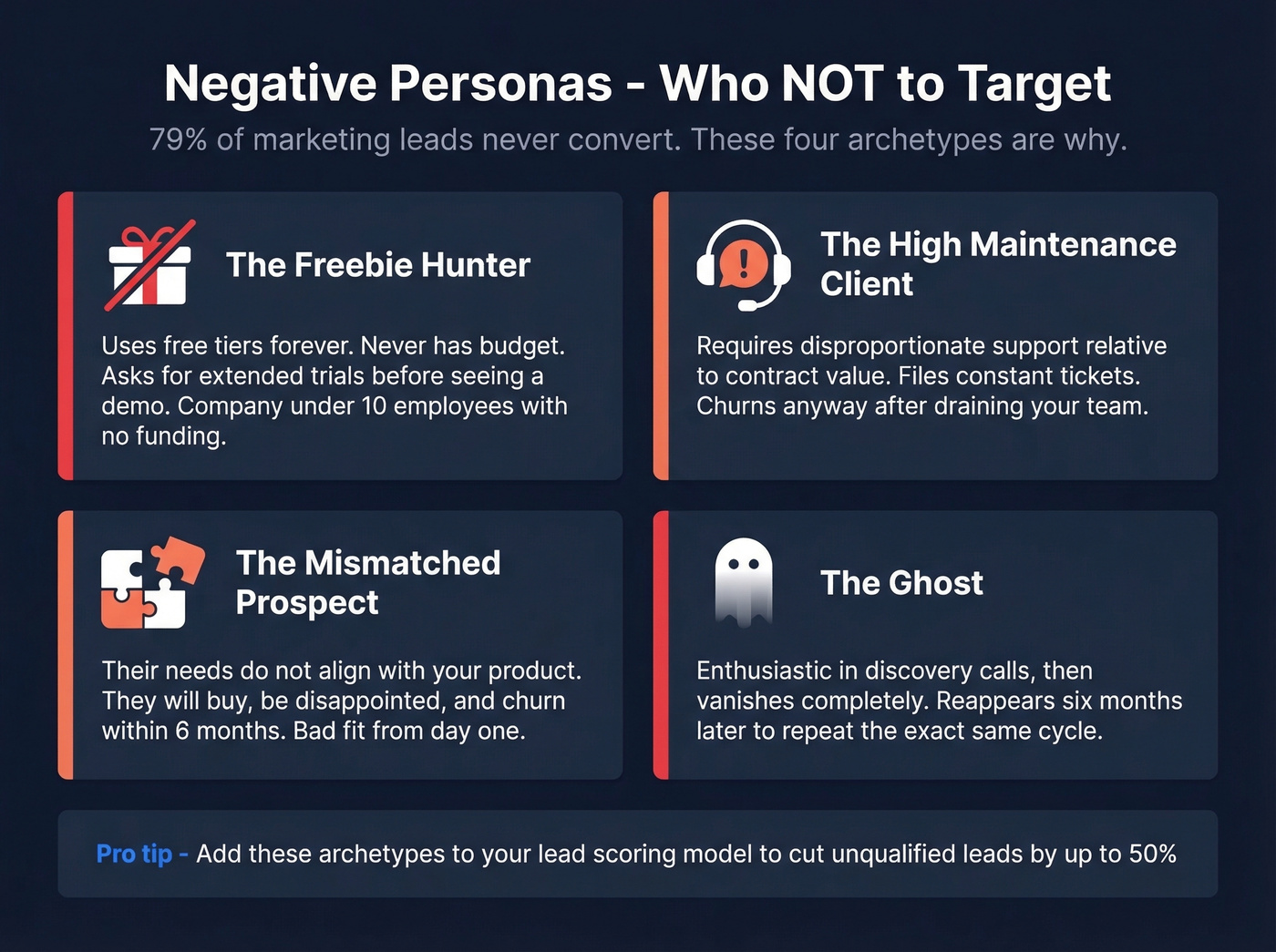
Four archetypes show up repeatedly:
- The Freebie Hunter: Uses free tiers indefinitely. Never has budget. Consumes support resources without converting.
- The High Maintenance Client: Requires disproportionate support relative to contract value. Churns anyway.
- The Mismatched Prospect: Their needs don't align with your product. They'll buy, be disappointed, and churn within 6 months.
- The Ghost: Enthusiastic in discovery calls, then vanishes. Reappears six months later to repeat the cycle.
To build negative personas, analyze your churned customers for common traits, collect input from sales and support on worst-fit accounts, identify shared demographic and behavioral patterns, categorize them into archetypes, and validate against campaign results. That Forrester stat - 21% of budget wasted on poor targeting - shrinks fast when you know who to exclude.
Use AI to Build Personas Faster
LLMs are excellent at generating structured first drafts. They're terrible at replacing real customer interviews. Use them as formatters, not as your research department. Here's a prompt adapted from r/sales that works well in ChatGPT or Claude:
You are a B2B buyer persona researcher. Before generating anything,
ask me clarifying questions about:
- My product/service and what it solves
- Whether this is B2B or B2C
- The specific role/title I'm targeting
- The industry and company size

Then generate a structured persona with these sections:
1. Name, role, and professional background
2. Top 3-4 pain points
3. Fears / what keeps them up at night (3-4)
4. Needs, wants, and desired outcomes (3-4)
5. Buying decision process (who's involved, criteria, timeline)
6. Ideal future state (what success looks like)

Keep it structured. No fluff. Use bullet points.
One warning: watch for the "Mirror Effect," where the AI reflects your assumptions back instead of challenging them. Always validate AI-generated personas against real interview data.
If you want a tool to speed up the formatting side, here are common options:
| Tool | Price | Best For |
|---|---|---|
| HubSpot Make My Persona | Free | Quick visual personas |
| UXPressia | Free tier; paid ~$10-$30/user/mo | Collaborative persona maps |
| Xtensio | Paid ~$10-$30/mo | Polished persona documents |
| FounderPal | Free tier | Solo founders, fast drafts |
Skip the AI-only persona generators if you don't have interview data to feed them. Garbage in, confident-sounding garbage out.
How to Operationalize Your Personas
A persona you don't operationalize is a creative writing exercise.
Map persona fields to CRM custom fields. If your persona says "VP of Marketing at mid-market SaaS," your CRM should have fields for title, company size, and industry that let you segment and report on persona fit. This sounds obvious, but we've audited CRMs where the persona doc described five segments and the CRM had zero corresponding fields.
Use personas for outbound targeting. Your persona says "VP of Marketing at mid-market SaaS companies using HubSpot with 200-500 employees." Prospeo lets you filter for exactly that - with 30+ search filters covering technographics, buyer intent, headcount growth, and job changes, plus 300M+ profiles and 98% email accuracy, you go from persona definition to verified prospect list in minutes. If you're building a repeatable outbound motion, pair this with proven sales prospecting techniques.

Personalize sequences by persona. Different personas get different email angles, different objection-handling in sales scripts, and different content recommendations. Your "Pipeline Paul" VP of Marketing cares about pipeline attribution. Your end-user persona cares about ease of setup. Same product, completely different message. (If you need a starting point, use personalized outreach frameworks.)
Align content and ad targeting. Each persona has preferred channels and content formats. Build your editorial calendar around what your personas actually consume, and use persona parameters for paid ad audience targeting - LinkedIn Ads custom audiences and Google Ads in-market segments both map directly to persona firmographics and intent signals.
Here's my hot take: if your deal sizes are under $10k-$15k, you don't need five personas and a 30-page playbook. You need one sharp persona, a negative persona, and a tool that lets you find matching contacts fast. Complexity is the enemy of execution.
Building personas without real contact data is just an exercise in creative writing. Prospeo returns 98% accurate emails and 125M+ verified mobile numbers so your persona research actually connects reps to real buyers - not bounced emails and voicemails. Teams using Prospeo book 26% more meetings than ZoomInfo users.
Stop building personas that collect dust. Start reaching the people they describe.
FAQ
What's the difference between an ICP and a buyer persona?
An ICP describes your ideal company - industry, size, revenue, tech stack - while a buyer persona describes the individual within that company, including their role, goals, and buying behavior. You need both: the ICP narrows your account list, and the persona shapes your messaging. Define the profile first, then layer on the human detail.
How many personas should I create?
Most B2B teams perform best with 3-5 core personas plus one negative persona. Use the 20% rule: if a segment represents less than ~20% of revenue, it probably doesn't need its own persona. One mega-persona covering everyone is too broad to personalize effectively.
Can AI replace customer interviews for persona research?
No. AI is excellent for generating structured first drafts and formatting outputs, but it can't surface real objections, emotional triggers, or buying context the way a 30-minute customer call can. Use LLMs to organize your research, then validate every assumption against actual interview data and CRM patterns.
What's a good free tool for building personas quickly?
HubSpot's Make My Persona generator is free and produces clean visual outputs. For outbound teams that need to go from persona to prospect list, Prospeo's free tier - 75 emails plus 100 Chrome extension credits per month - lets you search 300M+ profiles using the exact firmographic and technographic filters your persona defines.
How often should I update my personas?
Review monthly with your sales team; do a full data-backed refresh quarterly. Buying committees shift, new competitors emerge, and market conditions change. Stale personas lead to stale messaging and wasted pipeline.