

Introductory Email Templates That Actually Get Replies
You sent 200 intro emails last week and got three replies. That's not a copywriting problem - it's a math problem. The average cold email reply rate sits at 3.43%, which means three replies from 200 sends is literally average. Top performers hit 10.7%+. The gap between average and elite isn't a better introductory email template - it's better data, better deliverability, and shorter emails.
What You Need (Quick Version)
- Keep your intro email under 80 words and use a short subject line (2-4 words performs best for opens). Personalized subject lines average 46% opens and 7% reply rates - a 133% lift over non-personalized emails.
- Verify every email address before sending. Bounce rates above 2-3% tank your sender reputation and push future emails to spam.
- Grab a template below, personalize the first line with about three minutes of effort, and send Tuesday-Thursday between 8-11am in the recipient's timezone. Wednesday is the best day.
What the Data Says About Intro Emails
The [Instantly 2026 benchmark report](https://instantly.ai/cold-email-benchmark-report-2026) analyzed billions of cold email interactions across thousands of active workspaces. Average reply rate: 3.43%. Top quartile: 5.5%+. Elite top 10%: 10.7%+. Top performers A/B test weekly - subject lines and openers are usually the first levers - and that habit isn't optional if you want to stay in the top tier.
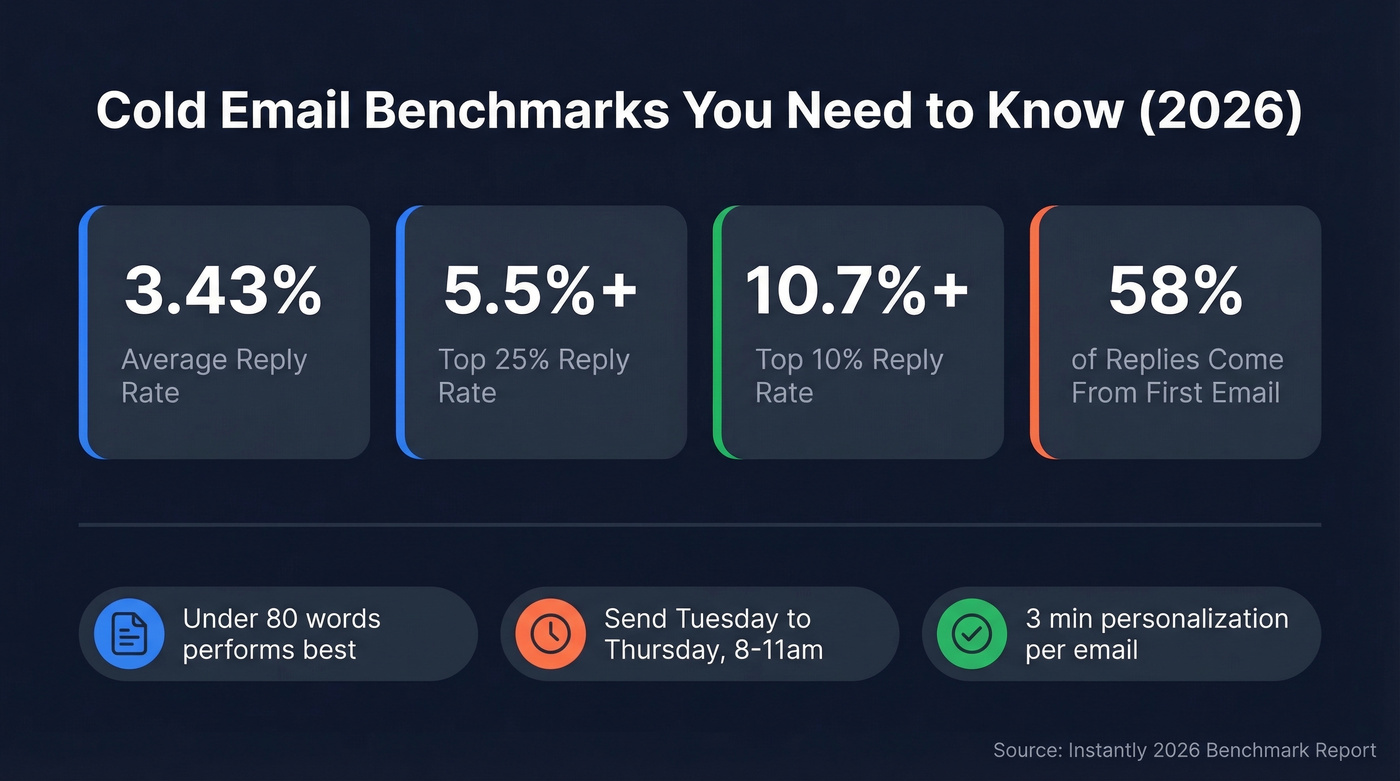
Best-performing campaigns keep emails under 80 words. One practitioner on r/Entrepreneur cut their emails from 141 words to under 56 and watched reply rates double from 3% to 6%. Shorter emails respect the reader's time and force you to lead with value.
Here's the number that should change how you prioritize: 58% of all replies come from the first email in a sequence. If your first touch is weak, follow-ups are just polishing a bad first impression. That's why choosing the right introductory email template matters more than perfecting your follow-up cadence.
Subject Lines That Work
A [Belkins study of 5.5 million emails](https://belkins.io/blog/cold-email-response-rates) gives us the clearest subject line data available:
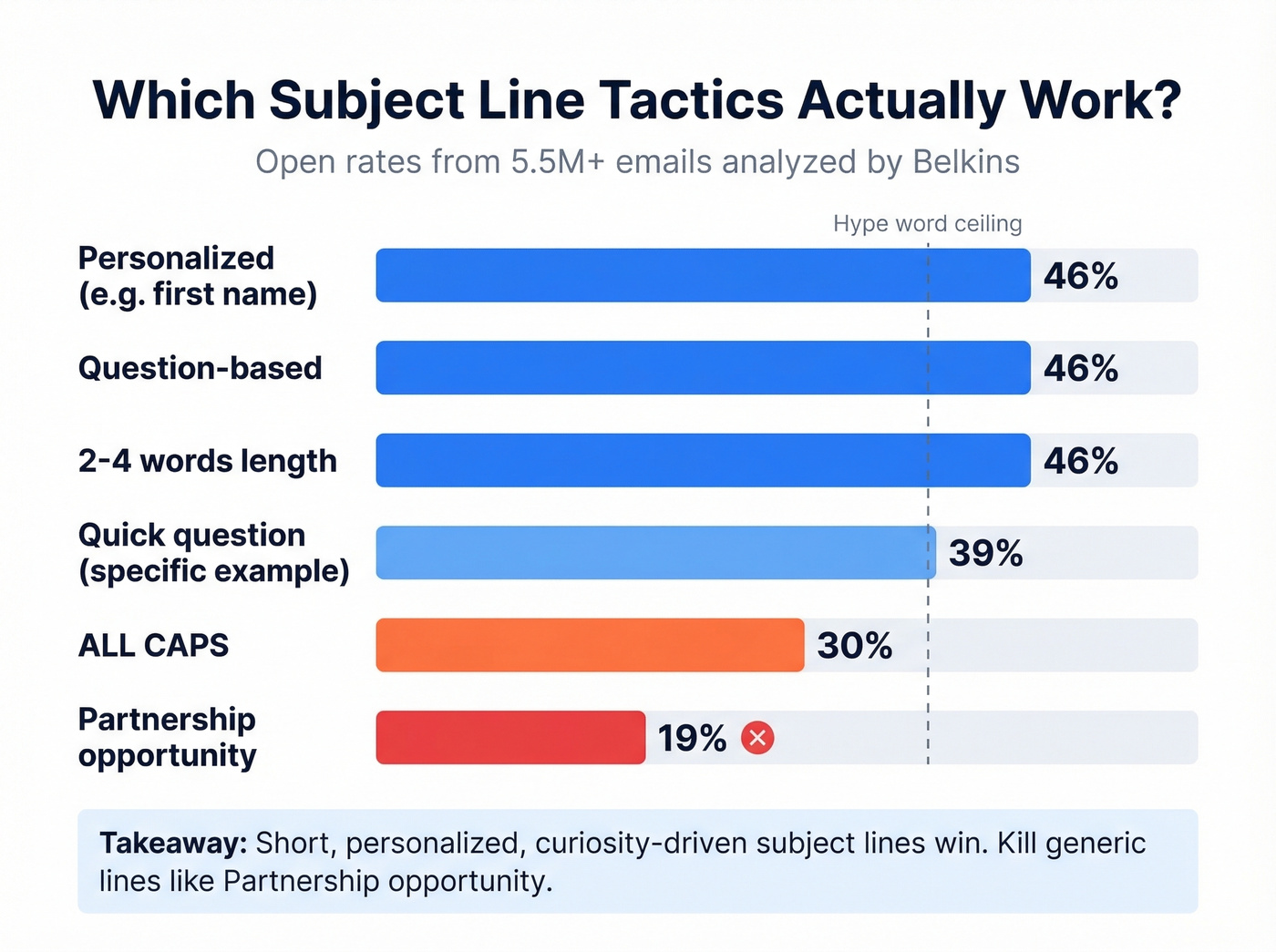
| Tactic | Open Rate | Notes |
|---|---|---|
| Personalized | 46% | 7% reply rate vs 3% without (133% increase) |
| Question-based | 46% | Top performer |
| 2-4 words | 46% | Drops after 7 words |
| ALL CAPS | 30% | Barely above title/lowercase at 29% |
| Hype words ("ASAP") | <36% | Tends to pull opens below 36% |
The r/Entrepreneur data lines up. "Quick question" pulled 39% opens. Company-name subject lines hit 33%. "Partnership opportunity" - the kind of generic line everyone defaults to - landed below 19%.
Short, personalized, and curiosity-driven wins. Generic and salesy loses. Kill "Partnership opportunity" from your vocabulary. Kill "Touching base." And don't bother with ALL CAPS - even when it performs, it only hits 30% opens, barely above title case at 29%.
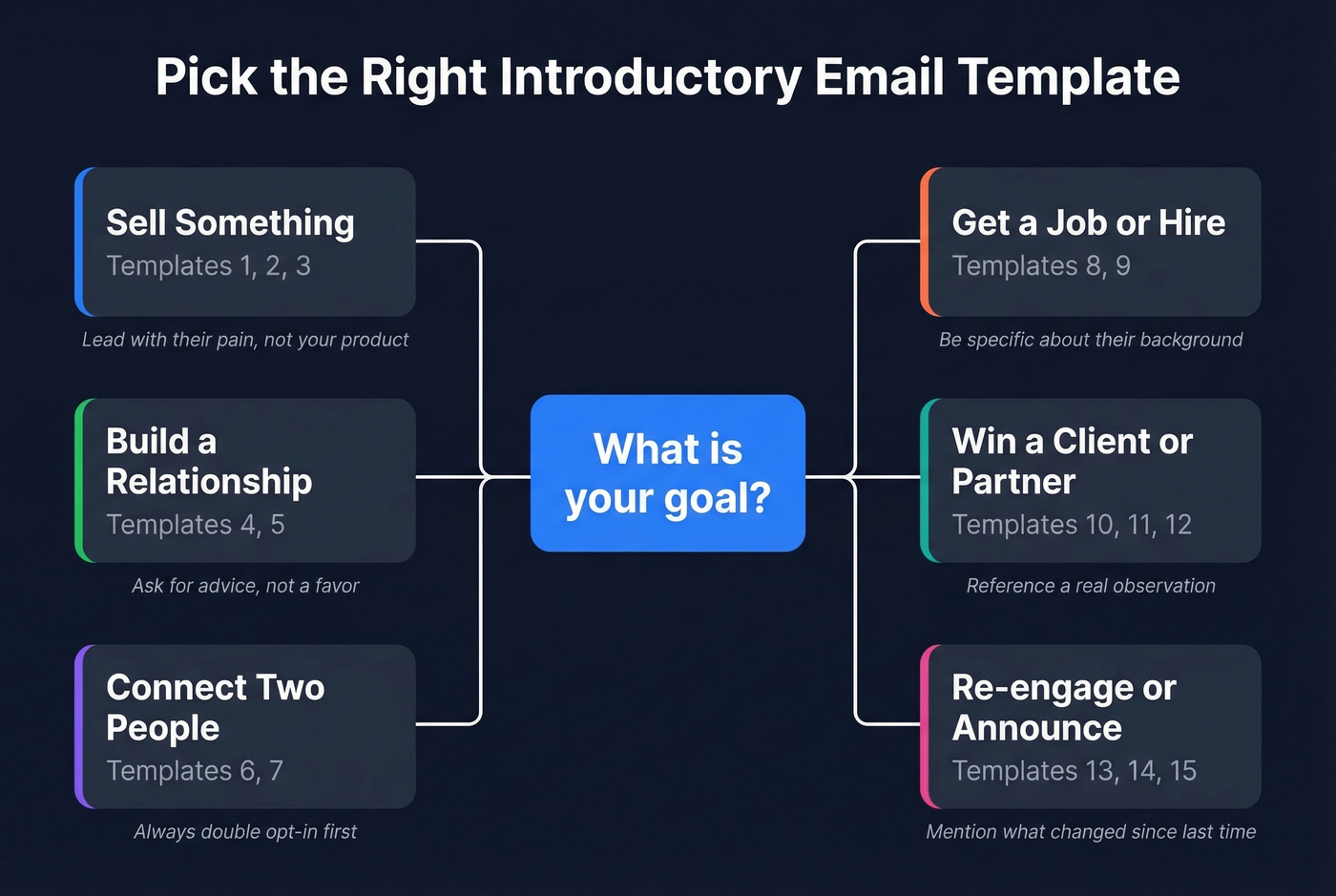
15 Templates for Every Scenario
Every template below follows the data: under 80 words, personalized first line, short subject line. Bracketed fields are where you personalize.
Cold Sales Outreach
Template 1 - Direct Value Prop
Subject: [First name], quick question
Hi [First name],
[Specific observation about their company - e.g., "Saw you're hiring 3 SDRs"]. When teams scale outbound that fast, [specific pain point] usually becomes the bottleneck.
We helped [similar company] [specific result] in [timeframe].
Worth a 15-minute call this week?
[Your name]
Template 2 - Pain-Point Question
Subject: [Company name]'s [specific metric]
Hi [First name],
Are you seeing [specific problem] as [Company name] scales [specific initiative]?
Most [their role title]s we talk to are spending [X hours/dollars] on this. We cut that by [percentage] for [reference customer].
Happy to share how - free, no pitch. 15 minutes?
[Your name]
Template 3 - Mutual Connection
Subject: [Mutual contact's name] suggested I reach out
Hi [First name],
[Mutual contact] mentioned you're working on [initiative]. We helped their team [specific result], and they thought we might be useful for you too.
Would a quick call make sense this week?
[Your name]
Networking and Mentorship
Template 4 - Event Follow-Up
Subject: Great meeting you at [event]
Hi [First name],
Really enjoyed your point about [specific thing they said] at [event]. It got me thinking about [related idea].
Would love to continue that conversation over coffee or a quick call. How's [day]?
[Your name]
Template 5 - Advice Request (Ben Franklin Effect)
Subject: Your take on [topic]?
Hi [First name],
I've been following your work on [specific project/content]. I'm navigating [related challenge] and would genuinely value your perspective.
Could I steal 15 minutes of your time? Happy to work around your schedule.
[Your name]
Asking for advice instead of pitching works because of the [Ben Franklin Effect](https://en.wikipedia.org/wiki/Ben_Franklin_effect) - people who do you a favor become more invested in you, not less. This is the best intro template for building genuine relationships rather than just generating pipeline.
Warm Introduction (Connecting Two People)
Template 6 - Double Opt-In
Subject: Intro - [Person A] + [Person B]?
Hi [Person A],
I'd love to connect you with [Person B], who's [one-line context]. I think you'd have a lot to talk about around [shared interest].
Mind if I make the intro?
[Your name]
Always double opt-in. Sending a cold introduction without permission puts both parties in an awkward spot. And here's a tip most people miss: write your email so the recipient can forward it directly. If Person A has to rewrite your message to explain who Person B is, you've created work instead of removing it.
Template 7 - Direct Intro (Forwardable Format)
Subject: Introducing [Person A] and [Person B]
[Person A], meet [Person B] - [one-line context about B]. [Person B], meet [Person A] - [one-line context about A].
You're both working on [shared topic]. I'll let you two take it from here.
[Your name]
This template works because either party can forward it to a colleague with zero editing. Every intro email should pass the "forwardable test."
Job Applications and Recruiting
Template 8 - Candidate Sourcing
Subject: [Role] at [Company] - your background fits
Hi [First name],
Your experience with [specific skill/project] caught my eye. We're hiring a [role] at [Company], and your background in [specific area] is exactly what the team needs.
Here's the role: [one-sentence summary]. Interested in a quick chat?
[Your name]
As David Chie, CEO of Palo Alto Staffing, puts it: "There's nothing worse than a recruiter cold blasting out job descriptions that have no relevance to the candidate's background." Specificity is everything.
Template 9 - Job Inquiry
Subject: [Specific role] - quick question
Hi [First name],
I saw [Company] is growing the [department] team. My background in [relevant experience] aligns closely with what you're building.
I'd love to learn more about the role and share how I could contribute. Do you have 15 minutes this week?
[Your name]
This self-introduction email template works because it leads with research about the company rather than a generic pitch about your qualifications.
Client and Agency Introduction
Template 10 - New Client Intro
Subject: Getting started - [Project/Account name]
Hi [First name],
I'm [Your name], your new point of contact for [project/account]. I've reviewed your onboarding notes and I'm excited to get moving.
I'd like to schedule a 30-minute kickoff to align on priorities. Does [day] work?
[Your name]
Template 11 - Agency Pitch (AIDA Framework)
Subject: [Their company]'s [specific challenge]
Hi [First name],
[Specific observation about their business - e.g., "Your careers page shows 12 open engineering roles."]
We specialize in [specific service] for companies scaling like yours. Last quarter, we helped [similar company] [specific result].
Worth 15 minutes to see if we can do the same?
[Your name]
This template follows the AIDA framework: the observation grabs Attention, the specialization builds Interest, the case study creates Desire, and the meeting ask is the Action.
Partnership and Collaboration
Template 12 - Partnership Outreach
Subject: [Your company] + [Their company]
Hi [First name],
Our customers keep asking about [their product/service area]. Your team does it better than anyone I've seen.
I think there's a natural partnership here - co-marketing, integrations, or referrals. Would you be open to exploring it?
[Your name]
Re-Engagement and Announcements
Template 13 - Dormant Contact Revival
Subject: Still relevant?
Hi [First name],
We spoke [timeframe] ago about [topic]. I know timing wasn't right then.
Since then, we've [new development - e.g., "launched a feature that cuts onboarding time by 40%"]. Thought it might change the equation.
Worth revisiting?
[Your name]
Template 14 - Product Launch Announcement
Subject: [Product name] just went live
Hi [First name],
We just launched [product/feature] - built specifically for teams dealing with [pain point you know they have].
[One-sentence result from beta users - e.g., "Beta users cut reporting time by 60%"]. Thought you'd want first look.
Want a quick walkthrough?
[Your name]
Internal / New Team Introduction
Template 15 - New Team Member Intro
Subject: Hey - new [role] on the team
Hi [First name],
I just joined as [role] on the [team] team. Before this, I was at [previous company] working on [relevant project].
I'd love to grab 15 minutes to learn about what you're working on and how our teams overlap. Coffee or Zoom - your pick.
[Your name]
Use this template when you're onboarding and need to build cross-functional relationships quickly. The key is leading with curiosity about their work, not a monologue about yours.

Bounce rates above 3% destroy your sender reputation - and every template above becomes useless if emails land in spam. Prospeo's 5-step verification delivers 98% email accuracy, so your introductory emails actually reach real inboxes. At $0.01 per verified email, cleaning your list costs less than a single bounced send costs your domain.
Stop perfecting templates for email addresses that don't exist.
Tone, Formatting, and Testing
Match your tone to the relationship. A cold sales email to a VP of Engineering should read differently than a networking email to a peer you met at a conference. When in doubt, lean casual - stiff, formal language is the fastest way to sound like a bot in 2026. Use contractions. Write like you talk. Keep paragraphs to two lines max on mobile.
If you want more depth on writing, see our email copywriting guide.
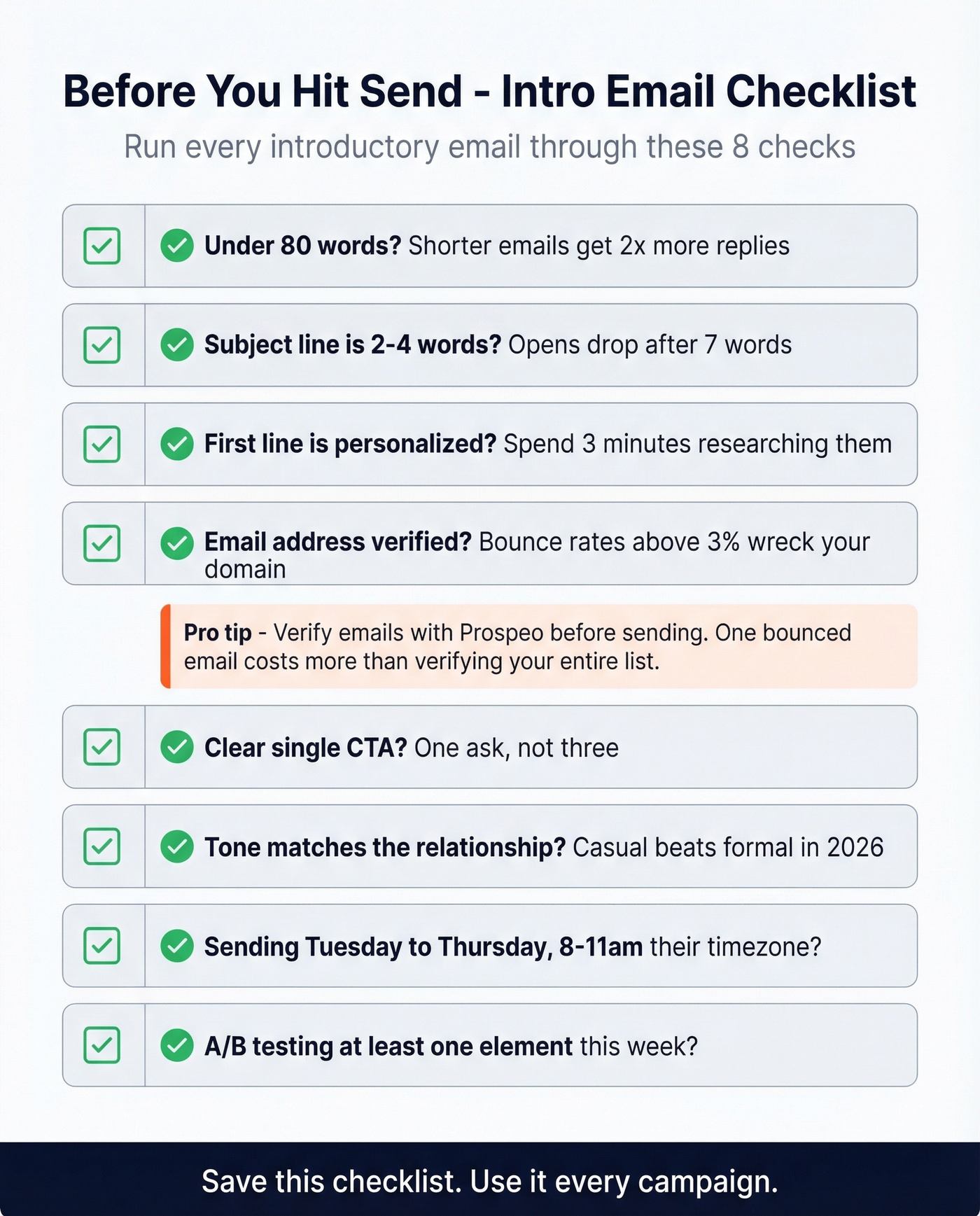
Before you send any template, A/B test it against a variant. Change the subject line, swap the opening line, or try a different CTA. We've seen teams lift reply rates 20-30% in a single week just by testing two versions of the same email. That's not a nice-to-have - it's how the top 10% stay there.
For more ideas, pull from these email subject line examples and run them through a subject line tester.
Why Great Templates Still Fail
You can write the perfect introductory email template and still land in spam. Deliverability is the silent killer of outbound campaigns, and most teams don't realize they have a problem until reply rates crater.
Authentication is non-negotiable. Set up SPF, DKIM, and DMARC before you send a single email. Without these, inbox providers treat your domain like a stranger at the door. (If you need a walkthrough, start with SPF record examples and DMARC alignment.)
Turn off open tracking. An analysis of 44 million emails found that disabling open tracking more than doubled reply rates - 2.36% with tracking off vs 1.08% with it on. The tracking pixel isn't worth the deliverability hit. If you're using tracking, understand how an email tracking pixel impacts inboxing.
Warm up new domains slowly. Google banned automated warm-up services in early 2023, so you're doing this manually:
| Week | Daily Volume |
|---|---|
| Week 1 | 10-20 |
| Week 2 | 20-40 |
| Week 3 | 40-80 |
| Week 4 | 80-150 |
Expect 8-12 weeks before a new domain reaches full sending capacity.
Spread sends across multiple domains. The r/Entrepreneur practitioner scaled from 3 sending domains to 7, capping each at 26 emails per day. That infrastructure change - not better copy - was the single biggest factor in their reply rate doubling. If you're sending more than 25-30 emails a day from one domain, you're asking for trouble. (More on safe limits in our email velocity guide.)
Verify before you send. That same practitioner dropped their bounce rate from 11% to under 2% after switching to manual verification. One change protected their sender reputation across all seven domains. Tools like Prospeo's email verification run a 5-step process with catch-all handling, spam-trap removal, and honeypot filtering at 98% accuracy - the kind of pre-send hygiene that keeps you out of the spam folder. If you want the benchmarks and fixes, see email bounce rate.
Avoid spam trigger words. "Free," "Congratulations," "Act Now," excessive caps, and stacked exclamation marks all flag filters. Write like a human, not a marketer. Use an email spam checker if you're unsure.
Let's be honest: most teams obsess over email copy when their real problem is infrastructure. We've seen teams with mediocre templates outperform brilliant copywriters because they had clean lists, warmed domains, and proper authentication. Fix the pipes before you polish the words.
Follow-Up Sequence That Works
58% of replies come from the first email, but that means 42% come from follow-ups. Don't stop at one touch. The first point of contact only accounts for 2% of sales. Sales teams on Reddit consistently report that deals close on the third or fourth touch, not the first.
A sequence that works:
- Day 1: Send your intro email using a template above.
- Day 4: Follow-up #1 - make it feel like a reply, not a new pitch. "Bumping this up - thought this might be relevant: [new value add]." Emails that feel like replies outperform formal follow-ups by roughly 30%.
- Day 8: Follow-up #2 - add a new angle. Share a case study, a relevant stat, or a resource.
- Day 12: Follow-up #3 - lighter touch. "Is this worth revisiting, or should I close the loop?"
- Day 18-25: Follow-ups #4-5 - breakup email or channel switch.
Space touches 3-4 days apart. Four to seven touchpoints is the sweet spot - beyond seven, diminishing returns kick in unless each touch adds genuinely new value.
If you want plug-and-play follow-ups, use these sales follow-up templates or the more specific cold email follow-up templates.
Legal Compliance Checklist
CAN-SPAM applies to every commercial email, including B2B. Penalties reach up to $53,088 per violating email. The seven requirements:
- Accurate "From," "To," and "Reply-To" headers
- Non-deceptive subject lines
- Disclose the message is an ad
- Include a valid physical postal address
- Provide a clear opt-out/unsubscribe mechanism
- Honor opt-outs within 10 business days
- You're responsible even if a third party sends on your behalf
GDPR adds another layer for EU contacts: you need explicit consent or legitimate interest, with penalties up to 20M EUR or 4% of global revenue. CCPA gives California residents opt-out rights. One nuance most guides skip: consent for email doesn't mean consent for phone or social outreach. Each channel requires its own permission basis.
If you're building lists for outbound, read is it illegal to buy email lists before you scale.
The data is clear: personalized subject lines get 133% more replies. But personalization requires knowing who you're emailing - their role, company size, recent hiring, tech stack. Prospeo gives you 50+ data points per contact and 30+ search filters including job changes and headcount growth, so every bracketed field in these templates gets filled with real intel.
Turn every template into a personalized email in seconds, not hours.
FAQ
How long should an introductory email be?
Under 80 words. Data from billions of cold emails shows shorter messages consistently outperform longer ones. One practitioner doubled their reply rate by cutting from 141 to 56 words. Three short paragraphs is the ceiling - anything longer gets skimmed or ignored on mobile.
What's the best day to send intro emails?
Wednesday delivers the highest engagement, with Tuesday close behind. Send between 8-11am in the recipient's timezone. Avoid Mondays (inbox overload) and Fridays (mental checkout). These windows align across multiple benchmark studies covering billions of sends.
How many follow-ups should I send?
Four to seven follow-ups spaced 3-4 days apart. 58% of replies come from the first email, but follow-ups capture the other 42%. The first point of contact only accounts for about 2% of eventual sales - persistence matters more than most teams realize.
Do I need an unsubscribe link in cold B2B emails?
Yes. CAN-SPAM requires a clear opt-out mechanism in every commercial email, including B2B outreach. Penalties reach up to $53,088 per violating email. There's no exception for "just one email" - every send needs a way for recipients to opt out.
Skip this if you're only sending a handful of emails, but for teams running campaigns at scale: what's the best way to verify emails before sending?
Run your list through a verification tool that catches spam traps, honeypots, and catch-all domains before you send. The goal is keeping bounce rates under 2-3%, which is the threshold where inbox providers start throttling your domain. Any verification tool with 95%+ accuracy will do the job - the important thing is that you're checking at all.