

IQL vs MQL vs SQL: Definitions, Scoring, and Benchmarks That Actually Help
Your VP of Sales says four out of five MQLs are garbage. Marketing disagrees - they hit their number last quarter. Meanwhile, the pipeline suffers and nobody can agree on what "qualified" actually means.
Understanding the differences between IQL, MQL, and SQL is the first step toward fixing this. The real solution isn't more leads. It's shared definitions, scoring thresholds that reflect real buying behavior, and SLA rules that force accountability on both sides.
Quick Definitions
- IQL (Information Qualified Lead) - consumed educational content and is still in the learning stage.
- IQL (Intent Qualified Lead) - showing buying signals, often across third-party sites, before they ever raise a hand with your brand.
- MQL (Marketing Qualified Lead) - matches your target profile and has taken higher-intent actions.
- SQL (Sales Qualified Lead) - moved from marketing to sales and has been vetted by a salesperson as ready for a real conversation.
The average B2B SaaS MQL-to-SQL conversion rate is 13%. Responding to a new lead within 5 minutes is 21x more effective than waiting 30.
Each Lead Stage Defined
Two framings of IQL show up in real funnels:
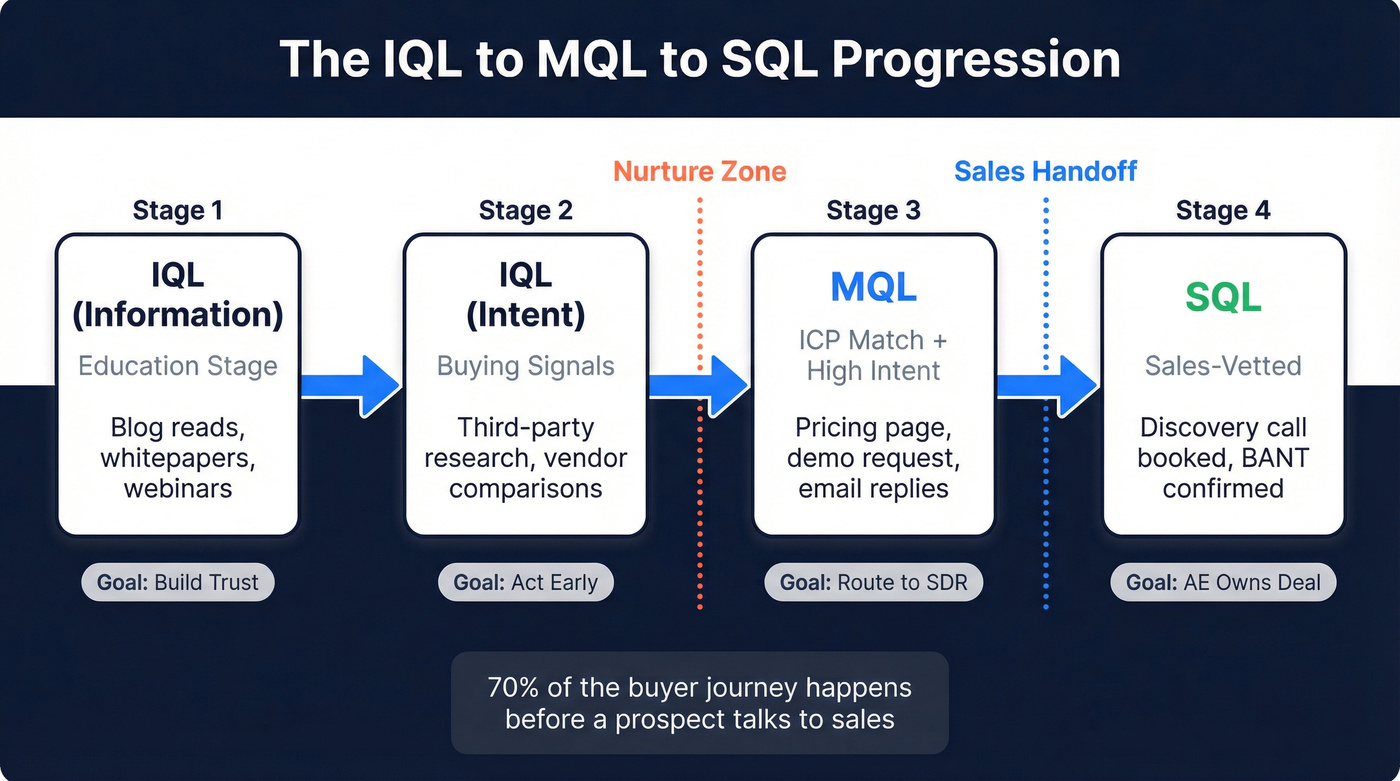
Salesforce uses IQL as "Information Qualified Lead" - people who are relatively unfamiliar with your company, where the goal is to deliver valuable information and build trust. Intent data teams use IQL as "Intent Qualified Lead" - prospects or accounts showing buying signals across third-party sites before they ever touch your brand.
Both are useful. The first gives you an explicit "education stage" bucket. The second lets you act earlier based on in-market behavior. 70% of the buyer's journey happens before a prospect engages with sales - that's the gap information and intent qualified leads are designed to capture.
| Lead Type | Definition | Typical Behaviors | Action |
|---|---|---|---|
| IQL (Information) | Early-stage education | Blog reads, whitepapers, webinars | Nurture sequences |
| IQL (Intent) | Early buying signals before a hand-raise | Researching topics on third-party sites, comparing vendors | Intent-based nurture + targeted outreach |
| MQL | Matches ICP + higher-intent actions | Pricing page, demo request, email replies | Route to SDR |
| SQL | Sales-vetted, ready for a sales process | Discovery call booked, qualification confirmed | AE owns deal |
You'll also see PQL (Product Qualified Lead) in PLG companies and SAL (Sales Accepted Lead) as a handoff checkpoint between MQL and SQL. Both are useful refinements, but the IQL-to-MQL-to-SQL framework is the backbone most B2B teams build on. SQL qualification typically runs through BANT - Budget, Authority, Need, Timeline.
MQL-to-SQL Conversion Benchmarks
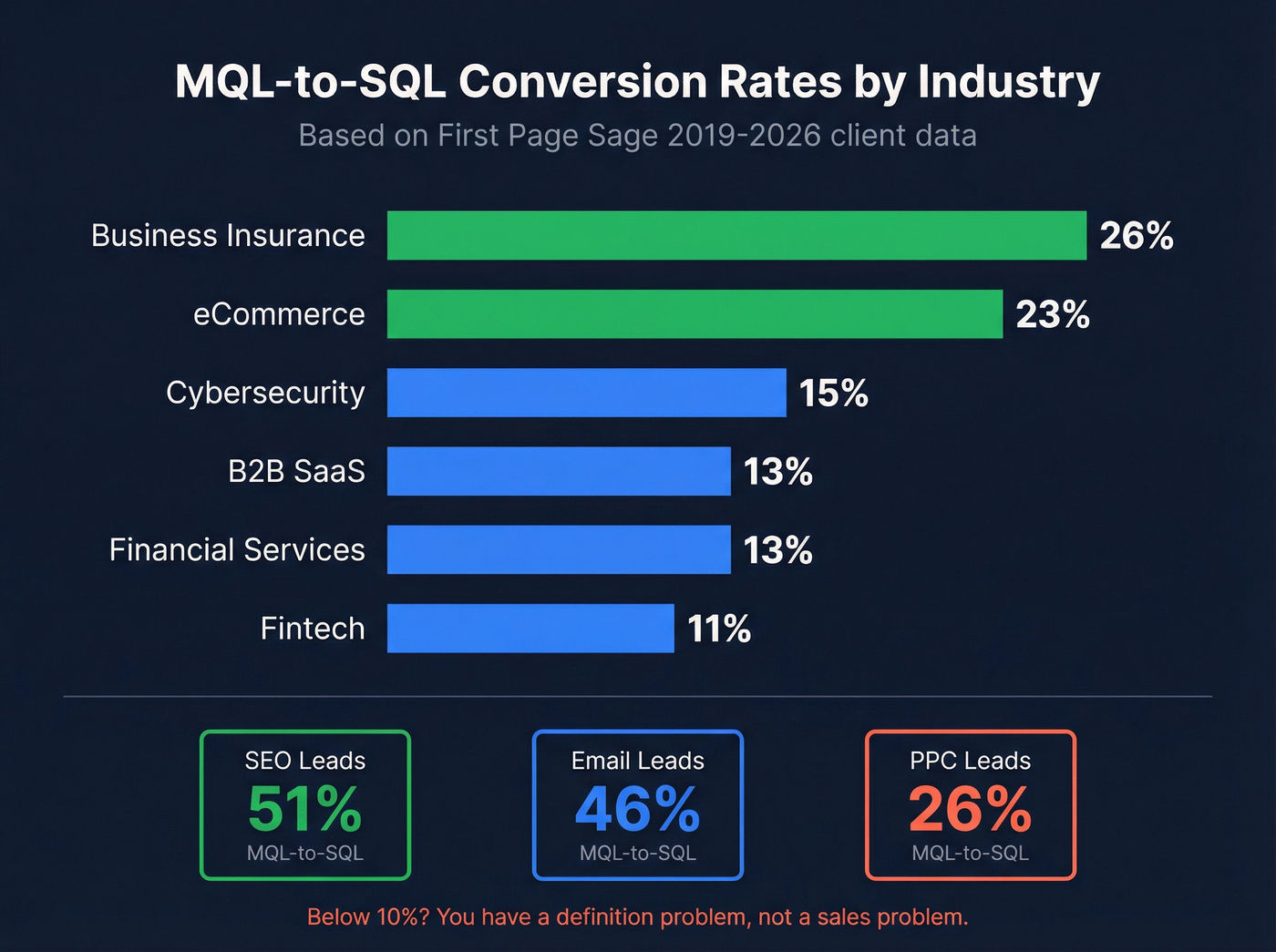
Here's what "normal" looks like, based on First Page Sage's 2019-2026 client data:
| Industry | MQL-to-SQL Rate |
|---|---|
| B2B SaaS | 13% |
| Cybersecurity | 15% |
| Financial Services | 13% |
| Fintech | 11% |
| eCommerce | 23% |
| Business Insurance | 26% |
Channel matters as much as industry. SEO-sourced leads convert MQL-to-SQL at roughly 51%, email marketing at ~46%, and PPC at ~26%. The takeaway is simple: higher-intent channels produce higher-intent handoffs.
Here's the thing: if your rate is below 10%, you don't have a sales problem. You have a definition problem.

If your MQL-to-SQL rate is below 10%, bad data is likely the culprit. Prospeo refreshes 300M+ profiles every 7 days and verifies emails at 98% accuracy - so your scoring model reflects real job titles, real companies, and real buying signals, not last quarter's org chart.
Stop scoring leads on stale data. Start with contacts you can trust.
A Scoring Model You Can Actually Use
Start with fewer than 10 criteria. We've seen teams build 30-variable scoring models that nobody trusts and nobody maintains - they die within a quarter. Simple wins.
If your scoring model has more than 15 variables, nobody on your team actually understands it. Cut it in half and watch adoption double.
IQL-stage behaviors earn lighter points: blog subscriptions worth +5, whitepaper downloads +10, ebook downloads +15, webinar attendance +15 (no-shows get +5), reading 3+ blog posts +10, and resource center visits +8. These signals show engagement, not purchase intent - treat them accordingly.
Fit + Intent Scoring for MQL and SQL
| Signal | Points |
|---|---|
| Director-level or above | +25 |
| Company 200-1,000 employees | +15 |
| Pricing page visit | +10 |
| Demo booking | +20 |
| 30+ days inactive | -10 |
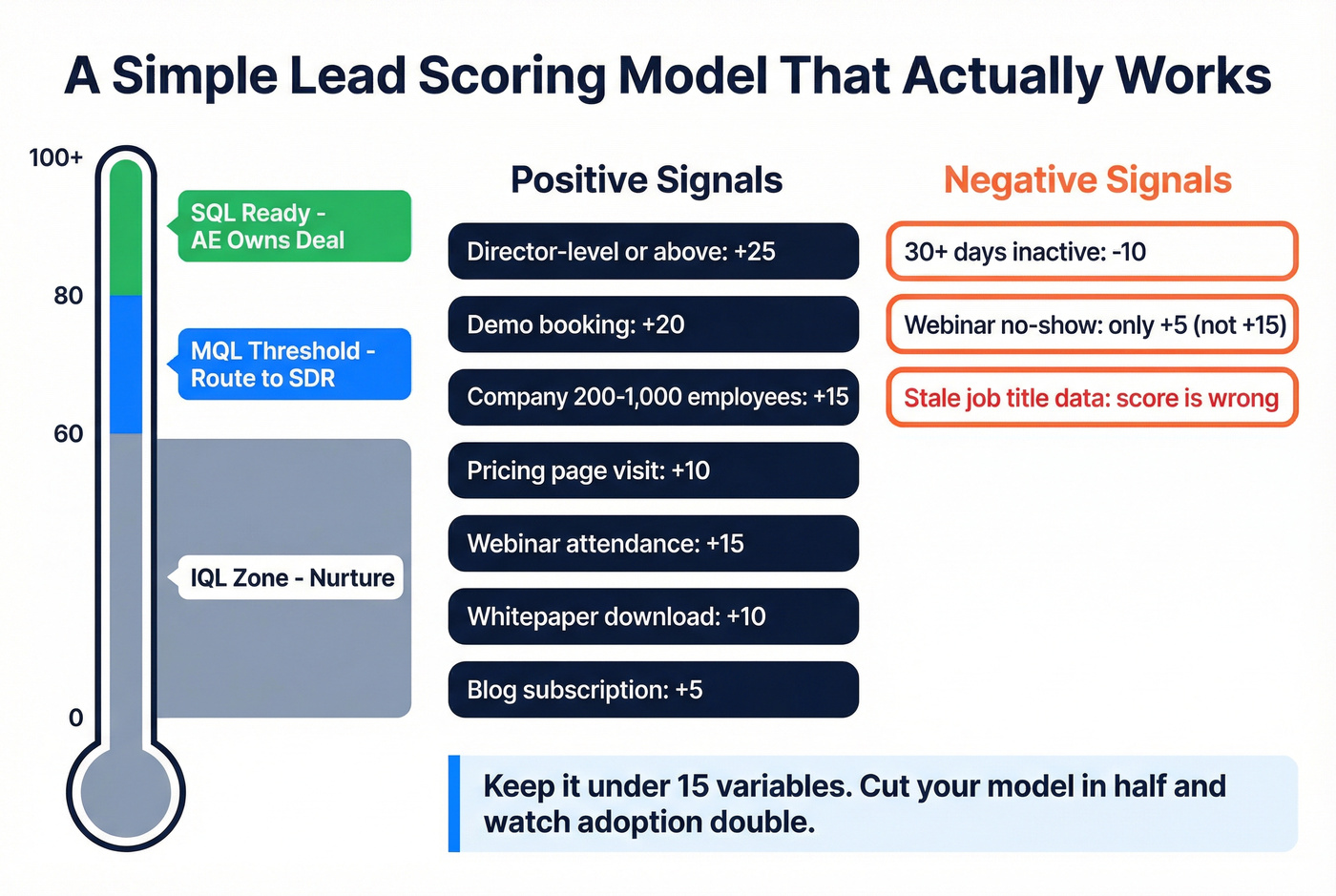
MQL threshold: 60-80 points. Once a lead crosses that line, it routes to sales. Negative scoring isn't optional - without it, a lead who downloaded an ebook 18 months ago and never came back still looks "warm."
That +25 for Director-level contacts only works if the job title in your CRM is current. Stale data corrupts scores silently. A tool like Prospeo, which refreshes records on a 7-day cycle and verifies emails at 98% accuracy, keeps your scoring model grounded in reality instead of last quarter's org chart.
If you want the full framework behind point thresholds, routing, and decay, use a dedicated lead scoring playbook.
SLA Rules That Prevent Fumbled Handoffs
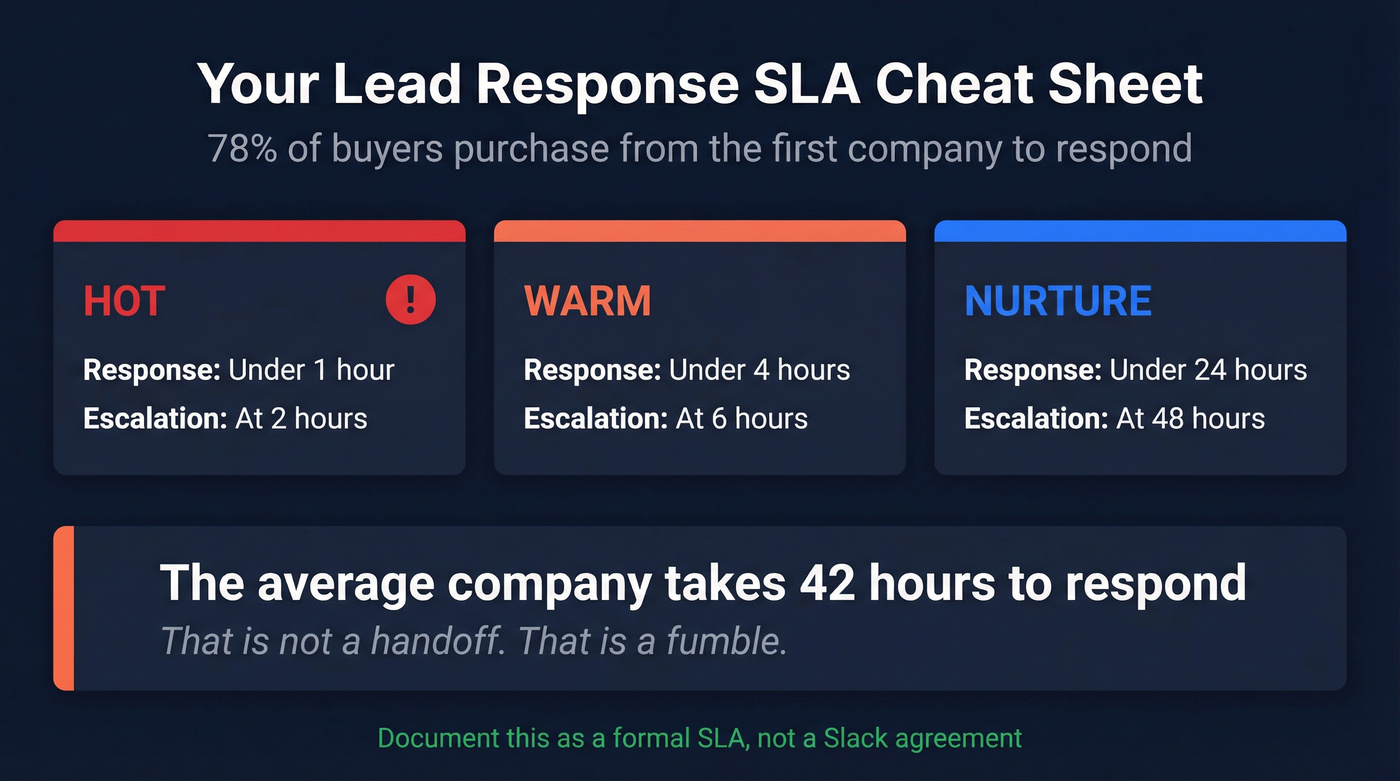
The average company takes 42 hours to respond to a new lead. That's not a handoff. That's a fumble. And 78% of buyers purchase from the first company to respond.
| Priority | Response Time | Escalation |
|---|---|---|
| Hot | < 1 hour | Escalate at 2 hours |
| Warm | < 4 hours | Escalate at 6 hours |
| Nurture | < 24 hours | Escalate at 48 hours |
Write these into a formal SLA between marketing and sales - not a Slack agreement, but a documented commitment with escalation paths and reporting. We've found that teams who skip this step end up relitigating the same handoff arguments every quarter.
To make this operational, define clear lead status values and automate the lead generation workflow end-to-end.
Five Mistakes That Break Your Pipeline
1. No shared MQL definition. When sales rejects 80%+ of MQLs, marketing celebrates volume while sales ignores it. Fix this in a single meeting with both leaders in the room. One meeting. That's all it takes.
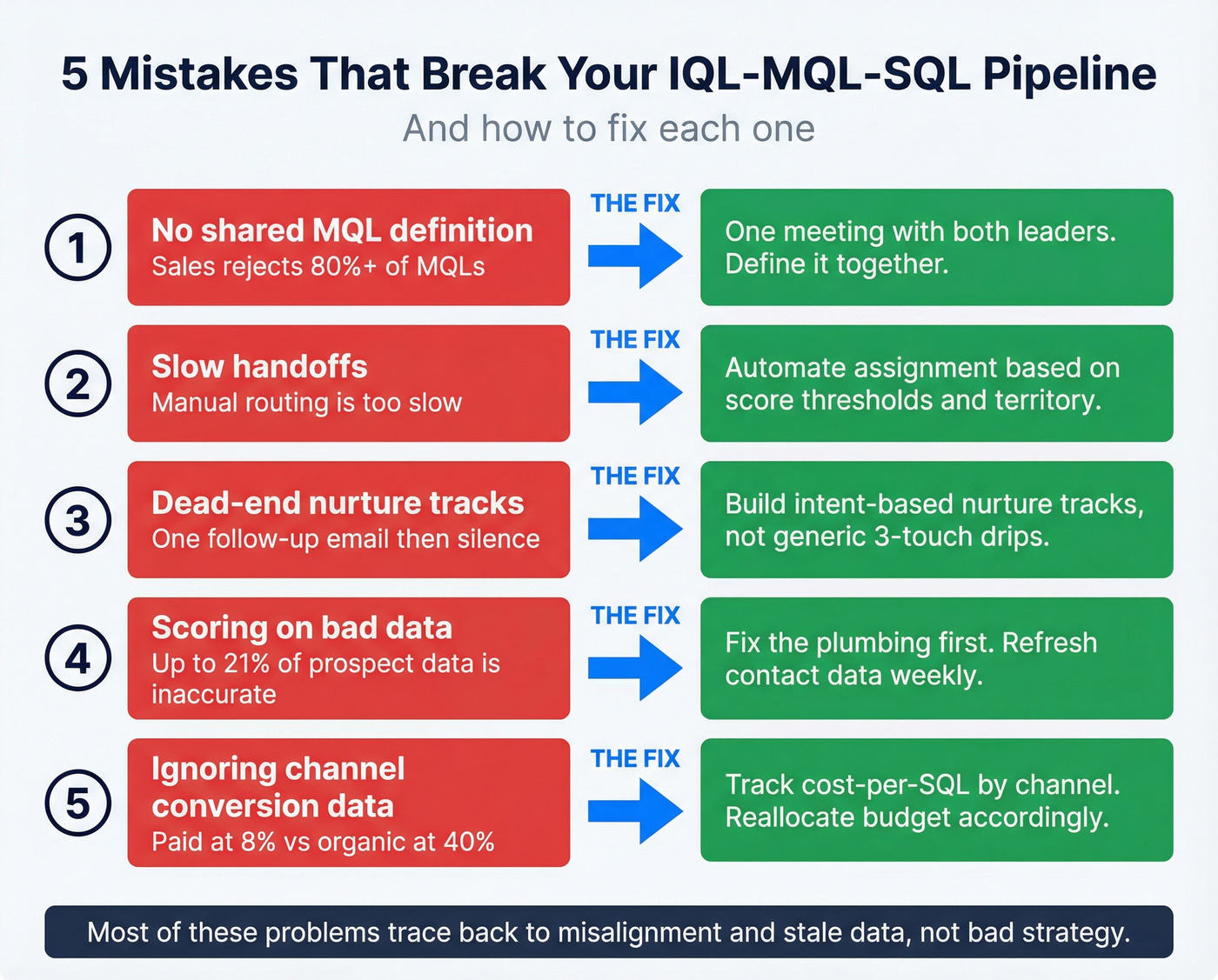
2. Slow handoffs. If routing is manual, it's too slow. Automate lead assignment based on score thresholds and territory rules.
3. Dead-end nurture tracks. If someone downloads a whitepaper and gets one follow-up email, then silence - that's your problem. Build intent-based nurture tracks, not generic drip sequences that peter out after three touches.
4. Scoring on bad data. When CRM, marketing automation, and intent tools aren't connected, nobody knows which touchpoints drove the SQL. And when up to 21% of prospect data is inaccurate, lead scoring becomes theater. Fix the plumbing before you optimize the funnel - a Director who got promoted to VP last month should actually score as a VP.
If you're rebuilding your stack, start with data enrichment and compare vendors in our guide to data enrichment services.
5. Ignoring channel-level conversion data. Not all lead sources are equal. If your paid leads convert at 8% while organic converts at 40%, your budget allocation is wrong - not your qualification criteria. Skip the vanity metrics and look at cost-per-SQL by channel instead.
This is where lead generation metrics and broader funnel metrics keep teams honest.
Is the MQL Dead?
The critique is real: forcing every prospect into a one-size-fits-all MQL category based on form fills doesn't reflect how modern buyers research. The consensus on r/sales and r/marketing leans toward "MQLs are broken," and there's truth in that frustration.
But MQLs aren't dead. The meaningful metric isn't MQL volume - it's MQL-to-SQL conversion quality. If your MQLs convert at 13%+ and sales accepts them, the framework is working.
Let's be honest: static MQLs based on content downloads alone are dead. The concept of a marketing-qualified stage isn't going anywhere - you just need to feed it intent data and behavioral signals instead of form fills. That's the difference between a lead stage that creates alignment and one that creates arguments.
If you're trying to spot those signals earlier, use a structured approach to identifying buying signals and intent based segmentation.
Scoring a Director +25 points only works if they're still a Director. With up to 21% of prospect data inaccurate, your IQL-to-MQL-to-SQL pipeline leaks silently. Prospeo's 7-day refresh cycle and 5-step verification keep every record current - for roughly $0.01 per email.
Clean data turns your scoring model from theater into pipeline.
FAQ
What's the difference between IQL and MQL?
An Information Qualified Lead is in the education stage - consuming content and building familiarity. An MQL matches your target profile and has taken higher-intent actions like visiting pricing pages or requesting demos. The gap is demonstrated intent, not engagement volume. IQLs need nurturing; MQLs need a sales conversation.
What's a good MQL-to-SQL conversion rate?
For B2B SaaS, 13% is the benchmark. eCommerce averages 23%, and business insurance hits 26%. Below 10% typically means your teams disagree on what "qualified" means - fix the shared definition before optimizing anything else.
How do you keep lead scoring accurate over time?
Review criteria quarterly, include negative scoring for inactivity (-10 points after 30 days of silence), and keep contact data current with a tool that refreshes records weekly. Enrichment APIs that return 50+ data points per contact help ensure scores stay aligned with real-time job titles and company data rather than stale CRM records.
Do you need all three stages - IQL, MQL, and SQL?
Most B2B teams with deal sizes above $5K benefit from all three stages. Smaller transactional sales can often collapse IQL and MQL into a single "marketing lead" bucket. The key is matching funnel complexity to your sales cycle length - a 90-day enterprise deal needs more qualification gates than a self-serve signup.