

Lead Enrichment for Sales: Benchmarks, Tools, and the Mistakes Killing Your Pipeline
You send 500 cold emails on Monday. By Wednesday, 47 bounce - a 9.4% bounce rate. Your sender reputation tanks, sequences stall, and deals that should've closed inside the 50-day window where win rates hit 47% slip past the threshold where they drop below 20%. That's what happens when your sales data goes stale and nobody verifies it. The fix isn't complicated, but most teams get it wrong.
The Cheat Sheet
- Enrichment = matching a lead to a record, appending missing fields, verifying the data, and syncing it to your CRM.
- Your data rots ~22.5% per year. Roughly 2.1% per month. If you're not refreshing monthly, you're emailing ghosts.
- Single-source enrichment gets you 40-50% contact coverage. Waterfall enrichment pushes that to 80%+.
- Verification isn't optional. Keep total bounces under 2%, hard bounces under 1%. (If you're troubleshooting, start with bounce rate benchmarks.)
What Lead Enrichment Actually Is
This isn't generic data cleaning. Lead enrichment for sales improves the records your reps actively work - giving them enough context to personalize outreach and enough accuracy to actually reach the person. If you want the broader framework and benchmarks, see our lead enrichment guide.
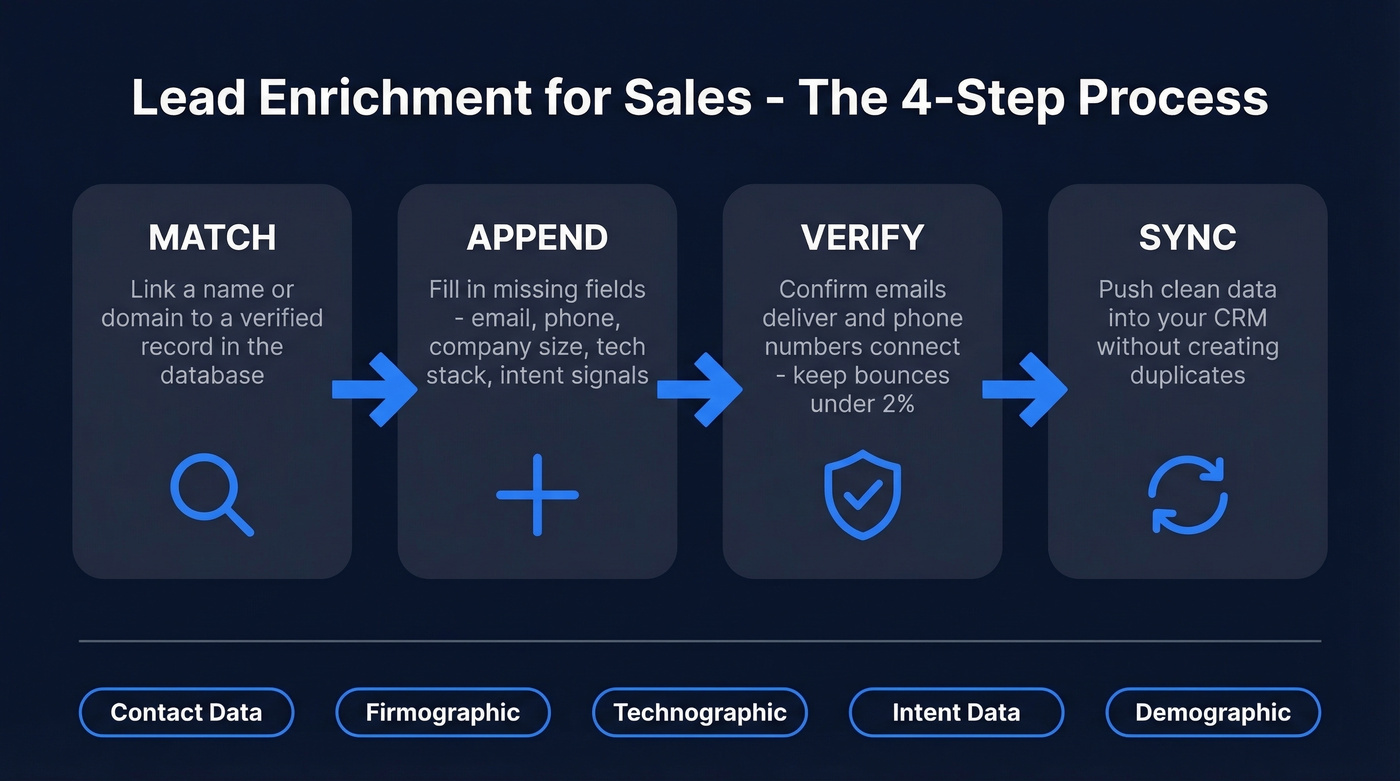
Four steps: match a name or domain to a verified record, append missing fields, verify that emails deliver and phones connect, and sync clean data into your CRM without creating duplicates.
The data falls into categories. Contact data covers emails, direct dials, and mobiles. Firmographic data includes company size, revenue, industry, and funding stage. Technographic data reveals what tools a company runs. Intent data signals active research behavior. Demographic data - title, seniority, department - helps route leads to the right rep. Most enrichment tools handle the first three well; intent and behavioral data are where premium tools pull ahead. (If you're building filters, firmographic and technographic data is the practical starting point.)
The Data Decay Problem
One number should keep RevOps teams up at night: B2B contact data decays 22.5% annually, roughly 2.1% per month. That benchmark comes from Dun & Bradstreet. If you're hiring for this function, here's what a RevOps manager typically owns.
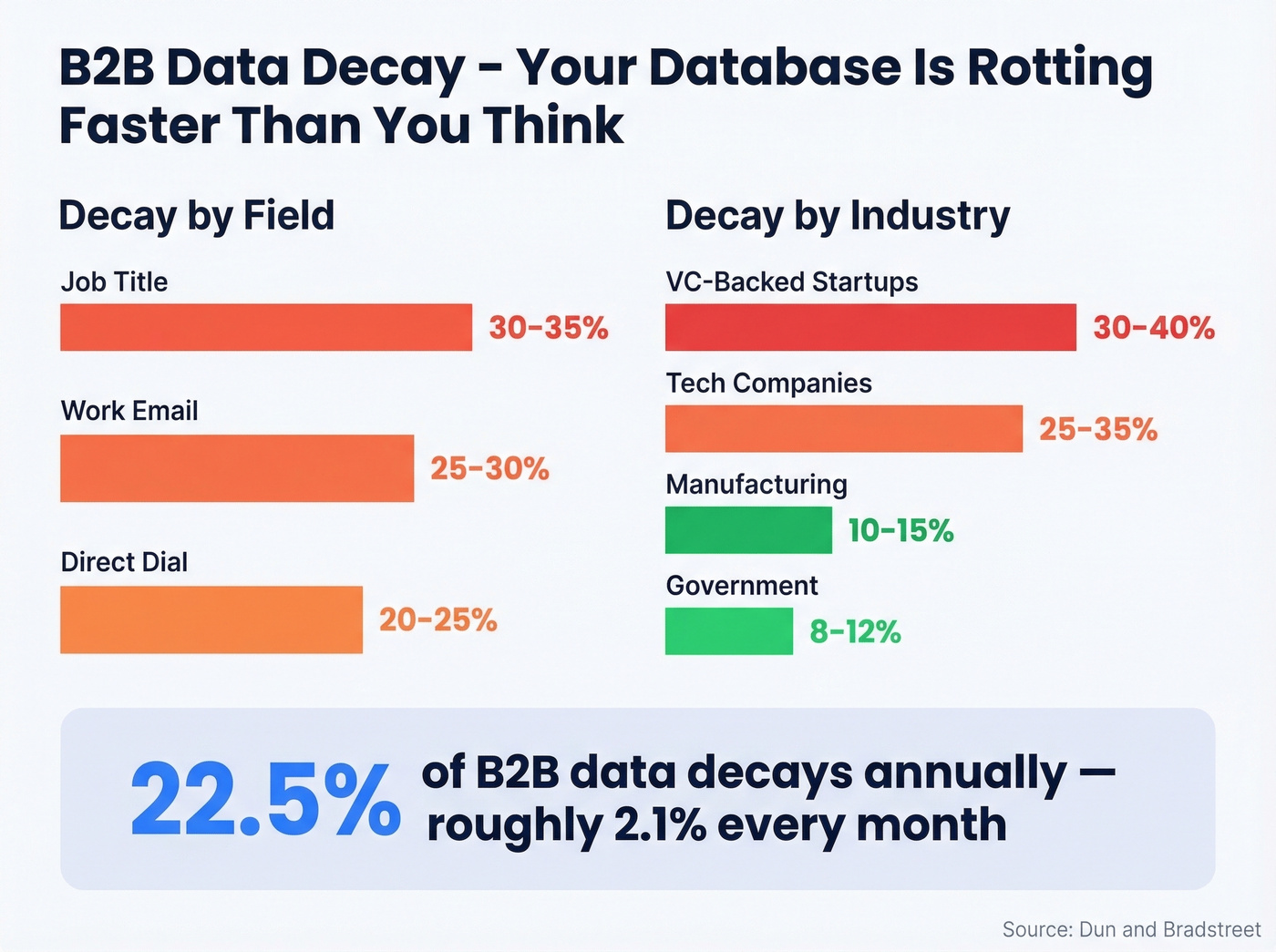
Here's the thing - that 22.5% measures overall data decay, records becoming completely unusable. A separate metric is even more alarming: 70.8% of business contacts experience at least one field-level change within 12 months. Different measurements, same conclusion. Your database is rotting faster than you think.
Some fields rot faster than others:
| Field | Annual Decay Rate |
|---|---|
| Work email | 25-30% |
| Direct dial | 20-25% |
| Job title | 30-35% |
Industry matters enormously. Tech companies see 25-35% annual decay. VC-backed startups hit 30-40% because people change roles constantly. Manufacturing sits at 10-15%, government at 8-12%.
The macro cost is staggering - IBM pegged the annual cost of poor data quality at $3.1 trillion. At the org level, that translates to $12.9-$15M per year in wasted effort, missed deals, and operational friction. For revenue teams, this decay is the single biggest threat to pipeline health. (To quantify the impact, track pipeline health alongside deliverability.)
Single-Source vs. Waterfall Enrichment
Let's be honest: most teams under 20 reps don't need waterfall enrichment. They need a single accurate source. But the data on waterfall is compelling enough that you should understand the tradeoff. If you're comparing vendors, start with data enrichment services.
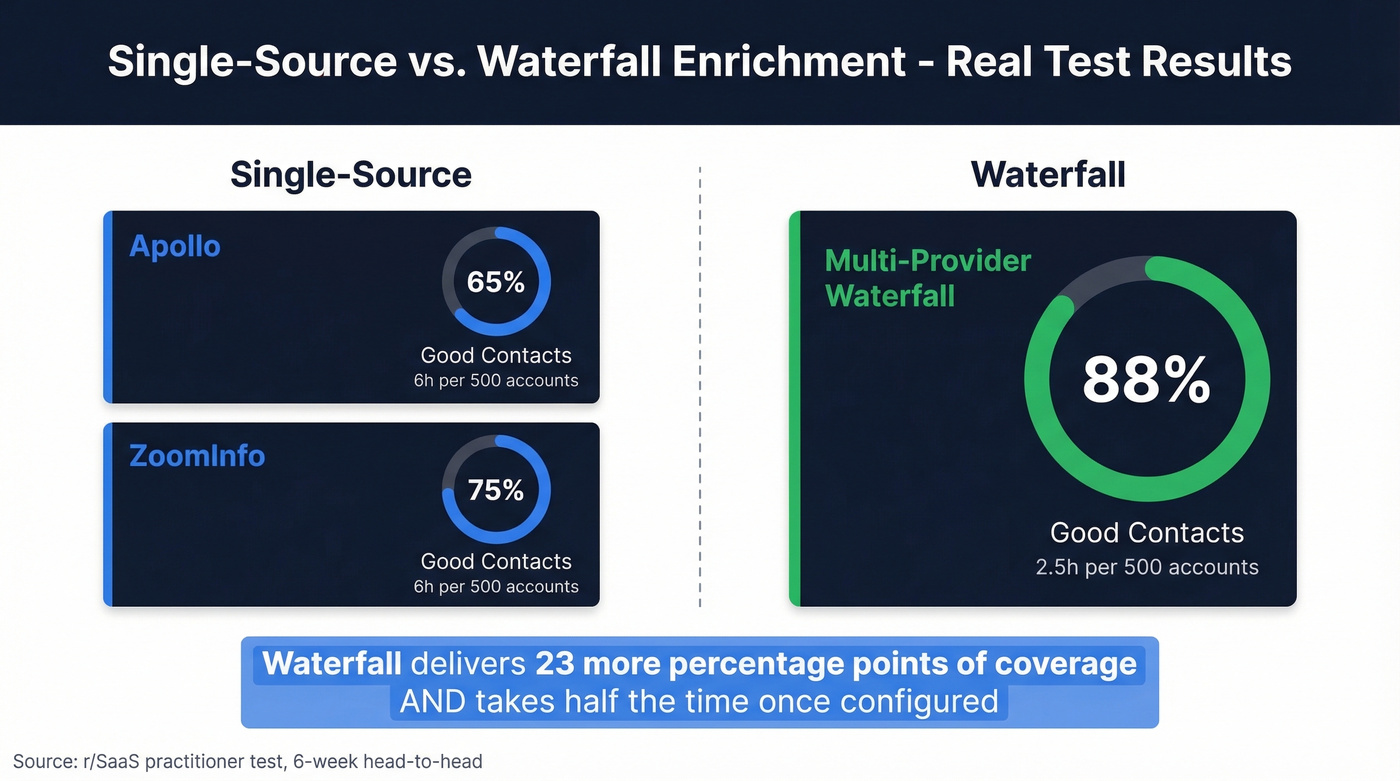
A single provider queries one database. If the contact isn't there or the data's stale, you get nothing. Waterfall enrichment queries multiple providers sequentially until it finds a verified match. (If you're building this in Clay, see Clay list building.)
We pulled actual numbers from a practitioner who ran a 6-week head-to-head test on r/SaaS - something you won't find in vendor marketing:
| Approach | Good Contacts | Time per 500 Accounts |
|---|---|---|
| Apollo (single) | ~65% | 6h |
| ZoomInfo (single) | ~75% | 5.5h |
| Waterfall | ~88% | 2.5h |
That's a 23-point coverage gap between Apollo alone and a waterfall setup - and the waterfall was faster once configured. But waterfall isn't free of risk. Cognism has flagged compliance concerns: mixing providers can create data conflicts and raise GDPR/CCPA questions depending on data origins.

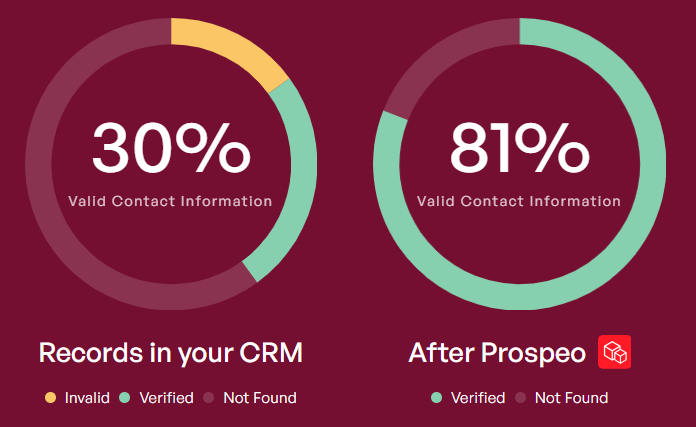
Single-source enrichment caps you at 50% coverage. Stale data costs you the other half. Prospeo's 7-day refresh cycle and 98% email accuracy mean your reps reach real buyers - not ghosts. At $0.01 per email, you get enterprise-grade enrichment without the enterprise contract.
Stop enriching leads with data that's already 6 weeks old.
What Enrichment Costs
Enrichment pricing is confusing on purpose. Here's what you'll actually pay. If you're evaluating sources, compare against sales prospecting databases.
| Tool | Pricing Model | Starting Price | Enterprise Range |
|---|---|---|---|
| Prospeo | Credits | Free (75 emails/mo); ~$0.01/email | Custom |
| Apollo | Per-seat | Free; $59/user/mo | $149/user/mo |
| Clay | Per-seat + credits | Free (100 credits); $149/user/mo | $800+/user/mo |
| ZoomInfo | Custom enterprise | ~$15K/year | $25K-$40K+/year |
| Cognism | Custom | ~$1K-$3K/mo | Custom |
| Lusha | Per-seat | Free; ~$29-$59/user/mo | Custom |
| Clearbit | Custom (HubSpot) | ~$12K-$80K/year | Volume-based |
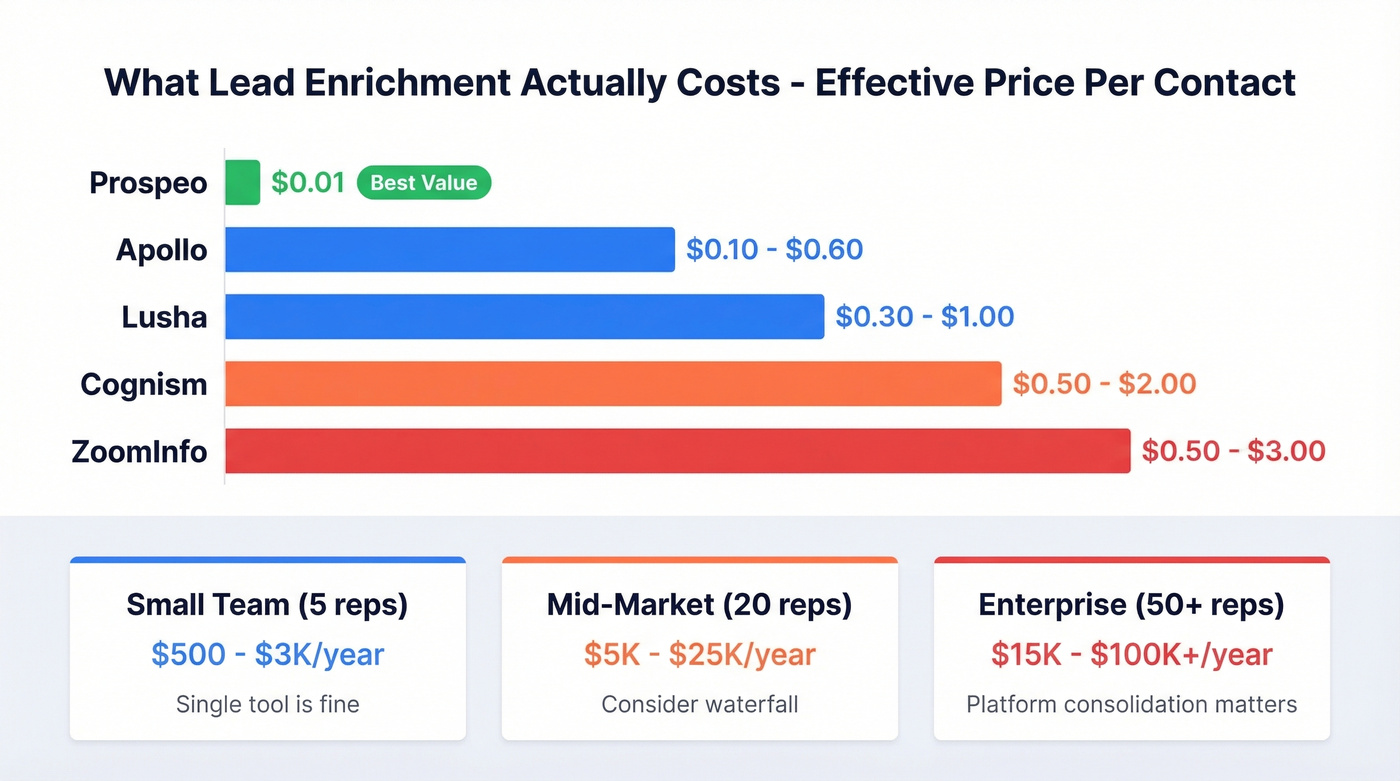
The effective cost per enriched lead tells the real story. Prospeo runs about $0.01 per email. Apollo typically lands around $0.10-$0.60 per contact depending on plan and export volume. ZoomInfo's effective cost-per-contact is usually $0.50-$3.00 once you factor in platform fees and seat licenses. For a mid-market team, enterprise tools run $15K-$100K+ per year.
Best Enrichment Tools for Sales Teams
| Tool | Best For | Email Accuracy | Pricing | Skip If |
|---|---|---|---|---|
| Prospeo | Accuracy + self-serve | 98% | Free; ~$0.01/email | You need built-in sequencing |
| Apollo | All-in-one SMBs | ~80% | Free-$149/user/mo | Bounce rate matters a lot |
| Clay | Custom waterfall | Varies by source | Free-$800+/user/mo | No RevOps person on staff |
| ZoomInfo | Enterprise (50+ reps) | ~85% | $15K-$40K+/year | Budget under $15K |
| Cognism | EMEA-focused teams | ~90% | ~$1K-$3K/mo | US-only market |
| Lusha | Individual reps | Not tested | Free; ~$29-$59/user/mo | You need bulk workflows |
| Clearbit | HubSpot-native teams | ~85% | ~$12K-$80K/year | Not on HubSpot |
Prospeo - Best for Accuracy
Prospeo's database covers 300M+ profiles with 143M+ verified emails and 125M+ verified mobile numbers. The 98% email accuracy comes from a proprietary 5-step verification process - catch-all handling, spam-trap removal, honeypot filtering - all built on infrastructure Prospeo owns end to end. Verification results aren't dependent on another vendor's uptime or data quality. (If you're auditing deliverability, use an email deliverability guide to spot upstream issues.)
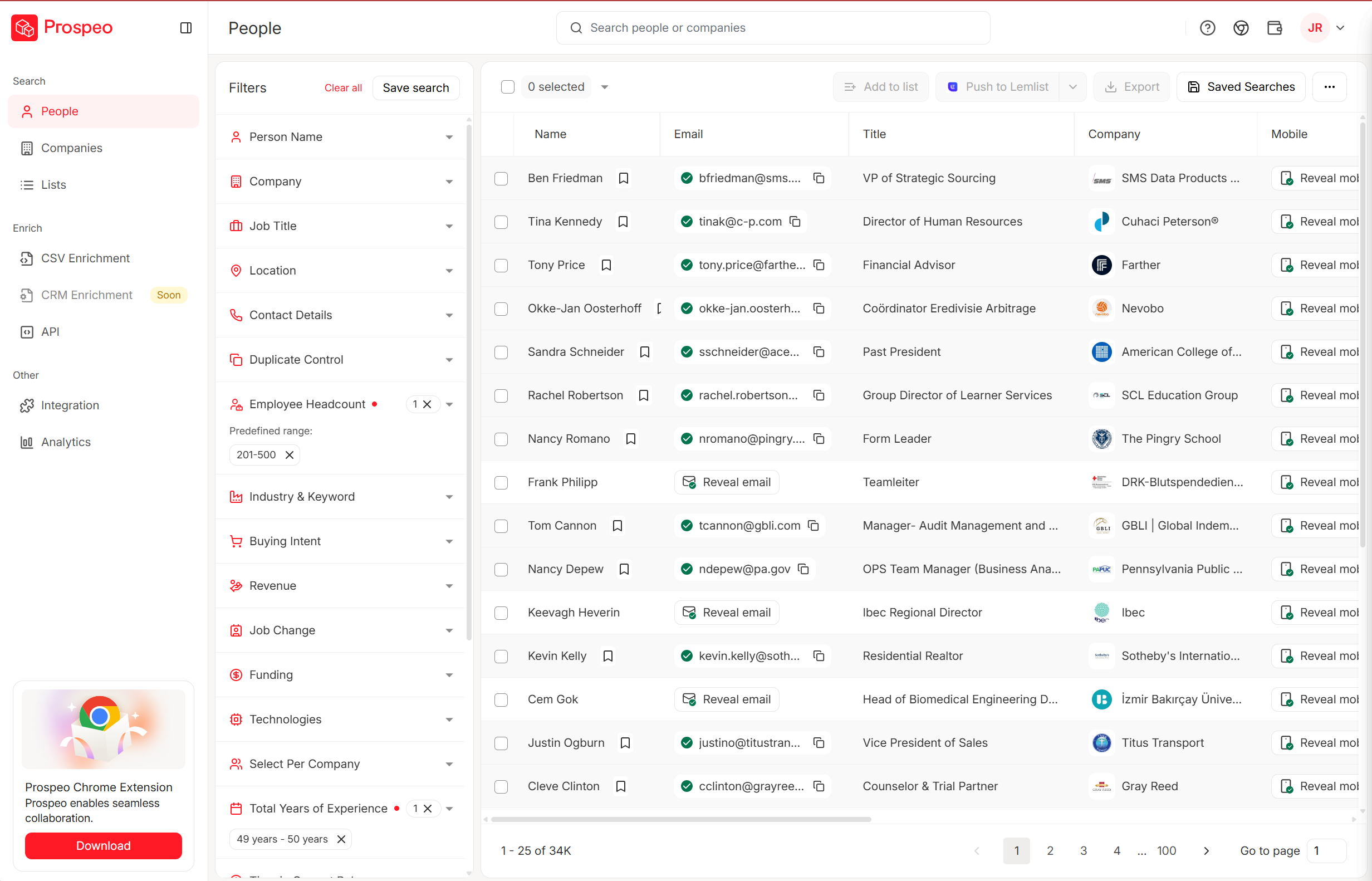
The 7-day data refresh cycle is the standout feature. While competitors update every 4-6 weeks, Prospeo catches job changes and email rotations before they cause bounces. Native integrations push directly into Salesforce, HubSpot, Clay, Smartlead, Instantly, Lemlist, Zapier, and Make. Real results: Meritt dropped their bounce rate from 35% to under 4% and tripled pipeline from $100K to $300K per week. Snyk's 50-person AE team saw AE-sourced pipeline jump 180% with 200+ new opportunities per month.
Prospeo doesn't include a built-in sequencer - pair it with Instantly or Lemlist for outbound. (If you're standardizing outreach, keep sequence management tight so clean data stays clean.)
Apollo - The Reddit Favorite (With Caveats)
The #1 thing you'll hear about Apollo on Reddit: "I love it until the emails bounce." That captures the tool perfectly.
Apollo's free tier is genuinely useful, and having database plus sequencing in one platform eliminates tool sprawl. The tradeoff is accuracy. In practitioner testing, Apollo delivered roughly 65% good contacts - a third of your list needs cleanup or secondary verification. Threads on r/coldemail consistently flag that "verified" emails still bounce at higher rates than expected. If speed-to-first-sequence matters more than deliverability perfection, Apollo is the obvious starting point. If you're sending 1,000+ emails daily, it's not enough on its own.
Clay - Power Tool, Power User Required
Clay lets you orchestrate 75+ data providers into custom waterfall workflows, chain providers, score leads with custom logic, and build enrichment sequences no single database can match. It's the most flexible enrichment tool on the market.
It's also the easiest to waste money on. Reddit users consistently warn that Clay burns credits fast if workflows aren't designed carefully, and you'll need a separate sending tool since Clay doesn't do outbound. The free tier gives you 100 credits/month to experiment; serious usage starts at $149/user/month. Without a RevOps person to build and maintain workflows, Clay is an expensive spreadsheet. Skip it if that's you.
ZoomInfo - Deep Data, Deep Pockets
ZoomInfo's US database depth is still the deepest in the market, and the intent data suite is genuinely useful for ABM. Tested email accuracy sits around 85%. For teams running 50+ reps, the platform consolidation alone can justify the cost.
But Reddit's #1 complaint is price - specifically, paying for modules you never activate. At $15K-$40K+/year, you're locked into annual contracts with limited flexibility. The UI is consistently called "clunky," and even at enterprise scale, teams report needing manual cleanup. If your average deal size is under five figures, you almost certainly don't need ZoomInfo-level infrastructure.
Cognism - Strong for EMEA
Cognism's European coverage is stronger than most US-first providers. Tested email accuracy runs around 90%, and custom pricing starts around $1K-$3K/month for small teams. If your market is primarily North America, Cognism's US data doesn't match ZoomInfo's depth - but for European selling, it's a strong option.
Lusha and Clearbit
Lusha is a lightweight Chrome extension for individual reps who need quick lookups. It's a spot-check tool, not a pipeline engine.
Clearbit has been absorbed into HubSpot's ecosystem. If you're already on HubSpot CRM, the native enrichment is convenient at roughly $12K-$80K/year depending on volume and plan. If you're not on HubSpot, there's no reason to consider it.
Meritt cut their bounce rate from 35% to under 4% and tripled pipeline to $300K/week. Snyk's 50 AEs generated 200+ new opportunities per month. The difference: 143M+ verified emails, 125M+ verified mobiles, and a 5-step verification process that catches bad data before it wrecks your sender reputation.
Enrich your pipeline with data that actually connects to real buyers.
Enrichment Mistakes That Kill Pipeline
We've watched these five patterns destroy pipeline across dozens of teams. Many of these show up as classic sales pipeline challenges.
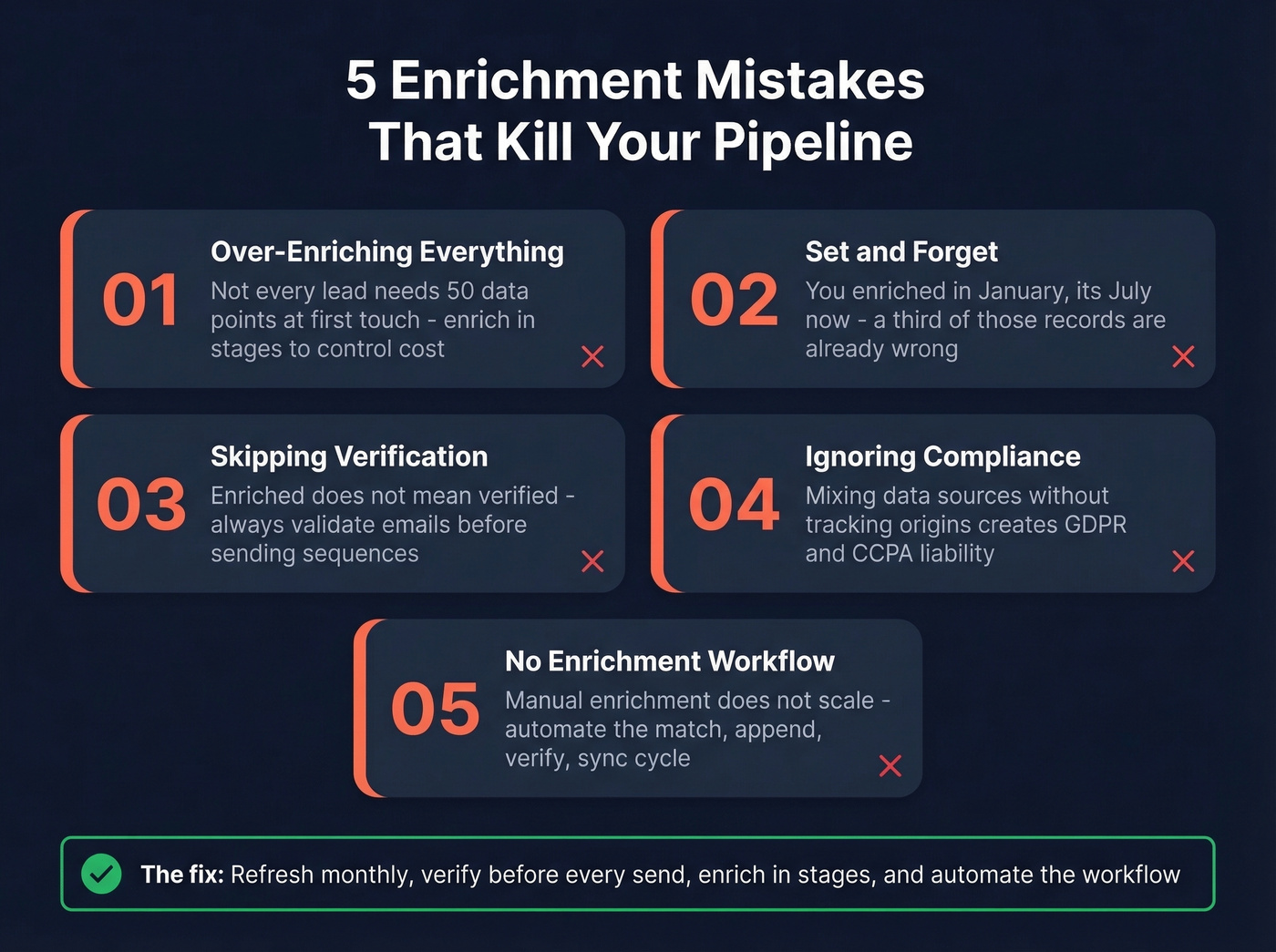
Over-enriching everything. Not every lead needs 50 data points at first touch. Enrich in stages - basic contact data at capture, firmographics at MQL, full enrichment at opportunity. This controls cost and keeps your CRM from becoming a data landfill.
Set-and-forget. You ran enrichment once in January. It's now July. A third of those records have decayed. Build a refresh cadence - monthly at minimum, weekly if your tool supports it. Smart workflows automate this so no rep has to remember to trigger it manually.
Skipping verification. Enrichment without verification is useless. An enrichment tool can append an email that looks valid but bounces on send. Keep total bounces under 2%, hard bounces under 1%. If your provider doesn't verify in real time, run every list through a dedicated verification step before it hits your sequencer.
Enriching at the wrong funnel stage. Blasting full enrichment on every inbound form fill wastes credits. Tier 1 data at capture, progressive enrichment as leads qualify. I've seen teams burn through their entire monthly credit allotment in the first week because they enriched every webinar registrant with 50+ fields on day one.
Poor CRM integration. The ZoomInfo-to-Clay migration thread on r/sales captures this perfectly - teams love the enrichment power but struggle with the handoff into HubSpot or Salesforce. If your enrichment tool creates duplicates or overwrites good data, the accuracy gains are meaningless.
How Enrichment Drives Higher Close Rates
The connection between enrichment quality and revenue is direct. When reps reach the right person with accurate contact info and relevant context, conversations start faster and deals progress with less friction. If you're tightening the full motion, map enrichment to your sales process optimization.
Consider the math: if a third of your outreach goes to bad data, your reps spend a third of their effort on leads that will never convert. Fixing that single variable - just getting clean, verified contact data into reps' hands - can improve sales productivity more than any new playbook or training program. The teams we see winning aren't necessarily better at selling. They're better at making sure every rep-hour goes toward a reachable, qualified contact.
Compliance You Can't Ignore
GDPR penalties had already totaled [EUR]5.65B by early 2025, and the number keeps climbing. The practical framework is straightforward. EU and UK personal emails require explicit opt-in; work emails are generally permissible under legitimate interest. US work emails are allowed with opt-out mechanisms under CAN-SPAM. Gmail and Yahoo require senders to stay below a 0.3% spam complaint rate or your domain gets throttled. Map every record by data type, region, and purpose - a US work email for sales outreach is green, an EU personal mobile for cold calling is red.
FAQ
What's the difference between lead enrichment and lead scoring?
Enrichment adds missing data fields to a contact record; scoring assigns a numerical value based on fit and engagement signals. You can't score what you don't have - enrichment feeds scoring models with the firmographic and technographic inputs they need.
How often should I refresh enrichment data?
Monthly at minimum for most B2B segments. Tech and startup verticals decay 30-40% annually, so weekly refresh cycles are ideal for those high-churn segments.
Is lead enrichment GDPR compliant?
Yes, when you use GDPR-compliant sources, suppress EU personal emails without consent, and honor opt-outs promptly. Choose providers with DPAs available and transparent data sourcing policies.
Do I need separate verification after enrichment?
If your enrichment tool doesn't verify in real time, absolutely. Unverified data can bounce at 5-10%+ and tank sender reputation within days. Some tools verify during enrichment; others require a separate step.
Can small teams afford lead enrichment for sales?
Yes. Enterprise platforms start at $15K/year, but self-serve tools offer free tiers and pricing as low as $0.01 per email with no contracts. Even a two-person SDR team can run effective enrichment without blowing their budget.