

How to Build a Lead Gen System That Actually Produces Revenue
Your VP of Sales just asked why the team booked 200 demos last quarter but only closed 12 deals. The answer isn't "we need more leads." The answer is you don't have a lead gen system - you have a collection of tools with no connective tissue. Modern B2B buyers require 70+ touchpoints across six channels before they're ready to buy, and a pile of disconnected SaaS subscriptions won't get you there.
A lead gen system is the architecture that connects strategy, data, scoring, sequencing, and measurement into a single revenue-producing machine. Let's build one.
The Starter Stack
A functional lead generation system has six layers: capture, CRM, data enrichment, sequencing, automation, and analytics. You need 4-6 tools, not 20. Start with revenue goals, not software demos.
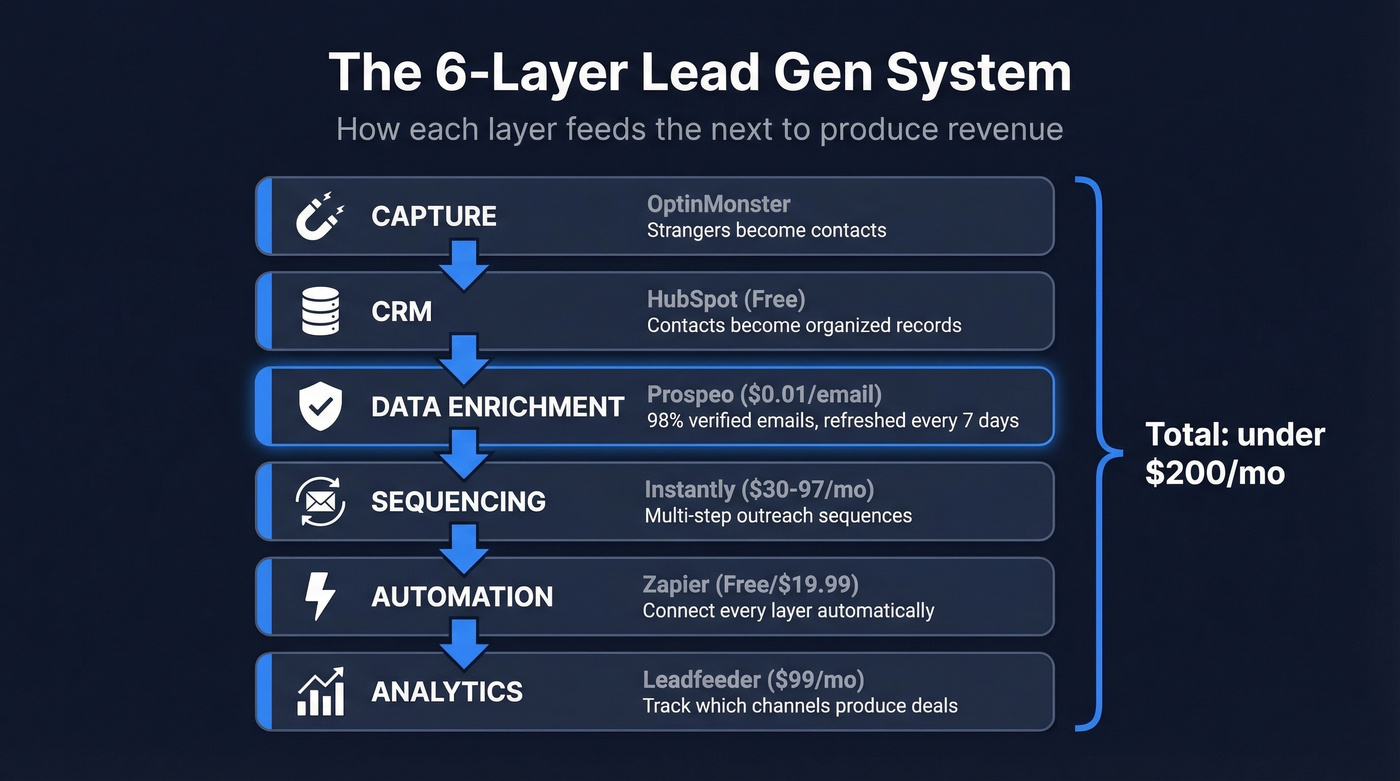
The biggest system killer is bad data. If your contact list bounces 25% on the first sequence, nothing downstream matters - not your copy, not your cadence, not your scoring model. (If you're troubleshooting this, start with bounce rate benchmarks and root causes.)
Here's the starter stack we'd recommend for most SMB teams:
- CRM: HubSpot (free tier)
- Data enrichment & verification: Prospeo (~$0.01/email, free tier available) (see data enrichment services)
- Sequencing: Instantly (~$30-97/mo) (compare more outbound lead generation tools)
- Automation: Zapier (free / $19.99/mo)
- Scheduling: Calendly (free)
- Analytics: Leadfeeder ($99/mo, free tier available)
Total cost for a functional system: under ~$200/month.
Start With Revenue Goals
Most teams pick tools first and figure out strategy later. That's backwards. Start with the number: how much qualified pipeline do you need, and what does a qualified lead look like?
Define three things before you touch a single tool. An MQL (marketing qualified lead) meets your firmographic criteria and has shown interest. An SQL (sales qualified lead) has been vetted by a rep and has budget, authority, and timeline. A PQL (product qualified lead) has used your product and hit activation thresholds. If your team can't agree on these definitions, your system will produce noise instead of revenue.
Then build your offer ladder around buyer readiness:
| Funnel Stage | Offer Types | Buyer Intent |
|---|---|---|
| TOFU | Guides, checklists, blogs | Awareness |
| MOFU | Webinars, case studies | Evaluation |
| BOFU | Audits, consultations | Decision |
56% of leads aren't ready to buy when they first enter your funnel. If your system only handles bottom-of-funnel leads, you're ignoring the majority of your opportunities. (This is where lead generation workflow design matters.)
Define Your ICP and Buying Committee
Your ICP isn't "Series B SaaS companies with 50-200 employees." That's a starting point. A real ICP includes firmographic criteria - industry, headcount, revenue, tech stack - and behavioral signals like hiring patterns, funding events, and intent data spikes. If you need a starting point, use an ideal customer profile template.
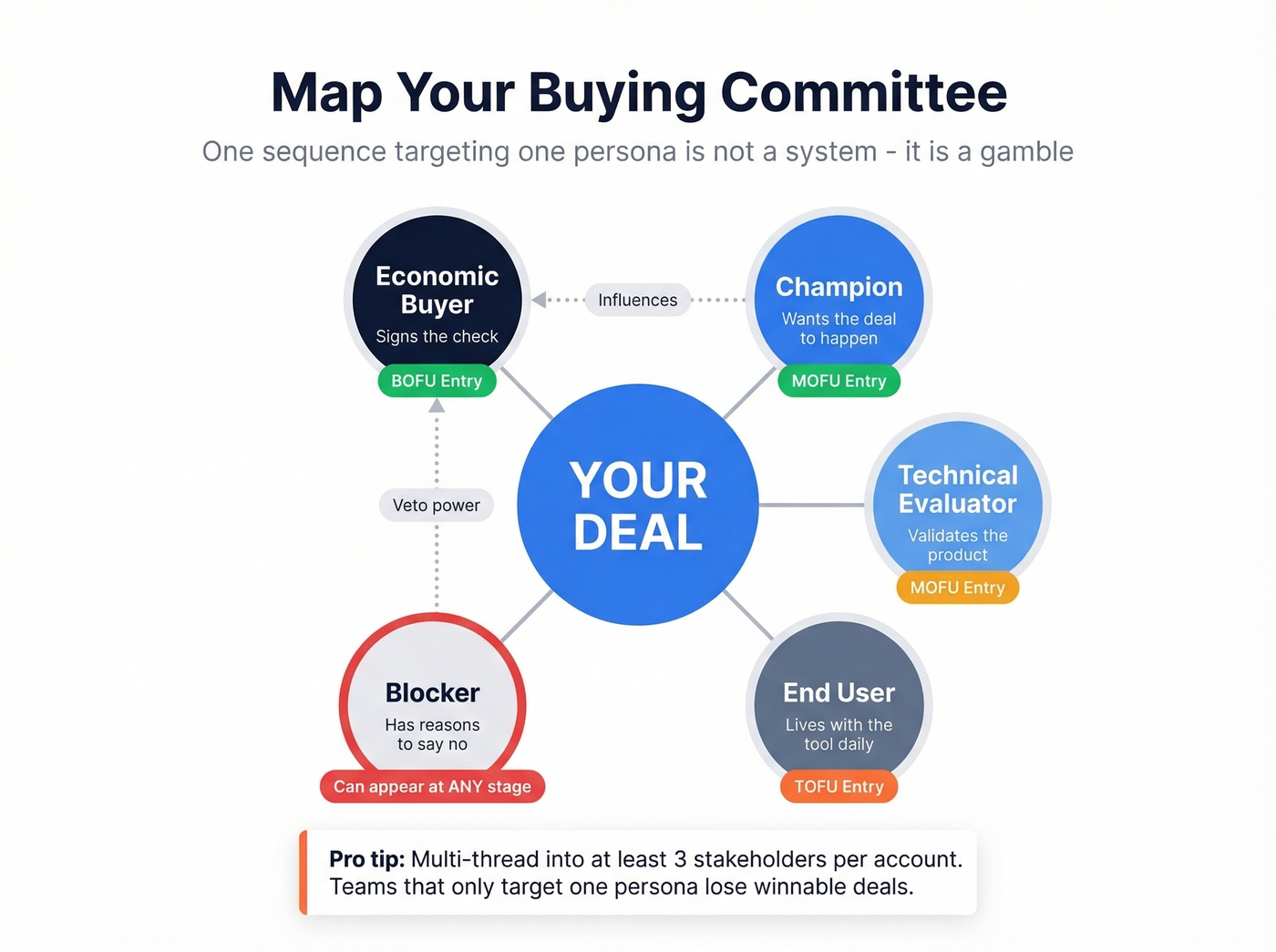
Break your ICP into sub-segments. A 75-person fintech that just raised a Series B has different pain points than one that's been bootstrapped for eight years. Then map the buying committee:
- Economic buyer - signs the check (see MEDDPICC economic buyer)
- Champion - wants the deal to happen
- Technical evaluator - validates the product
- End user - lives with the tool daily
- Blocker - has reasons to say no
Which stakeholders enter at which stage? Who has veto power? We've seen teams with great outbound sequences lose deals simply because they never multi-threaded into the CFO's office. One sequence targeting a single persona isn't a system - it's a gamble.
Assemble Your Tech Stack
A lead gen system isn't one tool - it's a connected stack where each layer feeds the next.
| Layer | Recommended Tool | Starting Price | Free Tier |
|---|---|---|---|
| Lead Capture | OptinMonster | ~$7/mo | No |
| CRM | HubSpot | $0 (free CRM) | Yes |
| Data Enrichment | Prospeo | ~$0.01/email | Yes (75/mo) |
| Sequencing | Instantly | ~$30-97/mo | No |
| Automation | Zapier | $19.99/mo | Yes |
| Analytics | Leadfeeder | $99/mo | Yes |
Lead Capture
This is where strangers become contacts. OptinMonster handles pop-ups and exit-intent forms. Leadpages ($37/mo) builds dedicated landing pages. Pick one - you don't need both.
CRM
Sales teams on Reddit endlessly debate whether to start with HubSpot free or Pipedrive. The answer depends on whether you need marketing automation (HubSpot) or pure pipeline management (Pipedrive at $14/seat/mo). For most teams building their first system, HubSpot's free CRM wins because it handles contact management, deal tracking, and built-in reporting without costing a dime. Zoho CRM ($14/user/mo) works if you're already in the Zoho ecosystem. If you're evaluating options, start with these examples of a CRM.

Data Enrichment & Verification
Here's the thing: this is the layer where most systems break. Your sequencing tool is only as good as the data feeding it, and bad emails don't just bounce - they destroy your sender reputation. (If you're seeing deliverability issues, use an email deliverability guide and then work on improve sender reputation.)
Prospeo covers 300M+ professional profiles with 98% email accuracy, 143M+ verified emails, and 125M+ verified mobile numbers. The industry average for email accuracy hovers around 85-87%, meaning 13-15 out of every 100 emails bounce. At scale, that's a domain reputation problem. Data refreshes every 7 days versus the ~6-week cycle most competitors run, and intent data tracking across 15,000 topics lets you prioritize accounts actively researching solutions like yours.

The proof: Meritt went from a 35% bounce rate to under 4% after switching, and their pipeline tripled from $100K to $300K per week. The free tier gives you 75 verified emails and 100 Chrome extension credits per month - enough to test before committing.
Sequencing & Outreach
Instantly (~$30-97/mo) and Lemlist (~$30-97/mo) are the two strongest options for cold email. Both handle multi-step sequences, warmup, and basic personalization. Smartlead (~$39/mo and up) is a solid third option if you're running multiple sender accounts at scale. For structure, use a proven B2B cold email sequence.
Skip Smartlead if you're a solo founder or small team - the multi-inbox management adds complexity you don't need yet.
Automation & Orchestration
Zapier connects your stack. New lead in HubSpot, enrich the contact, add to Instantly sequence, notify rep in Slack. That's a four-step Zap that takes 15 minutes to build. Make is a cheaper alternative for complex workflows. Clay (~$149/mo) is powerful for waterfall enrichment with AI agents, but watch costs at scale - teams regularly get surprised by credit burn once they start running multi-step enrichment flows.
Analytics & Tracking
Leadfeeder ($99/mo, free tier available) identifies companies visiting your site. Google Analytics (free) tracks source attribution. Together, they tell you which channels produce deals, not just traffic.

Bad data is the #1 system killer - you just read why. Prospeo's 5-step verification delivers 98% email accuracy and refreshes every 7 days, not 6 weeks. Meritt cut their bounce rate from 35% to under 4% and tripled pipeline to $300K/week. Your lead gen system deserves the same foundation.
Start with 75 free verified emails and see the difference in your first sequence.
Implement Lead Scoring
Lead scoring separates signal from noise. Without it, your reps treat every lead the same and waste hours on people who'll never buy.
Use scoring if you're receiving several dozen leads per week and reps can't manually qualify every one. Skip scoring if you're getting fewer than 20 leads per week - manual qualification works fine at that volume and gives you the pattern recognition you'll need later.
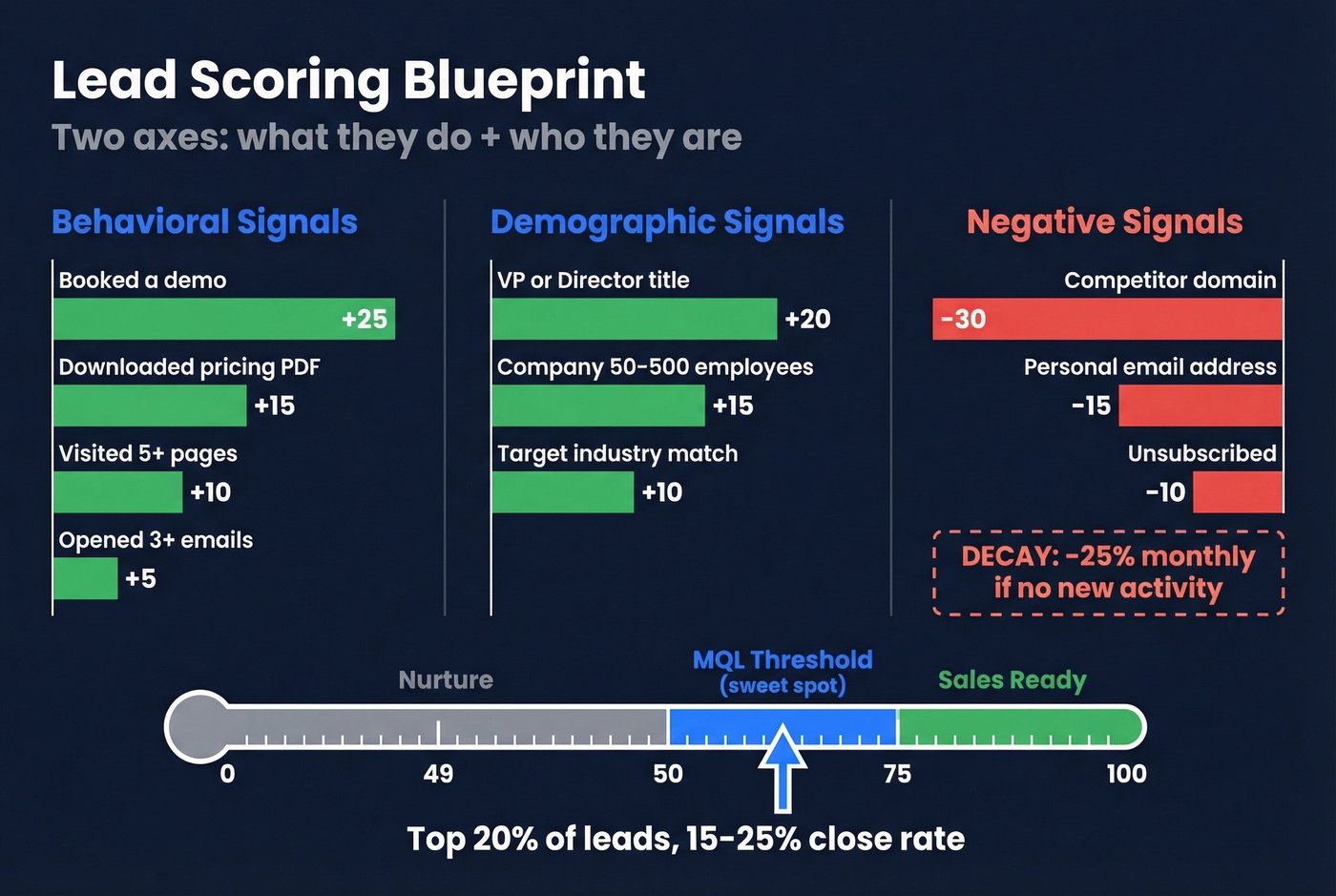
Build your model around two axes: behavioral (what they do) and demographic (who they are). For a deeper build, see lead scoring.
| Signal Type | Example | Points |
|---|---|---|
| Behavioral | Booked a demo | +25 |
| Behavioral | Downloaded pricing PDF | +15 |
| Behavioral | Visited 5+ pages | +10 |
| Demographic | VP/Director title | +20 |
| Demographic | Company 50-500 FTEs | +15 |
| Negative | Competitor domain | -30 |
| Negative | Personal email | -15 |
| Decay | No activity 30 days | -25% |
Set your MQL threshold at 50-75 points on a 100-point scale. That typically captures the top 20% of leads and yields 15-25% conversion rates from qualified leads to closed deals. Apply a 25% monthly decay to scores without new activity - a lead who was hot in January and silent since isn't hot in April.
Don't forget negative scoring. Competitors researching your product, personal Gmail addresses, and unsubscribes should all subtract points. The goal is to surface the leads most likely to close, not the leads most likely to browse.
Benchmarks That Matter
You can't optimize what you don't measure. Here are the numbers your system should track against.
Conversion rates by industry (First Page Sage's latest benchmark report):
| Industry | Avg. Conversion Rate |
|---|---|
| B2B SaaS | 1.1% |
| IT & Managed Services | 1.5% |
| Manufacturing | 2.2% |
| Legal Services | 7.4% |
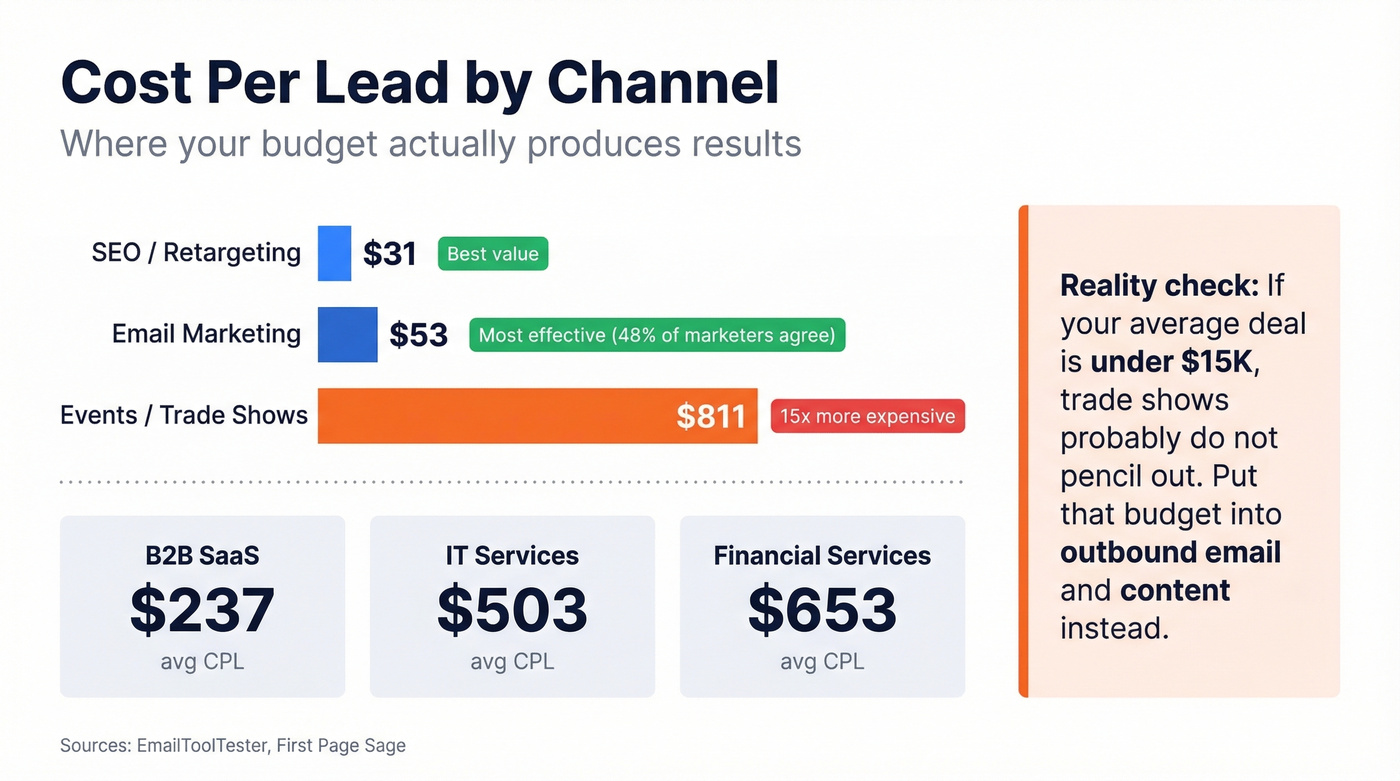
Cost per lead by channel (EmailToolTester):
| Channel | Avg. CPL |
|---|---|
| SEO / Retargeting | $31 |
| Email Marketing | $53 |
| Events / Trade Shows | $811 |
Industry CPL varies wildly: B2B SaaS averages $237, IT runs $503, Financial Services hits $653. If you're spending $800 per lead on trade shows when email marketing delivers at $53, your system has an allocation problem.
Let's be honest: if your average deal size is under $15K, you probably can't afford trade shows at all. The math doesn't work. Put that budget into outbound email and content.
Funnel micro-benchmarks to pin on your wall: landing page conversion 2-5%, form completion 25-40%, SQL rate 50-70%, and overall lead-to-customer conversion of 10-15%. Below 5% means something's broken. Above 20% is exceptional. And 48% of marketers say email remains their most effective lead gen tactic - which tracks with the CPL data above.
Measure Your System's ROI
The formula: ROI (%) = [(Revenue - Cost) / Cost] x 100.
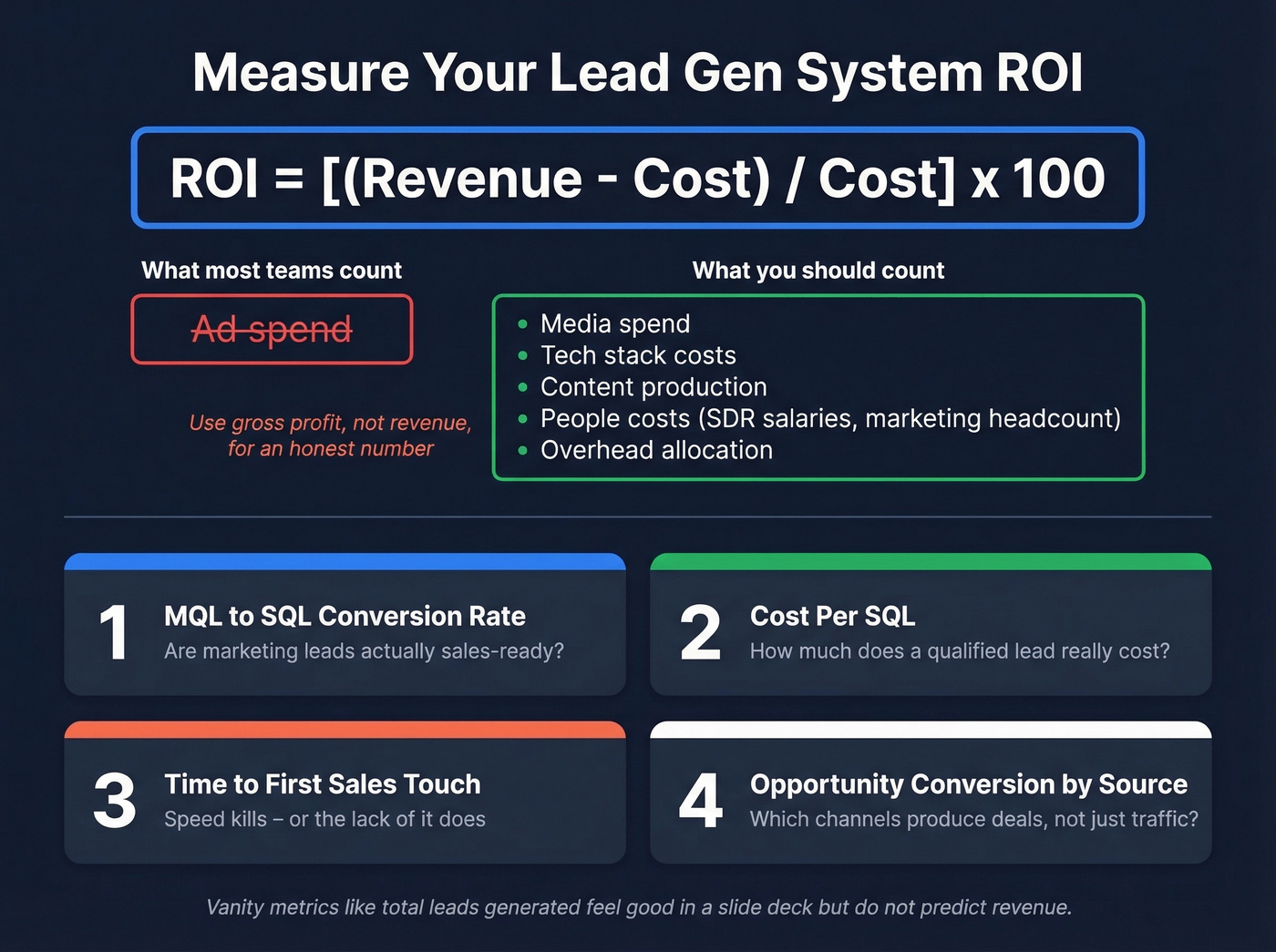
The mistake most teams make is only counting ad spend as "cost." A real ROI calculation includes media spend, technology tools across your entire stack, content production, people costs like SDR salaries and marketing headcount, and overhead allocations. Use gross profit instead of revenue for a more honest number.
Track four KPIs religiously: MQL-to-SQL conversion rate, cost per SQL, time to first sales touch, and opportunity conversion rate by source. These tell you where the system is leaking. Vanity metrics like "total leads generated" feel good in a slide deck but don't predict revenue.
Why Most Lead Generation Programs Fail
We've seen four failure modes kill these systems repeatedly.
Tool-first thinking. Teams buy six tools, connect none of them, and wonder why the dashboard is empty. A system is defined by how tools connect, not which logos are on the invoice.
Bad data. Your SDR's bounce rate hits 30% and your deliverability collapses. Suddenly, even your good emails land in spam. This is the most common and most preventable failure. Snyk's team was dealing with 35-40% bounce rates before switching to verified data - afterward, bounces dropped under 5% and AE-sourced pipeline jumped 180%.

No nurture layer. Remember that 56% stat? Most leads aren't ready to buy when they enter your system. Without a nurture sequence, those leads rot in your CRM. You paid to acquire them and then ignored them.
Vanity metrics. If your weekly report shows "1,200 new leads" but doesn't show how many became SQLs or generated qualified opportunities, you're measuring activity, not outcomes. Responding within 5 minutes versus 30 minutes can double your conversion rate on inbound leads. Speed-to-lead is a system design problem, not a rep motivation problem.
You just mapped the six layers of a real lead gen system. The enrichment layer is where most stacks break - and where Prospeo locks in. 300M+ profiles, 143M+ verified emails, 125M+ mobile numbers, intent data across 15,000 topics, and native integrations with HubSpot, Instantly, Lemlist, and Zapier. Every tool in your stack gets better when the data feeding it is accurate.
Connect your entire stack to data that actually converts - starting at $0.
The AI Layer in 2026
AI isn't replacing your lead gen system - it's accelerating each layer. Real-time data enrichment, AI-written email personalization, predictive lead scoring, and multi-channel sequence optimization are all working today. AI-driven lead gen improves conversion rates by 30-55% compared to manual prospecting, mostly by eliminating the hours reps spend on research and list building.
Tools with strong AI features worth evaluating: Apollo for AI-assisted prospecting, Clay for waterfall enrichment with AI agents, and HubSpot Sales Hub for predictive scoring. If you're building this motion, pair it with AI cold email outreach.
The AI capabilities checklist for your stack: does your enrichment tool refresh data automatically? Does your sequencer personalize beyond {first_name}? Does your scoring model learn from closed-won patterns? If the answer to all three is no, you're running a 2022 system in 2026. AI makes good systems faster. It doesn't fix broken ones.
FAQ
What is a lead gen system?
A lead gen system is the complete architecture - strategy, tools, scoring rules, and measurement - that turns strangers into qualified pipeline. It's not a single tool; it's how 4-6 tools connect to produce revenue, from initial capture through qualification to closed-won.
How much does it cost to build?
A functional SMB stack costs under ~$200/month: HubSpot free CRM, a data enrichment tool like Prospeo's free tier, Instantly or Lemlist for sequencing, Zapier for automation, and Calendly for scheduling. Enterprise stacks with Salesforce and ZoomInfo can run $3,000-5,000+/month.
How long does setup take?
Most teams can have a basic system operational in 2-4 weeks. Lead scoring and optimization take another 1-2 months of data collection before they're properly calibrated. Don't wait for perfection - launch and iterate.
What's the most important component?
Data quality. A system built on unverified contacts wastes rep time, damages domain reputation, and produces misleading metrics. Start with verified data and build every other layer on top.
When should I add lead scoring?
Add scoring when you're receiving 30+ leads per week. Below that threshold, manual qualification works fine. Above it, you need automated scoring to avoid missed follow-ups and rep burnout - most teams layer it in once they've collected 2-3 months of conversion data to calibrate point values.