

Lead Generation Email Templates That Actually Get Replies
Your Templates Aren't the Problem
A RevOps lead running outbound for a 40-person SaaS company watched their reply rate slide from 8% to 3% over 18 months. They rewrote their lead generation email templates four times. Tried new personalization angles. Added GIFs. Nothing moved.
Then they stopped touching the copy and rebuilt everything underneath it - domains, verification, sending cadence. Sixty-two days later, they were back at 6%. The templates they ended up using were shorter and simpler than anything they'd tried before.
Here's the thing: templates are maybe 20% of the equation. Your data, infrastructure, and cadence are the other 80%. Most template advice stops at the copy. We're giving you the copy, the system, and the numbers behind both.
Cold Email Benchmarks for 2026
Two large cold email datasets published recently - Instantly's benchmark report and Belkins' 16.5M-email study - set the bar clearly.
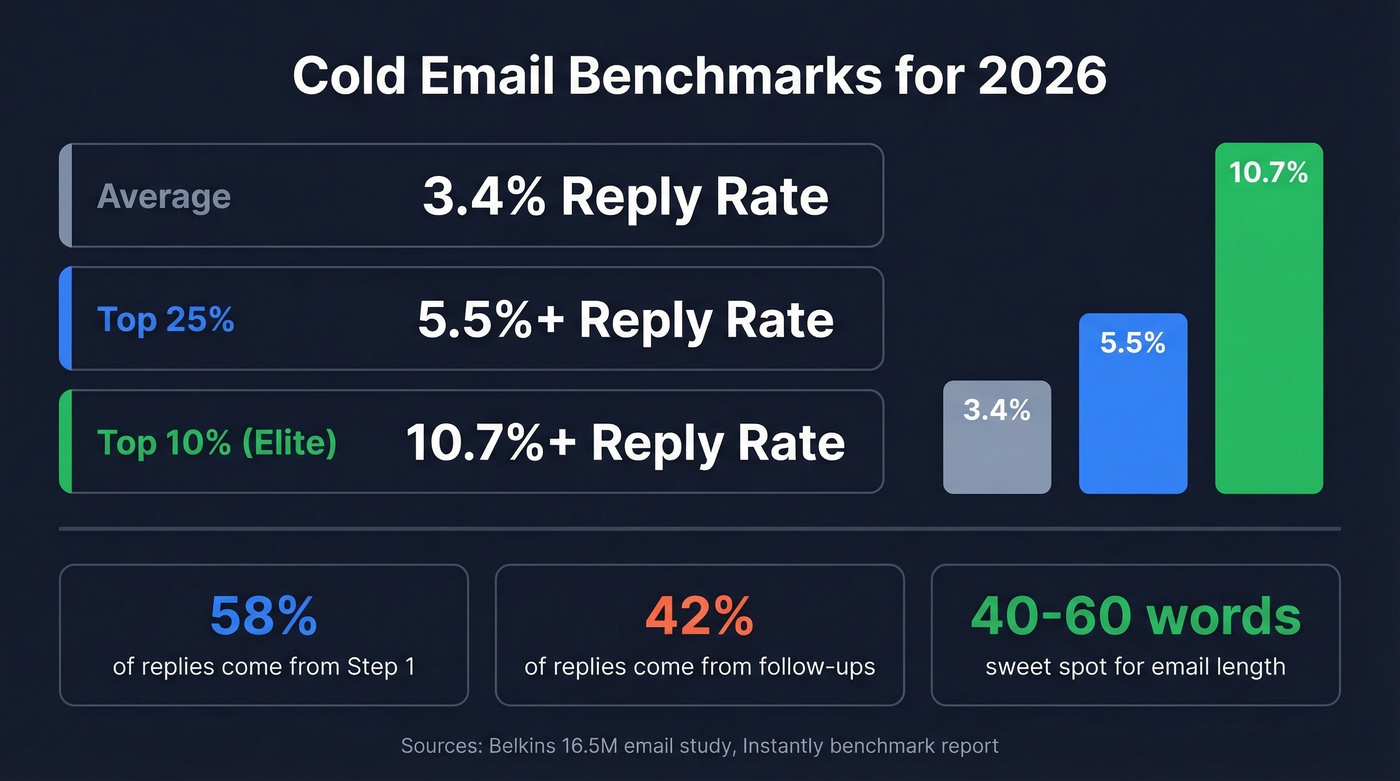
| Metric | Average | Top Quartile | Elite (Top 10%) |
|---|---|---|---|
| Reply rate | 3.43% | 5.5%+ | 10.7%+ |
| Step 1 share | 58% of replies | - | - |
| Follow-up share | 42% of replies | - | - |
Belkins reported an average reply rate of 5.8%, down 15% from 6.8% the prior year. The trend is unmistakable: inboxes are more crowded, filters are stricter, and generic outreach is dying.
Email length matters more than most people think. Instantly's top campaigns keep emails under 80 words. Belkins found 6-8 sentences hit the highest reply rates. The practitioner sweet spot sits even lower - 40-60 words across three short paragraphs. Woodpecker's analysis of 20M+ emails shows advanced personalization achieves a 17% reply rate versus 7% for generic sends.
Best send times: Thursday pulls the highest reply rate at 6.87%, with Monday trailing at 5.29%. Evenings between 8-11pm peak at 6.52%, though our team has consistently seen Tuesday-Thursday mornings (8-11am recipient time) deliver the best opens - roughly a 16% lift over other windows. Schedule accordingly. (If you want a deeper breakdown, see our guide on the best opens by day and hour.)
If you're sitting below 3%, don't rewrite your templates yet. Fix your list and your sending setup first.
Fix Your Infrastructure First
This is the section most template articles skip, and it's the section that determines whether your emails land in the inbox or the spam folder.
Authentication and Sending Setup
Configure SPF, DKIM, and DMARC on every sending domain - these authenticate your emails and prove to receiving servers you're legitimate. Since May 2025, Google and Yahoo also require RFC 8058 one-click unsubscribe headers for bulk senders. Miss this, and you're flagged before your copy gets read. (If you need a checklist, start with an SPF and DMARC alignment review.)
Hard thresholds: keep spam complaints under 0.3% and bounce rates under 2%. Exceed either, and your domain reputation takes damage that can take weeks to recover from. (More on the mechanics in our email deliverability guide.)
The gap between what your email provider allows and what's actually safe is enormous.
| Provider | Technical Limit | Safe Daily Limit |
|---|---|---|
| Google Workspace | 2,000/day | 100-150/day |
| Microsoft 365 | 10,000 recipients | 100-150/day |
| GoDaddy | 250 recipients | 50-75/day |
| Free Gmail | 500/day | Don't use for cold email |
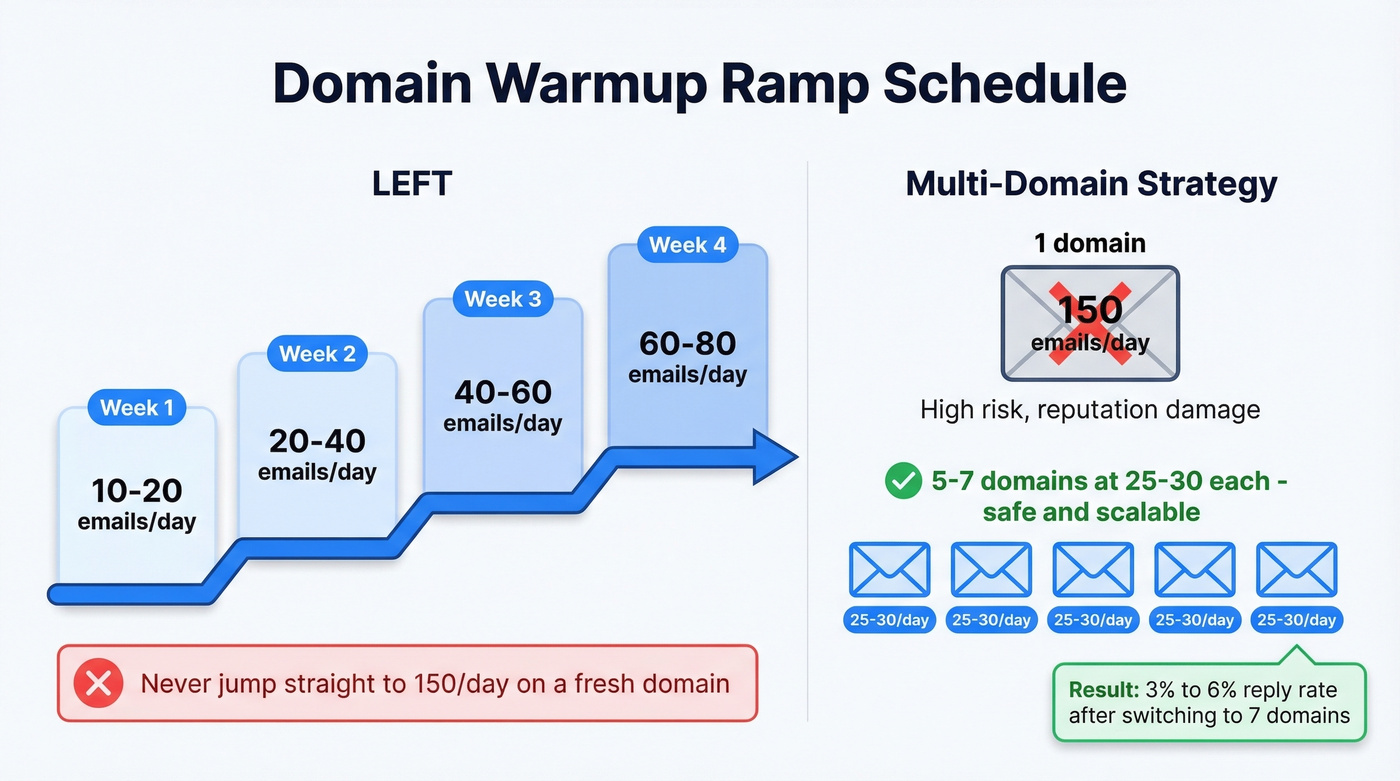
New domains need a ramp schedule. Week 1: 10-20 emails/day. Week 2: 20-40. Week 3: 40-60. Week 4: 60-80. Jumping straight to 150/day on a fresh domain is how you end up in spam purgatory. (If you're planning volume, track email velocity as a first-class metric.)
The smart play is a multi-domain strategy. Instead of pushing 150 emails through one domain, spread volume across 5-7 domains at 25-30 emails each. That RevOps lead who went from 3% to 6%? They scaled from 3 domains to 7 and capped each at 26 emails/day.
List Verification
Bounce rate is the silent killer of cold email campaigns. That same practitioner saw their bounce rate drop from 11% to under 2% once they stopped buying lists and started verifying every contact before sending. Prospeo runs a 5-step verification process with catch-all handling and spam-trap removal at 98% email accuracy on a 7-day data refresh cycle - and the free tier gives you 75 email verifications per month, enough to test the workflow before committing. (Benchmarks and fixes: email bounce rate.)
We've seen teams triple their reply rates just by fixing verification and domain setup, before touching a single template.
10 Cold Email Templates for Lead Generation
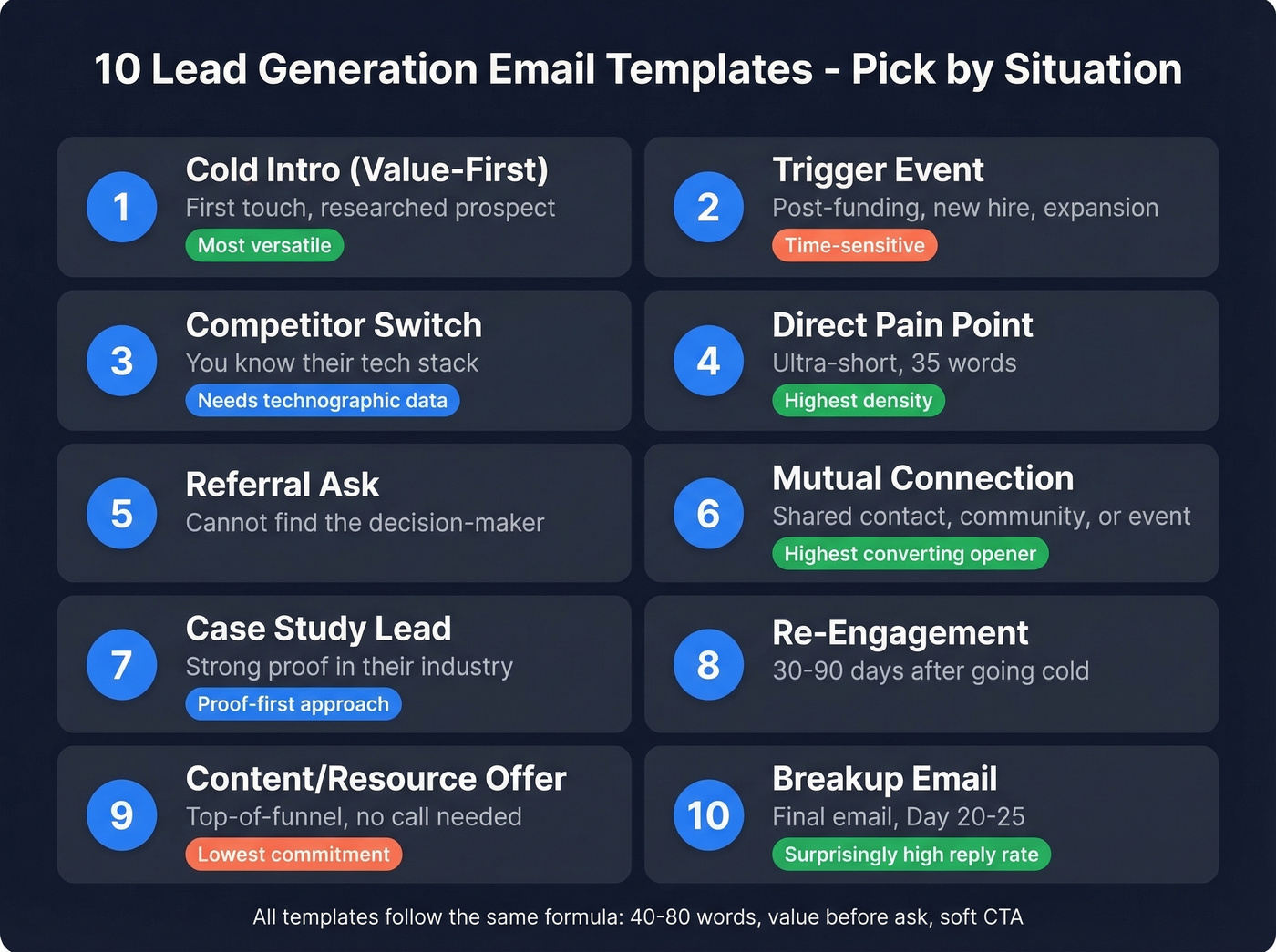
These templates are organized by situation, not sales stage - because the right outreach email depends on what you know about the prospect, not where they sit in your pipeline. Every template follows the same principles: 40-80 words, value before ask, soft CTA. (If you're building a full outbound motion, pair this with our sales prospecting techniques.)
Let's be honest about something the r/sales crowd brings up constantly: offer quality matters more than personalization. "I read your blog post" doesn't move the needle if your offer is weak. Keep your pronoun ratio at roughly 1:2 (I/my to you/your), and never ask for 30 minutes when "Worth a conversation?" will do. (More rules and examples in our email copywriting guide.)
1. Cold Intro (Value-First)
Subject: Quick question
Body:
Hi {{firstName}},
{{Company}} is scaling {{department}} - which usually means {{specific pain point}} becomes a bottleneck fast.
We helped {{similar company}} cut {{metric}} by {{result}} in {{timeframe}}.
Worth a quick conversation?
Use when: First touch to a researched cold prospect. Names the pain before pitching the solution, and the question CTA lowers commitment. This is the most versatile template in the set - it works across industries because it leads with the prospect's problem, not your product.
2. Trigger Event
Subject: Congrats on the raise
Body:
Hi {{firstName}},
Saw {{Company}} just closed your Series {{X}}. When teams scale post-funding, {{specific challenge}} usually hits within 90 days.
We work with {{similar stage}} companies to {{specific outcome}} before it becomes a fire drill.
Interested?
Use when: After a funding round, leadership hire, or expansion announcement. Timeliness creates relevance that generic personalization can't match.
3. Competitor Switch
Subject: {{Current tool}} frustrations?
Body:
Hi {{firstName}},
Teams using {{competitor}} usually run into {{specific limitation}} around the {{growth stage}} mark.
We built {{product/feature}} specifically for that - {{one-line result}}.
Happy to show you the difference in 10 minutes.
Use when: You have technographic data showing what they're running. Skip this if you're guessing at their stack - a wrong guess kills credibility instantly.
4. Direct Pain Point
Subject: {{Pain point}} at {{Company}}
Body:
Hi {{firstName}},
{{One sentence describing the problem and its cost.}}
We fix this for {{type of company}}. {{One sentence with a specific result.}}
Worth 5 minutes?
This version runs about 35 words. There's nothing to skim past. Every word earns its place.
5. Referral Ask
Subject: Who handles {{function}} at {{Company}}?
Body:
Hi {{firstName}},
I'm trying to reach whoever owns {{function}} at {{Company}}. We help {{type of company}} with {{outcome}}, and I think there's a fit.
Would you mind pointing me to the right person?
Use when: You can't identify the decision-maker. People forward these because it costs them nothing.
6. Mutual Connection
Subject: {{Mutual connection}} suggested I reach out
Body:
Hi {{firstName}},
{{Mutual connection}} mentioned you're working on {{initiative}}. We helped their team {{specific result}} - thought it might be relevant for {{Company}} too.
Worth a conversation?
Borrowed trust is the highest-converting opener in cold email. Even a shared community, investor, or event works - it doesn't have to be a close personal contact.
7. Case Study Lead
Subject: How {{similar company}} hit {{result}}
Body:
Hi {{firstName}},
{{Similar company}} was dealing with {{same problem you suspect}}. After {{timeframe}}, they {{specific measurable result}}.
I can share the full breakdown if it's relevant to what {{Company}} is working on.
Use when: You have a strong case study in their industry or company size. Proof first, pitch second - the CTA is just offering information. This is one of the strongest lead generation email templates because it lets results do the selling.
8. Re-Engagement
Best used 30-90 days after a conversation went cold. The key is acknowledging the gap without guilt-tripping, then giving them a new reason to respond.
Subject: Still on your radar?
Body:
Hi {{firstName}},
We connected {{timeframe ago}} about {{topic}}. Timing wasn't right then - totally get it.
Wanted to check if {{original pain point}} is still on your plate. We've since {{new development or result}}.
Still relevant?
9. Content/Resource Offer
Subject: Built this for {{role}} teams
Body:
Hi {{firstName}},
We put together a {{audit/report/Loom walkthrough}} showing how {{type of company}} can {{specific outcome}}.
No call needed - happy to send it over if useful.
Use when: Top-of-funnel with a genuinely useful resource. A Loom or audit outperforms "book 30 minutes" as a first-touch offer every time.
10. Breakup Email
Subject: Should I close your file?
Body:
Hi {{firstName}},
I've reached out a few times and haven't heard back - no worries at all.
I'll assume the timing isn't right and close this out. If things change, just reply to this thread.
Use when: Final email in a sequence, Day 20-25. Removing pressure often triggers a response. This is consistently one of the highest-reply emails in any sequence.
After You Pick Your Templates
Test one variable at a time - subject line, CTA, or opening line. The best campaigns in Instantly's dataset A/B test weekly. Refresh your templates quarterly; what works in Q1 will fatigue by Q3. And adjust touch frequency by prospect seniority - executives need fewer, more targeted touches than individual contributors. (For more ready-to-send sequences, see our sales follow-up templates.)

Templates only work when they reach real inboxes. Prospeo's 5-step verification and 7-day data refresh keep bounce rates under 2% - the exact threshold this article warns you never to cross. At $0.01 per email with 98% accuracy, you stop guessing and start sending.
Verify your list before you send another template.
Follow-Up Sequence Blueprint
Woodpecker's analysis of 20M+ emails found sequences with 4-7 emails achieve a 27% reply rate across the full sequence. That's 3x higher than sequences with 1-3 emails. Quitting after one email is the most expensive mistake in cold outreach. (If you want a full framework, use our B2B cold email sequence guide.)
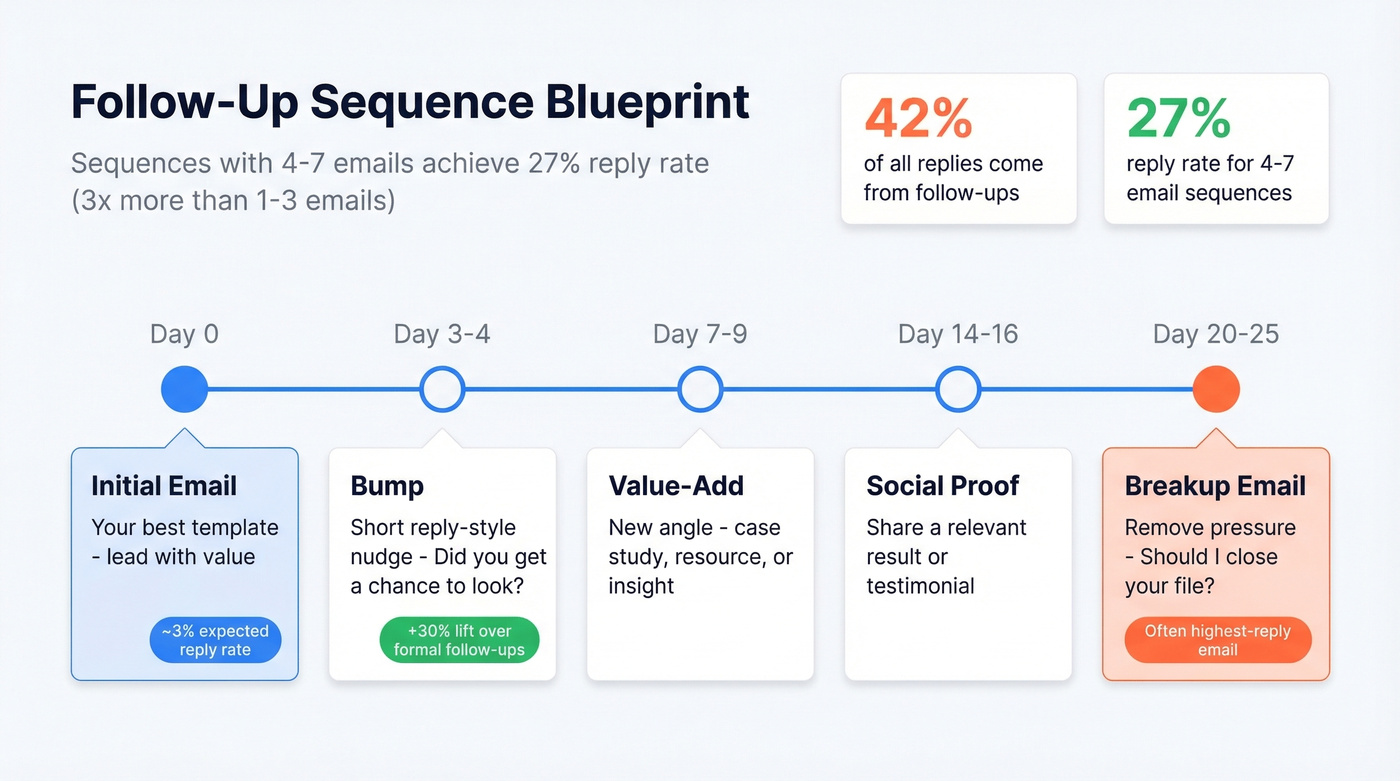
A counterintuitive wrinkle: Belkins' data shows single-email campaigns had the highest per-email reply rate at 8.4%. But that's per-email, not per-campaign. Multi-touch sequences generate more total replies, and 42% of all replies come from follow-ups. Here's the structure that balances persistence with professionalism:
- Initial email (Day 0) - Your best template from above. Expected reply rate: ~3%.
- Bump (Day 3-4) - Short, feels like a reply. "Just bumping this up - did you get a chance to look?" This tactic alone lifts replies ~30% over formal follow-ups.
- Value-add (Day 7-9) - New angle. Share a case study, resource, or relevant insight. Cumulative reply rate: ~4.8%.
- Pivot (Day 13-16) - Change the offer or ask. If you led with a call, offer a Loom. If you offered content, ask for a referral. Cumulative: ~5.8%.
- Breakup (Day 20-25) - The template above. Low pressure, high response rate.
Watch your complaint metrics as you extend sequences. Spam complaints climb from 0.5% on the first email to 1.6% by the fourth, and unsubscribes jump from 0.1% to 2% by round four. If your complaints spike, shorten the sequence - don't push through it.
Subject Lines That Get Opens
A Belkins and Reply.io study of 5.5M emails gives us the clearest picture of what works right now. Personalized subject lines hit 46% open rates versus 35% without - a 31% lift. Reply rates jumped from 3% to 7% with personalization, a 133% increase. That's not a marginal improvement; it's a different category of performance. (Need ideas? Steal from our email subject line examples.)
The sweet spot is 2-4 words, averaging 46% opens. Performance declines steadily after 7 words, dropping to ~35% at 9 words.
Do: Use 2-4 word subject lines. Personalize with the prospect's company or pain point. Ask a question. Consider turning off open tracking pixels - one internal experiment showed 3% higher response rates without them.
Don't: Use "ASAP," generic greetings like "Hello, friend," or marketing hype. Skip "free" entirely. "Partnership opportunity" drops below 19% opens.
Compliance Quick Reference
Cold email is legal in the US and widely used in the EU/UK/Canada - but the rules differ enough to trip you up.
| Jurisdiction | Consent | Key Requirements | Penalty |
|---|---|---|---|
| US (CAN-SPAM) | No | Headers, address, 30-day opt-out | $51,744-$53,088/violation |
| EU (GDPR) | Legitimate interest | Documented LIA, lawful sourcing | Up to 4% global revenue |
| Canada (CASL) | Yes (implied OK) | Relationship <24mo, 10-day unsub | Up to $10M CAD |
Deceptive subject lines - fake "Re:" prefixes, fake invoice urgency - are explicit CAN-SPAM violations, not just bad practice. GDPR legitimate interest isn't a blanket pass; you need a documented Legitimate Interest Assessment showing role relevance and lawful data sourcing. (Related: Is it illegal to buy email lists?.)
The biggest operational risk is suppression list fragmentation. If someone unsubscribes from one campaign but you're running sends from three different tools, those opt-outs need to sync across all of them. One missed suppression is one complaint too many.
Recommended Cold Email Stack
Look, if your average deal size is under $10k, you don't need a $40k/year platform. A lean stack built around verified data and a solid sending tool will outperform an enterprise suite you only use 20% of. (If you're comparing options, start with our roundup of outbound lead generation tools.)
| Tool | Role | Starting Price |
|---|---|---|
| Prospeo | Data and verification | ~$0.01/lead (free: 75/mo) |
| Instantly | Sending and sequences | $37/mo |
| Smartlead | Sending and sequences | $39/mo |
| Mailshake | Sending (alternative) | $29/mo |
| Woodpecker | Sending (alternative) | $29/mo |
The RevOps lead who rebuilt their system from scratch ran a comparable stack for ~$420/month total and generated 16 qualified leads per month from cold email. That's roughly $26.25 per qualified lead - beating most paid channels by a wide margin.
The trigger event and competitor switch templates above only work if you have the right data - funding signals, technographics, verified contacts. Prospeo gives you 30+ filters including buyer intent, tech stack, and job changes across 300M+ profiles so every template hits the right person at the right moment.
Build the list your templates deserve.
FAQ
How many cold emails should I send per day?
Stay at 100-150 per domain on Google Workspace or Microsoft 365. For higher volume, scale horizontally with multiple domains at 25-30 emails each rather than pushing a single domain past safe limits.
What's a good reply rate for cold email in 2026?
The average is 3.43% according to Instantly's benchmark data. Top-quartile campaigns hit 5.5%+, and elite campaigns exceed 10.7%. If you're consistently below 3%, the problem is almost certainly list quality or infrastructure, not your templates.
How long should a cold email be?
40-60 words across three short paragraphs. Belkins' data supports 6-8 sentences, but practitioners consistently report shorter performs better. If you can cut a word without losing meaning, cut it.
Is cold email legal under GDPR?
Yes, under legitimate interest (Article 6(1)(f)), but you need a documented Legitimate Interest Assessment showing your outreach is relevant to the recipient's role and that data was sourced lawfully. B2B outreach to relevant decision-makers is defensible; mass-blasting purchased lists with no targeting rationale isn't.
What's the best free tool for verifying lead generation email lists?
Prospeo's free tier includes 75 email verifications per month with the same 5-step verification and 98% accuracy as paid plans. Hunter offers 25 free searches monthly but caps enrichment. For teams running real campaigns, Prospeo's free credits go further.