

Lead Generation for Business: The Data-Backed Guide for 2026
Your marketing team just handed sales 500 "leads." Sixty bounced. Eighty were wrong numbers. Forty had no budget. Your cold emails pull a 2% reply rate, your LinkedIn ads cost $110 per lead, and your purchased list bounced 20%. The dashboard says CPL looks great. The pipeline says otherwise.
That disconnect between lead volume and actual revenue is the central problem of lead generation for business in 2026. The fix isn't more leads. It's better data, sharper targeting, and a stack that doesn't leak money at every stage.
The Cheat Sheet
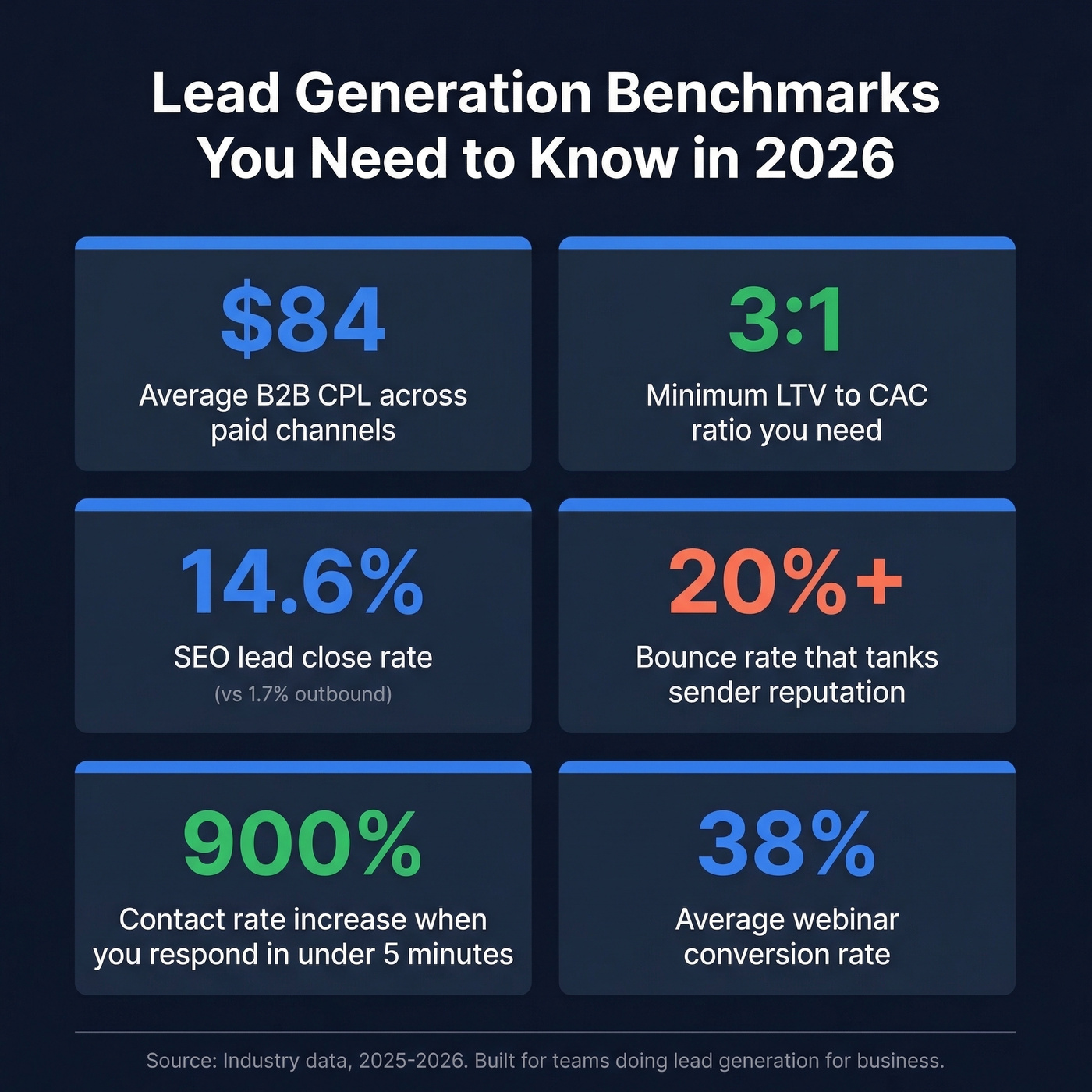
- Know your numbers. The average B2B CPL across paid channels is $84. Your LTV:CAC ratio needs to be 3:1 or better - anything below that and you're subsidizing growth with cash you don't have.
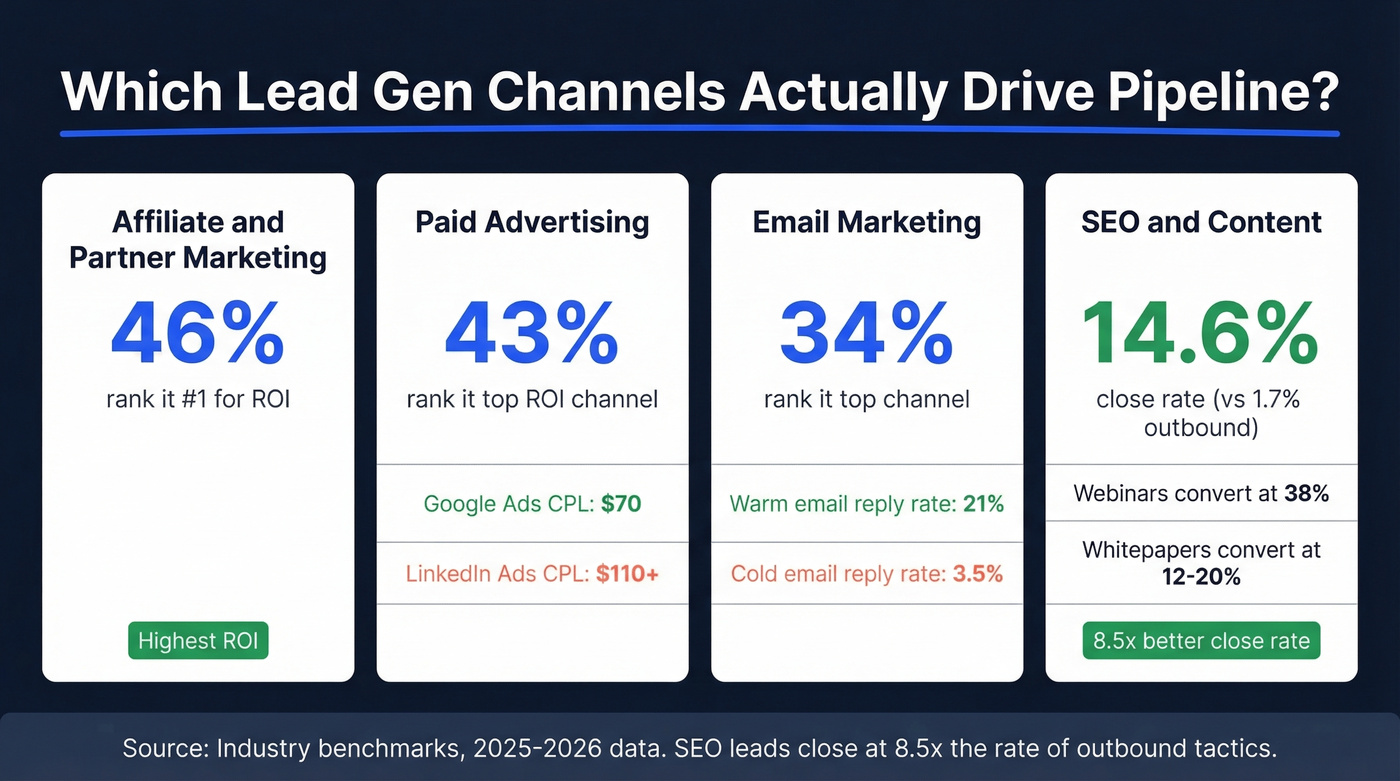
- Prioritize high-ROI channels. Affiliate and partner marketing tops the list, with 46% of respondents ranking it #1 for ROI, followed by paid ads (43%) and email (34%). SEO leads close at 14.6% versus 1.7% for outbound. That gap is enormous.
- Start with clean data. Bad contact info silently kills every channel. If your emails bounce at 20%+, your sender reputation tanks, your ads retarget ghosts, and your reps waste hours chasing dead numbers.
What Lead Generation Actually Is
Lead generation is the process of identifying people who might buy from you and getting them into a conversation. Everything else - the tools, the sequences, the landing pages - is infrastructure to make that happen at scale.
An MQL (marketing qualified lead) has engaged with your content or matched your targeting criteria. An SQL (sales qualified lead) has been vetted by a rep and has budget, authority, need, and timeline. A PQL (product qualified lead) has used your product and hit activation milestones. Inbound lead gen pulls prospects toward you through content, SEO, and ads. Outbound pushes your message to them through email, calls, and direct outreach. Most teams need both - the ratio depends on your deal size and sales cycle.
B2B vs. B2C - Know Your Game
Most of this guide leans B2B, but the principles apply broadly. The key differences come down to cycle length, decision complexity, and channel mix.
| Dimension | B2B | B2C |
|---|---|---|
| Sales cycle | Weeks to months | Minutes to days |
| Decision-makers | 3-7 stakeholders | 1 individual |
| Content style | Data-driven, educational | Emotional, creative |
| Primary channels | Email, SEO, events | Social, ads, influencers |
| Qualification | BANT, lead scoring | Behavioral signals |
If you're selling software to a 200-person company, you're navigating a buying committee, a procurement process, and a 60-day evaluation. Selling running shoes? You need a compelling Instagram ad and a fast checkout. Trying to apply B2C tactics to B2B deals is one of the fastest ways to burn budget.
What Lead Generation Costs
The mean CPL across all industries is $198.44, but that average hides massive variation by channel and vertical.
CPL by Channel
| Channel | Average CPL |
|---|---|
| [Google Ads | $70.11](https://www.wordstream.com/blog/2025-google-ads-benchmarks) |
| All paid channels avg | $84 |
| LinkedIn Ads | $110+ |
LinkedIn ads are a luxury channel. At $110+ per lead - roughly 57% more than Google Search - they only make sense once you know your conversion rates and can justify the premium. Start with Google Ads and email to establish a baseline, then layer LinkedIn for account-based plays.
CAC by Industry
CPL is only half the picture. Customer acquisition cost tells you what it actually takes to close a deal.
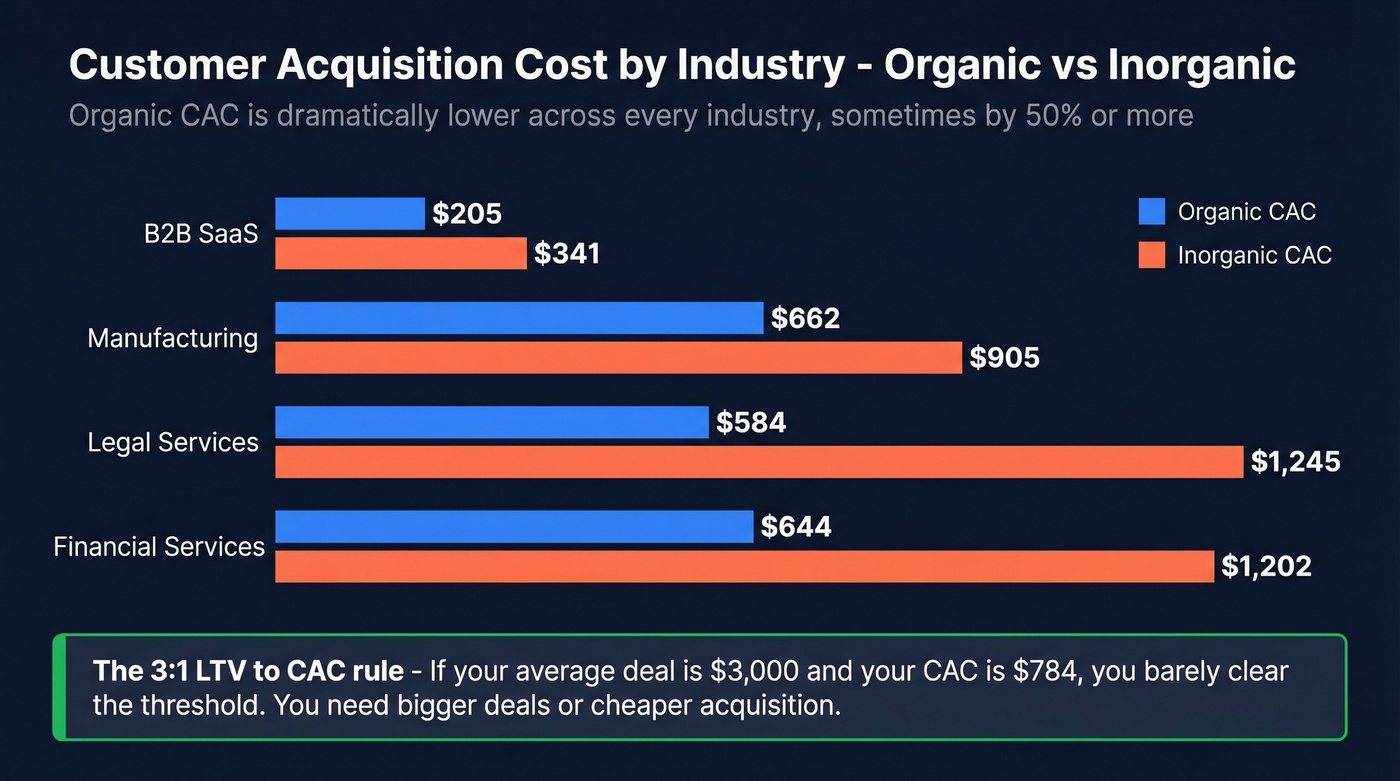
| Industry | Organic CAC | Inorganic CAC | Combined Avg |
|---|---|---|---|
| B2B SaaS | $205 | $341 | $239 |
| Manufacturing | $662 | $905 | $723 |
| Legal Services | $584 | $1,245 | $749 |
| Financial Services | $644 | $1,202 | $784 |
Two things jump out here. Organic CAC is dramatically lower than inorganic across every industry - sometimes by 50% or more. And if you're in financial services or legal, your inorganic CAC can easily exceed $1,200 per customer. That's why the 3:1 LTV:CAC rule matters so much: if your average deal is worth $3,000, a $784 CAC barely clears the threshold. You need either bigger deals or cheaper acquisition.
Which Channels Drive Real Pipeline
Not all channels are created equal. Here's how they stack up based on ROI data and close rates.
Affiliate & Partner Marketing
The highest-ROI channel, with 46% of respondents naming it their top performer. Partners bring warm introductions and built-in trust - your close rates are naturally higher because someone else has already vouched for you. Building a partner program takes time and relationship investment. It's not a quick win, but it compounds.
Paid Advertising
Forty-three percent of teams rank paid ads as a top ROI channel. Google Ads at $70 CPL is the workhorse - high intent, measurable, and scalable. LinkedIn works for account-based plays where you need to reach specific titles at specific companies, but the $110+ CPL means you need tight targeting and strong landing pages to make the math work.
Email Marketing
Thirty-four percent rank email as a top channel, and the data supports it. But the gap between warm and cold is enormous. Warm email sequences to opted-in or engaged contacts average a 21% reply rate. Cold email averages around 3.5%. That's the difference between verified, targeted outreach and spray-and-pray. If you need a starting point, use these sales prospecting techniques to tighten targeting before you scale volume.
SEO & Content
Here's the thing: SEO leads close at 14.6% versus 1.7% for outbound tactics. That's an 8.5x difference. The tradeoff is time - SEO takes months to build momentum, but once it's working, it compounds. Webinars convert at 38% on average, and whitepapers pull 12-20% conversion rates. If you're not investing in organic content, you're leaving the highest-quality leads on the table. For a deeper system, see SEO sales leads.
Our take: If your average deal size sits below $10k, you probably don't need $110 LinkedIn leads or a six-figure ABM platform. SEO plus cold email with verified data will outperform a bloated paid strategy nine times out of ten.

You just read that bad data silently kills every channel - bounced emails tank sender reputation, wrong numbers waste rep hours, and your CPL balloons. Prospeo's 5-step verification delivers 98% email accuracy and 125M+ verified mobiles with a 30% pickup rate. Data refreshes every 7 days, not 6 weeks. That's how teams like Snyk cut bounce rates from 35% to under 5% and grew AE-sourced pipeline 180%.
Stop subsidizing growth with bad data. Fix the foundation first.
The Modern Lead Gen Playbook
You don't need more leads. You need better data on fewer leads. Volume is the enemy; precision is the strategy. And yet 40.2% of B2B marketers feel pressure to deliver MQLs regardless of quality - that pressure is exactly what creates the volume-over-quality trap that kills pipeline.
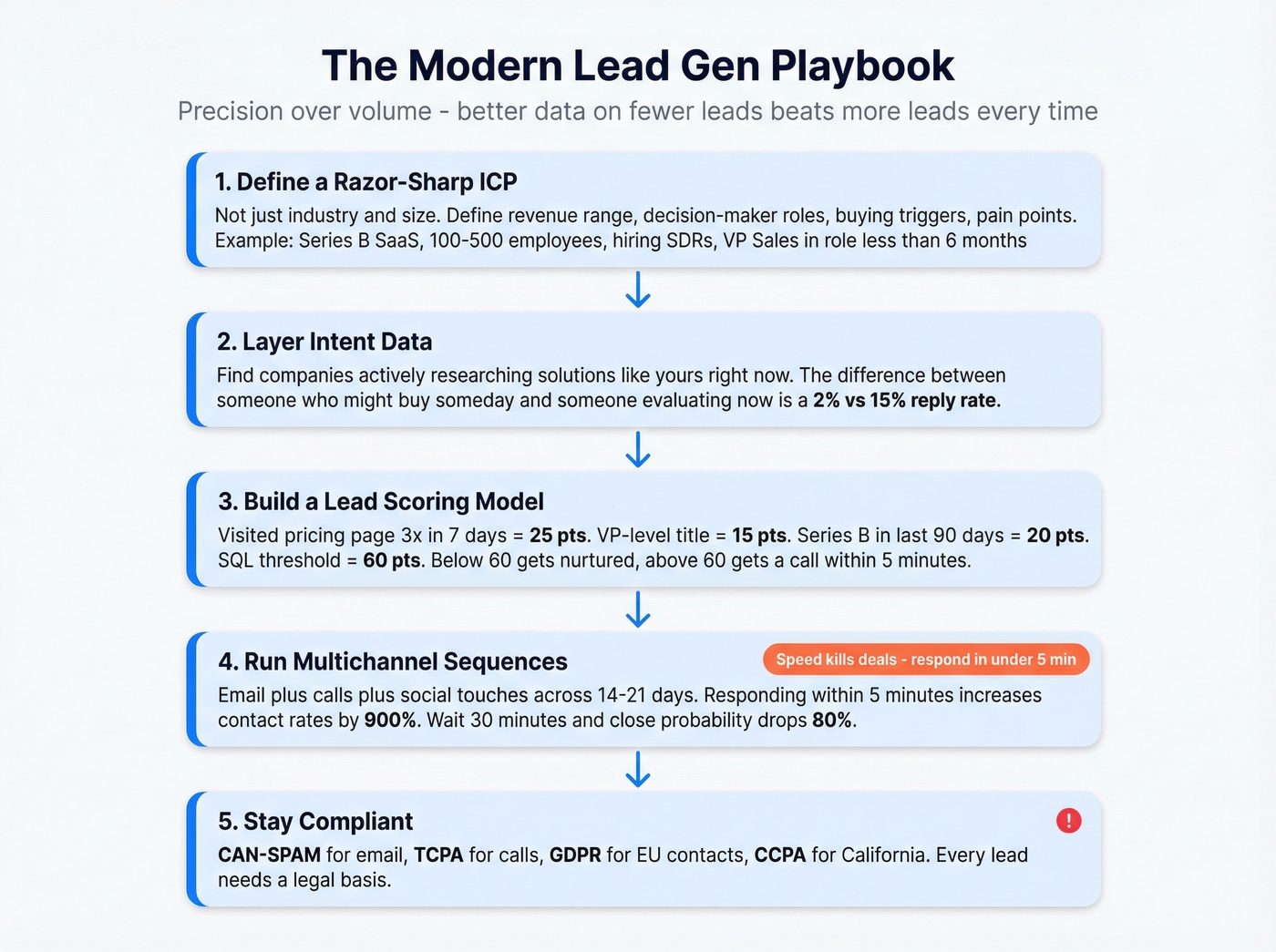
Start with a razor-sharp ICP. That means defining not just industry and company size, but specific revenue ranges, decision-maker roles, buying triggers, and pain points. "Mid-market SaaS companies" isn't an ICP. "Series B SaaS companies with 100-500 employees, hiring SDRs, using Salesforce, with a VP of Sales who's been in role less than 6 months" - that's an ICP. If you want a plug-and-play framework, use an ideal customer profile template.
Layer intent data on top to find companies actively researching solutions like yours. The difference between reaching someone who might buy someday and someone who's actively evaluating right now is the difference between a 2% and a 15% reply rate. This is where intent based segmentation pays off.
Build a lead scoring model. BANT (Budget, Authority, Need, Timeline) is old-school but still works as a framework. Assign points for engagement signals, firmographic fit, and intent activity. A practical example: "visited pricing page 3x in 7 days" gets 25 points, "VP-level title" gets 15 points, "company raised Series B in the last 90 days" gets 20 points. Set your SQL threshold at 60 points. Anyone below gets nurtured; anyone above gets a call within five minutes. If you want to go deeper, see lead scoring.
Run multichannel sequences. Email alone isn't enough. 97% of people ignore cold calls when that's the only touch, but the best-performing outbound teams combine email, calls, and social touches across a 14-21 day cadence. The phone becomes powerful as a follow-up to an email that's already been opened. Speed matters more than most teams realize: responding within 5 minutes increases contact rates by 900%. Wait 30 minutes and your close probability drops by 80%. To operationalize this, keep a set of sales follow-up templates ready for each stage.
Compliance isn't optional. CAN-SPAM governs email, TCPA covers calls and texts, GDPR applies to EU contacts regardless of your location, and CCPA protects California residents. Every lead you collect needs a legal basis. Don't let a lazy unsubscribe process undo months of pipeline work.
Expect structured campaigns to start generating meetings within 30-60 days. If someone promises results in a week, they're either running paid ads or lying.
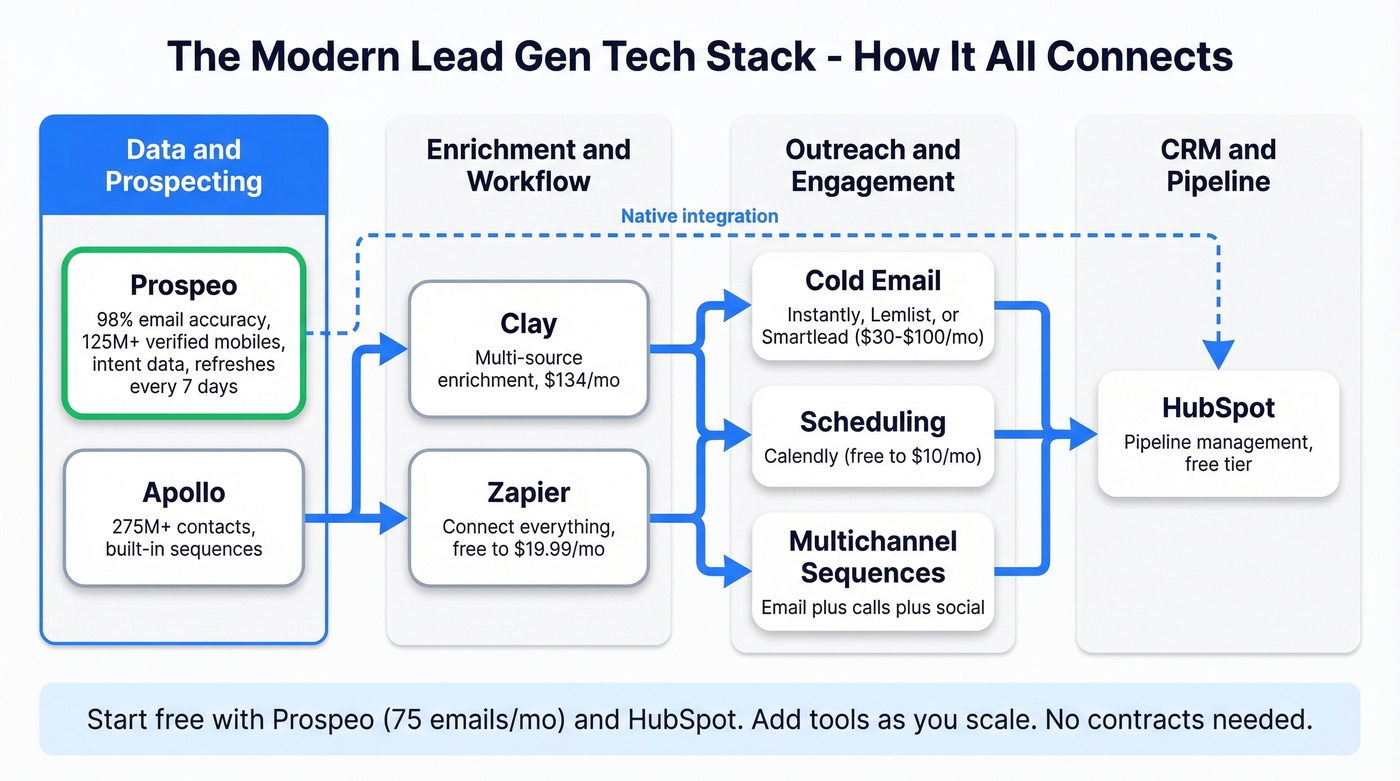
Build Your Lead Gen Stack
| Category | Tool | Starting Price | Best For |
|---|---|---|---|
| Prospecting/Data | Prospeo | Free (75 emails/mo) | Verified emails, mobiles, intent |
| Prospecting/Data | Apollo | Free / $49/user/mo | Sequence + data combo |
| Workflow Automation | Clay | $134/mo | Multi-source enrichment |
| CRM | HubSpot | Free | Pipeline management |
| Cold Email | Instantly/Lemlist/Smartlead | ~$30-$100/mo | Outbound sequences |
| Automation | Zapier | Free / $19.99/mo | Tool integrations |
| Scheduling | Calendly | Free / ~$10/user/mo | Meeting booking |
Prospecting & Data
Prospeo covers 300M+ professional profiles with 98% email accuracy, 143M+ verified emails, and 125M+ verified mobile numbers that hit a 30% pickup rate. That mobile number matters - when your cold email gets ignored, a direct dial to the right person gets you a conversation that email alone won't. Records refresh every 7 days versus the 6-week industry average, which means fewer bounces, fewer "this person left three months ago" moments, and more conversations with the right people. The 30+ search filters include buyer intent powered by Bombora across 15,000 topics, technographics, job changes, funding events, and headcount growth - so you're finding contacts who are likely to buy right now.
The proof is in the numbers. Snyk's 50-person sales team cut bounce rates from 35-40% to under 5% after switching, generating 200+ new opportunities per month. Pricing starts free at 75 emails/month and scales at roughly $0.01 per email with no contracts. Native integrations with Salesforce, HubSpot, Instantly, Lemlist, Smartlead, Clay, and Zapier mean it slots into whatever stack you're already running.

Apollo is a solid runner-up for teams that want prospecting and sequencing in one platform. The free tier is generous, and paid plans start at $49/user/month. Its database is large at 275M+ contacts, but email accuracy runs lower - expect more bounces on cold outreach. Good all-in-one if you don't want to manage multiple tools.
Clay is the workflow automation layer for enrichment. At $134/month with 2,000 enrichment credits, it pulls data from dozens of sources and lets you build custom enrichment waterfalls. It's not a database - it's the orchestration layer that sits on top of your data provider. If you're comparing vendors, start with these data enrichment services.
CRM & Outbound Tools
HubSpot's free CRM handles pipeline management for many small teams. You'll outgrow it eventually, but it's the right starting point. For cold email, Instantly optimizes for volume and deliverability, Lemlist adds personalization and multichannel, and Smartlead handles agency-scale sending. If you're building your outbound toolkit, these outbound lead generation tools are a solid shortlist.
Zapier connects everything that doesn't have a native integration. Calendly eliminates the scheduling back-and-forth that kills momentum after a prospect says yes.
This guide shows SEO leads close at 14.6% and cold email averages 3.5% - but that's the average. Cold email with verified, intent-layered data is a different game. Prospeo gives you 30+ filters including buyer intent across 15,000 topics, technographics, job changes, and headcount growth - so you reach the VP who's actively evaluating, not the one who left six months ago. All at $0.01 per email, 90% cheaper than ZoomInfo.
Build the precision-first lead gen stack this guide recommends - for $0.01 per lead.
How AI Changes Prospecting in 2026
Sales reps spend more than half their working hours hunting for leads, and only 28% of those prospects ever convert. AI is closing that gap - not by replacing reps, but by eliminating the manual research that eats their day.
The practical AI use cases right now are predictive lead scoring that surfaces accounts most likely to close, automated enrichment that fills in missing contact data in real time, personalized sequence generation that adapts messaging to each prospect's context, and real-time buyer signals that tell you when a target account starts researching your category. Apollo and Clay are both pushing hard on AI-powered workflows - Apollo for in-platform scoring and sequencing, Clay for building custom AI enrichment chains. For more, see generative AI lead generation.
Let's be honest, though: AI doesn't fix bad data. If your contact list is stale, AI just helps you send bad emails faster.
Five Mistakes That Burn Budget
1. Buying lead lists. The fastest way to destroy your domain reputation. Purchased lists are full of outdated emails, spam traps, and people who never opted in. Every dollar you save on list-building, you'll spend 10x on deliverability recovery. The consensus on r/coldemail is clear: nearly every deliverability horror story traces back to the same root cause - bad data. Build your own lists from verified sources. (If you're unsure on the rules, read is it illegal to buy email lists.)
2. Skipping lead qualification. Without scoring, without ICP criteria, without any filter between marketing and sales, your reps waste hours calling people who were never going to buy. Even a basic scoring model immediately improves conversion rates and rep morale.
3. Slow follow-up. The 5-minute rule isn't a suggestion. Yet 44% of sales reps say they're too busy to follow up with leads promptly. If your team can't respond fast, automate the first touch.
4. Generic lead magnets. A vague whitepaper titled "The Future of Digital Transformation" attracts tire-kickers. A targeted template titled "Cold Email Sequence for SaaS SDRs (Copy-Paste Ready)" attracts buyers. Specificity wins.
5. Ignoring data quality. Bad emails, stale phone numbers, and outdated job titles compound across every channel. Before you send a single email, verify your list. A 5-step verification process that catches spam traps, honeypots, and catch-all domains is the difference between a healthy sender reputation and one that silently degrades while your dashboard shows "delivered." If you're troubleshooting, start with email bounce rate.
Measuring What Matters
Track these metrics and ignore vanity numbers. Effective lead generation for business depends on knowing exactly where your funnel leaks - and fixing those gaps with data, not guesswork.
- CPL - what you're paying per lead, by channel. If you can't break this out by source, you can't optimize.
- CAC - total cost to acquire a customer, including sales time and tools. Target a 3:1 LTV:CAC ratio minimum.
- Conversion rate by stage - MQL to SQL, SQL to opportunity, opportunity to closed-won. Find the leak.
- Pipeline velocity - how fast deals move through your funnel. Slow velocity means either bad qualification or weak follow-up.
- Lead quality score - track whether higher-scored leads actually close at higher rates. If they don't, your model is broken.
For landing pages, the average conversion rate is 2.35%, but top performers hit 11%+. If you're below 2%, your page has a problem - usually messaging mismatch or too much friction in the form. We've seen teams double conversion rates just by cutting their form from eight fields to three.
FAQ
How much does lead generation cost for a small business?
CPL ranges from $55 (education) to $285 (financial services), with a cross-industry average around $198. A lean stack - a verified data provider, a free CRM, and a cold email tool - runs about $150-$250/month for a solo user. Scale spend as pipeline grows.
What's the fastest channel to generate leads?
Paid ads on Google or LinkedIn produce leads within days. SEO takes months but closes at 14.6% versus 1.7% for outbound. The fastest channel and the highest-converting channel aren't the same - budget for both on different timelines.
Is cold email still effective in 2026?
Yes, but only with verified data and genuine personalization. The average cold email reply rate sits around 3.5%. Warm, targeted sequences to verified contacts with relevant messaging hit 21%. The difference is data quality and message relevance - skip this channel entirely if you can't verify your list first.
What's a good lead-to-customer conversion rate?
Average landing page conversion is 2.35%, with top performers exceeding 11%. For B2B sales cycles, expect 2-5% of MQLs to become paying customers. If you're below 2% at any stage, audit qualification criteria and follow-up speed first.
How do I improve lead quality over volume?
Start with a tight ICP - specific industries, company sizes, roles, and buying triggers. Layer intent data to find companies actively researching your category. Verify all contact data before outreach, then score leads and only pass those above your threshold to sales. In our experience, this precision approach consistently outperforms high-volume tactics because every conversation starts with a qualified prospect.