

SaaS Lead Generation: A Data-Backed Playbook for 2026
You sent 5,000 cold emails last quarter. You got 12 replies and 8 unsubscribes. Your domain reputation took a hit, and the VP of Marketing is asking why outbound "doesn't work anymore."
The problem isn't outbound - it's that you're running a 2021 playbook in a 2026 market. Most lead generation for SaaS guides list 20 tactics and help nobody pick the right ones. This one picks for you.
The Short Version
- Pick your GTM motion first. Product-led growth, sales-led, or hybrid product-led sales. Everything downstream depends on this choice.
- Focus on 2-3 channels max. Bottom-of-funnel content, intent-based outbound, and a free trial or demo. Stack these before you touch anything else.
- Fix your data quality before you fix your copy. The best subject line in the world doesn't matter if 35% of your list bounces.
Everything below expands on these three priorities with benchmarks, cost data, and the specific workflows that produce deals.
Choose Your GTM Motion First
Most teams skip this step and jump straight to tactics. That's how you end up running LinkedIn Ads for a $3K ACV product or building a PLG funnel for enterprise deals. McKinsey's analysis of 107 publicly listed B2B SaaS providers found that pure PLG rarely outperforms at scale. The winning model is product-led sales (PLS) - self-serve product access combined with targeted sales motions for expansion.
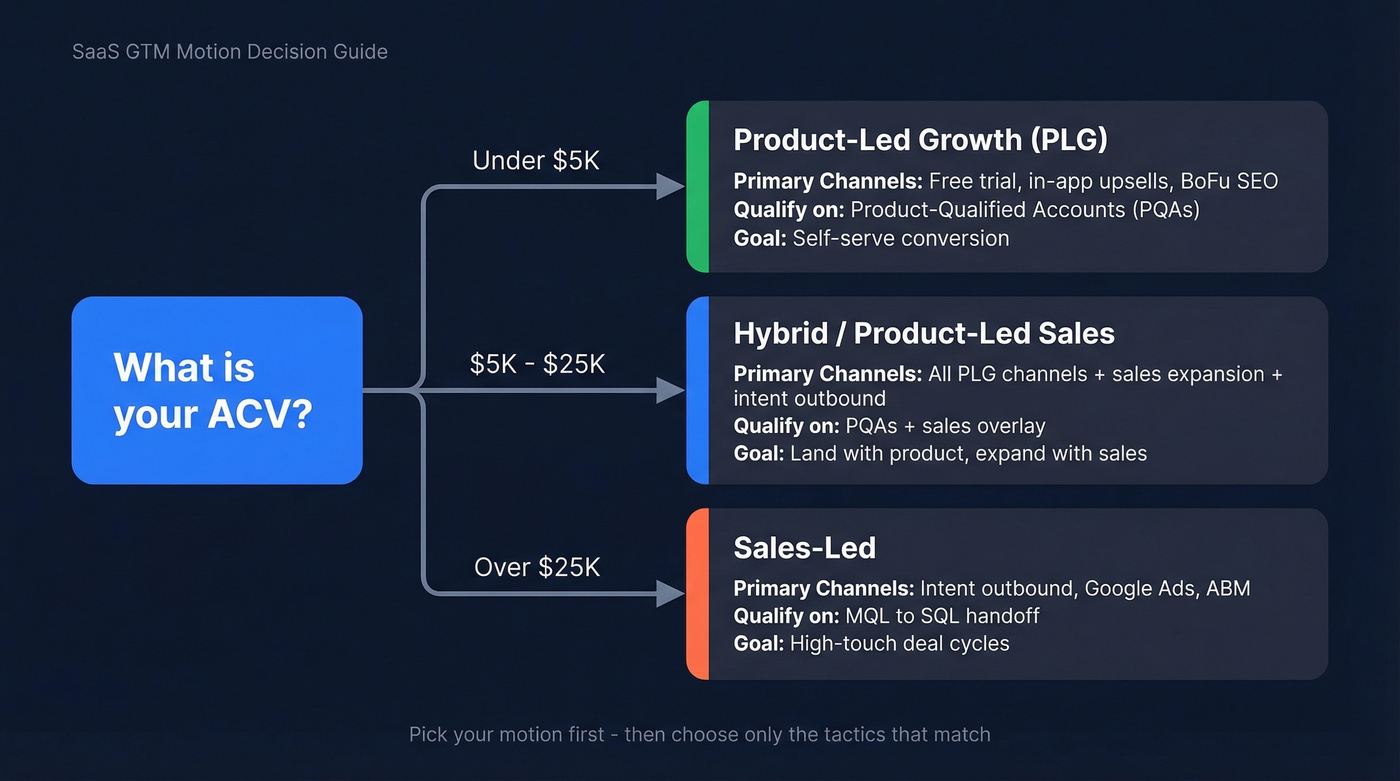
Instead of MQLs, PLS companies qualify on product-qualified accounts (PQAs). These are accounts showing real product engagement, not just whitepaper downloads. McKinsey recommends cross-functional growth teams of 7-9 people running activation experiments to improve conversion and time-to-value. Getting this motion right is the foundation of any effective SaaS lead generation strategy.
Your motion maps to channels like this:
| Motion | Primary Channels | Lead Qualification | Best For |
|---|---|---|---|
| PLG | Free trial, in-app, BoFu SEO | PQAs | ACV under $5K |
| Sales-Led | Intent outbound, Google Ads, ABM | MQL to SQL handoff | ACV over $25K |
| Hybrid (PLS) | All above + sales expansion | PQAs + sales overlay | ACV $5K-$25K |
Pick your row. Then read only the tactics that match.
B2B SaaS Lead Gen Benchmarks
You can't improve what you don't benchmark. These numbers come from a B2B SaaS CRO metrics roundup and give you a realistic picture of what "good" looks like at each stage.
| Stage | Average | Good | Elite |
|---|---|---|---|
| Visitor to Lead | 2.3% | 5-8% | 8-15% |
| MQL to SQL | 13% | 20-25% | 50%+ |
| SQL to Opportunity | 42% | 50-59% | 60%+ |
| Trial to Paid (self-serve) | 3-5% | 6-8% | 10%+ |
| Trial to Paid (sales-assisted) | 5-7% | 10-15% | 20%+ |
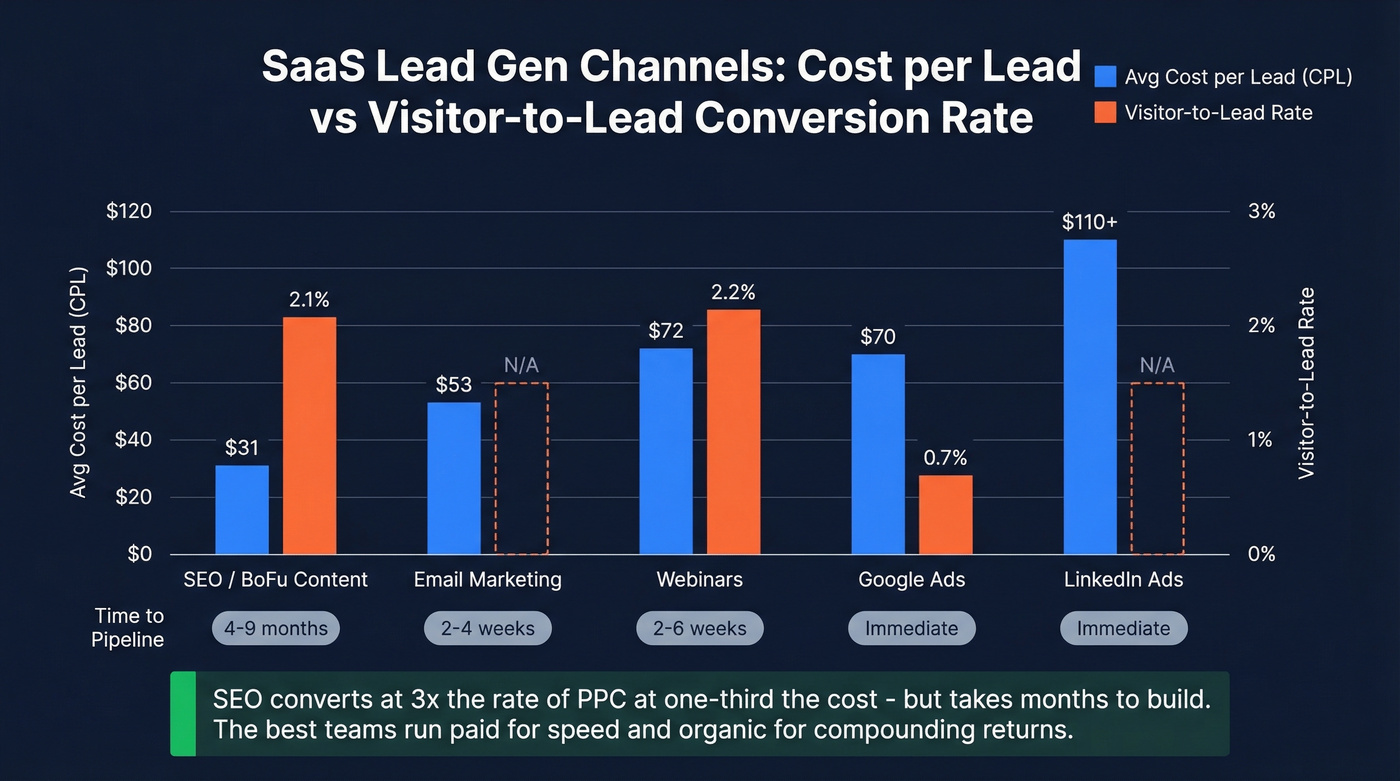
Channel-level visitor-to-lead rates tell a different story than most marketers expect. SEO converts at 2.1%, webinars at 2.2%, and PPC at just 0.7%. Paid search drives volume fast but converts poorly without tight landing page optimization. Organic and webinars convert at roughly 3x the rate of PPC - they just take longer to build.
What Each Channel Actually Costs
B2B SaaS benchmarks land at roughly $310 per lead for paid campaigns, $237 for blended marketing, and $164 for organic channels, with SEO cheapest at $31 per lead. A survey of 108 B2B tech companies found organic search is the top lead source (43%), with Google the preferred ad platform (50%) over LinkedIn (28%).
| Channel | Avg CPL | Time to Pipeline | Scalability |
|---|---|---|---|
| SEO / BoFu Content | $31 | 4-9 months | High (compounds) |
| Email Marketing | $53 | 2-4 weeks | Medium |
| Webinars | $72 | 2-6 weeks | Medium |
| Google Ads | $70 | Immediate | High (linear cost) |
| LinkedIn Ads | $110+ | Immediate | Medium (expensive) |
The benchmark that matters most is LTV:CAC of at least 3:1. If your average deal is $10K ACV and your CAC is $4K, you're underwater. The question isn't how much to spend - it's which channels give you the fastest path to that ratio.

The article says it clearly: fix your data quality before you fix your copy. Prospeo's 5-step verification delivers 98% email accuracy, and every record refreshes every 7 days - not the 6-week industry average. One SaaS team cut bounce rates from 35% to under 4% and tripled pipeline to $300K/week.
Stop burning your domain on bad data. Start with emails that land.
Strategies That Actually Fill SaaS Pipeline
BoFu Content That Converts Without Ads
A B2B FinTech company published three bottom-of-funnel blog posts - "[competitor] alternatives," a comparison piece, and a best-in-class roundup. Result: 24 high-intent leads with zero ad spend. The keywords had tiny search volumes, some as low as 20/month, and zero keyword difficulty.
This is the BoFu content playbook, and we've seen it work over and over. Target low-volume, high-intent keywords that your competitors ignore because the numbers look small. A post ranking for "capchase competitors" generates fewer visitors than a ToFu guide, but every visitor is actively evaluating solutions. Three well-targeted BoFu posts outperform fifty ToFu articles for pipeline. Not sometimes. Consistently.
If you want a tighter framework for building and measuring this, start with a B2B sales funnel template and map each BoFu page to a single conversion event.
Intent-Based Outbound (Not Database Blasting)
Here's the thing: static databases are failing. The consensus on r/b2bmarketing is brutal - contacts in the big databases are overused, 70% of phone numbers are wrong, and reply rates are cratering because every SDR team is emailing the same people. The fix isn't better copy. It's better signals.
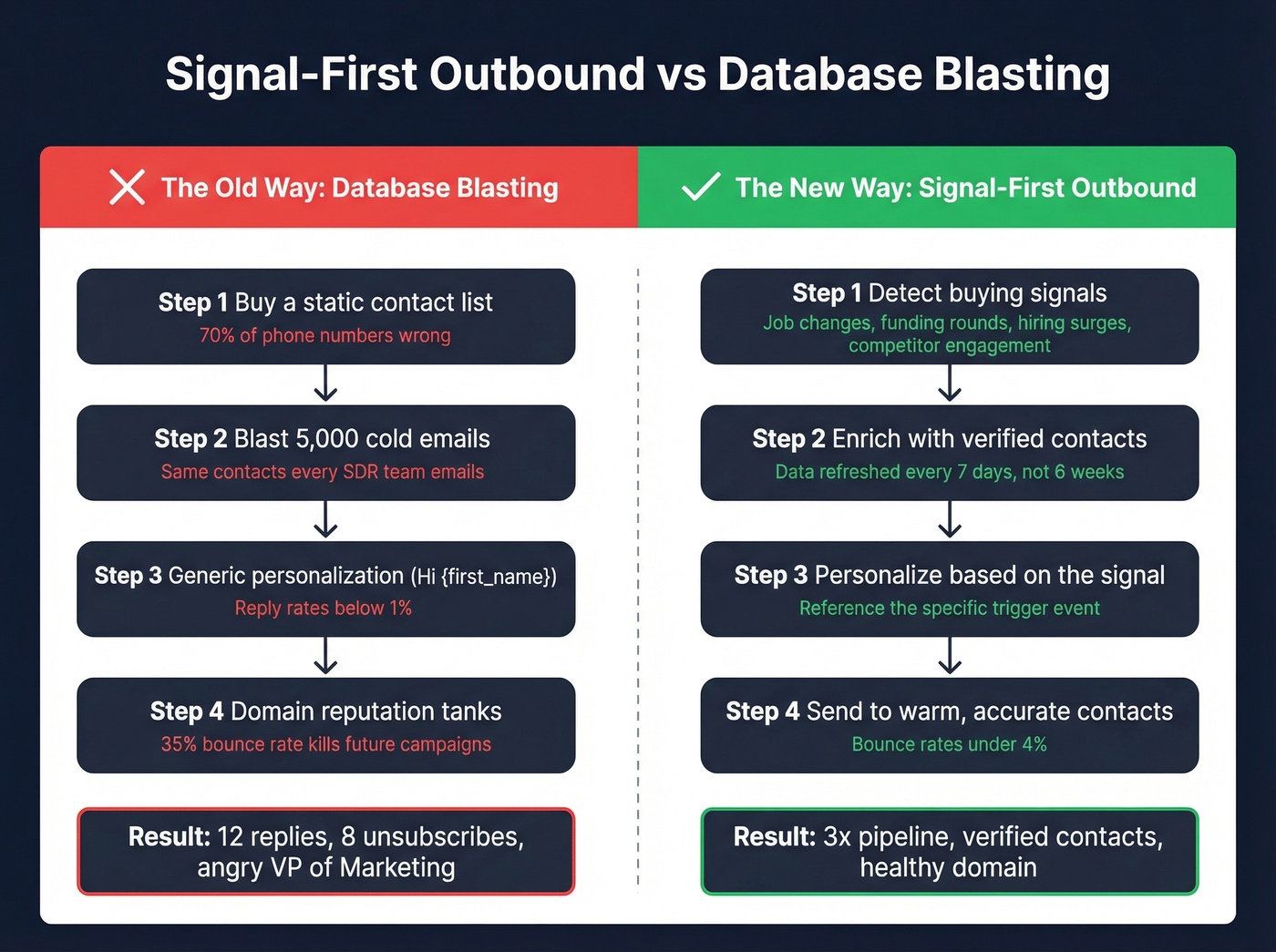
Detect buying signals - job changes, funding rounds, hiring surges, competitor engagement - then enrich those accounts with verified contact data, personalize based on the signal, and send. This signal-first approach is what separates modern outbound from the spray-and-pray tactics that dominated five years ago. (If you need a scoring model, use this guide to identifying buying signals.)
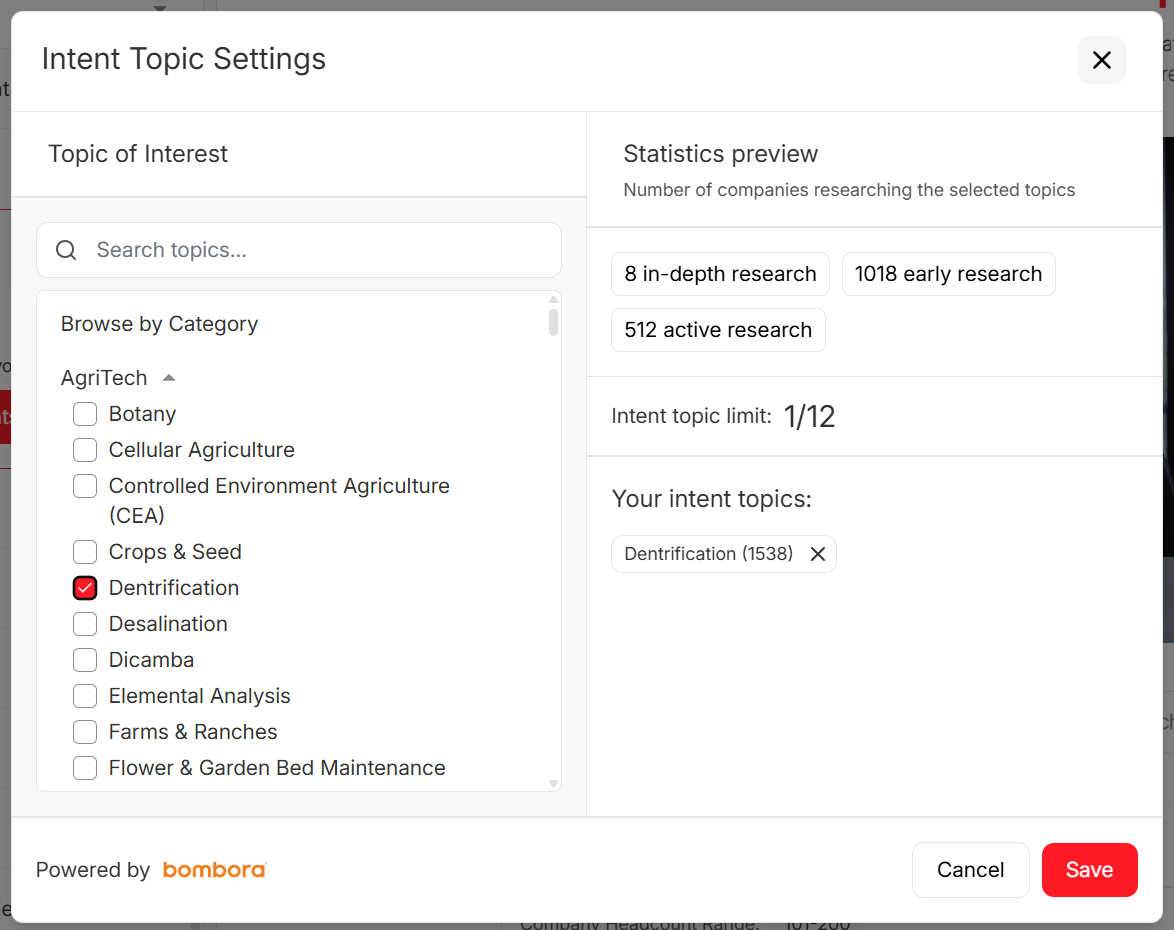
Prospeo tracks 15,000 intent topics via Bombora and layers buyer intent with job role and company growth signals. Its 300M+ contact database refreshes every 7 days (the industry average is 6 weeks), so you're not emailing contacts who changed jobs two months ago. One customer, Meritt, saw bounce rates drop from 35% to under 4% while tripling pipeline to $300K/week after switching.
If you're building lists in Clay, this Clay list building workflow pairs well with signal-first outbound.
Speed-to-Lead
Responding to inbound leads within 1 minute makes you 391% more likely to convert. Contact within 5 minutes and your contact rate jumps 8x. And 78% of leads buy from the first responder.
The kicker? 55% of companies take 5+ days to respond. This is the single highest-ROI fix most SaaS teams can make, and it costs nothing. If you skip every other section in this article, don't skip this one.
To operationalize it, set up a simple lead status system so every inbound is owned within minutes.
Free Trials and Interactive Demos
Self-serve access is a lead gen mechanism, not just a conversion tool. The key metric is time-to-value - how fast can a new user experience the core benefit? If your trial-to-paid rate sits below 3%, the problem is onboarding friction, not the product itself. Map the first three clicks after signup and eliminate anything that doesn't move the user toward their "aha" moment.
For sales-assisted motions, use a consistent product demo checklist so reps don’t improvise the critical steps.
Mistakes That Kill SaaS Pipeline
Do this: Define a tight ICP with 30+ filters (industry, headcount, tech stack, funding stage, intent signals) before building any list. (Use an Ideal Customer Profile template if you don’t have one.) Not that: Target "VP of Sales at companies with 50+ employees" and call it segmentation.
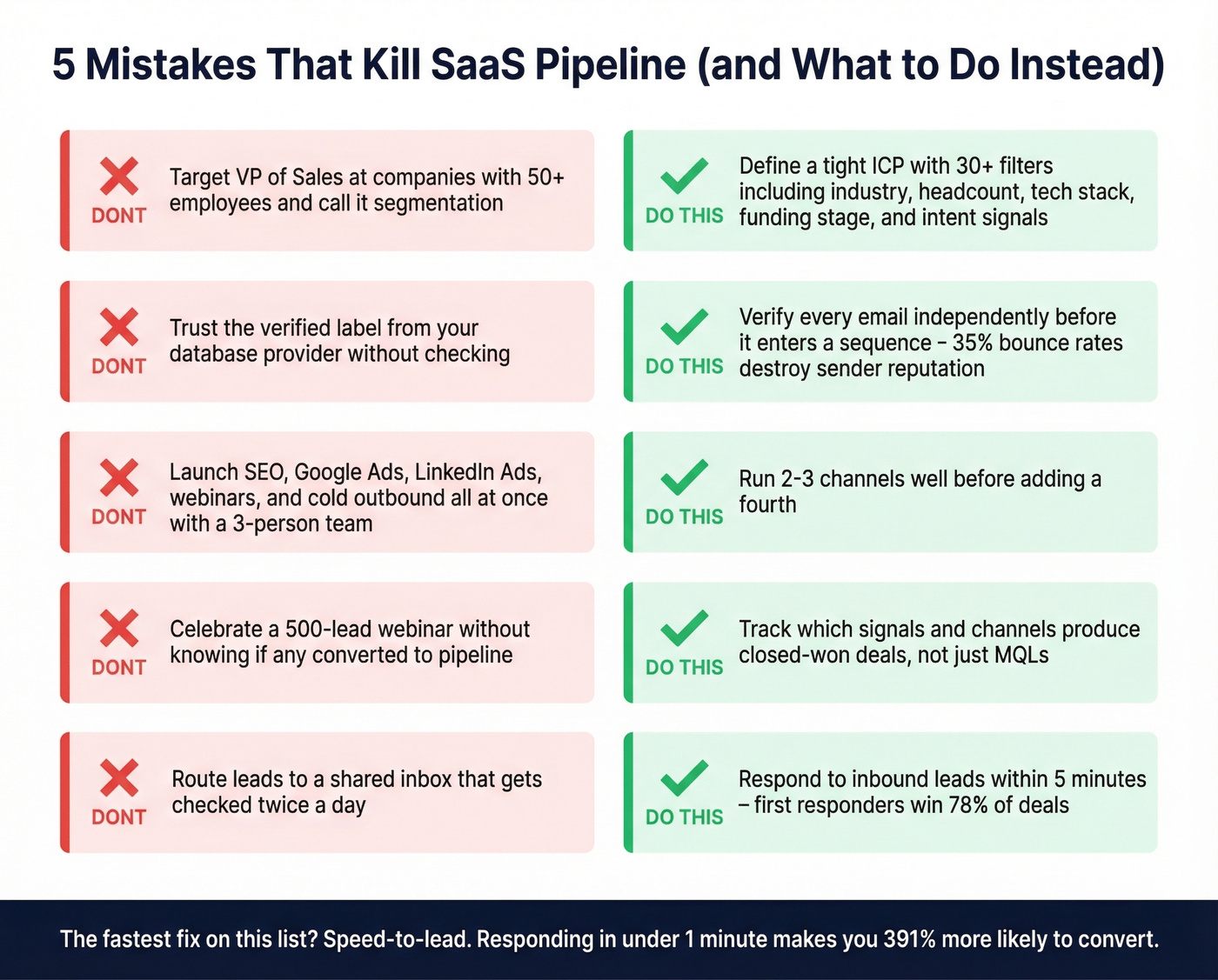
Do this: Verify every email before it enters a sequence. A 35% bounce rate doesn't just waste sends - it tanks your sender reputation for every future campaign. (If you're troubleshooting, start with email bounce rate benchmarks and fixes.) Not that: Trust the "verified" label from your database provider without independent verification.
Do this: Run 2-3 channels well before adding a fourth. Not that: Launch SEO, Google Ads, LinkedIn Ads, webinars, and cold outbound simultaneously with a three-person marketing team.
Do this: Track which signals and channels produce closed-won deals, not just MQLs. Not that: Celebrate a 500-lead webinar without knowing if any converted to pipeline.
Do this: Respond to inbound leads within 5 minutes. Not that: Route leads to a shared inbox that gets checked twice a day.
Your SaaS Lead Gen Tool Stack by Budget
The right stack depends on what you can spend. Here's what we'd recommend at each tier, based on what our team has seen work across dozens of SaaS outbound setups:
| Budget | Enrichment / Verification | Sequencing | CRM | Extras |
|---|---|---|---|---|
| $100-$500/mo | Prospeo (~$0.01/email) | Instantly or Lemlist | HubSpot Starter ($15/user/mo) | Ahrefs Lite ($129/mo) |
| $500-$2K/mo | Prospeo + Clay ($134/mo) | Instantly + Lemlist | HubSpot Pro ($90/user/mo) | Google Ads (~$70 CPL) |
| $2K+/mo | Prospeo API + Clay | Full sequencing suite | Salesforce Sales Cloud Starter ($25/user/mo) | LinkedIn Ads + Bombora |
Let's be honest: the enrichment/verification layer is the one piece that stays constant across every budget tier. Bad data poisons everything downstream - your sequences, your sender reputation, your CRM hygiene. Most teams overspend on sequencing tools and underspend on data quality. Flip that ratio and your outbound performance changes overnight. (If you’re comparing vendors, see these data enrichment services.)
If you’re rebuilding your outbound motion from scratch, start with these outbound lead generation tools and then standardize your sequence management.
Intent-based outbound beats database blasting every time. Prospeo tracks 15,000 buyer intent topics via Bombora, layers them with job changes, funding rounds, and headcount growth - then gives you verified contacts at $0.01/email. That's the signal-first workflow this playbook recommends, built into one platform.
Reach SaaS buyers already in-market - before your competitors do.
What's Changing in 2026
The lead gen software market is growing from $7.4B to a projected $16.2B by 2034, and the major shift is agentic AI replacing point tools. Instead of separate tools for signal detection, enrichment, messaging, and sending, platforms are collapsing these into unified workflows. Over 80% of B2B sales teams using AI report measurable revenue growth, and AI-driven prospecting reclaims 4-7 hours per rep per week.
The other shift is that PQAs are replacing MQLs as the primary qualification metric. The companies that win in 2026 won't have the biggest databases. They'll have the fastest signal-to-outreach loops. For teams rethinking lead generation for SaaS, the playbook is clear: invest in real-time signals, verified data, and speed over volume. (For budget planning, track the right lead generation metrics and align to your lead generation workflow.)
FAQ
What's the average cost per lead for SaaS companies?
B2B SaaS paid campaigns average $310 per lead, while organic channels average $164 and SEO is cheapest at $31. Target an LTV:CAC ratio of at least 3:1 to sustain growth - if your blended CPL exceeds one-third of first-year ACV, cut your worst-performing channel first.
How long does SEO take to generate SaaS leads?
Expect 4-9 months before meaningful pipeline from organic search. The shortcut: target bottom-of-funnel keywords like "[competitor] alternatives" that rank faster and convert at dramatically higher rates than top-of-funnel content. Three BoFu posts can outperform fifty ToFu articles.
Is cold outreach still effective for SaaS in 2026?
Traditional database blasting is dying - reply rates are cratering because contacts are overused across every sales team. Intent-based outbound targeting prospects showing buying signals still works, but only with verified, fresh data. Weekly data refreshes and 98% email accuracy keep bounce rates under 4%.
What's the best approach for early-stage SaaS lead gen?
BoFu content targeting comparison keywords, a free trial with fast time-to-value, and intent-based outbound with verified contacts. Focus on 2-3 channels before expanding. A free enrichment tier paired with Instantly (~$30/month) gives early teams enterprise-grade outbound for under $50/month.
PLG or sales-led - which generates more leads?
McKinsey's analysis of 107 B2B SaaS companies found pure PLG rarely outperforms at scale. The winning model is product-led sales - self-serve access combined with targeted sales motions for expansion, where PQAs replace MQLs. Match your motion to ACV: PLG under $5K, sales-led above $25K, hybrid in between.