

The Lead Generation Process: A Practitioner's Guide for 2026
You've got an SDR team sending 800 emails a week. 12% bounce. Maybe 2% reply. Zero meetings booked. The manager's staring at a dashboard that looks like a crime scene, and every guide they find says "create valuable content and nurture your lead generation process." Thanks. Super helpful.
As one SDR manager put it on r/b2bmarketing: "Cold email gets ~2% reply rate, LinkedIn requests get ignored, and ads are expensive with low conversion." That's not a one-off complaint - it's the norm. And here's what those guides skip: the actual numbers, the scoring model you can steal, and the specific steps where most lead gen efforts quietly bleed out. The average B2B team takes 42 hours to respond to a new lead. 68% of companies haven't even identified their funnel yet. Let's fix that.
The Short Version
If you're pressed for time, here's the whole thing distilled to six non-negotiable moves:
- Define your ICP before touching a single tool. Firmographics, technographics, buying signals. If you can't describe your ideal customer in two sentences, you're not ready to prospect.
- Verify your data. Bad emails kill deliverability, sender reputation, and pipeline. A 7-day refresh cycle and 98% email accuracy should be your baseline, not a luxury.
- Score leads with real thresholds. Demo request = 100 points. Blog visit = 5. Set a threshold tied to your sales team's capacity, not a gut feeling.
- Respond in under 5 minutes. You're 21x more likely to qualify a lead with fast response. Most teams take 42 hours. That's not a process - it's negligence.
- Nurture with multi-touch sequences. 80% of deals require 5+ touches. 44% of reps give up after one follow-up. Do the math.
- Measure at every funnel stage. If MQL volume is rising but SQL count is flat, your handoff is broken. Track the transitions, not just the top of funnel.
What Is Lead Generation?
Lead generation is the process of identifying potential buyers and converting them into contacts your sales team can work. Everything else - the content, the ads, the sequences, the scoring - is plumbing that moves people through that conversion.
The distinction between inbound and outbound matters less than it used to. Inbound pulls prospects to you through content, SEO, and events. Outbound pushes your message to targeted prospects directly. Most teams in 2026 run both, and the best ones blur the line entirely with intent-triggered outbound. 61% of marketers still say generating traffic and leads is their biggest challenge, which tells you how much room there is to gain ground by simply executing the basics well.
Not every lead deserves the same treatment. Here's the taxonomy that matters:
| Lead Type | Definition | Example Trigger |
|---|---|---|
| MQL | Meets marketing engagement thresholds | Downloaded 3 assets, visited pricing page |
| SQL | Vetted by sales for real buying intent | Confirmed budget, timeline, authority |
| PQL | Used product, hit activation threshold | Completed onboarding, invited team members |
| Service-Qualified | Existing customer flagging expansion need | Support ticket requesting enterprise features |
Cover these definitions once with your team, agree on the handoff criteria between them, and move on. The real differentiation is in execution.
Why Most Lead Gen Efforts Fail
Here's the contrarian take most guides won't give you: the "lead generation funnel" assumes you're moving strangers through stages. Reality doesn't work that way.
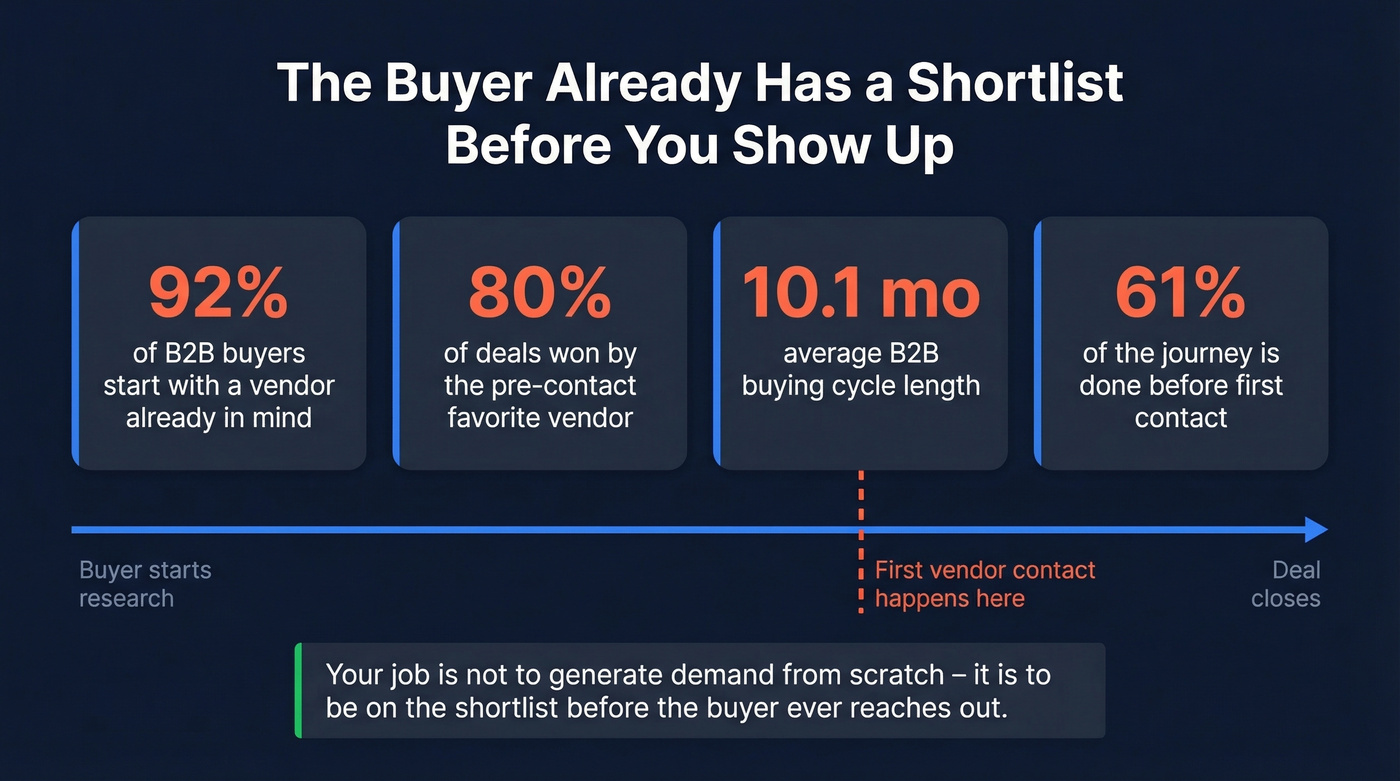
92% of B2B buyers start their evaluation with at least one vendor already in mind. 41% have a preferred vendor before the formal process even begins. The winning vendor is on the buyer's Day One shortlist 95% of the time, and the pre-contact favorite wins roughly 80% of deals. The average B2B buying cycle runs 10.1 months, and first contact doesn't happen until 61% of the way through.
What does this mean for your approach? You're not generating demand from scratch. You're competing to be on that shortlist - and then executing flawlessly once a hand goes up.
Most processes don't fail at attraction. They fail post-capture. The symptoms are predictable: MQL volume rises while SQL count stays flat, response times creep up, and sales rejects more leads. Marketing blames sales for not following up. Sales blames marketing for sending garbage. We've seen this pattern at companies of every size, and the root causes are almost always the same - misaligned handoff definitions, fragmented data across CRM and automation platforms, manual routing that adds hours of delay, and no real nurture after initial capture. The fix isn't more leads at the top. It's tighter execution at every stage below it.

Most lead gen processes fail post-capture because the data was bad from the start. Prospeo's 7-day refresh cycle, 5-step verification, and 30+ ICP filters mean you build lists that actually convert - not lists that bounce at 15% and torch your domain.
Stop bleeding pipeline to stale data. Start with 98% accuracy.
The 7-Step Lead Generation Process
Step 1: Define Your ICP and Personas
Before you touch a tool, answer these questions:
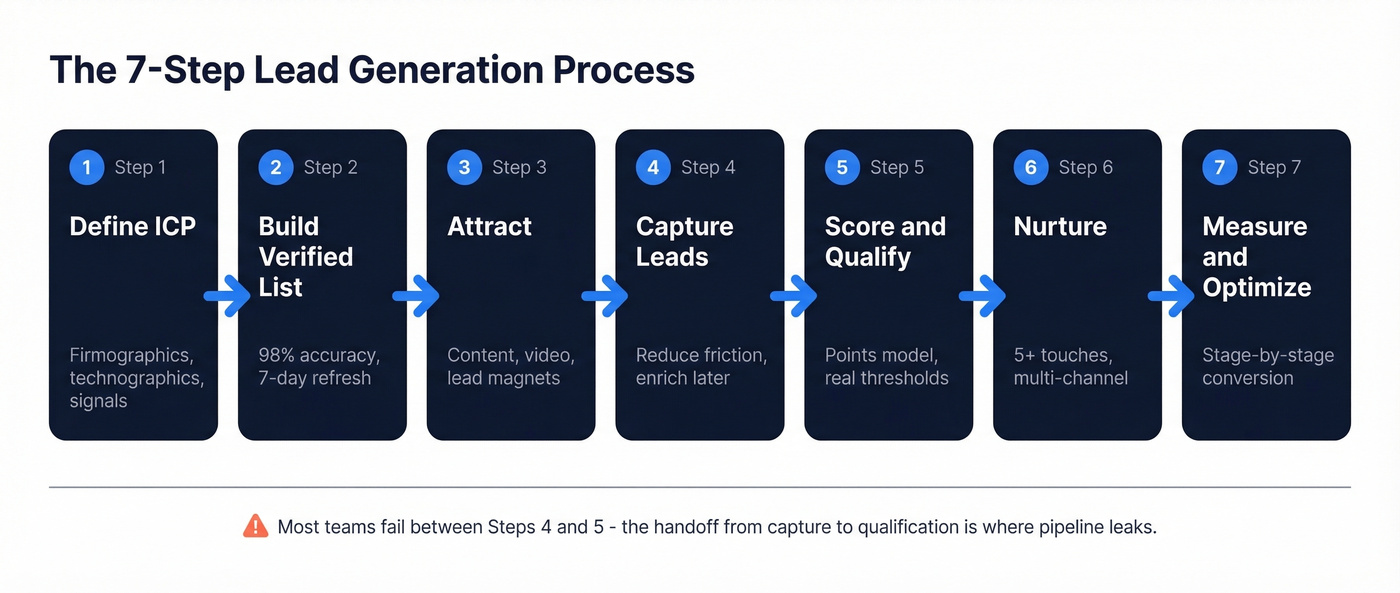
- Firmographics: Industry, company size, revenue range, geography, funding stage
- Technographics: What tools do they already use? CRM, marketing automation, competitor products?
- Behavioral signals: Are they hiring for relevant roles? Growing headcount? Showing intent on specific topics?
- Role-level criteria: Title, seniority, department, decision-making authority
A vague ICP like "mid-market SaaS companies" wastes credits and rep time. Compare that to "Series B+ SaaS companies, 100-500 employees, using HubSpot, hiring SDRs, showing intent on 'outbound sales'" - that's a list worth building. Platforms with 30+ search filters let you map directly to these criteria, including buyer intent, technographics, job changes, and headcount growth. This first step separates teams that scale from teams that spin their wheels. If you need a starting point, use an ideal customer profile template to lock definitions.
Step 2: Build a Verified Prospect List
Use this if: You need accurate contact data that won't tank your sender reputation. You're tired of 15-30% bounce rates from stale databases. You want to filter by intent signals, not just firmographics.
Skip this if: You already have a verified, fresh database with sub-5% bounce rates. (You probably don't.)
Data decays fast. People change jobs, companies get acquired, email domains rotate. The industry average refresh cycle is six weeks, which means by the time you're emailing a list, a meaningful chunk is already stale.
Prospeo addresses this with a 7-day refresh cycle across 300M+ professional profiles, including 143M+ verified emails and 125M+ verified mobile numbers. The 5-step verification process - catch-all handling, spam-trap removal, honeypot filtering - delivers 98% email accuracy. And the 30+ search filters let you target by buyer intent across 15,000 topics, technographics, job changes, headcount growth, funding, and revenue, so you're building lists of people who match your ICP and show buying signals. If you're comparing vendors, start with a shortlist of data enrichment services and a dedicated email deliverability guide so you don't fix list quality but break inboxing.

Real results back this up. Meritt tripled their pipeline from $100K to $300K per week after switching, with bounce rates dropping from 35% to under 4%. Snyk's 50-person AE team cut bounce rates from 35-40% to under 5% and generated 200+ new opportunities per month. The pattern is consistent: clean data compounds into pipeline. Dirty data compounds into domain damage.
The free tier gives you 75 verified emails per month plus 100 Chrome extension credits - enough to test your ICP filters before scaling. If you're building your stack on a budget, start with free lead generation tools and add paid data once you’ve proven conversion.
You just mapped your ICP with firmographics, technographics, and intent signals. Now you need a database that actually filters on all of them. Prospeo gives you 300M+ profiles, 15,000 intent topics, and buyer signals like job changes and headcount growth - at $0.01 per email.
Turn your ICP definition into a ready-to-work prospect list in minutes.
Step 3: Attract With Content and Channels
Channel diversification isn't optional anymore. 94% of marketing teams diversified their channel mix last year, and only 6% still rely on just one or two channels. The teams seeing results are testing aggressively - 45% allocate 10-20% of their budget to experimenting with new channels.
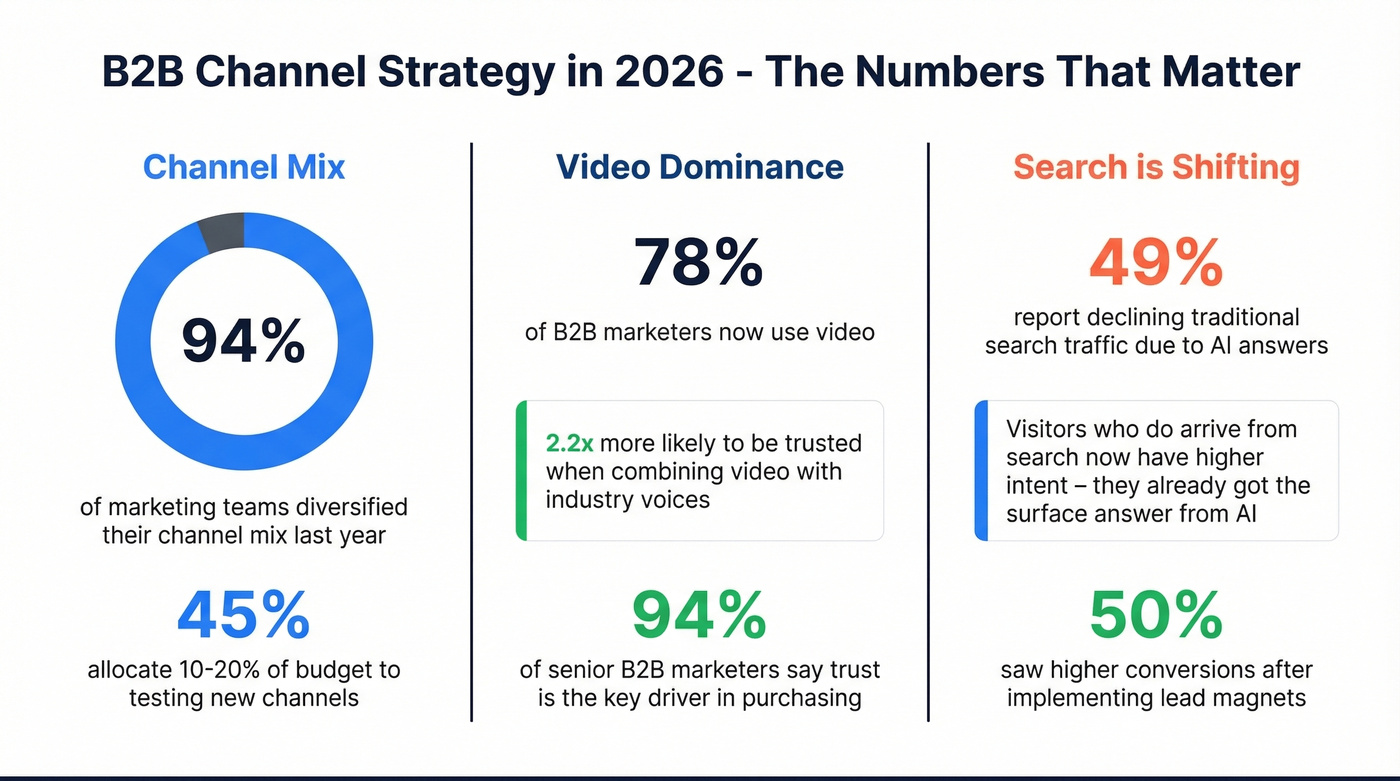
Video is the standout format. 78% of B2B marketers already use it, and brands combining video with industry voices are 2.2x more likely to be trusted. That trust metric matters because 94% of senior B2B marketers agree trust is the key driver in B2B purchasing decisions.
Lead magnets still work when they're genuinely useful. 50% of marketers reported higher conversion rates after implementing lead magnets, but "download our ebook" isn't a lead magnet in 2026. Templates, calculators, benchmark reports, and interactive tools outperform static PDFs. The magnet needs to solve a specific problem your ICP has right now, not educate them on your category. If you're building this engine from scratch, align it with what is B2B content marketing so content supports qualification, not just traffic.
One shift worth watching: 49% of marketers report declining traditional search traffic due to AI-generated answers. The visitors who do arrive from search tend to have higher intent - they've already gotten the surface-level answer from an AI summary and are looking for depth. Build content for that deeper intent.
Step 4: Capture Leads
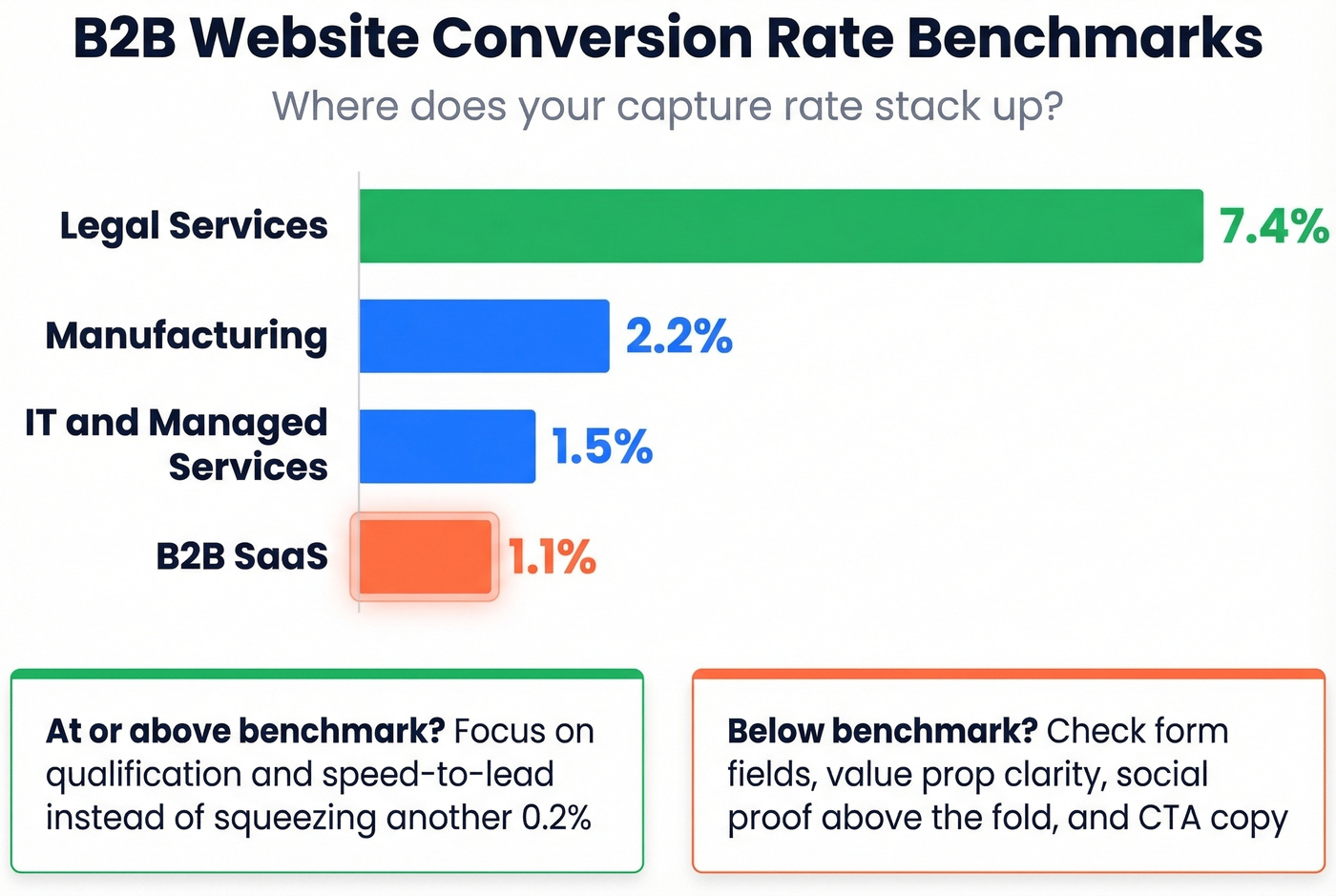
Your website conversion rate sets the ceiling for everything downstream. Here are the benchmarks that matter:
| Industry | Avg. Conversion Rate |
|---|---|
| B2B SaaS | 1.1% |
| IT & Managed Services | 1.5% |
| Manufacturing | 2.2% |
| Legal Services | 7.4% |
If you're in that range, your capture mechanism is working. Don't obsess over squeezing another 0.2% from your landing page - focus on qualification and speed-to-lead instead. If you're significantly below these numbers, the usual suspects apply: too many form fields, unclear value proposition, no social proof above the fold, or a CTA that says "Submit" instead of something specific.
The principle is simple: reduce friction to the minimum viable data capture. Name, email, company. Everything else can come from enrichment after the fact.
Step 5: Score and Qualify
Most lead scoring models are either too simple - hot, warm, cold - or too complex, with 50 weighted variables nobody maintains. Here's a starter model that actually works:
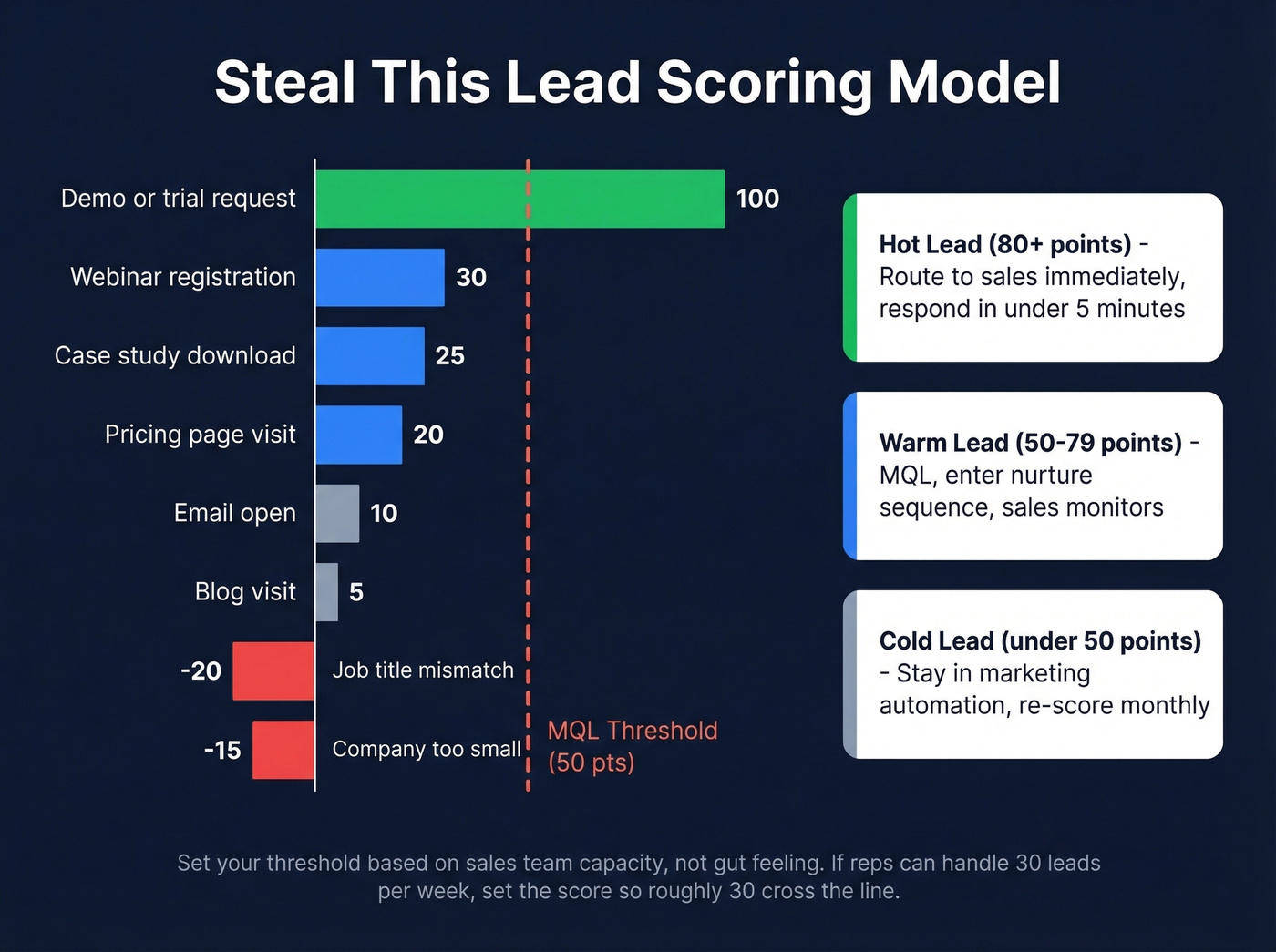
| Action | Points | Rationale |
|---|---|---|
| Demo/trial request | 100 | Direct buying intent |
| Pricing page visit | 20 | Evaluating cost |
| Webinar registration | 30 | Active engagement |
| Blog visit | 5 | Awareness-level |
| Case study download | 15 | Solution evaluation |
| Unsubscribe | -50 | Disengagement signal |
| 30-day inactivity | -10 | Decay penalty |
Set your MQL threshold based on sales capacity, not an arbitrary number. If your team can handle 50 qualified conversations per week, set the threshold so roughly 50 leads cross it. One team we worked with saw their MQL-to-meeting rate jump 13% after they lowered the activity threshold but tightened seniority filters - proving that who matters more than how much they engage. For a deeper build, use a dedicated lead scoring framework and document your buying signals so sales and marketing stop arguing about “quality.”
Funnel conversion benchmarks to aim for:
| Stage Transition | Healthy Range |
|---|---|
| MQL to SQL | 20-30% |
| SQL to Opportunity | 40-60% |
| Opportunity to Close | 15-25% |
If your numbers fall well below these ranges, the bottleneck is in qualification, not volume. A 10% MQL-to-SQL rate means your scoring model is too loose. A 10% Opp-to-Close rate means sales is working deals that shouldn't be in the pipeline.
The override rule is critical: if someone requests a demo, send them to sales immediately regardless of their score. A human requesting a conversation is the strongest signal in B2B. Don't let a formula override common sense.
Start rule-based for transparency. Once you've got 6-12 months of closed-won data, layer in AI-assisted scoring that can identify patterns your rules miss - like the fact that prospects who visit your integrations page within 48 hours of a webinar close at 3x the rate.
Step 6: Route and Respond Fast
Speed-to-lead is the single highest-leverage fix in most lead gen operations. The data is unambiguous: you're 21x more likely to qualify a lead with fast response versus waiting 30+ minutes. Responding in the first minute can drive a 391% increase in conversions.
The average B2B sales team takes 42 hours to respond. Even the "fast" companies aren't fast enough:
| Company Size | Avg. Response Time |
|---|---|
| Small (1-300 employees) | 48 minutes |
| Mid-market (301-2,500) | 1 hour 38 minutes |
| Enterprise (2,501+) | 1 hour 28 minutes |
Automated routing through your CRM or a dedicated tool like Chili Piper eliminates the manual handoff that adds hours of delay. Set up round-robin assignment with instant notification. If a lead requests a demo at 2 PM and doesn't hear back until the next morning, you've already lost ground to the competitor who responded in 5 minutes. This single step accounts for more lost revenue than any other in the entire lead generation process. If routing is messy, standardize your lead status definitions so handoffs are measurable.
Step 7: Nurture and Convert
Here's a stat that should reframe how you think about follow-up: buyers average 36 interactions before purchasing. Five follow-ups isn't pestering - it's barely getting started. Yet 44% of sales reps give up after a single follow-up, and 50% of qualified leads aren't ready to purchase at first contact.
Effective nurture isn't "send a check-in email every two weeks." It's a multi-touch sequence combining email, retargeting, direct mail, and phone - timed to behavioral triggers, not arbitrary cadences. When a prospect revisits your pricing page after 30 days of silence, that's a signal. When they download a competitor comparison, that's a signal. Build sequences that respond to these moments, not just calendar dates. If you need copy you can deploy fast, keep sales follow-up templates on hand.
The goal isn't to pester. It's to stay present and relevant until the buying window opens.
Five Mistakes That Kill Your Pipeline
1. Chasing volume over intent. B2B lead costs balloon from $40 to $300+ when you're targeting low-intent audiences. A list of 10,000 "marketing managers" isn't a pipeline - it's a vanity metric. Filter for intent signals, recent job changes, and technographic fit before you spend a single credit.
2. Treating all leads the same. A webinar attendee and a demo requester are not the same lead. Routing both through the same nurture sequence wastes the demo requester's urgency and overwhelms the webinar attendee. Segment by intent level and respond accordingly.
3. Using outdated linear scoring. If your scoring model hasn't been updated in 12 months, it's wrong. Buyer behavior shifts, new content gets published, and the signals that predicted closed-won deals last year don't predict them today. Review and recalibrate quarterly.
4. Broken marketing-to-sales handoffs. The classic symptom: MQL volume is rising, but SQL count is flat or declining. Sales says the leads are garbage. Marketing says sales isn't following up. The fix is a shared definition of "qualified" with explicit SLAs - marketing delivers leads meeting agreed criteria within a defined timeframe, sales responds within a defined window and provides disposition feedback.

5. Running on bad data. If your bounce rate is above 5%, your data is the problem, not your messaging. Every bounced email damages your sender reputation, which reduces deliverability on the emails that are valid. It compounds. Snyk cut their bounce rate from 35-40% to under 5% after switching to a platform with automated verification and a weekly refresh cycle. The fix is mechanical, not strategic: verify before you send. If you’re diagnosing the issue, start with email bounce rate benchmarks and remediation.
How AI Is Changing Lead Gen in 2026
Let's be honest about what AI actually does in lead generation today versus the hype.
Signal detection is where AI delivers the most immediate value. AI agents monitor buying signals - job changes, competitor reviews, website visits, hiring patterns, technology adoption - and surface prospects who match your ICP at the moment they're most likely to engage. Intent data platforms tracking thousands of topics are replacing batch-and-blast prospecting with signal-based targeting. And 58% of marketers say AI referral traffic already has higher intent than traditional search traffic, which means leads entering your funnel through AI-driven channels are often better qualified from the start.
Personalized sequence generation is the second practical application. Once signals are detected, AI can generate multichannel sequences personalized to the prospect's specific context - not "Hi {first_name}" personalization, but actual relevance: referencing their recent funding round, their tech stack, or the specific problem their job posting suggests they're trying to solve.
Predictive scoring rounds out the trio. Layer AI on top of your rule-based model once you've got enough historical data. The AI identifies patterns humans miss, like the correlation between a prospect's community activity and their likelihood to close.
Here's our hot take: the real advantage in 2026 isn't any single AI feature. It's unified platforms that combine data, signals, and orchestration versus disconnected point solutions that create data fragmentation. But AI doesn't fix a broken process. It accelerates whatever you already have. If your average deal size is under $10K, you probably don't need an AI-powered orchestration suite - you need clean data, a tight ICP, and fast follow-up. Get the 7 steps right first.
Essential Tools for Each Step
You don't need 15 tools. You need four or five that talk to each other.
| Process Step | Category | Recommended | Approx. Price |
|---|---|---|---|
| Prospect list | B2B data platform | Prospeo | Free tier; ~$0.01/email |
| Outreach | Email sequencing | Smartlead, Instantly, Lemlist | $30-100/mo |
| CRM | Pipeline management | HubSpot, Salesforce | Free-$300/user/mo |
| Lead routing | Speed-to-lead | Chili Piper, native CRM routing | $30-200/user/mo |
The stack that wins isn't the most expensive one. It's the one where data flows cleanly from prospecting through sequencing into your CRM without manual CSV exports or broken integrations. Native connections between your data platform and your sequencer matter more than any individual feature.
FAQ
What are the main stages of the lead generation process?
Seven stages: define your ICP, build a verified prospect list, attract with content and channels, capture leads, score and qualify, route and respond fast, nurture and convert. Each stage needs clear benchmarks and explicit handoff criteria to the next.
What's a good B2B website conversion rate?
B2B SaaS averages 1.1%, IT and managed services 1.5%, legal services 7.4%. If you're in range, shift focus to qualification and speed-to-lead rather than obsessing over landing page tweaks.
How fast should you respond to a new lead?
Under five minutes. Companies that respond within that window are 21x more likely to qualify the lead. The average B2B team takes 42 hours. Automate routing through your CRM or a tool like Chili Piper to eliminate manual delays.
What's the difference between MQL and SQL?
An MQL meets engagement and fit thresholds set by marketing - enough activity and demographic match to warrant sales attention. An SQL has been vetted by sales as having confirmed budget, timeline, and authority. Handoff criteria should be agreed on by both teams and reviewed quarterly.
What's a free tool to build verified prospect lists?
Prospeo's free tier includes 75 verified emails and 100 Chrome extension credits per month with access to 30+ search filters, including intent data and technographics. That's enough to test ICP targeting before committing budget, and the 98% email accuracy keeps bounce rates low from day one.