

Lead Generation Skills That Actually Drive Revenue
Mastering the right lead generation skills is the single biggest lever most B2B teams ignore. 84% of reps missed quota last year, and 80% of leads never convert. Meanwhile, 91% of B2B marketers rank lead gen as their top priority and 53% of sales and marketing teams spend over half their budgets on it.
That's a lot of money chasing a talent gap. The teams that win aren't the ones with the biggest tech stack - they're the ones whose people actually know what they're doing.
What You Need (Quick Version)
If you're building your skill stack from scratch, focus here first:
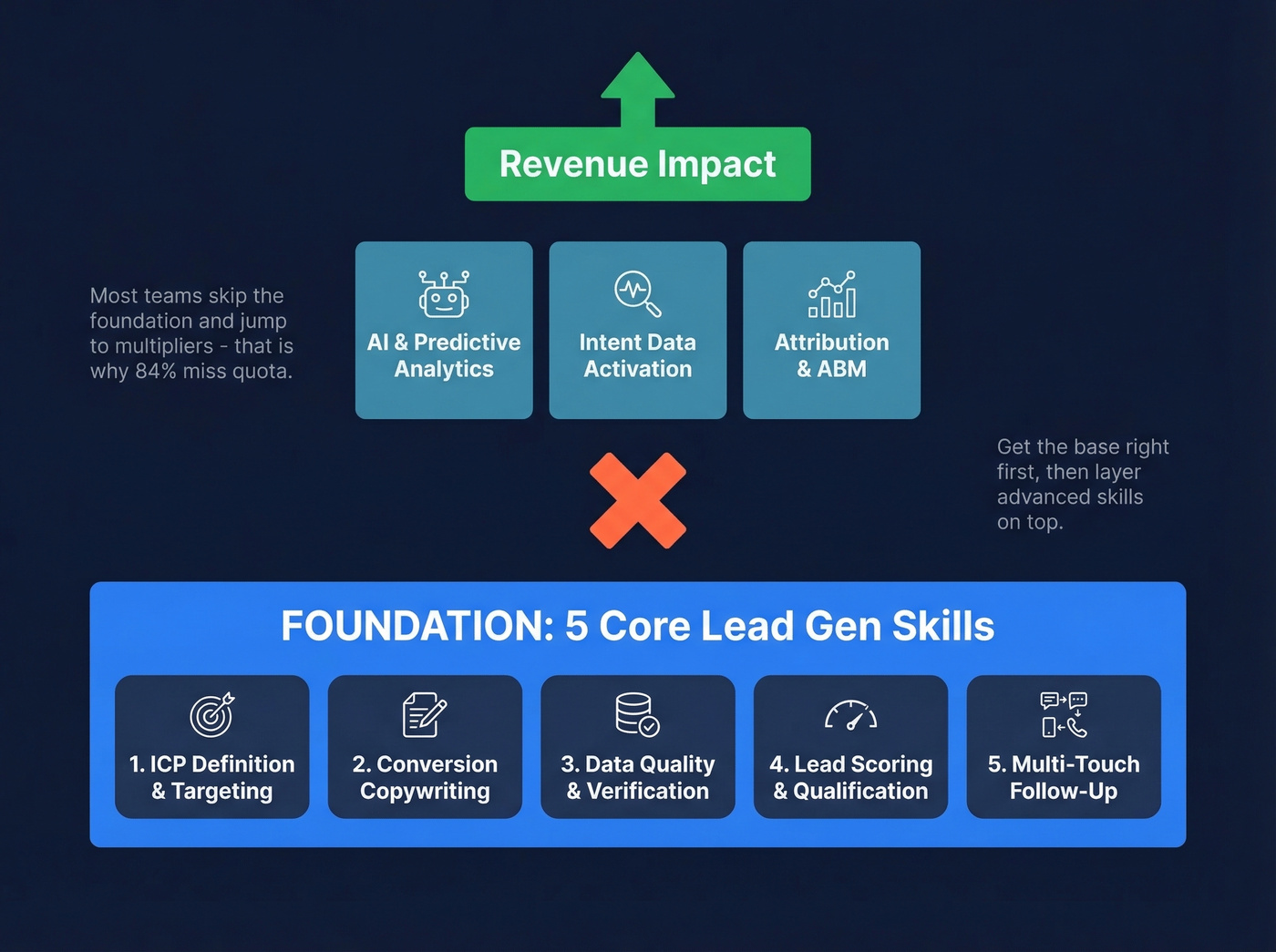
- ICP definition & targeting - everything downstream depends on this
- Conversion copywriting - turns attention into action
- Data quality & verification - the silent campaign killer
- Lead scoring & qualification - stop wasting sales' time
- Multi-touch follow-up discipline - most deals need 5-12 touchpoints
Everything else - AI, attribution, account-based strategy - is a multiplier on those five. Most articles list 15 skills and treat them equally. That's how you end up mediocre at everything.
Foundational Skills
ICP Definition & Targeting
This is skill number one because every other skill depends on it. Writing brilliant copy to the wrong audience is just generating expensive noise.
A real ICP isn't "mid-market SaaS companies." It's a document specifying industry, headcount range, tech stack signals, funding stage, and the specific titles you're targeting - plus the pain points that make prospects receptive right now. The teams we've seen hit quota consistently revisit their ICP quarterly, not annually, because markets shift faster than most planning cycles account for. If you need a starting point, use an ICP template and iterate from real pipeline data.
Copywriting for Conversion
The best lead gen copywriters don't write about their product. They write about the prospect's situation. Subject lines, opening hooks, CTAs, and the ability to articulate a prospect's problem better than they can - these aren't "nice to have" writing skills. They're revenue skills.
That shift in orientation is the whole game. If you want to go deeper on messaging, start with email copywriting fundamentals and build from there.
Persuasion Psychology
Cialdini's six principles - reciprocity, commitment, social proof, authority, liking, and scarcity - aren't academic concepts. They're the operating system behind every high-converting lead magnet and outreach sequence. Reciprocity drives the "free audit" play. Micro-commitments like quizzes and assessments use consistency bias to move prospects through your funnel. Layer in Drew Eric Whitman's eight core human desires - security, comfort, social approval - and you've got both the rational and emotional levers covered.
Persuasion isn't manipulation. If you need to manipulate someone into becoming a lead, you're targeting the wrong person.
Data Quality & Verification
This is the most underrated skill on this list. We've seen outbound programs fall apart when bounce rates hit the 35-40% range - sharp targeting, great messaging, disciplined follow-up, all wasted because the emails weren't real. Your sender reputation tanks, your domain gets flagged, and suddenly even the good emails land in spam.
Data quality means understanding verification processes, catch-all domain handling, refresh cycles, and bounce rate thresholds. Prospeo's 98% email accuracy rate with a 7-day data refresh cycle - compared to the 6-week industry average - illustrates why this matters when you're sending 500 cold emails a week. Treating data hygiene as a core competency is what separates teams that scale outbound from teams that burn domains. For benchmarks and fixes, see our guide to email bounce rate and the full email deliverability checklist.

Intermediate Skills That Separate Performers
Lead Scoring & Qualification
Picture this: marketing celebrates a 500-lead month while sales is furious because half those leads are unqualified. Sound familiar? If you're passing every inbound lead to sales unscored, you're part of the 84% problem.
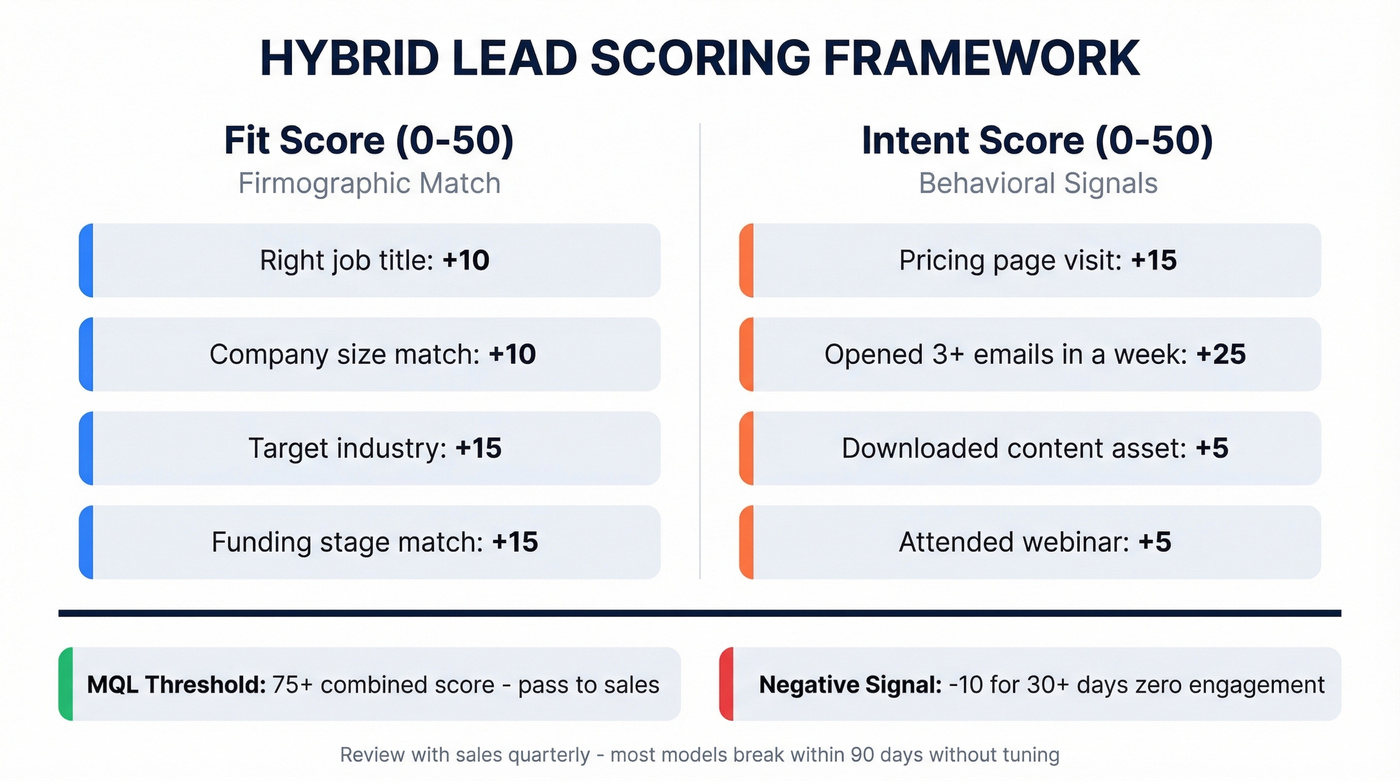
Start with a hybrid framework. Assign a Fit score from 0-50 based on firmographic match, plus an Intent score from 0-50 based on behavioral signals. Set your MQL threshold at 75+ and build from there. Give +10 for the right title, +15 for a pricing page visit, +25 for opening three emails in a week. Don't forget negative scoring either: -10 for 30+ days of zero engagement keeps your pipeline honest. Review the model quarterly with sales feedback - the consensus on r/sales is that most scoring models break within 90 days if nobody's tuning them. If you want a full setup, use this lead scoring playbook.
Multi-Touch Sequencing & Speed-to-Lead
75% of B2B buyers take longer to decide than they did in 2023, and most deals require 5-12 touchpoints before a prospect converts. Yet up to 50% of sales go to the first vendor to respond. The speed-to-lead data is brutal: contacting a lead within one hour makes you 7x more likely to qualify them. Wait 24 hours and you're basically out of the running.
The skill isn't just "follow up faster." It's designing sequences that combine email, phone, and social with appropriate timing and escalation logic. Persistence with relevance beats volume every time. If you need copy you can deploy quickly, use these sales follow-up templates.
Channel Mastery
Each channel has its own economics. 89% of B2B marketers use LinkedIn for lead gen, and 62% say it produces quality leads - it converts visitors at 2.74%, roughly 3.5x Facebook's rate. Cold email gives you volume and measurability with open rates of 15-25% and reply rates of 1-5%. Paid channels offer targeting precision but higher CPL: SEM averages ~$92/lead versus ~$72 for webinars and $811 for trade shows.
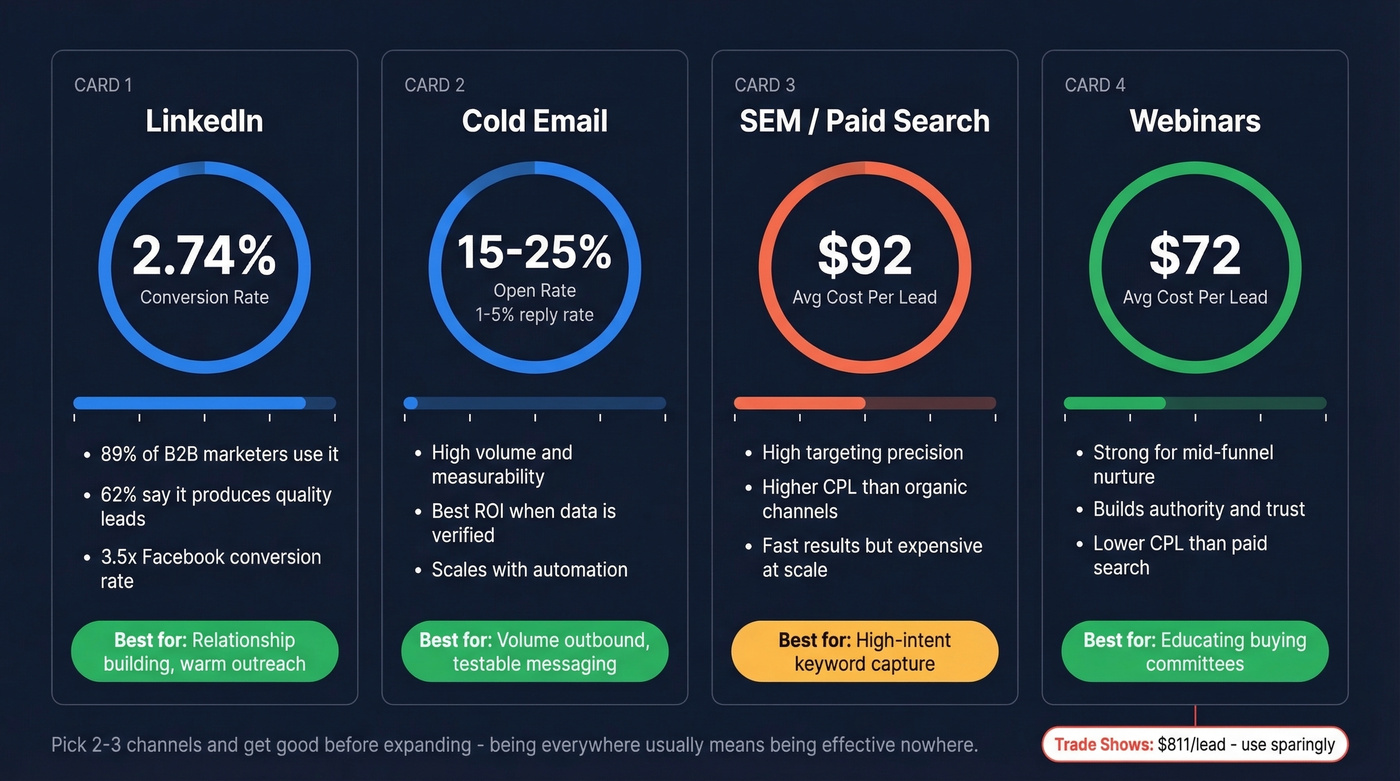
The skill isn't mastering one channel. It's knowing which channel fits which stage of your funnel and which segment of your ICP, then building workflows that move prospects across channels without dropping them. We've found that teams who try to be everywhere at once usually end up being effective nowhere - pick two or three channels, get good, then expand. For a broader view of what's changing, track these lead generation trends.
CRM & Automation Proficiency
A CRM isn't a contact database. It's the operational backbone of your lead gen engine. Teams with strong CRM adoption see 29% higher sales productivity, and over 75% of marketers use automation for lead nurturing. Forrester research shows teams doing it well generate 50% more sales-ready leads at 33% lower cost per lead. The gap between "has HubSpot" and "actually uses HubSpot" is enormous.
If you're standardizing your stack, start by aligning on examples of a CRM and then document the workflows in a repeatable lead generation workflow.

You just read that data quality is the most underrated lead gen skill - and that 35-40% bounce rates destroy outbound programs. Prospeo's 98% email accuracy and 7-day data refresh cycle mean your copywriting, sequencing, and scoring skills actually land. At $0.01/email, bad data is no longer an excuse.
Stop perfecting skills that bounce off invalid inboxes.
Advanced Skills for 2026
B2B selling has shifted permanently. 80% of sales interactions now happen in digital channels, buyers use an average of 10 interaction channels, and buying committees include 8-13 decision-makers.
AI & Predictive Analytics
79% of B2B marketers already use AI in their lead gen workflows. AI-driven lead generation improves conversion rates by 30-55% versus manual prospecting and cuts qualification time by up to 30%. The emerging model is the "agentic workflow" - AI handles prospecting, enrichment, and initial personalization while humans handle strategy, relationship building, and closing.
Here's the thing: AI doesn't replace strong prospecting fundamentals. It exposes who doesn't have them. If your basics are weak, AI just helps you fail faster and at greater scale. To build the right foundation, start with proven sales prospecting techniques.
Intent Data Activation
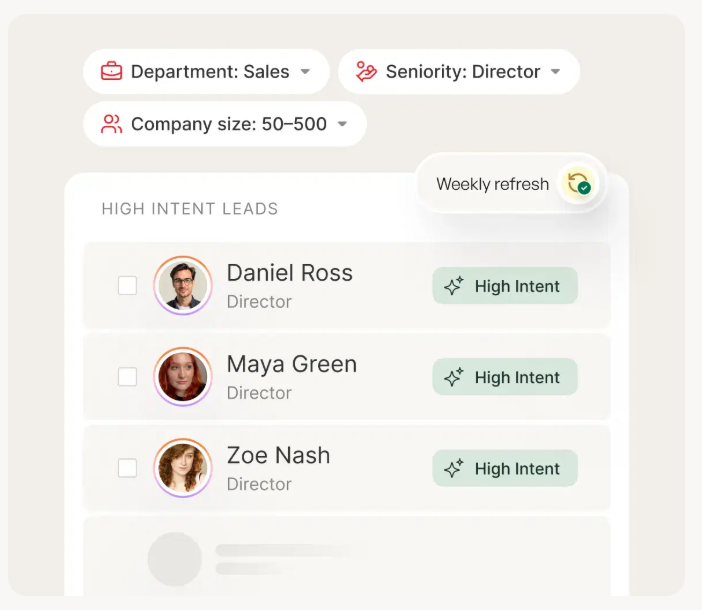
Intent data tells you who's actively researching solutions in your category before they fill out a form. The skill isn't buying intent data - it's operationalizing it. That means layering intent signals with firmographic fit, building triggers that route high-intent accounts to reps in real time, and designing sequences that reference the prospect's research context without being creepy about it.
The signal is only as good as your ability to act on it within hours, not days. Skip this skill entirely if you haven't nailed ICP targeting and lead scoring first - intent data on a broken foundation just creates more noise.
Attribution & Account-Based Multi-Threading
With 8-13 decision-makers in a typical buying committee, single-threaded outreach is a losing strategy. Account-based multi-threading means mapping the full committee, building role-specific messaging, and coordinating touches across the account - not just hammering the one contact who downloaded your whitepaper.
Multi-touch attribution models aren't perfect, but they're infinitely better than last-touch or gut feel. If you're building an ABM motion, use these account-based selling best practices.
Tools Mapped to Each Skill
You don't need 12 tools. You need the right five or six, mapped to the skills that matter most.
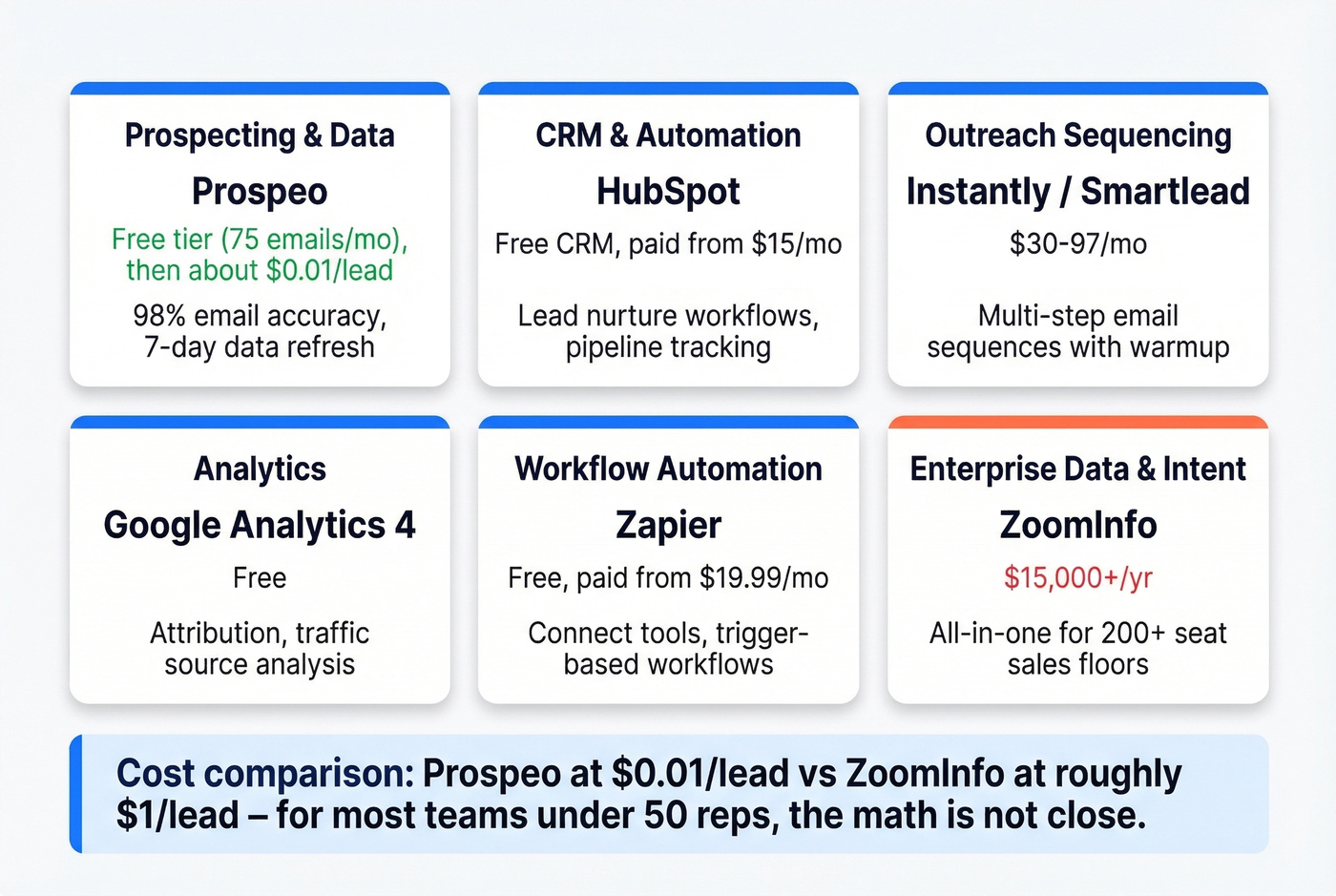
| Skill Area | Tool | Starting Price |
|---|---|---|
| Prospecting & Data | Prospeo | Free tier (75 emails/mo); ~$0.01/lead |
| CRM & Automation | HubSpot | Free CRM; paid from ~$15/mo |
| Outreach Sequencing | Instantly / Smartlead | ~$30-97/mo |
| Analytics | Google Analytics 4 | Free |
| Workflow Automation | Zapier | Free; paid from $19.99/mo |
| Enterprise Data & Intent | ZoomInfo | ~$15,000+/yr |
ZoomInfo is still the best all-in-one enterprise platform. But most teams under 50 reps don't need all-in-one, and at ~$1/lead versus $0.01/lead with Prospeo, the math isn't close for anyone who isn't running a 200-seat sales floor.
CRM proficiency and automation matter - but only when your data is clean going in. Prospeo enriches contacts with 50+ data points at a 92% match rate and integrates natively with HubSpot, Salesforce, Clay, and Zapier. Your lead gen skills finally compound instead of stall.
Plug verified data into your CRM and watch every skill on this list perform.
Habits That Kill Pipeline
These are the patterns we see repeatedly in teams that generate volume but can't convert:
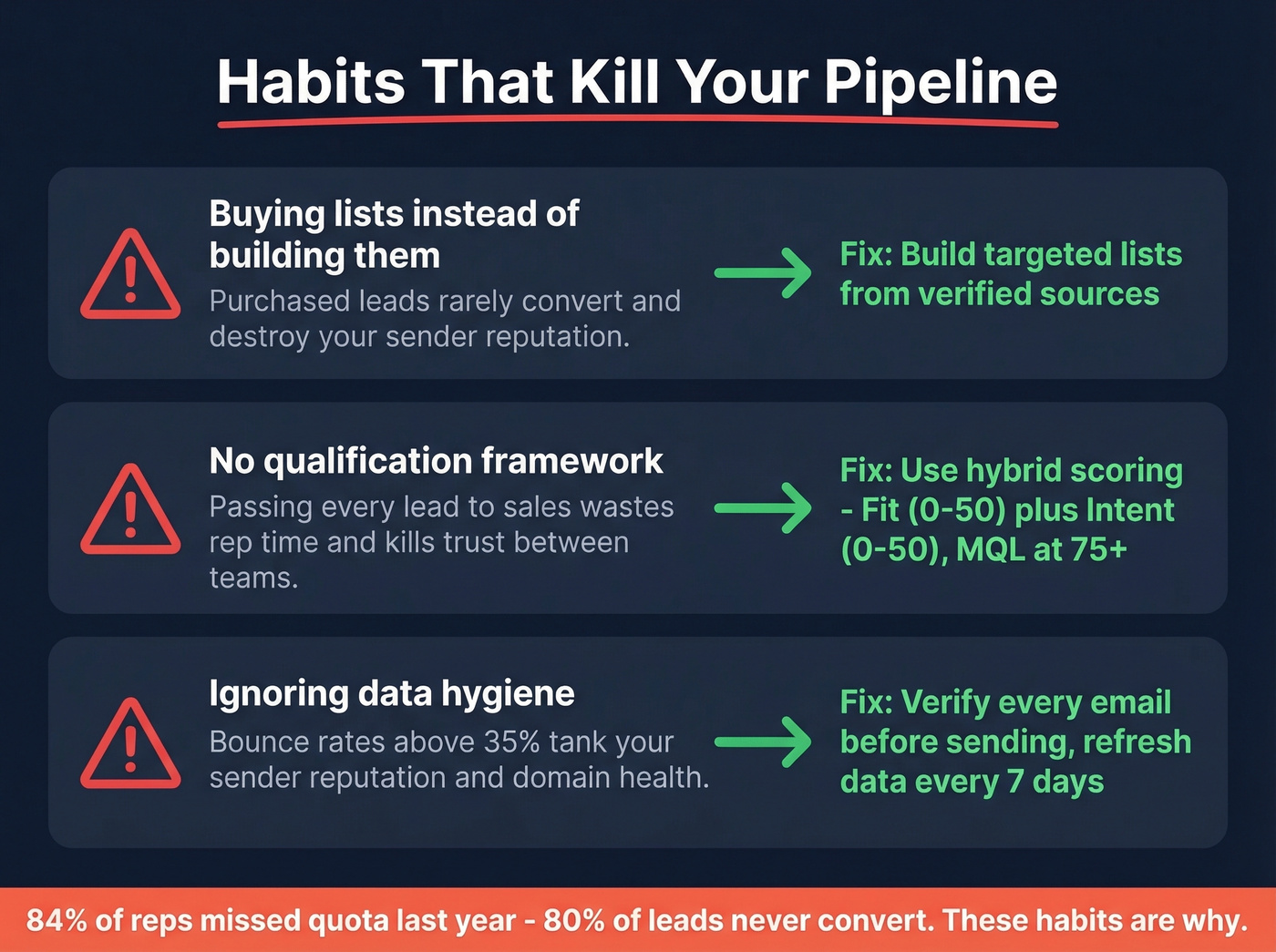
Buying lists instead of building them. Purchased leads rarely convert and destroy your sender reputation. Build targeted lists from verified sources.
No qualification framework. Passing every lead to sales unscored wastes rep time and erodes trust between marketing and sales. One team we worked with cut their sales cycle by three weeks just by implementing a basic fit + intent scoring model.
Slow follow-up. If your speed-to-lead is measured in days instead of minutes, you're losing half your deals to whoever responds first.
Generic lead magnets. "Subscribe to our newsletter" isn't a value proposition. Offer something specific enough that only your ICP would want it.
No sales feedback loop. If marketing never hears which leads actually closed, the scoring model never improves. Build a 30/60/90-day review cadence. If you want a simple operating rhythm, borrow this 30/60/90-day plan structure.
Career Path & Salary
Lead generation is one of the more accessible entry points into B2B revenue roles. In the US, entry-level positions start around $36,000/year, with the average at $76,990 and senior roles topping $94,000+.
The typical progression runs SDR/BDR to lead gen specialist to demand gen manager to RevOps or marketing leadership. Expect about six months to become competent with foundational skills and 1-2 years of hands-on campaign work to reach expert level. Career switchers frequently ask whether AI makes entry-level roles harder to land - which is exactly why fundamentals like targeting, messaging, and pipeline mechanics matter more than ever. The market's growing at 17.5% CAGR through 2031, and demand for skilled practitioners isn't slowing down.
FAQ
What are the most important lead generation skills?
ICP targeting, conversion copywriting, data verification, lead scoring, and multi-touch follow-up. Master these five deeply before branching into AI, intent data, or attribution modeling.
How long does it take to learn lead generation?
About six months for foundational competence with prospecting, messaging, and CRM workflows. Reaching expert level with scoring frameworks and multi-channel orchestration takes 1-2 years of hands-on campaign work.
Is lead generation a good career in 2026?
Yes. Average US salary is $76,990/year, senior roles exceed $94K, the market's growing at 17.5% CAGR through 2031, and many specialist positions are remote-friendly.
What tools do lead generation specialists need?
A CRM like HubSpot, a prospecting platform for verified contact data, a sequencing tool like Instantly or Smartlead, and Google Analytics 4 for attribution. Most specialists run four to six core tools.
Will AI replace lead generation jobs?
No. AI improves conversion rates 30-55% over manual prospecting, but it amplifies skilled practitioners rather than replacing them. Weak fundamentals plus AI just means failing at scale.