

9 Lead Nurturing Best Practices That Actually Convert
You built the nurture sequence. You loaded the list. You hit send. Three weeks later, open rates are cratering, half the list has gone silent, and the leads that do reply aren't remotely sales-ready. Welcome to the nurture graveyard.
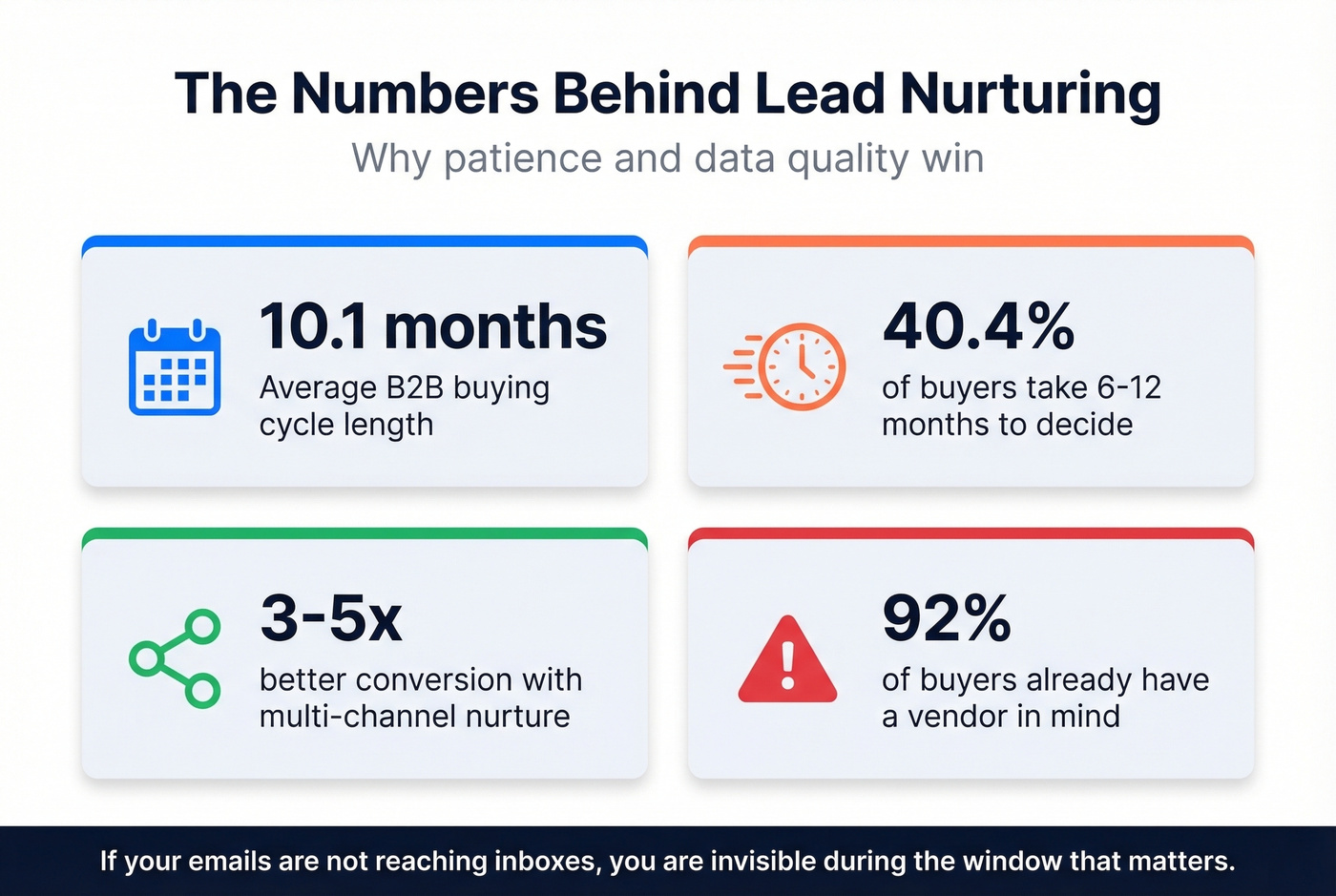
The average B2B buying cycle runs 10.1 months, and first contact doesn't happen until 61% of the journey is already over. Most lead nurturing guides tell you to segment and personalize. None tell you what to do when your bounce rate is 30% and your domain reputation is already torched. The fix isn't more emails - it's fewer, sharper touches on clean data with real segmentation behind them.
The Quick Version
Segment leads into Cold, Warm, and Hot buckets. Generic "one sequence fits all" is why nurture programs fail. Map content to funnel stages so cold leads get insights and hot leads get demos. Build a scoring model with positive AND negative signals, because a bounced email matters as much as a pricing page visit. And verify your data first - 92% of buyers start with a vendor already in mind, so if your emails aren't reaching inboxes, you're invisible during the window that matters.
Fix Your Data Before You Nurture
We've watched this play out dozens of times. An SDR manager launches a nurture campaign on Monday, checks deliverability on Friday, and discovers half the leads were dead emails. Bounce rate is sitting at 30%. The domain's sender reputation is already damaged, and now even the good emails are landing in spam.

Here's the threshold: under ~2% bounce rate is solid. Over 5% is a serious deliverability problem that compounds with every send. Once your domain reputation tanks, recovery takes weeks.
If you're already seeing deliverability issues, use an email deliverability checklist before you send again.
9 Tactics That Move Leads to Revenue
1. Segment by Temperature
The best framework we've seen from practitioners on r/b2bmarketing is dead simple. Cold leads downloaded something once and went dark. Warm leads are opening emails and attending webinars. Hot leads are showing buying signals - pricing page visits, demo requests, multiple content downloads in a short window.
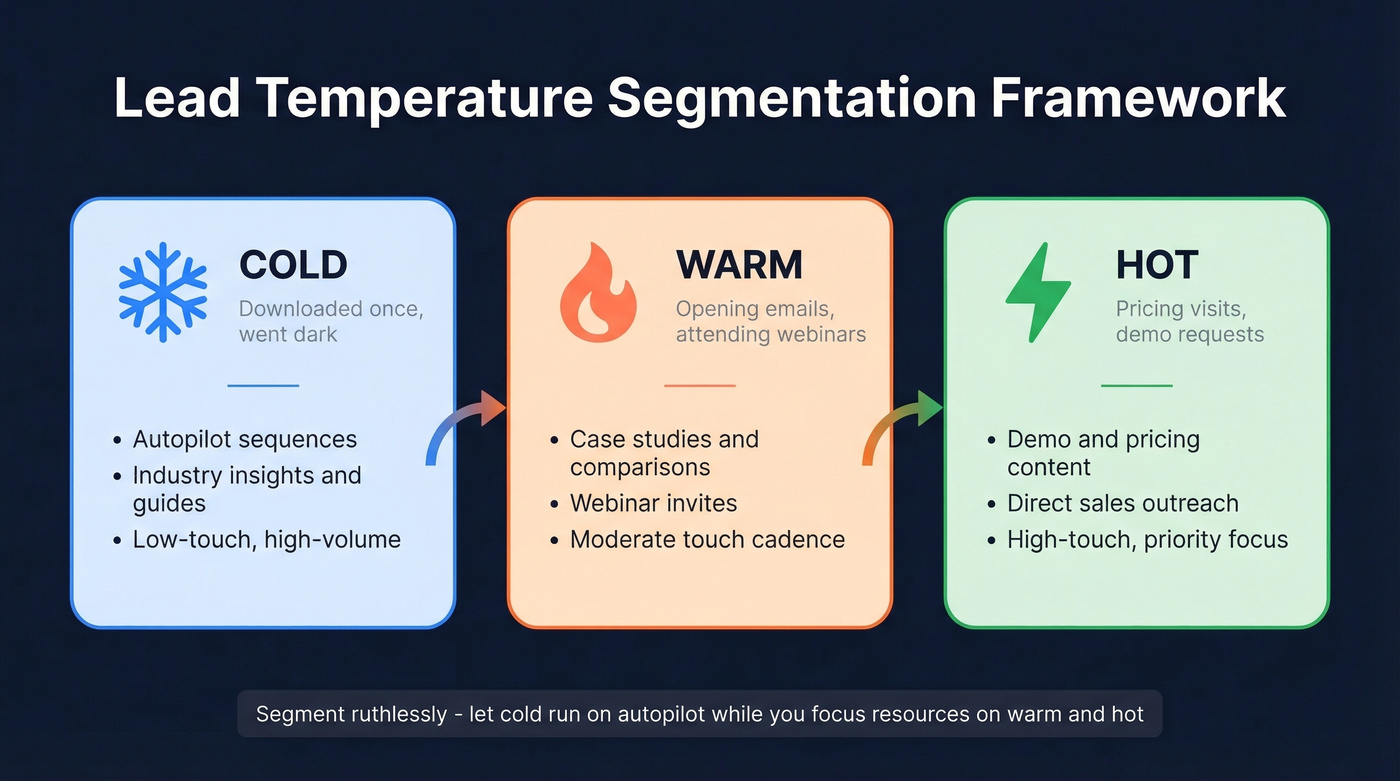
Each bucket gets a different sequence, different cadence, and different content. Some teams nurture every lead regardless of fit. We disagree - segment ruthlessly and let the cold bucket run on autopilot while you focus resources on warm and hot. Beyond temperature, consider purpose-based tracks: reactivation for dormant accounts, education for new leads, and expansion for existing customers.
If you want to go deeper than temperature, build tracks around intent and firmographic fit.
2. Map Content to Funnel Stages
| Stage | Lead Temperature | Content Types |
|---|---|---|
| TOFU | Cold | Industry insights, guides, short videos |
| MOFU | Warm | Case studies, webinars, comparisons |
| BOFU | Hot | Demos, pricing pages, ROI calculators |
The mistake most teams make is sending BOFU content to TOFU leads. A cold lead doesn't want your pricing page - they want to understand the problem you solve. Match the content to where the lead actually is, not where you wish they were. This is one of the most overlooked nurturing techniques, and it has the biggest impact on conversion.
This is also where a clean B2B sales funnel view helps you stop forcing the wrong CTA too early.
3. Build a Lead Scoring Model
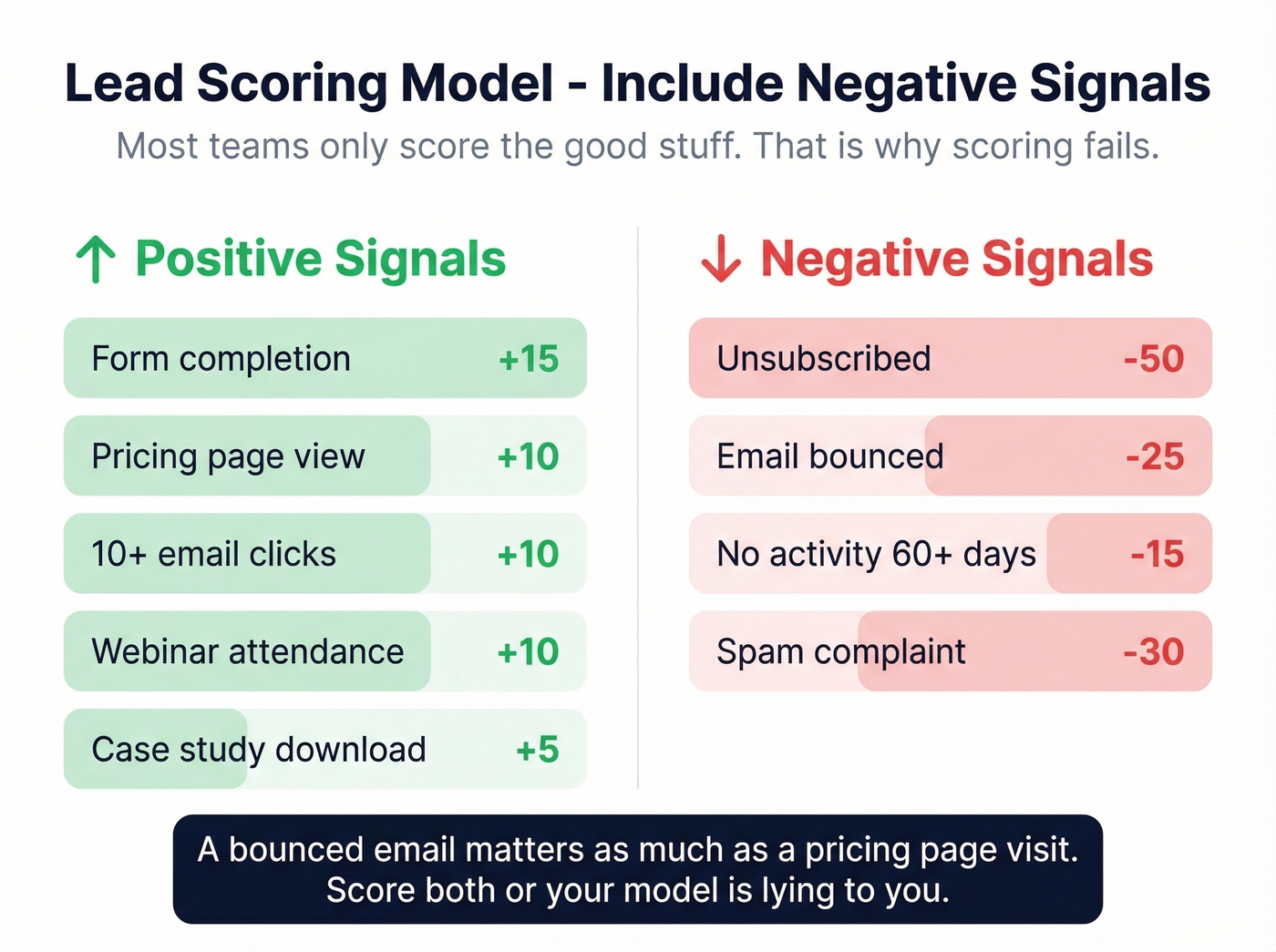
Scoring only works when you include negative signals. Most teams score page visits and email opens but never penalize bounces, unsubscribes, or inactivity. Here's a starting point adapted from Belkins' scoring framework, with decay signals we recommend adding:
| Signal | Points | Type |
|---|---|---|
| Pricing page view | +10 | Behavioral |
| Form completion | +15 | Behavioral |
| 10+ email clicks | +10 | Engagement |
| Webinar attendance | +10 | Engagement |
| Email bounced | -25 | Negative |
| Unsubscribed | -50 | Negative |
| No activity 60+ days | -15 | Decay |
Marketing ops configures the rules. Email marketers build sequences triggered by score thresholds. Sales reps prioritize outreach based on who's actually hot. Without this division of labor, scoring becomes a vanity metric nobody acts on.
For a full setup (including weighting and decay), see our lead scoring guide.
4. Set the Right Email Cadence
| Day | Email Purpose | Content Ratio |
|---|---|---|
| 1 | Thank-you / follow-up | Educational |
| 3 | Helpful resource | Educational |
| 7 | Webinar or demo invite | 80/20 split |
| 14 | Industry insight / data | Educational |
| 21 | Case study / testimonial | Educational |
| 28 | Direct CTA (book call) | Ask |
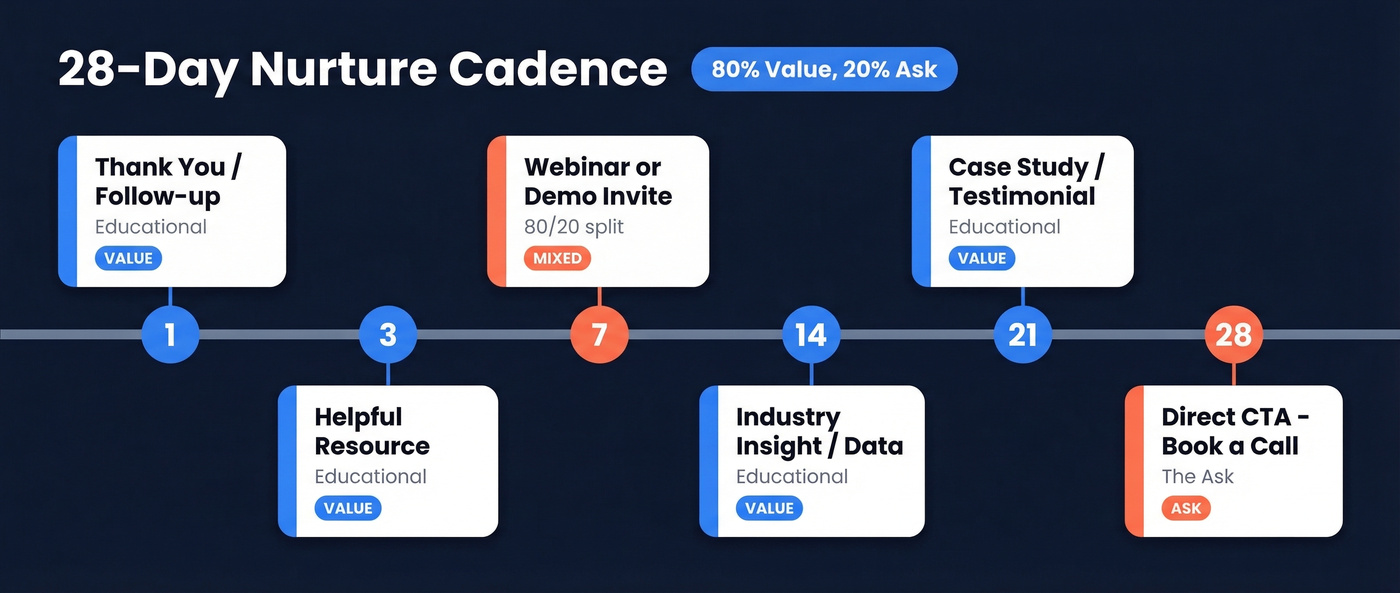
The 80/20 rule matters here: 80% of your touches should be educational or helpful, 20% can be direct asks. Flip that ratio and watch your unsubscribe rate climb. In our experience, cadence discipline is the single thing that separates programs that scale from programs that burn out lists in a quarter.
If you're struggling to keep engagement up, tighten your sequence management rules before you add more steps.
5. Pick a Cadence Model
Here's the thing: most teams default to the Standard model below and never revisit it. But if your average deal size is under $10k, you probably don't need a sophisticated multi-touch sequence - a tight 4-email trigger-based flow will outperform a bloated 12-email drip every time.
| Model | Frequency | Best For |
|---|---|---|
| Standard | 1-2/week | Most B2B nurture |
| Aggressive | 2-3+/week | Trials, launches, events |
| Slow Burn | Biweekly/monthly | Enterprise, long cycles |
| Trigger-Based | On action | Behavioral sequences |
Selling into enterprise with 12-month cycles? A slow burn with high-value content every two weeks will outperform weekly emails that feel like noise. Match the cadence to the buying cycle, not to your content calendar.
If you're selling longer cycles, align this with your enterprise B2B sales motion.
6. Go Multi-Channel
Email-only nurture caps your conversion potential. Teams running multi-channel nurture - email plus retargeting ads, sales touches, and social engagement - see 3-5x better conversion rates than email alone. One study found AI-powered segmentation drove 601% ROI growth when combined with multi-channel delivery.
Common tactics include retargeting ads, direct mail for high-value accounts, and personalized video outreach. A tactic that keeps surfacing from practitioners: 30-60 second personalized video snippets embedded in nurture flows to reopen dormant deals. It's not scalable for every lead, but for warm-to-hot prospects who've gone quiet, a quick Loom beats another templated email every time.
If direct mail is part of your mix, use a dedicated direct mail playbook so it actually supports pipeline.
7. Personalize Beyond First Name
80% of buyers say the experience a company provides is as important as its products, and 73% expect increased personalization compared to prior years. Dropping {{first_name}} into a subject line doesn't clear that bar.
What works: behavioral triggers over time-based drips. If someone visited your pricing page twice this week, send them a pricing comparison or ROI calculator - not your standard Day 7 email. If they downloaded a case study about a specific industry, follow up with content about that industry. Let behavior dictate the next touch, not a calendar.
For examples that go beyond token personalization, see personalized outreach.
8. Nurture After the Sale
Stopping nurture at close is one of the most common mistakes in B2B. Your customer just bought - now help them succeed, show them features they haven't activated, and surface expansion opportunities.
Retention, expansion, and upsell are three distinct post-close activities that most teams ignore entirely. The cheapest pipeline you'll ever build is the one sitting inside your existing customer base.
To operationalize this, track retention with a simple churn analysis framework.
9. Test Everything
Don't just A/B test subject lines. Test these variables systematically:
- Send times - changing send time can materially swing CTR
- CTA placement - top of email vs bottom vs inline
- Content format - text-heavy vs visual vs video thumbnail
- Sequence length - 4 emails vs 6 vs 8
Deprioritize open rates as a metric. Apple's Mail Privacy Protection inflates opens across the board, as Belkins' research confirms. Focus on CTR and reply rates - those are the signals that actually correlate with pipeline.
If you need a tighter testing plan, start with email preview text A/B testing and expand from there.

You just read why a 5% bounce rate destroys nurture campaigns. Prospeo's 5-step email verification delivers 98% accuracy - keeping you under that 2% threshold. Every record refreshes every 7 days, so the leads you nurture today don't become dead emails next month.
Stop nurturing ghosts. Start with verified data at $0.01 per email.
Mistakes That Kill Your Pipeline
Every email is a pitch. Follow the 80/20 rule - lead with value, ask sparingly. If your sequence reads like a five-part sales letter, you've already lost.
Same sequence for every lead. Segment by temperature and behavior, not just lifecycle stage. A cold download and a hot pricing-page visitor shouldn't get the same email on the same day.
Pressing for a sale too early. 40.4% of buyers take 6-12 months to decide. Another 15.4% take over a year. Match urgency to the buyer's timeline, not yours.
Stopping after the sale. 45.8% of buyers consume 7+ content pieces during their purchase journey - and that consumption doesn't stop at close. Build post-sale nurture tracks for retention and expansion.
Never testing or iterating. Set-and-forget sequences decay fast. Run monthly A/B tests on your lowest-performing sequence and kill what doesn't work.
Measuring Nurture Performance
| Metric | Benchmark | What It Tells You |
|---|---|---|
| Open Rate | 20-30% | Directional only (unreliable post-Apple MPP) |
| CTR | 2-5% | Content relevance and CTA strength |
| Response Rate | 3-10% | Engagement quality |
| Conversion Rate | 5-15% | Pipeline impact |
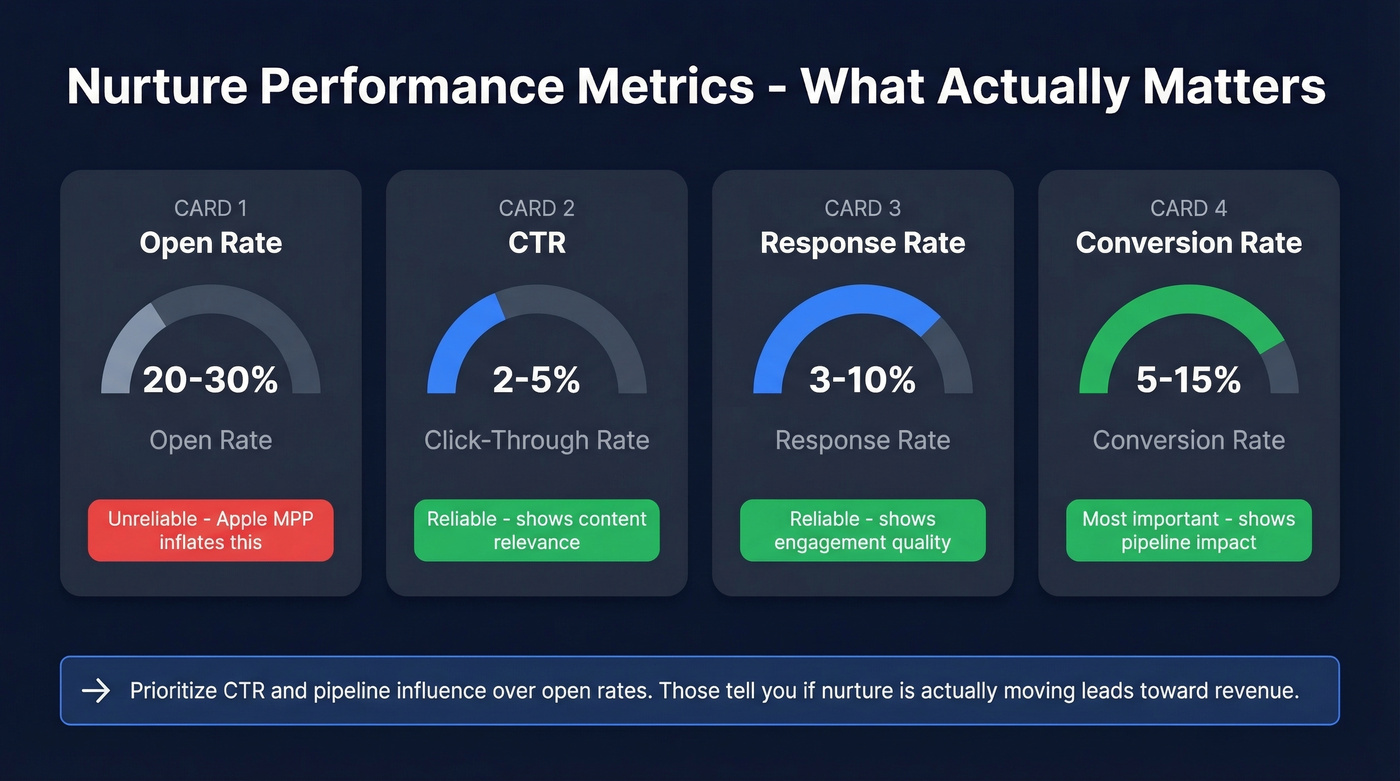
Let's be honest about open rates: they're the vanity metric of nurture programs. After Apple's Mail Privacy Protection, they're inflated and unreliable. Prioritize CTR and pipeline influence - those tell you whether your nurture is actually moving leads toward revenue.
If you want to benchmark the rest of your funnel, use these funnel metrics.
Building Your Tech Stack
Data quality and enrichment is where you start. If your contact data is stale, nothing downstream matters. Tools like Prospeo handle verification and enrichment in one step - 83% enrichment match rate, 50+ data points per contact, native HubSpot and Salesforce integrations, and intent data tracking across 15,000 topics via Bombora so you can trigger nurture sequences based on in-market signals.
If you're comparing vendors, start with a shortlist of data enrichment services.
CRM: HubSpot's free tier handles basic nurture for small teams; paid plans start around $20-$50/month depending on the product. Salesforce runs ~$25-$100/user/month depending on edition.
If you're still deciding, here are a few examples of a CRM to map features to your workflow.
Marketing automation: Marketo typically runs ~$1,000-$10,000+/month depending on database size. ActiveCampaign starts around ~$29-$70+/month depending on contacts. Skip Marketo if you're under 10,000 contacts - you're paying for complexity you don't need yet.
Segmenting by temperature only works when you have real data behind each lead. Prospeo returns 50+ data points per contact - job title, intent signals across 15,000 topics, technographics, funding stage - so your Cold, Warm, and Hot buckets actually mean something.
Enrich your nurture lists with the data that powers real segmentation.
FAQ
How often should you send nurture emails?
For standard B2B nurture, 1-2 emails per week is the right starting point. Adjust based on your sales cycle length and engagement signals. Use an aggressive cadence for trials or product launches, and a slow burn for enterprise deals with 12+ month cycles.
What's the difference between nurturing and lead generation?
Lead generation captures new contacts and brings them into your funnel. Nurturing builds relationships with contacts you already have - educating, engaging, and scoring them until they're ready to buy. Generation fills the top; nurturing moves leads through the middle.
Why are my nurture emails bouncing?
Stale or unverified data is almost always the cause. Run your list through an email verification tool before launching any sequence. A bounce rate above 5% actively damages your sender reputation, which means even your valid emails start landing in spam.
What tactics work best for long sales cycles?
For enterprise deals with 6-12+ month timelines, slow-burn cadences paired with high-value content perform best. Combine email with retargeting, social engagement, and occasional direct sales outreach. Behavioral triggers that respond to prospect activity will always outperform rigid time-based drips in long-cycle environments.