

Lead Nurturing Email Best Practices That Actually Move Metrics
Your first nurture email hits a 52% open rate. By email six, you're at 15%. We've watched teams abandon sequences right there - when the pipeline was about to break through. 40.4% of B2B buyers take 6-12 months to reach a purchase decision, so quitting early means leaving revenue on the table.
These lead nurturing email best practices will help you stay the course and actually convert.
What Good Benchmarks Look Like
| Metric | Industry Average | Engaged Lists |
|---|---|---|
| Open Rate | 23.44% | 39.26% |
| Click Rate | 2.62% | 6.21% |
| ROI | $10-$36 per $1 | $36-$50 per $1 |
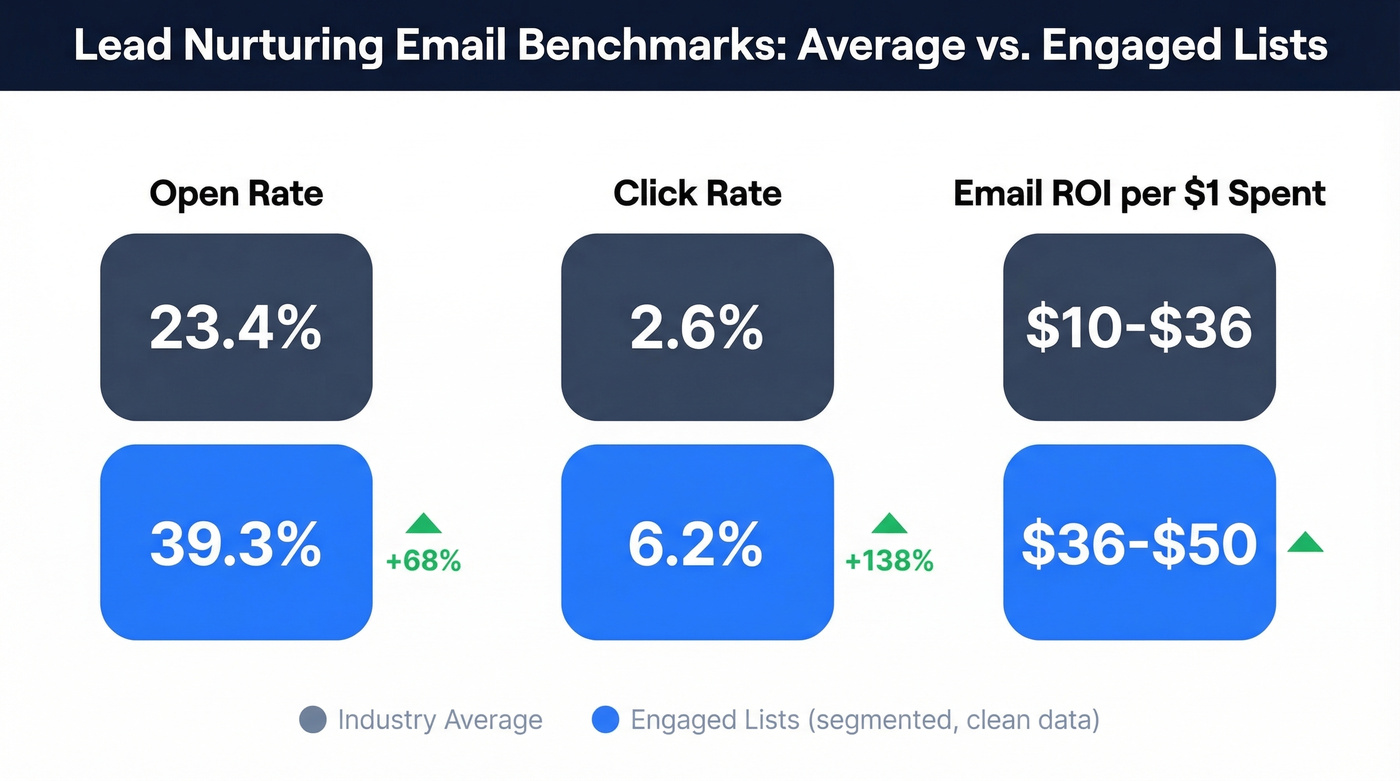
The gap between 23% and 39% open rates comes down to list hygiene and segmentation. Litmus's State of Email data shows the highest-ROI email type varies by segment: B2B gets the most from customer engagement emails, B2C from promotional sends, D2C from newsletters. None of them are batch-and-blast.
Fix Your Data First
None of the practices below matter if your list is bouncing above ~5%. High bounces hurt sender reputation and push more of your mail toward spam. 70% of emails already show at least one spam-related issue before they even leave the outbox.
Here's a real example: Snyk had 50 AEs prospecting 4-6 hours per week with bounce rates at 35-40%. After switching to Prospeo's 5-step email verification - catch-all handling, spam-trap removal, honeypot filtering - bounces dropped under 5% and AE-sourced pipeline jumped 180%. The free tier gives you 75 emails per month to test before committing.

8 Practices That Actually Work
1. Segment Before You Sequence
Effective nurturing is a system, not a drip. The consensus on r/b2bmarketing hammers this constantly. TOFU prospects get industry insights. MOFU leads get case studies. BOFU prospects get demos and pricing.
If you need a tighter definition of stages and handoffs, map it to your sales funnel first.
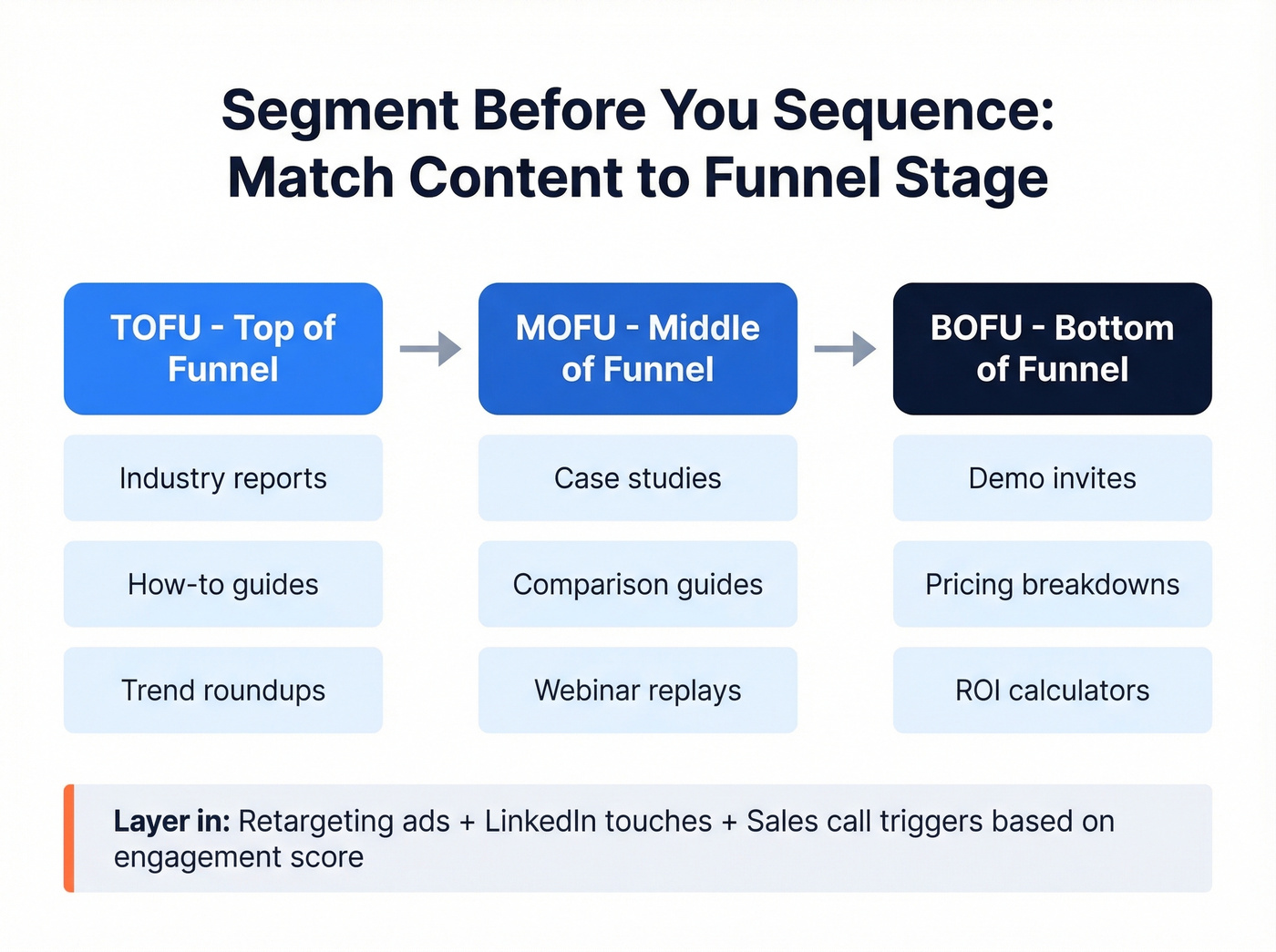
Don't limit this to email, either. Layer in retargeting ads, sales-call triggers based on engagement scores, and LinkedIn touches to build a true multi-channel nurture that meets buyers where they already are.
2. Write Subject Lines With Data
47% of recipients open based on subject line alone, and 69% report emails as spam because of it. The sweet spots: 61-70 characters for the highest open rate (43.38%), 41-50 characters for the best CTR (17.57%). Shorter for clicks, longer for opens - pick based on that email's goal.
If you want a swipe file, keep a running library of subject lines by segment and funnel stage.
3. One Topic, One CTA
Each email earns one action. Don't split attention between a case study, a demo link, and a social follow. Pick the single thing that moves the lead forward. That's it.
This is also where strong email copywriting pays off: clarity beats cleverness.
4. Set a Cadence Model
| Model | Frequency | Best For |
|---|---|---|
| Standard | 1-2/week | Most B2B nurture |
| Aggressive | 2-3/week | Trials, time-sensitive launches |
| Slow Burn | Biweekly/monthly | Long enterprise cycles |
| Trigger-Based | Behavioral | High-intent actions |
If you're torn between Standard and Aggressive, pick Standard. 56% of US consumers unsubscribe after 4+ marketing messages in 30 days, and the unsubscribe damage from over-sending is harder to recover from than slow nurture velocity. Getting cadence right is one of the most overlooked parts of any nurture sequence strategy.
If you're scaling volume, keep an eye on email velocity so you don't spike deliverability risk.
5. Personalize Beyond First Name
"Hi {first_name}" is table stakes. Use industry, pain point, content consumed, and funnel stage. 45.8% of B2B buyers consume 7+ content pieces during their purchase process - reference what they've already engaged with. A lead who downloaded your security whitepaper doesn't want a generic "learn more about our platform" email.
To operationalize this, build a simple lead scoring model that updates based on clicks, page visits, and intent.
6. Design Mobile-First
50-60% of email views happen on mobile, climbing to 81% in some industries. This is the #1 anxiety in practitioner communities like r/DigitalMarketing - whether native ESP editors handle responsive rendering well enough. Test across actual email clients, not just preview mode.
7. Use Branching Logic, Not Linear Drips
If/then workflows outperform static drips in most B2B programs. Clicked "Security Overview"? Send the IT security guide. Visited pricing? Trigger the pricing FAQ. Automated emails generate 320% more revenue than non-automated campaigns.
In our experience, the exit condition is what separates sequences that convert from ones that annoy - every branch needs a clear off-ramp so hot leads don't sit through seven more educational emails when they're ready to talk to sales.
If you're building this inside a tool, treat it like sequence management, not a one-off campaign.
8. Test Subject Lines and Send Times
A/B test these two variables before touching copy or design. They drive a disproportionate share of the variance in open rates. Everything else is optimization at the margins.
If you need a starting point, use a data-backed best time to send schedule and iterate from there.

Every nurture email that bounces chips away at your sender reputation - and pushes your entire sequence toward spam. Prospeo's 5-step verification with catch-all handling, spam-trap removal, and honeypot filtering delivers 98% email accuracy. Snyk cut bounces from 35% to under 5% and grew AE-sourced pipeline 180%.
Start with 75 free verified emails and see your bounce rate drop.
A 30-Day Nurture Sequence Blueprint
Most B2B sequences run 4-8 emails. Here's what performance decay looks like in practice:
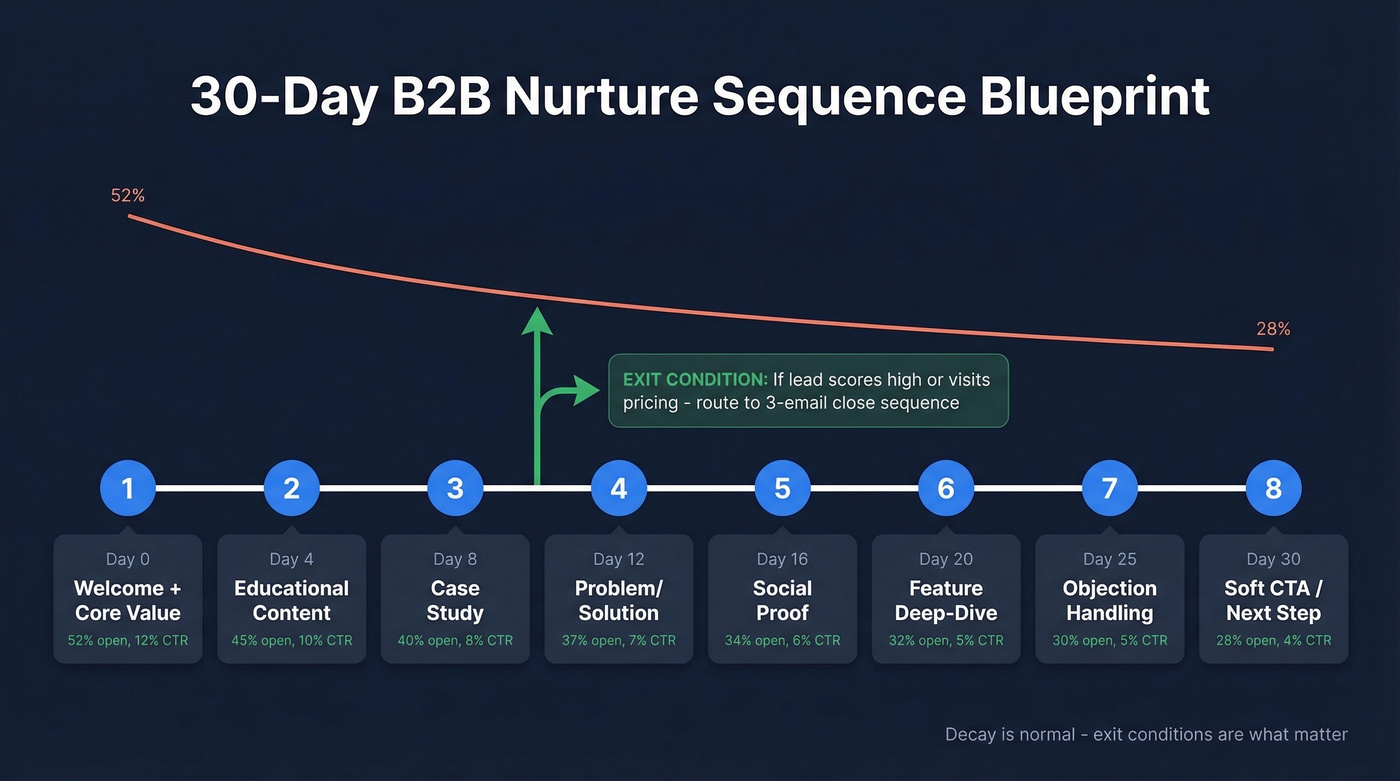
| Email # | Day | Content Focus | Expected Open Rate | Expected CTR |
|---|---|---|---|---|
| 1 | 0 | Welcome + core value | 52% | 12% |
| 2 | 4 | Educational content | 45% | 10% |
| 3 | 8 | Case study | 40% | 8% |
| 4 | 12 | Problem/solution | 37% | 7% |
| 5 | 16 | Social proof | 34% | 6% |
| 6 | 20 | Feature deep-dive | 32% | 5% |
| 7 | 25 | Objection handling | 30% | 5% |
| 8 | 30 | Soft CTA / next step | 28% | 4% |
That decay is normal. What matters is building exit conditions so high-intent leads don't sit through all eight emails when they're ready to buy at email three. When a lead's score crosses your threshold or they visit pricing, tag them as MQL, alert the rep, and run a tight 3-email close sequence instead.
If you need plug-and-play messaging for that close sequence, pull from proven sales follow-up templates.
Deliverability - The Silent Prerequisite
Let's be honest: skip fancy email design until your authentication is set up. SPF, DKIM, and DMARC come before templates, every time. Marketers who describe their programs as successful are 22% more likely to actively monitor deliverability. If inbox placement drops below 90%, stop sending and investigate before you do more damage.
For a deeper checklist, follow a dedicated email deliverability guide and keep a spam checker in your QA flow.
5 Mistakes That Kill Nurture Campaigns
Over-sending. 56% of consumers unsubscribe after 4+ messages in 30 days. Respect the threshold.
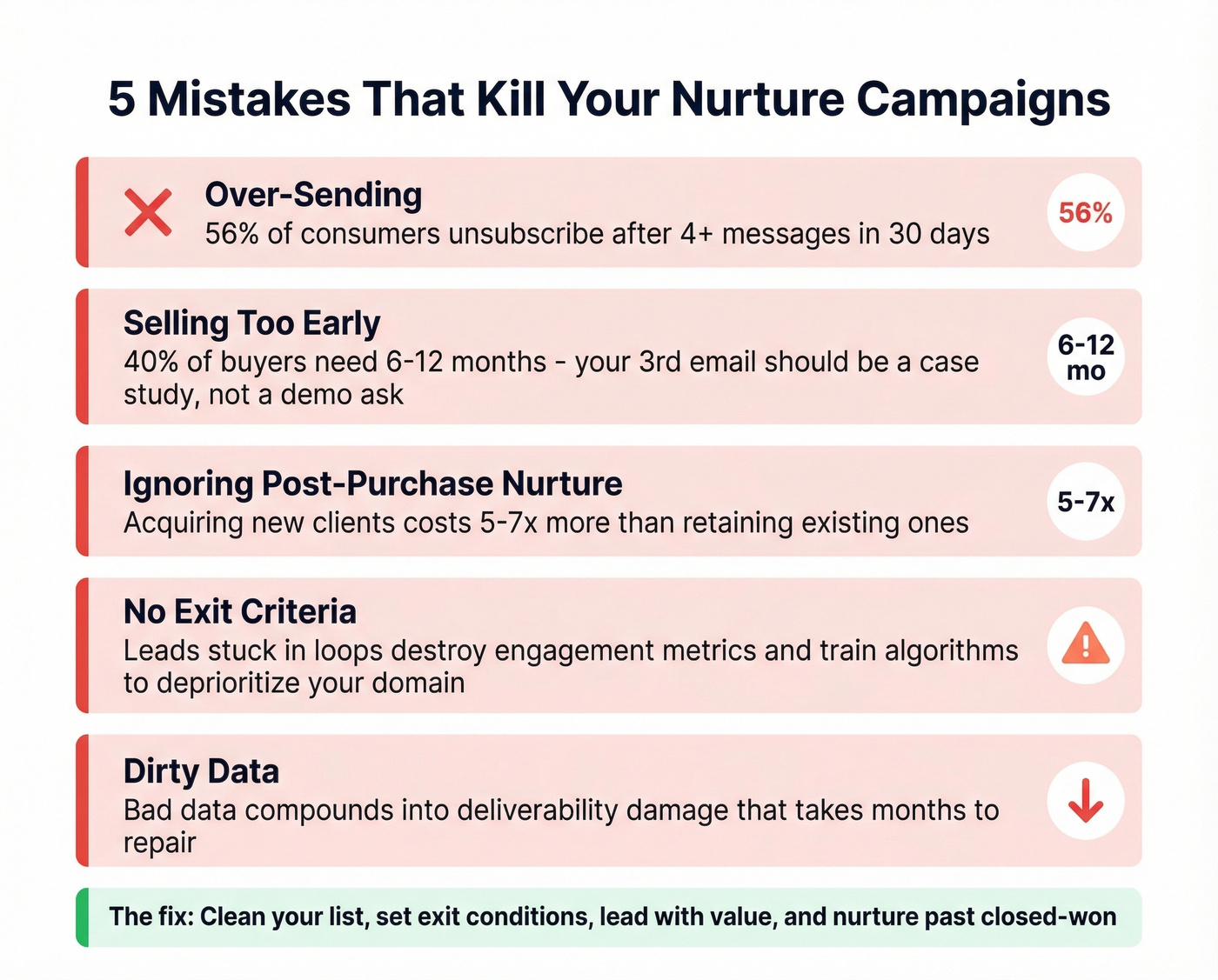
Selling too early. 40.4% of buyers take 6-12 months. Your third email should be a case study, not a demo request.
Ignoring post-purchase nurture. Acquiring new clients costs 5-7x more than retaining existing ones. Nurture doesn't end at closed-won.
No exit criteria. Leads stuck in loops destroy engagement metrics and train inbox algorithms to deprioritize your domain. This is the one we see teams miss most often - they build the sequence but never define when someone should leave it.
Dirty data. Bad data doesn't just waste sends - it compounds into deliverability damage that takes months to repair. One team we worked with cut bounce rates from 35-40% to under 5% and saw pipeline jump 180% just by verifying their list before launching.
If you're cleaning lists at scale, a dedicated spam trap removal process helps prevent repeat issues.
Personalization beyond first name requires real data - industry, job title, tech stack, intent signals. Prospeo enriches every contact with 50+ data points and tracks 15,000 buyer intent topics so your branching logic actually has something to branch on.
Stop sending generic nurture emails to leads you barely know.
FAQ
How many emails should a nurture sequence have?
Most B2B sequences run 4-8 emails. Educational nurtures go longer (8+); cold outreach stays at 4-5. Build exit conditions at each stage so high-intent leads skip ahead rather than sitting through the full drip.
What's a good open rate for nurture emails?
Industry average is 23.44%. Well-segmented lists hit 36-41%. Expect decay - Email 1 may reach 52%, while Email 8 drops to ~28%. Consistent engagement above 30% means your targeting and cadence are working.
How do I stop nurture emails from landing in spam?
Authenticate with SPF, DKIM, and DMARC before sending a single campaign. Verify your list to catch invalid addresses, spam traps, and honeypots before they damage your domain. If inbox placement drops below 90%, pause everything and investigate.
What's the biggest lead nurturing mistake teams make?
Selling too early. With 40.4% of B2B buyers needing 6-12 months to decide, pushing a demo in email two kills trust. Lead with educational value, layer in social proof, and reserve hard CTAs for leads showing genuine buying signals.