

How to Get More Leads for Your Business in 2026
You've read five articles about getting leads for your business and they all say the same thing: "create great content, optimize your SEO, run some ads." Meanwhile, your pipeline's empty and your budget's half gone. 85% of B2B marketers say lead generation is their number one challenge - and it's not because they haven't read enough blog posts. It's because most advice skips the part that actually matters: matching your spend to channels that work for your business, at your budget, right now.
The Short Version
- Define your ICP before picking any channel. Most wasted spend comes from targeting everyone.
- Match your channel to your budget. $0/mo means referrals and content. $1K-$3K/mo means email outreach with verified data. $5K+ means layering in paid search.
- Lead quality beats lead volume. A 98%-accurate prospect list outperforms 10x the contacts with 30% bounce rates. Every time.
That's the whole strategy. The rest of this article is the how.
How Buyers Actually Buy
Here's the uncomfortable truth about lead gen: 95% of your ideal customers aren't buying right now. That's the 95:5 rule - only 5% of your market is actively in-market at any given time.
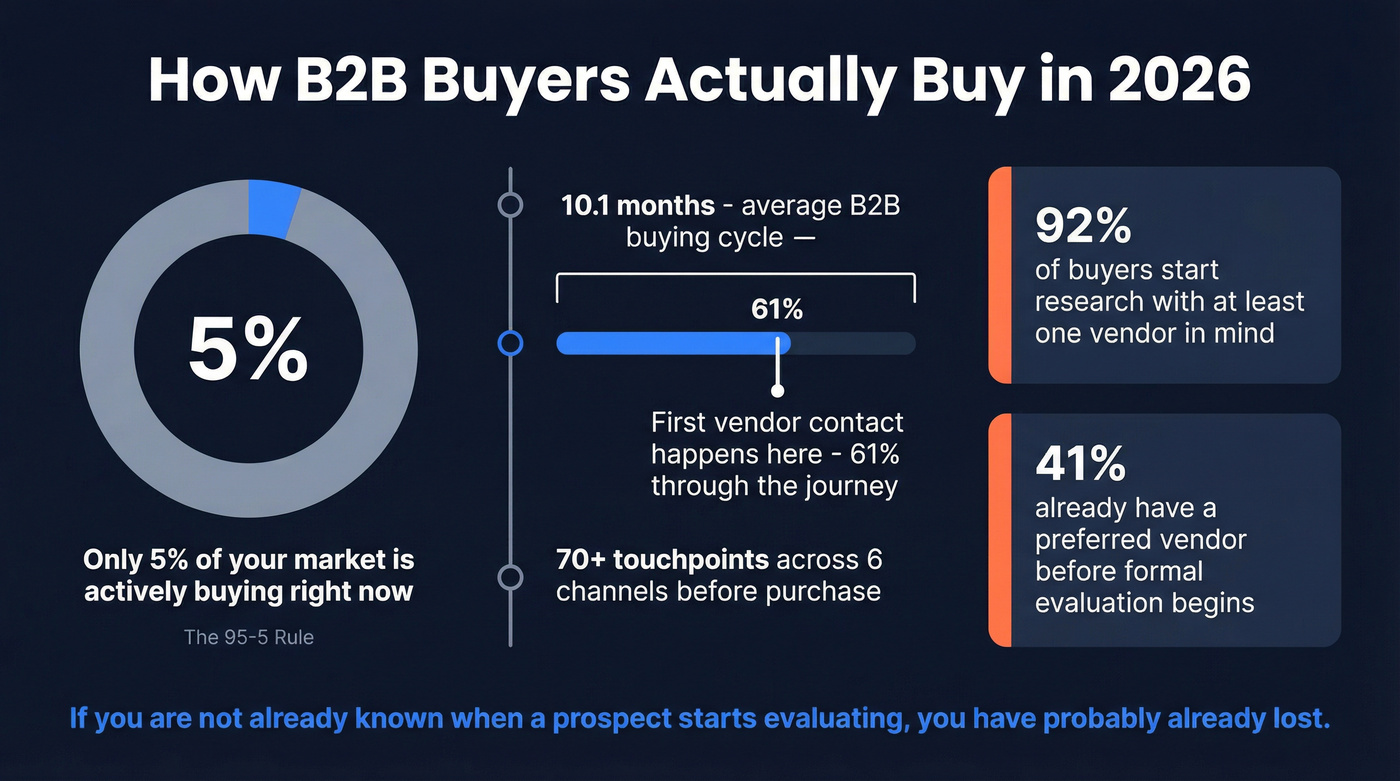
This changes everything about how you allocate budget. The average B2B buying cycle runs 10.1 months, and modern buyers need 70+ touchpoints across six channels before purchasing. First contact with a vendor doesn't happen until 61% of the way through that journey. The winning vendor is on the buyer's "Day One shortlist" 95% of the time.
If you're not already known when a prospect starts evaluating, you've probably already lost. 92% of buyers start research with at least one vendor in mind, and 41% have a preferred vendor before they even begin formal evaluation. Generating quality leads isn't just about capturing demand - it's about creating it months before the purchase.
B2B vs B2C: Pick Your Channels
| Factor | B2B | B2C |
|---|---|---|
| Audience | Decision-makers, committees | Individual consumers |
| Sales cycle | Months (multiple stakeholders) | Days to weeks (impulse) |
| Best channels | Email, SEO, events, ABM | Social ads, influencers, eComm |
Selling to businesses? Skip the TikTok strategy and focus on channels 1-5 and 9-10 below. B2C or local? Channels 5-7 are your sweet spot.
Define Your ICP First
Most businesses skip this and go straight to tactics. That's why their CPL is 3x what it should be.
Your ICP isn't "companies with 50-500 employees." It's a ranked list of sub-segments scored by ease of selling, strategic fit, and growth potential. Once you've ranked your segments, map the buying committee - keep it to five roles max: the economic buyer, the champion, the technical evaluator, the end user, and the blocker. A CFO cares about ROI. A VP of Sales cares about pipeline velocity. Same product, different pitches.
Do this before you spend a dollar on any channel. We've seen teams cut their CPL in half just by narrowing from "all mid-market SaaS" to "Series B fintech companies hiring SDRs." If you want a starting point, use an ICP scoring rubric.

You just read that narrowing your ICP can cut CPL in half. Now imagine pairing that focus with 300M+ profiles, 30+ filters for intent, technographics, and headcount growth - all refreshed every 7 days. That's Prospeo. Build laser-targeted lead lists at $0.01/email with 98% accuracy.
Define your ICP above, then build the list in minutes.
10 Ways to Generate Quality Leads, Ranked by ROI
1. Referrals and Partnerships
Free, immediate, and the highest-converting channel for any business. Referral leads close faster because trust is pre-built.
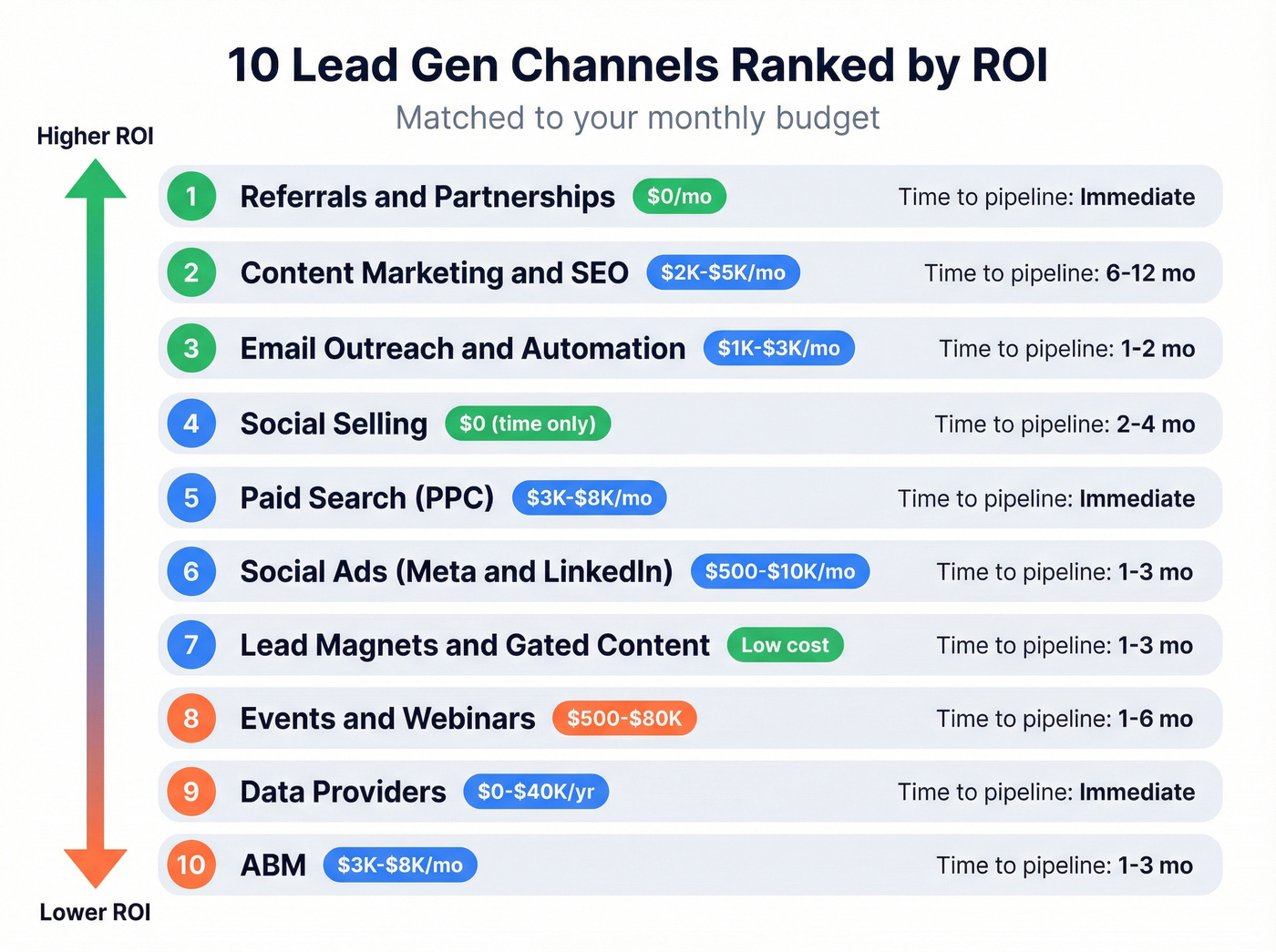
The catch: referrals don't scale unless you systematize them. Build a partner program, create a referral incentive, and ask every happy customer for an introduction. This should be channel #1 regardless of your budget.
2. Content Marketing and SEO
Budget: $2K-$5K/mo. Time to pipeline: 6-12 months. Organic CPL runs $83-$164 depending on industry - roughly half the cost of paid. The compounding effect is real: a blog post that ranks today generates leads for years. But your website isn't a channel on its own. Without traffic driving visitors to it, lead magnets and forms collect dust. If you're building an organic engine, start with the basics of B2B content marketing.
3. Email Outreach and Automation
This is the most reliable channel for B2B teams with a clear ICP. Budget: $1K-$3K/mo. Pipeline in 1-2 months. The entire game is data quality - your sequences are only as good as your contact list.
A ~2% reply rate on cold email is actually decent when the list is tight and verified. Pair a tool like Instantly or Lemlist with a verified contact database and you've got a scalable outbound engine. If you need pipeline yesterday, this is the channel. For a tighter outbound system, build a cold email sequence and keep your email deliverability clean from day one.
4. Social Selling
Free (time cost only). Two to four months to pipeline. This isn't posting motivational quotes - it's engaging with prospects' content, sharing insights, and building visibility with your ICP. Works best when combined with outbound, not as a standalone channel.
5. Paid Search (PPC)
Budget: $3K-$8K/mo. Leads arrive immediately. Google Ads averages a $70.11 CPL for B2B. If your average deal is $10K and you close 5% of leads, a $70 CPL is a no-brainer. The risk is bidding on broad terms and burning budget on unqualified clicks.
6. Social Ads (Meta and LinkedIn)
Meta runs $500-$2K/mo minimum with CPLs in the $30-$80 range - great for B2C, local businesses, and eCommerce. LinkedIn costs significantly more: CPMs run $60-$200 for B2B audiences, and you'll need $5K-$10K/mo to generate enough volume to optimize.
LinkedIn Ads work for enterprise B2B with high ACVs. For everyone else, the math rarely pencils out.
7. Lead Magnets and Gated Content
Low cost, 1-3 months to see results. Ebooks, templates, calculators, and checklists convert visitors into leads - but only if you already have traffic. A lead magnet without distribution is a PDF nobody downloads. Build this after you've got a content or paid channel driving visitors.
8. Events and Webinars
Trade shows run $15K-$80K per event with CPLs of $200-$500+. Virtual events cost $500-$2K and can be effective for niche audiences. Best for industries where deals are large and buying committees need face time. Skip this if your ACV is under $25K - the economics won't work.
9. Data Providers
This is where most teams either accelerate or waste money, depending entirely on data quality. ZoomInfo is the incumbent at $15K-$40K/year, but you're paying for a massive platform most teams underuse.
Apollo's free tier is a common starting point for teams just getting into outbound, with paid plans around $49/mo. Cognism is strong for European markets with DNC-checked mobile numbers and typically priced for mid-market/enterprise budgets. Lusha works well for quick lookups and has a free plan.
Prospeo offers 300M+ professional profiles with 98% email accuracy and a 7-day data refresh cycle - compared to the 6-week industry average. The database includes 30+ search filters covering buyer intent, technographics, job changes, and headcount growth. Start free, paid plans run ~$0.01/email, no contracts required. If you're comparing options, start with B2B company data providers and the best data enrichment services.

10. ABM (Account-Based Marketing)
Budget: $3K-$8K/mo. ABM flips the funnel - instead of generating leads and qualifying them, you pick target accounts first and run multi-channel campaigns to penetrate them. Best for high-ACV B2B where deals run $50K+. Requires tight sales-marketing alignment plus good account-level data. If you're going this route, follow account-based selling best practices.
Channel Comparison
| Channel | Avg CPL | Min Monthly Spend | Time to Pipeline | Best For |
|---|---|---|---|---|
| Referrals | ~$0 | $0 | Immediate | Everyone |
| Content/SEO | $83-$164 | $2K-$5K | 6-12 months | Long-term growth |
| Email outreach | $50-$150 | $1K-$3K | 1-2 months | B2B with clear ICP |
| Paid search | ~$70 | $3K-$8K | Immediate | In-market capture |
| Meta/Instagram | $30-$80 | $500-$2K | 1-3 months | B2C, local, eComm |
| LinkedIn Ads | $110+ | $5K-$10K | 1-3 months | Enterprise B2B |
| ABM | Varies | $3K-$8K | 1-3 months | High-ACV B2B |
| Trade shows | $200-$500+ | $15K-$80K/event | 1-6 months | Industry-specific |
Budget-Based Lead Gen Playbooks
Look, if your average deal size is under $10K, you probably don't need ZoomInfo-level data or LinkedIn Ads. Most teams overspend on tools and underspend on execution.
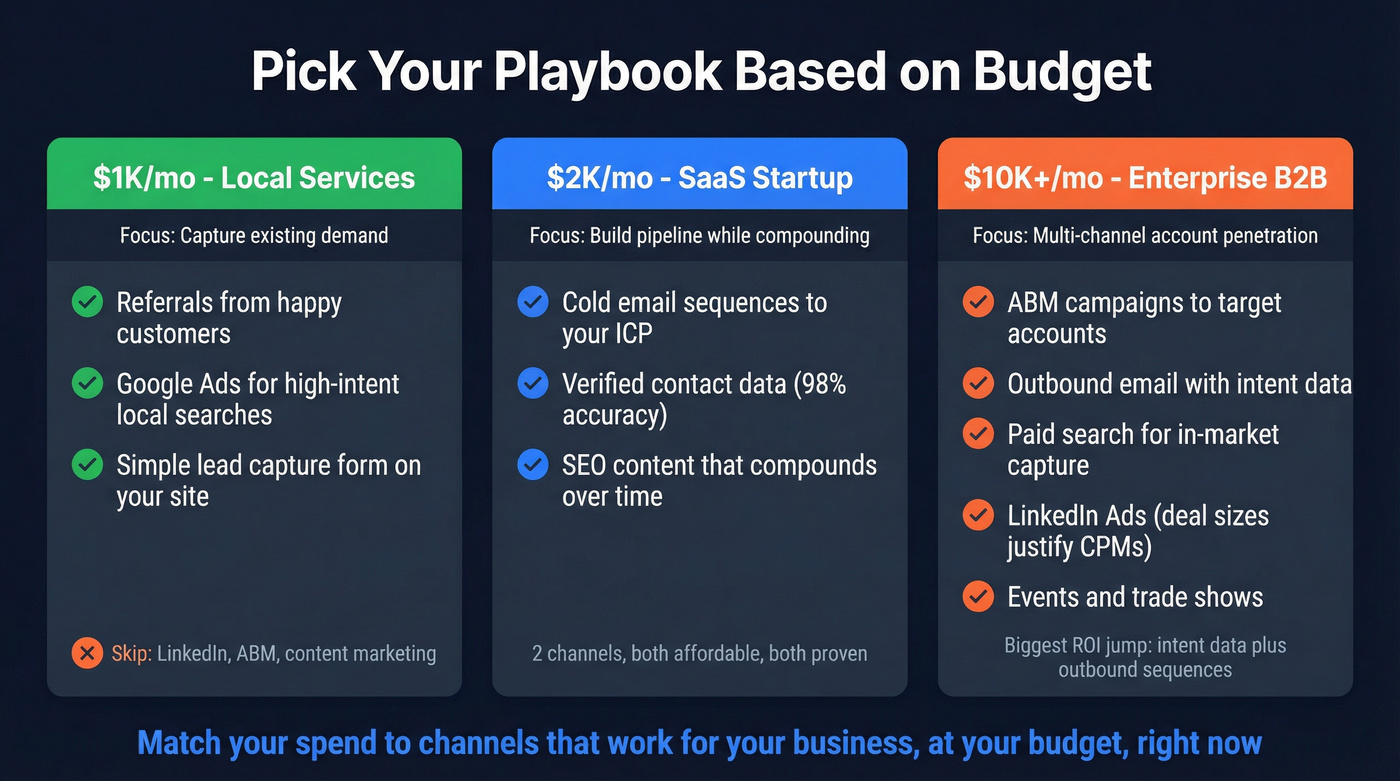
Here's what actually works at each level:
A SaaS startup spending $2K/mo should combine email outreach with verified data and content marketing. Run cold email sequences to your ICP while publishing SEO content that compounds over time. Two channels, both affordable, both proven. If you need more channel ideas, pull from these lead generation trends.
A local services business with $1K/mo should focus on referrals, Google Ads for high-intent local searches, and a simple lead capture form. Skip LinkedIn, skip ABM, skip content marketing - your buyers are searching "plumber near me," not reading whitepapers.
For enterprise B2B teams with $10K+/mo, layer ABM on top of outbound email, paid search, and events. This is where LinkedIn Ads start making sense, because your deal sizes justify the CPMs. Our team has found that the biggest ROI jump at this budget level comes from combining intent data with outbound sequences - you're reaching the right person at the right moment instead of spraying cold emails into the void.
What a Lead Actually Costs
Knowing your CPL by industry is the difference between a sustainable pipeline and a math problem. Benchmarks from FirstPageSage's 2026 report:
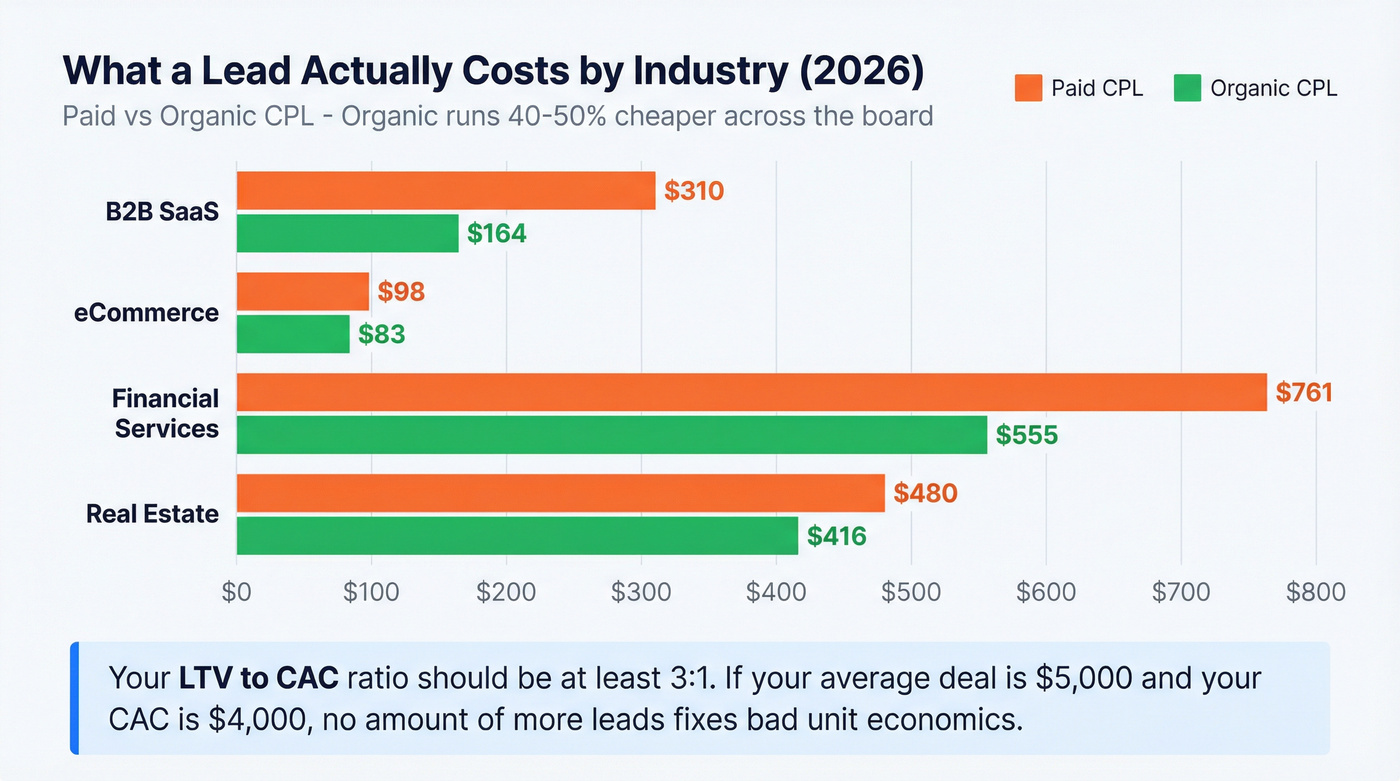
| Industry | Paid CPL | Organic CPL |
|---|---|---|
| B2B SaaS | $310 | $164 |
| eCommerce | $98 | $83 |
| Financial Services | $761 | $555 |
| Real Estate | $480 | $416 |
Your LTV:CAC ratio should be at least 3:1. If your average deal is $5,000 and your CAC is $1,500, you're sustainable. If your CAC is $4,000, you have a math problem - and no amount of "more leads" fixes bad unit economics. (If you want to go deeper on the math, see cost to acquire customer.)
Organic channels consistently run 40-50% cheaper than paid. That's the compounding argument for content and SEO. But when you need pipeline now, paid search at a $70 CPL is still efficient for most B2B companies.
Five Mistakes That Kill Your Pipeline
1. No ICP definition. Targeting everyone means converting no one. The broader your audience, the higher your CPL and the lower your close rate. Narrow ruthlessly.
2. Volume over quality. 1,000 unqualified leads don't beat 50 qualified ones. We've watched teams celebrate "record lead months" that produced zero revenue. The best prospects come from tight targeting and verified data, not from casting the widest net.
3. Slow follow-up. The likelihood of qualifying a lead drops by over 400% if you wait longer than five minutes to respond. Five minutes. If your SDRs are following up the next day, you're losing deals to competitors who respond in seconds. If you need copy you can deploy today, use these sales follow-up templates.
4. No lead scoring. Treating all leads equally wastes your sales team's time. A VP who downloaded your pricing guide isn't the same as an intern who grabbed a free template. Score them, route them differently. Here’s a practical lead scoring setup to steal.
5. Bad data. If your bounce rate is consistently above ~5%, your data is the problem. Bounced emails damage your domain reputation, disconnected phones waste call blocks, and stale data means your reps are pitching people who left the company six months ago. One team, Meritt, switched providers and saw their bounce rate drop from 35% to under 4% - pipeline tripled from $100K to $300K per week.

Your Lead Gen Tech Stack
You don't need 15 tools. You need four categories covered:
| Function | Recommended Tools | Starting Price |
|---|---|---|
| CRM | HubSpot, Salesforce | HubSpot Free; Salesforce ~$25/user/mo |
| Data and Verification | Prospeo, Apollo, Lusha | Prospeo Free; Apollo ~$49/mo; Lusha Free |
| Email Automation | Instantly, Lemlist, Smartlead | ~$30/mo |
| Chat / Capture | Drift, Intercom, live chat | Free-$50/mo |
Pick one data provider as your primary, verify everything before it hits your sequences, and connect it to your CRM. The difference between a 98%-accurate list and a 70%-accurate list isn't 28 percentage points - it's the difference between a healthy domain reputation and one that lands in spam. If you're troubleshooting bounces, start with email bounce rate benchmarks and fixes.
Getting leads for your business comes down to three things: a sharp ICP, the right channels for your budget, and data clean enough to protect your sender reputation. Nail those three and the pipeline follows.
The article is clear: outbound email is the fastest path to pipeline, but only if your data is clean. Teams using Prospeo see bounce rates under 4% thanks to 5-step verification and a 7-day refresh cycle - 6x faster than the industry average. No contracts, no sales calls. Start free with 75 verified emails.
Bad data kills outbound. Verified data at 98% accuracy fixes it.
FAQ
How many leads does my business need per month?
Work backward from revenue: divide your monthly target by average deal size, then divide by your close rate. A team closing 5% of leads at $5K per deal needs ~200 leads to hit $50K/month. Use your own conversion data - industry averages rarely reflect your specific sales cycle or deal complexity.
Is buying leads worth it?
Yes, when the data is verified. Providers with 98%+ email accuracy deliver reliable pipeline and protect your domain reputation. Unverified lists with 20-30% bounce rates do the opposite - they tank deliverability and waste rep hours.
What's the fastest way to generate leads?
Paid search delivers leads immediately with $3K-$8K/month in ad spend. For tighter budgets, cold email outreach with a verified contact list can produce pipeline in one to two months. Referrals are the fastest and free - but they don't scale without a systematic ask-and-incentive process behind them.
How do I get leads on a near-zero budget?
Start with referrals and social selling - both cost nothing but time, and referral leads convert at the highest rate of any channel. Add a simple lead capture form to your website. Once you can invest $1K-$3K/month, layer in email outreach with verified prospect data to build a repeatable pipeline.