

Outbound Email Templates: 7 Data-Backed Examples for 2026
Most outbound email templates floating around the internet were written in 2019 and recycled every year with a fresh date slapped on top. Meanwhile, the average cold email reply rate has dropped to 5.8% across 16.5 million emails analyzed - down 15% from the prior year. You don't need 55 templates. You need one strong outbound email template, clean data, and the discipline to follow up.
Here's the thing: a 10% reply rate means nothing if prospects ghost after the first response. Track meetings booked, not replies.
2026 Cold Email Benchmarks
Belkins analyzed 16.5 million cold emails across 93 business domains. These are the numbers that matter:
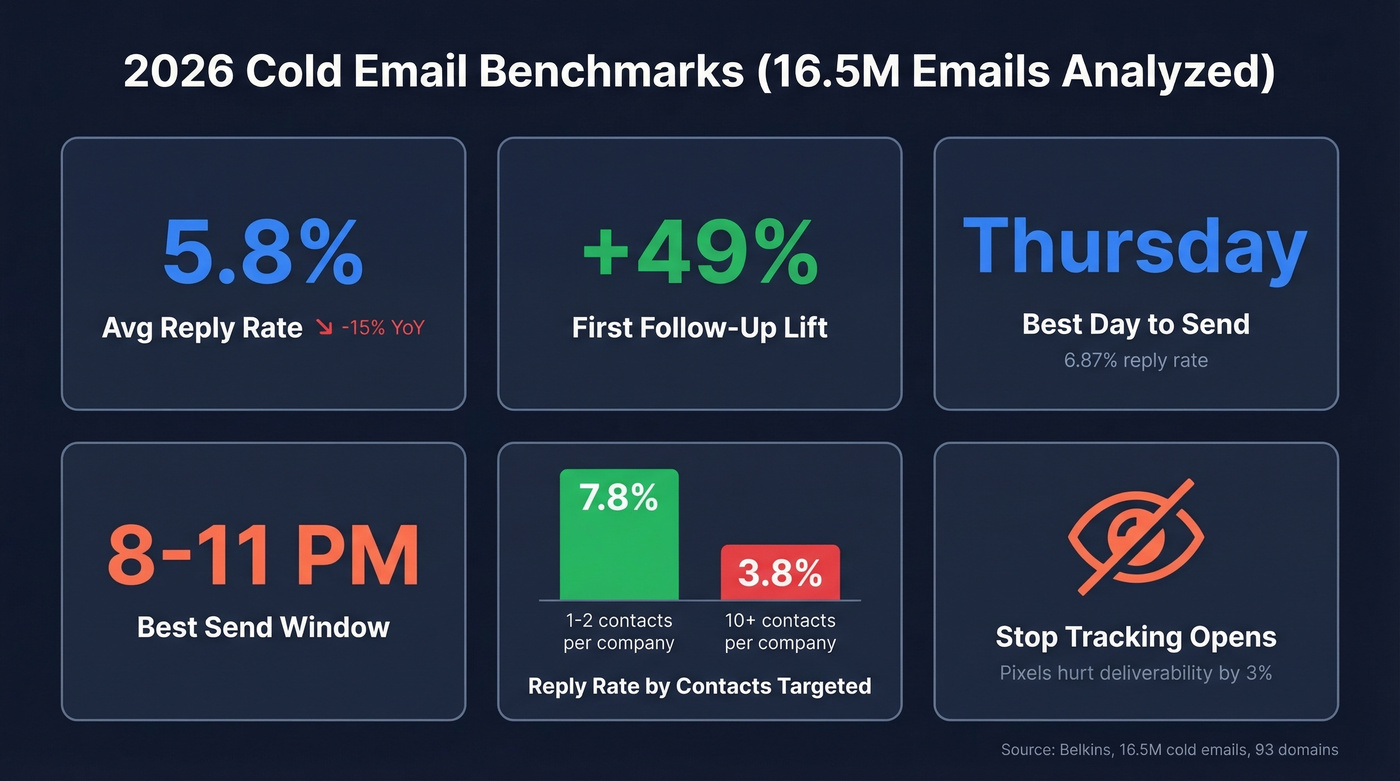
| Metric | Number |
|---|---|
| Avg reply rate | 5.8% |
| First follow-up lift | Up to 49% |
| Best day | Thursday (6.87%) |
| Best send window | 8-11 PM |
| 1-2 contacts/company | 7.8% reply |
| 10+ contacts/company | 3.8% reply |
Blasting ten people at the same company cuts your reply rate in half. And yes, evening sends outperform mornings - recipients catch up on email after hours, which is why that 8-11 PM window works.
Stop tracking open rates. Apple Mail Privacy Protection inflates the numbers, and open-tracking pixels hurt deliverability by roughly 3%. Opens are a vanity metric now. (If you still want to track it, start with email tracking pixels and how they impact inboxing.)
Subject Line Rules
A separate 5.5M-email study makes the rules clear:
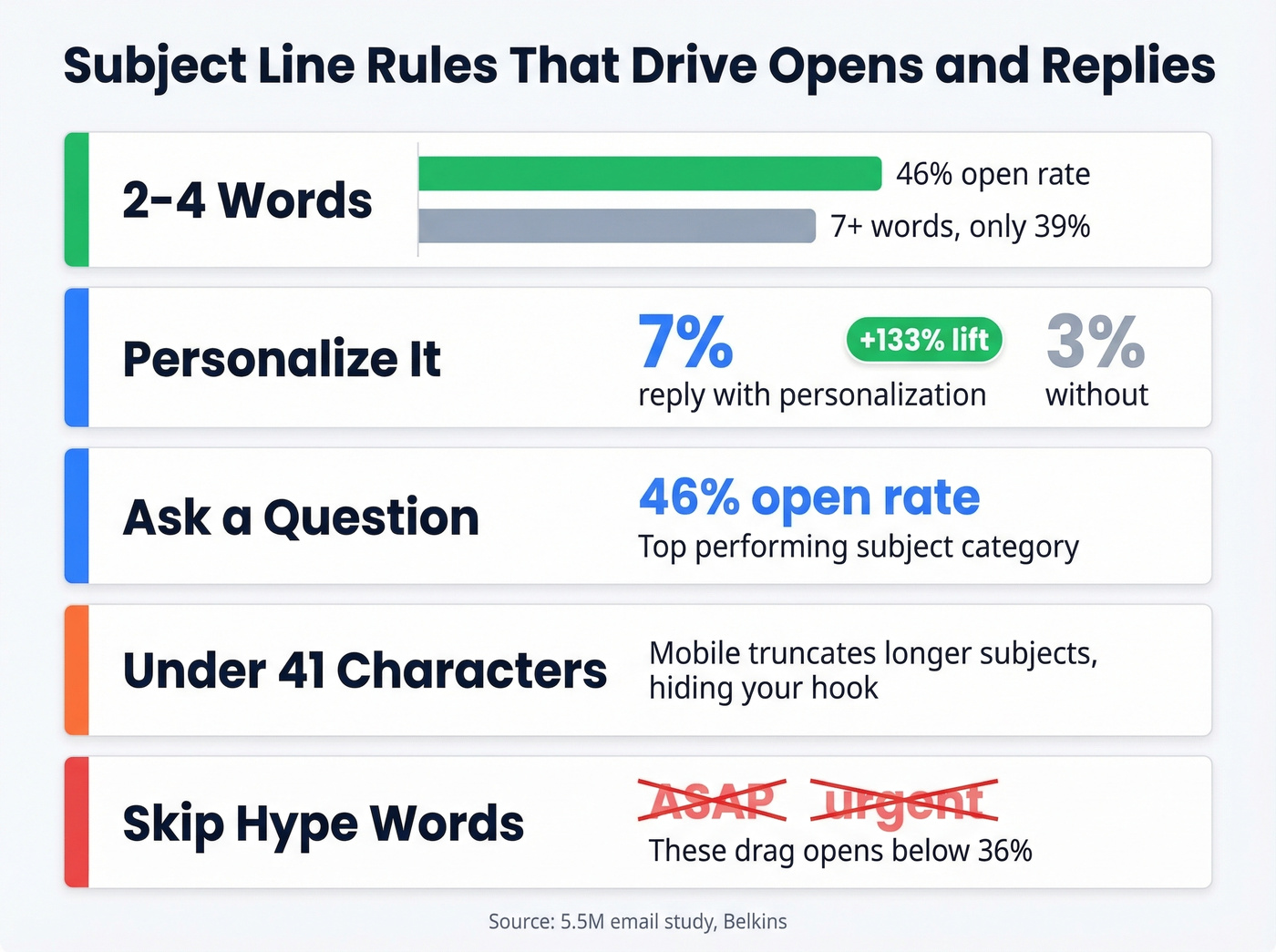
- 2-4 words hit 46% open rate. Beyond 7 words, opens drop to ~39%.
- Personalized subjects pull 7% reply vs 3% without - a 133% lift.
- Questions are the top-performing category at 46% open.
- Stay under 41 characters so mobile doesn't truncate your hook. (More ideas: cold email subject line examples.)
- Skip hype words like "ASAP" or "urgent" - they drag opens below 36%.

Signal-triggered emails outperform batch-and-blast by 3-5x. Prospeo tracks 15,000 intent topics, job changes, and funding signals - so every outbound email template you send lands with perfect timing and 98% verified contact data.
Stop guessing who to email. Start with buyers already in-market.
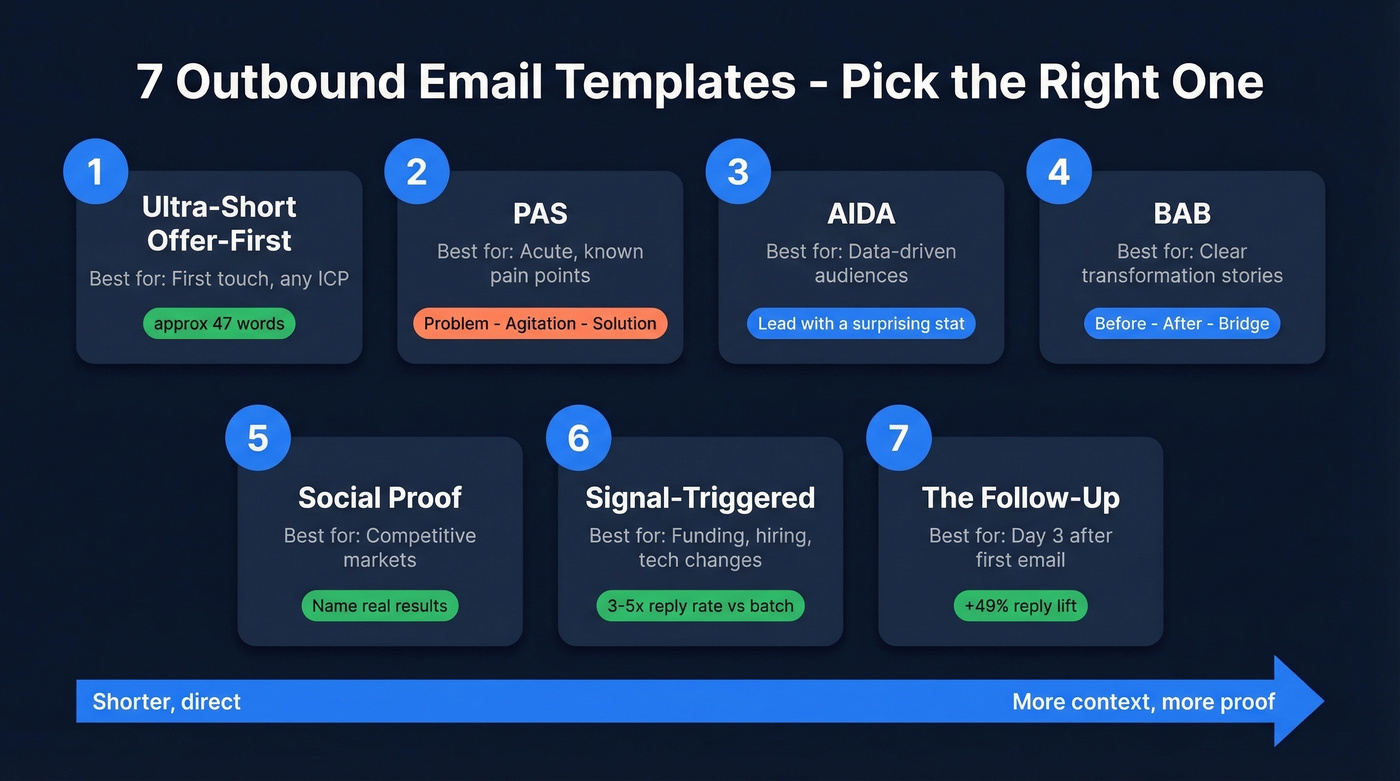
7 Proven Outbound Email Templates
1. The Ultra-Short Offer-First
Subject: Quick question
Saw [company] is [context trigger - hiring SDRs / expanding into EMEA / running on HubSpot].
We help [ICP] [specific outcome] - [proof: "cut list-building from 15 hrs to 3 for teams like X"].
Worth a conversation?
This ~47-word format matches what practitioners on r/coldemail report is getting responses. A specific offer in 50 words outperforms a 200-word essay with a "loved your podcast" opener every single time. We've tested this across dozens of campaigns, and the pattern holds: short, offer-first emails win. (If you want more structure, start with a B2B cold email sequence.)
2. PAS: Problem, Agitation, Solution
Subject: [Pain point]?
Most [role] at [company type] spend [X hours] on [painful task] - and still end up with [bad outcome].
That means [lost revenue / missed quota / wasted headcount].
We built [product] to [specific fix]. [One proof point]. Open to a 15-min look?
PAS shines when the pain is acute. Timeline-based hooks outperform problem hooks 2.3x on reply rate, but PAS wins when you can name a pain your prospect felt this week. (For more frameworks, see emails that get responses.)
3. AIDA: The Stat-Driven Hook
Subject: [Relevant result]
[Bold stat relevant to their role]. [How you achieve that result]. Your team [specific benefit - "ships X faster / books Y more meetings"].
Want me to send a 2-min walkthrough?
AIDA gives you room for a data-driven opener that earns attention before asking for anything. It works best when you have a genuinely surprising number to lead with - not "companies that use our tool see results," but "your competitors are booking 26% more meetings with verified data." Specificity is everything. (If you want the full model, use the AIDA sales funnel to map your message to each stage.)
4. BAB: Before, After, Bridge
Subject: Before/after
Before: Your reps spend 4 hrs/day researching prospects. After: Reps spend 30 min and get verified contacts with direct dials. Bridge: [Your product] does this for [similar company]. Quick call this week?
BAB is undeniable when the "after" is a real customer's result. Both this and AIDA stay under 80 words - the difference is whether you're leading with a stat or a story. In our experience, BAB converts better when you can name a company the prospect recognizes.
5. Social Proof Email
Subject: [Similar company] result
[Company in their space] was [dealing with problem]. In [timeframe], they [specific result - "tripled pipeline from $100K to $300K/week"].
We did the same for [second company]. Happy to show you how it'd work for [their company].
Lead with the result, not your product. The prospect should think "I want that outcome" before they think about what you sell. Skip this template if you don't have a real case study to reference - a vague "we've helped companies like yours" kills credibility faster than no social proof at all.
6. Signal-Triggered Email
Subject: Congrats on [event]
| Do this | Not this |
|---|---|
| "Saw [company] just raised Series B. Teams at that stage usually hit [challenge]. We help by [solution]." | "Hi, I noticed your company recently raised funding. I'd love to set up a call to discuss how we can help." |
| Specific trigger, specific challenge, proof | Generic observation, vague value, calendar link |
Use intent signals, job change alerts, or funding announcements as triggers. A well-timed email to a company actively researching your category is a completely different conversation. The consensus on r/sales is that trigger-based outbound consistently outperforms batch-and-blast by 3-5x on reply rates. (To operationalize this, use how to track sales triggers.)
7. The Follow-Up
Subject: Re: [original subject]
Circling back - wanted to add one thing.
[New value: a relevant stat, a case study link, or a specific insight about their company].
Still open to a quick chat?
The first follow-up lifts replies up to 49%. Use the 3-7-7 cadence: follow-up one on Day 3, follow-up two on Day 10, final touch on Day 17. Data shows 93% of replies arrive by Day 10, so cap your sequence at 3-4 total emails. Spam complaints rise from 0.5% on email one to 1.6% by email four. You're burning domain reputation for diminishing returns after that. (Need more options? See cold email follow-up templates.)
Writing Rules That Actually Matter
Let's be honest about personalization. I've seen teams obsess over first-line research - digging into every prospect's podcast appearances and blog posts - while completely ignoring the actual offer. A specific, low-friction offer ("I'll audit your top 3 landing pages and send a Loom with fixes") outperforms "I loved your recent post on..." every single time. Put the offer in the first three lines. (If you're rebuilding targeting, start with an Ideal Customer Profile.)
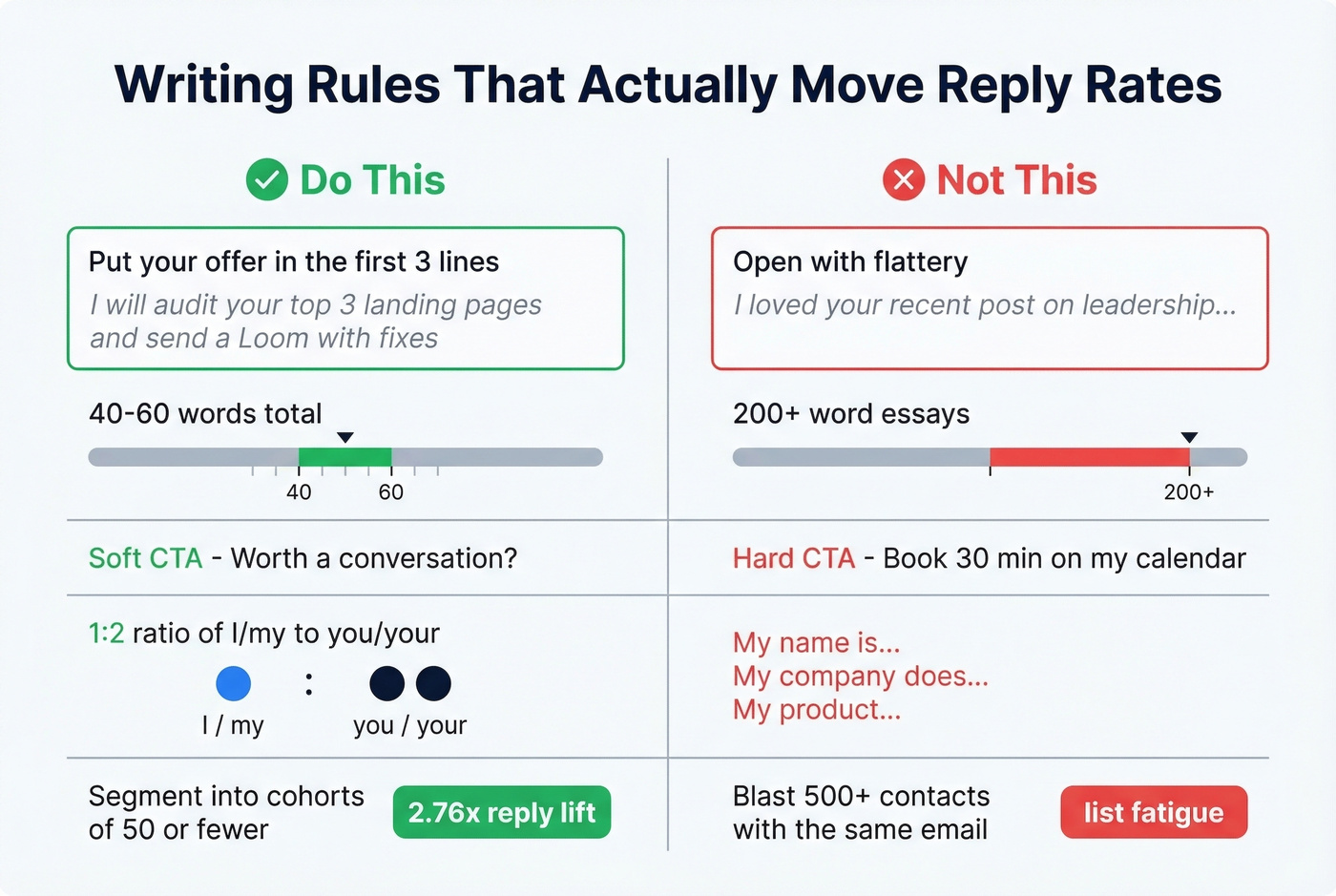
Use soft CTAs only. "Worth a conversation?" or "Open to a quick look?" - never "Book 30 minutes on my calendar." Hard CTAs feel presumptuous when someone hasn't asked to talk to you yet.
Keep emails between 40 and 60 words. If you're writing more, you're explaining too much. Aim for a 1:2 ratio of "I/my" to "you/your" - the email is about them, not you. And never open with "My name is..." Your signature handles the intro. (For deeper craft, see email copywriting.)
Segment into cohorts of 50 contacts or fewer. This alone drives a 2.76x reply rate lift. Smaller batches force better targeting, and better targeting means better offers.
Deliverability Checklist
The best outbound email template in the world bounces if your data is bad. We've seen campaigns tank overnight from a single batch of unverified emails - a 35% bounce rate will wreck your domain reputation fast. Run through this before any campaign goes live: (Full walkthrough: email deliverability guide.)
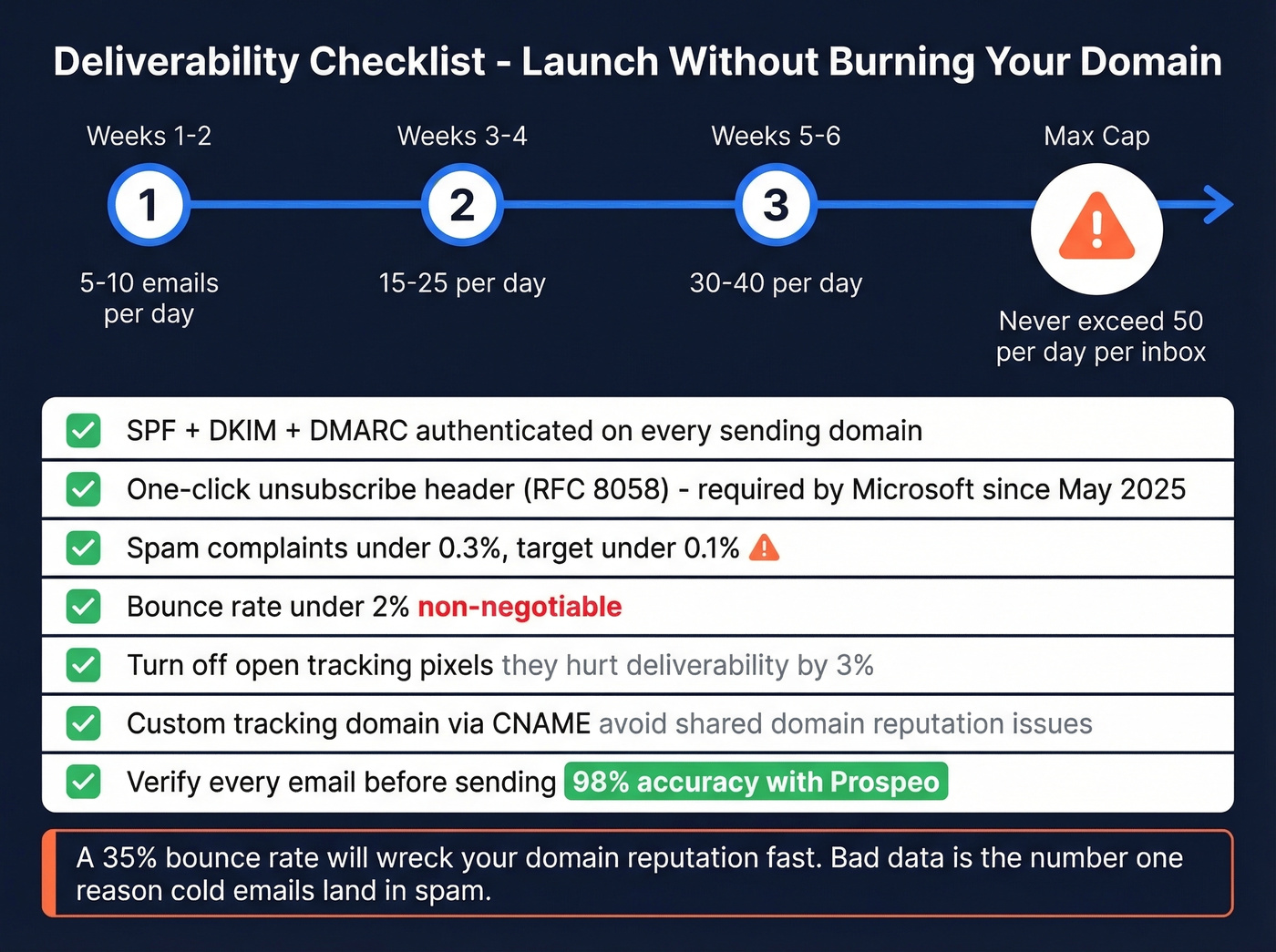
- SPF + DKIM + DMARC authenticated on every sending domain (If you need specifics, use these SPF record examples.)
- One-click unsubscribe header per RFC 8058 - Microsoft started enforcing this for high-volume senders in May 2025
- Warm up new inboxes: 5-10/day for weeks 1-2, ramp to 30-40/day by weeks 5-6, never exceed 50/day per inbox
- Spam complaints under 0.3% - target under 0.1%
- Bounce rate under 2% - non-negotiable (Benchmarks + fixes: email bounce rate.)
- Turn off open tracking pixels
- Custom tracking domain via CNAME to avoid shared-domain reputation problems (Setup details: tracking domain.)
- Verify every email before sending. This is where most campaigns silently fail. Prospeo's 5-step verification - catch-all handling, spam-trap removal, honeypot filtering - delivers 98% email accuracy. Stack Optimize used it to build from $0 to $1M ARR with 94%+ deliverability and zero domain flags across all clients.

The best outbound email template won't save you from a 35% bounce rate. Prospeo's 5-step verification delivers 98% email accuracy - teams like Meritt cut bounces from 35% to under 4% and tripled their pipeline to $300K/week.
Great copy plus bad data equals burned domains. Fix the data first.
FAQ
What reply rate should I expect from cold outbound in 2026?
The average is 5.8% based on 16.5M emails analyzed. Well-targeted campaigns with verified contacts and segmented lists hit 10-15%. If you're below 4%, revisit your list criteria and offer before scaling volume.
How many follow-ups should I send?
Three to four total emails max. The first follow-up lifts replies up to 49%, but spam complaints jump from 0.5% to 1.6% by email four - diminishing returns that risk your domain reputation.
How do I keep cold emails out of spam?
Authenticate your domain with SPF, DKIM, and DMARC. Warm up inboxes over 4-6 weeks. Keep bounces under 2% by verifying every address before sending. Bad data is the number one reason cold emails land in spam - it's not your copy, it's your list.