

How to Build an Outbound Sales Sequence That Doesn't Land in Spam
You rewrote the subject line three times, swapped in a new CTA, and still got a 0.8% reply rate. So you rewrote it again. Here's the uncomfortable truth: most underperforming outbound sales sequences aren't a copy problem - they're a data and deliverability problem. The emails never reached anyone worth replying.
What You Need Before Writing a Single Word
Nail these three things before you touch copy:
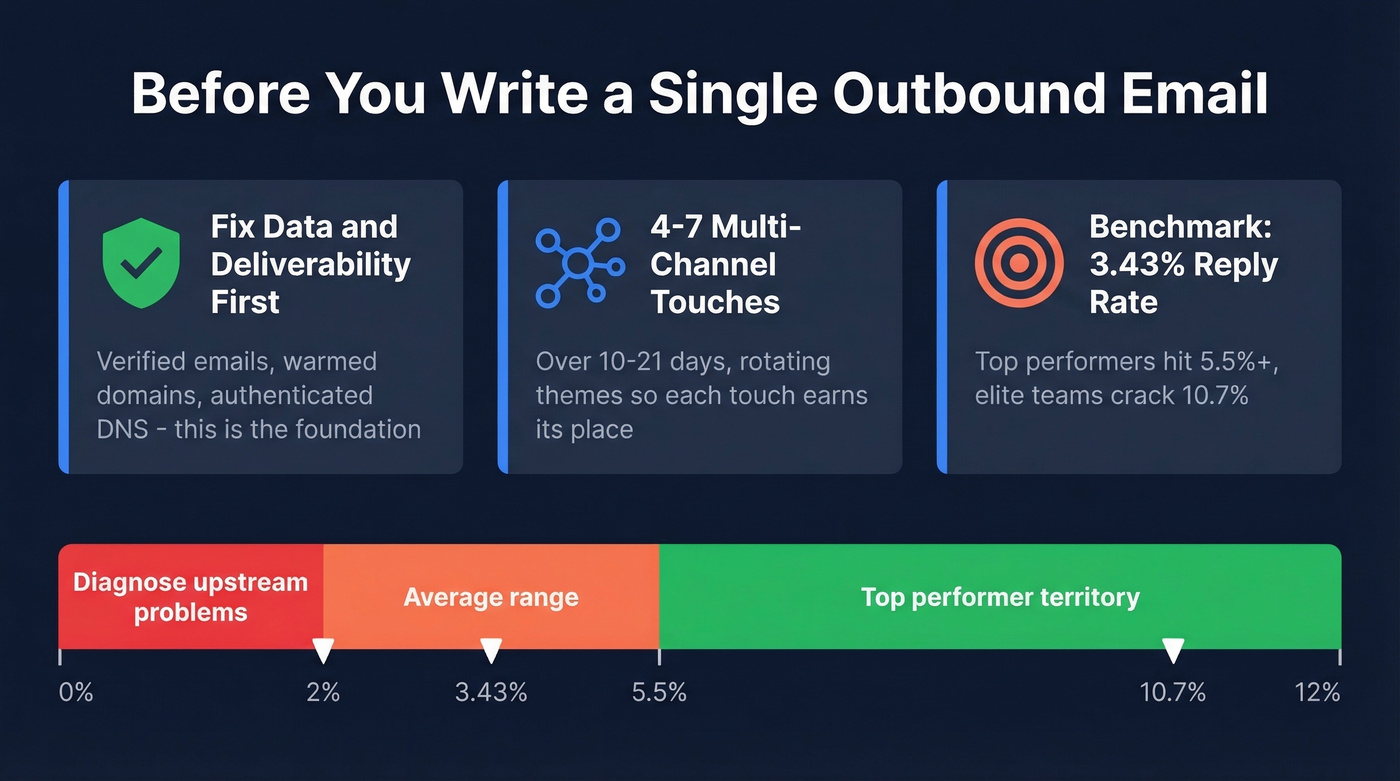
- Fix your data and deliverability first. Verified emails, warmed domains, authenticated DNS. This is the foundation everything else sits on. (If you need a deeper checklist, start with an email deliverability audit.)
- Use 4-7 multi-channel touches over 10-21 days, rotating themes so each touch earns its place.
- Benchmark against a 3.43% average reply rate. Top performers hit 5.5%+. Elite teams crack 10.7%. Below 2%? The problem is almost certainly upstream of your messaging.
Verify Data and Warm Your Domain
Your sequence starts weeks before the first email sends. Two things need to happen in parallel: list verification and domain warmup. (If you're still building lists, see how to generate an email list.)
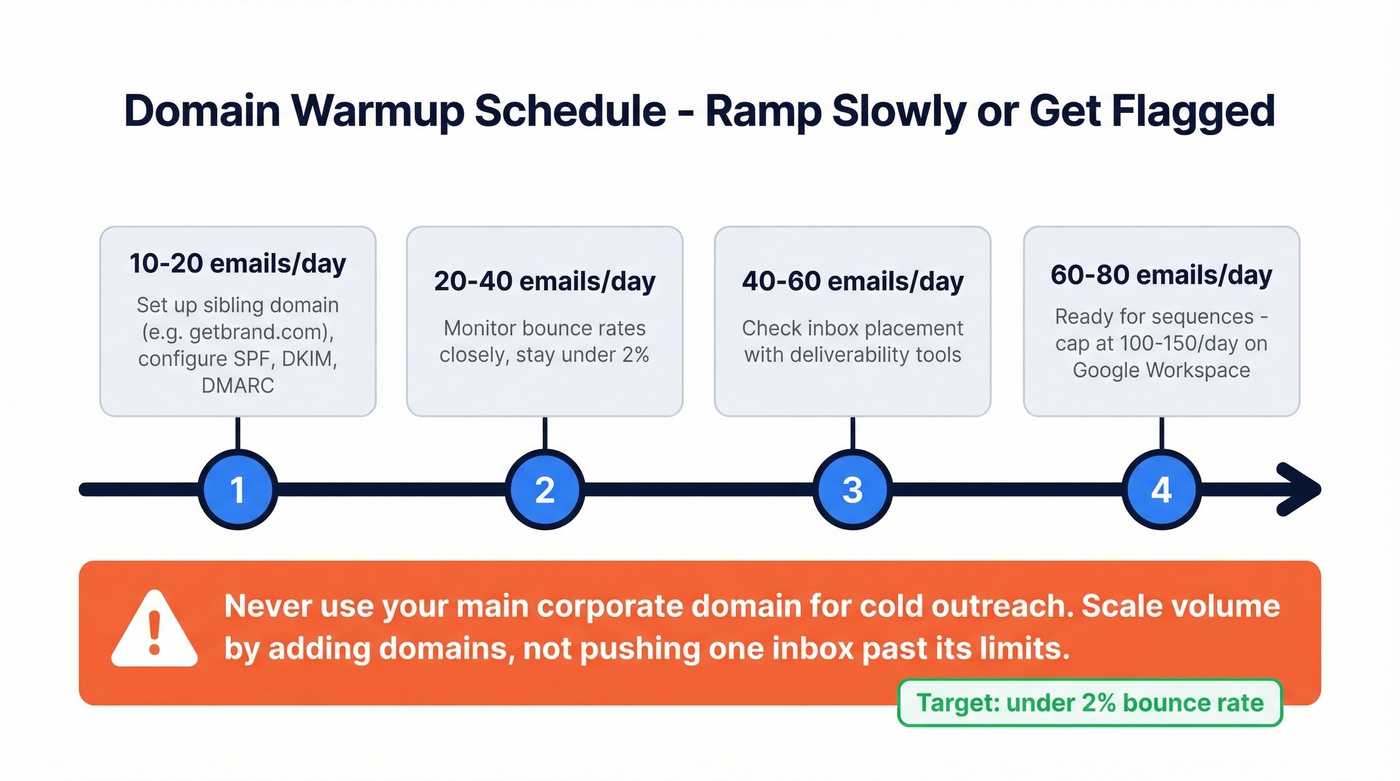
A hard bounce rate above 3% actively destroys your sender reputation. Your target is under 2%. The most reliable way to hit that consistently is verifying every address immediately before sending - not last week, not when you first scraped the list. Right before you load the sequence. Prospeo's 5-step verification catches invalid addresses, spam traps, honeypots, and catch-all domains at 98% accuracy for roughly $0.01 per email. Stack Optimize built their agency to $1M ARR running client campaigns through that verification pipeline, maintaining under 3% bounce rates and zero domain flags across every client. (For bounce benchmarks and fixes, use this email bounce rate guide.)

Never use your main corporate domain for cold outreach. Set up a sibling domain (like getbrand.com), configure SPF, DKIM, and DMARC, then ramp slowly: Week 1 at 10-20 emails/day, Week 2 at 20-40, Week 3 at 40-60, Week 4 at 60-80. Even after warmup, keep safe sending limits at 100-150 per day on Google Workspace. Scale volume by adding domains, not by pushing a single inbox past its limits. (To avoid throttling and reputation hits, follow email velocity best practices.)
Getting this stage right prevents the deliverability nightmares that sink campaigns later.
The 10-Touch Sequence Template
The best framework we've seen synthesizes the 30MPC "theme rotation" approach with multi-channel distribution. The core principle: sell one problem at a time, then rotate. Don't stack three value props into one email - that's a brochure, not a conversation. (If you want a dedicated cold sequence build, use this B2B cold email sequence guide.)
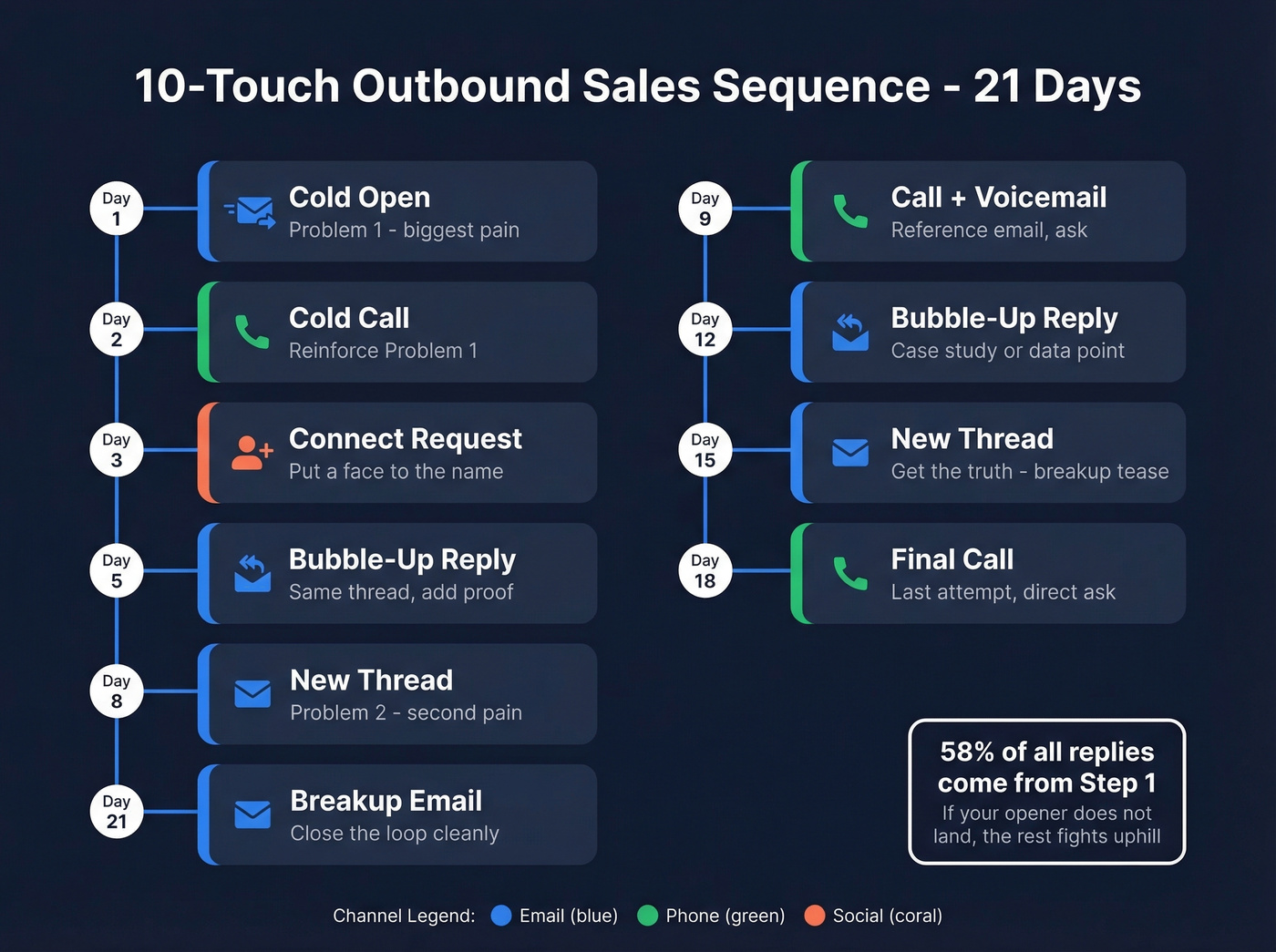
Here's a practical 10-touch, 21-day structure:
| Day | Channel | Touch Type | Theme / Purpose |
|---|---|---|---|
| 1 | Cold open | Problem #1 - biggest pain | |
| 2 | Phone | Cold call | Reinforce Problem #1 |
| 3 | Social | Connect request | Put a face to the name |
| 5 | Bubble-up reply | Same thread, add proof | |
| 8 | New thread | Problem #2 - second pain | |
| 9 | Phone | Call + voicemail | Reference email, ask |
| 12 | Bubble-up reply | Case study or data point | |
| 15 | New thread | "Get the truth" - breakup tease | |
| 18 | Phone | Final call | Last attempt, direct ask |
| 21 | Breakup email | Close the loop cleanly |
Step 2 emails that feel like casual replies - same thread, no new subject line - outperform formal follow-ups by roughly 30%. Keep every email under 80 words. (For ready-to-use copy, pull from these sales follow-up templates.)
Don't underestimate the first touch. 58% of all replies come from Step 1. If your opener doesn't land, the rest of the cadence is fighting uphill. Multi-channel matters because it buys you more touches without feeling like spam - seven emails in 14 days is annoying, but seven touches across email, phone, and social feels like genuine persistence. Armand Farrokh's version of this framework at 30MPC produces 20%+ reply rates from cold prospects. Even if your numbers are half that, you're well above average. (If you're rebuilding your top-of-funnel motion, these sales prospecting techniques help.)

Stack Optimize built a $1M agency running outbound sequences through Prospeo's verification pipeline - under 3% bounce rates, zero domain flags. 98% email accuracy, 5-step verification that catches spam traps and honeypots, at roughly $0.01 per email. Fix your data before you rewrite another subject line.
Stop diagnosing copy when the real problem is bad data.
Benchmarks for 2026
"Good" depends entirely on channel. Don't compare your cold email reply rate to your inbound sequence and panic.
| Channel | Key Metric | Average | Top Performers |
|---|---|---|---|
| Cold email | Reply rate | 3.4% | 5.5-10.7% |
| Cold call | Connect rate | 5-12% | ~2 meetings/rep/day at high volume |
| Social | Accept-to-reply | 16% accept, 21% reply-to-accept | ~3 replies per 100 requests |
| Blended | Meeting rate | 1-3% | 3%+ |
Outreach's customer data shows a 27.2% open rate and 2.9% reply rate on sequences, with cold outbound specifically running 8-15% prospect reply and 1-3% meeting conversion. Cold calling at scale produces roughly 2 booked meetings per rep per day at agencies running 400-750 dials daily. SaaS cadences combining email and calls can hit 18-25% reply rates in strong verticals. (To sanity-check your opens, compare against the standard email open rate.)
Fixing an Underperforming Sequence
If your reply rate is stuck below 2%, resist the urge to rewrite copy first. Diagnose in this order:
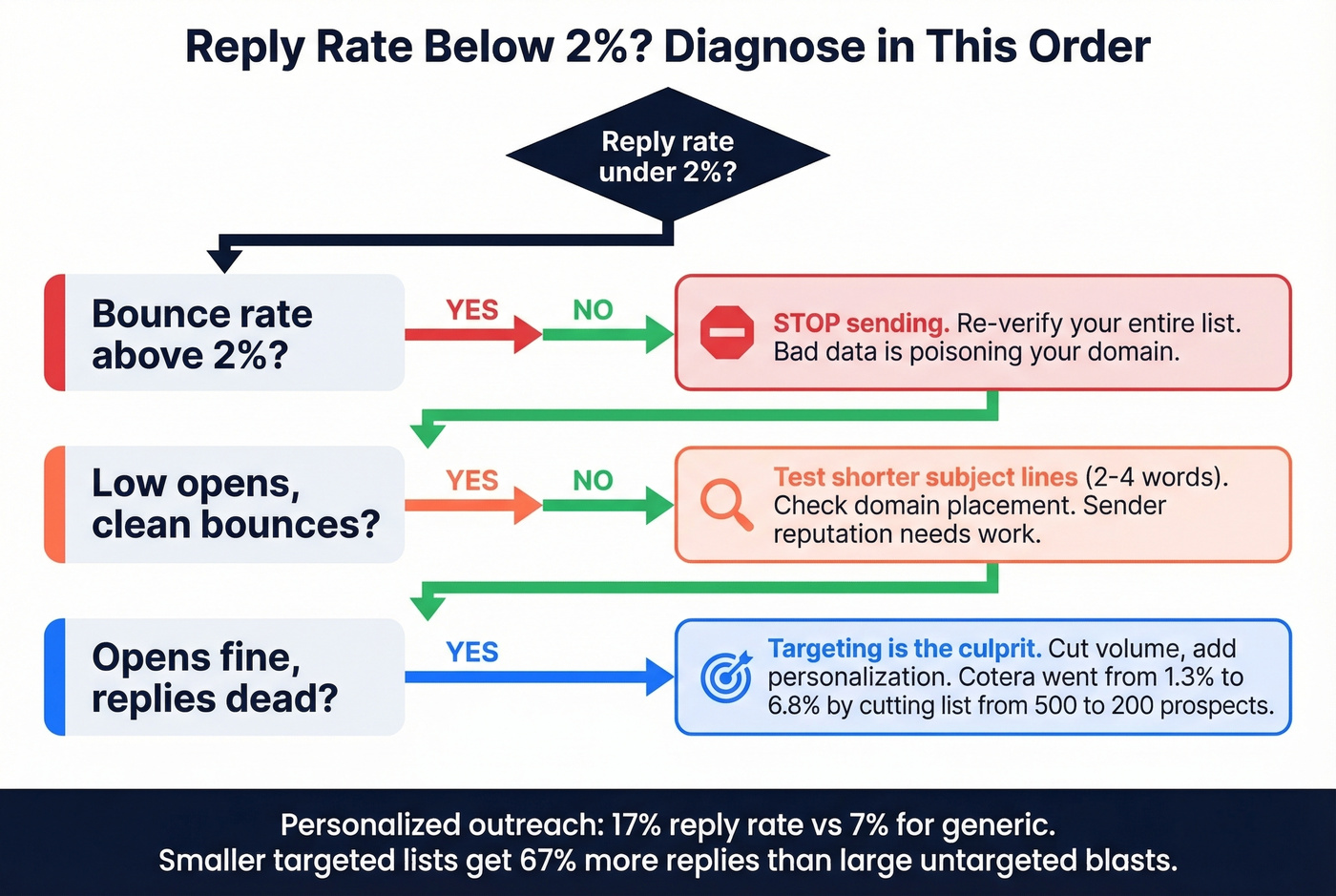
Bounce rate above 2% - stop sending. Re-verify your entire list. Bad data is poisoning your domain reputation and nothing else matters until it's fixed.
Low opens, clean bounces - your subject lines or sender reputation need work. Test shorter subjects (2-4 words) and check your domain's placement with a tool like GlockApps. (If you need ideas, use these cold email subject line examples.)
Opens fine, replies dead - your targeting is the most likely culprit. Cotera documented this exact scenario: their team cut volume from 500 prospects per month to 200, added research-based personalization, and reply rates jumped from 1.3% to 6.8%. Meetings nearly doubled. Personalized outreach pulls 17% reply rates versus 7% for generic messages, and emails to large untargeted lists get 67% fewer replies than smaller targeted groups. In our experience, the teams that cut volume and increase personalization always outperform the ones that keep blasting.
Let's be honest about something most vendors won't tell you: if your blended meeting rate is 2% and your CAC exceeds 3x CLV, you don't have a sequence problem. You have a unit economics problem. Cut list size and increase personalization before scaling volume. (If you want a framework for list quality, start with an ideal customer profile.)
70% of B2B teams now use intent data, and intent-driven strategies convert 78% higher than static lists. If you have access to intent signals, compress your cadence. A 2-3x response lift is common when the first touch lands within 24 hours of a buying signal. A/B test messaging weekly and kill underperforming variants fast. (For segmentation mechanics, see intent based segmentation.)
Mistakes That Kill Your Cadence
Skipping verification. This is the single fastest way to torch a domain. One bad send can take weeks to recover from. (If you suspect traps, follow this spam trap removal playbook.)
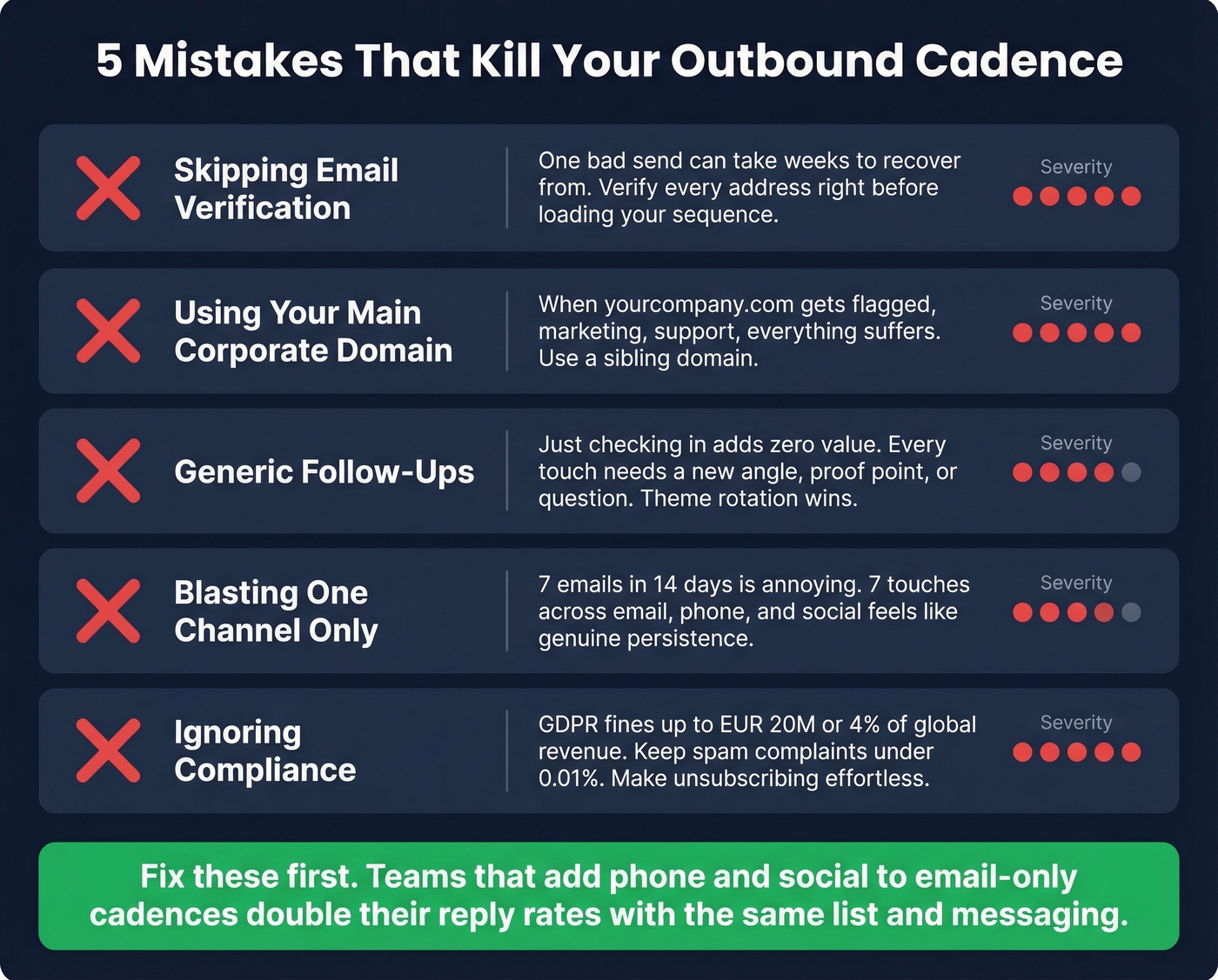
Using your main corporate domain. When yourcompany.com gets flagged, your entire org's email deliverability suffers - marketing, support, everything.
Generic follow-ups. "Just checking in" and "bumping this to the top" add zero value. Every touch should introduce a new angle, proof point, or question. Theme rotation beats the lazy bump by a wide margin.
Blasting one channel. The distinction between seven emails and seven multi-channel touches is the difference between meetings booked and inbox noise. We've watched teams double their reply rates just by adding phone and social touches to an email-only cadence - same messaging, same list, wildly different results.
Ignoring compliance. GDPR fines run up to EUR 20M or 4% of global annual revenue. Keep your spam complaint rate under 0.01% and make unsubscribing effortless. Skip this if you enjoy expensive conversations with legal.
FAQ
How many touches should an outbound sales sequence have?
Most high-performing sequences use 7-10 touches across email, phone, and social over 14-21 days. Fewer than 5 leaves pipeline on the table; more than 12 risks spam complaints. The 10-touch template above is a strong starting point for mid-market B2B.
What's a good reply rate for cold outbound email?
The industry average sits around 3.4%. Top-performing teams hit 5.5-10.7%. If you're below 2%, diagnose data quality and targeting before rewriting copy - bad contact data is the most common root cause.
How do I stop cold emails from landing in spam?
Use a dedicated sending domain with SPF, DKIM, and DMARC configured. Warm it over 3-4 weeks before full-volume sends. Verify every email address before loading your sequence and keep bounce rates under 2%, which is the threshold that protects sender reputation.
Should I use intent data in my outbound sequence?
Yes. Intent-driven outbound converts 78% higher than static lists. Layer buying signals - like active research on relevant topics - with job title and company filters to prioritize accounts most likely to reply. Compressing your cadence to reach prospects within 24 hours of a signal dramatically lifts response rates.
The article above proves it: intent-driven sequences convert 78% higher than static lists. Prospeo tracks 15,000 intent topics via Bombora and layers them with 30+ filters - job changes, headcount growth, technographics, funding. Build a list of prospects actively researching your category, then hit them within 24 hours.
Reach buyers already in-market instead of blasting cold lists.