

Personalized Emails: The Practitioner's Guide to Messages People Actually Read
You spent 20 minutes researching a prospect, wrote a genuinely thoughtful cold email, hit send - and it bounced. The address was dead. That's not a personalization problem. It's a data problem masquerading as one, and it's where most teams lose before they even start.
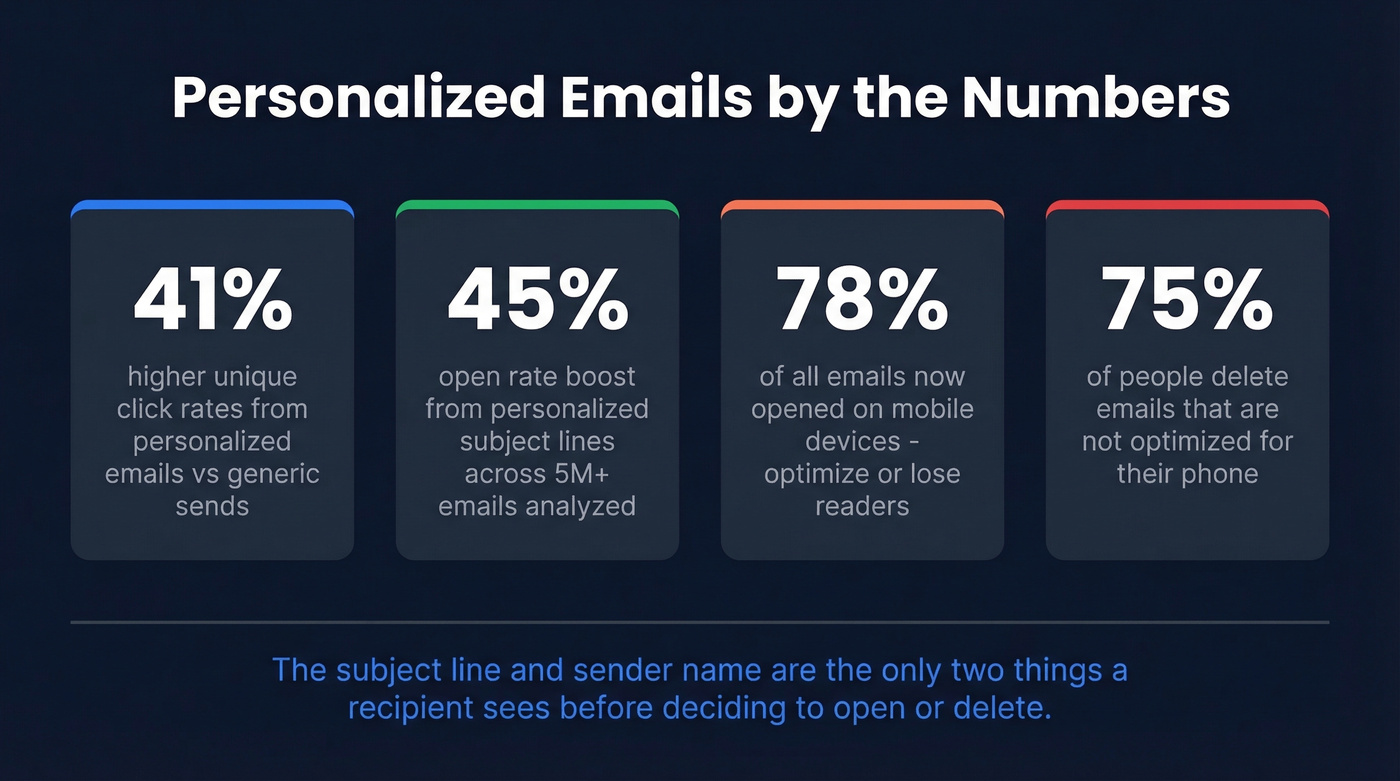
The inbox has never been more crowded. Close to 392.5 billion emails fly around the world every day in 2026, and the average professional fields 82-120 of them. Done right, personalized emails can drive 41% higher unique click rates than generic sends. But your tailored message isn't competing with spam anymore - it's competing with other individualized outreach from people who've read the same playbooks you have. Dropping in a first name and company name isn't personalization; it's a mail merge from 2014.
What actually works is a combination of sharper segmentation, smarter triggers, and - above everything - clean data.
What You Need (Quick Version)
- Marketing emails: Segmentation plus behavioral triggers beat merge-tag personalization every time. Dynamic content blocks based on what people do outperform content based on who they are.
- Cold outreach: Use the trigger-template method - 5 templates, under 3 minutes per lead, 10-15%+ reply rates. Full framework below.
- Before anything: Fix your data. Tailored messaging sent to dead inboxes is wasted effort. Verify your list first; catching invalid addresses, spam traps, and honeypots takes minutes and saves your sender reputation.
Email Personalization for Marketing
Segmentation and Dynamic Content
The #1 complaint from practitioners on Reddit is that teams are still blasting their entire list like it's 2010. Segment by behavior, not just demographics. Someone who visited your pricing page three times this week is a fundamentally different audience than someone who opened one newsletter six months ago.
Dynamic content blocks let you serve tailored copy - different messaging, images, and CTAs - to different segments within the same send. A SaaS company can show enterprise case studies to director-level contacts and ROI calculators to individual contributors. Same email, different experience.
Open-time personalization takes this further. Countdown timers that update when the email is opened, live inventory counts, and weather-based product recommendations all create urgency that static content can't match. Interactive elements like in-email polls and add-to-calendar buttons double as engagement drivers and zero-party data collectors - you learn what your audience cares about while giving them a reason to click.
Behavioral Triggers and Automation
Triggers fire based on what someone does, not who they are. Cart abandonment, welcome sequences, re-engagement drip campaigns after 30 days of silence - these are the workhorses of email marketing personalization.
But automation without intelligence is dangerous. Amazon learned this the hard way when their system mistakenly sent baby registry emails to the wrong users. The company called it a technical error. Your customers will call it creepy. Every automated trigger needs a logic check: does this recommendation make sense given what we actually know about this person?
Subject Lines and Sender Name
An analysis of over five million emails found that personalized subject lines boost open rates by up to 45%. That's the biggest lever you've got, because the subject line and sender name are the only two things a recipient sees before deciding to open or delete.
Use a real person's name as the sender, not just the brand. "Sarah from Acme" beats "Acme Marketing" because it signals a human on the other end. Subject lines that reference a specific action ("Your trial ends Thursday") beat generic curiosity hooks. A/B test your individualized subject lines against generic ones - the lift varies wildly by audience, and assumptions will mislead you. If you need a swipe file, start with these subject lines.
Mobile Optimization
78% of emails are now opened on mobile, and 75% of people delete emails that aren't optimized for their phone. Your beautifully crafted message is worthless if it renders as a wall of tiny text with broken images.
Use the "3x3" structure: three blocks of text, three lines each on mobile. Tap-friendly CTAs. Simple layouts. Test on actual devices, not just your desktop preview.
| Tactic | Expected Lift | Complexity |
|---|---|---|
| Behavioral segmentation | 20-40% CTR increase | Medium - requires event tracking |
| Dynamic content blocks | 15-30% CTR increase | Medium - needs content variants |
| Open-time personalization | 10-25% engagement lift | Low - plug-in tools handle it |
| Personalized subject lines | Up to 45% open rate lift | Low - template-level change |
| Real sender name | Higher engagement | Low - configuration only |
Personalized Emails for Cold Outreach
This is where email personalization gets interesting - and where most teams either over-invest or under-invest.
The 3 Levels of Personalization
Level 1: Tokens. First name, company name, job title. Table stakes. Every email sequence tool does this. Generic cold emails using only tokens average less than 1% reply rates. If this is your "personalization strategy," you don't have one. (If you're building sequences, this B2B cold email sequence guide helps.)
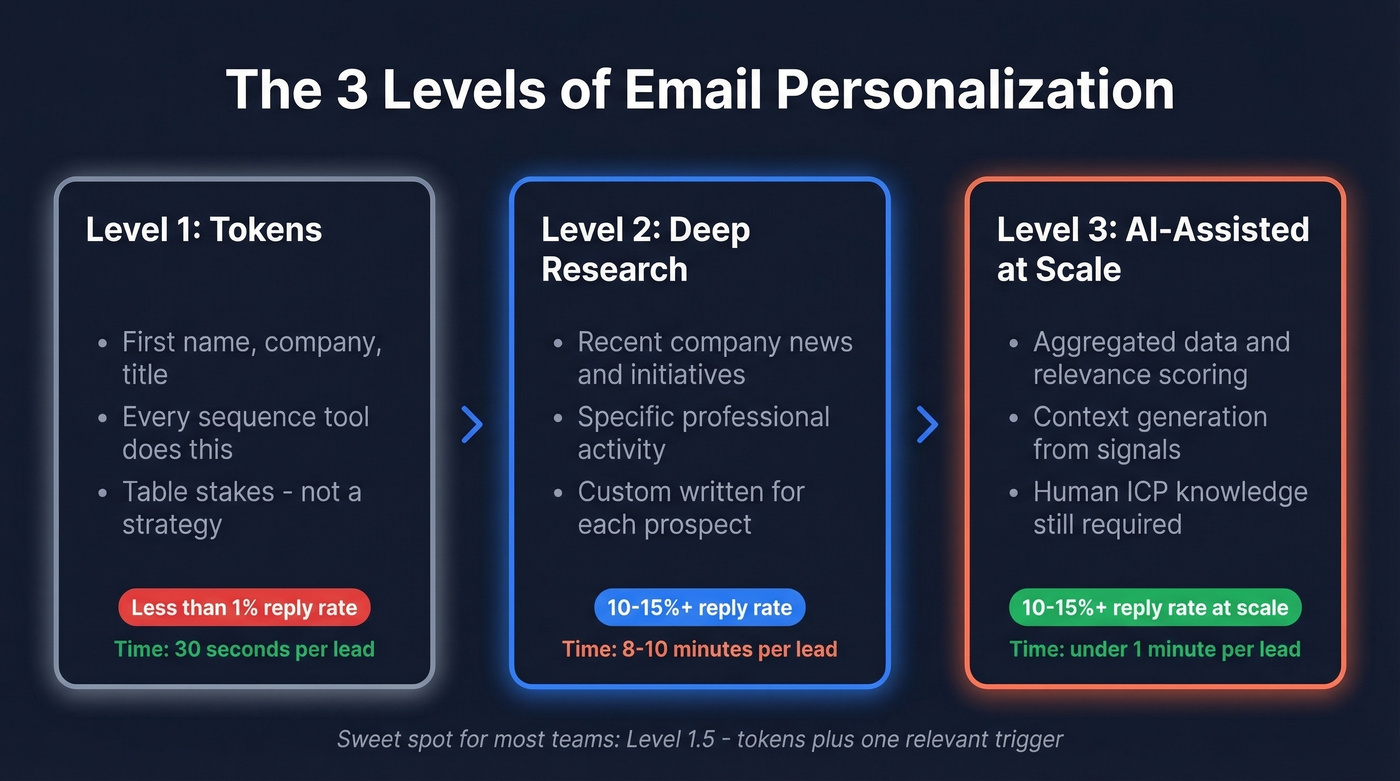
Level 2: Deep research. You're referencing a prospect's recent professional activity, company news, or specific initiatives. Reply rates climb to 10-15%+. The catch is time - we've seen reps spend 8-10 minutes per lead at this level, which kills throughput. The throughput-quality tension is real: reps either burn out on deep research or default to templates that get ignored.
Level 3: AI-assisted at scale. Aggregate data, relevance scoring, context generation, scalable execution. This is the frontier, and it's getting better fast. But AI still can't replace your knowledge of your ICP or fix a weak offer.
One boundary rule: stay "professionally personal." Use public, professional information. The moment a prospect thinks "how did they know that?" you've crossed the line from relevant to creepy.
The Trigger-Template Method
Here's the thing: you don't need to research every prospect from scratch. Build 5 trigger templates tied to your top buying signals, and you've got a system that actually scales.
- Funding round - "Congrats on the Series B. Teams at this stage usually hit [specific problem]..."
- New hire in your buyer's department - "Saw you just brought on a Head of RevOps. That usually means..."
- Tech adoption - "Noticed you're running [tool]. Most teams using it also deal with..."
- Market expansion - "Opening the EMEA office is a big move. One thing that trips up teams..."
- Leadership change - "New role, new priorities. When [title] changes, [problem] usually surfaces..."
Use the "first is best" research stack: scan for triggers in order, and use the first one you find. Don't dig for the perfect angle - the first relevant trigger is almost always good enough. (If you want a system for this, see how to track sales triggers.)
The email structure: research trigger, unique opener, bridge to your value prop, low-friction CTA. Three to four sentences max. Under 3 minutes per lead once you've built the templates.
The Personalization Paradox
A rep on r/coldemail described spending hours researching each prospect - reading 40-50 pages of website content, scraping recent professional posts. They sent 30 deeply researched emails. Got 3 replies. Two later ghosted.
That's a 10% reply rate, which is genuinely good. But it's also a reality check: personalization drives replies; your offer drives conversions. The consensus on r/b2bmarketing is that human-researched outreach can hit 15-30% reply rates - but only when the offer solves a problem the prospect has right now.
Let's be honest about deal size. If your ACV sits below $10K, you probably don't need Level 2 personalization at all. The trigger-template method at Level 1.5 - tokens plus one relevant trigger - gives you 80% of the reply rate at 20% of the time cost. Save deep research for your top 50 accounts. When you do follow-ups, use proven sales follow-up templates instead of improvising.
AI-Powered Personalization
AI isn't replacing personalization - it's compressing the time cost. Tools like Smartwriter.ai and Warmer.ai generate contextual opening lines from web and professional signals. Quality varies, but the best outputs are 80% as good as human-written at 5% of the time cost. Clay is a common choice for pulling enrichment data and feeding it into AI templates for dynamic email body copy tailored to industry, role, and company size. Most of these tools run $30-$300/user/month depending on volume and features. (If you're evaluating options, start with AI for sales emails.)
Beyond content generation, AI handles predictive send-time optimization - sending when a specific recipient is most likely to engage based on historical open patterns - and behavioral segmentation that clusters audiences by patterns humans would miss, like purchase velocity or feature adoption curves. For timing, see best time to send cold emails.
What AI can't do: replace your ICP knowledge, fix a bad offer, or understand the nuance of why a specific prospect would care about your product right now. By 2027, we'll be sending 408.2 billion emails per day. AI will write most of them. The ones that stand out will still need a human who understands the buyer.

You just read that personalized emails drive 41% higher click rates - but only if they reach real inboxes. Prospeo's 5-step verification delivers 98% email accuracy with spam-trap and honeypot removal, so your carefully crafted outreach never bounces.
Stop wasting research time on dead addresses. Verify before you personalize.
Common Mistakes
Six mistakes we see constantly - and we've made a few of these ourselves:
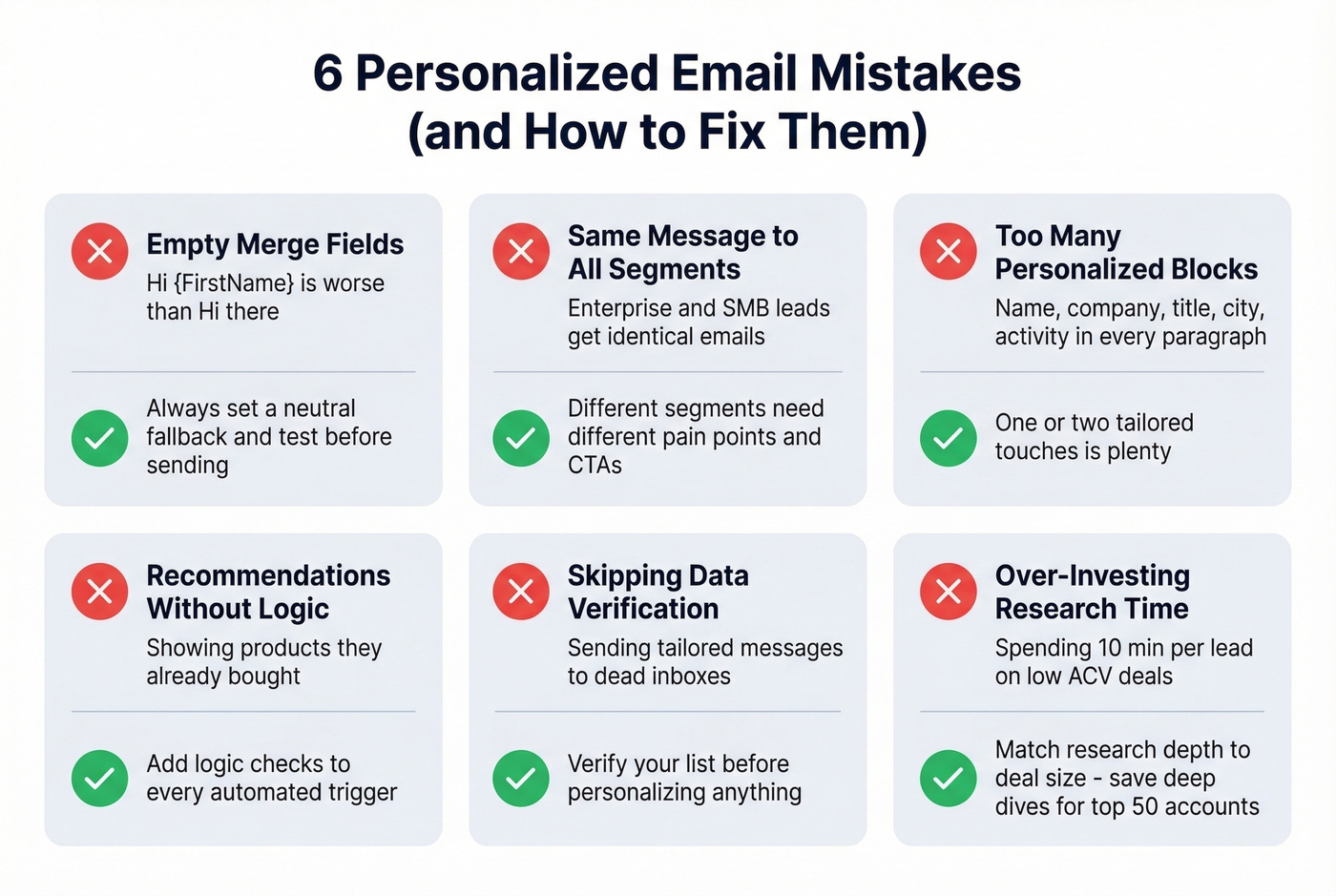
Empty merge fields. "Hi {FirstName}" is worse than "Hi there." Use a neutral fallback and test your templates with empty fields before every send.
Same message to all segments. If your enterprise prospects and SMB leads get identical emails, you're broadcasting, not personalizing. Different segments need different pain points, proof points, and CTAs.
Too many personalized blocks. Stuffing an email with the prospect's name, company, title, city, and recent activity in every paragraph creates a Frankenstein message. One or two tailored touches is plenty.
Recommendations without logic. Showing someone a product they already bought triggers what practitioners call the "robot effect." It erodes trust faster than no personalization at all.
Automation without oversight. Set-and-forget sequences drift. Triggers fire on stale data. A prospect who churned six months ago gets a renewal upsell. And over-emailing is the fastest path to unsubscribes and spam flags. Review your automations quarterly at minimum. If you're troubleshooting inboxing, use an email deliverability guide and check your email velocity.
Not testing across environments. Your email looks great in Gmail on desktop. It's unreadable in Outlook mobile. 75% of recipients delete emails that don't render properly on their device. Test on mobile, webmail, and desktop before every campaign.
Privacy and Compliance
Personalization runs on data, and data runs into regulation. Here's the practical breakdown:
| GDPR (EU/EEA) | CCPA/CPRA (California) | |
|---|---|---|
| Consent model | Opt-in (explicit) | Opt-out |
| Key requirement | Lawful basis needed | "Do Not Sell" link |
| Max penalty | EUR 20M or 4% turnover | $7,500/intentional violation |
| Data rights | 8 rights via DSAR | Right to know, delete, opt out |
81% of consumers say how an organization treats their personal data reflects how much it respects them as customers. Privacy isn't just a legal checkbox - it's a trust signal.
Get explicit consent for marketing emails in GDPR jurisdictions. Include a visible "Do Not Sell" link for CCPA. Make opt-out easy and instant. If you're doing cold outreach in the EU, make sure you have a legitimate interest basis documented - "we bought a list" isn't one. (Related: Is it illegal to buy email lists?)
Data Quality: The Foundation Everyone Skips
One stat should keep every email marketer up at night: B2B contact data decays at roughly 20-30% per year. People change jobs, companies get acquired, email servers get decommissioned. The list you built six months ago is already degrading.
Personalization is only as good as the data feeding it. A beautifully crafted message that bounces doesn't just waste your time - it damages your sender reputation, which tanks deliverability for your next 100 sends. We've watched teams pour hours into personalization workflows while sitting on lists with 30%+ bounce rates. All that effort, straight into the void. If you're diagnosing this, start with email bounce rate and how to improve sender reputation.
Prospeo's database covers 300M+ professional profiles refreshed every 7 days, compared to the 6-week industry average. The 5-step verification catches spam traps and honeypots before they damage your domain. One customer, Meritt, saw their bounce rate drop from 35% to under 4%, and their pipeline tripled from $100K to $300K per week. At roughly $0.01 per verified email with a free tier of 75 emails per month, skipping verification is leaving pipeline on the table.
The trigger-template method works - but only with fresh data. Prospeo refreshes 300M+ profiles every 7 days, so your funding-round and new-hire triggers hit verified contacts at $0.01 per email. No stale data. No bounces. No burned domains.
Pair sharp personalization with data that's actually current.
Personalized Emails FAQ
What's the difference between personalization and segmentation?
Segmentation groups your audience by shared traits - industry, company size, behavior - while personalization tailors the message to the individual within that segment. You need both: start with segments, then layer in individual context for high-value contacts.
How long should a personalized cold email be?
Three to four sentences max: one trigger-based opener, a bridge to your value prop, and a low-friction CTA. Longer emails reduce response rates, especially on mobile where 78% of emails are opened.
How do I prevent bad data from ruining my deliverability?
Verify your list before every campaign. Budget 5 minutes for verification before every send - it saves weeks of deliverability recovery. Tools with real-time verification and spam-trap filtering, like Prospeo, catch the addresses that'll hurt your domain before you hit send.
Does email personalization actually improve reply rates?
Yes. Individualized cold emails using trigger-based openers consistently hit 10-15% reply rates, compared to under 1% for token-only sends. The lift is even higher in marketing: personalized subject lines alone can boost open rates by up to 45%.