

Personalized Outreach at Scale Is a Data Problem, Not a Copywriting Problem
Your SDR spent 20 minutes crafting the perfect cold email. Custom first line, relevant case study, sharp CTA. It bounced. The prospect changed jobs three months ago, and your database never caught it.
That's the real problem with personalized outreach at scale - and no amount of better copywriting fixes it.
A practitioner test on Reddit tells the story well: a generic AI template blasted to 500 people pulled a 2% response rate, while a researched, human-sounding version sent to just 50 people hit 18%. The difference wasn't writing talent. It was research quality and the data underneath it.
What Scalable Personalization Actually Requires
Personalization that scales rests on three pillars:
- Clean data. Verified emails, fresh records, bounce rates under 2%. Your personalization is worthless if it never reaches an inbox. (If you're rebuilding your stack, start with data enrichment and verification.)
- Signal-based research. Automate the context-gathering - job changes, funding rounds, tech stack shifts - but keep the writing human. (This is the core of personalized outreach done right.)
- A sequencer that doesn't torch your domain. Warm-up, ramp schedules, reply-as-follow-ups. (More on safe sending in our email deliverability guide.)
You need three tools, not ten. A data provider, an enrichment layer, and a sending platform. The goal is infrastructure that doesn't sacrifice relevance for volume.
The Foundation Most Guides Skip
Nearly half of outbound senders don't track their bounce rates. That's like running paid ads without tracking conversions. Before you write a single personalized line, your deliverability infrastructure needs to be airtight.
The checklist isn't optional:
- SPF, DKIM, and DMARC configured on a separate outreach domain
- Bounce rate under 2% (if your data provider doesn't auto-refresh, re-verify lists every 90 days) - see email bounce rate benchmarks and fixes
- Warm-up for 2-6 weeks before volume (use a plan from unlimited email warmup tools)
- Ramp gradually: 10 → 25 → 40 emails/day (tie this to your email velocity)
One insight from Snov.io's analysis of 44 million emails surprised us: turning off open tracking more than doubled reply rates (2.36% vs. 1.08%). Open-tracking pixels hurt deliverability and replies. If you're choosing between vanity metrics and actual conversations, kill the pixel. (If you want the technical why, see email tracking pixels.)
This is where your data provider matters more than your copywriter. Prospeo runs a 5-step verification process with catch-all handling, spam-trap removal, and honeypot filtering on a 7-day refresh cycle versus the roughly 6-week industry average. The proof is in production: Stack Optimize built to $1M ARR using Prospeo data with zero domain flags and bounce rates under 3% across all clients. Meritt cut their bounce rate from 35% to under 4%.

The Research-Writing Split
The breakthrough isn't writing faster. It's separating research from writing entirely.
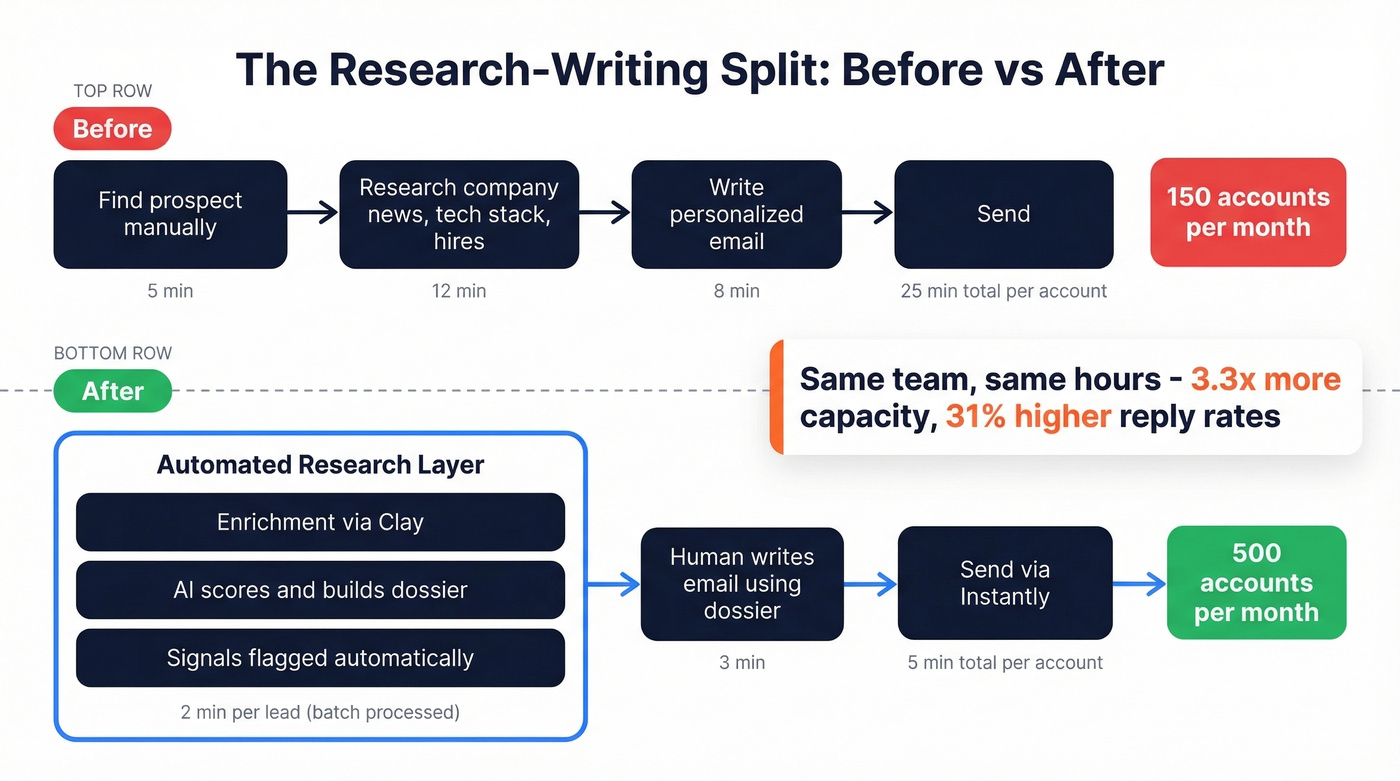
One enterprise team documented this shift: personalization used to take 25 minutes per account. They automated the intelligence gathering - company news, tech stack, recent hires, competitive signals - into a pre-built dossier. Writing time dropped to 5 minutes. Same team, same hours, but capacity jumped from 150 to 500 accounts per month, and reply rates climbed 31%.
You don't need enterprise tooling to pull this off. One practitioner built a DIY stack with Apify, Google Gemini, and Sheets that processed 80 leads in under 10 minutes - each with a lead score and a personalized first-line snippet. The output looked like this:
- "Saw you have over 100 reviews for Expert Tax Inc. in Chelmsford - that's incredibly impressive."
- "Noticed [Champion Name] just joined your team from [Previous Company] - we helped them cut onboarding time by 40% there."
- "Your team just adopted Segment - most companies in that window are evaluating CDPs within 60 days."
AI did the research. A human wrote the actual email. That's the pattern that works.

Your personalized first line means nothing if the email bounces. Prospeo's 5-step verification, catch-all handling, and 7-day data refresh keep bounce rates under 3% - the same infrastructure Stack Optimize used to hit $1M ARR with zero domain flags across every client.
Fix the data layer before you touch the copy. 98% accuracy at $0.01/email.
Signal-Based Targeting Tiers
Not all personalization signals are equal. We call this the 24-48-168 Rule - the hours you have to act before a signal goes cold.
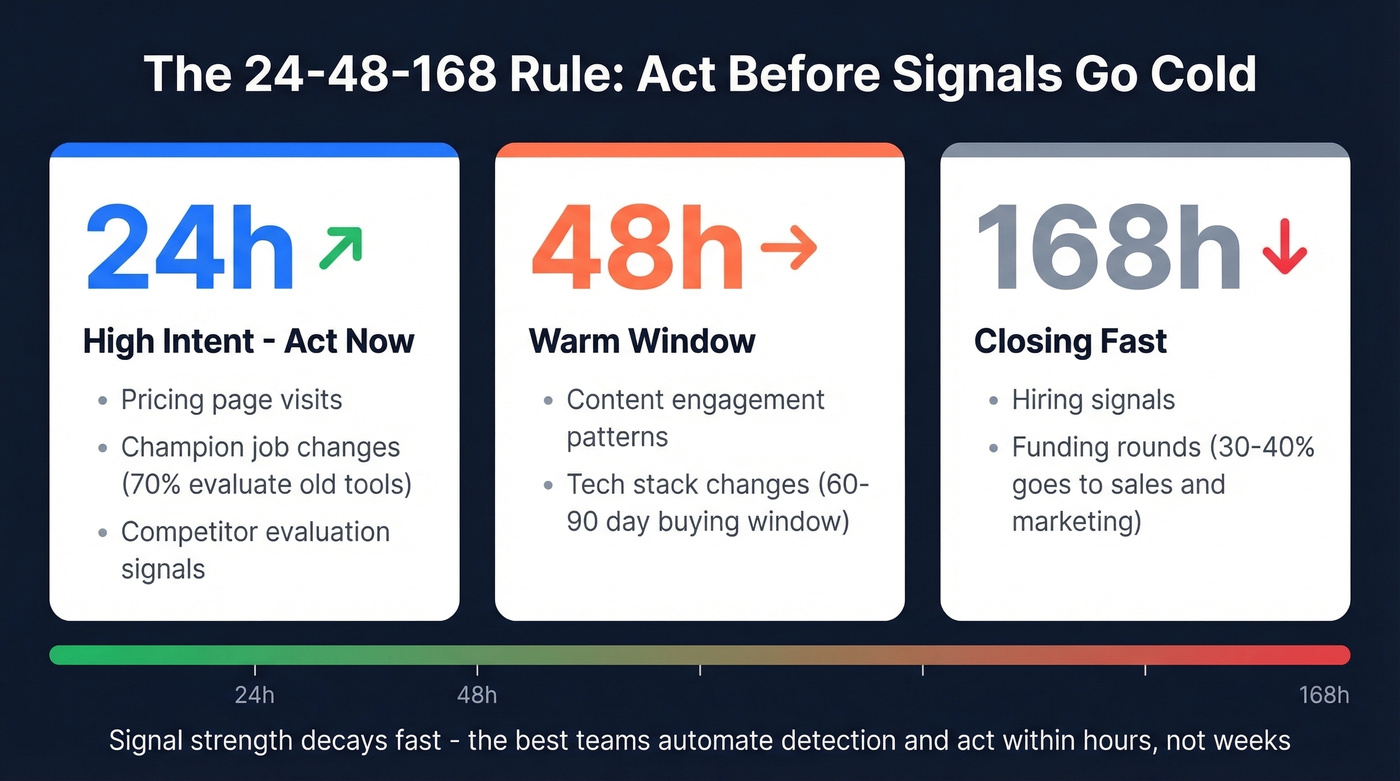
Act within 24 hours. Pricing page visits, champion job changes, competitor evaluation signals. These are high-intent and time-sensitive. 70% of champions who change jobs evaluate their previous tools at the new company. That's a warm conversation, not a cold one. (To operationalize this, use a system for identifying buying signals.)
Act within 48 hours. Content engagement patterns, tech stack changes. A company adopting a tool adjacent to yours creates a 60-90 day buying window. Here's the thing: this is one of the most underused signals in outbound. If a prospect just adopted Segment, they're actively building their data stack and are far more receptive to adjacent solutions than they'll be six months from now. (This fits neatly into intent based segmentation.)
Act within 168 hours. Hiring signals, funding rounds. Post-funding, companies typically allocate 30-40% of new capital to sales and marketing infrastructure. Still strong when acted on promptly, but the window closes fast.
The Salesmotion framework adds a useful lens: personalize at three layers - individual (role, recent activity), company (growth stage, tech stack), and industry (regulatory shifts, market trends). You don't need all three in every email. Pick the strongest signal and lead with it.
2026 Cold Outreach Benchmarks
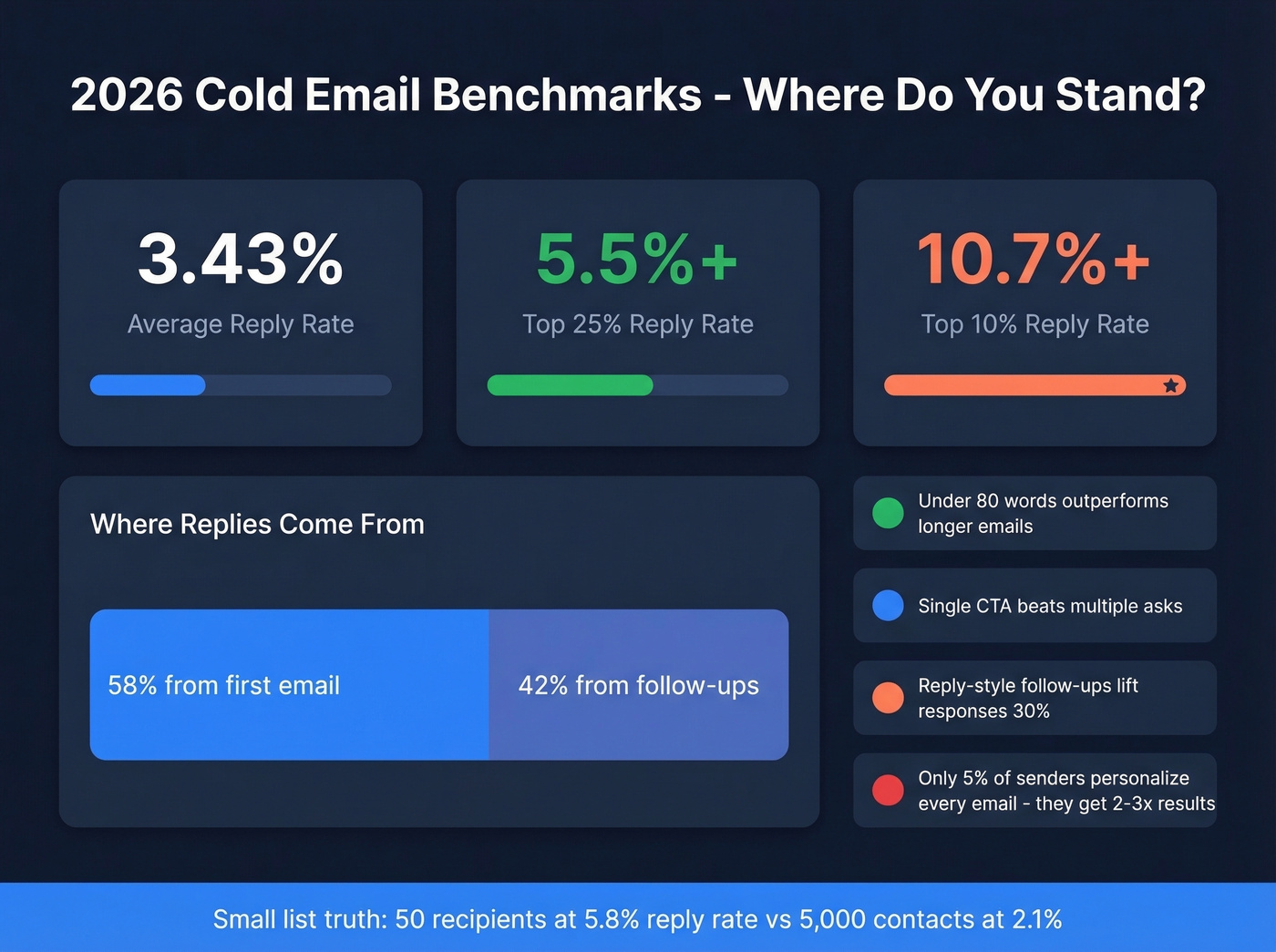
The Instantly 2026 benchmark data gives us a clear picture of what "good" looks like right now:
| Metric | Number |
|---|---|
| Average reply rate | 3.43% |
| Top 25% | 5.5%+ |
| Top 10% | 10.7%+ |
| Replies from 1st email | 58% |
| Replies from follow-ups | 42% |
Emails under 80 words outperform longer ones. A single CTA beats multiple asks. Follow-ups framed as replies - not formal reminders - lift response rates by about 30%. Reaching executives takes roughly 9 touches on average, compared to about 4 for lower-level contacts. (If you need examples, use these sales follow-up templates.)
The personalization gap is stark. Only 5% of senders personalize every email, and they get 2-3x better results. Campaigns targeting 50 or fewer recipients pull 5.8% reply rates versus 2.1% for large blasts.
Let's be honest: if your deal size is under $10k, you probably don't need to scale outreach at all. A tight list of 50 ideal prospects with genuinely researched emails will outperform a 5,000-contact "personalized" blast every single time. Scale is earned, not assumed.
The 3-Tool Stack
If we had to build a stack from scratch tomorrow:
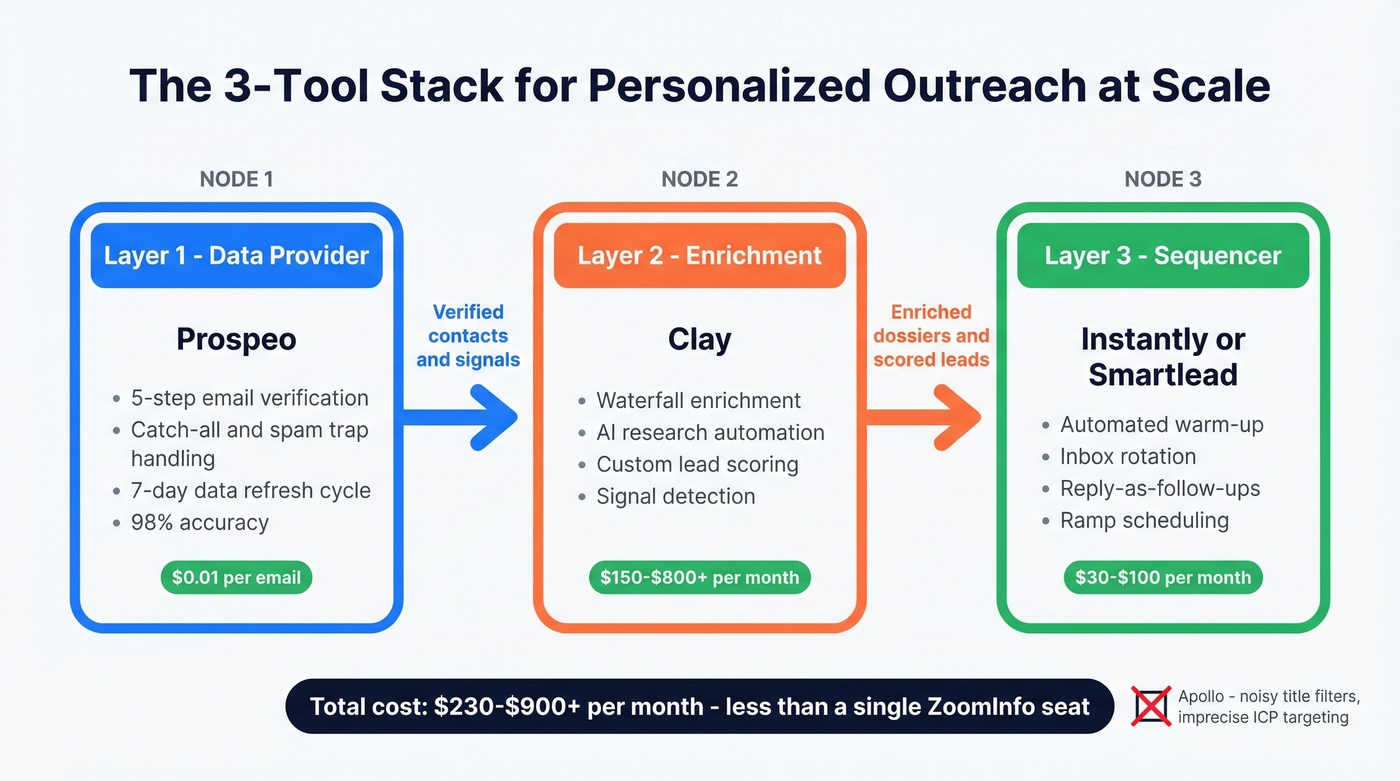
| Layer | Tool | Cost |
|---|---|---|
| Enrichment | Clay | ~$150-$800+/mo |
| Sequencer | Instantly | ~$30-$100/mo |
Clay handles enrichment and research automation - waterfall enrichment, AI-powered research, custom scoring. It's the "dossier builder" that makes the research-writing split possible and is essential for any signal-based workflow at volume. (If you're new to it, start with Clay list building.)
Instantly or Smartlead (~$40-$100/mo) handles sending, warm-up, and inbox rotation. Both are solid. Instantly has a slight edge on UX; Smartlead is better for agencies managing multiple clients. (If you're comparing options, see AI bulk email sender.)
Apollo (~$49-$99/user/mo) tries to be all three layers in one. The consensus on r/agency is that Apollo's title filters are noisy - you'll get irrelevant roles and industries when targeting a tight ICP. For teams that need precision over convenience, the three-tool stack wins. Total cost: typically $230-$900+/month depending on Clay usage, and less than a single ZoomInfo seat.
Personalization Anti-Patterns
Personalization done wrong is worse than no personalization at all. McKinsey's research shows 76% of buyers feel frustrated when it misses the mark, and a PwC study found 71% of buyers would stop doing business with companies that make them feel surveilled.
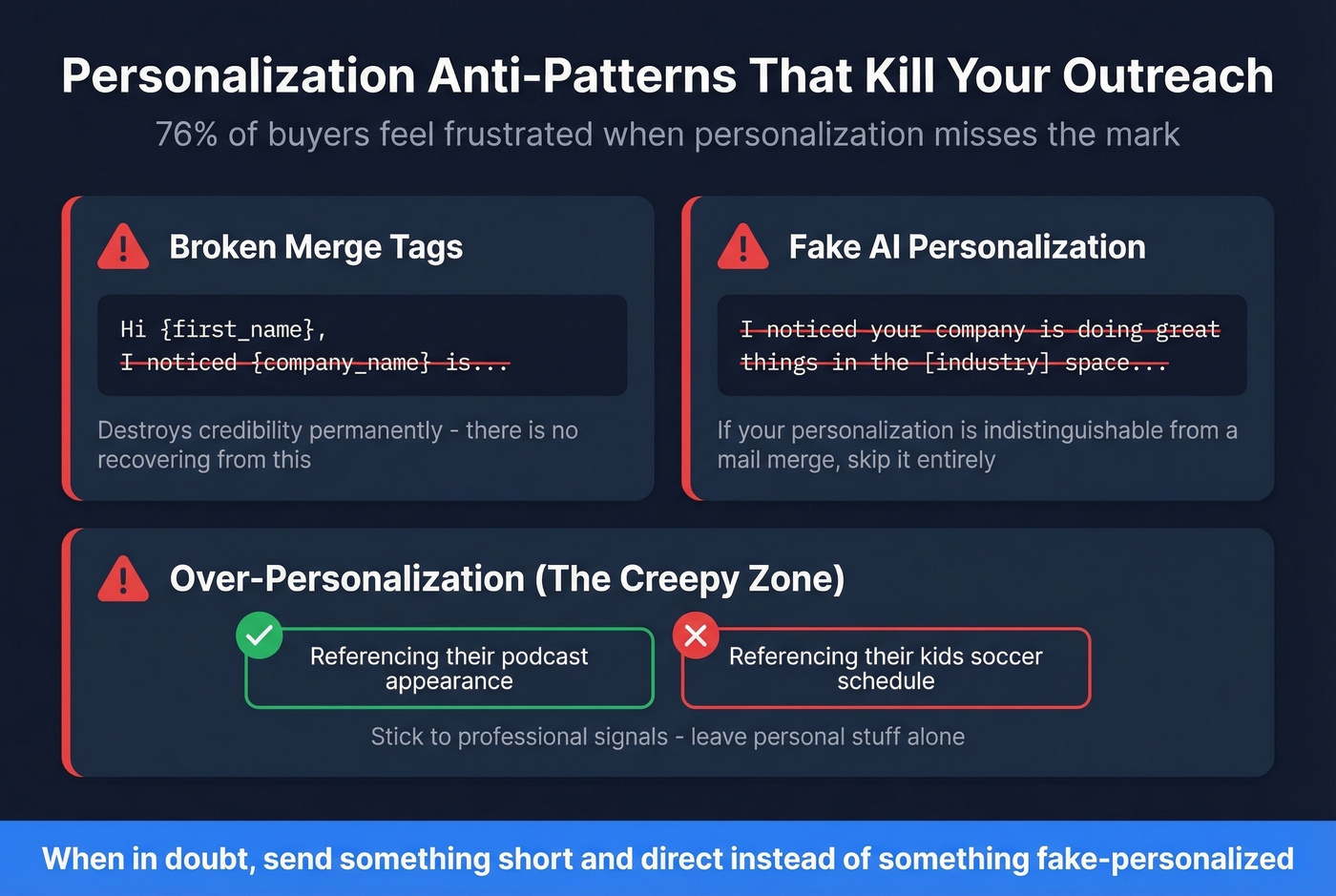
Three patterns to avoid:
Broken merge tags are the single worst offender. "Hi {first_name}" destroys credibility permanently. There's no recovering from that.
"AI-personalized" emails that all open with "I noticed your company is doing great things in the [industry] space" aren't personalized - they're templated with extra steps. We've seen dozens of these land in our own inboxes, and they all read exactly the same. If your "personalization" is indistinguishable from a mail merge, skip it and send something short and direct instead. (For a deeper playbook, see AI cold email outreach.)
Over-personalization that crosses into creepy territory is the third rail. Referencing someone's podcast appearance is smart. Referencing their kid's soccer schedule is not. When in doubt, stick to professional signals and leave the personal stuff alone.
Signal-based outreach only works when you can act fast on job changes, tech stack shifts, and funding rounds. Prospeo tracks 15,000 intent topics and refreshes 300M+ profiles every 7 days - so your signals are still warm when your email lands.
Stop personalizing emails to people who left the company three months ago.
FAQ
How many emails should I personalize per day?
Focus on 20-50 high-quality, signal-based emails rather than 500 generic ones. Campaigns targeting 50 or fewer recipients pull 5.8% reply rates versus 2.1% for large blasts. The math favors depth: 50 emails at 10% reply rate beats 500 at 2%.
Can AI replace human writing in outreach?
AI excels at research automation - scraping context, scoring leads, drafting first-line snippets - but fully AI-written emails pull roughly 2% response rates, no better than generic templates. Use AI to build the dossier. Write the actual email yourself, or heavily edit the AI draft.
What reply rate should I expect in 2026?
The 2026 average cold email reply rate is 3.43%. Top-quartile teams hit 5.5%+, and the top 10% exceed 10.7%. Signal-based campaigns targeting fewer than 50 recipients regularly hit 5-18%, depending on ICP fit and offer relevance.
What's a good free tool to start scaling outreach?
Prospeo offers 75 verified emails per month on its free tier with full verification - enough to test signal-based campaigns on a tight list. Clay has a free plan for basic enrichment, and Instantly starts at ~$30/month for sending. You can run a complete workflow for under $50/month while validating your ICP.