

Pipeline Development Strategy: The Numbers, Formulas, and Playbook You Actually Need
It's end of Q1. Your coverage is 2.1x against a $500K quota. Your reps spend 72% of their time on everything except selling, and someone's telling you to "align your stages to the buyer journey." Meanwhile, win rates are trending downward - the largest cohort now sits at 21-25%, down from 31-40% a year ago.
87% of enterprises missed revenue targets last year. That's not a strategy problem. It's a math problem - and most teams are still running pipeline on gut feel instead of measurable coverage, conversion, and velocity.
What You Need (Quick Version)
- Coverage math - opportunities needed to hit quota, weighted by stage probability, not raw deal count.
- Data quality - bad contacts silently destroy pipeline. If 18% of your emails bounce, your effective pipeline is 18% smaller than your CRM shows. (If you want the deeper deliverability side, start with bounce rates.)
- Early positioning. 92% of buyers start with a vendor in mind, and the average B2B buying cycle runs 10.1 months. First contact doesn't happen until 61% of the way through. You need to be on the shortlist before the evaluation starts.
Pipeline Math That Matters
Coverage by Segment
Quota / Average deal size / Win rate = Opportunities needed.
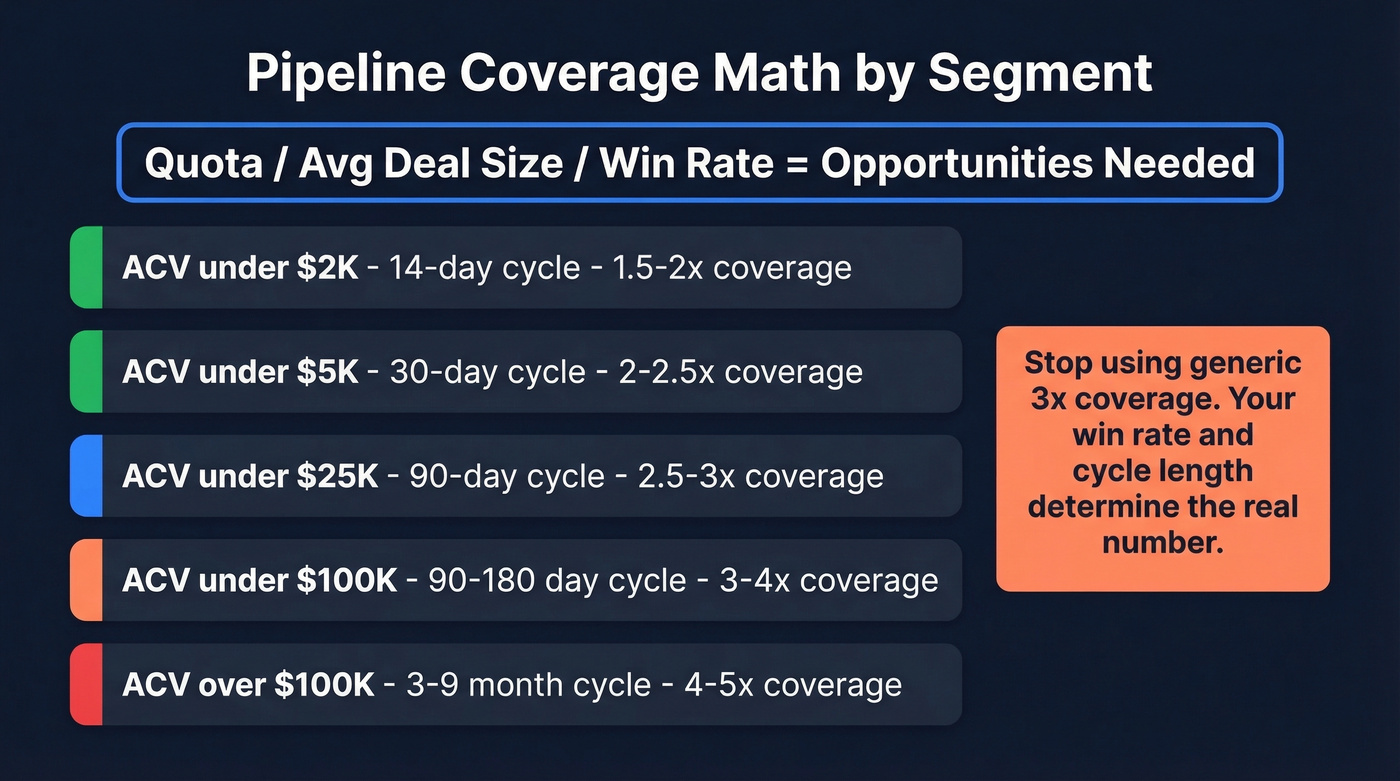
A team targeting $1M with $10K deals and a 20% win rate needs 500 opportunities. Coverage ratio layers on top: how much pipeline relative to your remaining target?
The generic "3x coverage" advice ignores that coverage depends on win rate and cycle length. SMB teams with 45-day cycles and 40%+ win rates operate at 1.5-2x. Enterprise teams running 12-month cycles at 15% win rates need 4-5x. Software Equity's segmentation framework is the best we've seen for this.
Stop forecasting off raw pipeline. Weighted pipeline multiplies each deal by stage probability - Discovery at 10-15%, Demo at 30%, Proposal at 50%, Negotiation at 80%. That weighted number is what you forecast against. Raw pipeline is a vanity metric. (If you're tightening your measurement stack, use a pipeline health scorecard alongside weighted coverage.)
Pipeline Velocity Formula
(Opportunities x Avg deal size x Win rate) / Avg sales cycle in days.
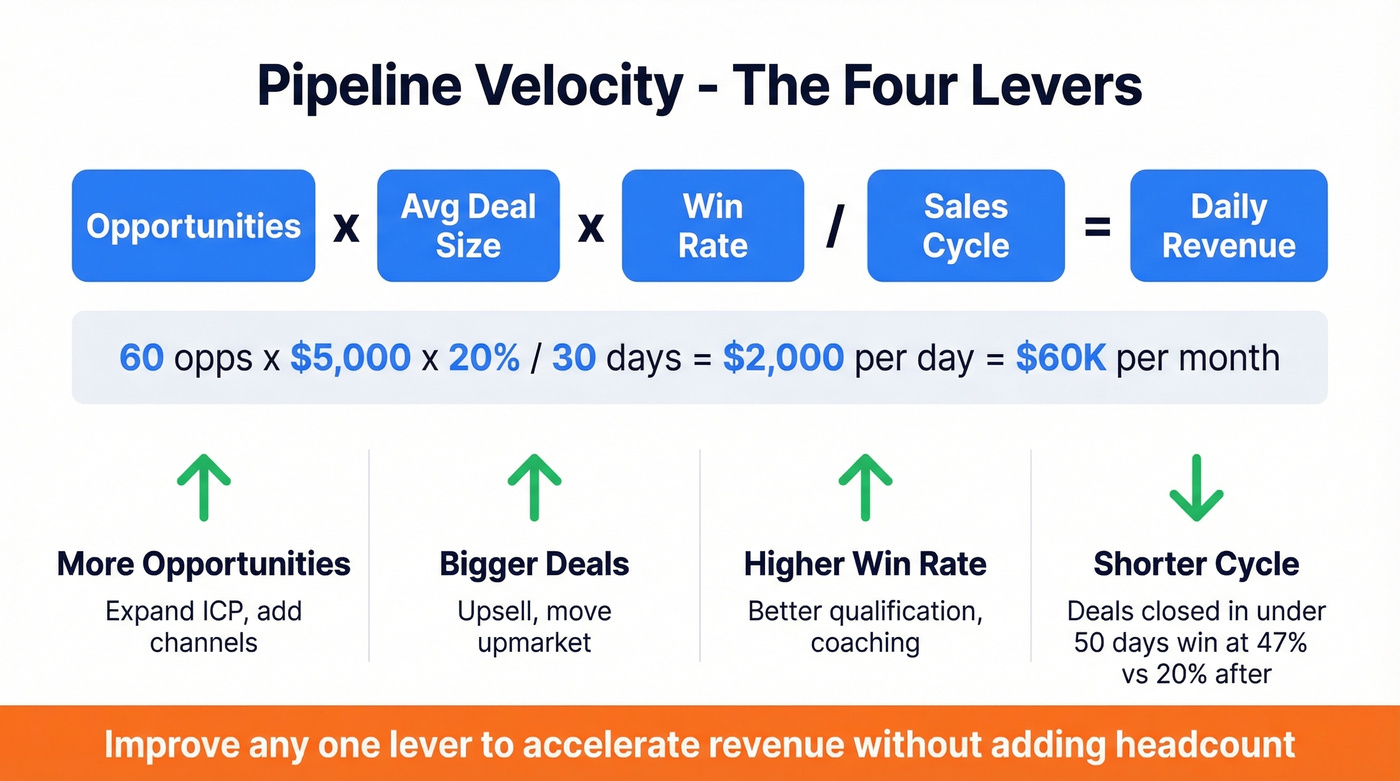
Example: 60 opportunities x $5,000 x 20% / 30 days = $2,000/day, or $60K/month. Opportunities closed within 50 days carry a 47% win rate versus 20% or lower past that threshold. Time kills deals. Your velocity number tells you whether you're winning fast enough.
| ACV Range | Typical Cycle | Target Coverage |
|---|---|---|
| < $2K | 14 days | 1.5-2x |
| < $5K | 30 days | 2-2.5x |
| < $25K | 90 days | 2.5-3x |
| < $100K | 90-180 days | 3-4x |
| > $100K | 3-9 months | 4-5x |
Benchmarks You Can Steal
Funnel Conversions
| Segment | Lead to MQL | MQL to SQL | SQL to Opp | SQL to Closed |
|---|---|---|---|---|
| B2B SaaS | 39% | 38% | 42% | 37% |
| Cybersecurity | 24% | 40% | 43% | 46% |
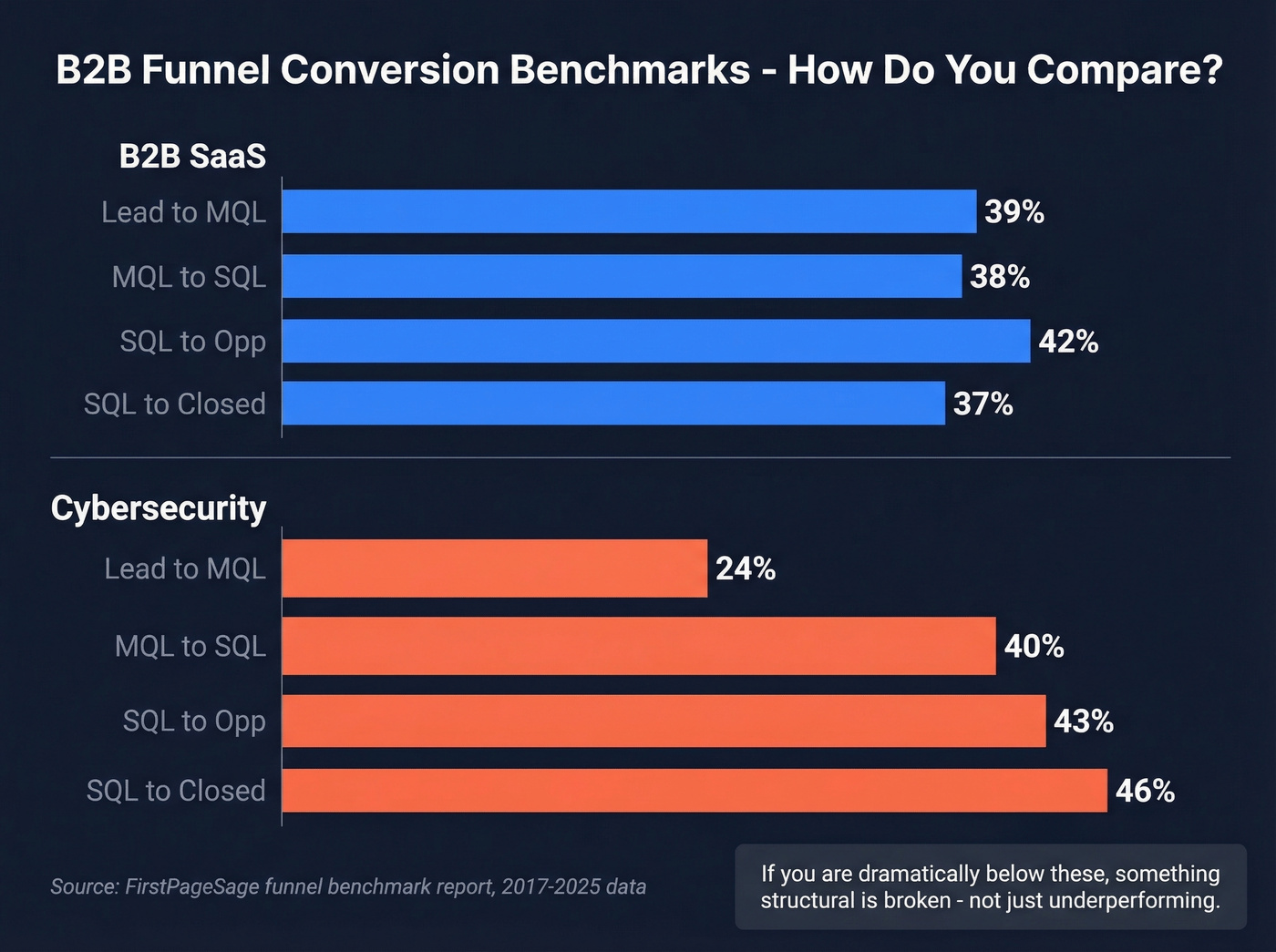
From FirstPageSage's funnel benchmark report, drawn from anonymized client data across 2017-2025. If you're dramatically below these, something structural is broken - not just underperforming. (For a full KPI list, map these to your funnel metrics.)
Outbound Benchmarks
| Channel | Benchmark |
|---|---|
| Cold email reply rate | 1-5% |
| Cold call conversion | 2.3% |
| Multichannel lift vs single-channel | +287% |
| Touches to close | 5+ (44% of reps quit after 1) |
Single-channel strategies underperform badly. Here's a benchmark most teams miss: SDRs should source 40-60% of net-new pipeline. Outbound delivers time-to-value in 30-90 days versus 6-12 months for inbound. If your SDR team isn't pulling that weight, the problem is usually data or sequencing, not effort. (If you're rebuilding outbound from scratch, start with sales prospecting techniques and a tighter sequence management process.)

Your velocity formula has four levers - but none of them work if your contact data decays every 6 weeks. Prospeo refreshes 300M+ profiles every 7 days, so your 500 required opportunities stay at 500. Snyk's 50 AEs cut bounce rates from 35% to under 5% and grew AE-sourced pipeline 180%.
Stop letting data decay silently shrink your pipeline coverage.
What a Real Pipeline Sprint Looks Like
A bootstrapped B2B SaaS team on r/startups grew pipeline by 8x in two weeks. Their deal size was $12K-$15K ARR, and the playbook was tight ICP, 9-15 touchpoints per prospect in Apollo, and a deliberate channel sequence: email first, then social warming through profile views and post engagement, then direct messages with a useful asset, then calls last. (If you need a tighter definition and scoring rubric, use an ideal customer profile template.)
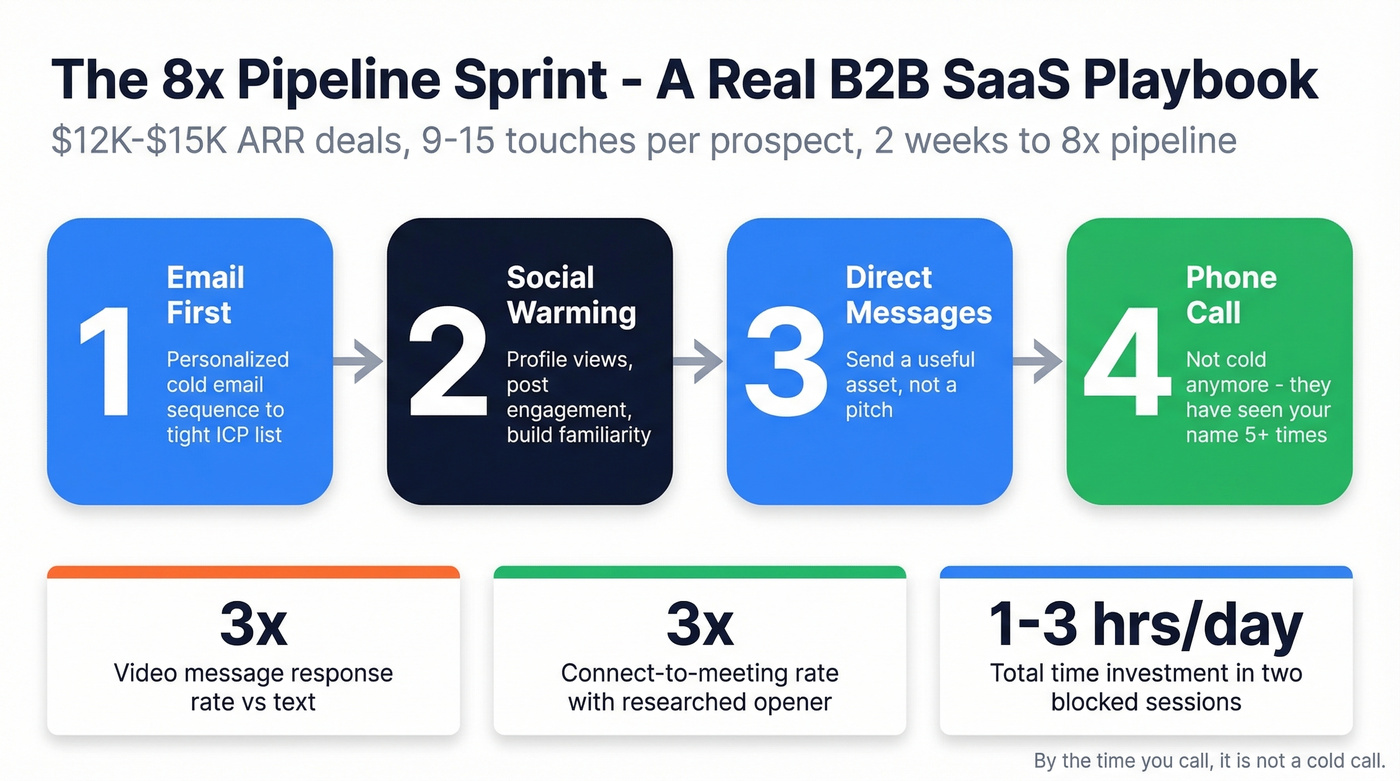
By the time they picked up the phone, it wasn't a cold call. Their opener - "This is a cold call, but it's a well-researched cold call. Can I have 30 seconds?" - tripled connect-to-meeting conversion. Video messages pulled 3x the response rate of text. Total time: 1-3 hours per day in two blocked sessions. (If your team needs better talk tracks, pull from these sample elevator pitches.)
The Data Quality Problem
The consensus on r/sales is that volume tools have "burnt more bridges" over time. Every new outreach tool that promises scale just accelerates channel fatigue when the underlying data is bad.
Here's what fixing the data layer actually looks like. Snyk had 50 AEs prospecting 4-6 hours per week with bounce rates at 35-40%. After switching to Prospeo, bounces dropped under 5%, AE-sourced pipeline jumped 180%, and they generated 200+ new opportunities per month.
We've seen bounce rates above 15% silently destroy forecast accuracy across dozens of teams we've worked with. When your data refreshes every 7 days instead of the 6-week industry average, your 500 required opportunities stay at 500 - not 410 after bounces eat your pipeline. (If you're evaluating vendors, compare data enrichment services and your lead enrichment workflow.)
Let's be honest: most teams don't have a pipeline generation problem. They have a data decay problem disguised as a pipeline generation problem. Fix the data layer first, and half your "pipeline strategy" fixes itself.

SDRs should source 40-60% of net-new pipeline, but bad data turns multichannel sequences into domain-burning exercises. At $0.01/email with 98% accuracy, Prospeo gives your outbound team verified contacts that actually connect - not bounce.
Get the 287% multichannel lift without the bounce rate tax.
Building Your Operating System
The formulas above are useless without operating rhythm. A pipeline development strategy lives or dies by how consistently you execute week over week - not by how elegant the spreadsheet looks. (If you're formalizing RevOps ownership, this RevOps manager breakdown helps.)
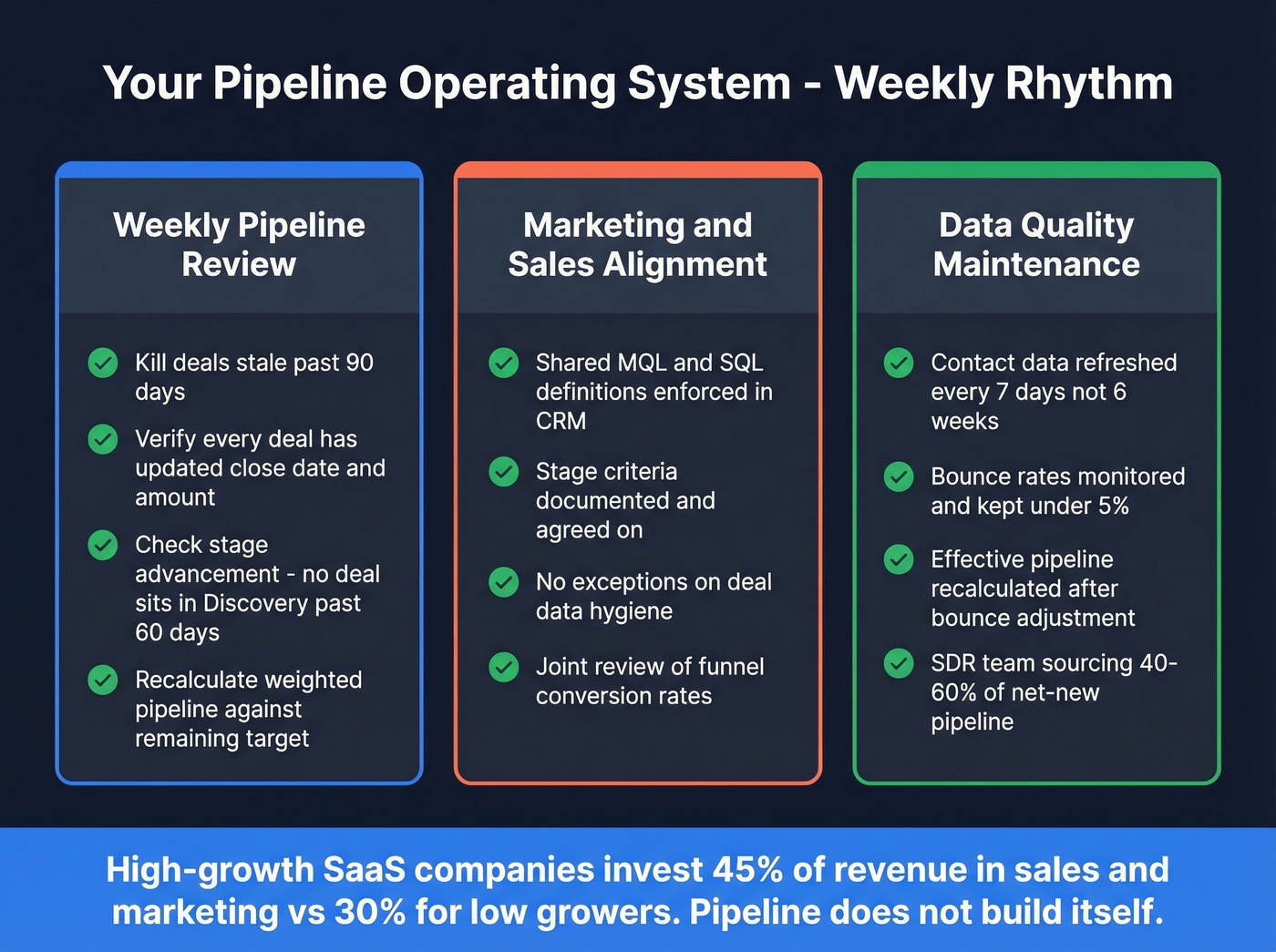
Run weekly pipeline reviews, not monthly. Deals age fast. We set a hard 90-day threshold and kill anything that hasn't advanced a stage, because stale pipeline is worse than no pipeline - it distorts your forecast and inflates your coverage ratio. If your velocity math says you need a 30-day cycle and a deal has been sitting in Discovery for 60 days, it's dead. Accept it and move on.
Marketing and sales need shared definitions. If marketing counts an MQL differently than sales counts an SQL, your funnel math is fiction. Align on stage criteria and enforce them in your CRM - every deal needs an updated close date, amount, and stage with no exceptions. Skip this step if you want dashboards that look great and forecasts that mean nothing. (If you're cleaning up process, use a sales process optimization checklist.)
High-growth SaaS companies invest ~45% of revenue in sales and marketing versus 30% for low growers. Pipeline doesn't build itself. Get the math right, keep the data clean, and run the rhythm. That's the entire strategy.
FAQ
What's a good pipeline coverage ratio?
SMB teams with 40%+ win rates operate fine at 1.5-2x coverage. Enterprise teams closing at 15% need 4-5x. Calculate from your actual historical win rate and cycle length - the generic "3x" rule ignores both variables and leads to either over-investment or missed targets.
How do you calculate pipeline velocity?
Multiply opportunities x average deal size x win rate, then divide by average sales cycle in days. For example, 60 opps x $5K x 20% / 30 days = $2,000/day. Improve any of the four levers to accelerate revenue without adding headcount.
What's the difference between raw and weighted pipeline?
Raw pipeline counts every deal at face value. Weighted pipeline multiplies each deal by its stage probability - Discovery at 10-15%, Proposal at 50%, Negotiation at 80%. Always forecast against weighted numbers. Raw totals inflate confidence and hide risk.
What free tools help with pipeline data quality?
Prospeo offers 75 free verified emails per month plus 100 Chrome extension credits - enough to test data quality impact on a real campaign. Hunter gives 25 free searches monthly but caps enrichment. For teams under 500 prospects per month, a free tier is enough to prove whether bad data is killing your pipeline.