

Power Words for Sales That Actually Close Deals (2026)
You're still getting ghosted after "just following up on my last email" for the 400th time. Meanwhile, the rep sitting next to you books three meetings before lunch using almost the same pitch - just different words. That gap isn't talent. It's language.
Most power word lists are recycled fluff - "synergy," "unlock," "game-changer" - with zero evidence they move a deal forward. As one r/sales poster put it: "Have conversations, not presentations." The words that actually close deals aren't the ones that sound impressive. They're the ones identified across 519,000+ recorded B2B sales calls, the ones Belkins tracked across 5.5 million cold emails, and the ones backed by decades of behavioral science.
If You Only Change Three Things This Week
- Use the prospect's name more. Data from 519K+ calls shows a 14% higher close rate when reps say the prospect's name roughly four times per hour.
- Add risk-reversal language to every proposal. Phrases like "30-day no-obligation trial" lift win rates by 32%.
- Kill "just checking in" permanently. Replace every empty follow-up with a value-led message - a case study, a relevant insight, a specific question. (If you need options, start with these follow-up templates.)
The Psychology Behind Persuasive Sales Words
A restaurant server gives diners one mint. Tips go up 3%. Two mints: 14%. But when the server gives one mint, walks away, then comes back and says "for you nice people, here's an extra mint," tips jump 23%. Same product. Different words. That's reciprocity and personalization working together - two of Robert Cialdini's seven principles of persuasion.
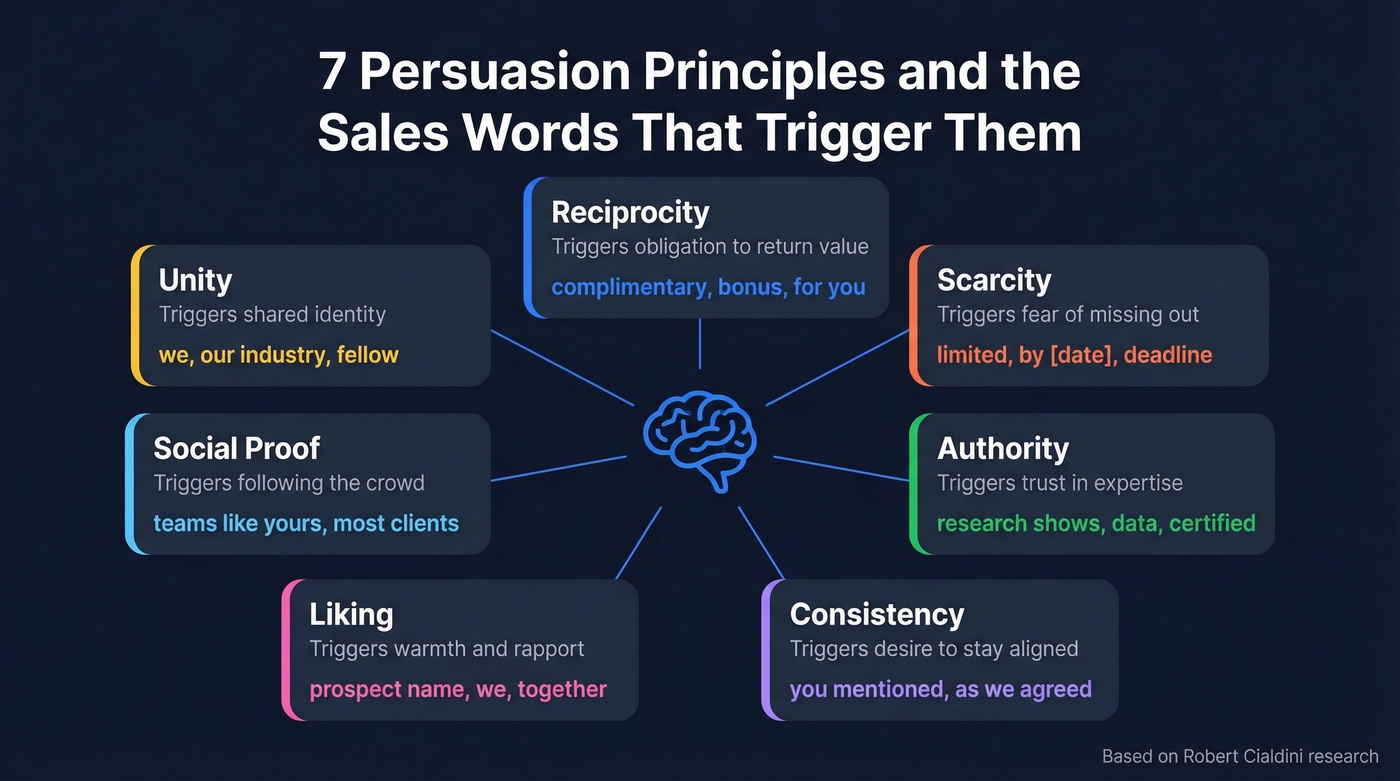
Ellen Langer's 1977 copy-machine study proved this at an even more fundamental level. Adding "because" to a request - even with a meaningless reason like "because I need to make copies" - increased compliance from 60% to 93%. The word itself does the heavy lifting. Single words trigger automatic psychological responses before the rational brain catches up, and that's exactly why they matter in sales conversations.
Authority language follows the same pattern. In one real estate study, having reception staff introduce an agent's credentials before the call increased appointments by 20% and signed contracts by 15%. The agent didn't change a word of their pitch. Someone else just framed their expertise first. Chris Voss calls this kind of deliberate language choice "tactical empathy," and it starts with understanding which words activate which responses. (This is also the core of sales communication: what you say, when you say it, and why it lands.)
Each principle maps to specific sales language:
| Principle | What It Triggers | Sales Words |
|---|---|---|
| Reciprocity | Obligation to return value | "complimentary," "bonus," "for you" |
| Scarcity | Fear of missing out | "limited," "by [date]," "deadline" |
| Authority | Trust in expertise | "research shows," "data," "certified" |
| Consistency | Desire to stay aligned | "you mentioned," "as we agreed" |
| Liking | Warmth and rapport | Prospect's name, "we," "together" |
| Social Proof | Following the crowd | "teams like yours," "most clients" |
| Unity | Shared identity | "we," "our industry," "fellow" |
What 519K+ Calls Reveal About Words That Sell
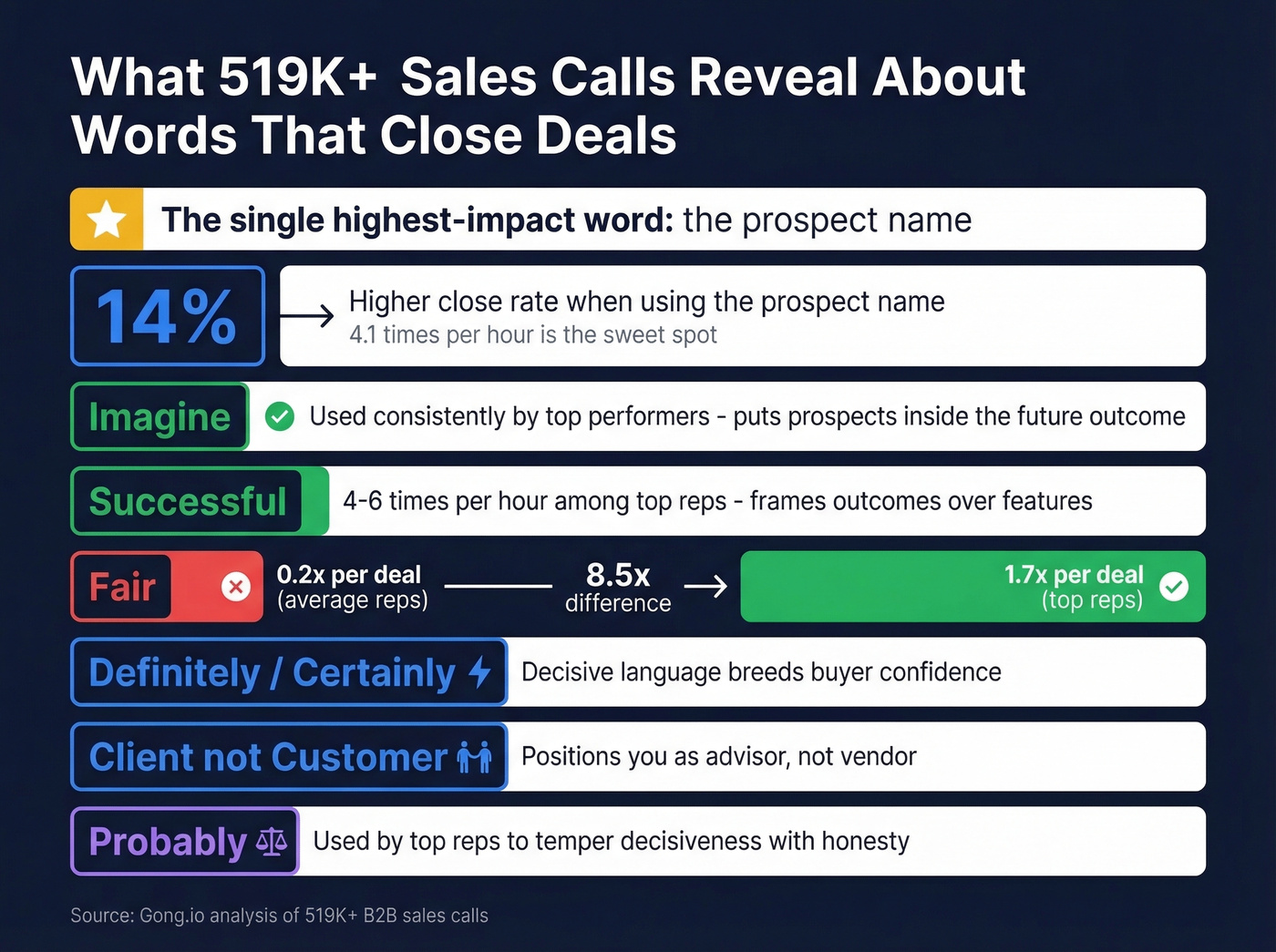
The 519,000+ B2B call analysis is one of the largest published datasets on which words correlate with closed deals. Here's what it actually says:
| Word/Phrase | What the Data Shows | Why It Works |
|---|---|---|
| Prospect's name | 14% higher close rate; 4.1x/hr usage | People pay attention when they hear their own name |
| "Imagine" | Used consistently by top performers | Puts the prospect inside the future outcome |
| "Successful" | Top reps use it 4-6x/hr | Frames outcomes instead of features |
| "Fair" | 1.7x/deal (top reps) vs 0.2x (others) | Signals equity and builds trust |
| "Definitely" / "Certainly" | Correlated with higher close rates | Decisive language breeds buyer confidence |
| "Client" (not "customer") | Preferred by top performers | Positions you as advisor, not vendor |
| "Probably" | Used by top reps as a balancing tool | Tempers decisiveness with honesty |
Quick caveat stated once: correlation isn't causation. Saying "imagine" 47 times on a call won't save a bad product. But the patterns are consistent enough across half a million calls that ignoring them is leaving money on the table.
The "fair" finding is particularly interesting. Most reps never use the word at all - 0.2 times per deal on average. Top performers use it 1.7 times, sparingly but deliberately. "I want to make sure this feels fair to both sides" does more work than any discount ever will. These are the kinds of powerful sales words that don't feel like selling - they feel like partnership.
And the single highest-impact word in the dataset? The prospect's name. Not a fancy persuasion technique. Not a closing trick. Just their name, used naturally, about four times an hour. We've seen reps overthink this - the data says keep it simple. (If you want the bigger picture, map these moments to the steps to close a sale.)

Power words only work when they reach the right inbox. Prospeo's 98% email accuracy and 7-day data refresh mean your carefully crafted cold outreach actually lands - not bounces. At $0.01 per email, bad data is no longer an excuse for bad results.
Stop perfecting emails that bounce. Start sending them to verified contacts.
Choosing the Right Words by Funnel Stage
Different stages demand different language. A word that kills it in discovery can feel pushy in prospecting. (If you need a framework, use an AIDA sales funnel lens to match language to intent.)
Prospecting and Cold Outreach
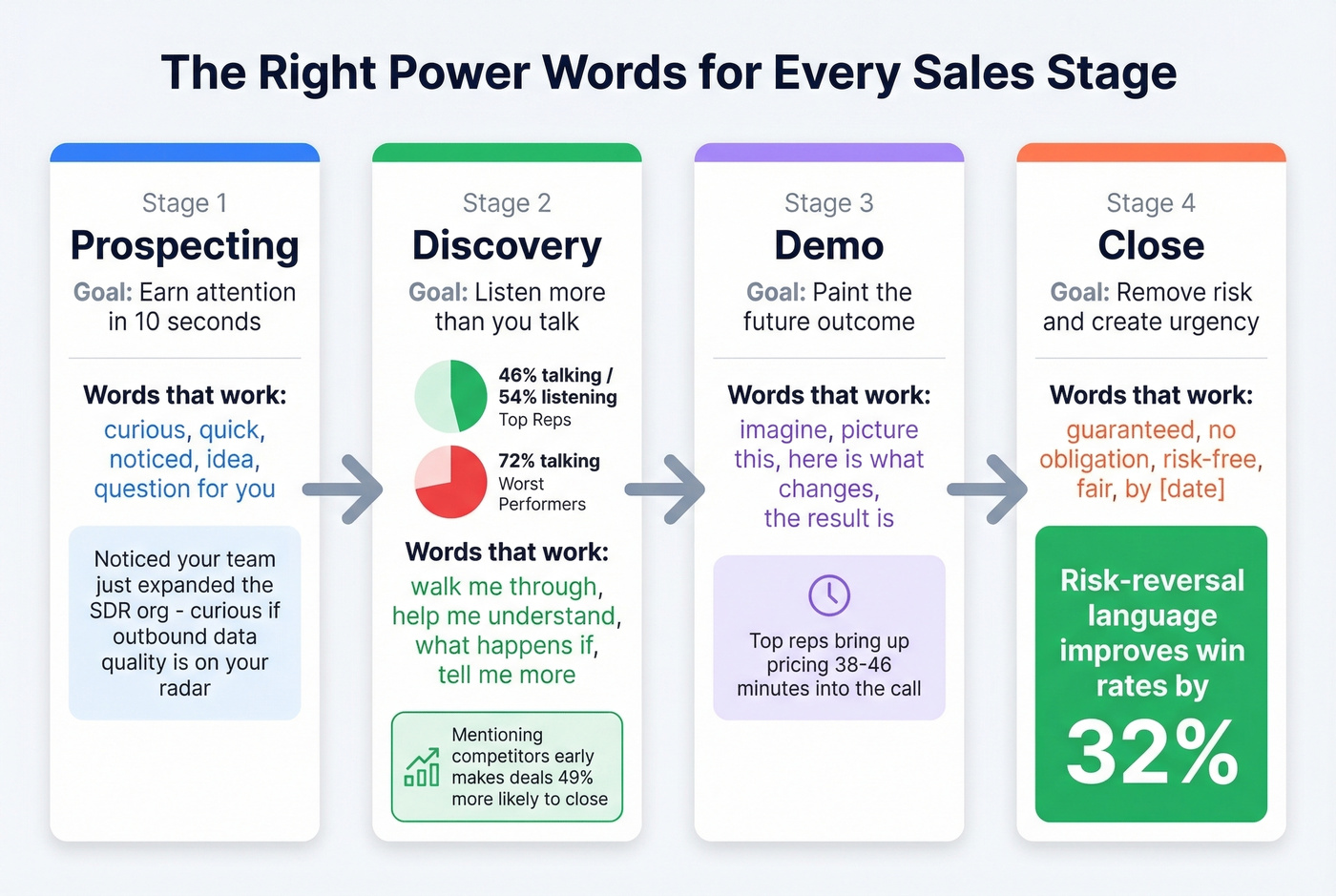
The goal here is attention, not persuasion. You have roughly ten seconds on a cold call, and words that earn curiosity win.
Words that open doors: "curious," "quick," "noticed," "idea," "question for you."
Example: "Noticed your team just expanded the SDR org - curious if outbound data quality is on your radar."
Short, personalized, and specific. Belkins' email data backs the same fundamentals: personalization and brevity beat cleverness. The right sales pitch words at this stage earn attention - they don't demand it. (For more, see sales prospecting techniques.)
Discovery
Here's the thing: the call analysis found that top performers talk only 46% of the time and listen 54%. Average reps? They talk 68%. The worst performers hit 72%. The best power word at this stage is silence.
The phrases that get prospects talking aren't flashy - "walk me through," "help me understand," "what happens if," "tell me more about." And here's a stat most reps miss: bringing up competitors early in discovery makes a deal 49% more likely to close versus never mentioning competition at all. Don't be afraid to say, "How does this compare to what you're seeing from [competitor]?"
Deals with multiple seller-side participants are also 258% more likely to close. Bring your SE to the demo. (If you want a tighter structure, use these discovery questions.)
Demo and Presentation
"Imagine your reps spending two hours less per day on list building and putting that time into actual conversations."
Lead with that. Visualization language dominates this stage - "imagine," "picture this," "here's what changes," "the result is." Persuasive sales pitch words here tend to be outcome-oriented: they help the prospect see the after, not just the before. (Pair this with a product demo checklist so the story lands.)
Top reps bring up pricing 38-46 minutes into the call. Not at the beginning, not at the very end. They let the value land first, then anchor the price to what the prospect just saw.
Words That Close More Deals
Risk-reversal language improves win rates by 32%. That's not a marginal lift - that's a third more deals. This is the single biggest language lever at the close.
Words that close: "guaranteed," "no obligation," "risk-free," "fair," "by [date]," "before," "deadline"
Example: "We can start with a 30-day pilot - no obligation, no long-term commitment. If the results aren't there, you walk away."
Urgency words work here too, but only when tied to real deadlines. "This offer expires Friday" with no actual expiration is manipulation. "Your team mentioned Q3 launch - to hit that, we'd need signatures by the 15th" is honest urgency. The moment a prospect senses dishonesty, persuasive language loses its effect entirely. (If you want to go deeper on pricing language, study the anchor in negotiation.)
Power Words for Sales Emails
Belkins analyzed 5.5 million cold emails and the findings are clear: personalization and brevity beat cleverness every time.
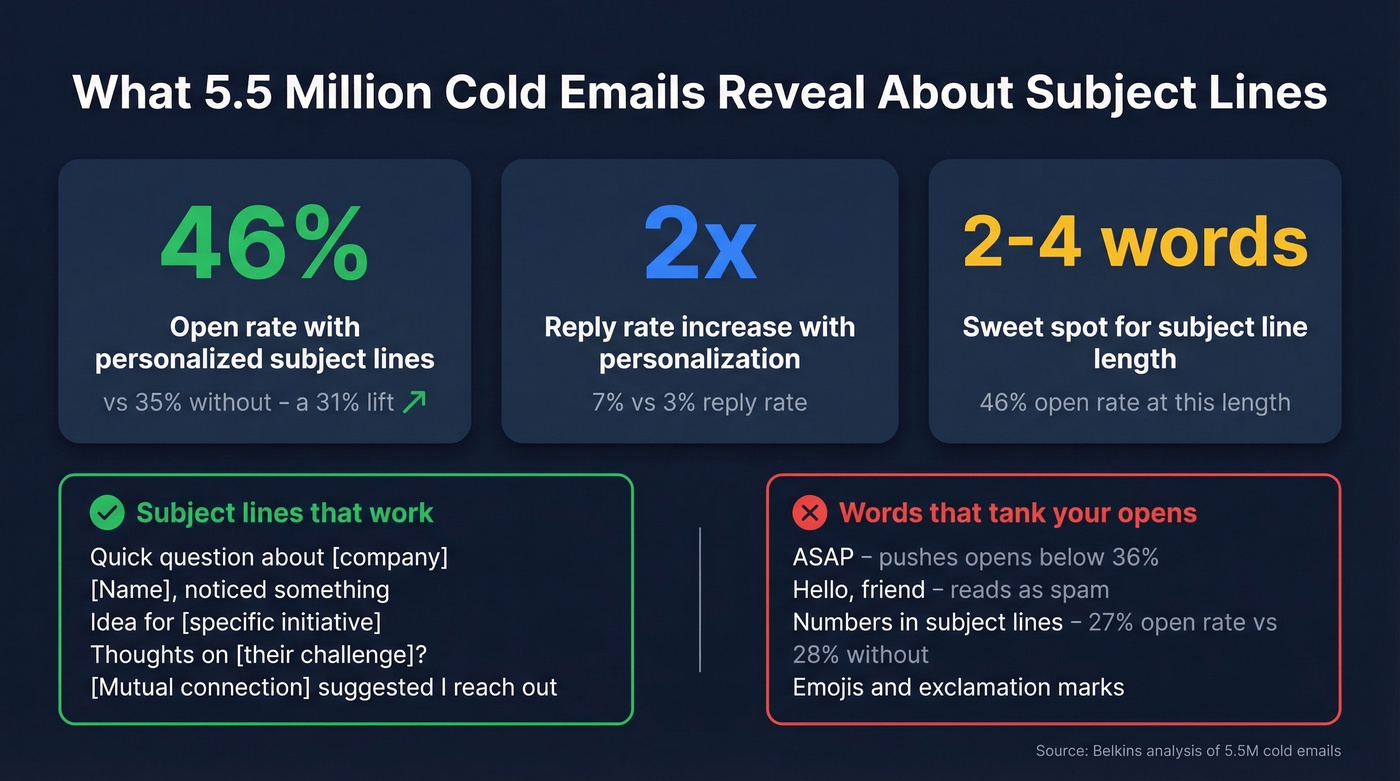
Personalized subject lines hit 46% open rates versus 35% without - a 31% lift. Reply rates jumped from 3% to 7%, more than doubling. Questions as subject lines averaged 46% opens. The sweet spot for length: two to four words, also at 46%.
Subject lines that work:
- "Quick question about [company]"
- "[Name], noticed something"
- "Idea for [specific initiative]"
- "Thoughts on [their challenge]?"
- "[Mutual connection] suggested I reach out"
Words that tank your opens:
"ASAP," "Hello, friend," and anything that reads like marketing hype push open rates below 36%. And despite what you've heard, numbers in subject lines don't help - 27% open rate with numbers versus 28% without. Skip the "5 ways to..." format for cold outreach.
The 2026 sales insights roundup backs this up with the concept of "camouflaged" subject lines - short, lowercase, priority-based language that looks like an internal email. Think "new sales trainer hire" rather than a subject line stuffed with emojis and exclamation marks. (If you want more swipeable options, pull from these email subject line examples.)
Of course, the best subject line in the world bounces if the email address is bad. Before testing your new copy, verify your list. Prospeo checks addresses in real time with 98% accuracy, and you only pay for valid results. No point optimizing language if half your emails never land. (If you're troubleshooting, start with email bounce rate benchmarks and fixes.)
Sales Pitch Words to Avoid
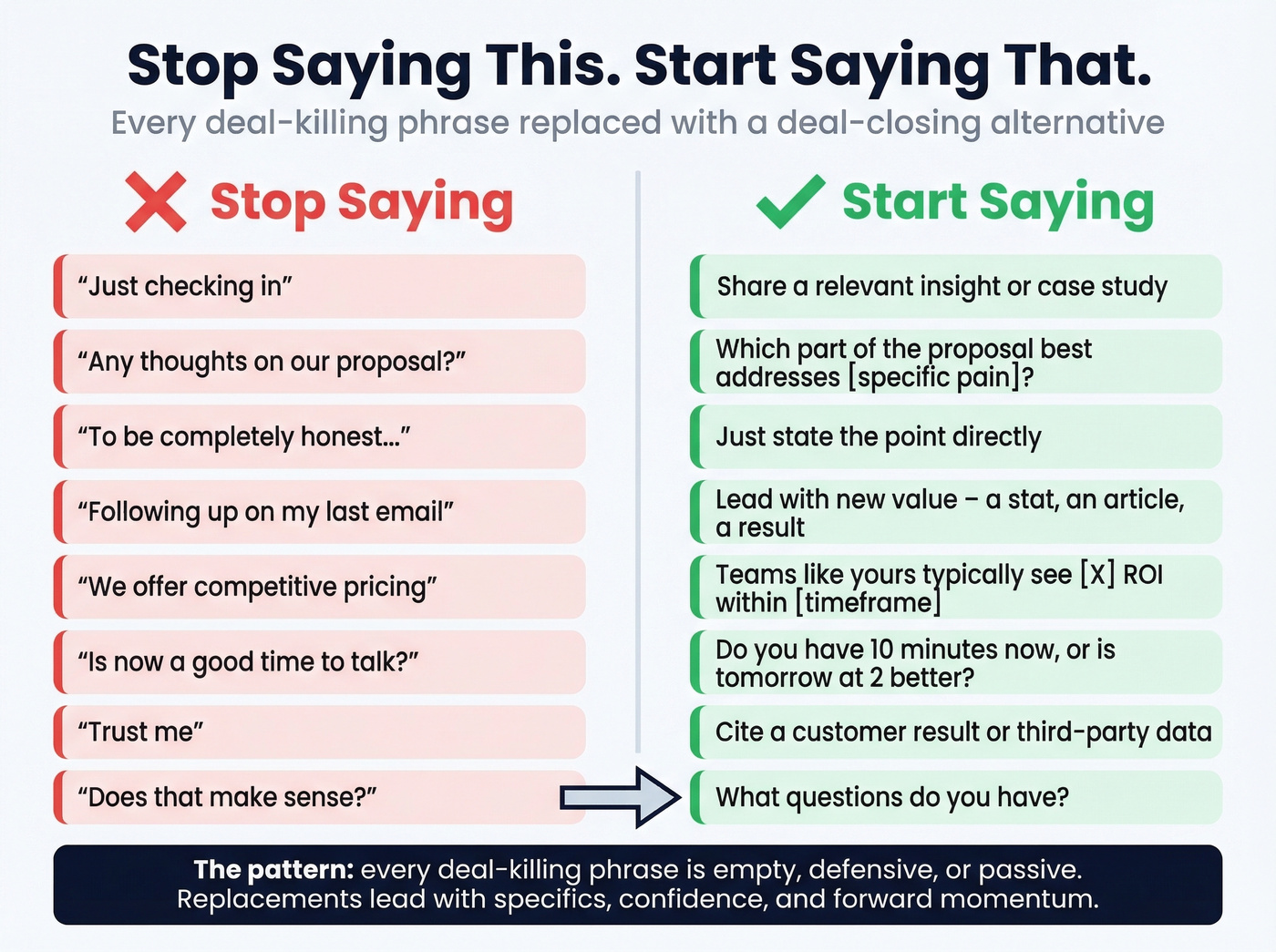
Knowing what to say matters. Knowing what to stop saying matters more.
| Instead of This | Say This |
|---|---|
| "Just checking in" | Share a relevant insight or case study |
| "Any thoughts on our proposal?" | "Which part of the proposal best addresses [specific pain]?" |
| "To be completely honest..." | Just state the point directly |
| "Following up on my last email" | Lead with new value - a stat, an article, a result |
| "We offer competitive pricing" | "Teams like yours typically see [X] ROI within [timeframe]" |
| "Is now a good time to talk?" | "Do you have 10 minutes now, or is tomorrow at 2 better?" |
| "Touching base" | State the specific reason you're calling |
| "Trust me" | Cite a customer result or third-party data |
| "We're the best in the space" | "[Company name] cut their [metric] by 40% in 90 days" |
| "Does that make sense?" | "What questions do you have?" |
The pattern is obvious: every deal-killing phrase is either empty, defensive, or passive. The replacements lead with specifics, confidence, and forward momentum.
We've watched reps transform their connect rates just by eliminating "just checking in" from their vocabulary. It tells the prospect exactly one thing: you have nothing new to offer. The right words carry real information; filler phrases signal you have none. (If you need alternatives, see how to say just checking in professionally.)
How to Test Your Sales Language
Let's be honest: most sales teams obsess over scripts and ignore measurement. If you're running deals under $15K, you probably don't need conversation intelligence software. You need a spreadsheet, 60 calls, and one variable change.
For calls: Make 30 calls with your current script. Track appointments booked. Then make 30 calls with one specific language change - swap "checking in" for a value-led opener, or add the prospect's name three more times per call. Compare the results. That's it.
For emails: A/B test subject lines in batches of 100+. Change only the subject line, keep the body identical. Measure opens and replies separately - a great open rate with zero replies means your subject line overpromised. Build a clean test list with verified contacts so your results reflect language performance, not data quality, because high bounce rates will contaminate any A/B test you run. (If you're building the system end-to-end, start with email copywriting.)
For measurement at scale: Conversation intelligence tools can track word usage across your entire team automatically. Sellers who frequently use AI-powered coaching tools generate 77% more revenue than those who don't - and a big part of that is measuring what language actually works. Skip this if your team is under five reps, though. The ROI on conversation intelligence doesn't kick in until you have enough call volume to spot real patterns.
The data says personalization lifts close rates by 14%. But personalization requires knowing who you're reaching and having accurate contact data. Prospeo gives you 300M+ profiles with 30+ filters - buyer intent, job changes, tech stack - so every power word you use hits someone who actually fits your ICP.
Find the right prospects first. Then use the right words to close them.
FAQ
What are the most effective power words for cold calls?
The prospect's name tops the list - it correlates with a 14% higher close rate across 519K+ calls. "Imagine" and decisive words like "definitely" and "certainly" also rank high. But top performers talk only 46% of the time, so a well-timed pause often outperforms any single word.
What are the best persuasive words for sales emails?
Personalization and brevity matter more than any individual word. Across 5.5M emails, personalized subject lines hit 46% open rates versus 35% without. Keep subject lines to two to four words, use questions, and avoid hype terms like "ASAP" that push opens below 36%.
How do I make sure my sales emails actually reach prospects?
Even the best subject line fails if the email bounces. Use a verification tool like Prospeo to clean your list before sending - the free tier gives you 75 lookups per month with 98% accuracy, enough to validate your highest-priority prospects before any campaign.
Which words help close more deals in negotiations?
Risk-reversal phrases like "guaranteed," "no obligation," and "risk-free" improve win rates by 32%. Pair those with honest urgency tied to real deadlines, and use "fair" deliberately - top reps average 1.7 uses per deal versus 0.2 for average performers. Sparingly and strategically, not as a crutch.