

How to Write a Product Introduction Email That Actually Gets Opened
You hit send on your big product announcement. Open rate comes back in the single digits. Not because the copy was bad - because a big chunk of your list was dead data and the email never reached an inbox. That's the story nobody tells in the "12 best product introduction email examples" posts.
You don't need 12 examples. You need two solid templates, a proven sequence, and a clean list. Let's build all three.
What You Need (Quick Version)
- Two types matter most: launch announcements (to subscribers) and cold product introductions (to prospects). Other types exist - referral intros, event follow-ups, re-engagement - but these two cover most use cases. Know which you're writing before you open a blank draft.
- Keep it under 150 words. Lead with the recipient's problem, not your feature list.
- Use a multi-email sequence of 5-7 emails, not a single blast. One email is a coin flip. A sequence is a system. (If you need follow-up copy, steal from these follow-up templates.)
- Verify your list before sending. A bounce rate above 2.5% tanks your deliverability and sender reputation before your copy even matters. (More on benchmarks in our email bounce rate guide.)
Anatomy of an Effective Intro Email
Every effective product introduction email has four parts, and they need to appear in this order.
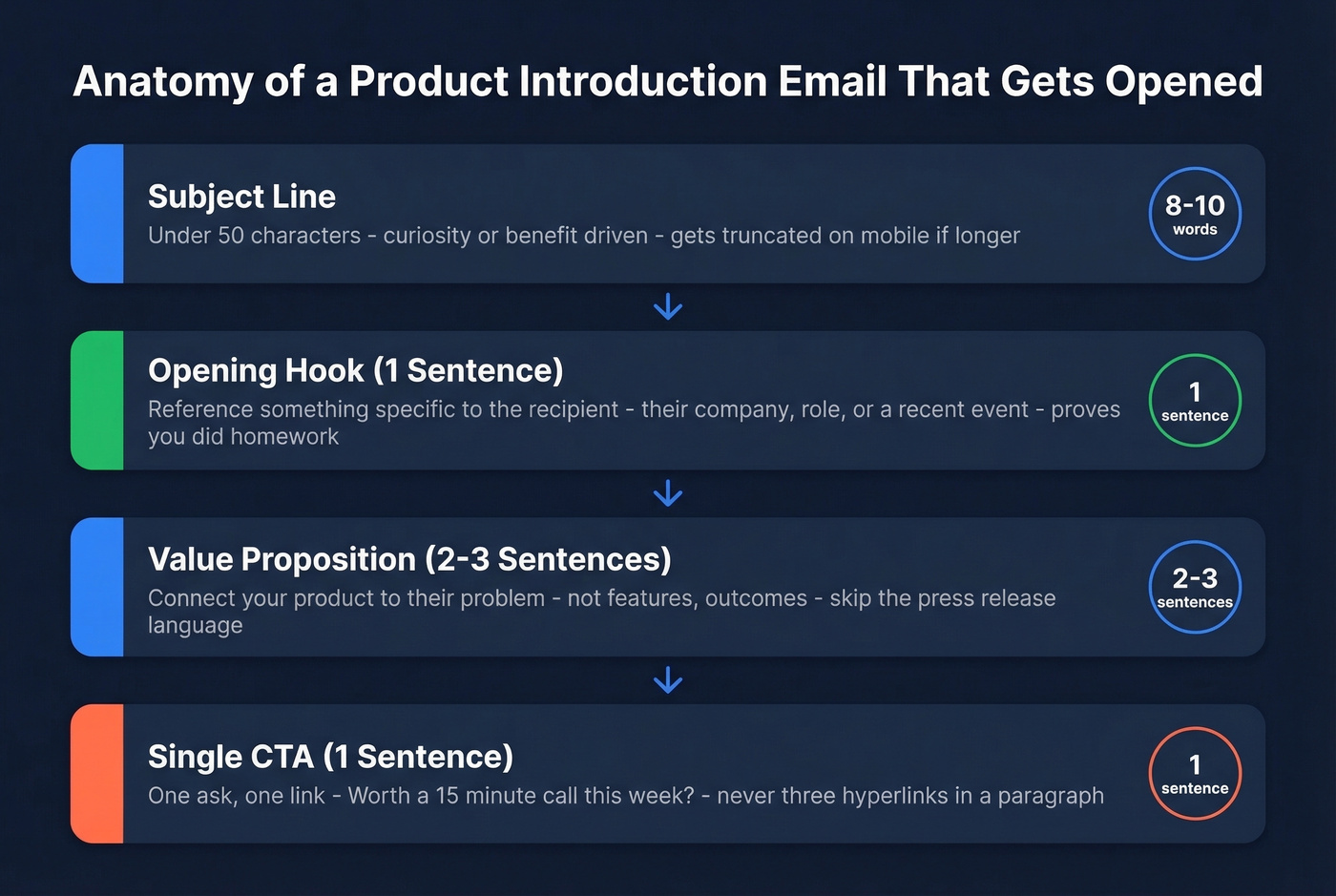
Subject line: Under 50 characters. Curiosity or benefit-driven - "Helping [Company] reduce [pain point]" or "Quick question about [specific challenge]." Anything longer gets truncated on mobile.
Opening hook (1 sentence). Reference something specific to the recipient - their company, their role, a recent event. This isn't about you yet. It's about proving you did a minute of homework. (If you want a deeper framework, see our guide to email copywriting.)
Value proposition (2-3 sentences). Connect your product to their problem. Not "we built an AI-powered platform" but "your team is probably spending 4 hours a week on X - we cut that to 20 minutes." The practitioners on r/emailmarketingnow are blunt: emails that read like press releases get deleted.
Single CTA (1 sentence). One ask. Not "check out our website, follow us on Twitter, and book a demo." One link, one action. "Worth a 15-minute call this week?" works. A paragraph with three hyperlinks doesn't. (More examples in our email call to action breakdown.)
Two Templates You Can Steal
Whether you're writing a launch announcement to warm subscribers or a cold email introducing your company and product to prospects, these two templates cover the core use cases. If you want more variations, start with these company introduction email examples.
Cold Product Introduction
Need a sample email to introduce your company and product to someone who's never heard of you? Start here. (For a full sequence, use this B2B cold email sequence playbook.)
Subject: Cutting [pain point] at {{Company}}
Hi {{First Name}},
Noticed {{Company}} is scaling its {{department}} team - congrats. [This proves you did research. It's the hook that earns the next sentence.] Most teams at your stage hit a wall with {{specific problem}}, and it usually costs 10-15 hours a week in manual work.
We built [Product] to fix that. {{One-sentence description of what it does}}. [Customer name] cut their {{metric}} by {{result}} in the first month. [Social proof with a specific number - vague claims like "great results" get ignored.]
Worth a quick call Thursday or Friday?
Best, [Your name]
~95 words. One link. One ask.
Launch Announcement
Figma's beta launch email nailed this format: it led with the problem ("design handoffs are broken") before mentioning a single feature. Here's the structure, which doubles as a strong template for SaaS teams:
Subject: [Product] is live - here's what it does for you
Hi {{First Name}},
We've been working on something for the past six months, and it's finally ready.
[Product] helps you {{primary benefit}} without {{primary pain point}}. Here's what's different:
- {{Benefit 1 - tied to a specific outcome}}
- {{Benefit 2 - tied to a specific outcome}}
- {{Benefit 3 - tied to a specific outcome}}
Three bullets max. Each tied to an outcome, not a feature spec.
Early access pricing is available through {{date}}. After that, it goes to full price.
[CTA button: See it in action →]
Thanks for being part of this, [Your name]
~110 words. One CTA. Urgency built into the deadline.
The 5-Day Launch Sequence
A single email is a gamble. A sequence is a strategy. One practitioner on r/copywriting documented $15,162 in revenue from a 7-email, 5-day launch sequence. The author attributed results to three factors: offer quality, list quality, and consistent mailing - not just copy.
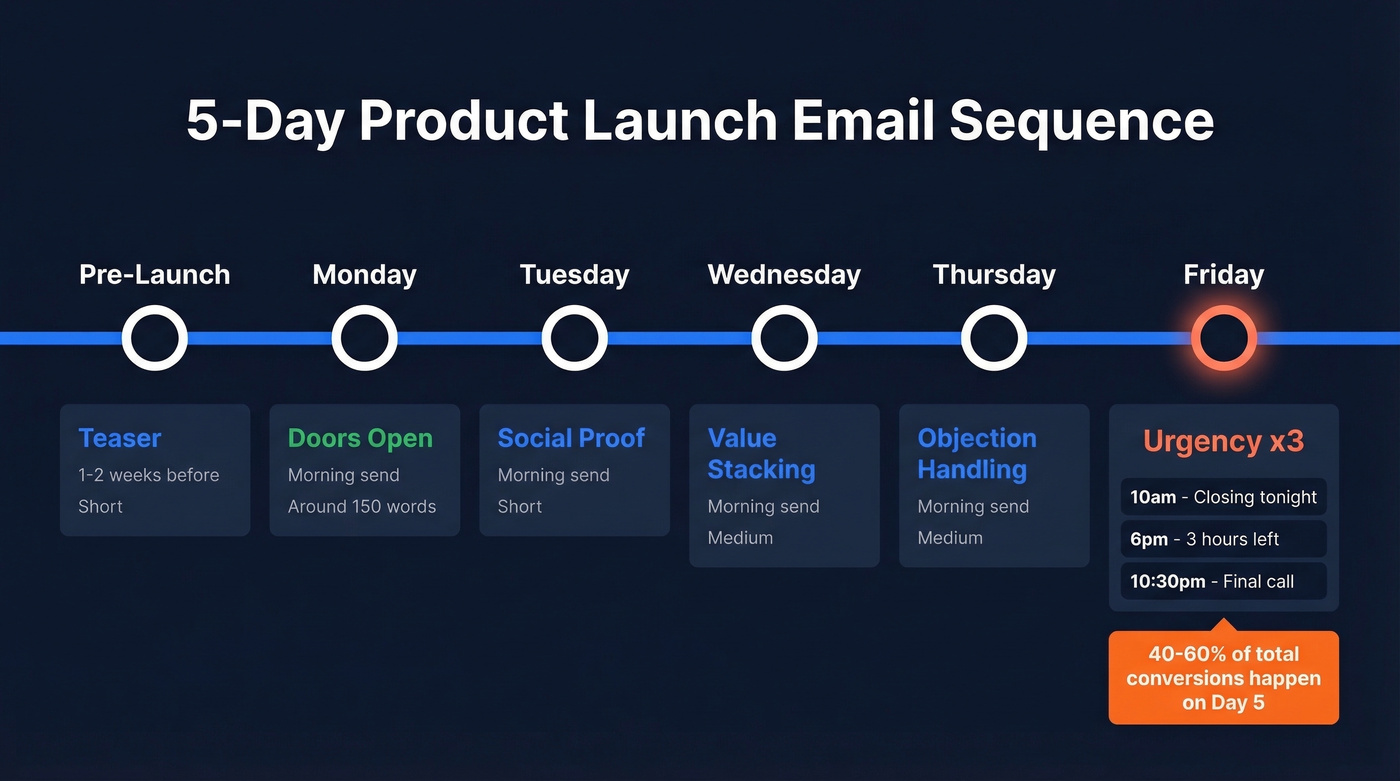
| Day | Email Role | Timing | Length |
|---|---|---|---|
| Pre-launch | Teaser | 1-2 weeks prior | Short |
| Mon (Day 1) | Doors open | Morning | ~150 words |
| Tue (Day 2) | Social proof | Morning | Short |
| Wed (Day 3) | Value stacking | Morning | Medium |
| Thu (Day 4) | Objection handling | Morning | Medium |
| Fri (Day 5) | Urgency x 3 | 10am, 6pm, 10:30pm | Short |
Those three emails on the final day aren't spam - they're often the highest-converting sends in the entire sequence. Each escalates urgency: "closing tonight," "3 hours left," "final call." (If you're building a repeatable system, see our guide to sequence management.)

You just built the perfect product introduction email. Now imagine 15% of your list bouncing before anyone reads it. Prospeo's 5-step verification with catch-all handling and spam-trap removal delivers 98% email accuracy - so your launch sequence actually lands.
Stop A/B testing subject lines on a list full of dead addresses.
Cold Outreach Timing
For cold outreach, send Tuesday through Thursday, 9-11 AM in the recipient's timezone. Space follow-ups 3-7 days apart. Sequences with 4-7 steps generate 27% reply rates versus 9% for 1-3 steps. (More data in our best time to send cold emails guide.)
A practical interval framework: Day 0, Day 3, Day 7, Day 14, Day 21, Day 30. Each follow-up should add new value or a different angle - not just "bumping this to the top of your inbox." We've seen teams triple their reply rates simply by adding a case study link in email three instead of repeating the same pitch. (If you need follow-up language, use these cold email follow-up templates.)
Segment Before You Send
Segmented campaigns get +14.31% more opens and +101% more clicks than batch-and-blast sends. For B2B product introductions, four segmentation lenses matter:
- Demographic - job title, seniority level
- Behavioral - clicked or engaged within the last 2-4 weeks
- Firmographic - industry, company size, funding stage
- Psychographic - pain points, buying motivations
Even basic segmentation - splitting your list by role and industry - dramatically outperforms sending the same email to everyone. But here's the thing: segmentation is worthless if your underlying data is bad. In our experience, the single biggest killer of product introductions isn't weak copy. It's sending to an unverified list. We've watched teams agonize over subject line A/B tests while 15% of their list was bouncing. (If you're building your ICP, start with an ideal customer profile template.)

Tools like Prospeo run a 5-step verification process with catch-all handling, spam-trap removal, and honeypot filtering, delivering 98% accuracy. The free tier covers 75 emails plus 100 Chrome extension credits per month - enough to audit your list quality before committing to a full campaign. (If you want the technical side, read our email deliverability guide.)
Mistakes That Kill Your Outreach
I've reviewed hundreds of cold product intros, and the same five mistakes show up constantly.
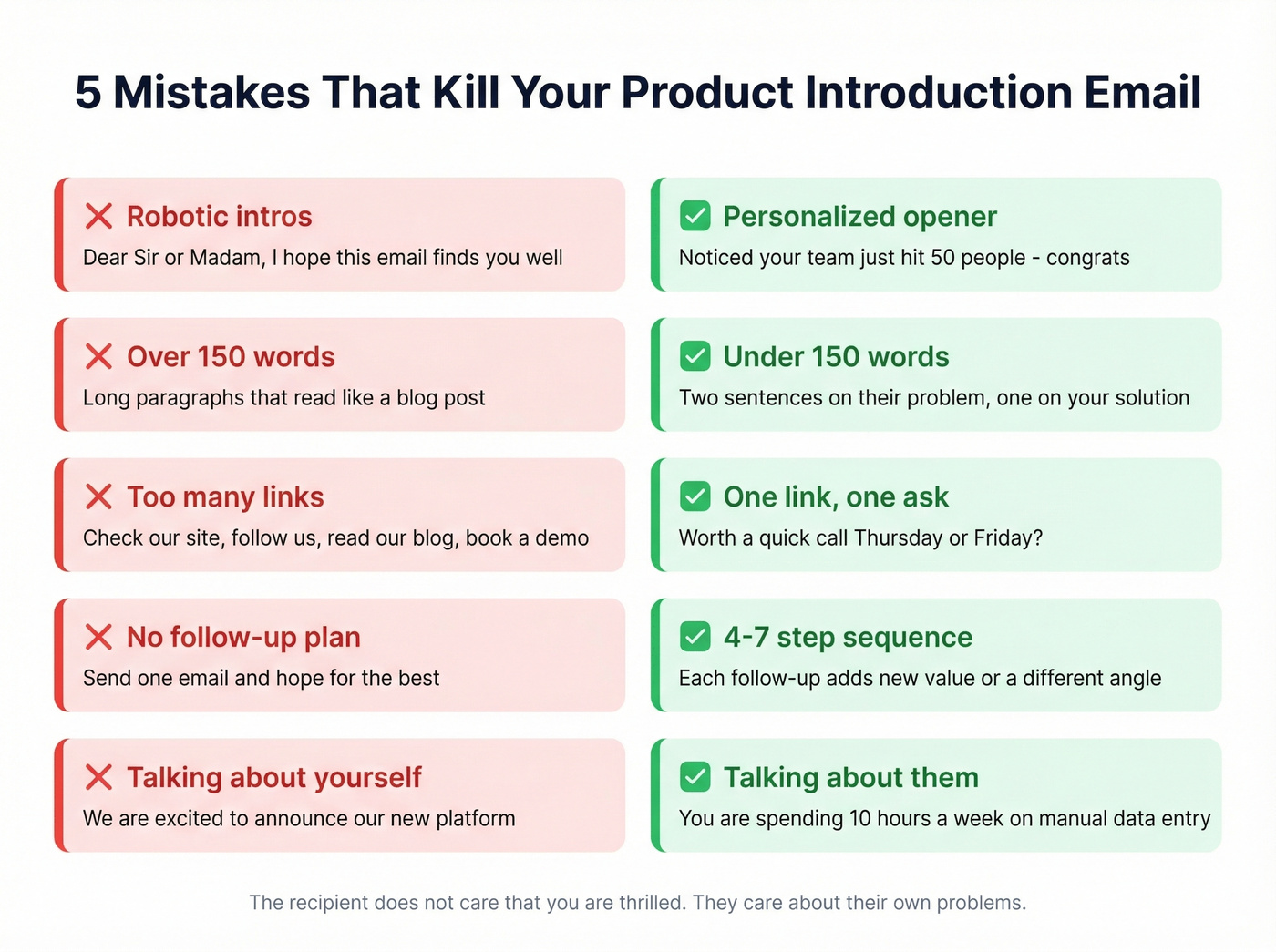
Robotic intros. "Dear Sir or Madam" or "I hope this email finds you well" signals you didn't bother personalizing. Delete it.
Emails over 150 words. Cold emails that read like blog posts get skimmed or trashed. Respect the recipient's time. If you can't explain your value in two sentences, you don't understand it well enough yet.
Too many links or attachments. Multiple hyperlinks hurt deliverability and dilute your CTA. One link. One ask.
No follow-up. Sending one email and waiting is the single most common mistake. Plan 2-4 follow-ups minimum. (If you need the why + data, see importance of follow-up in sales.)
Talking about yourself. "We're excited to announce" is about you. "You're spending 10 hours a week on X" is about them. Write about them. This applies whether you're drafting an email introducing company services or pitching a single feature - the recipient's problem always comes first.
Skip the "we're thrilled" opener entirely. Nobody cares that you're thrilled. They care about their own problems.
Deliverability & Compliance
SPF, DKIM, and DMARC authentication are mandatory for high-volume senders in 2026. Keep your spam complaint rate below 0.3% - that's Google's hard threshold. GDPR requires explicit opt-in consent with penalties up to EUR 20M or 4% of global revenue. CAN-SPAM allows unsolicited email but mandates a clear unsubscribe mechanism, a physical mailing address, and accurate subject lines - penalties run $43,280+ per violation. (If you’re troubleshooting alignment, see DMARC alignment.)
If you're doing cold outreach at scale, don't skip authentication setup. It's boring. It's also the difference between landing in the inbox and landing in spam.
How to Measure Performance in 2026
Here's our hot take: stop obsessing over open rates. The most recent cross-industry benchmark from HubSpot, updated November 2025, puts the average email open rate at 42.35% with a 2.3% CTR. Those numbers look healthy until you realize Apple Mail Privacy Protection inflates open rates by roughly 18 points - and Apple Mail accounts for 46% of email clients. (If you want the math, use this click rate formula in email marketing guide.)
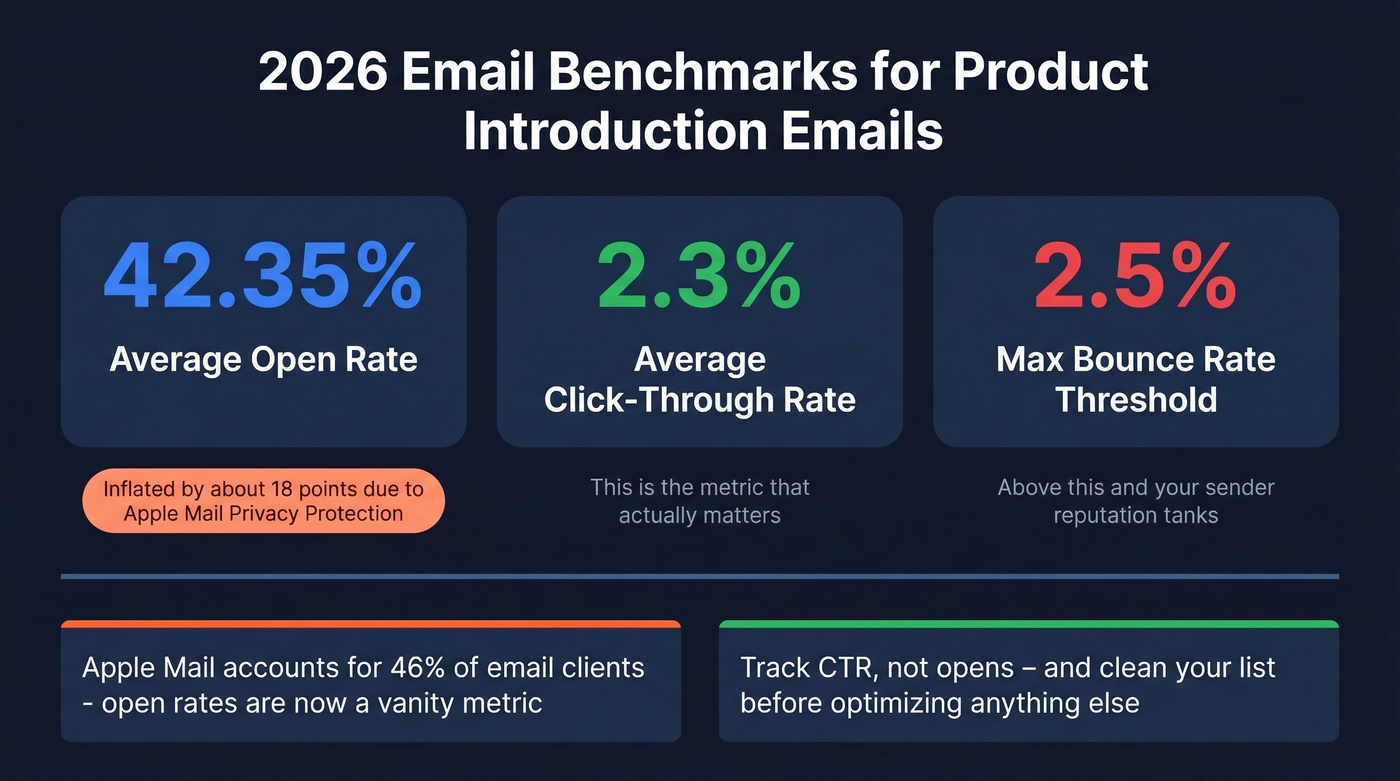
Track click-through rate, not opens. Opens are a vanity metric post-MPP. If your emails hit 2.3%+ CTR, you're at or above the industry average. And if your bounce rate is above 2.5%, your list needs cleaning before you optimize anything else. No amount of subject line testing fixes dead addresses.
Segmentation only works when the underlying data is real. Prospeo gives you 30+ filters - job title, company size, funding stage, buyer intent - across 300M+ verified profiles refreshed every 7 days. Build the exact list your product introduction deserves at $0.01 per email.
Send your launch email to the right people, not a recycled CSV.
FAQ
How long should a product introduction email be?
Under 150 words for cold outreach, up to ~200 for launch announcements. Shorter emails consistently earn higher reply rates - anything beyond 200 words sees a measurable drop in engagement.
How many emails should a launch sequence include?
Five to seven emails over a tight 5-day window. The final day's three sends (morning, evening, late night) typically drive 40-60% of total conversions - don't skip them.
What's a good CTR for a product launch email?
The 2026 industry average CTR is 2.3%. Aim to beat that. Ignore open rates - Apple Mail Privacy Protection inflates them by ~18 points, making them unreliable.
Do these templates work for service introductions too?
Yes. The anatomy - hook, value prop, single CTA - applies whether you're introducing a SaaS tool, a consulting service, or a physical product. Adjust the value proposition bullets to match what you're selling, but keep the structure identical.
How do I prevent intro emails from bouncing?
Verify every address before sending. If your bounce rate exceeds 2.5%, your list needs cleaning. Prospeo's free tier lets you verify 75 emails per month plus 100 Chrome extension credits - enough to audit list quality before a full campaign send.