

Prospects in Business: What They Are, How to Find Them, and How to Convert Them
A rep on r/sales put it perfectly: "Basic fact-finding feels like I'm talking to NPCs." Vague answers, sudden ghosting, circular conversations that go nowhere. The problem isn't the pitch - it's that most teams can't tell the difference between contacts and actual prospects, and it's costing them pipeline every single week.
What You Need (Quick Version)
A prospect is a qualified potential buyer who fits your ideal customer profile and has the budget, authority, need, and timeline to purchase. Not a name on a list. Not someone who downloaded a whitepaper three months ago.
If you're building a prospecting motion from scratch, three things matter most: define your ICP before you touch a single tool, verify your contact data before outreach (bad emails destroy sender reputation faster than anything), and use a qualification framework like BANT or MEDDIC to filter before you pitch. For tools, start with clean data and a CRM like HubSpot's free plan. You can build a surprisingly effective stack for under $100/month.
What Is a Prospect in Business?
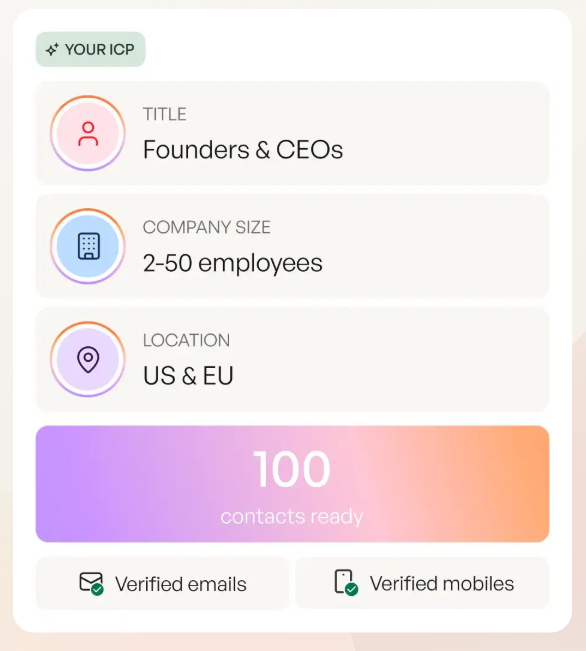
A business prospect is a potential buyer who's been qualified against your ideal customer profile. They aren't just a name in your CRM or a badge scan from a conference. They're someone you've confirmed has a plausible reason to buy, the budget to do it, and enough authority to move a deal forward.
The distinction matters more than most teams realize:
- A contact is anyone whose information you have.
- A lead is someone (or a company) that's expressed interest.
- A prospect is a lead you've vetted - someone who fits your ICP and has a realistic path to becoming a customer.
Here's the thing: when reps complain about "bad prospects," they're usually describing unqualified leads that never should've made it to a discovery call. The fix isn't better objection handling. It's better qualification upstream.
Prospect vs. Lead vs. Opportunity
These three terms get used interchangeably in most sales orgs, and it creates real confusion - especially when marketing and sales are trying to agree on handoff criteria.
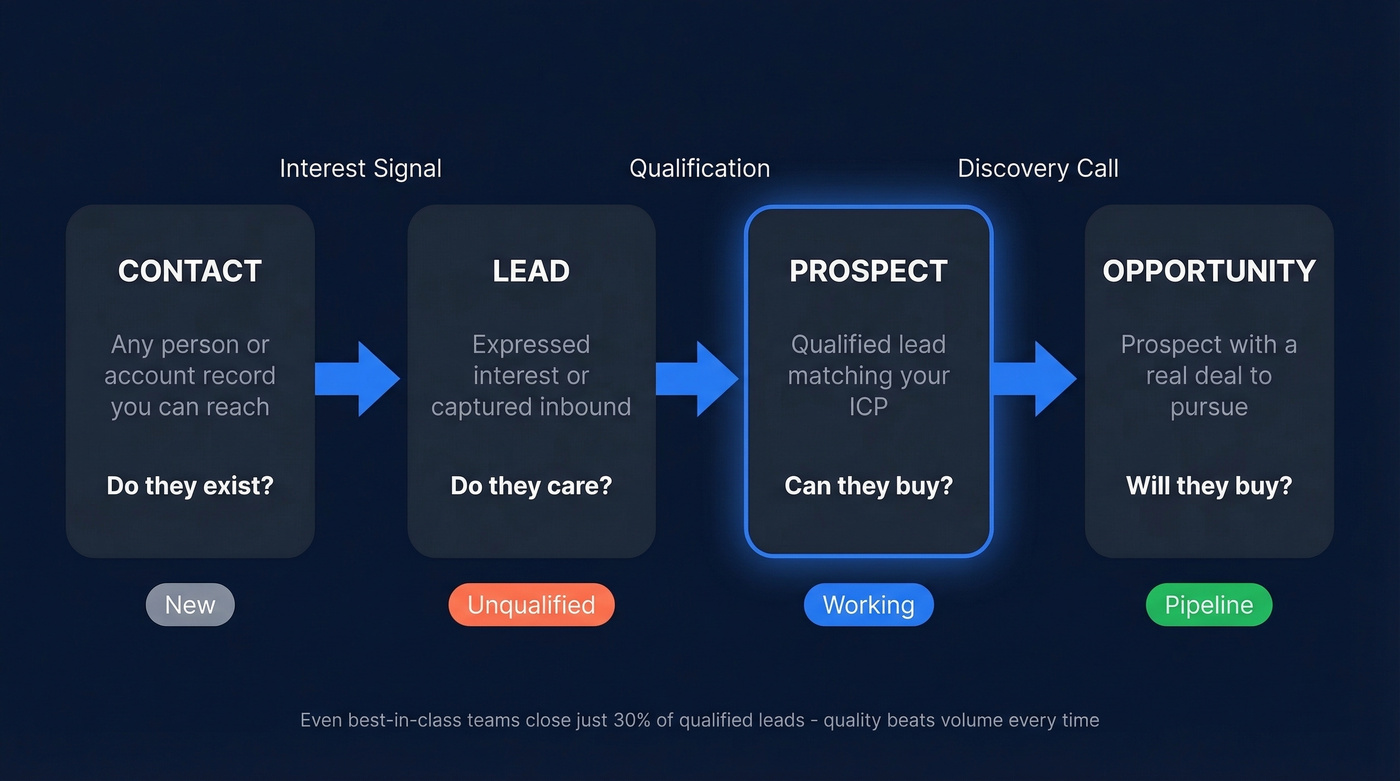
| Stage | Definition | CRM Status | Key Question |
|---|---|---|---|
| Contact | Any person/account record you can reach | New | "Do they exist?" |
| Lead | Expressed interest or captured inbound | Unqualified | "Do they care?" |
| Prospect | Qualified lead matching ICP | Working / Qualified | "Can they buy?" |
| Opportunity | Prospect with a real deal to pursue | Pipeline / Forecast | "Will they buy?" |
Salesforce defines the progression cleanly: a lead has expressed interest, a prospect is a qualified lead more likely to convert, and an opportunity is a prospect with real potential to close. The key word is "qualified" - that's what separates each stage.
Zendesk's framework adds useful granularity by breaking qualification into three levels. Organization-level qualification checks ICP fit - industry, size, location. Opportunity-level qualification asks whether they can actually implement and benefit from your solution. Stakeholder-level qualification identifies whether you're talking to someone with decision-making authority.
Even best-in-class companies close just 30% of sales qualified leads. That means 70% of the qualified buyers your team identifies still won't close. You need volume at the top, but you need quality even more.
Types of Business Prospects
Not all potential buyers are created equal. Here's a practical taxonomy that maps to how you should prioritize outreach.
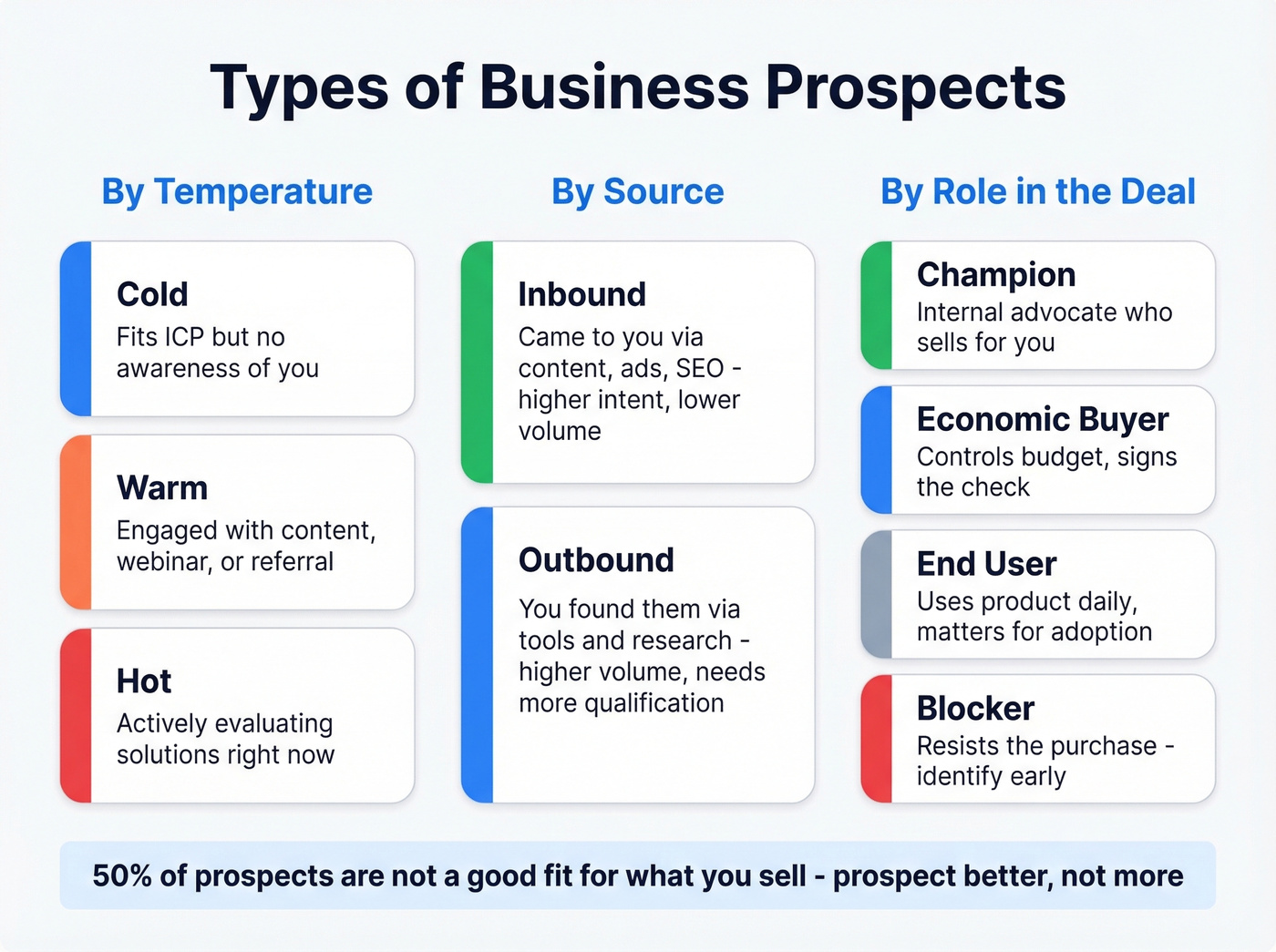
By temperature:
- Cold - fits your ICP but has no awareness of you. Requires outbound effort.
- Warm - has engaged with your content, attended a webinar, or been referred. Knows you exist.
- Hot - actively evaluating solutions, possibly in a buying cycle right now.
By source:
- Inbound - came to you through marketing efforts like content, ads, and SEO. Typically higher intent but lower volume.
- Outbound - you found them through prospecting tools, lists, or research. Higher volume, requires more qualification.
By role in the deal:
- Champion - internal advocate who wants your solution and will sell it internally.
- Economic buyer - controls the budget, signs the check, but may never touch the product.
- End user - will use the product daily. Their buy-in matters for adoption, not for closing.
- Blocker - actively or passively resisting the purchase. Identifying them early saves months of wasted effort.
50% of prospects aren't a good fit for what you sell. The goal isn't to prospect more - it's to prospect better. A tighter ICP and better qualification criteria will do more for your pipeline than doubling your outreach volume.
Why Prospecting Matters
The data on buyer behavior in 2026 is stark.
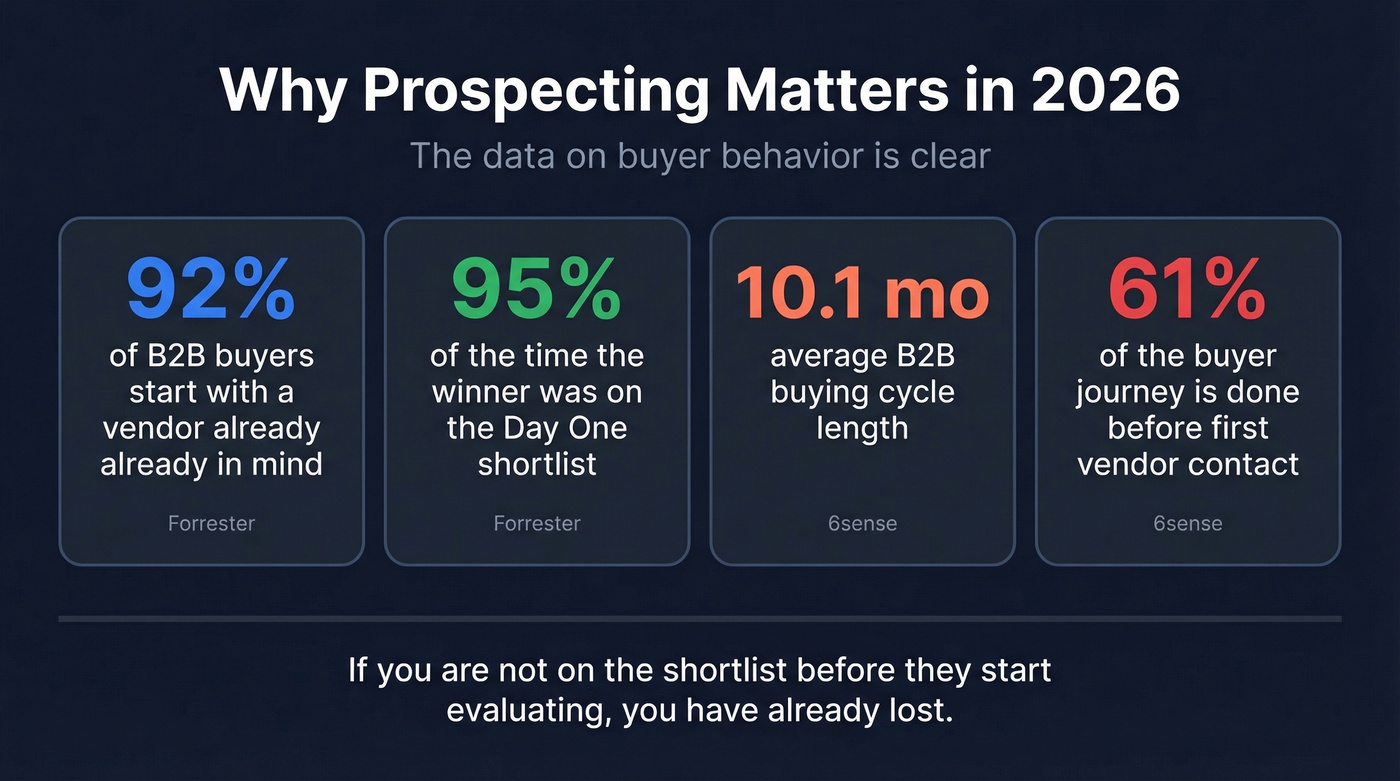
Forrester found that 92% of B2B buyers start their evaluation with at least one vendor already in mind, and the winning vendor is on the buyer's Day One shortlist 95% of the time. If you're not on that shortlist before they start evaluating, you've already lost. Meanwhile, 6sense's research shows the average B2B buying cycle runs 10.1 months, and first contact with a vendor happens at 61% of the journey - meaning nearly 70% of the buyer's journey is complete before a rep gets involved.
This is why prospecting isn't just "top of funnel activity." It's how you get on the shortlist early enough to matter. The teams that win aren't the ones with the best demo. They're the ones who showed up six months earlier with a relevant insight, a warm introduction, or an intent-triggered email that landed at exactly the right moment.
Budget tightening has also pushed more prospecting responsibility onto AEs - it's no longer just an SDR job. And in a market where 61% of B2B buyers prefer a rep-free experience, the reps who do get meetings need to earn them through smarter, earlier prospecting.
Let's be honest about something: if your average deal size is under $10K, you probably don't need a massive prospecting tech stack. A verified email list, a sequencer, and a tight ICP will outperform a $40K/year data platform every time. The expensive tools exist for enterprise teams running complex, multi-threaded deals. Everyone else is better off investing in targeting discipline.

You just read that 50% of prospects aren't a good fit. Prospeo's 30+ search filters - buyer intent, technographics, headcount growth, funding - let you qualify before you ever hit send. 300M+ profiles, 98% email accuracy, data refreshed every 7 days.
Build a prospect list worth calling in under five minutes.
How to Qualify Prospects
Qualification is where most sales processes either create pipeline or waste it. We've seen teams with great data and strong outreach still miss quota because they couldn't tell a real opportunity from a polite conversation.
BANT vs. CHAMP vs. MEDDIC
| Framework | Stands For | Best For | Weakness |
|---|---|---|---|
| BANT | Budget, Authority, Need, Timeline | High-volume, transactional | Too simplistic for complex deals |
| CHAMP | Challenges, Authority, Money, Prioritization | Consultative, mid-market | Requires more skill and time |
| MEDDIC | Metrics, Economic Buyer, Decision Criteria, Decision Process, Identify Pain, Champion | Enterprise, complex sales | Heavy training investment |
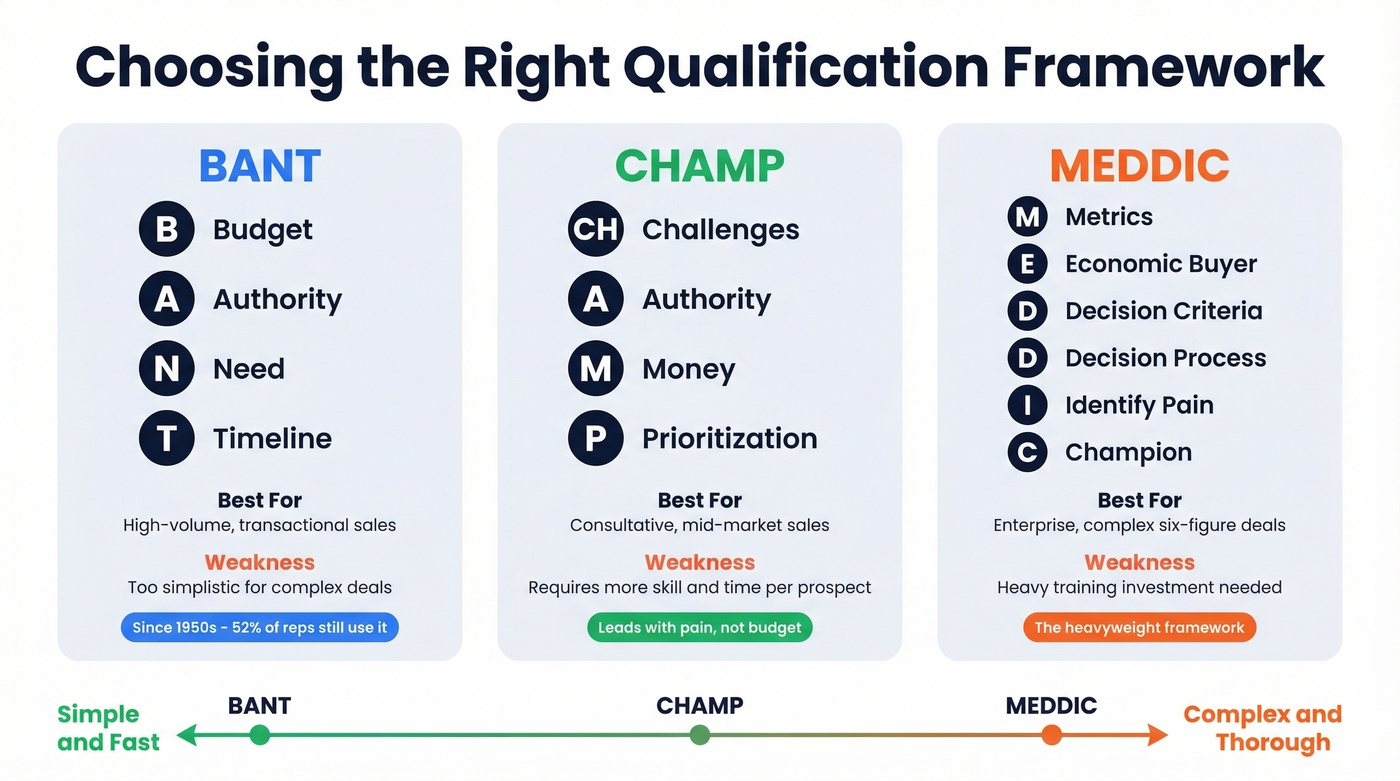
BANT originated at IBM in the 1950s, and 52% of sales reps still trust it. It works for transactional deals where the buying process is straightforward. But it falls apart for complex deals where budget and decision-making are messy and multi-stakeholder.
CHAMP flips the script by leading with challenges instead of budget - better for consultative sales where the prospect doesn't yet know they have a problem. MEDDIC is the heavyweight: it forces you to map the entire decision process, identify a champion, and understand the metrics that matter to the economic buyer. Overkill for a $5K deal. Essential for six-figure contracts.
Discovery Questions That Work
The best discovery questions reveal information the prospect wouldn't volunteer. A frequently shared r/sales thread lists 21 discovery questions - the best ones map directly to the frameworks above. Here are the five we've found most consistently useful:
"What happens if you do nothing?" This reveals urgency. If the answer is "nothing much changes," you don't have a real opportunity.
"How does budget signoff work at your company?" This maps the decision process without the awkward "do you have budget?" question. You learn who's involved, what thresholds trigger approvals, and whether there's a procurement gauntlet waiting.
"What other solutions are you evaluating?" Buyers who are genuinely purchasing will tell you. Those who are just browsing will dodge. Either answer is useful.
"When do you need a solution in place by?" Timeline pressure is the single best predictor of deal velocity. No timeline usually means no deal.
"What have you tried before, and why didn't it work?" This surfaces both pain and objections in one question. If they tried a competitor and churned, you know exactly what to position against.
One tactic worth borrowing from HubSpot's sales playbook: reverse qualification. Actively look for reasons to disqualify. If you can't find any, you've got a real opportunity. If you find three, you just saved yourself a month of follow-ups that were never going to close.
Prospecting Methods That Work in 2026
Cold Email
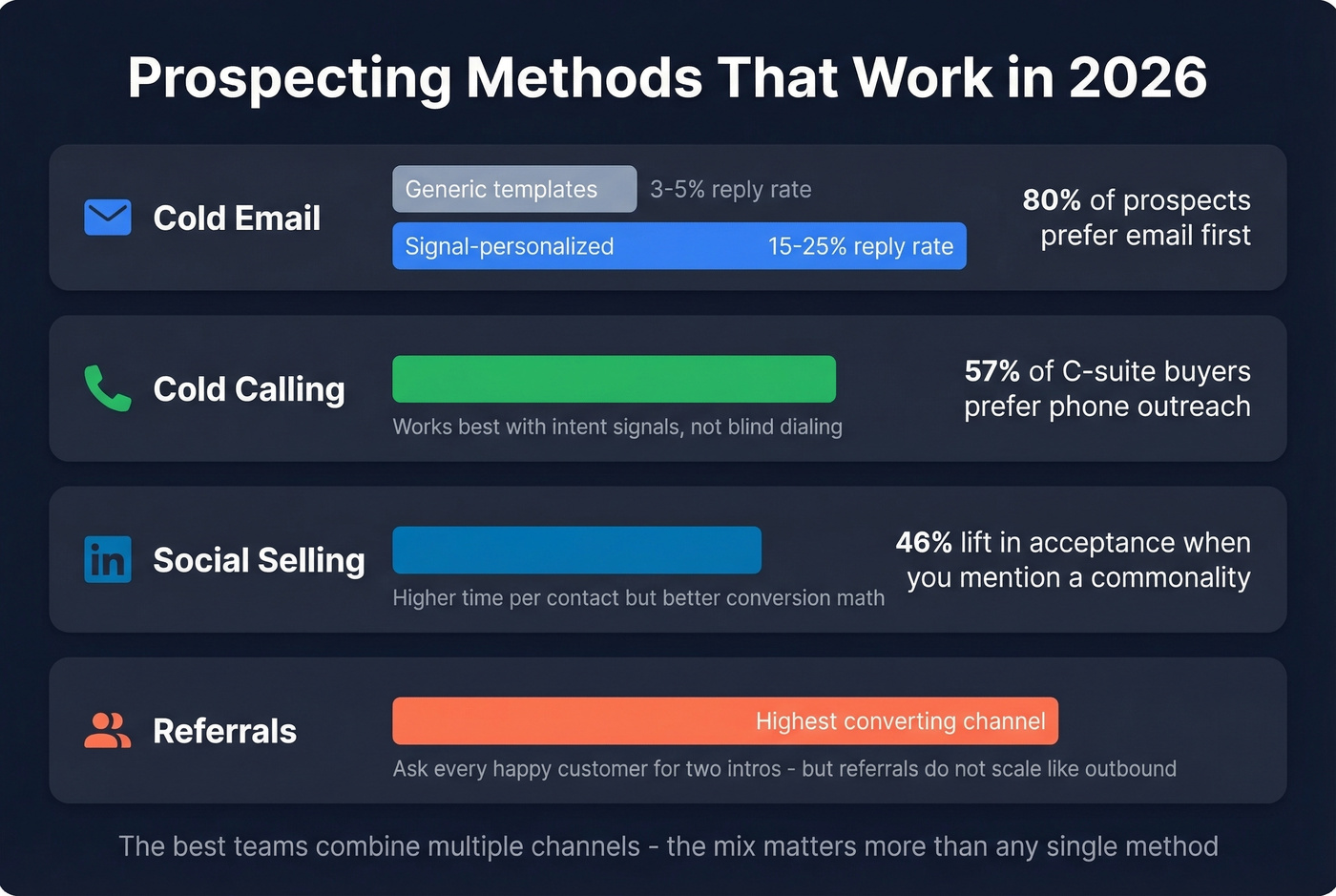
80% of prospects prefer email as the first touchpoint. It's non-intrusive, scalable, and measurable. But the gap between good and bad cold email has never been wider. Generic templates get 3-5% reply rates. Signal-personalized outreach - emails triggered by job changes, funding rounds, or intent signals - gets 15-25%. The difference is entirely in targeting and relevance.
Cold Calling
Don't let anyone tell you cold calling is dead. 57% of C-suite buyers prefer phone outreach. The reps who make it work are calling into warm accounts with intent signals or recent engagement, not dialing blind from a spreadsheet.
For a repeatable approach, build a cold calling system and keep a few cold call rejection responses ready.
Social Selling
LinkedIn InMail data shows a 46% lift in acceptance rates when you mention a commonality - shared connections, same school, mutual group membership. Engaging with a prospect's content before reaching out turns a cold touch into a warm one. It takes more time per contact, but the conversion math often works out better.
Referrals
Still the highest-converting channel by a wide margin. A warm introduction from a mutual connection bypasses most of the trust-building that cold outreach requires. Build referrals into your process - ask every happy customer for two introductions - but don't rely on them as your primary pipeline source. They don't scale the way outbound does.
Intent-Based Prospecting
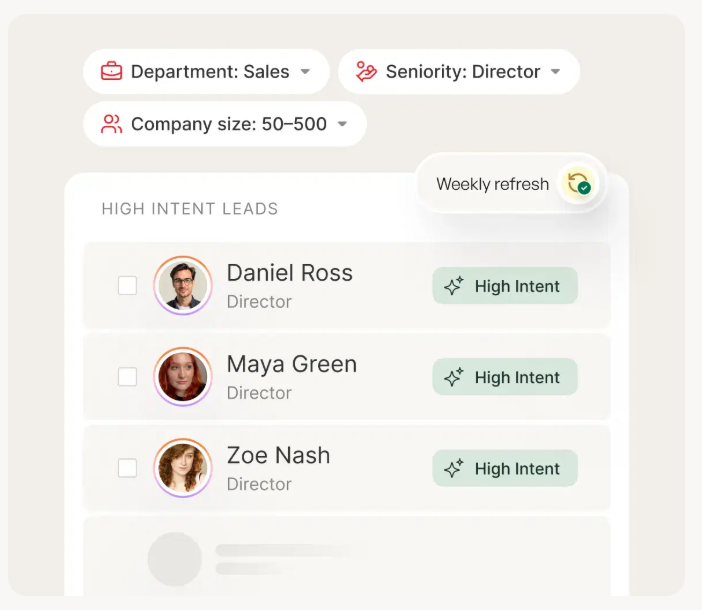
This is where prospecting has changed the most. Instead of guessing which accounts are in-market, intent data lets you prioritize accounts actively researching topics related to your solution. Signal-qualified leads convert 47% better and close 43% larger deals. Layering intent signals with job role, company growth, and technographic filters builds lists of accounts that are actually ready to talk.
If you want a scoring model, see identifying buying signals and intent data.
AI-Assisted Prospecting
81% of sales teams are experimenting with or have implemented AI in their prospecting workflow, and the AI SDR market is projected to hit $15B by 2030. But here's our honest take: AI isn't replacing prospecting - it's making bad prospectors worse and good prospectors unstoppable. If your ICP is vague and your data is dirty, AI just helps you send bad emails faster. If your targeting is sharp, AI handles the research and personalization that used to eat hours per day.
If you're building this workflow, start with AI cold email outreach and AI for sales emails.
Mistakes That Kill Pipeline
Targeting the wrong people. 50% of prospects aren't a good fit. If you're not ruthless about ICP definition and enforcement, half your outreach is wasted before it starts. This is the most expensive mistake in sales because it wastes the most expensive resource - rep time.
Giving up too early. 80% of sales require five or more follow-ups, but 92% of reps quit after four attempts. 43% of buyers who accept meetings say they're fine with being contacted five or more times. Most reps stop one touch before the prospect would've said yes.
If you need a system, use these sales follow-up templates and track your importance of follow-up in sales benchmarks.
Prospecting with bad data. Entirely preventable. Snyk's sales team was running bounce rates of 35-40% before they overhauled their data stack. After switching to verified data, bounces dropped under 5%, and AE-sourced pipeline jumped 180% with 200+ new opportunities per month. Bad data doesn't just mean missed contacts - it means burned domains, tanked sender reputation, and sequences that land in spam.
If you're diagnosing this, start with email bounce rate and an email deliverability guide.
No personalization. That 46% InMail lift from mentioning a single commonality? It applies across channels. Generic outreach signals that you don't know or care about the recipient. Even basic personalization - referencing a company's recent funding round or a relevant blog post - lifts response rates significantly.
Showing up unprepared. Buyers say 58% of sales meetings aren't valuable. If you fought through five touchpoints to get a meeting and then wing the discovery call, you've wasted everyone's time. Research the account, prepare specific questions, and have a hypothesis about their pain before you dial in.
Pipeline Math for Prospecting
Every prospecting strategy needs to connect to a number. Without clear math, even the best business development efforts fall apart.
Sales velocity = (Number of opportunities x Average deal size x Win rate) / Average sales cycle length
Let's work a real example. Say you need $500K in closed revenue this quarter. Your average deal is $25K, and your win rate is 20%. That means you need 100 qualified opportunities in your pipeline. If your prospect-to-opportunity conversion rate is 10%, you need to engage 1,000 qualified buyers to generate those 100 opportunities.
The standard rule of thumb is 3x pipeline coverage - meaning you want $1.5M in pipeline to close $500K. In our experience, teams need closer to 4x in competitive markets where sales cycles stretch and multi-threading is required.
Work this math backward from your quota. It tells you exactly how many people each rep needs to engage per week, which makes prospecting feel less like an art and more like a system. If the numbers don't work - if you'd need 2,000 contacts per rep per quarter and you only have 500 in your TAM - the problem isn't effort. It's your ICP, your deal size, or your win rate.
Essential Prospecting Tools
Prospeo
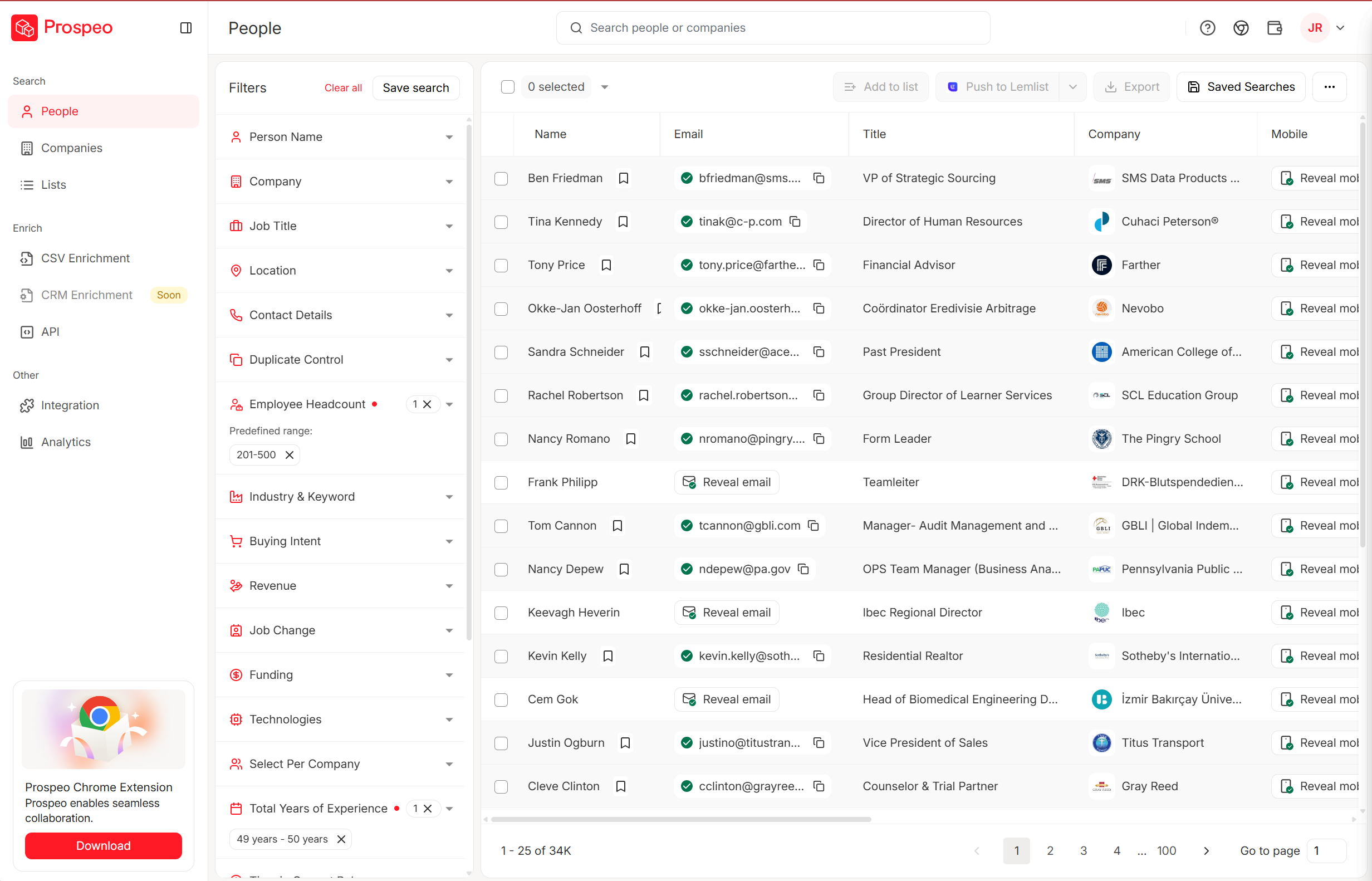
Prospeo covers 300M+ professional profiles, 143M+ verified emails, and 125M+ verified mobile numbers. The 30+ search filters include buyer intent across 15,000 topics via Bombora, technographics, job changes, headcount growth, funding, and revenue - so you're finding contacts at companies showing buying signals right now, not just companies that match a static list. Email accuracy sits at 98% with a 30% mobile pickup rate across all regions. Data refreshes every 7 days, compared to the 6-week industry average, which matters more than most teams realize - stale data is the number-one cause of high bounce rates and burned sender domains.
The Chrome extension with 40,000+ users lets you pull verified contact info from any website or CRM in one click, and native integrations with Salesforce, HubSpot, Smartlead, Instantly, Lemlist, Clay, Zapier, and Make mean it slots into existing stacks without custom API work. Meritt tripled their pipeline from $100K to $300K per week after switching, with bounce rates dropping from 35% to under 4%. Pricing starts free at 75 emails per month, with paid plans running about $0.01 per email. No contracts, no sales calls required.
Apollo
Apollo covers 275M+ contacts and is the obvious starting point for teams that want database, sequencing, and basic CRM in one tool. The free tier is genuinely useful for solo founders and early-stage teams, and paid plans start at $49/mo per user. The tradeoff is email accuracy - Apollo's verification isn't as rigorous as dedicated tools, so expect higher bounce rates on exported lists. Skip this if data quality is your top priority, but for teams that need an all-in-one outbound platform and can tolerate some variance, it's hard to beat on value.
Other Tools Worth Knowing
| Tool | Starting Price | Best For |
|---|---|---|
| Prospeo | Free (75/mo); ~$0.01/email | Verified emails & mobiles, intent data |
| Apollo | Free; $49/mo per user | All-in-one outbound |
| HubSpot CRM | Free; Sales Hub ~$20/mo per seat | CRM + pipeline management |
| Hunter | Free tier; $49/mo | Email finding |
| Instantly | $30/mo | Cold email sequencing |
| Clay | $149/mo | Enrichment + orchestration |
| ZoomInfo | ~$995/mo | Enterprise data teams |
HubSpot CRM is the default free CRM, and the free tier is legitimately good for teams under 10 reps. Sales Hub paid plans start around $20/mo per seat when you need sequences and automation.
ZoomInfo is the enterprise standard at ~$995/mo starting, with most mid-market contracts landing in the $15-40K/year range. If you're under 50 reps, it's probably overkill.
Hunter does one thing well: finding email addresses by domain. Instantly handles cold email sequencing at $30/mo - pair it with a data tool for the actual contacts. Clay at $149/mo is the orchestration layer for teams that want to chain multiple data sources and enrichment steps into automated workflows.
If you're comparing options, start with a shortlist of sales prospecting databases and data enrichment services.
Bad emails don't just bounce - they torch your sender reputation and kill future deliverability. Prospeo's 5-step verification and proprietary email infrastructure deliver 98% accuracy at $0.01 per email. Teams using Prospeo book 35% more meetings than Apollo users.
Protect your domain and fill your pipeline with verified prospects.
FAQ
What's the difference between a prospect and a lead?
A lead is someone who's expressed interest. A prospect is a lead qualified against your ICP with confirmed budget, authority, need, and timeline. This distinction determines whether reps spend time on real opportunities or chase dead ends that never close.
How many prospects do I need to hit quota?
Work backward from your revenue target: divide by average deal size, then by win rate, then by prospect-to-opportunity conversion rate. Most outbound teams need 500-1,000 qualified prospects per rep per quarter to generate enough pipeline at 3x coverage.
What's the best way to find prospects in business?
Define your ICP first - industry, company size, job titles, tech stack, growth signals. Then use a B2B data platform to find verified contact information filtered by those criteria. Layer in intent data to prioritize accounts actively researching relevant topics so you're reaching qualified buyers, not just names on a list.
How many times should I follow up?
At least five. 80% of sales require five or more follow-ups, but 92% of reps quit after four. Space your touches across email, phone, and social over two to three weeks. Persistence isn't pushy - 43% of buyers say five-plus contacts is perfectly acceptable.
Is cold outreach still effective in 2026?
Yes, but only when it's personalized and signal-driven. Generic cold email gets 3-5% reply rates. Signal-personalized outreach - triggered by intent data, job changes, or funding events - gets 15-25%. The channel works. Lazy execution doesn't.